
Caribbean & Bahamas Yacht Charter Taxes, Permits and Fees (2026)
Yacht charter taxes and fees in the Caribbean and Bahamas: BVI $16 per guest per day (2021 schedule), Bahamas 14 percent, USVI nothing. Every figure sourced.
Last Updated: October 18, 2026
Yacht charter taxes and fees in the Caribbean and Bahamas come down to a short list of government charges, and every one of them is published somewhere official. The list: a $16 per guest per day cruising permit in the British Virgin Islands, a 14 percent charter tax in the Bahamas, marine park fees in the Tobago Cays and the Exumas, and nothing per guest in the US Virgin Islands. This page is the registry. For each destination it gives the charge, who collects it, the document it comes from, the date we last read that document, and whether your all-inclusive rate or your APA already covers it. It sits alongside our Caribbean yacht charter cost page, which carries the weekly rates these charges attach to.
Two rules shaped it. Every figure is money that reaches your invoice or your APA statement, read from the gazetted schedule or fee page linked in each table (verified August and September 2026), and where no official figure exists the table says so instead of guessing. And the procedure behind these fees belongs to your crew: they file the permits and clear the yacht in and out. You bring a passport.
How much are yacht charter taxes and fees in the Caribbean in 2026?
Government charges on a Caribbean or Bahamas crewed yacht charter run from zero to 14 percent of the charter fee, plus $0 to about $1,000 a week in per-guest permits, levies and park fees for a group of eight, depending on the island (gazetted BVI and Bahamas schedules and published park fee pages, verified September 2026).
The Bahamas is the only destination with a percentage tax, the BVI carries the largest per-guest charges, and the USVI and the French islands charge guests almost nothing.
The chart puts those Caribbean yacht charter fees and taxes on one scale for a typical week: eight guests, seven nights, the median all-inclusive catamaran rate where a percentage applies. Only the Bahamas bar is a tax you pay directly. The others are permit, levy and park fees that the all-inclusive rate almost always absorbs, or that come out of the APA on plus-expenses terms.
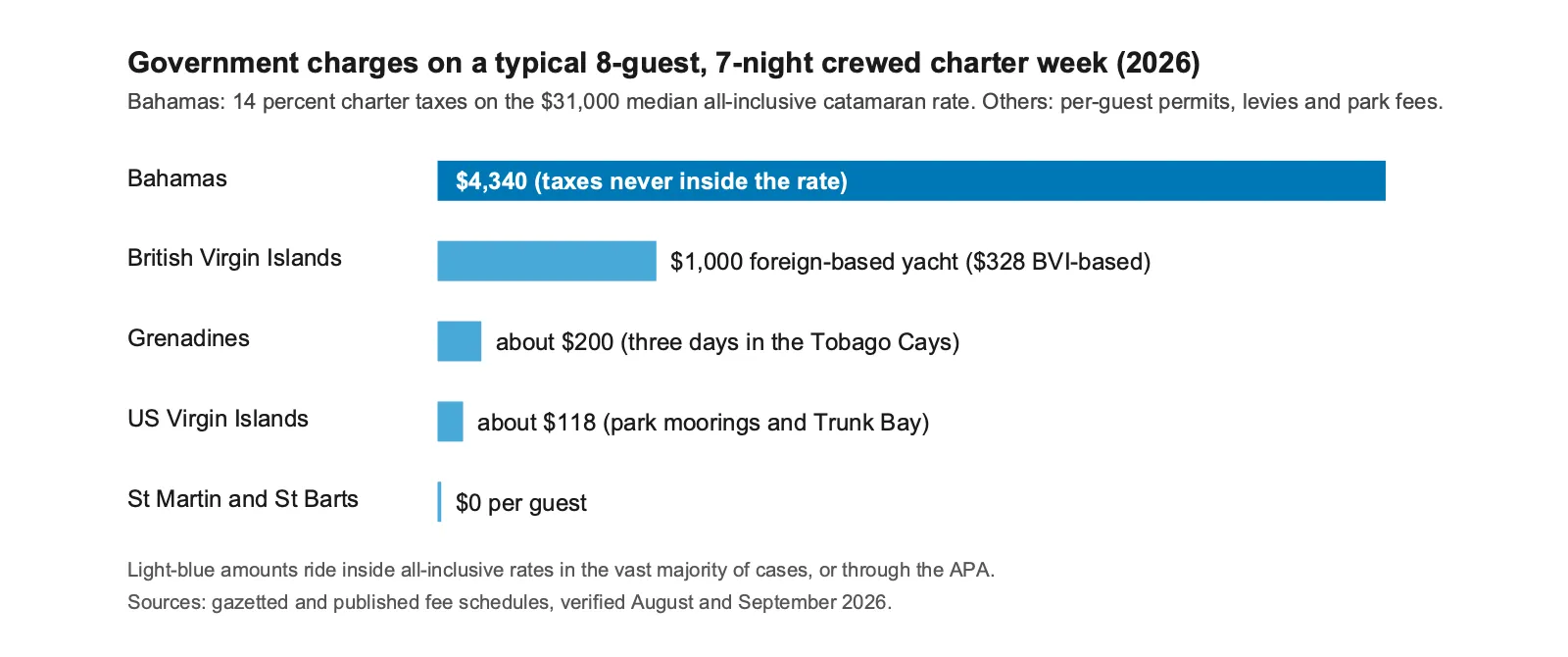
View data table
| Destination | Government charges, 8 guests, 7 nights | What it is | Who pays on all-inclusive terms |
|---|---|---|---|
| Bahamas | $4,340 | 10 percent VAT plus 4 percent charter tax on a $31,000 rate; Exuma park fees (inside the rate or the APA) are not in this figure | You (the taxes); the rate or the APA (park fees) |
| British Virgin Islands | $1,000 ($328 on a BVI-based yacht) | Cruising permit $16 per guest per day ($4 BVI-based), $10 arrival levy, $3 Baths pass | The rate, on nearly every contract |
| Grenadines | About $200 | Tobago Cays Marine Park, three days: EC$15 per guest per day plus EC$60 per vessel per day | The rate or the APA |
| US Virgin Islands | About $118 | Three park-mooring nights at $26 plus $5 per person at Trunk Bay | The rate or the APA |
| St Martin and St Barts | $0 | No per-guest visitor tax; port dues fall on the yacht | Nothing to pay |
The registry at a glance
Here’s the registry at a glance. Each destination section below carries the full table with the source document and the date we read it.
| Destination | Charter tax | Per-guest permits and levies | Park and mooring fees | Who collects |
|---|---|---|---|---|
| British Virgin Islands | None | Cruising permit $16 per guest per day on foreign-based yachts, $4 on BVI-based; $10 arrival levy | The Baths $3 per adult; National Parks Trust marine permit, price unpublished | HM Customs; National Parks Trust |
| US Virgin Islands | None | None | Park mooring $26 per night (paid by the yacht); Trunk Bay $5 per person, ages 16 and up | National Park Service |
| Bahamas | 14 percent (10 percent VAT plus 4 percent charter tax) | $30 passenger tax only if you enter aboard from Florida | Exuma park moorings from $27.27 per night plus $12.73 per guest per day, plus VAT; entrance $15 per adult | Port Department; Bahamas Customs; Bahamas National Trust |
| Grenadines | None on your invoice | None | Tobago Cays EC$15 per guest per day plus EC$60 per vessel per day | Tobago Cays Marine Park |
| St Martin and St Barts | None | None (a 1 euro per person per day waste tax in Gustavia is paid by the yacht) | Nature reserve free by day; Gustavia port dues on the yacht | Port de Gustavia; Réserve Naturelle |
What lands on a Caribbean charter invoice in 2026
The island sets the amounts: 14 percent in Bahamas taxes, up to $16 per guest per day in BVI cruising fees, nothing per guest in the USVI. The contract sets who pays: all-inclusive rates cover permits, park fees and levies in the vast majority of cases; charter taxes and the 15 to 20 percent gratuity are always yours.
| Line item | Typical amount | Who sets it | Source |
|---|---|---|---|
| APA (Advance Provisioning Allowance) | None mandatory on all-inclusive catamarans (about 2 percent of rates state around 5 percent). Plus-expenses charters add an APA, typically 30 to 35 percent of the base rate, intended to cover every running fee except government taxes, refunded where unspent | The charter contract; mechanics per MYBA | MYBA, Information for Charter Yacht Captains and Crew |
| Government charter taxes | 0 to 14 percent of the charter fee by destination; the Bahamas is highest at 10 percent VAT plus a 4 percent charter tax (per-destination figures in the destination blocks) | Each territory’s government | S.I. No. 57 of 2025 (Bahamas example) |
| Marine park fees | Where you cruise them: EC$15 per guest per day at the Tobago Cays, $12.73 per extra guest per day in the Exuma park, $3 at the BVI’s Baths | TCMP; Bahamas National Trust; BVI National Parks Trust | TCMP fee schedule, effective January 1, 2023 |
| Crew gratuity | Customarily 15 to 20 percent of the charter fee in the Caribbean crewed fleet, the band CYBA’s Inclusive Agreement (Clause 2.B) calls the customary rate; MYBA’s 2026 guidelines publish no percentage, and both leave it at your discretion | Custom, written into the CYBA form | CYBA Inclusive Agreement, Clause 2.B (2020) |
Fees verified September 2026.
Who pays: the all-inclusive rate, the APA, or you?
On all-inclusive terms the rate covers cruising permits, park fees and levies on nearly every contract, and the percentage charter taxes and the crew gratuity are always yours (CYBA Inclusive Charter Agreement, Clause 2, 2020; Vital Charters rate analysis, September 2026).
On plus-expenses terms the APA absorbs every running fee except the government taxes, which appear as their own line on the quote.
The contract says so in plain words. Clause 2.A of the CYBA Inclusive Charter Agreement, the form behind most all-inclusive Caribbean catamarans, reads: “Unless specified otherwise under Special Conditions, the Total Charter Fee includes the hiring of the Yacht, the services of a fully licensed Crew, all meals, standard ship’s bar, fuel, cruising taxes and permits, clearance taxes, mooring fees and all expenses related to running of the Yacht and use of on-board leisure and sports equipment.” Clause 2.B lists what the fee excludes, led by the discretionary crew gratuity at the customary 15 to 20 percent, and Clause 2.C has you settle those excluded items before you disembark. The plus-expenses form draws that line somewhere else entirely, which our guide to what a yacht charter fee includes sets out clause by clause.
The fleet’s own listings agree. Across currently bookable Caribbean rate listings, 476 all-inclusive rate rows name who pays the cruising permit, and 456 of them (96 percent) say the boat; on plus-expenses rows the answer flips, with 115 of 143 (80 percent) naming the client, which in practice means the APA. The Bahamas splits the same way: 50 of 59 all-inclusive rows say the boat, 368 of 418 plus-expenses rows say the client. Of the 379 yachts with current Caribbean (non-Bahamas) rates, 93 spell it out in their price notes, and 70 of those say the permits are included against 4 that say they are extra.
The percentage taxes never move. Where a destination levies one (only the Bahamas among these five), it sits on top of an all-inclusive rate and on top of a plus-expenses base alike, because it is a tax on the charter fee itself rather than a running cost. Under the MYBA Charter Agreement used by most plus-expenses motor yachts, Clause 8 has the charterer pay “at cost” for “berthing dues and other harbour charges including pilots’ fees, local taxes, divers’ fees, customs formalities and any charges for waste disposal”, which is the APA doing its job; how the APA works and refunds is its own page.
Before the destination sections, see which crewed yachts are open for your dates; every rate on the results page is a listed weekly rate, with taxes and gratuity on top as this page describes.
What does the BVI charge guests? $16 per person per day, a $10 levy and National Parks Trust mooring fees
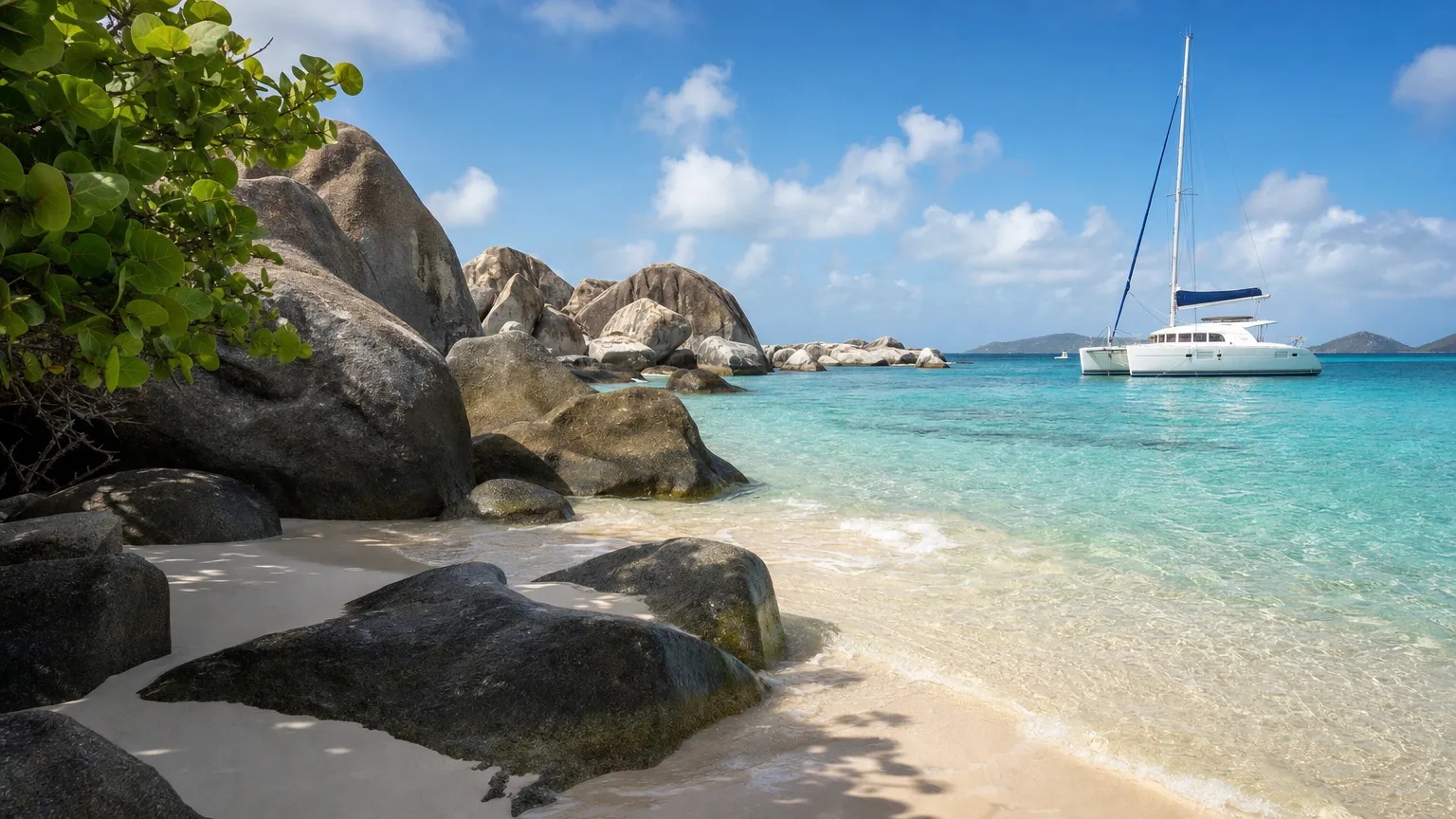
The BVI cruising permit is $16 per guest per day on foreign-based yachts and $4 on BVI-based under Schedule 2 of the Cruising and Home Port Permit Act, 2021, plus a $10 Environmental and Tourism Levy per guest on arrival. For eight guests over seven nights that’s about $1,000, inside an all-inclusive rate on nearly every contract.
On a BVI-based yacht the same week comes to $328, and a stop at The Baths adds $3 a head (National Parks Trust ticketing). Three bodies collect in the BVI: HM Customs takes the cruising permit and the $10 levy when the yacht clears in, the National Parks Trust sells the Baths pass and the yacht’s marine conservation permit, and the BVI Ports Authority charges charter guests nothing.
| Government charge | Amount | Who sets and collects it | Source | Verified |
|---|---|---|---|---|
| Cruising permit (per guest, per day) | $16 per guest per day on foreign-based charter yachts, including USVI-based ones; $4 on BVI-based yachts (an amending Order took effect June 1, 2025 and its text is not published, so confirm the current rate when you book) | HM Customs, Government of the Virgin Islands | Cruising and Home Port Permit Act, 2021, Schedule 2 | September 2026 |
| Environmental and Tourism Levy | $10 per guest (age 3 and over), once per arrival, air or sea | Government of the Virgin Islands | GIS release, September 2017 (archived) | August 2026 |
| National Parks Trust fees | The Baths day pass $3 per adult, $2 per child. Park mooring permits are handled by your crew and are not billed to you | National Parks Trust of the Virgin Islands | NPT ticketing, The Baths National Park | August 2026 |
Which rate your yacht pays
The permit is what most people mean by the “BVI cruising tax”; there’s no percentage tax on a BVI charter fee. It is a per-person, per-day charge under section 5 of the Cruising and Home Port Permit Act, 2021 (No. 29 of 2021, gazetted August 10, 2021), which repealed the old Cruising Permit Act. Schedule 2 has no seasonal split and no age exemption; crew are exempt under section 5, and section 13 makes the fee apply to the owner’s friends and guests as well as paying charterers. Which rate a yacht pays turns on one definition.
Home based charter boat: registered in the Virgin Islands, with its base of operations there, and managed by a Virgin Islands company for five months or more of the year (section 2). Everything else is foreign based, including the many crewed catamarans that operate out of St Thomas and cross into BVI waters.
A base port doesn’t settle it. Of the 220 yachts we track that name a Virgin Islands base for their current season, 168 list a BVI port and 52 list St Thomas, but a Tortola berth alone does not make a yacht “home based” under the Act. Ask your broker which permit rate your yacht pays; on all-inclusive terms the answer changes nothing on your bill.
The $4 or $6 question
The gazetted Schedule 2 says $4, and the $6 that some operators still quote matches the rate in a 2017 government release under the repealed Act (that page has since been taken down). One caveat applies to both rates. An amending Order, the Cruising and Home Port Permit (Amendment of Schedule 2) Order, 2024 (S.I. 2024 No. 83), took effect on June 1, 2025, and its text isn’t published online, so $4 and $16 are the last rates we can verify from the gazetted Act. We’ve asked HM Customs to confirm both and will update this table.
The levy, the parks and the ports
The Environmental and Tourism Levy is $10 per visitor arriving by air or sea under the Environmental Protection and Tourism Improvement Fund Act, 2017 (the Government’s FAQ survives as a copy hosted by the Virgin Islands Professional Charter Association, VIPCA). Children two and under are exempt, crew are exempt, and it’s charged once per visit. If you fly into Tortola you pay the $10 at the airport; if you board in St Thomas and enter by sea, the yacht settles it at clearance.
The National Parks Trust sells a $3 adult and $2 child day pass for The Baths, the only Trust charge collected per guest; its marine conservation permit is a per-vessel permit your operator holds, and the Trust doesn’t publish its price. Moorings in the BVI, park or private, are paid by the yacht and ride inside the rate or the APA. The BVI Ports Authority’s fee schedule (effective December 2020) has no per-passenger line for yachts at all.
What do USVI charter guests pay? No cruising permit, no charter tax
The US Virgin Islands charge charter guests no cruising permit and no per-guest charter tax (USVI Department of Planning and Natural Resources). The only government charges around St John are National Park Service fees: a $26 per night park mooring paid by the yacht, and $5 per person at Trunk Bay for ages 16 and up (Virgin Islands National Park fees page, last updated May 2024). For eight guests over three park nights that’s about $118, and on all-inclusive terms the rate covers it.
| Government charge | Amount | Who sets and collects it | Source | Verified |
|---|---|---|---|---|
| Cruising permit or charter tax (per guest) | None. There is no per-guest government charge in the US Virgin Islands | USVI Department of Planning and Natural Resources | DPNR, Anchoring and Mooring | August 2026 |
| National Park Service fees | $5 per person at Trunk Bay, ages 16 and up. Park mooring fees are paid by the yacht, not billed to you (a proposal to raise these has not been implemented) | National Park Service | Virgin Islands National Park, Fees and Passes | August 2026 |
A USVI cruising permit does exist, but the Department of Planning and Natural Resources requires it from the operator, not from you: any charter vessel not registered in the USVI that anchors overnight in territorial waters must hold one, and no per-guest fee is published. The “12.5 percent USVI charter tax” that circulates online isn’t a charge on charter guests; no such line exists in the DPNR or Port Authority schedules. No percentage charter tax reaches a guest in either Virgin Islands territory; among these five destinations only the Bahamas levies one.
The National Park Service proposed in September 2024 to raise Trunk Bay to $10 for ages 10 and up and park moorings to $40 or $60 a night by vessel length, with the increase possible from January 2025. As of September 2026 no decision has been published and the official fee page still shows $26 and $5. If it changes, it changes for the yacht, and on all-inclusive terms your rate absorbs it. The BVI versus USVI comparison weighs that fee gap against everything else that separates the two.
Why is the Bahamas charter tax 14 percent? VAT plus a 4 percent fee
A worked Bahamas week with both taxes, the provisioning allowance and the gratuity added to a real rate is in our Bahamas yacht charter prices guide.
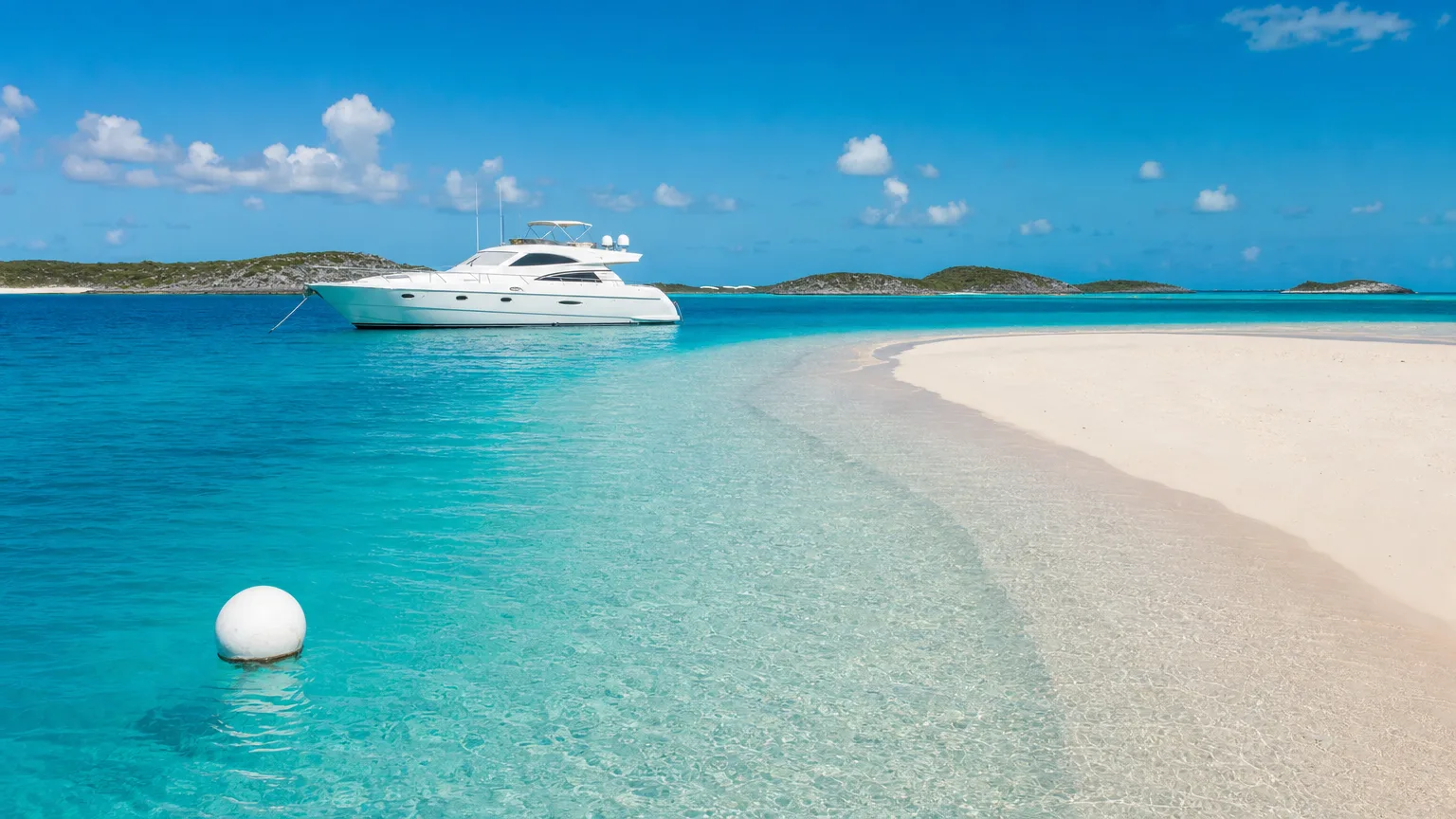
The Bahamas’ 14 percent charter tax is two charges: 10 percent VAT under the Value Added Tax Act plus a 4 percent charter tax under the Boat Registration (Yacht) Rules, paid together to the Port Department since January 1, 2026 (S.I. No. 57 of 2025). On the $31,000 median all-inclusive catamaran week that’s $4,340, and no rate includes it.
The Rules say “Port Authority”; the office behind it is the Bahamas Port Department, the name Customs’ own clearance page uses. On the $80,500 median high-season plus-expenses motor-yacht base the tax is $11,270, and it sits outside the APA on that contract too (Vital Charters rate analysis, September 2026; n=28 catamaran and n=146 motor-yacht high-season rate rows).
Where the 14 percent comes from
| Government charge | Amount | Who sets and collects it | Source | Verified |
|---|---|---|---|---|
| Charter taxes (VAT + charter tax) | 14 percent of the charter fee: 10 percent VAT plus a 4 percent charter tax, collected together by the Port Department (S.I. No. 57 of 2025 rewrote Rule 6 so both are paid together from January 1, 2026; the percentages come from the VAT Act and the earlier Rule 6) | Government of The Bahamas (VAT Act Ch. 370A; Boat Registration (Yacht) Rules) | S.I. No. 57 of 2025 | September 2026 |
| Cruising permit (per vessel) and passenger tax | Paid by the yacht: $500 to $3,000 for 12 months by length (thresholds at 50 and 100 ft), or $150 to $600 for 30 days, inside the rate or the APA. If you enter aboard from Florida, a $30 passenger tax per non-resident passenger beyond three, ages 6 and up (regulation 91(5), 2025; Customs’ clearance page still shows $20), not charged again on departure | Bahamas Customs (Customs Management Regulations, reg. 91) | Bahamas Customs, Pleasure Vessel Clearance (tiers effective April 1, 2026) | September 2026 |
| Exuma Cays Land and Sea Park fees | Moorings from $27.27 per night by vessel size plus $12.73 per extra guest per day, 10 percent VAT added; park entrance $15 per adult from July 1, 2026 | Bahamas National Trust | BNT, Exuma Park fees | August 2026 |
The rule itself is one sentence. Rule 6(1) of the Boat Registration (Yacht) Rules, as rewritten by S.I. No. 57 of 2025, has the owner or operator of a chartered vessel “pay to the Port Authority or Registered Charter Agent (a) a sum equivalent to four per centum of the sum payable to that owner or operator in respect of that carriage; and (b) value added tax as such rate as may be charged under the Value Added Tax Act (Ch. 370A) on the sum payable to that owner or operator in respect of that carriage.” Both percentages apply to the charter fee, so they add rather than compound, and the Department of Inland Revenue puts the standard VAT rate at 10 percent.
Some sources call the 4 percent a “charter fee”, a “port fee”, a “port authority tax” or a “cruising tourism fee”; they all mean the same 4 percent under Rule 6(1), and Customs’ own clearance page puts it plainly: “The requisite fee per charter (4%) is also payable on arrival.” It isn’t the cruising permit, which is a flat per-vessel fee the yacht pays.
The news framing of a “new 14 percent charter tax law” in July 2025 gets the story backwards. The instrument was made in June 2025, the part that has both paid together took effect on January 1, 2026, and the instrument rewrote how the two are collected, not the percentages, which come from the VAT Act and the pre-existing Rule 6. The fleet had already priced it in: of the 269 yachts with current Bahamas rates we track, 84 write “14 percent” into their own price notes and 124 mention the tax in some form (28 of them use the term “port fee”), always as an addition to the rate. Four in five Bahamas rate rows are plus-expenses (430 of 533), so the APA rules apply to most Bahamas weeks, and the 14 percent is the one line the APA doesn’t absorb.
The permit, the passenger tax and the Exuma park
The other Bahamas charges fall on the yacht. The Bahamas cruising permit is a flat per-vessel charge, priced by length and permit duration (the tiers are in the table above), and Bahamas Customs reset those tiers on April 1, 2026, with a fishing permit on top. On all-inclusive terms it’s inside the rate; on plus-expenses terms the APA pays it.
The one per-guest line is a passenger tax on every non-resident passenger beyond the first three, ages six and up, charged when a yacht enters with guests aboard, which means a charter that starts in Florida and crosses to the islands. It is $30 under regulation 91(5) of the 2025 Regulations and on Customs’ tax schedule, though Customs’ clearance page still shows $20. It doesn’t apply when you fly to Nassau and board there (you clear immigration at the airport with a passport, and the permits are the crew’s paperwork), and the same passenger is exempt on departure on showing the receipt. The April 2026 tiers come from the Ministry of Tourism’s statement of April 6, 2026.
In the Exuma Cays Land and Sea Park, the Bahamas National Trust charges charter vessels a nightly mooring by length, from $27.27 under 40 feet to $172.73 at 120 to 150 feet, plus $12.73 per guest per day, crew excluded ($14 with VAT), with VAT on the mooring too. A 60-foot catamaran with eight guests spends about $576 on three park nights. None of the six Abaco parks charges guests this way, and our Abacos yacht charter itinerary covers that week. Park entrance is $15 per adult, $8 per child and $10 per senior from July 1, 2026. The yacht’s own annual charter permit from the Port Department is operator cost that explains Bahamas pricing and never reaches your bill directly. Our Bahamas charter guide covers the itineraries these fees attach to.
What do the Grenadines charge guests? Tobago Cays park fees only
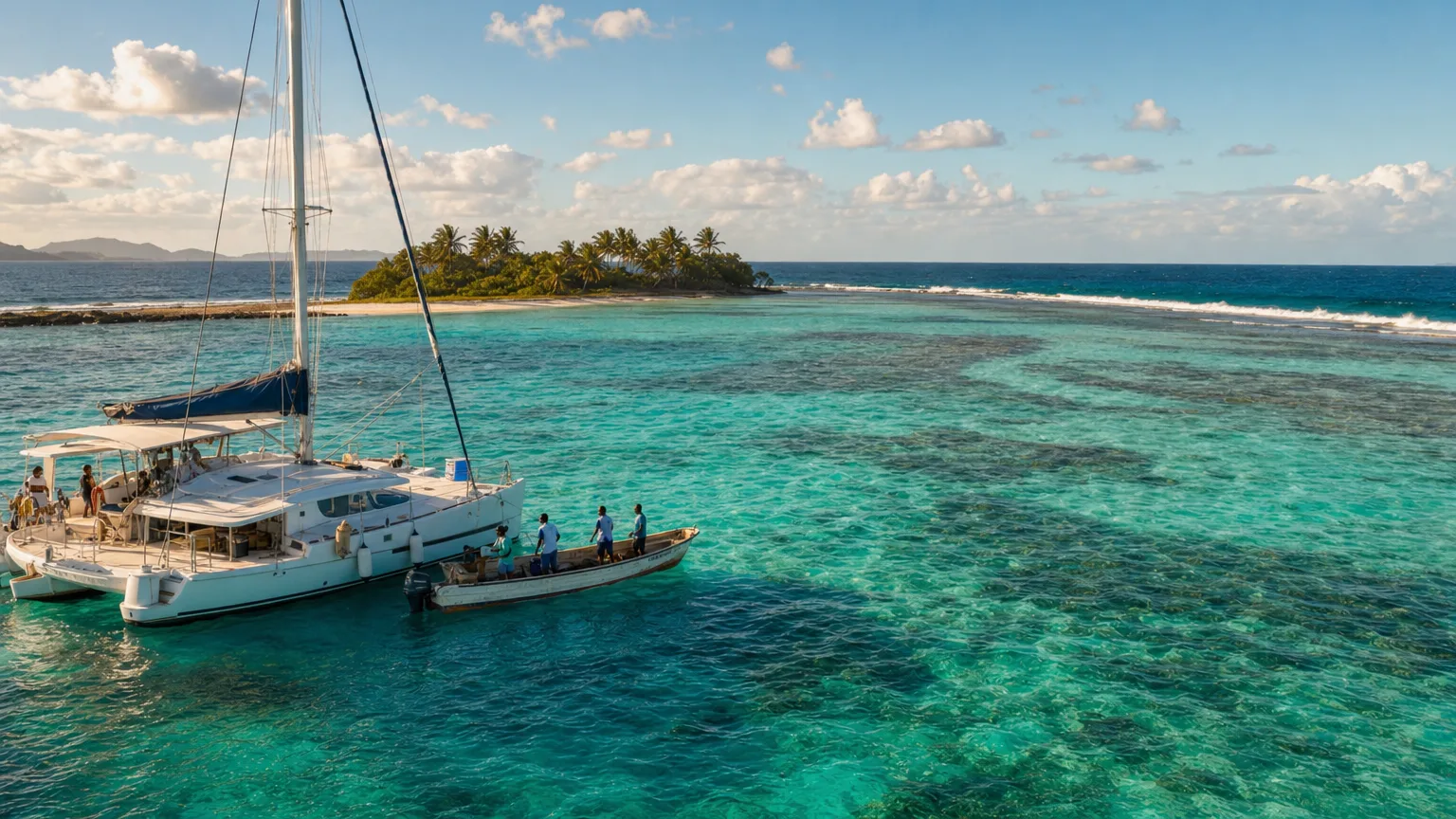
In St Vincent and the Grenadines the only government charge that reaches a charter guest is the Tobago Cays Marine Park: EC$15 (about US$5.60) per person per day plus EC$60 per vessel per 24 hours on a park mooring or at anchor, or about US$200 for eight guests over three park days (Tobago Cays Marine Park fee schedule).
Rangers collect on the water and your crew settles it, inside the all-inclusive rate or from the APA.
| Government charge | Amount | Who sets and collects it | Source | Verified |
|---|---|---|---|---|
| SVG charter tax (per guest) | None on your invoice; SVG’s cruise tax and charter licence are the operator’s paperwork | SVG Customs; Ministry of Tourism | SVG Ministry of Tourism, Yachting | August 2026 |
| Tobago Cays Marine Park fees | EC$15 (about US$5.60) per guest per 24 hours; EC$60 per vessel per 24 hours on moorings or at anchor | Tobago Cays Marine Park | TCMP fee schedule, effective January 1, 2023 | August 2026 |
The park’s fee sheet charges the same $15 per person whether you arrive on a charter boat, a private yacht or a cruise ship, and the same $60 per 24 hours whether you take a park mooring, anchor inside the reef, or lie in Clifton Harbour or Salt Whistle Bay. The sheet prints the amounts with a bare dollar sign; St Vincent and the Grenadines prices in Eastern Caribbean dollars, pegged at EC$2.70 to US$1, and the older EC$10 figure the web still repeats hasn’t applied since 2023. The turtle sanctuary at Baradal is inside the fee.
Beyond the park, St Vincent and the Grenadines levies a cruise tax on private vessels and requires charter yachts to hold an SVG cruising licence, according to the Ministry of Tourism, but neither is a per-guest charge and no government page publishes an amount, so nothing from either appears on this registry. Mustique asks visiting yachts to reserve one of its moorings through the island’s Moorings Office and doesn’t publish the fee; the crew books it and it rides inside the rate or the APA. Our Grenadines routes page shows where the park days fall in a week.
What do St Martin and St Barts charge guests? Nothing per head
French St Martin and St Barts charge charter guests no visitor tax: St Martin abolished its taxe de séjour in 2020, and St Barts’ 5 percent visitor tax is collected by hotels, villa owners and other lodging providers, with nothing in the Code applying it to vessels (Saint-Martin tax administration notice, 2022; Code des contributions de Saint-Barthélemy, Articles 123 to 124 bis). What Gustavia does charge falls on the yacht: port dues scaled to the yacht’s size, on the order of 60 euros a day for a 60-foot catamaran at anchor, and a 1 euro per person per day waste tax that counts crew as well as guests.
| Government charge | Amount | Who sets and collects it | Source | Verified |
|---|---|---|---|---|
| Visitor or tourist tax (per guest) | None: French St Martin abolished its visitor tax in 2020; the St Barts visitor tax covers land stays only | Collectivité de Saint-Martin; Collectivité de Saint-Barthélemy | Saint-Martin tax administration notice | August 2026 |
| Gustavia port dues and waste tax | Paid by the yacht: port dues per vessel by length and beam (higher for charter vessels), plus a 1 euro per person per day waste tax, crew included | Collectivité de Saint-Barthélemy; collected by the Port de Gustavia | Saint-Barthélemy Code des contributions, Art. 128-1 and 139 | September 2026 |
| St Martin nature reserve moorings | Free by day, no request needed; overnight only at Tintamarre and Rocher Créole with prior authorisation, which your crew arranges | Réserve Naturelle de Saint-Martin | Réserve Naturelle, mouillage | September 2026 |
For eight guests and four crew over three nights off Gustavia, the yacht pays about 36 euros in waste tax and roughly 180 euros in anchoring dues (Article 128-1 scales them to length times beam, and a winter berth on the quay costs more). None of it is billed per guest, and on all-inclusive terms none of it reaches you. The Réserve Naturelle de Saint-Martin keeps its daytime moorings free with no request needed; overnight stays are allowed only at Tintamarre and Rocher Créole with prior authorisation, which the crew arranges. On the Dutch side, Simpson Bay’s bridge and lagoon charges are vessel-side and aren’t published on an official page, and we found no per-passenger head tax on yachts anywhere in Sint Maarten. Our St Barts itinerary shows how those Gustavia nights fit a week.
How do these fees show up on your quote?
Three questions sort the yacht charter taxes and fees on any Caribbean or Bahamas quote, and the answers should be on the first proposal (Vital Charters’ booking practice; CYBA Clause 2).
- Is the cruising permit inside the rate?
- Is the charter tax shown as its own line, in dollars?
- Is the gratuity discretionary or written into the terms?
Here’s how the answers land on the two most common weeks we book, using the median all-inclusive catamaran rates we track.
| Line | BVI, $32,000 median all-inclusive catamaran (n=237), 8 guests aboard | Bahamas, $31,000 median all-inclusive catamaran (n=28), 8 guests aboard |
|---|---|---|
| Listed weekly rate | $32,000 | $31,000 |
| Charter tax | $0 | $4,340 (10 percent VAT plus 4 percent) |
| Permits, levy and park fees | About $1,000, inside the rate | About $576 for three Exuma park nights, inside the rate |
| Crew gratuity, 15 to 20 percent | $4,800 to $6,400 | $4,650 to $6,200 |
| Out of pocket | $36,800 to $38,400 | About $40,000 to $41,500 |
The two weeks list within $1,000 of each other and land about $3,200 apart: the Bahamas tax, net of the $1,000 difference in the two listed rates and the slightly smaller gratuity on the lower one. On a plus-expenses motor yacht the same logic holds with one more line: the APA (typically 30 to 35 percent of the base, as the table above states) pays the permits and park fees, the tax sits outside it, and the unspent balance comes back to you. Our worked invoice examples take a $40,000 BVI week and a $60,000 Bahamas motor-yacht week line by line, and the operator add-ons that aren’t government charges (dockage you request, scuba, premium wines, transfers) have their own page. If a quote is silent on any of the three questions, ask; a broker who can’t answer from the contract shouldn’t be quoting the boat.
The bottom line on yacht charter taxes and fees
Yacht charter taxes and fees in the Caribbean and Bahamas are five short lists, and only one of them carries a percentage. The BVI’s gazetted schedule charges $16 per guest per day on foreign-based yachts, $4 on BVI-based, plus a $10 arrival levy, all inside an all-inclusive rate on nearly every contract; a 2025 amending Order is unpublished, so confirm the rate that applies to your yacht when you book. The USVI charges guests nothing beyond park fees the yacht pays. The Bahamas adds 14 percent to every charter fee, two taxes at one collection point, on top of any rate. The Grenadines charge EC$15 a head a day in the Tobago Cays and nothing else per guest. The French islands charge the yacht, not you. Every figure above links to the document it came from, dated (official schedules, verified August and September 2026), and where a figure is unpublished the table says so.
Vital Charters’ crewed yacht fleet is quoted with these lines shown in dollars on the first proposal, permits marked as included or not, the tax where it applies, and the gratuity noted as discretionary. If you have a quote in hand from anyone and want the government lines checked against this registry, send it over; it takes us ten minutes and it’s the kind of arithmetic we’d rather do before you book than after.
Frequently Asked Questions
What taxes and fees are added to a Caribbean yacht charter?
It varies by destination: 14 percent in the Bahamas (10 percent VAT plus a 4 percent charter tax), $4 to $16 per guest per day in BVI cruising fees plus a $10 arrival levy, marine park fees in the Grenadines and Exumas, nothing per guest in the USVI, and in the French islands only a 1 euro per person per day waste tax in Gustavia. On all-inclusive terms the permits, levies and park fees are covered by the rate in the vast majority of cases; the percentage taxes and the crew gratuity are the lines you pay directly.
How much is the BVI cruising permit for charter guests in 2026?
$16 per person per day on foreign-based charter yachts, which includes USVI-based ones, and $4 on BVI-based yachts, under Schedule 2 of the Cruising and Home Port Permit Act, 2021. An amending Order took effect June 1, 2025 and its text is not published, so confirm the rate that applies to your yacht when you book. Your crew files the permit, and on all-inclusive terms the rate covers it in the vast majority of cases. A $10 environmental and tourism levy is also collected per guest on arrival.
Do USVI charter guests pay a cruising permit or charter tax?
No. There is no USVI cruising permit charge for guests and no per-person charter tax. The only National Park Service charge you meet directly is $5 per person at Trunk Bay, for ages 16 and up. Park mooring fees are paid by the yacht rather than billed to you.
Is the Bahamas yacht charter tax 14 percent?
Effectively yes, but it is two charges: 10 percent VAT under the VAT Act plus a 4 percent charter tax under the Boat Registration (Yacht) Rules, collected together by the Port Department since January 1, 2026 (S.I. No. 57 of 2025). The reform changed the collection point, not the rates.
How much are the Tobago Cays Marine Park fees?
EC$15 (about US$5.60) per person per 24 hours since January 1, 2023, plus EC$60 per vessel per 24 hours on a park mooring or at anchor. Rangers collect on the water; on a crewed charter the crew handles payment, covered by the all-inclusive rate or the APA in the vast majority of cases.
Do yacht charter guests pay a tourist tax in St Martin or St Barts?
No. French St Martin abolished its taxe de séjour in 2020 and St Barts applies its visitor tax to land accommodation only. Port dues in Gustavia are the yacht’s cost, set by length and beam; the one per-person line there is a 1 euro per person per day waste tax on visiting vessels, crew included, also paid by the yacht.
Are permits and park fees included in an all-inclusive charter?
Almost always, yes. Clause 2.A of the CYBA Inclusive Charter Agreement puts “cruising taxes and permits, clearance taxes, mooring fees” inside the Total Charter Fee, and 96 percent of the Caribbean all-inclusive listings that name a payer say the boat pays the cruising permit. The rare yacht that bills the permit separately says so on the first proposal. Percentage charter taxes, such as the Bahamas’ 14 percent, are never included.
Does the APA cover the Bahamas charter tax?
No. The APA is a pre-funded account for running costs (fuel, food, dockage, park and permit fees), and any unspent balance is refunded. The 14 percent Bahamas charge is a tax on the charter fee itself and appears as its own line on top of both the rate and the APA. Budget for it separately: $4,340 on a $31,000 week, $11,270 on an $80,500 base.
Is the 4 percent Bahamas charter fee the same as the cruising permit?
No. The 4 percent is a tax on the charter fee under Rule 6(1) of the Boat Registration (Yacht) Rules, collected with the 10 percent VAT, whatever name a listing gives it: charter fee, port fee, port authority tax or cruising tourism fee. The cruising permit is a flat per-vessel Customs fee, priced by length and duration, that the yacht pays and the rate or the APA absorbs.
Who collects the BVI cruising permit: Customs, the Ports Authority or the National Parks Trust?
HM Customs. The cruising permit and the $10 levy are paid to Customs when the yacht clears in, under the Cruising and Home Port Permit Act, 2021. The National Parks Trust sells The Baths day pass ($3) and a per-vessel marine conservation permit whose price it doesn’t publish, and the BVI Ports Authority’s schedule has no per-passenger charge for yachts. On a crewed charter the crew handles all three.
Is the BVI cruising permit $4 or $6 for BVI-based yachts?
The gazetted Schedule 2 of the Cruising and Home Port Permit Act, 2021 says $4 per person per day for home based charter boats and $16 for foreign based. The $6 some operators quote is the 2017 rate under the Act that the 2021 law repealed. An amending Order took effect on June 1, 2025 and its text isn’t published online, so we’ve asked HM Customs to confirm both rates; on all-inclusive terms the difference stays inside the rate either way.
Every fee on your quote, itemized up front
Tell us your destination, group size and dates and we’ll show you the full invoice, taxes and permits included, before you commit to a yacht.