
Hidden Fees in Yacht Charters: Government vs Operator Add-Ons (2026)
Yacht charter hidden fees are two short lists: governments (BVI $16 per guest per day, Bahamas 14 percent) and operator add-ons. See each one before you sign.
Yacht charter hidden fees in the Caribbean and Bahamas come from exactly two places: a government, or the yacht itself. Governments set four kinds of charge (a cruising permit, an arrival levy, a marine park fee and, in the Bahamas, a 14 percent charter tax), and the yacht’s contract names everything else, from the 15 to 20 percent crew gratuity to a relocation fee for meeting you away from its base. Both lists are short, both are published, and this page walks them line by line with the figures from the gazetted schedules and from the rate sheets of the 634 yachts we track that hold a current Caribbean or Bahamas rate (September 2026).
The word “hidden” is doing less work than it used to. On an all-inclusive catamaran the contract puts the permits and park fees inside the rate, so the only lines that land on top are the crew gratuity, a charter tax where one exists, and whatever you choose to add. The surprises come from not knowing which contract you’re on. So that’s where we start, after the short version.
Last Updated: October 18, 2026
Originally published March 4, 2026.
What are yacht charter hidden fees? Two lists, and both are short
Yacht charter hidden fees split cleanly into government charges and operator add-ons, and on a Caribbean all-inclusive catamaran the first list is mostly already paid. The contract behind most of the fleet, the CYBA Inclusive Charter Agreement, puts “fuel, cruising taxes and permits, clearance taxes, mooring fees” inside the fee and lists nine exclusions, led by the discretionary crew gratuity at “customary rate of 15-20%” (CYBA, Clause 2, 2020).
That is the whole map. A government sets the amount of a permit, a levy, a park fee or a charter tax, and publishes it. The yacht sets everything else, and states it on the rate sheet your broker works from: the gratuity custom, a relocation fee if you board away from its base, a sleep-aboard night before the charter, premium brands at the bar, rendezvous diving. Nothing on either list is secret. What’s genuinely hidden is which list a given line belongs to, and whether your contract has already absorbed it.
| Who sets it | The lines | Where the figure is published | On an all-inclusive rate |
|---|---|---|---|
| A government | Cruising permit, arrival or environmental levy, marine park fees, VAT-style charter tax | Gazetted schedules and park fee pages, collected in our Caribbean and Bahamas fees registry | Permits, levies and park fees inside the rate in the vast majority of cases; the charter tax always on top |
| The yacht, by contract | Crew gratuity, scuba, premium beverages, excessive alcohol, off-yacht excursions, dockage you request, fishing licenses, communications, airport transfers | CYBA Inclusive Agreement, Clause 2.B | Excluded by name; settled before you disembark (Clause 2.C) |
| The yacht, by rate sheet | Relocation fee, sleep-aboard night, holiday surcharge, short-charter pricing, minimum stay | The yacht’s own rate notes, quoted on your first proposal | Only if you ask for them, or book the dates they attach to |
| You | Trip cancellation insurance, medical evacuation cover, flights and hotels | Your insurer; the contract recommends the cover (Clause 22) | Never in any rate |
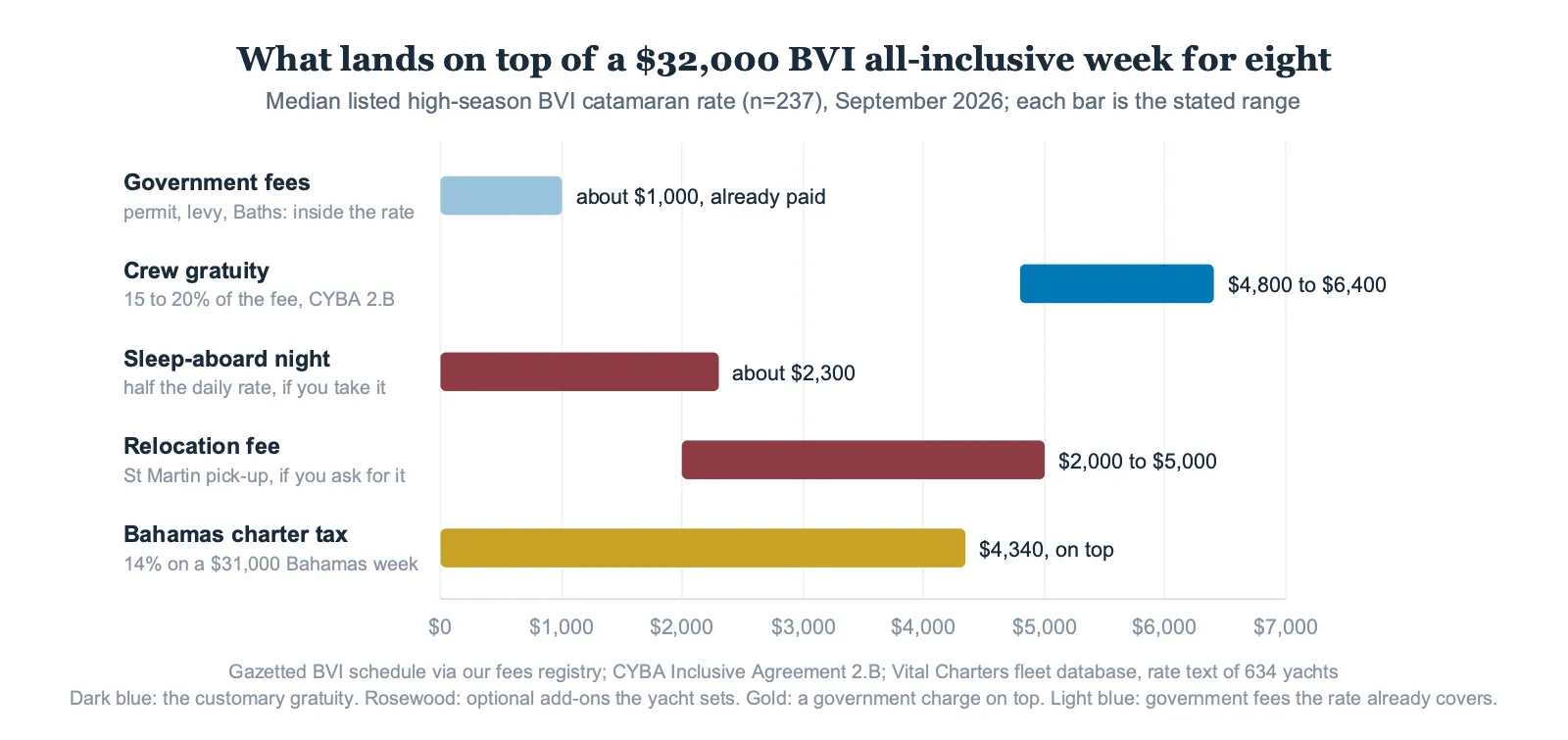
View data table
| Line | Who sets it | Amount on a $32,000 BVI all-inclusive week for eight | Basis |
|---|---|---|---|
| Government fees (cruising permit, arrival levy, The Baths) | BVI government | About $1,000, inside the rate | $16 x 8 guests x 7 days + $10 x 8 + $3 x 8, gazetted 2021 schedule |
| Crew gratuity | Custom, written into CYBA Clause 2.B | $4,800 to $6,400 | 15 to 20 percent of the charter fee |
| Sleep-aboard night | The yacht, if you take it | About $2,300 | Half the daily rate; 216 of 336 all-inclusive yachts offer one |
| Relocation fee, St Martin or St Barts pick-up | The yacht, if you ask for it | $2,000 to $5,000 | Stated on 20 BVI-based rate sheets |
| Bahamas charter tax, for comparison | Bahamas government | $4,340 on a $31,000 Bahamas week | 10 percent VAT plus 4 percent charter tax, S.I. No. 57 of 2025 |
Are you on all-inclusive or plus-expenses terms? Ask this first
Of those 634 yachts, 336 list only all-inclusive terms and 294 only plus-expenses, with four offering both (September 2026). The two contracts draw the line between “inside the rate” and “on top” in different places, so every fee question on this page has two answers, and the first thing to read on any quote is which one you’re being given. Which contract you get is decided by the boat, not the island: our guide to what a yacht charter fee includes sets the two forms side by side and shows the fleet flipping at 70 feet. If you are also weighing a bareboat quote against an all-inclusive one, that comparison has its own page: the two numbers cover different amounts of the week.
All-inclusive: the CYBA form
Clause 2.A of the CYBA Inclusive Charter Agreement, the form behind most Caribbean catamarans, reads: “Unless specified otherwise under Special Conditions, the Total Charter Fee includes the hiring of the Yacht, the services of a fully licensed Crew, all meals, standard ship’s bar, fuel, cruising taxes and permits, clearance taxes, mooring fees and all expenses related to running of the Yacht and use of on-board leisure and sports equipment.” There is no APA clause anywhere in the document. Our all-inclusive yacht charter explainer covers what that bundle feels like on board.
Two things follow. Fuel is inside the rate with no hours attached in the contract; the “four hours of cruising a day” figure you’ll read elsewhere isn’t in the CYBA form, and only three of the 336 all-inclusive yachts put an hourly cap in their own rate notes. The hours-a-day idea comes from the plus-expenses world: MYBA’s specimen agreement restricts “time under way to an average of six (6) hours per day” (Clause 4(a)), under a contract where fuel is billed through the APA anyway. Yacht-specific limits on an all-inclusive boat belong in the Special Conditions, which is why Clause 2.A opens “Unless specified otherwise under Special Conditions.” And the permits are the yacht’s problem: Clause 8 has the owner deliver the yacht “having all licenses required for any jurisdiction within the CRUISING AREA.”
Plus-expenses: the MYBA form
Plus-expenses charters, most motor yachts and nearly the whole Bahamas motor fleet, run on the MYBA Charter Agreement or a copy of it. Its Clause 8 says the fee “includes the charter of the Vessel with all its equipment in working order; tools; stores; cleaning materials and basic consumable stores for engine room, deck, galley and cabins; laundry of ship’s linen; the crew’s wages, uniforms and food; the insurance of the Vessel and crew.” Then: “The CHARTERER will pay, at cost, for all other expenses,” a list that runs from fuel and food to “berthing dues and other harbour charges including pilots’ fees, local taxes” and “communications and internet use” (MYBA Charter Agreement, specimen).
Those “at cost” expenses are what the APA pre-funds, so on plus-expenses terms the permits and park fees come out of the APA rather than arriving as a separate bill. A charter tax never does; it’s calculated on the fee itself and billed beside it.
The extra costs beyond the weekly rate are small on all-inclusive terms and large on plus-expenses terms: on an all-inclusive catamaran only the 15 to 20 percent crew gratuity and any charter tax land on top, so the listed rate is about 85 percent of the final bill (CYBA Clause 2.B), while a plus-expenses yacht adds a 30 to 35 percent APA and the taxes, so the listed rate is about 60 percent. Our yacht charter costs guide works both invoices to the dollar.
Which government charges does your rate already cover?
Government charges on a Caribbean or Bahamas charter run from nothing per guest in the US Virgin Islands to 14 percent of the charter fee in the Bahamas. On all-inclusive terms the fixed ones are inside the rate: CYBA Clause 2.A includes “cruising taxes and permits, clearance taxes, mooring fees,” and 96 percent of the Caribbean all-inclusive listings that name a payer say the boat pays the cruising permit (456 of 476, September 2026). The percentage taxes are the exception, and they’re never inside any rate.
What lands on a Caribbean charter invoice in 2026
The island sets the amounts: 14 percent in Bahamas taxes, up to $16 per guest per day in BVI cruising fees, nothing per guest in the USVI. The contract sets who pays: all-inclusive rates cover permits, park fees and levies in the vast majority of cases; charter taxes and the 15 to 20 percent gratuity are always yours.
| Line item | Typical amount | Who sets it | Source |
|---|---|---|---|
| APA (Advance Provisioning Allowance) | None mandatory on all-inclusive catamarans, except a small allowance, usually 5 percent, on about 1 rate in 50. Plus-expenses charters add an APA, typically 30 to 35 percent of the base rate, intended to cover every running fee except government taxes, refunded where unspent | Each yacht’s own charter terms; MYBA publishes the mechanics, not a percentage | Vital Charters APA listings analysis |
| Government charter taxes | 0 to 14 percent of the charter fee by destination; the Bahamas is highest at 10 percent VAT plus a 4 percent charter tax (per-destination figures in the destination blocks) | Each territory’s government | S.I. No. 57 of 2025 (Bahamas example) |
| Marine park fees | Where you cruise them: EC$15 per guest per day at the Tobago Cays, $12.73 per extra guest per day in the Exuma park, $3 at the BVI’s Baths | TCMP; Bahamas National Trust; BVI National Parks Trust | TCMP fee schedule, effective January 1, 2023 |
| Crew gratuity | Customarily 15 to 20 percent of the charter fee in the Caribbean crewed fleet, the band CYBA’s Inclusive Agreement (Clause 2.B) calls the customary rate; MYBA’s 2026 guidelines publish no percentage, and both leave it at your discretion | Custom, written into the CYBA form | CYBA Inclusive Agreement, Clause 2.B (2020) |
Fees verified September 2026.
The per-destination figures, each linked to the gazette or fee page it comes from, live in the registry. The short version by island:
- British Virgin Islands: a cruising permit of $16 per guest per day on foreign-based yachts and $4 on BVI-based ones under the gazetted 2021 schedule, a $10 arrival levy per person, and $3 at The Baths. About $1,000 for eight guests over a week, inside an all-inclusive rate. Details in the BVI section of the registry.
- US Virgin Islands: no cruising permit charge to guests and no per-person charter tax; only park fees if you moor inside the national park at St John. USVI section.
- Bahamas: 10 percent VAT plus a 4 percent charter tax, collected together since January 1, 2026, always on top of the rate; plus $12.73 per extra guest per day in the Exuma park, which rides inside the rate or the APA. Bahamas section.
- Grenadines: EC$15 per guest per day at the Tobago Cays, collected by rangers on the water and settled by the crew on a crewed charter. Grenadines section.
- St Martin and St Barts: nothing per head; the port’s own charges at Gustavia fall on the yacht. St Martin and St Barts section.
One Bahamas detail worth knowing before the relocation section: the yachts that quote relocation fees there write “relocation fees + 14% tax” on the sheet. The charter tax applies to the fee for moving the boat as well as to the charter itself, so a $2,000 Staniel Cay pick-up is $2,280 on the invoice.
What is not included in an all-inclusive charter? Operator add-ons
The yacht can bill exactly what its contract excludes. The CYBA Inclusive Agreement names the list in Clause 2.B, after the same Special Conditions proviso as Clause 2.A: “the Total Charter Fee excludes suggested Crew gratuities (discretionary) at customary rate of 15-20% of Charter Fee, at guest discretion; scuba diving and equipment; premium beverages and fine wines; excessive alcohol requests and/or consumption; off Yacht excursions; dockage as requested by the CHARTERER; fishing licenses (if required); communications; airport transfers; or similar expenses incurred by the CHARTERER” (CYBA, 2020). Clause 2.C has you settle them “in cash, or upon other agreed means, prior to disembarking the Yacht.”
Notice the list’s shape. Apart from the gratuity, every item is something you ask for: the contract doesn’t let the yacht invent a line, it lets the yacht charge for what a guest chooses to add. Here’s how each shows up on the 336 all-inclusive yachts.
Premium beverages
Twenty-six of the 336 spell the bar limit out on the rate sheet, in near-identical words: “house wines, beer and standard liquor, no premium brands,” or “premium brands are available on request at cost.” The other 310 rely on the contract’s “standard ship’s bar.” In practice a case of champagne or a particular tequila goes on the preference sheet, the crew buys it, and you settle it at cost on the last day. Tell the crew a price band on the preference sheet and the line never surprises you.
Scuba and excursions
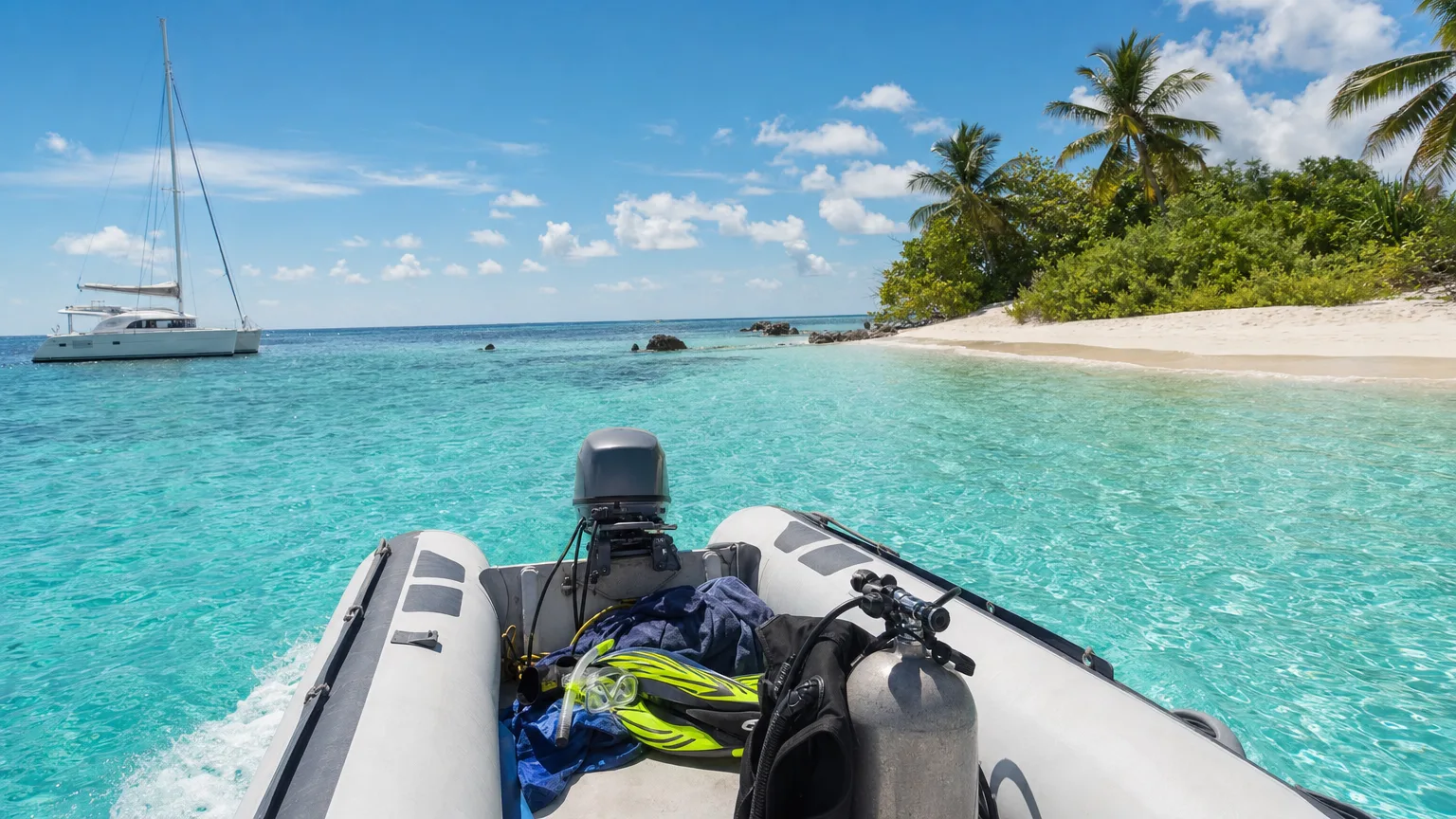
Twenty-seven all-inclusive yachts mention diving, nearly all as “rendezvous diving available”: a licensed dive boat meets the yacht at the site, and you pay the operator directly. The same goes for anything ashore. Restaurant dinners, a rented car on Virgin Gorda, a guided hike: “off Yacht excursions” are yours by contract, and a good crew books them for you and hands you the receipt. Our guide to reading a yacht charter contract goes through the clause language line by line.
Dockage you request
A mooring the yacht picks up on its itinerary is inside the fee (“mooring fees,” Clause 2.A). A marina night you ask for, to walk to dinner or plug in, is “dockage as requested by the CHARTERER,” and it’s yours. Most catamaran weeks have none.
Communications
Wi-Fi is now standard, and the fleet’s wording is careful: “onboard wifi is included, however data rates cannot be guaranteed since the yacht is moving and on the ocean.” Where a yacht meters satellite data the sheet says so; one motor yacht includes 500 GB of Starlink a week and prices extra data at $125 per 50 GB. Stated, capped and small.
Airport transfers and fishing licenses
Both are on the contract’s list, and CYBA’s booking-procedures guide is blunt about the first: brokers are to tell guests they are “responsible” for the taxi transfer “even when it is organized by the Crew.” The same guide tells brokers to “refrain from using the term ‘all inclusive’ within proposals and conversations” and to “explain what is included and what is not included, and that ‘open bar’ does not mean excessive alcohol consumption” (CYBA, Standardizing Charter Booking Procedures). A fishing license, where an island requires one, is excluded by Clause 2.B: the crew arranges it, you pay for it.
The sleep-aboard night
This is the add-on most first-time guests never hear about until they ask to board early. Of the 336 all-inclusive yachts, 216 offer a sleep-aboard: you board the evening before the charter starts, usually after 4 or 5 pm, with a welcome cocktail, breakfast the next morning and dinner ashore at your own expense. The standard price is half the daily rate, and of the 33 yachts that state a flat figure the median is $2,200. On a $32,000 week that’s about $2,300 for a night that saves a hotel and gets you sailing at 8 am.
What is a relocation fee, and how do you owe nothing? $750 to $5,000
A relocation fee is what a yacht charges to sail from its base to a pick-up or drop-off port you’ve chosen, and 127 of the 634 state one on their rate sheet (September 2026). Of the 40 that put a dollar figure beside it, the lowest figure each quotes has a median of $1,750, the middle half falls between $1,000 and $3,000, and the range runs from $500 to $15,000. It’s the largest operator add-on that has nothing to do with the contract type, and the easiest to avoid.
The corridors repeat across the fleet, and so do the prices:
| Corridor | Stated on the rate sheets | Yachts naming it | Typical wording |
|---|---|---|---|
| BVI base, pick-up in St Thomas or St John | $750 each way, $1,500 round trip | 24 | “St. Thomas/St John: $750 each way ($1500 round trip)” |
| BVI base, pick-up in St Martin or St Barts | $2,000 to $5,000, with 48 to 72 hours required either side of the charter for the passage | 20 | “Relocation fee of $3,000, minimum 48 hours required on either side of charter dates for boat transit” |
| Nassau base, pick-up at Staniel Cay | $1,000 to $2,500 one way, $2,000 to $4,000 round trip, plus 14 percent tax | 22 | “Nassau: no relocation fee. Staniel Cay: $2,000 one-way, $4,000 round-trip” |
| Nassau base, pick-up in the Abacos | $4,000 round trip, 96 hours required either side | 8 | “Abacos: $4,000 round-trip (96hrs required)” |
| Grenadines, one-way to Grenada or St Lucia | $500 to $1,500 | Several St Vincent-based yachts | “One way: St Vincent or Bequia to Grenada: $750” |
Vital Charters listings analysis, rate text of 634 yachts with a current Caribbean or Bahamas rate, September 2026. Corridor counts are yachts whose relocation note names that place.
Two patterns in the wording matter. Only 40 of the 127 print a figure at all, so the number on your proposal is the number, not the one on a public listing. And 52 mention the turnaround the passage needs (48, 72 or 96 hours either side), which can matter more than the money: a St Barts pick-up on a BVI boat can shift your available dates by a week.
The contracts back the fee’s existence without pricing it. MYBA’s form carries a “Delivery/Re-delivery Fees” line on its first page beside the charter fee and APA, and its guidance for captains says “pre-agreed costs for any delivery / redelivery transit should be given clearly to the charterer at the start of the charter” (MYBA, Information for Charter Yacht Captains and Crew, April 2018 edition; MYBA’s 2026 guidelines keep the sentence). On the Caribbean side, CYBA’s booking-procedures guide lists “repositioning fees” among the facts a charter manager must supply “when receiving the enquiry” (CYBA, Standardizing Charter Booking Procedures). If the fee isn’t on your first proposal, ask; the associations expect it to be.
The way to owe nothing is to board where the yacht lives. Of the yachts naming a Virgin Islands base, 168 list a BVI port and 52 St Thomas, and 16 relocation notes say outright that pick-up at the home port carries no fee or that the yacht won’t relocate at all. Tell your broker the islands you want to see before you name a port, and let the base choose itself. Our Caribbean crewed charter destinations guide maps which fleets live where.
Is the crew gratuity included in any rate? No, it’s 15 to 20 percent
The crew gratuity is 15 to 20 percent of the base charter fee by Caribbean custom, and the custom is written into the contract: CYBA’s Clause 2.B excludes “suggested Crew gratuities (discretionary) at customary rate of 15-20% of Charter Fee, at guest discretion.” MYBA, whose form governs plus-expenses charters, removed its lower 5 to 15 percent suggestion in its 2026 guidelines, which leave the gratuity “entirely up to the Charterer’s discretion” (MYBA Guidelines for Charter Yacht Captains & Crew, 2026, section 23; MYBA’s announcement of the update). On the $32,000 median BVI catamaran week that’s $4,800 to $6,400, and on a $60,000 motor-yacht base it’s $9,000 to $12,000, calculated on the base fee only, never on the APA or the taxes.
The fleet’s own sheets agree with the contract. Across the Caribbean and Bahamas rate sheets we track, 18 yachts state a single gratuity figure, and every one sits between 15 and 20 percent (measured for our tipping guide, September 2026). The Charter Yacht Society of the BVI says the same on its member-fleet page: “Any extra expenses will always be clearly laid out. What is not included in the charter fee is crew gratuity. In the Caribbean crew gratuities customarily run 15-20% of the charter fee” (Charter Yacht Society of the BVI).
Seven Bahamas and Florida motor yachts go further and make 20 percent mandatory on day charters, “collected at the time of contract,” which turns a custom into a line item; ask whether the figure on your proposal is discretionary or contractual. Everything else, including how to hand it over and when to go above or below the custom, is in our guide on how to tip yacht crew.
What is the APA on a plus-expenses yacht? 30 to 35 percent, refunded
Plus-expenses yachts add an Advance Provisioning Allowance on top of the base fee, and the fleet states it far more precisely than the web does: of 222 plus-expenses listings that name an APA, 132 say 35 percent, 53 say 30, 23 say 25, 12 say 40 and two say 20 (September 2026). MYBA’s own form leaves the percentage blank for the broker to fill in; the mechanics in Clause 8 have the captain report spending “at intervals,” top the fund up if it runs short, and return the balance at the end.
The APA is your money held in trust, spent on receipts, and it’s meant to cover every running cost the week generates except the taxes: fuel, provisions, dockage, park and permit fees, communications. On a $60,000 Bahamas motor-yacht base at 35 percent that’s $21,000, and separately the 14 percent charter tax of $8,400 is billed beside it, never drawn from it. Our APA guide has the full distribution and the refund mechanics. All-inclusive catamarans carry no mandatory APA on all but roughly 2 percent of rate listings; the exceptions state about 5 percent for premium extras.
Holiday weeks and short charters: the surcharges on the rate sheet
Twenty-two yachts print an explicit Christmas and New Year rate, and their median festive premium over their own high-season rate is 14 percent (Vital Charters listings analysis, August 30, 2026 snapshot). Both lines in this section are set by the yacht and printed on the sheet before you ever see a proposal. The rate sheets call that holiday surcharge a festive premium; the group medians are $65,000 in high season and $75,000 for the festive week, and the 14 percent is the median of each yacht’s own premium, so the ratio of the two medians runs nearer 15. And 226 of the 634 yachts put a start-date rule on the festive week, typically no earlier than December 27 or 28, so the calendar is a condition as well as a price. Our Caribbean yacht charter cost page has the seasonal picture.
Short charters aren’t a surcharge in name, but the arithmetic works like one. Of the 336 all-inclusive yachts, 270 state a minimum stay, and the sheets use two formulas for fewer than seven nights. Of the 112 that print one, 102 divide the weekly rate by seven and multiply by the nights; ten charge six and a half sevenths for six nights and five sixths for five (“6 nights = weekly rate ÷ 7 × 6.5; 5 nights = weekly rate ÷ 6 × 5”). On a $32,000 week the two give $27,429 and $29,714 for six nights. Ask which formula the yacht uses before comparing quotes.
The same sheets list the discounts nobody calls hidden. Of the 336 all-inclusive yachts, 204 offer a half-board option (two lunches and two dinners ashore at your expense, for a lower rate) and 170 a “local fare” version of it. If the budget is tight, those are the lines to ask about, not the exclusions.
What happens if you cancel, and which insurance do you buy yourself?
Cancellation is where the contract is strictest, and it says so plainly. Under CYBA Clause 4, “all Charter Fee payments shall be deemed earned and non-refundable unless otherwise set forth herein.” Under Clause 6.A, if you cancel, “the OWNER may retain any amounts paid,” and a refund only follows if the week is re-booked, “after deducting 20% of the Charter Fee” for commissions and costs. Then the sentence to read twice: “If, despite reasonable efforts, the OWNER is unable to book a new charter, the CHARTERER will receive no refund” (CYBA Inclusive Agreement, 2020).
If a hurricane cancels: Clause 10.C
Hurricanes are handled separately. Clause 9 lists “tropical storms, hurricanes” among the force majeure events, and if the owner can’t deliver the yacht because of one, Clause 10.C gives you a choice: a credit for the full fee against a re-booked charter within twelve months, or “a refund of all the payments made less a 35% cancelation charge from the Charter Fee.” The Atlantic season runs June 1 to November 30, peaking on September 10 with most activity between mid-August and mid-October (NOAA National Hurricane Center), so the clause governs roughly half the calendar. Our guide to chartering during hurricane season covers how the fleet actually handles it.
Trip insurance and Cancel For Any Reason
That’s why Clause 22 exists. The contract itself says “trip insurance plus Cancel For Any Reason policy upgrade is recommended to minimize the CHARTERER’S financial risks,” and that a guest who declines it “assumes all expenses and losses related to non-refundable payments.” You initial that clause on its own line, directly beneath it on the last page of the contract. The cost is yours, and it’s the one line on this page that never appears on a charter invoice at all.
The price is published by the insurers themselves. A comprehensive trip policy runs about 4 to 10 percent of the prepaid, non-refundable trip cost, and averaged roughly 6 percent across the policies Squaremouth sold in 2026; the US Travel Insurance Association puts the band at 4 to 8 percent (Squaremouth, July 2026; USTIA). Cancel For Any Reason raises the premium by roughly 40 to 60 percent, typically reimburses 50 to 75 percent of what you’d otherwise lose, and must be bought within 14 to 21 days of your first trip payment (Squaremouth, August 2026). On the $37,600 midpoint of the BVI week above, that’s about $1,500 to $3,800 for the base policy and $2,100 to $6,000 with CFAR.
Medical evacuation
Medical evacuation is a separate membership, and it’s cheap next to the rest of this page. Medjet’s short-term cover lists at $99 for eight days or $155 for fifteen per person, $198 and $260 for a family (Medjet, 2026 rate sheet). Global Rescue’s individual memberships start at $139 for seven days (Global Rescue, 2026). The Virgin Islands charter association, VIPCA, offers its own plan with CFAR to guests and states the rule that catches people: it “must be purchased with initial policy and within 21 days of the initial trip deposit date” (VIPCA). Your charter deposit is the trip payment that starts that clock.
Damage and liability
Two more guest-side items sit in the same clause family. Clause 15 has the owner insure the yacht, adds that “the CHARTERER may purchase additional charterer liability insurance at his or her expense,” and has you and your guests “accept all risks” for the tender, swimming and the water toys, so medical cover for an active week is your own decision. And Clause 18 has you “make good to an as-new standard any damage caused by the CHARTERER or the Guests”: a lost paddleboard or a cracked tender console is a line on the final statement, not an insurance claim.
What does a $32,000 all-inclusive week really cost? BVI vs Bahamas
The same catamaran lands about $3,150 apart in the two destinations, and the gap is a single government line: the $4,340 Bahamas charter tax, less the $1,000 by which the Bahamas listed rate happens to be lower. Here is the median high-season all-inclusive catamaran week in each ground, eight guests, seven nights, with every fee sorted by who set it (rates are listed asking rates from Vital Charters’ listings analysis, September 2026; government figures from the registry).
| Line | Who sets it | BVI, $32,000 week (n=237) | Bahamas, $31,000 week (n=28) |
|---|---|---|---|
| Listed all-inclusive rate | The yacht | $32,000 | $31,000 |
| Cruising permit, levy, park fees | Government | About $1,000, inside the rate | Exuma park fees, inside the rate |
| Charter tax | Government | None | $4,340 (14 percent), on top |
| Crew gratuity, 15 to 20 percent | Custom, in the contract | $4,800 to $6,400 | $4,650 to $6,200 |
| Out of pocket before your choices | $36,800 to $38,400 | About $40,000 to $41,500 | |
| Sleep-aboard night, if taken | The yacht | About $2,300 | About $2,200, plus 14 percent |
| Relocation, if you board away from base | The yacht | $750 (St Thomas) to $5,000 (St Barts) | $1,000 to $2,500 one way (Staniel Cay), plus 14 percent |
| Trip insurance, if bought | You | About 4 to 10 percent of the trip cost, $1,500 to $3,800 on the BVI week and 40 to 60 percent more with Cancel For Any Reason; plus $99 to $155 per person for a short-term evacuation membership | |
Rates are listed asking rates on the yachts Vital Charters carries; the medians are label-based high-season cells. Government figures per the gazetted BVI schedule and Bahamas S.I. No. 57 of 2025, via the registry.
All in, a $32,000 BVI all-inclusive week for eight costs $36,800 to $38,400 before any optional add-on, and the same catamaran in the Bahamas at $31,000 costs about $40,000 to $41,500, the difference being the 14 percent charter tax (Vital Charters listings analysis, September 2026; Bahamas S.I. No. 57 of 2025). Notice what isn’t in either column: a fuel bill, a mooring bill, a permit bill, a provisioning reconciliation. On all-inclusive terms those were inside the first line. The 85 percent rule holds: $32,000 is 83 to 87 percent of the BVI total, and the Bahamas week only drops to 75 to 78 percent because of the tax. The per-destination version of this table, for every Caribbean ground, is on our Caribbean charter cost by destination page.
Seven questions that surface every fee before you sign
CYBA’s guidance to its brokers is to “review the pricing notes to make sure they have not missed any extra costs” before a proposal goes out (CYBA, Standardizing Charter Booking Procedures), so every line above can be pinned down on the first proposal. These seven questions are the guest’s side of that review, and a broker who can’t answer them in one reply hasn’t structured the quote yet.
- Which contract is this, all-inclusive or plus-expenses? Everything else on this page flows from the answer.
- Which government charges are inside the rate, and which are on top? On all-inclusive terms the answer should be “permits and park fees inside, charter tax on top.” A yacht that bills its permit separately will say so here.
- Is there a relocation fee for my pick-up port, and how many days of turnaround does it need? The turnaround moves your dates; the fee moves your budget.
- Is the gratuity on this proposal discretionary or contractual? Seven motor yachts make 20 percent mandatory on day charters.
- What does the bar include, and what’s at cost? “Standard ship’s bar” is the contract’s phrase; ask the yacht to name the brands.
- What are the sleep-aboard price and the short-charter formula? Half the daily rate is the norm for the first; the second differs by about $2,300 on a six-night week.
- What is the cancellation schedule, and what do you recommend for insurance? The CYBA form recommends trip insurance with Cancel For Any Reason; a broker should say so unprompted.
Our guide to choosing a charter broker is really a guide to finding someone who answers all seven before you ask.
The bottom line on yacht charter hidden fees
Yacht charter hidden fees in the Caribbean and Bahamas are two published lists, one written by governments and one by the yacht’s contract, and on an all-inclusive catamaran the first list is inside the rate. What lands on top is the crew gratuity at 15 to 20 percent, a charter tax where one exists, and the things you choose: a night aboard before the charter, a pick-up away from the yacht’s base, premium brands at the bar, a dive boat, dinner ashore. The registry has every government figure with its source, and the rate sheet has every operator figure before you book.
The order of operations hasn’t changed. Read the contract type first. Sort every line by who set it. Ask the seven questions. Then compare yachts on the number you’ll actually pay, not the number on the listing. When you’re ready to do that against real dates, start a yacht search at Vital Charters or talk to us, and we’ll send the proposal with both lists already separated.
Frequently Asked Questions
What are the hidden fees in a yacht charter?
Two lists. Governments set cruising permits, arrival levies, marine park fees and, in the Bahamas, a 14 percent charter tax. The yacht’s contract sets the rest: the 15 to 20 percent crew gratuity, scuba, premium beverages, off-yacht excursions, dockage you request, communications and airport transfers (CYBA Clause 2.B), plus rate-sheet items such as a relocation fee or a sleep-aboard night. On all-inclusive terms the permits and park fees sit inside the rate.
Does an all-inclusive yacht charter include permits and park fees?
In the vast majority of cases, yes. Clause 2.A of the CYBA Inclusive Agreement puts “cruising taxes and permits, clearance taxes, mooring fees” inside the Total Charter Fee, and 96 percent of the Caribbean all-inclusive listings that name a payer say the boat pays the cruising permit. The rare yacht that bills the permit separately says so on the first proposal. On plus-expenses terms the permit is paid from the APA rather than billed as a separate line. A percentage charter tax, such as the Bahamas’ 14 percent, is never included.
Does an all-inclusive yacht charter have an APA?
Almost never. The CYBA Inclusive Agreement has no APA clause, and only about 2 percent of all-inclusive rate listings state a mandatory APA. Plus-expenses yachts are different: 132 of the 222 listings that name an APA say 35 percent, and 53 say 30. Unspent APA is refunded at the end of the charter.
What is a relocation fee on a yacht charter?
The charge for sailing the yacht from its base to a pick-up or drop-off port you’ve chosen. Of the 634 yachts with a current Caribbean or Bahamas rate, 127 state one, and the 40 that give a figure quote a median lowest fee of $1,750: $750 each way from the BVI to St Thomas, $2,000 to $5,000 from the BVI to St Martin or St Barts, $1,000 to $2,500 one way from Nassau to Staniel Cay. Boarding at the yacht’s home port avoids it.
What is a sleep-aboard on a yacht charter?
A night on the yacht before the charter officially starts, usually boarding after 4 or 5 pm with a welcome cocktail and breakfast the next morning, dinner ashore at your expense. Of the 336 all-inclusive yachts, 216 offer one, normally at half the daily rate; the median stated flat price is $2,200.
Is the crew gratuity included in a yacht charter fee?
No. The CYBA Inclusive Agreement excludes “suggested Crew gratuities (discretionary) at customary rate of 15-20% of Charter Fee,” and MYBA’s 2026 guidelines for plus-expenses charters publish no percentage. Calculate it on the base charter fee only, never the APA or the taxes, and hand it to the captain for the whole crew on the last evening. Seven motor yachts make 20 percent mandatory on day charters, so ask whether yours is discretionary or contractual.
What happens to my deposit if I cancel a yacht charter?
Under the CYBA Inclusive Agreement, payments are “deemed earned and non-refundable.” If you cancel, the owner may keep what you’ve paid; if the week is re-booked you receive the new charter’s net proceeds less 20 percent of the fee and any costs, and if it isn’t re-booked you receive nothing. If a hurricane stops the owner delivering the yacht, you choose a credit against a re-booked charter within twelve months or a refund less a 35 percent cancellation charge. The form leaves the payment dates to its first page; under Clause 4 the stakeholder releases no more than 35 percent of the fee to the owner ten days before the charter and the balance on the first day.
Do I need travel insurance for a yacht charter, and how much does it cost?
The contract recommends it in writing: CYBA Clause 22 says “trip insurance plus Cancel For Any Reason policy upgrade is recommended,” and a guest who declines “assumes all expenses and losses related to non-refundable payments.” The yacht’s own insurance covers the vessel and crew, not your cancellation, your medical care or an evacuation, and Clause 15 offers charterer liability cover as an optional purchase at your expense. A comprehensive trip policy runs about 4 to 10 percent of the non-refundable trip cost, roughly $1,500 to $3,800 on a $37,600 BVI week, and a Cancel For Any Reason upgrade adds about 40 to 60 percent to the premium (Squaremouth, 2026; USTIA).
See the full cost before you sign.
Share your group size, dates and destination and we’ll send a proposal with every government charge and operator add-on already separated, so the number you see is the number you pay.