
How to tip yacht crew: the custom, and what’s published
How much to tip yacht crew: 15 to 20 percent of the base fee is the Caribbean custom, written into CYBA’s contract. MYBA’s 2026 guidelines set no figure.
How much should you tip yacht crew? In the Caribbean crewed fleet the custom is 15 to 20 percent of the base charter fee, and it’s written down: the Charter Yacht Brokers Association’s own Inclusive Agreement lists crew gratuities as excluded from the fee “at customary rate of 15-20% of Charter Fee, at guest discretion” (CYBA, 2020). MYBA, whose form governs most plus-expenses charters, used to suggest a lower 5 to 15 percent, and its 2026 guidelines dropped the figure entirely. Both leave the gratuity at your discretion.
That old gap between 15 to 20 and 5 to 15 is where most of the confusion online comes from, and most of the invented “guidelines” too; plenty of pages still quote a MYBA band that no longer exists. This page settles it with the documents themselves, what the fleet’s own listings say, and the mechanics that matter on the last evening: which number the percentage applies to, how to hand it over, and when to go above or below the custom.
Last Updated: October 18, 2026
Originally published March 4, 2026.
How much should you tip yacht crew? 15 to 20 percent of the base fee
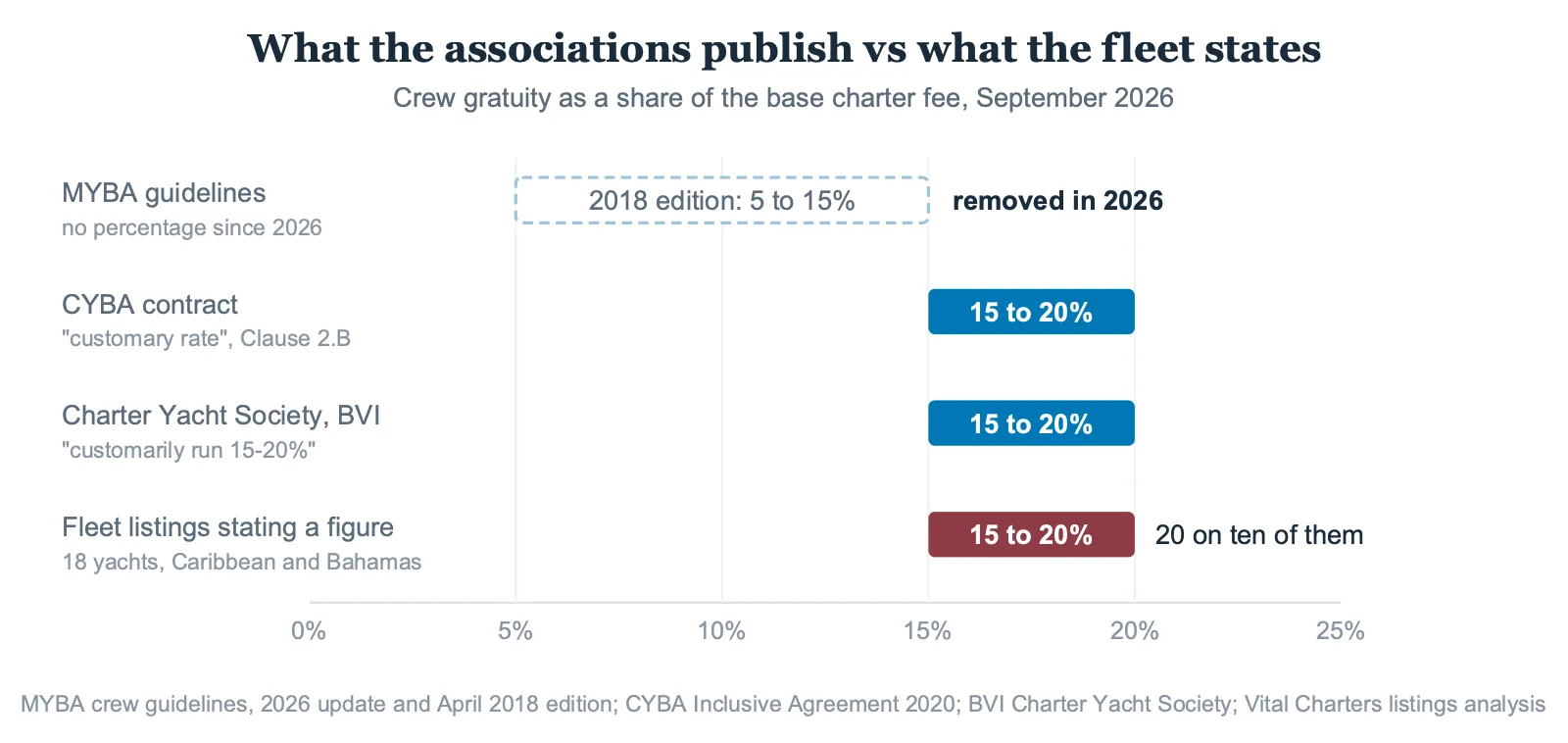
Tip yacht crew 15 to 20 percent of the base charter fee on a Caribbean crewed charter. That’s the fleet custom, and CYBA’s Inclusive Agreement (Clause 2.B) lists the gratuity as excluded from the fee “at customary rate of 15-20% of Charter Fee, at guest discretion” (CYBA, 2020). On the $31,500 median all-inclusive catamaran week, that is $4,725 to $6,300.
View data table
| Source | Gratuity band | Status |
|---|---|---|
| MYBA Guidelines for Charter Yacht Captains & Crew, 2026 update | No percentage | “Entirely up to the Charterer’s discretion”; the April 2018 edition’s 5 to 15 percent suggestion was removed |
| CYBA Inclusive Agreement, Clause 2.B | 15 to 20 percent of the charter fee | “Customary rate,” excluded from the fee, at guest discretion |
| Charter Yacht Society of the BVI, member-fleet page | 15 to 20 percent of the charter fee | “Customarily run 15-20%,” not included in the charter fee |
| Vital Charters listings analysis, 18 yachts stating a figure | 15 to 20 percent (20 on ten yachts, 18 on five, 15 on three) | Listing text, September 2026 |
The dollar figures follow from the rates. The table below runs the custom across the fee levels that actually occur in the Caribbean crewed fleet, from an entry-level catamaran to a large motor yacht, using the median listed rates for the two marked rows; our Caribbean yacht charter cost guide carries the full tables.
| Base charter fee (week) | 15 percent | 20 percent |
|---|---|---|
| $20,000 | $3,000 | $4,000 |
| $31,500 (median all-inclusive sailing catamaran, n=272) | $4,725 | $6,300 |
| $40,000 | $6,000 | $8,000 |
| $60,000 | $9,000 | $12,000 |
| $85,000 (median Caribbean motor-yacht base rate, n=167) | $12,750 | $17,000 |
| $150,000 | $22,500 | $30,000 |
Base fees only. On plus-expenses yachts the APA and any charter tax are not in the base, and the gratuity is not calculated on them; see the base-fee rule below.
Why was the Caribbean custom always higher than MYBA’s old band? Because the Caribbean crewed fleet serves a largely American clientele, and the 15 to 20 percent that is normal in American hospitality came aboard with them. CYBA, the association whose all-inclusive form prices most Caribbean catamarans, wrote that custom into its contract as a customary rate rather than a rule. The 10 to 20 percent band that circulates online does have a published source, the American Yacht Charter Association’s 2026 guidelines for captains, but it isn’t the Caribbean custom, and on this page 10 percent is the answer to an adequate week, not the starting point. Our Caribbean catamaran charter rates guide carries the fee medians by size and island that these percentages sit on.
What does MYBA publish on tipping? No percentage since 2026
MYBA publishes no gratuity percentage. Section 23 of its Guidelines for Charter Yacht Captains & Crew, updated in August 2026, says only: “Gratuities are considered entirely up to the Charterer’s discretion. While brokers may recommend a gratuity for excellent service, it is important to remember that gratuities are not mandatory” (MYBA Guidelines for Charter Yacht Captains & Crew, 2026, section 23; MYBA’s announcement of the update). It’s guidance captains sign before a charter, not a contract clause.
The same update removed the 5 to 15 percent figure its April 2018 edition had carried, which said brokers “generally suggest to Charterers that a gratuity calculated between 5% and 15% of the contracted gross Charter Fee only is appropriate if the crew has given excellent service.” Any page still quoting a MYBA 5 to 15 percent, this one included until September 2026, is quoting that superseded edition.
The 2026 section carries the two points guests should know by heart. “The Charterer is under no obligation to provide a gratuity,” and gratuities “should never be requested or solicited in any form when settling the final account or at any other time during the charter.” That is stricter than the 2018 wording, which covered only the final account. A crew member who raises the subject is stepping outside guidelines their captain signs; if it happens, tell your broker.
Two things people still read into MYBA that aren’t there. There’s no “10 percent rule”: MYBA never published a baseline, and the 10 percent that circulates in forums was simply the midpoint of the band it has now removed. An earlier version of this page repeated it, so consider this the correction. And MYBA’s old band was never the Caribbean custom; MYBA began as the Mediterranean Yacht Brokers Association, and that guidance reflected the market its form was written for. Its plus-expenses form is common on Caribbean motor yachts, and on those boats the Caribbean custom applies. Our guide to what’s included in a yacht charter fee reads the MYBA form clause by clause.
Want to see the gratuity line on a real quote? Search the crewed fleet, then ask us for a proposal that shows the rate, the APA where there is one, and the customary gratuity on their own lines.
What CYBA and VIPCA publish (and don’t)
The Charter Yacht Brokers Association (CYBA) publishes the 15 to 20 percent band inside its Inclusive Agreement as a customary rate, excluded from the fee and at guest discretion. The Virgin Islands Professional Charter Association (VIPCA) publishes no gratuity figure or guest guidance at all, and the Charter Yacht Society of the BVI states the custom outright: “In the Caribbean crew gratuities customarily run 15-20% of the charter fee” (Charter Yacht Society of the BVI). No association publishes a rule.
CYBA’s other relevant document is its booking-procedures guidance. It tells member brokers to “include gratuity/tip explanation from first proposal and throughout the booking process” and to “explain ‘discretionary’ and explain gratuity is earned and therefore not ‘optional'” (CYBA, Standardizing Charter Booking Procedures). Brokers must also make sure guests know “the Crews preferred types of gratuity accepted, e.g., cash, check, PayPal, Venmo.”
CYBA tells crews to “never discuss gratuity with the Charterer/s unless specifically asked.” That’s why a proposal from a CYBA broker shows the customary gratuity on the first page rather than on the last evening, and why a crew that raises it unprompted is stepping outside its own association’s standard.
What VIPCA and the Charter Yacht Society of the BVI publish
VIPCA is the US Virgin Islands industry body, founded in 2017, which in its own words “unifies, supports and furthers the capabilities of the marine charter industry within the U.S. Virgin Islands by providing compliance guidance, youth training, and one voice to assist in the development of industry standards” (VIPCA). Its public material is written for operators, covering licensing, customs and moorings; its members agreement covers membership, not charter terms; and nothing on its site mentions a gratuity.
The Virgin Islands Professional Charter Association keeps a public yacht directory of its member vessels; it’s where to find a USVI member yacht, and it carries no gratuity guidance. Any page quoting “VIPCA’s 15 to 20 percent guideline” has invented a source.
The Charter Yacht Society of the BVI, founded in 1982 by the owners of crewed charter boats based in the territory and “the only BVI government recognized body within the crewed yacht industry,” whose membership “is currently comprised of 100 crewed charter yachts,” says it plainly on its member-fleet page: “What is not included in the charter fee is crew gratuity. In the Caribbean crew gratuities customarily run 15-20% of the charter fee. When planning a charter vacation guests should remember to budget for the tip.” That’s the BVI answer, from the BVI body: 15 to 20 percent of the charter fee, not the 10 to 20 sometimes quoted for the territory, and it matches the CYBA clause to the point.
Tip on the base fee or the total? The base fee, never the APA or taxes
Calculate the gratuity on the base charter fee only. CYBA’s clause sets the custom as a percentage “of Charter Fee,” and MYBA’s 2018 guidance, when it still printed a band, applied it to “the contracted gross Charter Fee only.” On a $60,000 Bahamas motor-yacht week carrying a $21,000 APA and $8,400 in charter taxes, 15 to 20 percent means $9,000 to $12,000, not the $13,400 to $17,900 you’d get by tipping on the $89,400 total.
| Worked week | Base fee | What’s added on top | Gratuity at 15 to 20 percent |
|---|---|---|---|
| All-inclusive BVI catamaran, 8 guests | $40,000 | Nothing else out of pocket: permits, levies and park fees ride inside the rate | $6,000 to $8,000 |
| Plus-expenses Bahamas motor yacht, 8 guests | $60,000 | $21,000 APA at 35 percent, plus $8,400 in Bahamas charter taxes | $9,000 to $12,000, on the $60,000 only |
Both weeks are worked line by line in our yacht charter costs guide; the APA mechanics are in the APA guide.
The base-fee rule is the single most common gratuity mistake we see, and it cuts both ways. Guests on a plus-expenses motor yacht sometimes calculate on the all-in quote and overpay by thousands; guests on an all-inclusive catamaran occasionally net out the “extras” they imagine are in the rate and underpay. On the catamaran there’s nothing to net out: the rate already covers the permits and park fees, and the gratuity is the only real addition. Our hidden fees guide separates what is genuinely extra from what only looks extra.
What the fleet’s own listings say about gratuity
Of the 615 active yachts with current Caribbean or Bahamas rate listings we track, only 18 state a gratuity figure in their rate text, and every one of them sits between 15 and 20 percent: 20 on ten yachts, 18 on five, 15 on three (verified September 2026). Seven Bahamas- and Florida-based motor yachts go further and write a mandatory 20 percent into their day-charter terms, collected at booking.
| Stated gratuity | Yachts | How the listing phrases it |
|---|---|---|
| 20 percent | 10 | Mostly Bahamas and Florida motor yachts: “plus 20% crew gratuity” on day-charter terms, seven of them “mandatory, collected at the time of contract”; one USVI all-inclusive catamaran: “rate does not include 20% gratuity at guests’ discretion” |
| 18 percent | 5 | Florida-based motor yachts listing it beside the APA and sales tax: “Gratuity: 18%” |
| 15 percent | 3 | “Crew gratuity: customarily 15%” (a Bahamas power catamaran); “15% crew gratuity” as an additional fee (a Bahamas all-inclusive catamaran); a Caribbean motor yacht’s day rates |
| No figure stated | 597 | The custom is assumed and the proposal carries it |
Rate text of active yachts with bookable Caribbean or Bahamas rates in the winter 2026-27 window; a yacht counts once. Vital Charters listings analysis, verified September 2026.
Read this as two facts. First, the silence of the other 597 yachts isn’t an absence of expectation; it’s the custom being taken for granted, which is exactly why brokers are told to put it on the first proposal. Second, when a listing does state a figure, treat it as that yacht’s expectation, and if the word is “mandatory,” it’s no longer a tip but a contract line, most often on a day charter. Ask your broker whether the figure on your proposal is discretionary or contractual before you sign, so you know which kind of number you’re looking at.
How and when to hand it over: cash to the captain, last evening
Tip yacht crew by handing the gratuity to the captain on the last evening of the charter, in cash, as one envelope for the whole crew; the captain distributes it. If you’d rather not carry that much cash, tell your broker when you book: pre-paying the gratuity through the broker is a recognized route (CYBA’s guidance tells brokers to “inform the Crew if gratuities have been pre-paid”), and we take it by bank transfer and pass it to the captain. CYBA also asks brokers to tell you which forms the crew accept, “e.g., cash, check, PayPal, Venmo,” so ask; the answer differs by yacht.
- Decide the percentage before you board, 15 to 20 percent of the base charter fee, so the last evening holds no arithmetic.
- Bring it in cash as one envelope for the whole crew, or pre-pay it through your broker by wire before the charter.
- Hand it to the captain on the last evening, with a short note; the captain divides it among the crew.
The last evening, not the last morning: departure mornings are luggage, tenders and paperwork, and a thank-you handed over in that rush lands badly. US dollars work throughout the charter grounds, so there’s no need to source local currency; on the French islands the euro is official, but crews take dollars. Skip personal cheques, which crew can’t easily bank from a boat. The crew remembers a short note in the envelope, naming what they got right, longer than the amount.
The captain divides the envelope among the crew. Do not tip crew members individually instead of the captain; it undercuts the people who worked out of sight, from the engineer who kept the air conditioning running to the deckhand who launched the toys before breakfast. The one exception is a small personal gift or a separate note for someone who did something extraordinary for you or your children, on top of the group gratuity, never in place of it.

When to tip more, or less
Both associations make the gratuity discretionary, so the percentage should track the week. Go to 20 percent or above when the crew handled weather, dietary needs or a changed plan without fuss. Stay at 15 percent for a good, professional week. Go below the custom only when service genuinely fell short, and then tell your broker why so the management company hears it.
Where the top of the band is earned:
- The week changed and the crew absorbed it: a weather reroute, a guest under the weather, a mechanical hiccup, and you barely noticed.
- The itinerary bent to you: you mentioned wanting to see rays or a particular beach bar, and it appeared the next morning.
- The chef handled the hard table: a shellfish allergy, a vegan, a picky child and a birthday cake, all in one week.
- Service became hospitality: the crew remembered what you drink at lunch and where you like to sit at sunset without being told twice.
At the other end, 10 percent or a little more is a fair answer to a merely adequate week: food that was fine but flat, a crew that was correct but disengaged, or an issue that was raised and not fixed. Going well below that is a message, and it should come with the reasons, given to your broker in writing. And if anyone aboard hints at a number before you’ve decided on one, remember that MYBA says a gratuity is never to be solicited and CYBA tells crews never to discuss it unless asked; the hint is the problem, not your response to it.
The bottom line on tipping yacht crew
Tipping yacht crew comes down to one custom, one rule about the base and one way to hand it over. What to keep:
- The custom: 15 to 20 percent of the base charter fee in the Caribbean crewed fleet, the band CYBA’s Inclusive Agreement calls customary, the Charter Yacht Society of the BVI states outright, and every fleet listing that names a figure sits inside
- What MYBA publishes: no percentage since its 2026 guidelines, the gratuity entirely at your discretion and never to be solicited; the 5 to 15 percent still quoted online is the removed 2018 figure
- The base: the percentage applies to the base fee only, never the APA, taxes or extras
- The handover: cash to the captain on the last evening, one envelope for the whole crew, or a wire through your broker
- The exception: a listing that says “mandatory” is a contract line, not a tip; ask which kind of number your proposal carries
When you’re ready to match a yacht to your dates, start a yacht search at Vital Charters and we’ll put the customary gratuity on the proposal, against the base fee, so the last evening holds no arithmetic. Planning your first crewed week? Our guide to planning a Caribbean yacht charter walks the whole sequence, and the BVI crewed charter insider guide covers the Virgin Islands specifically. Questions first? Reach out to our team.
Association language quoted from MYBA’s Guidelines for Charter Yacht Captains & Crew (2026 update, and the superseded April 2018 edition), the CYBA Inclusive Agreement (2020) and booking-procedures guidance, and the Charter Yacht Society of the BVI, as published by each body; listing figures verified September 2026 by Vital Charters against current rate text.
Frequently Asked Questions
Is the crew gratuity included in an all-inclusive yacht charter?
No. CYBA’s Inclusive Agreement, the form behind most all-inclusive Caribbean catamarans, lists “suggested Crew gratuities (discretionary) at customary rate of 15-20% of Charter Fee” among the items the fee excludes, alongside off-yacht excursions and premium wines. The rate covers the yacht, crew, meals, bar, fuel, permits and mooring; the gratuity is the one real addition.
How much do you tip yacht crew for a day charter?
The same custom applies: 15 to 20 percent of the day rate, handed to the captain at the end of the outing. On some Bahamas- and Florida-based motor yachts the day-charter terms make a 20 percent gratuity mandatory and collect it at booking, so ask your broker whether the figure on your proposal is discretionary or contractual.
Do you tip on the APA or on the taxes?
No. Calculate the gratuity on the base charter fee only. CYBA’s clause says “of Charter Fee,” and MYBA’s 2018 guidance applied its old band to “the contracted gross Charter Fee only.” On a $60,000 base with a $21,000 APA and $8,400 in Bahamas taxes, 15 to 20 percent is $9,000 to $12,000, not a percentage of the $89,400 total.
Can you tip yacht crew by card or bank transfer?
By bank transfer, yes, through your broker, who passes it to the captain; CYBA’s guidance recognizes pre-paid gratuities and asks brokers to tell you which forms the crew accept, “e.g., cash, check, PayPal, Venmo.” A card reader on board should never be assumed. Cash to the captain on the last evening remains the most common method in the Caribbean and the Bahamas, and US dollars work everywhere in the charter grounds.
Should you tip the captain separately from the crew?
No. Hand one envelope to the captain for the whole crew; the captain distributes it. Tipping individuals instead shortchanges the crew who worked out of sight. A small personal gift or note for someone who went far beyond for you is appropriate on top of the group gratuity, never instead of it.
Is it rude not to tip yacht crew?
The gratuity is discretionary under both MYBA’s guidance and CYBA’s contract, so it’s never owed, but the 15 to 20 percent custom is firmly expected in the Caribbean crewed fleet and a good crew will have earned it. If the week genuinely fell short, tip below the custom and tell your broker why in writing; the management company needs to hear it more than the crew needs to guess.
Know the gratuity before you step aboard
We’ll tell you what’s customary for your yacht and destination up front. Share your group size and dates and we’ll match you to the right crewed yacht.