
Caribbean Yacht Charter Cost in 2026: Weekly Rates From a 670-Yacht Fleet
The median Caribbean yacht charter costs $31,500 per week all-inclusive in 2026, measured across a 670-yacht crewed fleet. Rates by size, destination and tier.
Caribbean yacht charter cost in 2026 has a real answer, not a shrug: the median crewed charter lists at $31,500 per week, all-inclusive, measured across the 272 currently bookable high-season listings among the 670 active crewed yachts we track (verified August 2026). The full spread runs from about $20,500 for a new entry-level crewed catamaran to past $1 million at the superyacht tier.
This guide publishes the measured numbers: medians by yacht type with listing counts, rates by destination, what all-inclusive covers, how bareboat quotes really compare, and every fee that lands on the invoice after the weekly rate. For the full anatomy of a charter invoice, our pillar on yacht charter costs and what they include goes line by line.
Last Updated: September 2, 2026
What’s the average Caribbean yacht charter cost per week in 2026?
The average Caribbean yacht charter cost in 2026 is $31,500 per week for an all-inclusive crewed sailing catamaran in high season: the median listed rate across 272 currently bookable listings among the 670 active crewed yachts we track, verified August 2026. Most of the crewed fleet lists between $25,000 and $100,000+ per week.
One caution before the per-destination tables below. Destination medians mostly measure which boats are parked where, not what a place charges. The Bahamas median reads 2.3 times the British Virgin Islands, but three quarters of the Bahamas fleet is motor yachts and three quarters of the BVI fleet is catamarans; compare a sailing catamaran to a sailing catamaran and it is $31,000 against $32,000, a difference of about 3% (Vital Charters rate analysis, September 2026). We published the whole fleet cut, exclusions included, in the 2026 fleet rate report.
Here’s the same measurement across the three yacht types the fleet actually carries:
| Yacht type | Median weekly rate, winter 2026-27 | Middle half of listings | Listings |
|---|---|---|---|
| Sailing catamaran, all-inclusive | $31,500 | $24,500-$43,000 | 272 |
| Power catamaran, all-inclusive | $42,210 | $39,900-$51,000 | 25 |
| Motor yacht, plus expenses (APA folded in) | $118,800 | $77,400-$168,800 | 167 |
All figures are listed asking rates published by each yacht’s central agent, not audited transaction prices. Motor-yacht totals fold in the typical advance provisioning allowance; unspent APA is refunded at the end of the charter. Taxes and gratuity come on top; permits and park fees ride inside all-inclusive rates in the vast majority of cases, or route through the APA (covered below).
Two seasonal facts most guides get wrong. Winter and summer list nearly flat: the low-season catamaran median is $31,000 against winter’s $31,500, a spread of under 2 percent. The real premium is the festive weeks, where yachts publishing a separate Christmas and New Year rate list a median 14 percent above their own winter figure (Vital Charters listings analysis). The listed rate is the same whichever company or broker you book through, because each yacht’s central agent sets one published rate; our guide to choosing a charter broker explains what actually differs between them.
The global charter market is projected to grow from $9.30 billion in 2025 to $12.69 billion by 2031, a 5.32 percent compound annual growth rate (Mordor Intelligence, 2026). That demand keeps a deep, modern fleet stationed in the islands, which is exactly why Caribbean pricing stays competitive.
What does a charter cost by destination in 2026?
Destination barely moves the catamaran number: median listed rates for an all-inclusive crewed sailing catamaran in high season sit between $31,000 and $32,000 per week across all five major Caribbean grounds, per Vital Charters’ listings analysis verified August 2026. See our answer to: Where can you stay on a private island in the Caribbean? Where you cruise changes the sailing and the fees, not the weekly rate.
| Destination | Median weekly rate (all-inclusive sail cat, high season) | Listings |
|---|---|---|
| British Virgin Islands | $32,000 | 237 |
| U.S. Virgin Islands | $32,000 | 156 |
| Leeward Islands | $32,000 | 92 |
| Windward Islands and Grenadines | $31,000 | 83 |
| Bahamas | $31,000 | 29 |
One caveat for the Bahamas: its crewed fleet skews heavily toward motor yachts, which list at a $120,250 median there with the provisioning allowance folded in (154 listings), so the typical Bahamas invoice runs higher than the catamaran row suggests. For a side-by-side that holds the yacht constant and changes only the island, see our breakdown of Caribbean charter costs by destination; for catamaran-specific rate bands by size, our catamaran charter Caribbean guide publishes the full ladder.
What’s the cheapest country to charter a yacht?
The Caribbean is the cheapest major region in the world to charter a yacht, and the single biggest reason is tax: most Caribbean destinations charge no VAT on charters, while the Mediterranean adds 13 to 24 percent to the base fee depending on the country (European Commission, 2025). On a $100,000 charter, that difference alone is $13,000 to $24,000.
Pair the no-VAT advantage with supply and the math gets friendlier still. A large, modern share of the world’s crewed fleet repositions to the Caribbean every winter, so there’s real competition for your booking. Abundant inventory plus no VAT is why a brand-new all-inclusive catamaran in the islands can list below an older plus-expenses boat in the South of France.
The destination-level detail, verified against the primary sources in August 2026:
- British Virgin Islands: No VAT. The BVI charges a cruising permit per guest per day: $16 for foreign-based charter boats and $4 for BVI-based boats under the gazetted Cruising and Home Port Permit Act, 2021 (some operators still quote $6 for local boats; confirm the current figure with your broker), plus a $10 arrival levy.
- U.S. Virgin Islands: No VAT, no cruising permit, and no per-guest charter tax at all. You may see a “12.5 percent USVI charter tax” repeated online; that figure is the territory’s hotel occupancy tax on land accommodations, and it does not apply to charter guests. The only government fees in play are National Park charges around St. John.
- St. Vincent & the Grenadines: No VAT; modest cruising-license and marine-park fees instead. Consistently the lowest-base-rate corner of the Caribbean.
- The Bahamas: The outlier at 14 percent. News coverage described the 2025 change as VAT being replaced by a single 14 percent fee; the gazetted instrument (S.I. No. 57 of 2025) actually keeps both charges, 10 percent VAT plus a 4 percent charter tax, and unifies their collection at the Port Department.
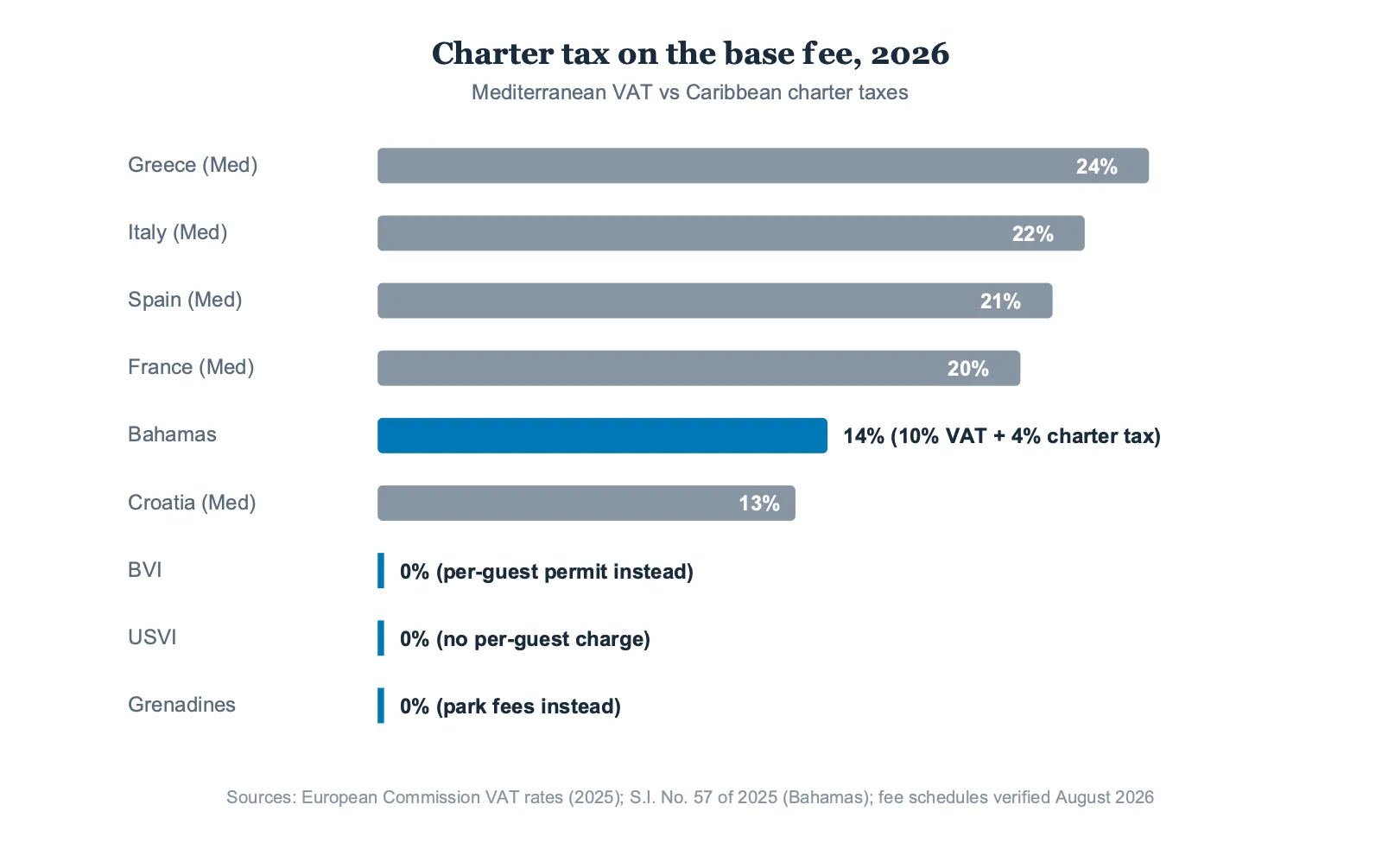
View data table
| Country / Region | Charter tax on base fee |
|---|---|
| Greece (Med) | up to 24% VAT |
| Italy (Med) | 22% VAT |
| Spain (Med) | 21% VAT |
| France (Med) | 20% VAT |
| Bahamas (Caribbean) | 14% total: 10% VAT + 4% charter tax |
| Croatia (Med) | 13% VAT |
| BVI (Caribbean) | 0% VAT; per-guest cruising permit instead |
| USVI (Caribbean) | 0%; no per-guest charge |
| Grenadines (Caribbean) | 0% VAT; marine-park fees instead |
Which Caribbean island is best for yachting?
The British Virgin Islands is the best Caribbean destination for yachting, and it isn’t especially close: 237 of the 272 bookable high-season catamaran listings cover the BVI (verified August 2026). Inside the protected Sir Francis Drake Channel, dozens of islands sit one-to-two-hour hops apart, with mooring balls almost everywhere you go.
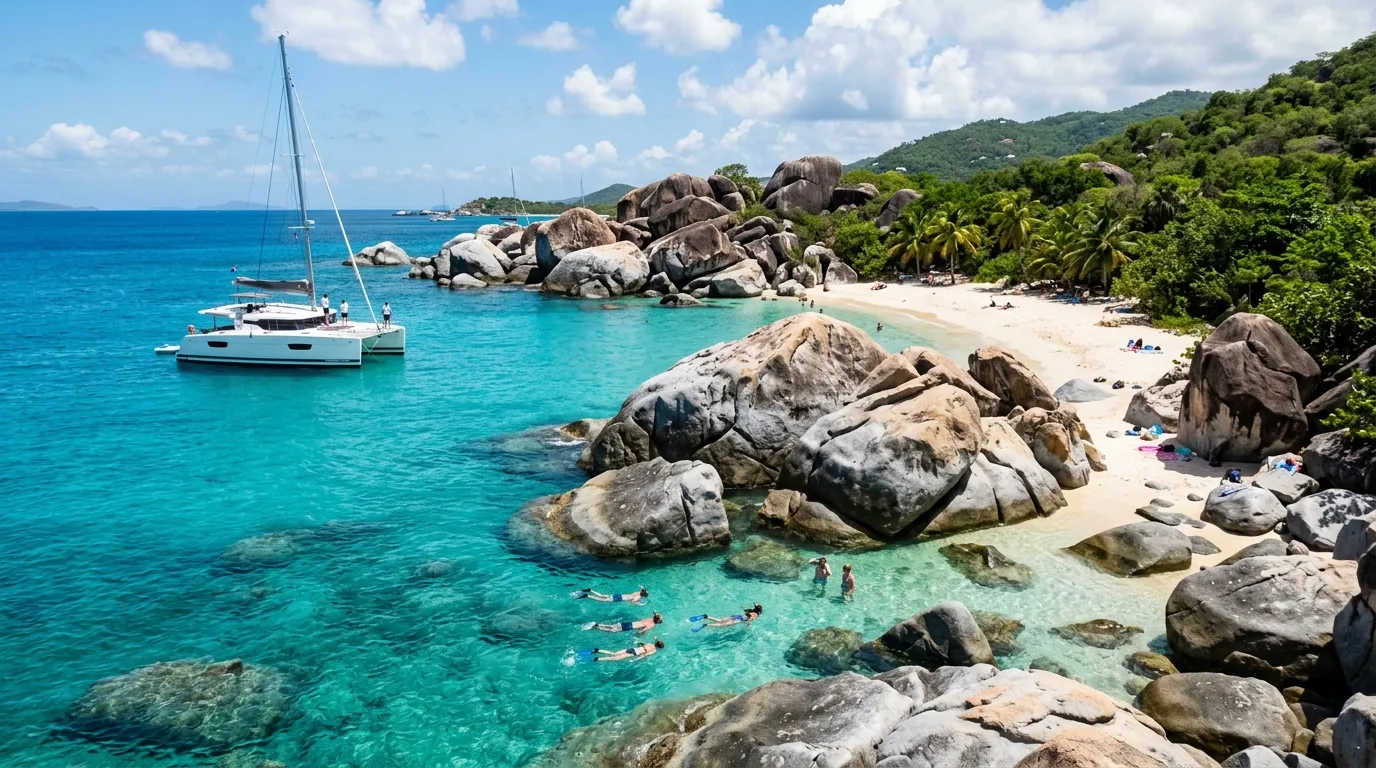
Why the BVI wins for most charterers:
- Calm, protected water. The channel blocks the open-Atlantic swell, so even nervous sailors and kids stay comfortable.
- Short passages. Most legs are under two hours. You spend the day swimming, snorkeling, and at beach bars, not crossing open water.
- Fleet depth. The densest concentration of crewed catamarans in the Caribbean means more choice and better last-minute availability.
- Iconic anchorages. The Baths at Virgin Gorda, the Bight at Norman Island, Anegada’s lobster, and the Soggy Dollar at White Bay are all a short sail apart.
If you’re weighing the islands against each other, our BVI crewed yacht charter guide covers itineraries and fleet in depth, and our BVI, Bahamas, and St. Martin comparison lines up the trade-offs. The runners-up each have a case: the Grenadines for the lowest base rates and seclusion, the Bahamas for shallow-draft cruising and proximity to the US.
Ready to see what these numbers get you? Search crewed Caribbean yachts by island and group size; every result is a live, fully crewed charter you can request a quote on.
How do crewed and bareboat charter costs compare?
A crewed all-inclusive catamaran lists at a $31,500 median per week, while a comparable 4-cabin bareboat catamaran in the BVI advertises around $10,000 in high season before provisioning, fuel, mooring and the damage waiver add roughly 25 to 50 percent (Vital Charters listings analysis and its 2026 bareboat comparison). The two quotes aren’t the same product, so compare landed costs.
| Bareboat 4-cabin catamaran (BVI) | Crewed all-inclusive catamaran | |
|---|---|---|
| Advertised weekly rate | ~$5,700 low season, ~$10,000 high season | $31,500 median, high season (n=272) |
| You still add | Provisioning ($50-75 per person per day), fuel, mooring balls, damage waiver, a skipper if you hire one | 15-20% crew gratuity plus island taxes and fees |
| Worked example, landed | $8,000 shoulder-season base became $12,033 loaded | The quoted rate plus gratuity is the trip cost |
| Who runs the boat | You do: sailing, cooking, navigation | A professional captain and chef (crew of 2-3) |
Compare like for like, though: against a comparable-size entry-level crewed all-inclusive catamaran (Morning Star lists at $20,500 to $21,000 per week), a loaded bareboat week still lands roughly 30 to 44 percent cheaper, and for experienced sailors that’s a real saving. What it can’t buy is the chef, the local knowledge, or the week off from responsibility. Our all-inclusive vs bareboat pricing comparison runs the full arithmetic line by line.
Are there all-inclusive yacht charters in the Caribbean?
Yes, and they’re the norm, not the exception: 817 of the 1,473 currently bookable rate listings (55.5 percent, verified August 2026) are all-inclusive. Most sit on the CYBA contract, where the advertised weekly rate already covers the crew, all meals, a standard bar, fuel, and use of the water toys.
You state your provisioning preferences before the trip, show up, and the quoted number is very close to the number you pay.
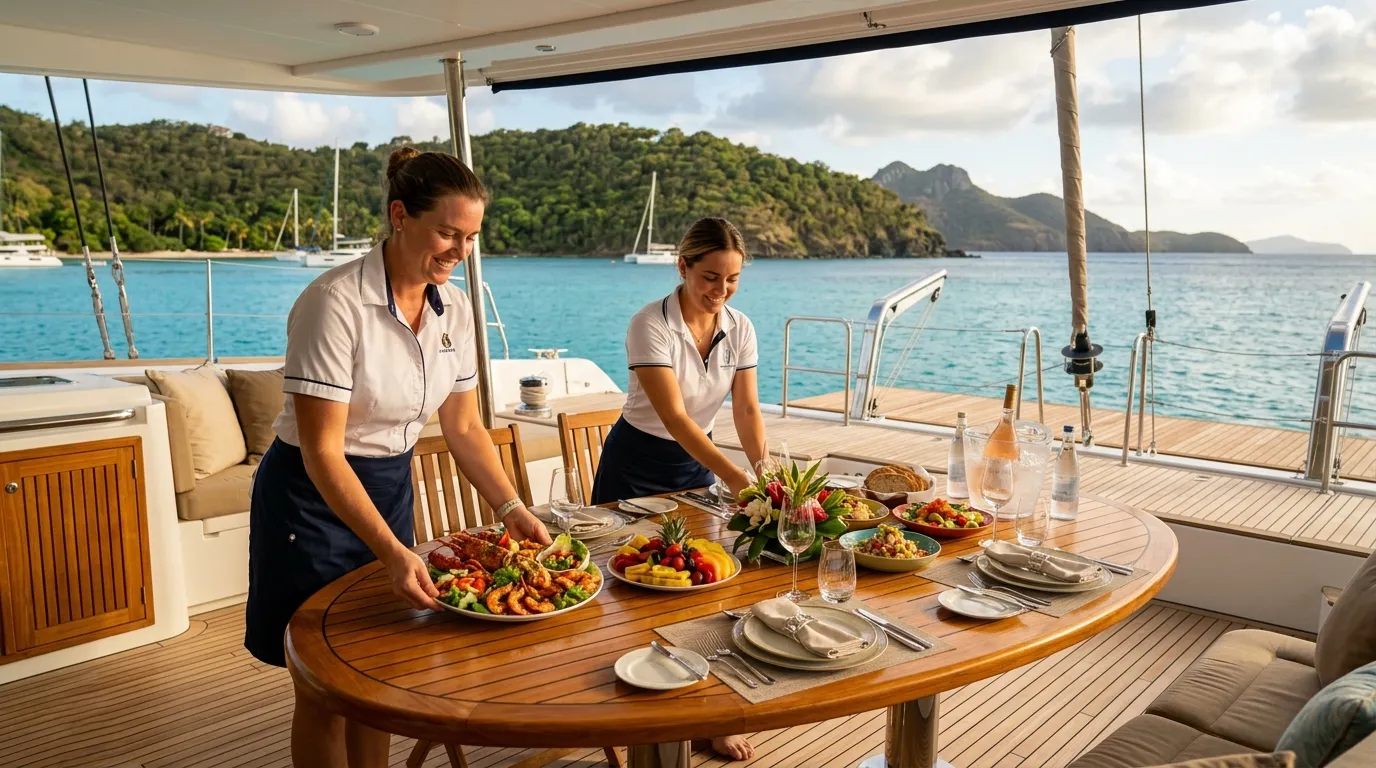
The two pricing worlds you’ll encounter:
- All-inclusive (CYBA): The rate is the rate. Crew, food, bar, fuel and toys are baked in; you add gratuity and any off-menu requests. Measured across Vital Charters’ current listings, all but about 2 percent of all-inclusive rates carry no mandatory APA at all, and the few exceptions state around 5 percent. This is how most Caribbean catamarans under roughly 80 feet are sold.
- Plus-expenses (MYBA-style): Common on larger motor yachts and superyachts. You pay the base fee, then pre-fund an APA, typically 30 to 35 percent of the base, that covers fuel, provisioning, dockage and park and permit fees (every additional fee except a government tax), reconciled at the end of the week with the unspent balance refunded. See our explainers on APA and how much to budget and what’s actually included in a charter fee.
What does a week-long Caribbean yacht charter cost?
A week-long crewed Caribbean charter lists between roughly $20,500 and $95,000 for the catamarans and motor yachts most families book, and the price climbs steadily with length, age, and luxury level. Below are current examples from the fleet Vital Charters brokers, at each tier: actual yachts you can charter, with their published 2026-27 rates, rather than industry averages.
Entry & value tier ($20K-$36K/week):
- Morning Star: a 2023 Dufour 48 catamaran sleeping 8 in 4 cabins with a captain and chef. All-inclusive at $20,500-$21,000/week. About as affordable as a nearly new, fully crewed Caribbean catamaran gets.
- Valinor: a 2026 Bali 5.2 sailing catamaran, 52 feet, sleeping 10 across 5 cabins. All-inclusive at $32,000/week, strong value for a larger group.
Mid tier ($38K-$60K/week):
- Solaire: a 2026 Two Oceans 58 power catamaran for 6 guests. All-inclusive at $38,000-$42,000/week.
- Nehalennia: a Fountaine Pajot Samana 59 sailing catamaran sleeping 10 in 5 cabins. All-inclusive at $46,000/week.
- Gyrfalcon: a 2019 Sunreef 60 sailing catamaran, 10 guests, 3 crew. All-inclusive at $53,000-$55,000/week.
Premium tier ($60K-$95K/week):
- Six Seven: a 2025 Azimut 80 motor yacht for 10 guests. $60,000/week plus expenses, roughly $81,000 with its APA folded in.
- Time Off: a 2022 Pershing 78 motor yacht, 8 guests. $70,000/week plus expenses, roughly $87,500 with its APA folded in.
- Odyssey: a 2022 Lagoon 77 sailing catamaran with 5 crew. All-inclusive at $84,000/week.
Plus-expenses totals fold in each yacht’s own advance provisioning allowance, stated in its listing where the yacht publishes one and taken at the regional norm otherwise, so the multiplier varies by boat. Unspent APA is refunded at the end of the charter.
A useful rule from these numbers: an all-inclusive catamaran almost always delivers more boat and more included value per dollar than a similarly priced plus-expenses motor yacht, once you add the APA back in. Sailing cats also burn far less fuel, which keeps the all-in figure lower. For the per-day math behind these weekly rates, see our yacht charter cost per day breakdown, and for catamaran-specific tiers, luxury catamaran charter price tiers.
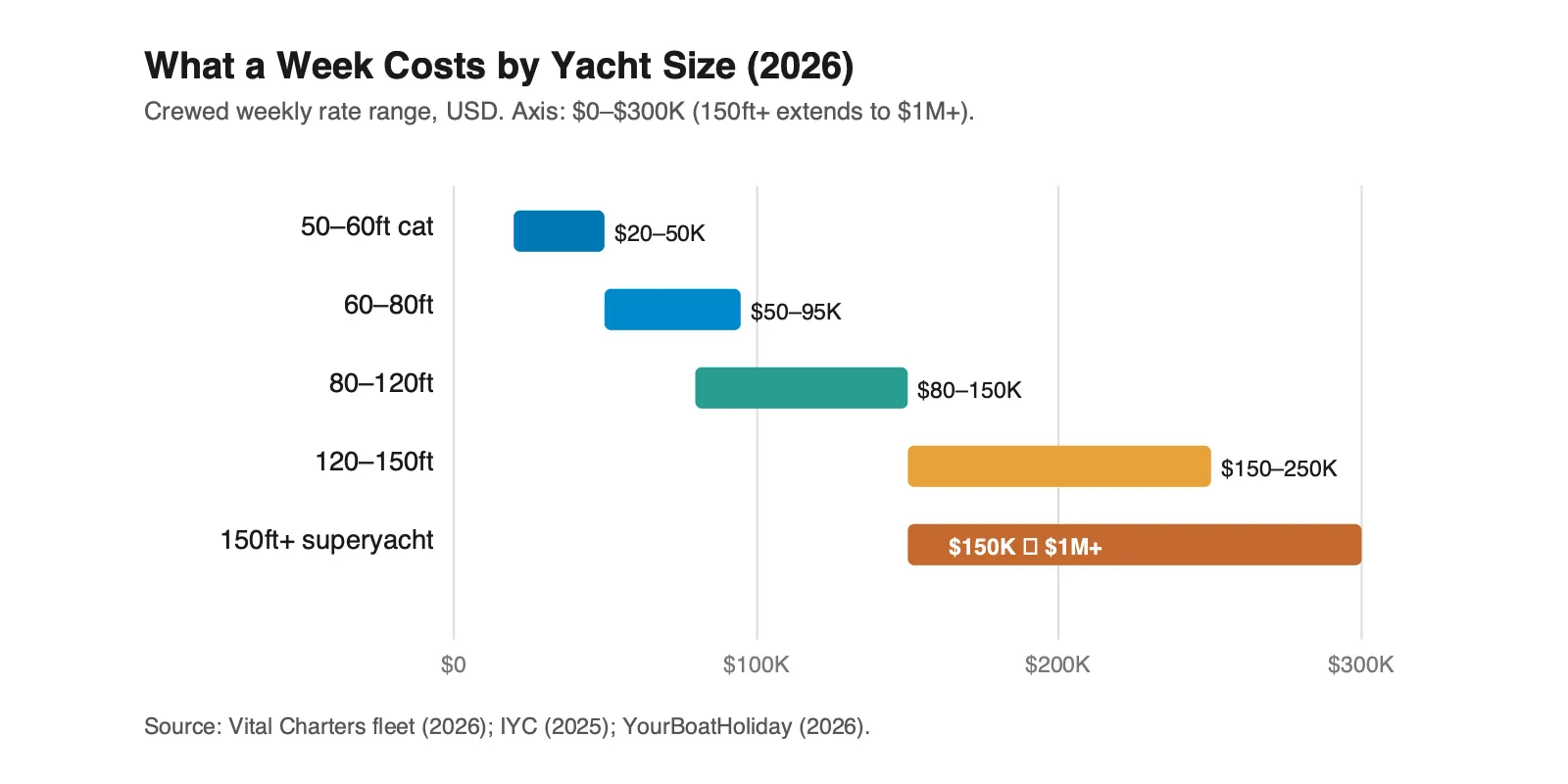
View data table
| Yacht size | Typical weekly rate (2026) |
|---|---|
| 50-60ft catamaran | $20,000-$50,000 |
| 60-80ft catamaran / motor yacht | $50,000-$95,000 |
| 80-120ft motor yacht | $80,000-$150,000 |
| 120-150ft motor yacht | $150,000-$250,000 |
| 150ft+ superyacht | $150,000-$1,000,000+ |
The numbers the weekly rate doesn’t show
On an all-inclusive catamaran the weekly rate is most of the story, but no charter invoice ends there: budget a customary 15 to 20 percent crew gratuity everywhere and a charter tax of zero to 14 percent depending on the destination. The permits and marine-park fees you see quoted are real, but the all-inclusive rate covers them in the vast majority of cases (fee schedules verified by Vital Charters, August 2026). On plus-expenses boats, the APA comes on top too, and it absorbs those fees.
What lands on a Caribbean charter invoice in 2026
The island sets the amounts: 14 percent in Bahamas taxes, up to $16 per guest per day in BVI cruising fees, nothing per guest in the USVI. The contract sets who pays: all-inclusive rates cover permits, park fees and levies in the vast majority of cases; charter taxes and the 15 to 20 percent gratuity are always yours.
| Line item | Typical amount | Who sets it | Source |
|---|---|---|---|
| APA (Advance Provisioning Allowance) | None mandatory on all-inclusive catamarans (about 2 percent of rates state around 5 percent). Plus-expenses charters add an APA, typically 30 to 35 percent of the base rate, intended to cover every running fee except government taxes, refunded where unspent | The charter contract; mechanics per MYBA | MYBA, Information for Charter Yacht Captains and Crew |
| Government charter taxes | 0 to 14 percent of the charter fee by destination; the Bahamas is highest at 10 percent VAT plus a 4 percent charter tax (per-destination figures in the destination blocks) | Each territory’s government | S.I. No. 57 of 2025 (Bahamas example) |
| Marine park fees | Where you cruise them: EC$15 per guest per day at the Tobago Cays, $12.73 per extra guest per day in the Exuma park, $3 at the BVI’s Baths | TCMP; Bahamas National Trust; BVI National Parks Trust | TCMP fee schedule, effective January 1, 2023 |
| Crew gratuity | Customarily 15 to 20 percent of the charter fee in the Caribbean crewed fleet, the band CYBA’s Inclusive Agreement (Clause 2.B) calls the customary rate; MYBA’s 2026 guidelines publish no percentage, and both leave it at your discretion | Custom, written into the CYBA form | CYBA Inclusive Agreement, Clause 2.B (2020) |
Fees verified September 2026.
Watching for the gap between an advertised base rate and the real all-in number is the most common first-timer mistake; our guide to hidden fees in yacht charters walks through every line, and the costs-explained pillar works three full invoices start to finish.
How much does it cost to charter a superyacht?
A 150-foot-plus superyacht charters in the Caribbean for roughly $150,000 to $500,000+ per week, and the largest, newest vessels exceed $1 million (Vital Charters listings analysis, winter 2026-27). At this tier you’re no longer renting a boat so much as a floating private estate with a hotel-grade crew, and the pricing is always plus-expenses with a substantial APA on top.
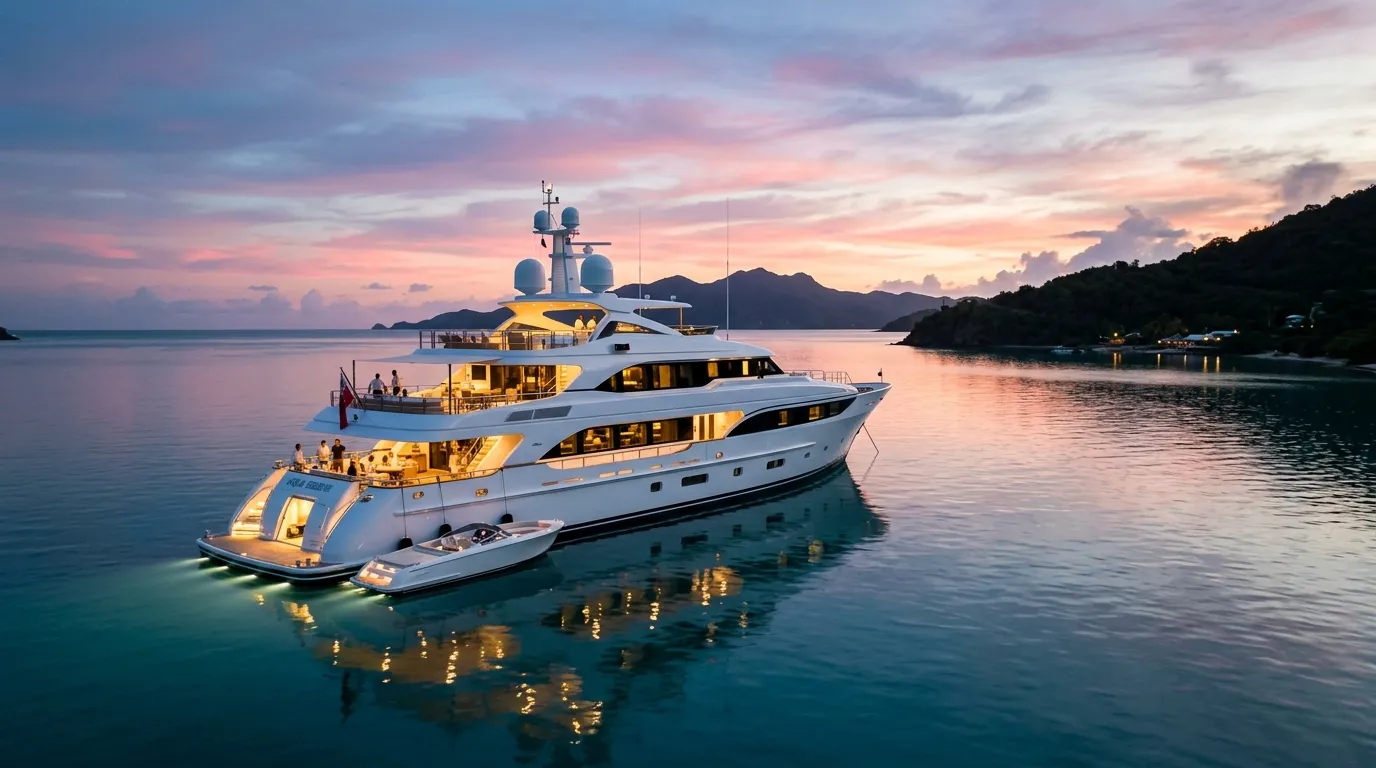
A real example from the same fleet shows what the entry to the true superyacht class looks like:
- Jubilee: a 151-foot (46m) Pendennis motor yacht sleeping 12 guests in 7 cabins, run by a professional crew of 10. Listed at roughly $194,000-$227,000/week depending on season, plus expenses; with its APA folded in, budget about $257,000-$300,000 before dockage and gratuity.
- Risk & Reward: a 120-foot Crescent motor yacht for 9 guests. Listed at $80,000-$95,000/week plus expenses (roughly $106,000-$126,000 with its APA folded in), a useful midpoint between a premium catamaran and a six-figure superyacht.
What the extra money buys at the 150ft+ tier: stabilizers that all but eliminate motion at anchor, a crew of eight to twelve, elevators and beach clubs on the largest boats, and a garage of tenders, jet skis, SeaBobs and dive gear. For how price scales with length across the whole range, see our data study on superyacht charter cost by size.
If a superyacht week is on your radar, the smartest first move is a conversation rather than a search: the best vessels at this level book privately, and the real all-in number depends heavily on itinerary and season. You can start a yacht search with our team and we’ll match the boat to the budget rather than the other way around.
Get your exact 2026 number
Every figure above is a listed rate you can check, and the fleet behind them is searchable. The step this page can’t do is match a specific yacht, crew and itinerary to your dates and your group, which is where a quote turns exact. Tell us your week, your headcount and the islands on your list, and we’ll send real yachts with current 2026-27 rates, taxes and fees included, so the number you budget is the number you pay.
Frequently Asked Questions
How much does it cost to charter a yacht in the Caribbean for a week?
The median is $31,500 per week for an all-inclusive crewed sailing catamaran in high season 2026-27, across 272 current listings among the 670 crewed yachts we track. The middle half of catamaran listings falls between $24,500 and $43,000; motor yachts list at a $118,800 median with the APA folded in.
What’s the cheapest way to charter a yacht in the Caribbean?
An entry-level crewed catamaran in a no-VAT destination: a nearly new 48-foot boat like Morning Star lists at $20,500-$21,000 all-inclusive. Don’t chase a seasonal discount, though. Winter and summer list under 2 percent apart at the median; the only weeks that really cost more are Christmas and New Year, at a median 14 percent premium.
Is a Caribbean charter cheaper than the Mediterranean?
Generally, yes. Most Caribbean destinations charge no VAT, while the Mediterranean adds 13 to 24 percent to the base fee (European Commission, 2025). Combined with a deep, modern catamaran fleet and all-inclusive pricing, the same money usually buys more boat and a more predictable bill in the Caribbean.
Are Caribbean yacht charters really all-inclusive?
Most are: 55.5 percent of the current rate listings are all-inclusive, typically on the CYBA contract, with crew, meals, a standard bar, fuel and toys built into the quoted rate. You add a customary 15 to 20 percent gratuity and any charter tax; permits and park fees are inside the rate in the vast majority of cases. Larger motor yachts more often use the plus-expenses model with an APA.
How much does it cost to charter a 150-foot yacht?
A 150-foot superyacht in the Caribbean runs roughly $150,000 to $500,000+ per week plus expenses. For example, the 151-foot Pendennis motor yacht Jubilee lists at about $194,000-$227,000 per week by season; with the APA folded in, budget roughly $257,000-$300,000 before dockage and gratuity.
What’s not included in the charter price?
On all-inclusive boats, the main add-ons are the customary 15 to 20 percent crew gratuity, a charter tax of zero to 14 percent by destination, and anything you do ashore; permits and marine-park fees are covered by the rate in the vast majority of cases. On plus-expenses boats, you also pre-fund an APA of typically 30 to 35 percent of the base rate, which absorbs those fees and is refunded where unspent.
Your charter cost, quoted exactly
Tell us your dates, group and islands, and we’ll send real yachts with current 2026-27 rates, taxes and fees included.