
What’s Included in a Yacht Charter Fee: MYBA vs CYBA Terms
A yacht charter fee covers different things on CYBA all-inclusive terms than on MYBA plus expenses. See both contracts, the APA, and the 70-foot fleet split.
Last Updated: October 20, 2026 | Originally Published: March 3, 2026
A yacht charter fee covers a different list of things depending on which of two contracts your yacht runs on, and the gap between those lists is worth about a third of what you finally pay. One contract puts your dinner, your fuel and your mooring inside the advertised rate. The other puts the yacht and her crew inside the rate and bills you at cost for the rest. Neither is hiding anything. They’re simply two different ways of selling the same week, and the proposals look almost identical until you read the line above the price.
This page sets the two side by side using the associations’ own published contracts, then answers the question those documents can’t: which one you’ll actually be offered. That last part comes from the 635 yachts with a current Caribbean or Bahamas rate that we track, and the answer turns out to have almost nothing to do with where you sail. It isn’t the island. It’s the boat.
What’s included in a yacht charter fee? Two contracts, two answers
Every crewed charter in the Caribbean and Bahamas is written on one of two contract families, and the difference is a single line on the rate sheet: “inclusive” or “plus expenses.” On inclusive terms one number buys the week. On plus-expenses terms the advertised number is a hire fee and a second pot of money, the Advance Provisioning Allowance, pays for everything consumed on board.
Here is what each family puts inside the rate, drawn from the contracts themselves rather than from anyone’s marketing.
| Association | The rate covers | You pay separately | Where you meet it |
|---|---|---|---|
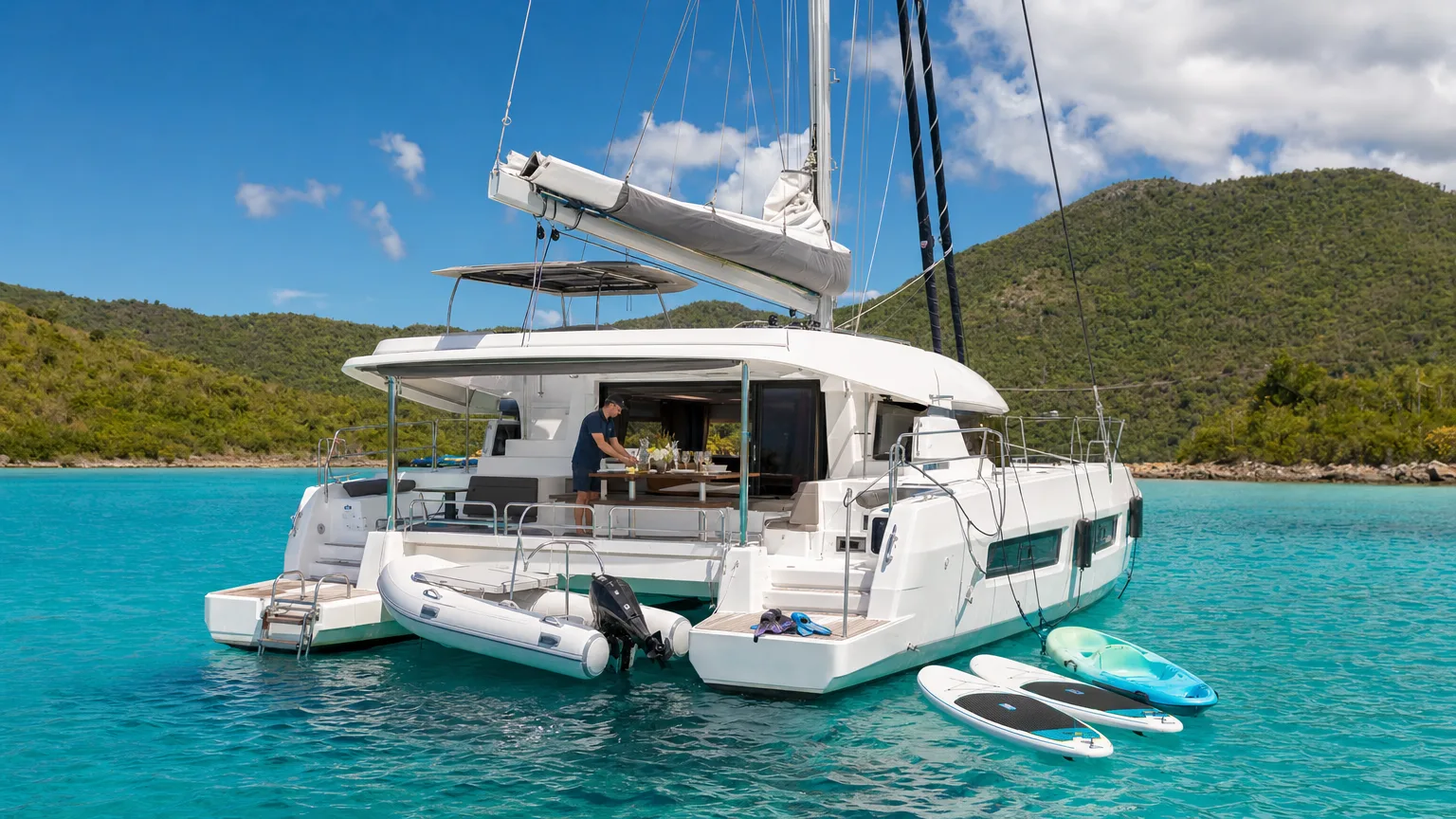
| CYBA Charter Yacht Brokers Association International Inclusive Charter Agreement | Yacht, licensed crew, all meals, standard ship’s bar, fuel, cruising taxes and permits, clearance taxes, mooring fees, onboard leisure and sports equipment | Crew gratuity 15 to 20 percent, scuba diving, premium beverages and fine wines, off-yacht excursions, dockage you request, fishing licences, communications, airport transfers | Caribbean catamarans under 70 feet. 291 of the 337 all-inclusive yachts sail the Caribbean only, most of them in the British Virgin Islands. |
| MYBA MYBA The Worldwide Yachting Association MYBA Charter Agreement | Yacht and equipment, tools, stores, cleaning materials, basic consumables, laundry of ship’s linen, crew wages, uniforms and food, vessel and crew insurance | Fuel for engines, generators, tenders and toys; your food and all beverages; berthing dues and harbour charges; local taxes; customs formalities; personal laundry; communications and internet. All at cost, via the APA | Motor yachts over 70 feet, and most of the Bahamas fleet. 161 of the 294 plus-expenses yachts are Bahamas only. |
| AYCA American Yacht Charter Association AYCA Uninspected Contract | Vessel in complete working order, seaworthy and clean, tanks filled, all Coast Guard and flag-state safety equipment, basic ship’s laundry | All fuel, harbour pilot and diver’s fees, customs formalities, water, electricity, local taxes; food, beverages, dockage, personal laundry and transport are charterer’s expenses | US-flagged yachts working US waters and the Virgin Islands |
| IYBA International Yacht Brokers Association | Publishes no charter agreement. Its own magazine directs members to the MYBA form. | Nowhere, as a contract. One rate sheet in 631 classified sheets names it. | |
Sources: CYBA Inclusive Charter Agreement, version 2020-03, Clause 2; MYBA Charter Agreement, revised 2009, Clause 8; Captains Guidelines for the AYCA Contracts 2026; IYBA. Listing counts from Vital Charters’ listings analysis, September 5, 2026.
Which contract will you be on? The fleet flips at 70 feet
Of the 635 yachts we track with a current 2026 to 2027 Caribbean or Bahamas rate, 631 state their terms plainly enough to classify: 337 sell on all-inclusive terms and 294 on plus expenses, a near-even split. The remaining four quote both. That headline number is useless for planning, though, because the split isn’t random. It tracks the size of the boat almost perfectly, on the same fleet behind our Caribbean charter cost analysis.
Under 60 feet, seven yachts in eight are all-inclusive. At 100 feet and over, 122 of 126 are plus expenses. The crossover sits at 70 feet, and it is abrupt: the 60 to 69 foot band is 69 percent all-inclusive and the very next band, 70 to 79 feet, is 29 percent.
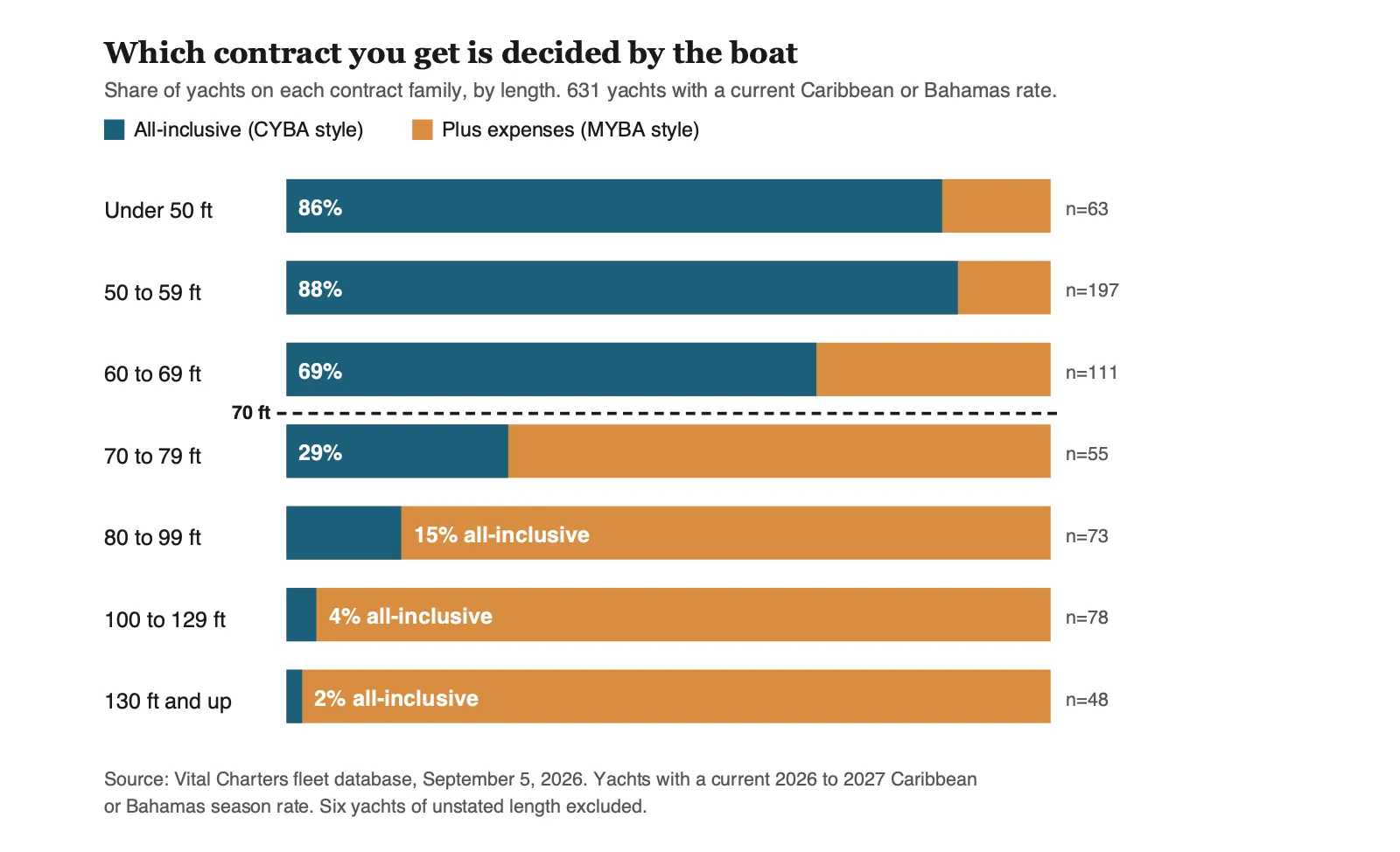
View data table
| Yacht length | All-inclusive | Plus expenses | Share all-inclusive |
|---|---|---|---|
| Under 50 ft | 54 | 9 | 86% |
| 50 to 59 ft | 173 | 24 | 88% |
| 60 to 69 ft | 77 | 34 | 69% |
| 70 to 79 ft | 16 | 39 | 29% |
| 80 to 99 ft | 11 | 62 | 15% |
| 100 to 129 ft | 3 | 75 | 4% |
| 130 ft and up | 1 | 47 | 2% |
Vital Charters listings analysis, September 5, 2026. The 631 yachts whose terms we can classify; the 625 with a stated length are charted, and six of unstated length are excluded.
The vessel type says the same thing more bluntly. Of the 337 all-inclusive yachts, 319 are catamarans with a median length of 55 feet and a median low-season week of $32,000. Of the 294 plus-expenses yachts, 219 are motor yachts with a median length of 100 feet and a median low-season week of $65,000. A 55-foot crewed catamaran and a 100-foot motor yacht are not really competing for the same booking, which is why the two contract styles coexist without either winning.
There is a destination pattern too, and it is worth understanding because it is easy to misread. Among the Caribbean-only yachts, 291 are all-inclusive against 73 plus expenses. Among Bahamas-only yachts it inverts: 161 plus expenses against 38 all-inclusive. That looks like a local custom, and it isn’t one. The Bahamas plus-expenses fleet is 149 motor yachts at a median 95 feet, most of them working down from Florida; the Caribbean inclusive fleet is 280 catamarans at a median 55 feet. Different boats, not different rules. The islands aren’t setting the terms; the fleets are. Compare the underlying rates in our breakdown of charter costs by destination.
What does a CYBA all-inclusive rate cover? Meals, bar, fuel and toys
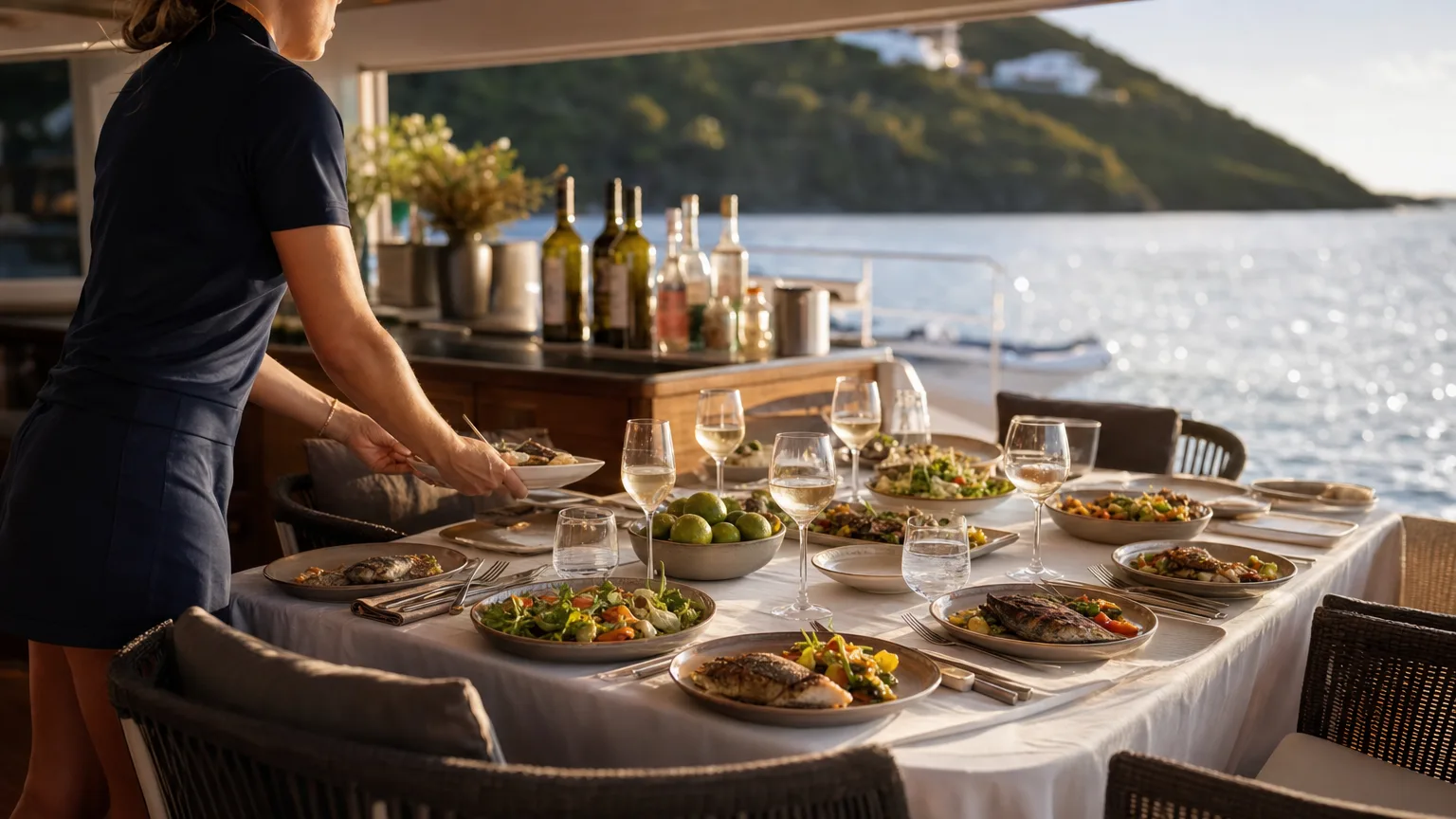
One number buys the week on CYBA terms, and the meals, the bar, the fuel, the moorings and the cruising permits are all inside it. The Charter Yacht Brokers Association International, founded in 1982, publishes the contract that prices most Caribbean crewed catamarans. Its Inclusive Charter Agreement states in Clause 2.A that, unless the Special Conditions say otherwise, the Total Charter Fee “includes the hiring of the Yacht, the services of a fully licensed Crew, all meals, standard ship’s bar, fuel, cruising taxes and permits, clearance taxes, mooring fees and all expenses related to running of the Yacht and use of on-board leisure and sports equipment.”
Read that list slowly, because it’s doing more work than it looks like it’s doing. Fuel is in the rate, so a longer cruising day costs you nothing. Cruising permits and clearance taxes are in the rate, so the government paperwork between islands is already paid. Mooring fees are in the rate. The paddleboards, the kayaks and the snorkel gear are in the rate. On this contract there’s no running tab at all, and nothing to reconcile at the end of the week.
The exclusions are equally specific, and carry the same Special Conditions caveat. Clause 2.B lists what the fee does not cover: “suggested Crew gratuities (discretionary) at customary rate of 15-20% of Charter Fee, at guest discretion; scuba diving and equipment; premium beverages and fine wines; excessive alcohol requests and/or consumption; off Yacht excursions; dockage as requested by the CHARTERER; fishing licenses (if required); communications; airport transfers; or similar expenses incurred by the CHARTERER.” Clause 2.C adds that anything on that list is settled “in cash, or upon other agreed means, prior to disembarking the Yacht.”
Nine items, and only three of them are likely to appear on your final statement: the gratuity, scuba if you dive, and premium wine if you ask for it. The rest are things you either won’t want or won’t do. We walk through each one and what it typically costs in our guide to hidden fees on yacht charters, and the full picture of what an all-inclusive week does and does not buy is in all-inclusive yacht charter explained.
One clarification worth making, because the association’s name misleads people constantly. CYBA is the Charter Yacht Brokers Association International, not a Caribbean body, though the 2020 agreement itself is issued in the shorter form, Charter Yacht Brokers Association, Inc. It was founded in Florida and its own materials say its “reach crosses international waters.” Its form dominates Caribbean catamaran chartering because that is the market that adopted it, not because it was written for the region. The association also notes that its agreement “may be adapted for Non-Inclusive/Plus Expenses charters and be used for charters anywhere in the world,” so the CYBA form and inclusive terms are not the same thing, even though they usually travel together.
What does a MYBA charter fee cover? The yacht and crew, then the APA
A MYBA charter fee buys the yacht and the people who run her, and nothing you consume. MYBA The Worldwide Yachting Association, founded in 1984 and known until recently as the Mediterranean Yacht Brokers Association, publishes the contract that prices most larger motor yachts, and its Clause 8, headed Operating Costs, draws the line in one sentence: the Charter Fee “includes the charter of the Vessel with all its equipment in working order; tools; stores; cleaning materials and basic consumable stores for engine room, deck, galley and cabins; laundry of ship’s linen; the crew’s wages, uniforms and food; the insurance of the Vessel and crew as per Clause 16.”
Then the other half: “The CHARTERER will pay, at cost, for all other expenses. These include, but are not limited to, shoreside transport; fuel for the main engines and generators; fuel for tenders and water sports equipment; food and all beverages for the Charter Party; berthing dues and other harbour charges including pilots’ fees, local taxes, divers’ fees, customs formalities and any charges for waste disposal, charges for water and electricity taken from shore; ships’ agents’ fees where applicable; personal laundry; Charter Party communications and internet use; and hire or purchase costs of any special equipment placed on board at the CHARTERER’s request.”
Note what that means in practice. Your crew’s food is included. Yours isn’t. The ship’s linen is laundered free; your shirts aren’t. The yacht’s insurance is covered; the fuel you burn getting to the next island isn’t.
How much is the APA, and what does it pay for?
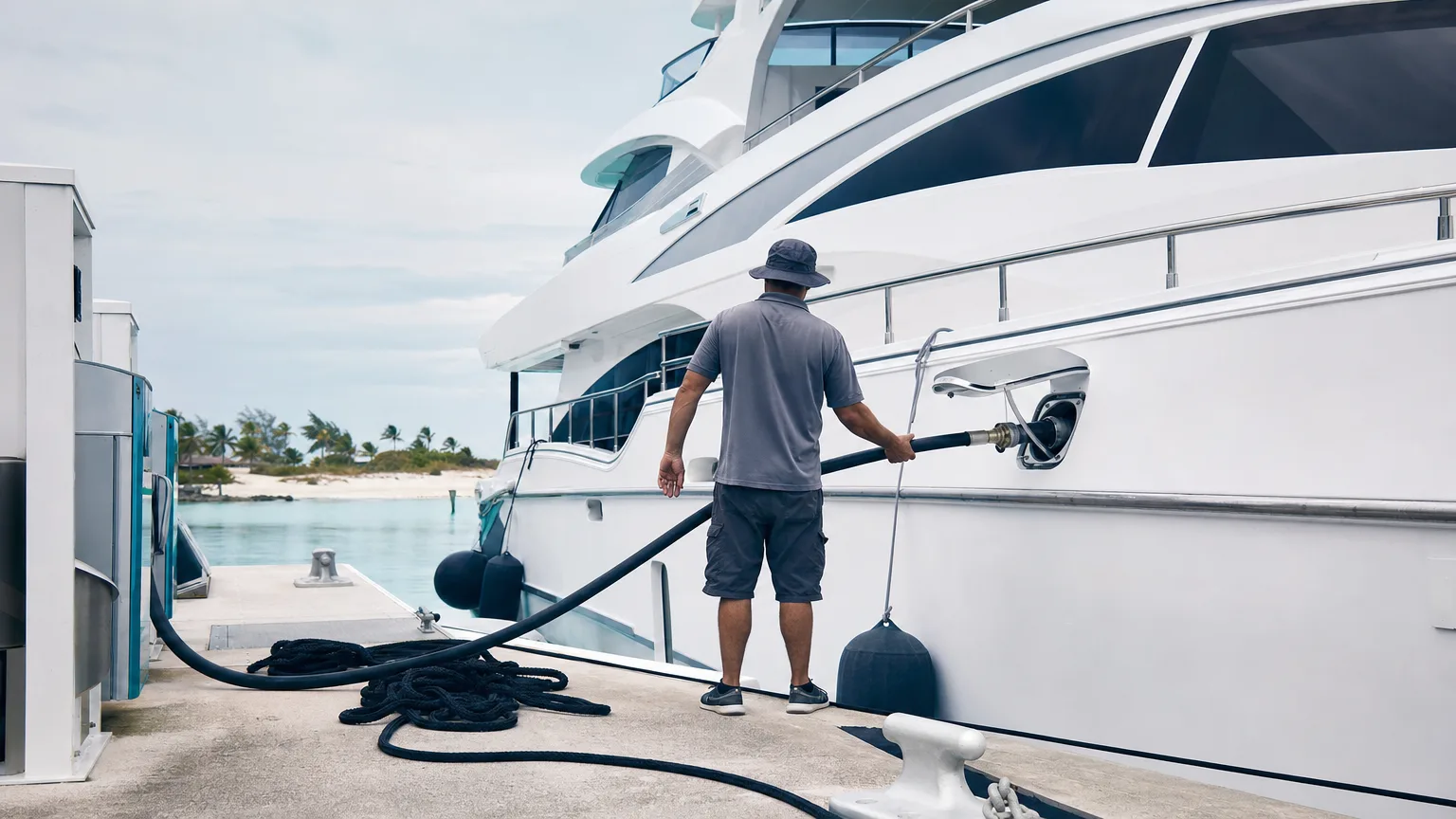
That “at cost” list is what the APA pays for. Of the 294 plus-expenses yachts, 102 state an APA percentage as of September 2026, and the median is 35 percent of the base fee. The distribution is tight: 51 of those yachts quote exactly 35 percent, 29 quote 30 percent, and 11 quote 25 percent. On a $65,000 week that is roughly $22,750 of provisioning money handed over before you board. The mechanics, and how much of it typically comes back, are covered in detail in our explainer on what APA means and how much to budget.
The APA is a deposit, not a fee. Clause 8 requires the captain to keep you informed “at intervals, as to the disbursement of the APA,” and at the end: “Prior to disembarkation at the end of the Charter Period, the Captain shall present to the CHARTERER a detailed account of expenditure, with as many supporting receipts as possible, and the CHARTERER shall pay to the Captain the balance of the expenses or the Captain shall repay to the CHARTERER any balance overpaid, as the case may be.” Money you don’t spend comes back to you.
The MYBA contract you can read is not the one MYBA endorses
This is worth knowing before you go looking for the document, because you won’t find what you expect. The only MYBA Charter Agreement available to the public is the six-page version marked “Revised 2009,” which MYBA still hosts on its own site. But MYBA’s own guidance to brokers, published in January 2019, says plainly: “The only valid MYBA Charter Agreement is now the 2017 version. Any previous version of the MYBA Charter Agreement is no longer endorsed by MYBA.”
So the association simultaneously publishes a specimen it has disavowed and withholds the version it endorses, which is distributed only through its paid contract service. A further revision landed in 2025, described in the trade press as the contract’s most sweeping transformation since its inception, adding know-your-customer and beneficial-ownership requirements and extending force majeure to cyber and geopolitical events. The operating-costs split quoted above has been stable across every version we have seen, but if you want to read your actual contract, ask your broker for the executed form rather than downloading the public one. The public one isn’t it.
Six hours a day, and what that means for your itinerary
One MYBA clause changes the shape of a holiday and almost never gets mentioned. Clause 4(a) requires the charterer to “restrict time under way to an average of six (6) hours per day, unless the Captain, at his sole discretion, agrees to exceed this time.” It’s an average across the week rather than a daily cap, so a long delivery day is fine if the surrounding days are short. Still, an itinerary that assumes eight-hour hops every day is outside the standard terms, and the captain has to agree to it. All-inclusive contracts carry no equivalent limit, which is one quiet reason island-hopping itineraries suit the catamaran fleet.
AYCA terms: the American form MYBA’s own contract names
AYCA splits the bill the way MYBA does, and prices two things nobody else puts in writing. Look at the bottom of the MYBA agreement and you’ll find the line “Produced by MYBA and adopted by the American Yacht Charter Association.” AYCA, founded in 1986, is an invitation-based body of North American charter brokers, and it publishes its own contracts and, unusually, a public 2026 guidelines document that spells out fee inclusions in ordinary English.
AYCA’s split resembles MYBA’s with an American accent. The Charter Fee includes “the Vessel in complete working order, seaworthy, clean, in good condition throughout, with tanks filled and ready for service,” plus all Coast Guard and flag-state safety equipment. It does not include operating costs: the charterer pays at cost for “all fuel for the Vessel, its tenders and all watersports equipment; harbor pilot and diver’s fees; customs formalities, water, electricity and national and or local taxes as applicable,” with food, beverages, dockage, personal laundry and transport also to the charterer’s account.
Three details in that document are more useful than anything else published on the subject. AYCA defines the APA as covering onboard costs only and explicitly “not intended to cover expenses of the Charter Party ashore; such as shore-side tours, meals, entertainment.” It states that basic ship’s laundry, “including sheets, towels, table linens, and uniforms,” is inside the fee while personal laundry is not. And on one of its two contracts it prices crew food, which is normally invisible: “Customary invoicing for crew food and beverage is averaged at $20-$25 per day, per crew member and deducted from the A.P.A.”
That last line is the single clearest statement anywhere of a cost most guests never see itemized. On a yacht with four crew across a seven-day charter it is $560 to $700 of your APA, and it explains a chunk of the gap between what guests expect to spend on food and what the final accounting shows.
IYBA and VIPCA: a member-only charter form, and none at all
Two names come up often enough in charter searches to be worth answering directly, and the honest answer for both is the same: neither publishes a charter agreement.
The International Yacht Brokers Association, known as the Florida Yacht Brokers Association until it renamed in November 2016, is the largest of these bodies with over 2,000 individual members representing more than 900 businesses. It publishes listing agreements and purchase-and-sale forms through its own forms platform, and it added bareboat and time charter forms of its own in 2022. It does not publish those publicly, so you cannot read one before a broker hands it to you. What it does publish is more interesting: its own magazine ran a piece by a maritime attorney telling members that “many charter brokers and managers in the U.S. use the MYBA Charter Agreement as a go-to form for charters,” while warning that “the document was developed in Europe, thus making it best suited for use with charters taking place in European waters.”
That article makes a point worth carrying into any large-yacht booking. The MYBA form’s dispute-resolution clause specifies English law and arbitration in London, which for an American chartering in the Caribbean “means that if a dispute arises, the client must travel to London at least once, if not multiple times, to engage in arbitration,” and must hire an English lawyer. The attorney’s recommendation is to modify that provision in the special conditions. The form itself, she notes, “is not meant to be modified, except for page one where the parties fill in the specifics of the charter and page two where the parties can fill in special conditions.” If you are signing a MYBA contract for a Caribbean charter, that is the clause to ask your broker about, and our walkthrough of a charter contract covers where it sits.
The Virgin Islands Professional Charter Association, founded in 2017 with over 600 members, is a US Virgin Islands trade body rather than a contract publisher. It works on licensing, crew certification and marine infrastructure, and it publishes nothing about charter fees, APA or gratuities. Its one guest-facing programme is a set of overnight moorings off St Thomas sized for smaller boats, so a larger crewed yacht anchors off instead and brings you ashore by tender. Neither association’s name appearing on a broker’s website tells you anything about what your rate includes.
What is a delivery fee on a yacht charter?
A delivery fee is what a yacht charges to move itself from where it is based to where you want to start or finish, and it is a named line on the MYBA agreement’s first page, printed under the Charter Fee and the APA as “Delivery/Re-delivery Fees.” It is not part of the APA and not part of the charter fee. It is its own number, agreed before you sign.
The confusing part is that the two contract families call it different things. Plus-expenses rate sheets say “delivery”: 56 of the 294 plus-expenses yachts use that word against 13 of 337 all-inclusive ones. All-inclusive sheets say “relocation”: 100 of the 337 use it against 26 of the 294, with one more on a sheet quoting both. Same charge, two vocabularies, and searching a rate sheet for the wrong one will make you think there’s no fee.
Across the whole fleet, as of September 2026, 177 of 635 yachts mention a move fee in some form. Of the 127 that use the word relocation, 40 print an actual figure next to it, and among those the median lowest quoted fee is $1,750, with the middle half falling between $1,000 and $3,000. Real examples from current sheets show how location-specific it gets: $1,000 for a US Virgin Islands pick-up and drop-off; $1,500 from St Vincent and the Grenadines to St Lucia or Grenada; $2,000 from the BVI to St Martin or St Barths, with another $1,000 to add Anguilla; $5,000 for St Martin, St Barts or Anguilla. In the Bahamas the corridors are priced like a timetable: Nassau to Norman’s Cay $1,500 one way or $2,500 return, Nassau to Staniel Cay $2,500 one way or $4,500 return.
The good news is that this is the most avoidable charge on any charter, because it’s usually waived by default. The waiver language is explicit on the sheets that carry it: “Pick-ups in Nassau with no delivery for 3 nights or more,” and “No delivery fees for charters starting and ending in the Bahamas at full rate.” A third yacht charges $2,500 only “to all charters of less than seven days when the vessel is required to reposition.” The pattern is consistent. Start and end where the yacht already is, book the full week, pay the standard rate, and there’s normally nothing to pay.
Is there VAT on a Caribbean or Bahamas yacht charter?
Only the Bahamas charges VAT on a yacht charter in this region: 10 percent, collected together with a 4 percent charter tax. The Virgin Islands, the Grenadines and the French islands put no VAT on a charter fee, which is one reason a Mediterranean quote and a Caribbean quote cannot be compared line for line on tax. What most of these islands charge instead is a cruising permit or a park fee, and the amount depends on whose waters you are in that week rather than on the yacht’s price.
The Bahamas levies 14 percent on the charter fee: 10 percent VAT plus a 4 percent charter tax, paid together to the Port Department since January 1, 2026. The British Virgin Islands charges a cruising permit of $16 per guest per day on foreign-based yachts and $4 on BVI-based ones, plus a $10 arrival levy per guest. The US Virgin Islands charge no cruising permit and no per-guest charter tax at all. Every figure, with the act or statutory instrument it comes from, is set out in our Caribbean and Bahamas taxes, permits and fees registry.
Which contract you are on decides how you meet those numbers, not whether you pay them. Under CYBA all-inclusive terms, Clause 2.A puts cruising taxes and permits and clearance taxes inside the rate, so a BVI permit never reaches your invoice. Under MYBA plus-expenses terms, Clause 8 lists local taxes and customs formalities among the expenses the charterer pays at cost, so the identical permit comes out of your APA. The Bahamas 14 percent sits outside the rate on both.
How much should you tip the crew? Four associations, two figures
Not one of these contracts includes the crew gratuity in the charter fee, and every association says it is discretionary. What they do not agree on is whether to print a number at all.
| Association | Published guidance | Where it appears | Document date |
|---|---|---|---|
| MYBA | No percentage; the April 2018 edition’s 5 to 15 percent suggestion was removed | Guidelines for captains and crew | 2026 update |
| AYCA | 10 to 20 percent of the charter fee | Guidance to captains | 2026 |
| CYBA | 15 to 20 percent of the charter fee | Clause 2.B of the contract itself | Version 2020-03 |
| IYBA | Nothing published | Not applicable | Not applicable |
The published figures run from 10 percent to 20 percent, which on a $32,000 week is the difference between $3,200 and $6,400. MYBA used to sit lower still: its April 2018 guidance suggested 5 to 15 percent, a band written for large plus-expenses yachts where the fee is enormous and the crew is numerous, and its 2026 update removed the figure entirely. CYBA’s band was written for catamarans where the fee is smaller and the crew is two people who cooked every meal.
One structural difference outweighs the percentages. CYBA is the only one of the four that writes the number into the binding contract. AYCA’s figure sits in guidance issued to captains, which you’d never normally see, and MYBA’s guidance to crew now carries no figure at all. So on an all-inclusive Caribbean charter the customary range is a term of the agreement you sign, printed in the exclusions; on a MYBA charter it is a convention your broker is expected to explain. MYBA’s own 2019 broker guidance makes that duty explicit, telling retail brokers they “should inform the client about the usual extra costs including a crew gratuity and how the APA works.”
Our full treatment of the custom, including when and how to hand it over, is in how to tip yacht crew.
What does the same week cost on each contract?
Numbers make this concrete faster than clauses do. Below are the two median yachts from those listings, seven nights, priced through to what leaves your account. The catamaran is the median all-inclusive Caribbean boat at $32,000; the motor yacht is the median plus-expenses boat at $65,000.
| Line | 55 ft catamaran, all-inclusive (CYBA terms) | 100 ft motor yacht, plus expenses (MYBA terms) |
|---|---|---|
| Advertised weekly rate | $32,000 | $65,000 |
| Food, bar, fuel, moorings, permits | Included | Via APA |
| APA at 35 percent | None | $22,750 |
| Crew gratuity | $4,800 to $6,400 (15 to 20%) | $9,750 to $13,000 (15 to 20%) |
| Delivery or relocation | $0 to $2,000 | $0 to $5,000 |
| Typical landed cost | $36,800 to $40,400 | $97,500 to $105,750 |
| Advertised rate as a share of the total | About 83 percent | About 64 percent |
Rates are median listed asking rates from Vital Charters’ listings analysis, September 5, 2026. Gratuity at the Caribbean custom of 15 to 20 percent on both yachts, since MYBA’s 2026 guidelines publish no figure. The delivery rows use the quartile range of stated fees, $0 where the yacht is already on station. Government taxes are excluded here because they vary by destination; the Bahamas adds 14 percent and the BVI charges per guest per day. Every figure is set out in our Caribbean and Bahamas taxes, permits and fees registry.
The ratio at the bottom is the number to remember. On all-inclusive terms the advertised rate is about 83 percent of what you actually pay. On plus-expenses terms it is just under two thirds. That is why comparing two sticker prices across the contract line tells you almost nothing, and why our charter cost breakdowns always work from the landed number instead. If you want to see how the rate itself moves with size, our cost by yacht size comparison runs the same fleet through three price tiers.
Seven questions to ask before you sign
- Is this inclusive or plus expenses? Everything else follows from the answer. It’s written on the rate sheet, usually in small type.
- If it is plus expenses, what is the APA percentage, and what does it exclude? Thirty-five percent is the fleet norm. Ask specifically whether crew food is charged to it.
- Where is the yacht based, and is there a delivery or relocation fee to my start port? Ask before booking flights, not after.
- What gratuity does my paperwork mention? Fifteen to twenty percent is written into a CYBA form; MYBA’s 2026 guidelines print no figure, so on a MYBA charter ask what is customary for that yacht, and see how to tip yacht crew for the handover.
- Which contract version am I signing? If it is MYBA, ask for the executed form; the public specimen isn’t the one the association endorses.
- On a MYBA form, what does the dispute-resolution clause say? The standard answer is English law and London arbitration, and it can be varied in special conditions.
- What are the taxes at my destination, and are they inside the rate? CYBA terms include cruising and clearance taxes. A Bahamas charter tax is separate on either contract.
Our step-by-step booking guide sets out where each of these lands in the timeline, and the budget worksheet turns the answers into a number. If you would rather have those answered before you look at boats, send us the dates and the party size and we will come back with the contract type named on every option.
The bottom line
A yacht charter fee is not one thing, and the industry has never pretended otherwise. It’s two things wearing the same label. On the all-inclusive form that governs most Caribbean catamarans, the rate is close to the whole story: meals, bar, fuel, moorings and permits are in it, and the gratuity is the only large number left outside. On the plus-expenses form that governs most larger motor yachts, the rate buys the vessel and her crew and a separate deposit of about 35 percent buys everything you consume.
The practical consequence is that you can’t compare two charter quotes on price alone unless you already know they’re on the same terms, and most of the time they aren’t, because the contract follows the boat. Under 70 feet, expect all-inclusive, the model we unpack in all-inclusive versus bareboat pricing. Over 70 feet, expect an APA. Read the two words above the rate before you read the rate, and the rest of the paperwork won’t surprise you. When you are ready to compare real boats on real terms, start a yacht search at Vital Charters and every proposal will name its contract type on the first page.
Frequently Asked Questions
What is included in a yacht charter fee?
It depends on the contract. Under CYBA all-inclusive terms the fee includes the yacht, a licensed crew, all meals, the standard bar, fuel, cruising taxes and permits, clearance taxes, mooring fees and onboard watersports equipment. Under MYBA plus-expenses terms it includes only the yacht, its equipment and the crew’s wages, uniforms, food and insurance, with everything else billed at cost through the APA.
What is the difference between MYBA and CYBA contracts?
MYBA’s agreement separates a hire fee from an Advance Provisioning Allowance that pays for fuel, food, beverages, berthing and local taxes at cost. CYBA’s Inclusive Charter Agreement bundles those running costs into one rate with no APA and no end-of-week reconciliation. Across current listings, MYBA terms dominate yachts over 70 feet and CYBA terms dominate catamarans under 70 feet.
Does the charter fee include the crew gratuity?
No. Every association treats the gratuity as discretionary and outside the fee, but they publish different figures: CYBA writes 15 to 20 percent into Clause 2.B of its contract and AYCA suggests 10 to 20 percent in its captains’ guidelines. MYBA’s 2026 guidelines publish no percentage, and IYBA publishes no public figure. CYBA is the only one that puts the number inside the binding agreement.
How much is the APA on a Caribbean or Bahamas charter?
Thirty-five percent of the base fee is the norm. Of the 294 plus-expenses yachts with a current Caribbean or Bahamas rate, 102 state an APA percentage and the median is 35 percent, with 51 of them quoting exactly that figure and 29 quoting 30 percent. The APA is a deposit against costs, and any unspent balance is returned to you at the end of the charter.
Does IYBA have its own charter contract?
Yes, since 2022, but you cannot read it in advance. The International Yacht Brokers Association is best known for its listing and purchase-and-sale forms, and it added bareboat and time charter forms of its own in 2022. It does not publish them publicly. Writing in IYBA’s own magazine in 2016, a maritime attorney noted that many US charter brokers use the MYBA Charter Agreement as their go-to form, and cautioned that the document was developed in Europe and is best suited to European waters. Only one of the 631 classified rate sheets names IYBA at all.
What is a delivery fee, and can I avoid it?
A delivery or relocation fee pays for the yacht to move from its base to your chosen start or finish port. It appears on the MYBA agreement’s first page as its own line. Among yachts quoting a figure, the median lowest is $1,750 and the middle half runs $1,000 to $3,000. It is usually waived if you start and end where the yacht is based and book a full week at the standard rate.
Is an all-inclusive charter cheaper than a plus-expenses one?
Not automatically, but the advertised rate is far closer to the truth. On all-inclusive terms the listed rate is about 83 percent of the landed cost; on plus-expenses terms it is just under two thirds. A $32,000 all-inclusive catamaran week lands near $36,800 to $40,400, while a $65,000 plus-expenses motor-yacht week lands near $97,500 to $105,750 once the APA and gratuity are added.
Do I pay VAT on a Caribbean or Bahamas yacht charter?
Only in the Bahamas. Its 14 percent is 10 percent VAT plus a 4 percent charter tax on the charter fee, billed on top of the rate on every contract and never drawn from the APA. Elsewhere the charge is a permit, not a tax: in the British Virgin Islands a cruising permit of $16 per guest per day on foreign-based yachts plus a $10 arrival levy. On plus-expenses terms the APA pays the permit; on CYBA all-inclusive terms cruising and clearance taxes are already inside the advertised rate.
Which contract will a Bahamas charter use?
Most likely plus expenses. Of the Bahamas-only yachts, 161 sell on plus-expenses terms against 38 on all-inclusive terms, because the Bahamas fleet is dominated by 149 motor yachts at a median 95 feet. That is a consequence of the boats working those waters rather than a local rule, and the 14 percent Bahamas charter tax applies on either contract.
See both contracts before you choose.
Send us the dates and the party size. Every proposal we return names its contract type, its APA and its gratuity band on the first page.