
BVI vs USVI Catamaran Charter 2026: Which Is Right for You?
168 of 268 Virgin Islands crewed catamarans work both territories at the same median rate, so the real difference is the passport rule, the passage lengths and what each government charges.
Last Updated: September 6, 2026
Choosing between a BVI vs USVI catamaran charter feels like a bigger decision than it is. Of the 268 crewed catamarans with a bookable 2026-2027 high-season rate and a Virgin Islands cruising area, 168 list both territories (Vital Charters rate analysis, September 2026). The fleet has largely already answered the question. What’s left to decide is where you start, where you sleep, and whether your week crosses an international border.
This guide compares the two on the things that actually differ for a guest: passports and paperwork, sailing distances, anchorages, what each government charges, and the combined itinerary most groups end up choosing. Both are world-class. They are not interchangeable.
The Short Answer: Most Crewed Catamarans Do Both
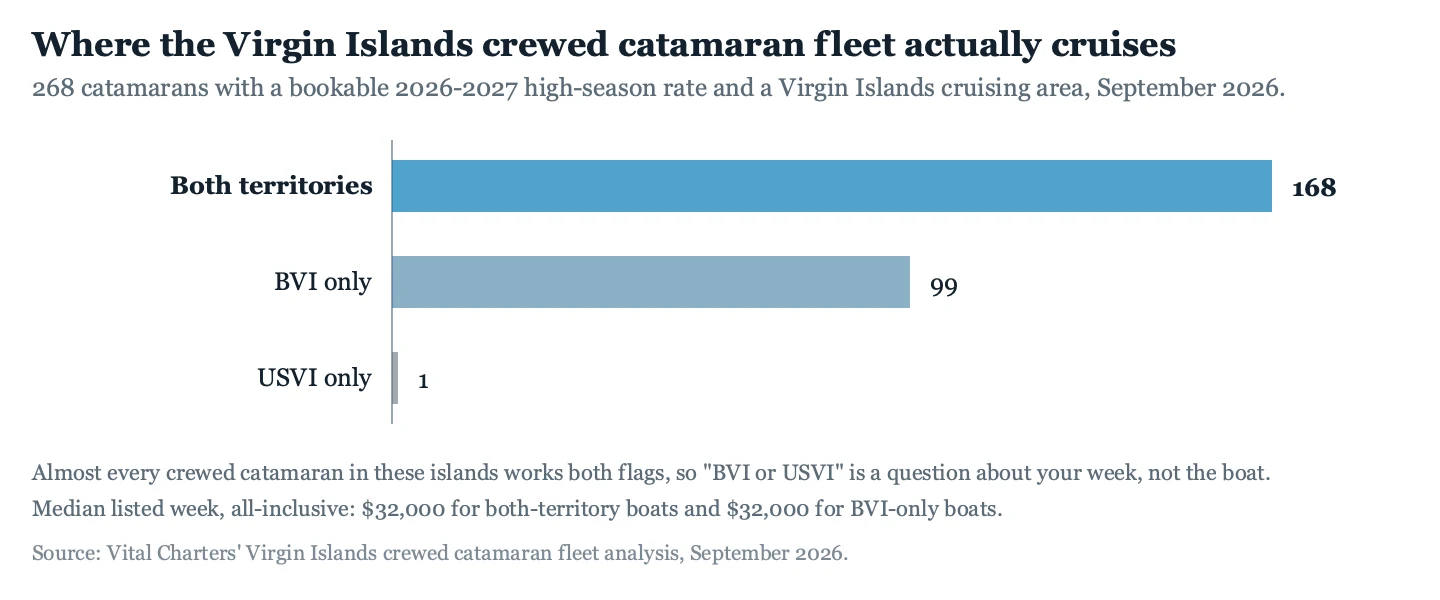
Splitting the Virgin Islands charter fleet by cruising area gives a lopsided answer. 168 of 268 catamarans list both the BVI and the USVI, 99 list the BVI alone, and one lists the USVI alone (Vital Charters rate analysis, September 2026). A USVI-only crewed catamaran is very close to a thing that doesn’t exist.
View data table
| Cruising area listed | Catamarans | Median listed week, all-inclusive | Middle half |
|---|---|---|---|
| Both BVI and USVI | 168 | $32,000 | $26,000 to $43,500 |
| BVI only | 99 | $32,000 | $25,000 to $48,000 |
| USVI only | 1 | $19,500 | n/a |
Source: Vital Charters rate analysis, September 2026. Active crewed sailing and power catamarans with an unexpired 2026-2027 high-season all-inclusive rate. Listed prices, not quotes.
That has a practical consequence. You are not really choosing a fleet, you’re choosing an itinerary, and the yacht you like will probably sail either one. Where the two territories genuinely diverge is paperwork, passage length and what the government charges.
Do You Need a Passport for the BVI or the USVI?
This is the single hardest difference between the two, and it isn’t close. The USVI is United States territory, so US citizens need no passport to travel there from the mainland or Puerto Rico (Visit USVI, the territory’s tourism authority). The BVI is a British Overseas Territory, and a valid passport is required of every visitor (Government of the Virgin Islands), including US citizens arriving by boat from St Thomas twenty minutes away.
Three things follow from that, and they catch people out every season:
- A USVI-only week needs no passport for US citizens. Bring whatever ID your domestic flight requires, and carry proof of citizenship for the journey home: US Customs and Border Protection treats citizens returning directly from a US territory as never having left the country, but you still need to be able to show who you are.
- Any route that touches the BVI needs a passport for everyone aboard. Children included. There is no exception for a day trip, a lunch stop or a single night.
- Since 1 January 2025 the BVI also requires an online arrival card from every traveller, submittable up to 72 hours before you arrive (UK Foreign, Commonwealth and Development Office).
Everything else at the border belongs to your captain. The yacht’s clearance, the cruising permit and the crew and guest list are filed for you. You hand over a passport and get it back.
How Do BVI and USVI Compare for Catamaran Sailing?
The BVI’s islands sit inside a roughly 30-mile cluster of about 60 islands and cays (Caribbean Tourism Organization), so a day’s sail is rarely more than 10 nautical miles and the next island is usually already in sight. The USVI has four main islands and around 50 smaller cays spread over a wider area, and the leg from St Thomas to St Croix is a 35-nautical-mile open-water crossing.
For a guest, that difference shows up as time on passage rather than difficulty. In the BVI you are underway for an hour or two and anchored by lunch. In the USVI, a week that includes St Croix has one long day in it. A catamaran handles both comfortably, and on a crewed charter your captain picks the window either way.
The island chains also run different directions. The BVI’s east-west line puts you on a beam or broad reach for most of the week, which is the flattest, driest point of sail. The north-south run between St Thomas and St Croix can put you closer to the wind, which even a wide-beam cat can’t make feel like a beam reach.
What Does a BVI vs USVI Catamaran Charter Cost in 2026?
Effectively the same. The median listed all-inclusive week is $32,000 for both-territory catamarans and $32,000 for BVI-only ones, with the middle half running $26,000 to $43,500 and $25,000 to $48,000 respectively (Vital Charters rate analysis, September 2026). Those are advertised list prices for the 2026-2027 high season, not quotes, and the crew gratuity sits outside all of them.
Because the boat costs the same, the only real cost difference between the two territories is what each government charges on top. That gap is bigger than most people expect, and it runs the opposite way to the rate. The full picture, including how the rate moves with length and why waiting for low season rarely helps, is in our all-inclusive Virgin Islands rate breakdown.
What lands on a British Virgin Islands charter invoice in 2026
The BVI charges guests three things: a cruising permit of $16 per guest per day on foreign-based yachts or $4 on BVI-based ones, a $10 arrival levy, and small National Parks Trust fees. All-inclusive rates cover these in most cases, and the customary 15 to 20 percent crew gratuity is always yours. No mandatory APA.
| Line item | Typical amount | Who sets it | Source |
|---|---|---|---|
| APA (Advance Provisioning Allowance) | None mandatory on all-inclusive catamarans (about 2 percent of rates state around 5 percent). Plus-expenses charters add an APA, typically 30 to 35 percent of the base rate, intended to cover every running fee except government taxes, refunded where unspent | The charter contract; mechanics per MYBA | MYBA, Information for Charter Yacht Captains and Crew |
| Cruising permit (per guest, per day) | $16 per guest per day on foreign-based charter yachts, including USVI-based ones; $4 on BVI-based yachts (an amending Order took effect June 1, 2025 and its text is not published, so confirm the current rate when you book) | HM Customs, Government of the Virgin Islands | Cruising and Home Port Permit Act, 2021, Schedule 2 |
| Environmental and Tourism Levy | $10 per guest (age 3 and over), once per arrival, air or sea | Government of the Virgin Islands | GIS release, September 2017 (archived) |
| National Parks Trust fees | The Baths day pass $3 per adult, $2 per child. Park mooring permits are handled by your crew and are not billed to you | National Parks Trust of the Virgin Islands | NPT ticketing, The Baths National Park |
| Crew gratuity | Customarily 15 to 20 percent of the charter fee in the Caribbean crewed fleet, the band CYBA’s Inclusive Agreement (Clause 2.B) calls the customary rate; MYBA’s 2026 guidelines publish no percentage, and both leave it at your discretion | Custom, written into the CYBA form | CYBA Inclusive Agreement, Clause 2.B (2020) |
Fees verified September 2026.
What lands on a US Virgin Islands charter invoice in 2026
A USVI crewed charter adds little to your invoice: no cruising permit, no per-guest charter tax. The only government fee you meet directly is $5 per person at Trunk Bay; national park mooring fees are the yacht’s cost, not yours. Budget a customary 15 to 20 percent crew gratuity.
| Line item | Typical amount | Who sets it | Source |
|---|---|---|---|
| APA (Advance Provisioning Allowance) | None mandatory on all-inclusive catamarans (about 2 percent of rates state around 5 percent). Plus-expenses charters add an APA, typically 30 to 35 percent of the base rate, intended to cover every running fee except government taxes, refunded where unspent | The charter contract; mechanics per MYBA | MYBA, Information for Charter Yacht Captains and Crew |
| Cruising permit or charter tax (per guest) | None. There is no per-guest government charge in the US Virgin Islands | USVI Department of Planning and Natural Resources | DPNR, Anchoring and Mooring |
| National Park Service fees | $5 per person at Trunk Bay, ages 16 and up. Park mooring fees are paid by the yacht, not billed to you (a proposal to raise these has not been implemented) | National Park Service | Virgin Islands National Park, Fees and Passes |
| Crew gratuity | Customarily 15 to 20 percent of the charter fee in the Caribbean crewed fleet, the band CYBA’s Inclusive Agreement (Clause 2.B) calls the customary rate; MYBA’s 2026 guidelines publish no percentage, and both leave it at your discretion | Custom, written into the CYBA form | CYBA Inclusive Agreement, Clause 2.B (2020) |
Fees verified September 2026.
Read together, the two blocks say something simple: the BVI charges per guest per day and the USVI charges essentially nothing, but on all-inclusive terms the yacht absorbs the BVI charges in the vast majority of cases, so neither reaches your invoice. Our guide to what actually appears on a charter invoice splits government charges from operator add-ons across the region.
Which Territory Has Better Anchorages for Catamarans?
The BVI, on organisation rather than beauty. Most of its famous bays have maintained mooring fields, so the boat is settled quickly and predictably: The Bight at Norman Island, Great Harbour on Jost Van Dyke, the north end of Virgin Gorda. USVI anchorages lean more towards anchoring, which gives a captain more freedom and takes longer.
What that means for you is arrival time. In the BVI the best bays fill from early afternoon in high season, so a crewed week is paced to be settled before the field is full. In the USVI there is usually room, and the constraint is the National Park mooring system around St John rather than competition.
Catamarans draw 3.5 to 5 feet, which opens up water a deep-keeled monohull can’t enter. Anegada’s reef-fringed anchorages in the BVI and Christmas Cove off St Thomas in the USVI are both easier in a cat than anything else afloat.

Can You Combine Both Territories in One Charter?
Yes, and given that 168 of 268 Virgin Islands crewed catamarans already list both cruising areas (Vital Charters rate analysis, September 2026), it’s the itinerary the fleet is built for. The crossing from St John to Jost Van Dyke is about 4 nautical miles, which is under an hour in a catamaran.
A typical combined week looks like this. You board at Red Hook on St Thomas, which US guests reach without a passport and often on a direct flight. Day one runs east through Pillsbury Sound to St John: Waterlemon Cay for a snorkel, a night in Francis Bay. Day two clears into the BVI at Jost Van Dyke or West End on Tortola. Four or five BVI days follow, then a return leg west.
Budget an extra hour on the clearance day. It isn’t complicated and it isn’t instant, and it’s the one morning of the week that runs on somebody else’s clock. Your captain does the paperwork; your job is to have a passport in your hand.
If you’d rather not cross a border at all, a BVI-only week from Tortola is the more common shape and the one laid out day by day in our 7-day BVI crewed catamaran sample itinerary.

BVI or USVI: Which Is Better for a First Crewed Charter?
For a first crewed week, the honest answer is that the sailing difference barely reaches you. The territory logged 1,092,139 visitor arrivals in 2024, of which 305,876 stayed overnight (Government of the Virgin Islands, Central Statistics Office, January 2025), and the BVI’s reputation as the easier sailing ground is real, but on a crewed charter the captain absorbs all of it.
What actually decides it for a first-timer:
- Start in the USVI if the group includes anyone whose passport is expired, uncertain or three weeks from renewal, or if a direct US flight into St Thomas saves you a connection.
- Start in the BVI if you want the shortest sails, the mooring fields and the stops people picture when they picture a Caribbean charter: The Baths, Anegada, Jost Van Dyke.
- Do both if you have seven days and everyone has a valid passport. That’s the week most groups end up loving, and it’s what the fleet is set up to run.
The USVI’s own charter sector is worth knowing about as context rather than as a factor in your booking: it generated $92 million and supported around 800 jobs in 2024 (VI Consortium, October 2025), and the territory’s charter association has publicly linked a recent loss of boats to the BVI’s licensing changes. It’s a smaller base than the BVI’s, not a worse one.
BVI vs USVI Side by Side
| Factor | British Virgin Islands | US Virgin Islands |
|---|---|---|
| Passport, US citizens | Required, no exceptions | Not required from the US mainland or Puerto Rico |
| Arrival paperwork | Online arrival card, every traveller, since 1 January 2025 | None beyond normal domestic travel |
| Cruising permit, per guest per day | $16 on foreign-based charter yachts, $4 on BVI-based | None |
| Per-guest arrival charge | $10 environmental and tourism levy | None |
| Charter tax or VAT on the fee | None | None |
| Park fees you might see | The Baths day pass, $3 adult and $2 child | $26 per night park mooring, paid by the yacht; $5 per person at Trunk Bay |
| Departure tax | $50 by air, $20 by ferry | None |
| Islands within reach | About 60 islands and cays inside roughly 30 miles | 4 main islands and about 50 cays, more spread out |
| Longest likely passage | Around 10 nm | 35 nm, St Thomas to St Croix |
| Overnight style | Maintained mooring fields in most popular bays | More anchoring, plus National Park moorings around St John |
| Crewed catamarans listing it | 267 of 268 | 169 of 268 |
| Median listed week, all-inclusive | $32,000 | $32,000, since almost all of these boats also work the BVI |
Fee sources as cited in the two invoice blocks above. Fleet and rate figures from Vital Charters rate analysis, September 2026. The crew gratuity, customarily 15 to 20 percent, applies in both territories and sits outside every rate shown.
Your Next Move
If you can only take one thing from this page, take the passport rule: the BVI needs one from everybody, the USVI does not, and that single fact has ended more Virgin Islands itineraries than weather has.
After that, the choice is genuinely low-stakes. The boats are the same boats, the rates are the same rates, and the crew handles the border. Most groups with a full week and valid passports start in St Thomas, cross to the BVI on day two, and spend the balance of the week in the BVI. If you want that route built around your group, start a yacht search at Vital Charters and we’ll send crewed catamaran options for both territories with the all-in numbers attached.
Frequently Asked Questions
Do I need a passport to charter a catamaran in the Virgin Islands?
It depends entirely on whether your route touches the BVI. The USVI is US territory, so US citizens need no passport arriving from the mainland or Puerto Rico (Visit USVI). The BVI is a British Overseas Territory and requires a valid passport from every visitor (Government of the Virgin Islands), including US citizens crossing by boat from St Thomas. Since 1 January 2025 the BVI also requires an online arrival card from every traveller.
How much does it cost to charter a catamaran in the BVI vs USVI in 2026?
Effectively the same. The median listed all-inclusive week is $32,000 for catamarans that work both territories and $32,000 for BVI-only boats, with the middle half at $26,000 to $43,500 and $25,000 to $48,000 (Vital Charters rate analysis, September 2026). There is no meaningful BVI premium on the yacht itself. The cost difference between the territories is in government charges, and on all-inclusive terms the yacht absorbs those in the vast majority of cases.
What does the BVI charge that the USVI does not?
A cruising permit of $16 per guest per day on foreign-based charter yachts or $4 on BVI-based ones, a $10 environmental and tourism levy per guest on arrival, and small National Parks Trust fees. The USVI has no cruising permit and no per-guest charter tax at all; its only guest-facing government charges are National Park Service fees, $26 a night for a park mooring paid by the yacht and $5 per person at Trunk Bay. Neither territory levies VAT or a percentage on the charter fee.
Can I sail a catamaran from the USVI to the BVI?
Yes, and most crewed catamarans here are set up for it: 168 of 268 list both territories as cruising areas. The crossing from St John to Jost Van Dyke is about 4 nautical miles, under an hour in a catamaran. Your captain clears in at Jost Van Dyke or West End on Tortola and handles the paperwork. Every guest needs a passport for that leg.
What is the best time of year for a BVI or USVI catamaran charter?
December through April brings the steadiest trade winds and the busiest anchorages. May and November are quieter with similar weather. The seasonal discount is smaller than most people expect: of the BVI crewed sailing catamarans that publish both a high-season and a low-season all-inclusive rate, 182 of 236 charge the same price year round (Vital Charters rate analysis, September 2026). The Atlantic hurricane season runs June 1 to November 30 with a peak around September 10 (NOAA National Hurricane Center).
Which territory is easier for a first crewed charter?
On a crewed charter the sailing difference barely reaches you, because the captain absorbs it. The BVI has shorter hops and organised mooring fields, which is why it’s the more common first charter. The USVI’s advantage is logistical: direct US flights into St Thomas and no passport requirement for American guests. If everyone in the group holds a valid passport, doing both in one week is the option most first-timers end up preferring.
BVI or USVI: we’ll match you to the right charter.
Share your group size and dates and we’ll send crewed catamaran options for both territories with honest all-in pricing so you can make the call.