
Yacht Charter Deals: A Broker’s Guide to Real Savings
Most Caribbean yachts publish the same rate all year. Here’s where the real savings actually are: repositioning weeks, introductory pricing, and last-minute specials.
Last Updated: September 7, 2026
Do Yacht Charters Actually Go on Sale?
They do, but not the way hotels and airlines do. About one crewed yacht in ten across the Caribbean and Bahamas is carrying a live promotional offer at any moment, and the usual size of that offer is ten percent off the weekly rate, which is worth reading against the 2026 Caribbean fleet rate report to see what that ten percent is ten percent of (Vital Charters listings analysis, September 2026). These yacht charter deals are not blasted across comparison sites. They sit in the listing feed brokers work from, they are withdrawn the moment the week fills, and the good ones go quickly.
If you’ve been researching what yacht charters actually cost, you already know the sticker price can feel steep at first glance. But here’s what the listing pages won’t tell you: the charter market has a rhythm to it, and understanding that rhythm is how you save real money without sacrificing the experience.
The deals fall into a few predictable categories: seasonal dips, new yacht introductions, last-minute availability, and broker-negotiated group rates. Before the categories, here is the measured shape of the whole market, which is the part no listing page will show you.
What the Offer Market Actually Looks Like
Sixty-six of the 668 crewed yachts active in the Caribbean and Bahamas are carrying a live promotional offer, and of the 91 offers that state a figure, 71 are the same figure: ten percent (Vital Charters listings analysis, September 2026). This is a market with one instrument and very nearly one price. A list of the boats running an offer today would be wrong within a fortnight, so what follows is the shape of the market instead, which barely moves.
| Discount advertised | Live offers | Yachts |
|---|---|---|
| 5% | 15 | 10 |
| 10% | 71 | 48 |
| 15% | 3 | 3 |
| 30% | 2 | 2 |
| No percentage stated | 5 | 4 |
| All live offers | 96 | 66 |
Eighty-six of the 91 stated discounts are five or ten percent off the weekly rate. Two yachts in the entire region are advertising more than fifteen percent, and both describe it as a last-minute rate. If a page has promised you thirty or forty percent off a Caribbean charter as a matter of course, that promise is not coming from this fleet.
View data table
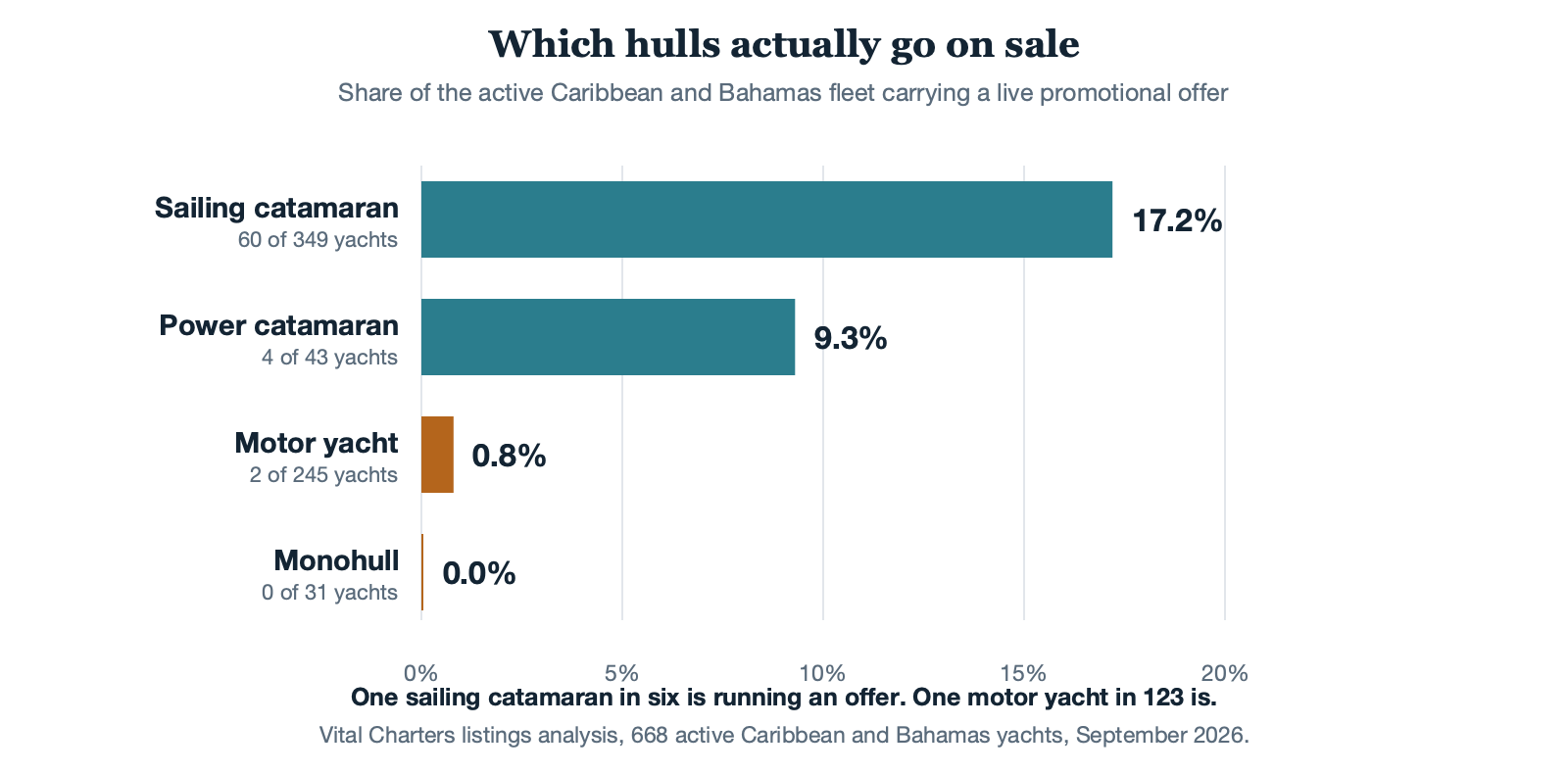
| Hull | Active in the region | Carrying an offer | Share |
|---|---|---|---|
| Sailing catamaran | 349 | 60 | 17.2% |
| Power catamaran | 43 | 4 | 9.3% |
| Motor yacht | 245 | 2 | 0.8% |
| Monohull | 31 | 0 | 0% |
One sailing catamaran in six is running an offer. One motor yacht in 123 is. The two hulls discount in opposite ways, and knowing which one you are shopping for changes where you look: motor yachts move their published rate between seasons, while roughly three catamarans in four quote the identical number in high and low season and use a promotional offer instead (Vital Charters rate analysis, September 2026).
Our observation: The discounted boats are not the leftovers. Sailing catamarans carrying an offer have a median high-season rate of $32,000 a week, and the 263 carrying no offer have a median of $32,000 as well. The offer is a calendar problem, not a boat problem. We have never once had a client regret taking one because of what the yacht turned out to be.
Read the restriction before you read the number. Sixty-nine of the 96 live offers carry one, and 46 of those exclude the festive period. Ninety-one of the 96 are a straight percentage off the weekly rate, which makes every other form of deal in this article rarer than its marketing implies.
Shoulder Season Deals: Where They Actually Exist
The Caribbean charter season peaks from mid-December through March, but the shoulder months rarely bring a published discount: of 522 Caribbean yachts listing both a high and a low season rate, 280 quote the identical number in both (Vital Charters rate analysis, September 2026). Where a shoulder deal exists it is a specific boat with a gap to fill rather than a season-wide markdown, and that is exactly what a promotional special is. At the time of writing 65 of 635 Caribbean and Bahamas yachts carry one, a median of 10 percent off, most of them between 5 and 10 percent, and they cluster in the April-to-August and November-to-December windows (Vital Charters listings analysis, September 2026). They are not printed on the rate card and the list changes weekly. Hurricane season officially starts June 1, but the BVI and USVI rarely see serious weather before late August, meaning April, May, June, and early July offer excellent sailing conditions at reduced rates.
This is the most straightforward way to get a deal. When demand softens after the winter rush, owners want to keep their yachts booked. Many proactively drop rates or offer bonus-night promotions to fill the gaps. You’re not getting a lesser experience: the water’s warmer, the anchorages are emptier, and the crew is just as attentive.
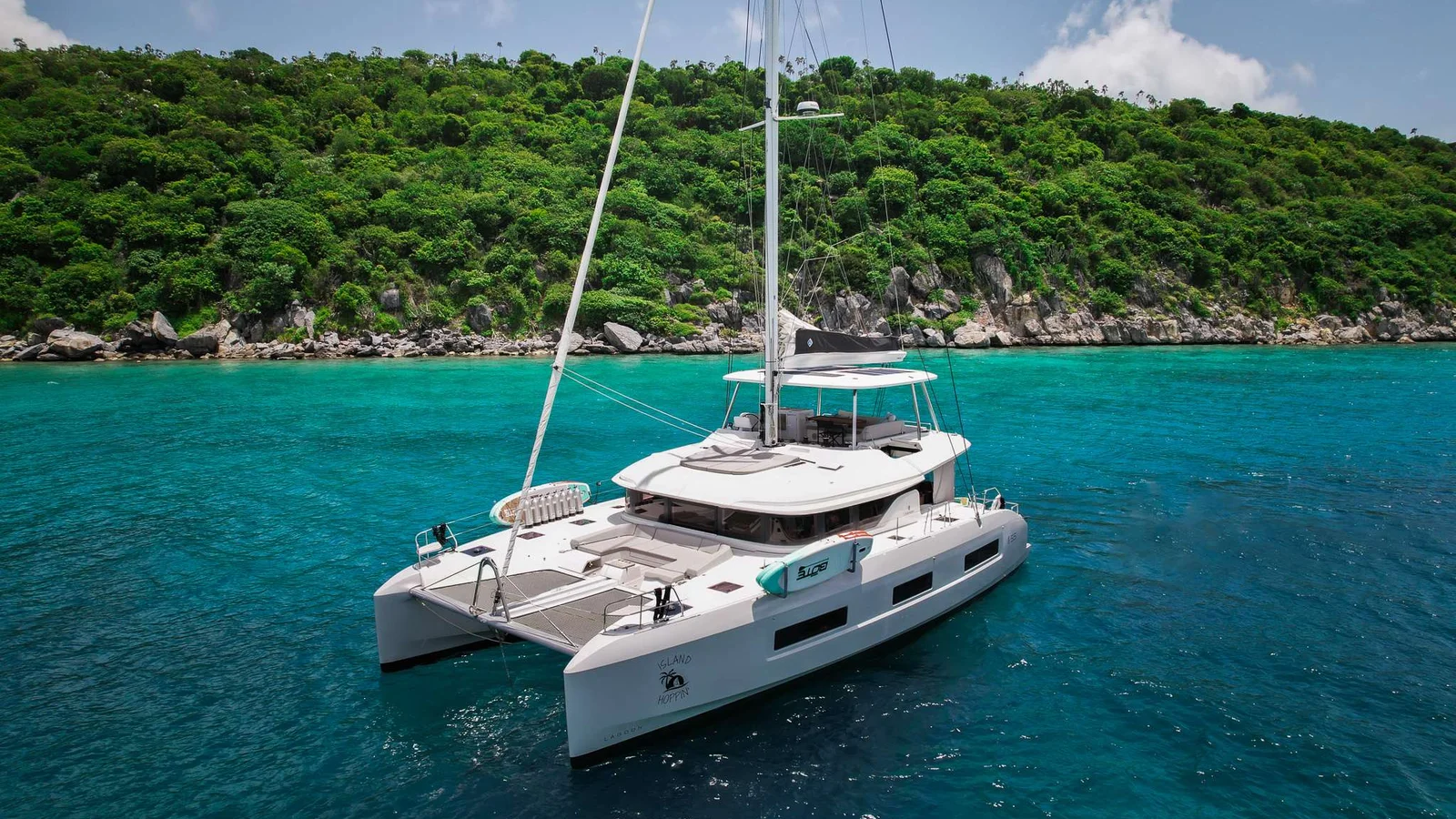
The boats this lands on are ordinary ones. Island Hoppin’ 55, a 2024 Lagoon 55 with a crew of two, and La Sirena, a 51-foot Lagoon, are both the four-cabin, eight-guest configuration that most charter parties book, and both have run a shoulder-season offer. Neither is a boat anybody struggled to sell.
What a shoulder offer is worth in cash depends on the boat rather than the season. Ten percent of a $25,000 week is $2,500; ten percent of a $45,000 week is $4,500. The percentage is close to fixed across the fleet, so the size of the saving is really a decision about the size of the yacht.
Our observation: In our experience booking Caribbean charters, April and May are the sweet spot. Trade winds are still consistent, rain showers are brief, and you’ll often have popular anchorages like The Baths or Tobago Cays practically to yourself. We regularly steer first-time charterers toward these months when the budget is tight.
New-to-Market Yachts: Introductory Rates You Won’t See Again
When a yacht enters the charter market for the first time, owners face a cold-start problem: no reviews, no repeat clients, no word-of-mouth. Their solution? Introductory pricing that undercuts established competitors to build a booking history fast.
An introductory rate never shows up in the specials feed. Not one of the 96 live promotional offers in the Caribbean and Bahamas describes itself as an introductory or new-to-market rate (Vital Charters listings analysis, September 2026), and that is not because the discount is imaginary. A yacht in its first charter season does not mark down a published rate, it publishes a low one. The saving is real and it is invisible, which is why the only way to find it is to compare a new hull against established boats of the same length and layout.
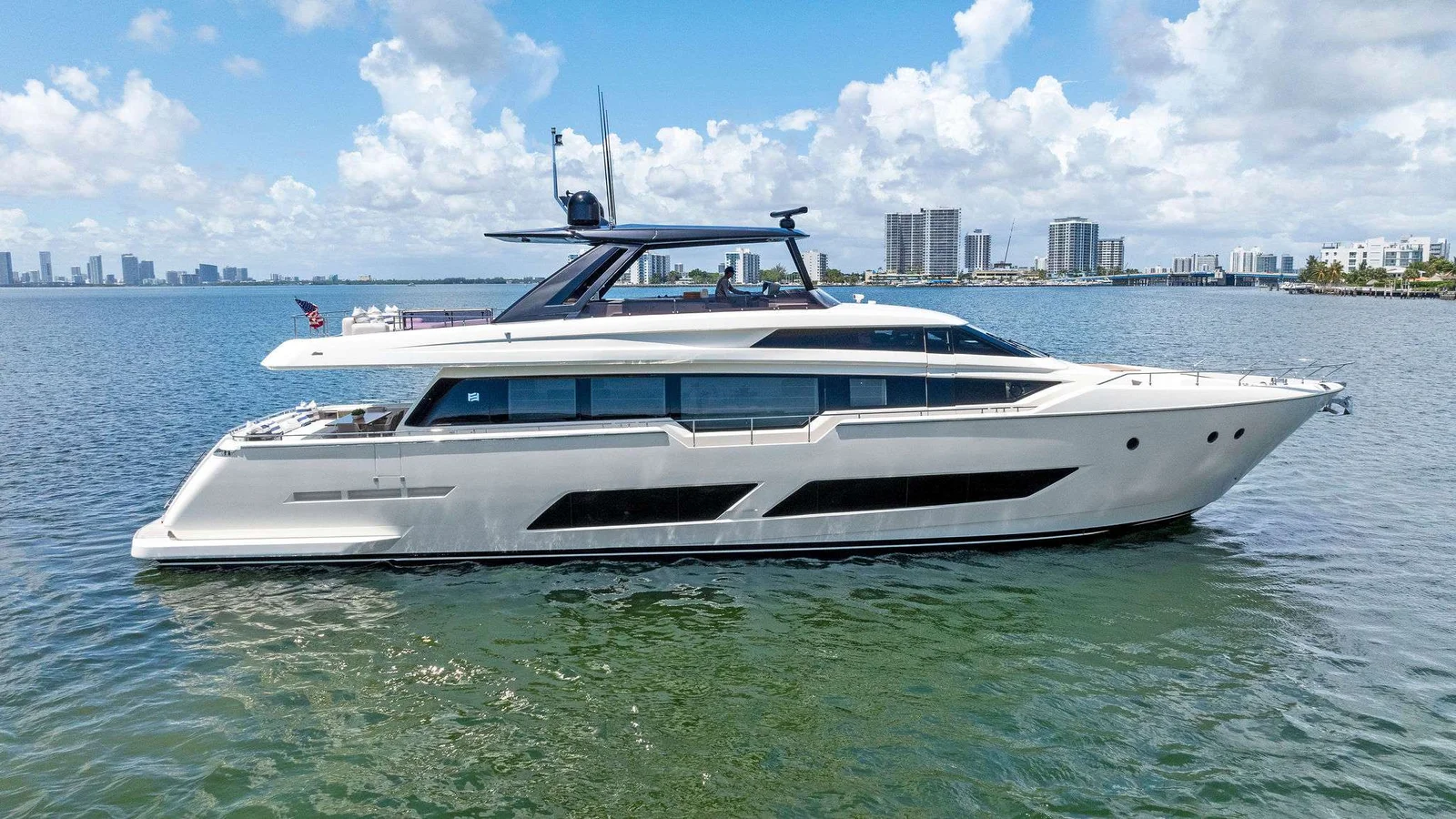
The Brass Ring came into the Bahamas fleet on exactly that basis. She is an 85-foot Ferretti 850 built in 2022, carrying 9 guests in 4 cabins with a crew of 4, stabilizers at anchor, a full suite of water toys and a 27-foot tender. Her opening rate sat below where a boat of that specification settles once its calendar fills, and nothing on the listing said sale.
You are getting a nearly new vessel at a price set to win a booking history rather than to reflect one. Compare her against motor yachts of the same length that have been chartering for five seasons and the gap is the discount, even though no listing anywhere prints it as a number.
These introductory windows are brief. Once a yacht builds its reputation and fills its calendar, the discounts disappear. If you see a yacht you like that’s new to charter, don’t wait. The first season is your best shot at the lowest rate you’ll ever see on that vessel.
New Ownership Specials: A Fresh Start Means Fresh Deals
Ownership changes happen regularly in the charter world. When a new owner takes over an existing charter yacht, they often relaunch with promotional pricing, sometimes with a refreshed interior, new crew, or updated equipment. It’s similar to the new-to-market dynamic, but the yacht itself is already proven.
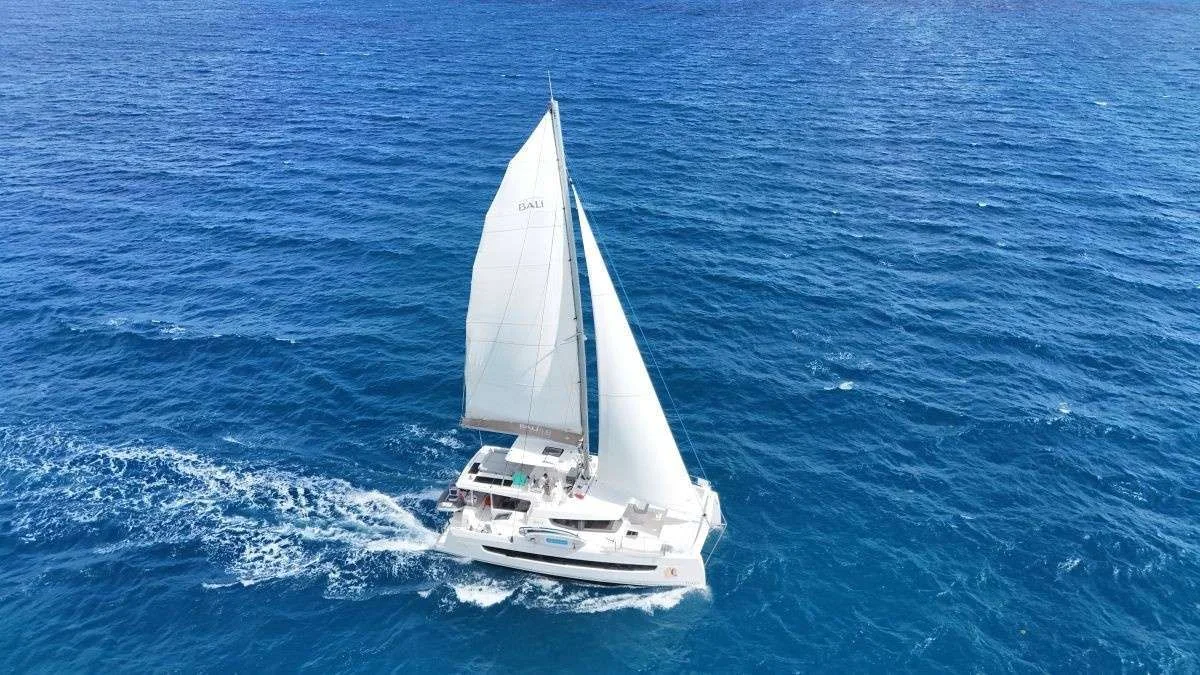
Merry-Time, a 2022 Bali 4.8, is the pattern in miniature. She changed hands, ran a new-ownership offer in the Virgin Islands, and went back to her standard rate once the calendar filled. She sleeps 8 guests in 4 queen cabins, each with a private ensuite and individual air conditioning, and her rate is all-inclusive.
The point is the timing, not the boat. A new-ownership offer is a short window on a vessel that already has a track record in the BVI fleet, which is the opposite of the usual trade-off. Ask your broker which yachts have changed hands in the last six months; it is a question almost nobody asks and the answer is a short, useful list.
Last-Minute Yacht Charter Deals: The Biggest Savings
The deepest discounts in the region are last-minute, and right now there are two of them. Exactly two yachts in the active Caribbean and Bahamas fleet advertise more than fifteen percent off, both at thirty percent, and both call it a last-minute rate (Vital Charters listings analysis, September 2026). That is the honest ceiling on this market: a thirty percent week exists, it is rare, and it goes to whoever can move.
This is where the biggest discounts live, but they require flexibility. As the end of the Caribbean winter season approaches (late March through April), yachts with open weeks face a choice: sail empty or drop the price. Most owners choose revenue over pride.
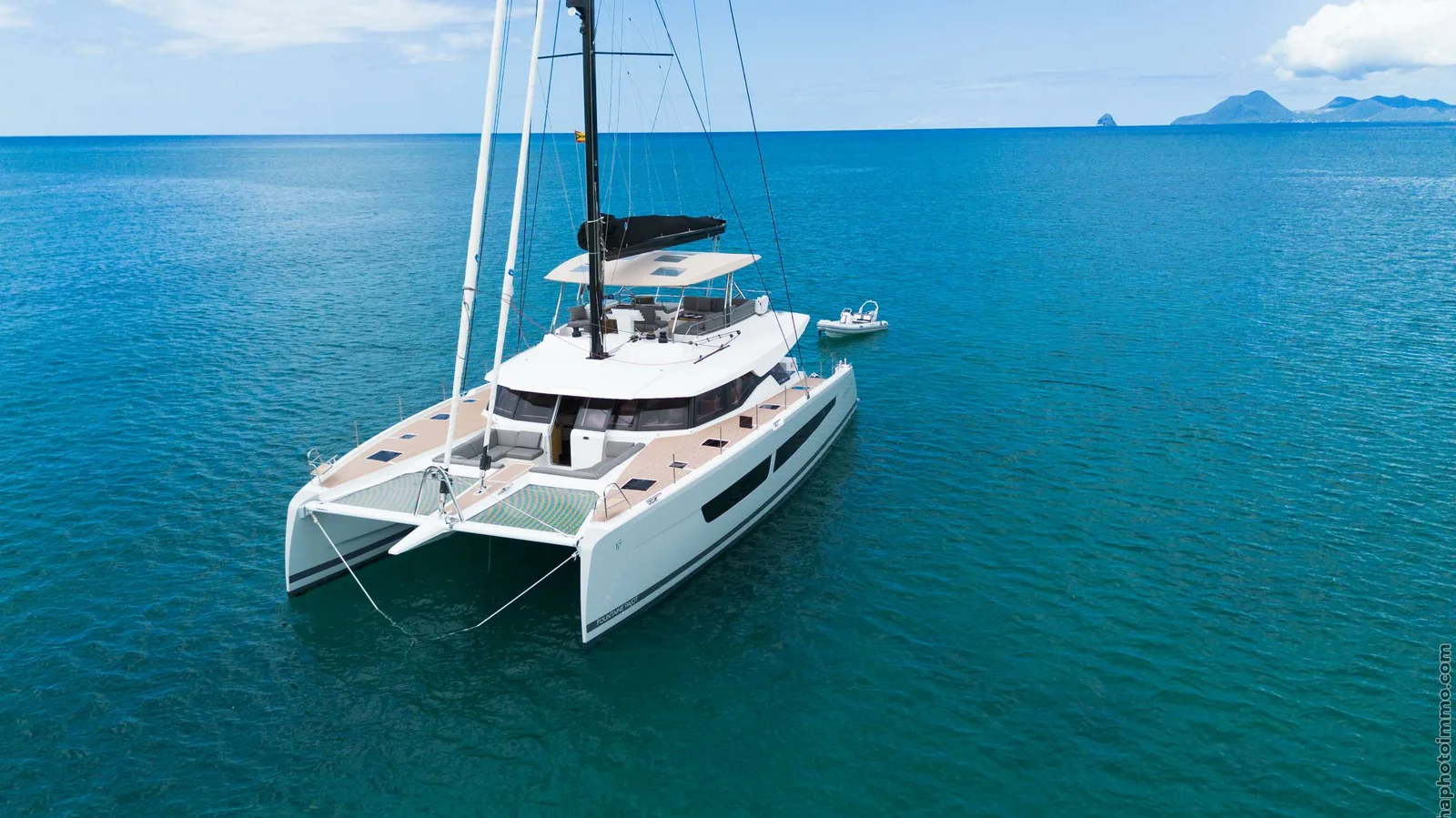
The boats that end up here are usually the larger ones. Okinawa carries 10 guests across 5 cabins with a crew of 3, and a party of ten is simply harder to assemble at four weeks’ notice than a party of six. Shades of Grey, a 78-foot Sunreef, has the same problem at the top of the market. Neither discount is a discount because something is wrong with the yacht.
The end of the Caribbean winter season, late March into April, is when this happens most. A yacht with an open week then faces a straightforward choice, and most owners choose revenue over pride.
What most reviews miss: The best last-minute deals aren’t advertised on public listing sites. They come through broker channels because yacht management companies prefer to offer quiet discounts rather than publicly slash their rates. This is exactly why working with an active broker, someone who monitors availability feeds and owner communications daily, gives you access to deals that the general public simply won’t see.
Free Nights and Bonus Time: Rarer Than the Marketing Suggests
One of the 96 live offers in the Caribbean and Bahamas mentions a free night (Vital Charters listings analysis, September 2026). Pay for six, sail for seven is a staple of charter marketing and it is close to absent from the actual fleet, so if it is what you are holding out for, you are waiting on a one-in-a-hundred event. Ninety-one of the 96 are a straight percentage off the weekly rate instead.

When one does appear it is worth more than it looks. A seventh night given away off a seven-night week is a fourteen percent saving, which beats every percentage discount currently advertised in the region except the two thirty percent ones. Liquid Sky, a 67-foot Fountaine Pajot sleeping 8 in 4 cabins, has run exactly that promotion in the shoulder-season transition.
So ask for it by name rather than waiting to see it advertised. An owner with an awkward gap between two bookings will sometimes add a night rather than cut the rate, because a night costs less than a precedent: a discount sets a number the next client will ask for, and a free night does not.
Holiday and Event Specials: Timing-Specific Savings
Start with what is excluded rather than what is offered. Forty-six of the 96 live offers in the Caribbean and Bahamas specifically exclude the festive period, and 69 carry a restriction of some kind (Vital Charters listings analysis, September 2026). Christmas and New Year are the two weeks the fleet will not discount, and an offer advertised as running through the winter will almost always stop short of them.
The holiday deals that do exist are tied to the weeks either side: dates that fall between peak periods, or lesser-known travel windows that would otherwise go unbooked.
Gullwing, a 2024 Lagoon 55 and Best in Show winner at the BVI Charter Yacht Society Show that year, has discounted a July 4th week. Timaiao 2, a 38-foot Lagoon, has run a late Easter special in the Grenadines with embarkation from St. Vincent or Grenada. Neither is a week most people would think to ask about.
So do not assume every holiday week is full price. American holidays that are not Caribbean holidays, the weeks flanking Easter, and anything outside the December 20 to January 5 window are all negotiable as the date approaches. The two weeks inside it are not.
Multi-Charter Group Rates: The Deal Most People Don’t Know About
If you’re planning a trip with an extended family, a corporate retreat, or a group of friends large enough to need more than one yacht, you have significant negotiating power that most charterers don’t realize they have.
This is the one category in this article with no published number attached, and that is the point. Nothing in the specials feed describes a group rate, because a group rate is never advertised: it is asked for, and it is negotiated directly between the broker and each yacht’s management company. What is available depends on the combined booking value and on how badly each owner wants that particular week.
Here’s how it works: Your broker contacts the management companies for each yacht and uses the combined booking value as a negotiating tool. A two-yacht booking for the same week represents guaranteed revenue that management companies are willing to discount for. Three yachts? The negotiating power increases further.
We’ve arranged multi-yacht charters for family reunions, milestone birthdays, and corporate incentive trips where the group discount effectively paid for the provisioning on one of the boats. The savings scale with the number of yachts and the total charter value. It’s always worth asking.
Our observation: Group charters are one of our favorite bookings to arrange. Beyond the discount, there’s something special about a flotilla of 2–3 yachts anchoring together at sunset, everyone gathering on the largest boat for cocktails, then splitting off the next morning to explore different coves. The kids kayak between boats. It’s a completely different experience from a single-yacht charter, and the group rate makes it more affordable per person than most people expect.
Why Your Broker Is Your Best Deal-Finding Tool
Every deal in this article has one thing in common: they flow through brokers before they hit public listing sites. Charter management companies send specials directly to their broker networks because a broker can match the right yacht with the right client quickly and close the booking. Public listing sites are a last resort.
An active broker (one who works with the charter fleets daily, not someone who dabbles in charters as a side business) has several advantages that directly translate to savings for you:
- Real-time access to specials: Management companies distribute new deals via email blasts, WhatsApp groups, and direct calls. Your broker sees these before they’re posted anywhere public.
- Negotiation strength: Brokers who consistently bring bookings to a management company can negotiate rates that one-time clients can’t.
- Itinerary knowledge: A broker who knows that a yacht is repositioning from the BVI to the Bahamas might secure a one-way discount along the delivery route. That’s insider knowledge, not public information.
- Calendar awareness: Your broker knows which yachts have open weeks before anyone else does. An empty week two months from now is a future discount waiting to happen.
If you’re serious about planning a yacht charter on a fixed budget, start the conversation with a broker early. The earlier we know your dates, guest count, and preferences, the better positioned we are to match you with a deal when one appears.
How to Maximize Your Chances of Getting a Yacht Charter Deal
Based on years of booking charters, here’s what actually moves the needle on price:
- Be flexible with dates. This is the single biggest factor. If you can shift by even 2–3 weeks, you might land in a shoulder-season window or catch a last-minute opening. Clients who say “sometime in spring” get better deals than those who say “the third week of February.”
- Book early or book late. Paradoxically, both ends of the timeline work. Early bookings (6–9 months out) let your broker negotiate from a position of guaranteed revenue. Late bookings (within 4–6 weeks) catch distressed inventory. The worst time for deals is 2–4 months before the charter date, too late for early-bird treatment, too early for last-minute panic.
- Consider new yachts. Introductory rates are some of the best values in the market, and you’re getting a vessel in peak condition. Check what’s new from the major builders (Lagoon, Fountaine Pajot, Bali, Sunreef) and ask your broker about any that just entered the charter fleet.
- Look beyond peak destinations. The BVI and USVI are the most popular Caribbean charter grounds, but the Grenadines, Bahamas, and Leeward Islands often have more availability and consequently more deals. If you haven’t committed to a destination, let the deals guide you.
- Ask about repositioning charters. When yachts move between summer and winter grounds, they sometimes offer discounted one-way charters along the delivery route. These are rare but can be exceptional value.
How to Actually Catch One
Offers turn over faster than any published list can track: the specials feed behind this article is rebuilt daily, and a week that gets booked takes its discount off the market the same day. That is why this article carries the shape of the market and not a table of boats. The practical version is short.
- Give a window, not a date. Two or three weeks of flexibility is the difference between choosing from every offer live that month and choosing from none.
- Say yes to a catamaran. Seventeen percent of sailing catamarans in the region carry an offer against 0.8 percent of motor yachts, so the hull you are open to decides whether there is anything to find.
- Set your expectation at ten percent. That is the market rate. Treat fifteen as a good week and thirty as a boat somebody needs to move by Friday.
- Ask what is excluded before you ask what is offered. Seven offers in ten come with a restriction attached.
- Ask for the form, not just the size. A bonus night is worth fourteen percent and is almost never advertised, so it has to be requested.
Tell your broker your window, your guest count and the number you are working to, and let the offers come to you as they appear. Reach out and we will watch the feed for you rather than asking you to watch it yourself.
Ready to Find Your Deal?
The yacht charter market rewards informed, flexible clients who work with experienced brokers. Whether you’re targeting a shoulder-season getaway, eyeing a new yacht’s introductory rate, or open to a last-minute adventure, the deals are out there. You just need someone who knows where to look.
Reach out to us at Vital Charters with your rough dates, guest count, and budget range. We’ll match you with the best available yacht charter deals from current listings and handle every detail from there. No pressure, no booking fees: just honest advice from people who charter these yachts ourselves. You can also search current crewed listings yourself.
Frequently Asked Questions
What’s the cheapest time to charter a yacht in the Caribbean?
April through early July is where a discount is most likely to exist at all, though fewer than one yacht in ten drops its rate by even 15 percent (Vital Charters rate analysis, September 2026). The weather is still excellent for sailing. June marks the official start of hurricane season, but serious storm activity rarely begins before late August in the BVI and USVI.
Can you negotiate yacht charter prices?
Yes, but it depends on the context. Direct negotiation works best through a broker who has an established relationship with the yacht’s management company. Multi-charter group bookings, extended-duration charters, and last-minute bookings all create room for negotiation. Trying to negotiate during peak Christmas or New Year’s weeks won’t get you far. Those sell out at full price months in advance.
Are last-minute yacht charter deals worth it?
Yes, if you can be flexible, though the discounts are smaller than the marketing suggests. Last-minute offers within 4-6 weeks of the charter date are where the deepest cuts sit, but exactly two yachts in the active Caribbean and Bahamas fleet are currently advertising more than 15% off (Vital Charters listings analysis, September 2026). The trade-off is that you cannot be picky about the specific yacht or the exact dates.
How far in advance should I book to get the best deal?
There are two sweet spots: 6–9 months ahead (when brokers can negotiate early-commitment discounts) and within 4–6 weeks (when last-minute openings create urgency). The 2–4 month window is typically the worst for deals. It’s too late for early-bird pricing and too early for distressed inventory.
Do new yachts cost more to charter?
Not necessarily, and a new yacht is one of the few genuine bargains in the market. A hull in its first charter season sets a low rate to build a booking history rather than discounting a published one, so the saving never appears as a special and cannot be found by browsing. Ask your broker what has recently entered the charter fleet, then compare it against established boats of the same length and layout.
Let a broker find your best available rate.
Share your group size, dates, and budget and we’ll surface shoulder-season rates, introductory pricing, and last-minute deals you won’t find on your own.