
Last Updated: April 5, 2026 | Originally Published: March 2, 2026
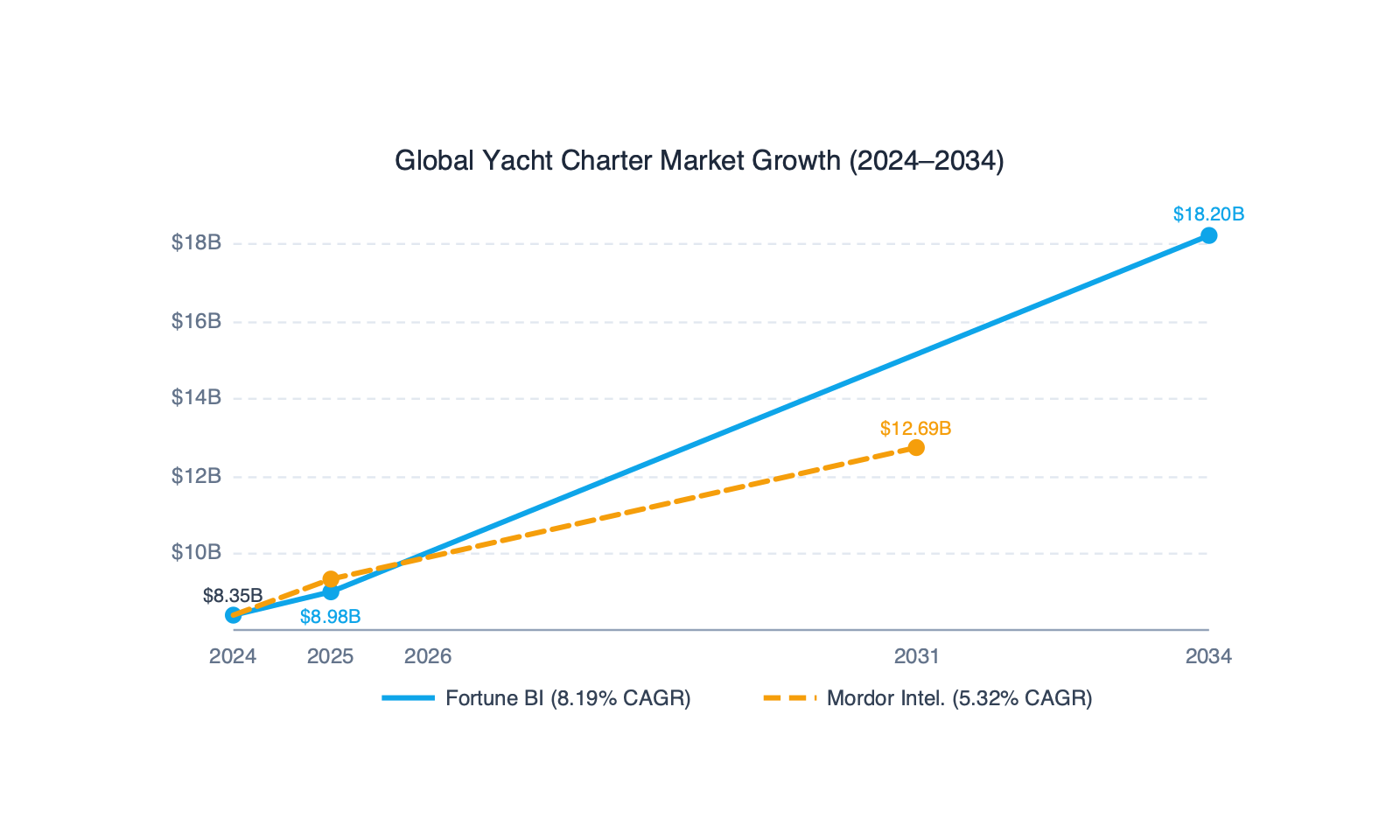
The global yacht charter market hit $8.98 billion in 2025 and is projected to reach $18.20 billion by 2034 at an 8.19% CAGR (Fortune Business Insights, 2026). That growth has brought more first-timers into the market than ever — and with them, more confusion about what a charter actually costs.
Here’s the one thing that clears up most of that confusion: most Caribbean crewed charters are priced all-inclusive. Your weekly rate covers meals, open bar, fuel, and the full crew. No separate expense account. No reconciliation at the end of the week. The APA model — where you pre-fund a discretionary allowance that gets settled on departure day — is primarily a superyacht and Mediterranean convention. If you’re comparing Caribbean and Mediterranean quotes side by side, you aren’t comparing apples to apples.
This guide covers every layer of yacht charter costs: base rates by vessel type and destination, daily pricing, how seasonal rates swing your budget by 30–40%, how the APA works when it applies, what add-ons actually cost, how crew gratuity works, and which line items catch first-timers off guard.
TL;DR: Caribbean crewed catamarans run $25,000–$45,000/week ($3,600–$6,400/day) for a 50–60 ft vessel, all-inclusive. Motor yachts start at $50,000/week and use the plus-expenses model — budget an extra 50–55% on top of the base rate for a realistic all-in number (YATCO, 2024). Season matters: low-season rates can run 30–38% below peak (BVI Sail, 2025).
How Much Does a Yacht Charter Cost Per Week?
Budget an additional 50–55% on top of the base charter rate if you’re booking a plus-expenses charter — so a $50,000 base rate becomes roughly $77,500 all-in once APA, gratuity, and taxes are added (YATCO, 2024). That gap is the most common budget surprise for anyone stepping outside the Caribbean all-inclusive model.
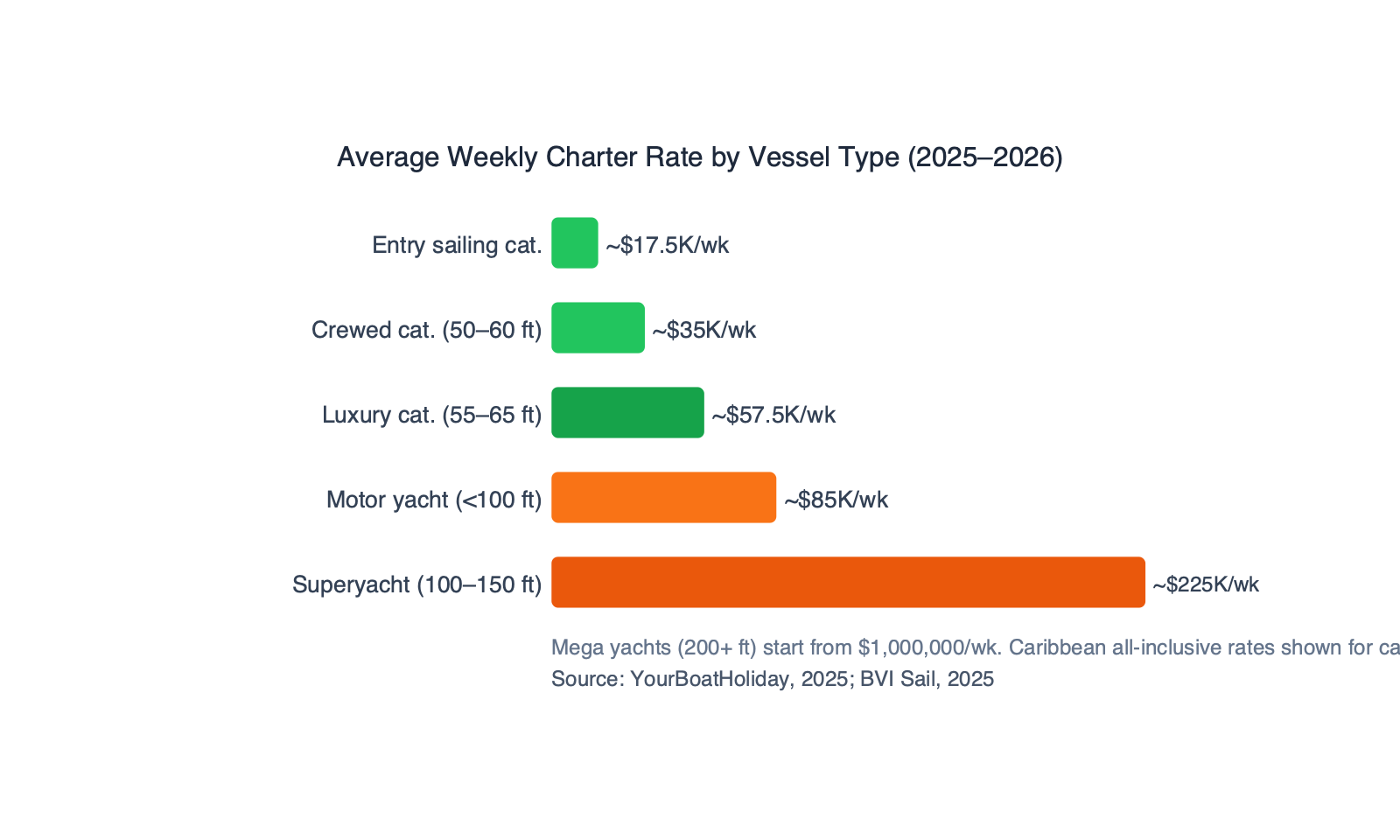
Weekly base rates span a wide range depending on vessel type and crew configuration:
- Entry-level crewed sailing catamarans: From $10,000/week
- Crewed catamarans (50–60 ft): $25,000–$45,000/week in the Caribbean
- Luxury catamarans (55–65 ft): $45,000–$70,000/week
- Motor yachts (under 100 ft): $50,000–$120,000/week
- Superyachts (100–150 ft): $150,000–$300,000/week
- Mega yachts (200+ ft): From $1,000,000/week
For comparison, bareboat charters (self-skippered, no crew) run $3,000–$8,000/week for a similar-sized catamaran — but they require a valid sailing certification and leave all provisioning, navigation, and logistics to you. Most first-timers choose crewed. For a look at all-inclusive vs. bareboat pricing in detail, see our pricing model comparison.
Those numbers only make sense once you know the pricing model. An all-inclusive Caribbean catamaran at $35,000/week is genuinely $35,000 — plus crew gratuity. A Mediterranean motor yacht at $85,000/week base can land at $130,000+ once APA, gratuity, and local taxes are factored in. Caribbean: almost always all-inclusive. Mediterranean, superyachts, and most motor yachts: plus expenses with APA.
Planning a larger group? Learn about the 12-person yacht rule and how it affects your charter options.
View data table
| Vessel Type | Size | Avg. Weekly Rate | Source |
|---|---|---|---|
| Entry sailing catamaran | 40–50 ft | ~$17,500/wk | YourBoatHoliday, 2025 |
| Crewed catamaran | 50–60 ft | ~$35,000/wk | BVI Sail, 2025 |
| Luxury catamaran | 55–65 ft | ~$57,500/wk | BVI Sail, 2025 |
| Motor yacht | <100 ft | ~$85,000/wk | Worldwide Boat, 2024 |
| Superyacht | 100–150 ft | ~$225,000/wk | Worldwide Boat, 2024 |
Weekly rates range from ~$17,500 for an entry-level sailing catamaran to ~$225,000 for a 100–150 ft superyacht, with crewed 50–60 ft catamarans averaging ~$35,000/week in the Caribbean (YourBoatHoliday, 2025; BVI Sail, 2025).
What Does a Yacht Charter Cost Per Day?
Short-duration charters of 3–4 days are now the fastest-growing booking segment in the industry, expanding at 11.39% CAGR — though weekly charters still represent roughly 55% of all bookings (Dream Yacht Sales, 2026). That shift makes daily pricing increasingly relevant, even for charterers who end up booking a full week.
Here’s the overview for Caribbean crewed charters:
| Yacht Type | Size Range | Daily Cost Range | Pricing Model |
|---|---|---|---|
| Crewed Catamaran | 45–65 ft+ | $2,400–$18,600/day | All-inclusive (meals, bar, fuel, crew) |
| Crewed Motor Yacht | 60–100 ft+ | $3,700–$30,000+/day | Plus-expenses (base only; add APA + gratuity) |
The daily rate on a short charter typically runs 10–20% higher than the weekly rate divided by seven. For tier-by-tier breakdowns, true all-in costs with APA and gratuity, and per-person comparisons, see our complete yacht charter cost per day guide.
Our observation: We’ve noticed a growing number of first-time charterers asking for 4–5 day trips as a “test run” before committing to a full week. It’s a smart approach — you’ll pay slightly more per day, but you won’t overcommit on a vacation style you haven’t tried yet.
How Do Seasonal Rates Affect Yacht Charter Costs?
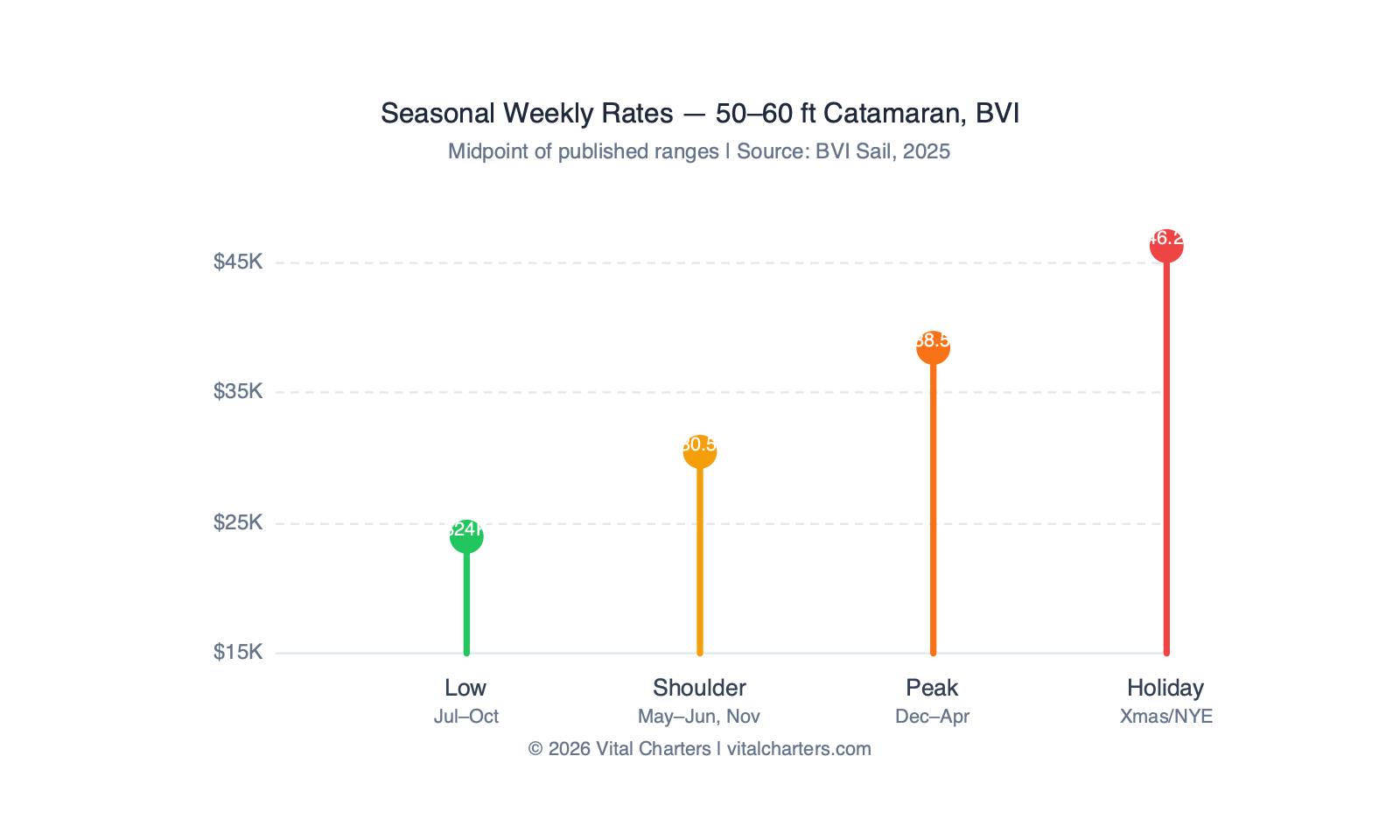
Low-season Caribbean rates (July through October) run 30–38% below peak-season pricing for the same yacht and crew, making timing one of the biggest levers you have on your total charter cost. On a 50–60 ft crewed catamaran in the BVI, that’s a swing of $12,000–$17,000 per week.
Here’s what each season looks like:
- Low season (Jul–Oct): $20,000–$28,000/week. Best value, but it’s hurricane season. Weather’s typically fine day-to-day, and fleet availability is wide open.
- Shoulder season (May–Jun, Nov): $26,000–$35,000/week. The sweet spot — 15–25% below peak with reliable weather and good yacht selection.
- High/Peak season (Dec–Apr): $32,000–$45,000/week. Best weather, highest demand. Premium yachts book 6–12 months out.
- Holiday weeks (Christmas/NYE): 15–20% surcharge on top of peak rates. A 76 ft catamaran that runs $54,950–$64,950/week in January jumps to $79,990 for Christmas week and $95,000 for New Year’s.
View data table
| Season | Months | Weekly Rate (50–60 ft cat) | vs. Peak |
|---|---|---|---|
| Low | Jul–Oct | $20,000–$28,000 | -30% to -38% |
| Shoulder | May–Jun, Nov | $26,000–$35,000 | -15% to -25% |
| Peak | Dec–Apr | $32,000–$45,000 | Baseline |
| Holiday | Christmas/NYE | $38,000–$54,000+ | +15% to +20% |
Seasonal midpoints for a 50–60 ft BVI catamaran: $24K/week in low season, $30.5K shoulder, $38.5K peak, and $46.2K during holiday weeks — a 93% swing from cheapest to most expensive.
Our observation: We’ve seen clients save $8,000–$12,000 by shifting a trip from mid-December to early December — same weather, same yacht, dramatically lower rate. The Christmas premium kicks in around December 20 and doesn’t let go until January 3. If you can travel the first two weeks of December, you’ll get high-season conditions at near-shoulder prices.
Want to stretch your budget further? Check our guide to real charter deals and savings.
What Is the APA and Why Does It Add 25–40% to Your Budget?
Under current MYBA terms, sailing yachts and catamarans on a plus-expenses charter carry an APA of 25–35% of the base charter fee, while motor yachts carry 35–40% due to significantly higher fuel burn. On a $100,000 motor yacht charter, that’s $35,000–$40,000 in pre-funded expenses before you’ve tipped the crew.
The APA (Advance Provisioning Allowance) is a pre-funded expense account you load at the start of the charter. It covers the running costs your crew will spend on your behalf: fuel, provisions, docking and marina fees, port charges, park permits, and communications. Your captain tracks every expenditure. At departure, you get a full accounting — unspent funds are refunded, overages get settled before you step off the boat.
Chartering in the Caribbean? This entire process mostly doesn’t apply. Your all-inclusive rate already covers fuel and food. The captain won’t hand you a receipt at the end of the week. For a deeper dive into how the APA works in practice, see our complete APA guide.
Why does motor yacht APA run higher than sailing yacht APA? Fuel, mostly. A large motor yacht can burn through $2,000–$5,000 in diesel in a single active cruising day — and with BVI marine diesel running $6.50–$7.50 per gallon, those costs add up fast. Sailing catamarans run on wind most of the time, keeping fuel a fraction of total expenses.
View data table
| Cost Component | % of Total | On $100K Base |
|---|---|---|
| Base charter fee | 60% | $100,000 |
| APA (fuel, food, docking) | 30% | $35,000 |
| Crew gratuity | 10% | $15,000–$20,000 |
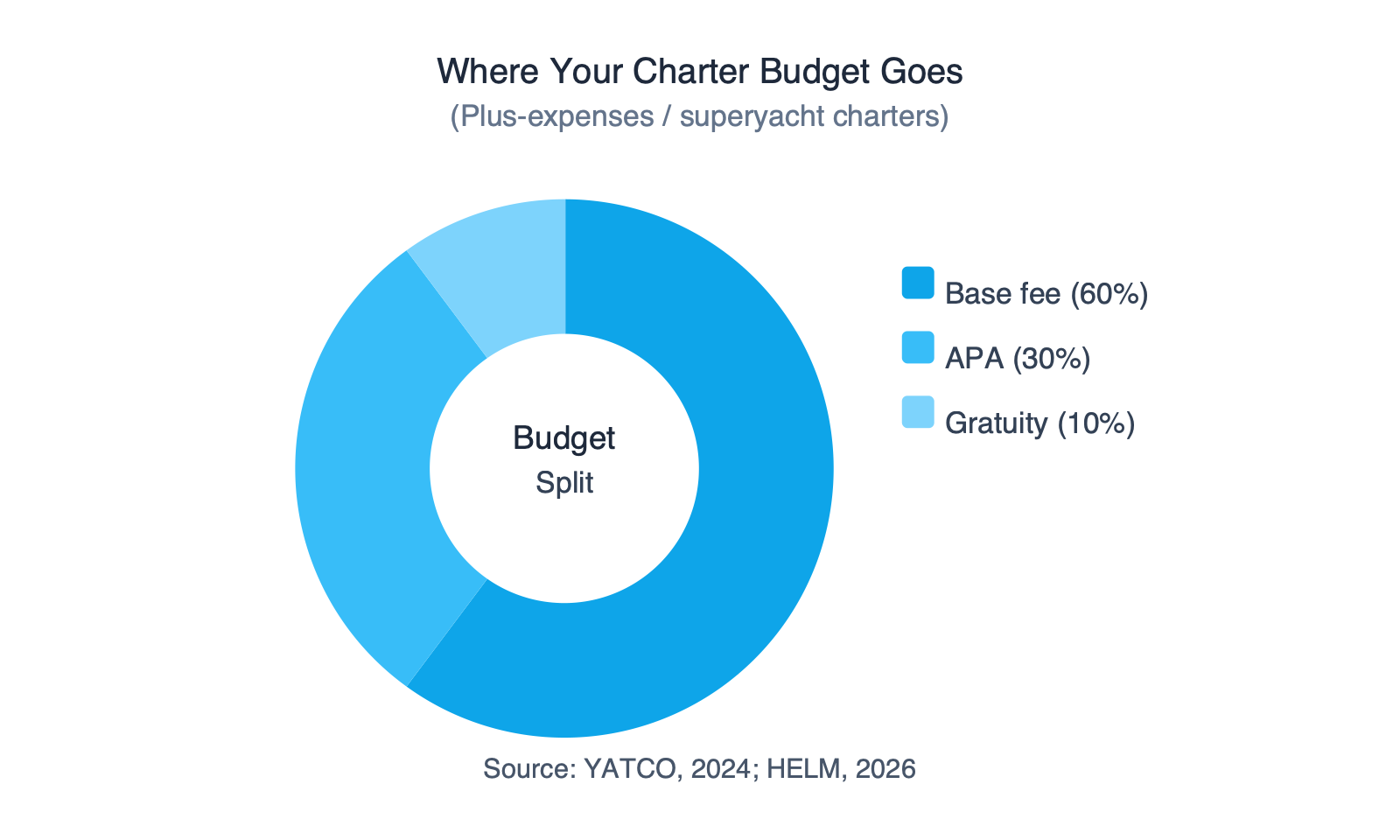
On a plus-expenses charter, the base fee accounts for roughly 60% of total spend, with APA adding 30% and crew gratuity 10% — meaning a $100,000 base rate becomes approximately $155,000–$160,000 all-in (YATCO, 2024; HELM, 2026).
How Do Charter Costs Change by Destination?
The Bahamas’ consolidated 14% charter tax — merged from a 10% VAT and 4% port department fee effective July 1, 2025 — has made it the most expensive Caribbean charter destination by tax burden alone, and industry groups report a 40% decline in Bahamas charter activity since the rate took effect (The Tribune Nassau, 2025). That’s reshaped the destination math for cost-conscious charterers.
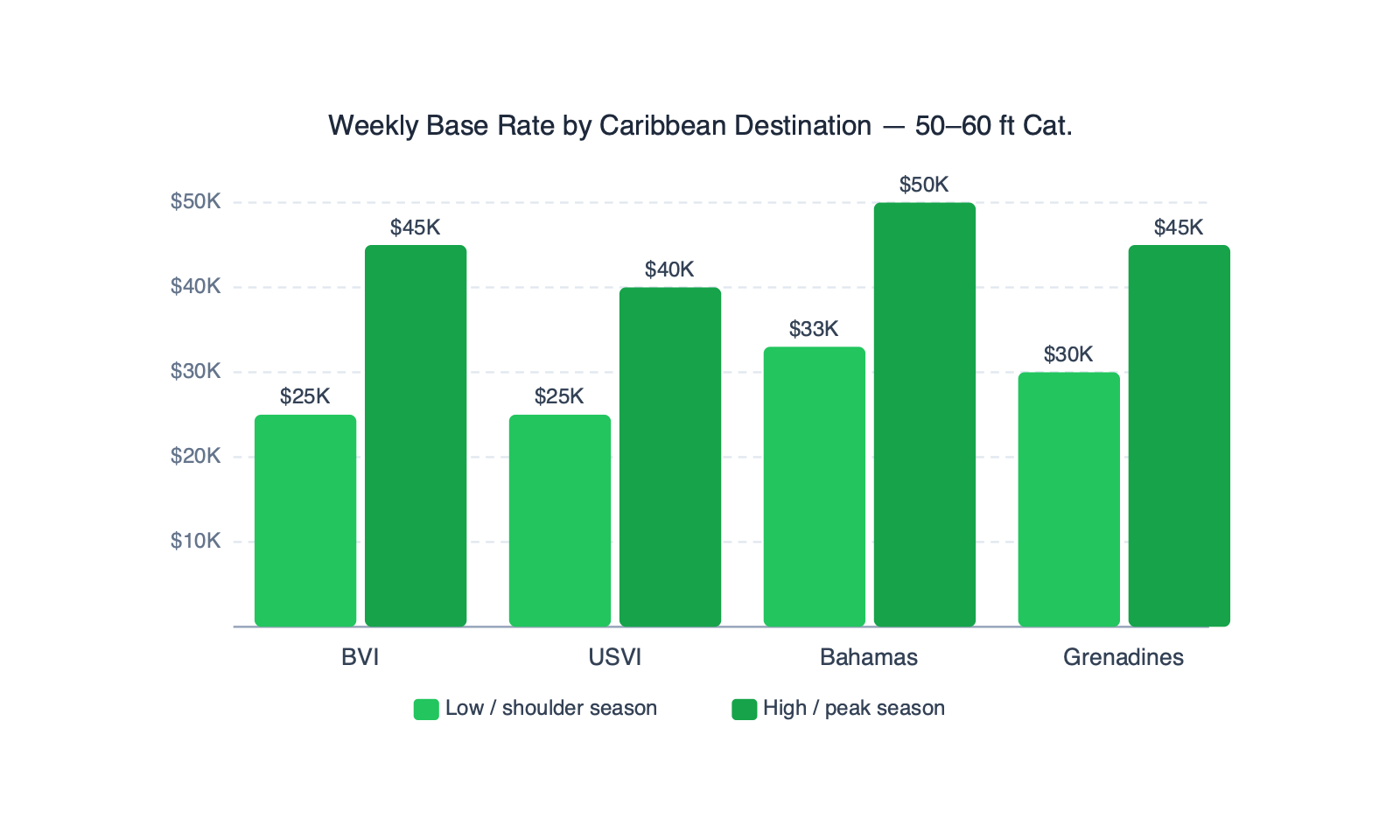
Here’s how the main Caribbean destinations stack up for a 50–60 ft crewed catamaran:
- BVI: $25,000–$45,000/week, all-inclusive. Cruising tax of $6/person/day for home-based charters or $16/person/day for foreign-based vessels (BVI Government). National park permits additional. Christmas/NYE surcharge 15–20%. Foreign charter licensing fees increased significantly in 2025 — annual unlimited licenses now run $24,000 (VIPCA, 2025).
- Bahamas: $33,000–$50,000/week, all-inclusive common. 14% consolidated charter tax applies (The Tribune Nassau, 2025). Marine park fees in the Exumas. That 14% on a $40,000 charter adds $5,600 that doesn’t exist in the BVI.
- USVI: $25,000–$40,000/week. 5% gross receipts tax, prorated by time in USVI waters. The pending Marine Charter Business Revitalization Act proposes cutting this to 0–2.5% with additional fuel concessions (St. Thomas Source, 2025).
- Grenadines: $30,000–$45,000/week. Cruising tax of roughly $13 USD/person/month (SVG Ministry of Tourism, 2025). Charter licenses $60–$140 for occasional use.
- Greece/Mediterranean: €22,000–€42,000/week base, plus expenses. 13% Greek VAT applies. When you add APA, gratuity, and VAT, the true Mediterranean cost often exceeds the Caribbean rate by $15,000–$25,000 for the same yacht class.
For a deeper look at how these destinations compare beyond pricing, see our BVI vs. Bahamas vs. St. Martin comparison.

View data table
| Destination | Low/Shoulder Rate | Peak Rate | Charter Tax |
|---|---|---|---|
| BVI | $25,000 | $45,000 | $6–$16/person/day |
| USVI | $25,000 | $40,000 | 5% gross receipts |
| Bahamas | $33,000 | $50,000 | 14% consolidated |
| Grenadines | $30,000 | $45,000 | ~$13/person/month |
BVI offers the lowest-cost Caribbean chartering at $25,000–$45,000/week with minimal taxes. The Bahamas runs $33,000–$50,000/week plus a 14% consolidated charter tax — the highest in the Caribbean-Atlantic region (The Tribune Nassau, 2025).
Our observation: Since the Bahamas consolidated its charter tax to 14% in mid-2025, we’ve had more clients pivot to the BVI or USVI mid-planning. The Exumas experience is genuinely unique — but on a $40,000 catamaran charter, that 14% adds $5,600 in taxes alone. The BVI offers comparable sailing with minimal tax overhead. If the Exumas are what you’re after, budget accordingly.
What Add-Ons Will Affect Your Final Bill?
Premium charter add-ons — Seabob rentals, guided scuba dives, helicopter transfers, and spa services — can add $500–$5,000 per day to a plus-expenses charter budget, while most standard water toys (paddleboards, kayaks, snorkeling gear) are already included at no extra charge on well-provisioned Caribbean all-inclusive charters. Know the difference before you board.
For plus-expenses charters, these draw from your APA balance. Here’s what to expect:
- Water toy upgrades (Seabob, e-foil, jet ski): $200–$600/day per unit; frequently yachts include one or two in the base rate
- Guided scuba diving: $60–$100 per person per dive in the Caribbean
- Spa and wellness services: $150–$300 per session through a shoreside provider; some superyachts carry onboard spa staff
- Helicopter transfers: $1,500–$5,000 per leg depending on distance and destination
- Custom provisioning upgrades: Specialty wines, specific spirits, or elaborate themed dinners add $500–$2,000+ to the provisioning bill
What’s worth spending on? Families with younger kids typically get the most value from water toys — they’ll use them every single day. Couples tend to prioritize spa services and premium dining. First-timers often discover that well-provisioned all-inclusive Caribbean charters already include more than they expected. For a full breakdown of what’s hidden and what’s not, see our hidden fees guide.
How Much Should You Tip the Crew?
The MYBA recommends crew gratuity of 5–15% of the base charter fee, but Caribbean norms run higher — 15–20% is standard practice, reflecting U.S. hospitality tipping culture. On a $35,000 Caribbean all-inclusive charter, that’s $5,250–$7,000 in cash at departure.
You pay in an envelope to the captain. The captain distributes it to the full crew. A few things worth knowing:
- Gratuity is never part of the charter price — not on all-inclusive, not on any charter type
- A crew of 3–5 on a 50–60 ft yacht each gets a meaningful share of that envelope
- If service was exceptional, tipping above 20% is always appropriate
- Ask your broker for the crew size before the charter so you can calibrate
For more detail on tipping etiquette and customs by region, read our guide to tipping yacht crew.

All-Inclusive vs. Plus-Expenses: Which Model Costs More?
Budget 50–55% on top of a plus-expenses base rate for a realistic all-in number — that’s standard industry guidance (YATCO, 2024). A Mediterranean motor yacht at $32,000/week base becomes $48,000–$52,000 once APA, gratuity, and Greek VAT are added. An all-inclusive Caribbean catamaran at $38,000/week is a known, fixed number. The comparison looks very different depending on which model you’re evaluating.
The global charter market’s growth toward $18.20 billion by 2034 (Fortune Business Insights, 2026) — with Mordor Intelligence projecting a more conservative $12.69 billion by 2031 (Mordor Intelligence, 2026) — reflects a shift toward the crewed segment, which now accounts for 62–82% of global charter revenue (Dream Yacht Sales, 2026). Much of that growth is Caribbean-driven, where all-inclusive pricing makes budgeting predictable. First-time charterers now represent roughly 40% of all clients.
View data table
| Year | Fortune Business Insights | Mordor Intelligence |
|---|---|---|
| 2024 | $8.35B | $8.35B |
| 2025 | $8.98B | $9.30B |
| 2031 | — | $12.69B |
| 2034 | $18.20B | — |
The global yacht charter market is projected to grow from $8.98 billion in 2025 to between $12.69 billion (Mordor Intelligence) and $18.20 billion (Fortune Business Insights) by 2031–2034, driven largely by Caribbean all-inclusive demand.
When does all-inclusive make the most sense? Almost always when:
- It’s your first charter and you want cost certainty
- You’re traveling with a family or group with defined dietary needs
- The charter is a week or less and managing an expense account adds unnecessary complexity
- You’re booking in the Caribbean, where it’s the industry standard
If you’re weighing the two models, our all-inclusive charter explainer walks through the trade-offs in detail. And for first-timers figuring out the whole process, see our complete guide to planning a Caribbean yacht charter.
What Hidden Costs Should You Watch For?
The Bahamas’ 14% consolidated charter tax — the highest in the Caribbean-Atlantic region — adds $5,600 to a $40,000 charter that wouldn’t exist on the same booking in the BVI or USVI (The Tribune Nassau, 2025). It’s one of several line items that routinely surprise clients seeing their first full charter estimate.
Here’s what to ask about before you sign:
- Charter taxes: 14% in the Bahamas, 5% in the USVI (pending reduction), $6–$16/person/day in the BVI, ~$13/person/month in the Grenadines. Greek VAT adds 13%. This alone can swing your cost by $5,000–$15,000 on the same yacht.
- Port and marina fees: Not always covered by APA; $200–$800/night at popular marinas and superyacht berths
- National park and cruising permits: BVI national park fees can run $16/person/day; Exumas marine park fees apply in the Bahamas
- Damage deposit: Typically $5,000–$25,000 held on credit card; refunded after inspection
- Satellite communications: Premium internet and satellite phone packages aren’t always included; $50–$200/day extra on some vessels
Our observation: In advising clients on Caribbean charters, taxes are the most consistently underestimated line item — especially since the Bahamas rate jumped to 14%. First-timers often compare a Bahamas quote to a BVI quote without accounting for that difference. On a $40,000 charter, that’s $5,600 in taxes that simply doesn’t exist on a BVI booking.
Before signing any charter agreement, ask your broker for a fully itemized all-in estimate: base rate, APA (if applicable), estimated gratuity, taxes, known port fees, and damage deposit. A broker who hesitates to provide this should raise a flag. Want to compare costs to other vacation types? See how chartering stacks up against luxury resorts or small ship cruises.
Frequently Asked Questions
What is the cheapest way to charter a yacht?
Entry-level crewed sailing catamarans in the Caribbean start around $15,000–$20,000/week under all-inclusive pricing (YourBoatHoliday, 2025). Booking shoulder season — May through June or November — typically lowers rates by 15–25% compared to peak winter months. All-inclusive pricing means what you see is what you spend, plus crew gratuity.
Is the APA refundable if you don’t spend it all?
Yes. The APA is your pre-funded expense account, and any unspent balance is returned at the end of the charter. Your captain presents a full, itemized accounting of every expenditure. If you went over budget, you settle the difference before stepping off the boat.
What’s typically included in a Caribbean crewed charter?
On a Caribbean all-inclusive crewed charter, your weekly rate covers: all meals and beverages, fuel for normal cruising, standard onboard water toys, crew wages, and provisioning. Not included: crew gratuity (budget 15–20% of the base rate), national park fees, and any premium add-ons you arrange in advance.
How far in advance should you book?
Peak Caribbean season charters — Christmas through Easter — book 6–12 months in advance for strong yacht selection. New Year’s week specifically books 12–18 months out for premium vessels. Shoulder season charters can sometimes be arranged 4–8 weeks ahead, though selection narrows as the date approaches.
Do charter costs include food and drinks?
On most Caribbean crewed charters, yes — food and beverages are fully covered in the all-inclusive rate. On plus-expenses charters, provisions are funded from the APA. Specialty requests like premium wines, specific spirits, or dietary accommodations are always possible and simply added to the provisioning budget.
How much does a yacht charter cost per day?
Caribbean crewed catamarans range from $2,400 to $18,600 per day depending on size, while motor yachts run $3,700 to $30,000+ per day before APA and gratuity. Short-duration charters of 3–4 days usually carry a 10–20% premium over the weekly rate divided by seven. For a full breakdown, see our daily charter cost guide.
The Bottom Line on Yacht Charter Costs
Charter pricing isn’t complicated once you know which model applies. Caribbean crewed charters are all-inclusive and straightforward — what you’re quoted is what you spend, plus gratuity. Superyacht and Mediterranean charters use the APA model, which adds flexibility but requires more careful budgeting.
Key takeaways:
- Caribbean all-inclusive: $25,000–$45,000/week for a 50–60 ft crewed catamaran ($3,600–$6,400/day); no APA; tip the crew 15–20%
- Plus-expenses model: Add 50–55% to the base rate for a realistic all-in number
- Season matters: Low-season rates run 30–38% below peak; shoulder season offers the best value-to-weather ratio
- Crew gratuity: 15–20% in the Caribbean; 5–10% in the Mediterranean; always paid in cash
- Watch the taxes: Bahamas at 14% is the costliest Caribbean destination by tax burden; BVI and USVI are significantly lower
- Add-ons: Most water toys are included on Caribbean charters; premium experiences need pre-arrangement
The right charter for your group depends on destination preference, budget comfort, and how much you want to customize your week. If you’d like a specific cost estimate for a route, yacht size, or travel window, reach out to our team at Vital Charters — we’ll put together an itemized quote with no surprises.
Rates sourced from published 2025–2026 charter listings and verified April 2026. Contact Vital Charters for current availability and pricing.
Jason Acosta is the co-founder and principal broker of Vital Charters. He is an avid sailor and yacht charterer. Jason is also a Master Diver and certified ASA 104 sailor.