
How to Budget for Your First Yacht Charter (Worksheet Included)
Your base charter fee is only 60-80% of total cost. Use our yacht charter budget worksheet to plan every expense, from APA to gratuity, before you book.
Last Updated: October 18, 2026
Here’s what catches most first-time charterers off guard: your yacht charter budget needs to account for a more than the listing price. The base charter fee you see advertised typically covers just 60-80% of your total trip cost (Vital Charters rate analysis, 2026). Gratuity, provisioning, flights, insurance, and a handful of other line items can add 20-40% on top of that number.
That gap is why we built this yacht charter budget worksheet. This guide walks you through every cost, line by line, so you’ll know exactly what charter rates actually include and what falls outside that base fee.
You’ll get a printable 15-item worksheet, a quick formula to work backwards from any budget, and real dollar examples for Caribbean destinations. No surprises. No math panic on embarkation day.
What Does a Yacht Charter Actually Cost?
The base charter fee accounts for 60-80% of total trip cost on a crewed yacht (Vital Charters rate analysis, 2026). For a Caribbean crewed catamaran in the 45-50 foot range, that base fee runs $17,000-$24,000 per week. Step up to 55-62 feet and you’re looking at $30,000-$55,000 per week (Vital Charters, 2026).
But those numbers don’t tell the whole story. How much you’ll actually spend depends on your charter type, destination, season, and group size. Two main pricing models exist in the Caribbean:
- All-inclusive charters: One price covers the base fee, food, drinks, fuel, and often water toys. Entry-level all-inclusive crewed catamarans start at $15,000-$20,000 per week (Vital Charters rate analysis, 2026). You’ll still pay gratuity and travel costs separately.
- Plus-expenses (MYBA-style) charters: You pay the base fee plus an Advance Provisioning Allowance (APA): a deposit covering food, fuel, and dockage during your charter. The APA typically runs 25-40% of the base fee.
Want a deeper comparison? We break down all-inclusive versus bareboat pricing in a separate guide. For budgeting purposes, the worksheet below covers both models.
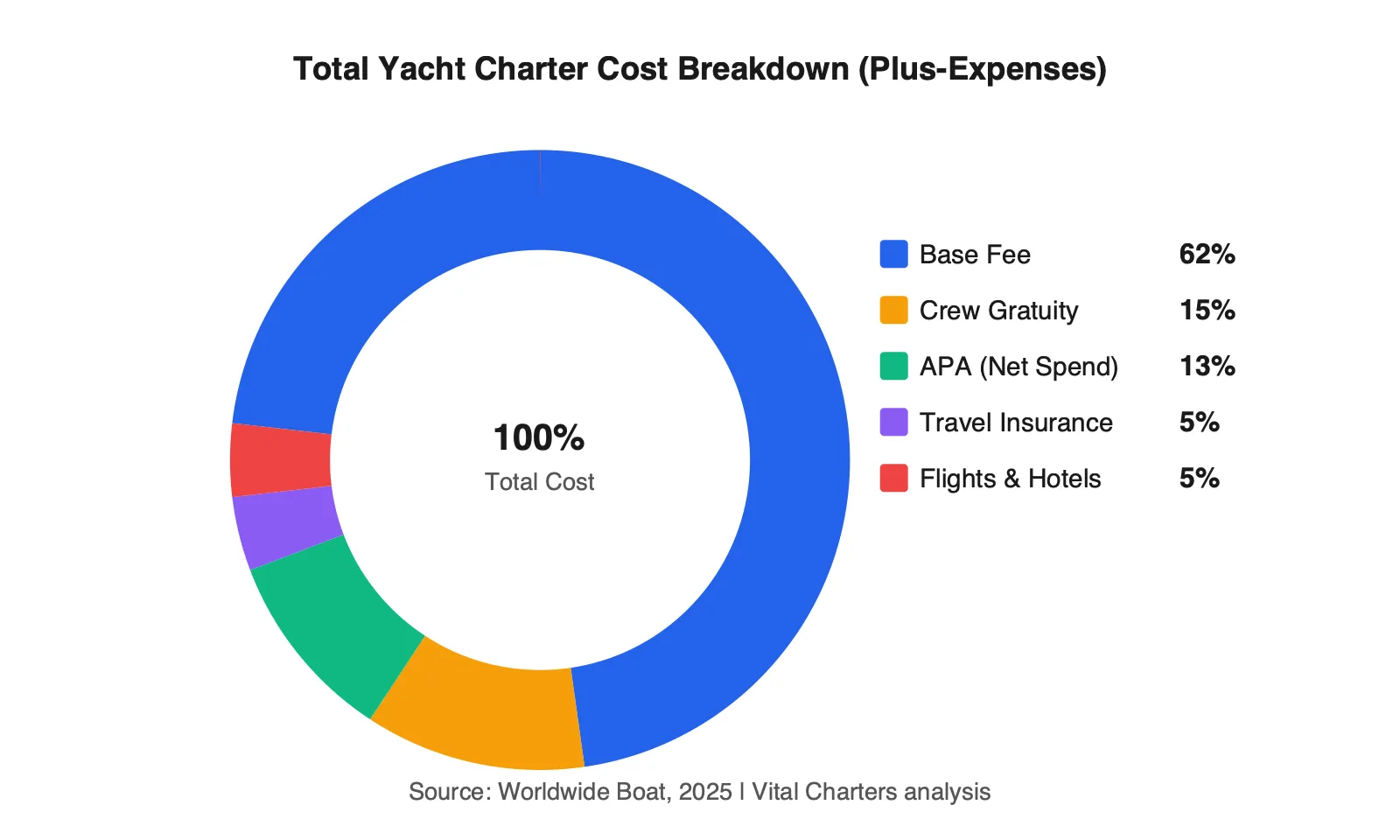
View data table
| Cost Category | % of Total | Example ($25K Base) |
|---|---|---|
| Base Charter Fee | 62% | $25,000 |
| Crew Gratuity (15-20%) | 15% | $3,750-$5,000 |
| APA Net Spend | 13% | $5,000-$6,250 |
| Travel Insurance (4-10%) | 5% | $1,000-$2,500 |
| Flights & Hotels | 5% | $1,500-$3,000 |
| Total Estimated | 100% | $36,250-$41,750 |
The Complete Yacht Charter Budget Worksheet
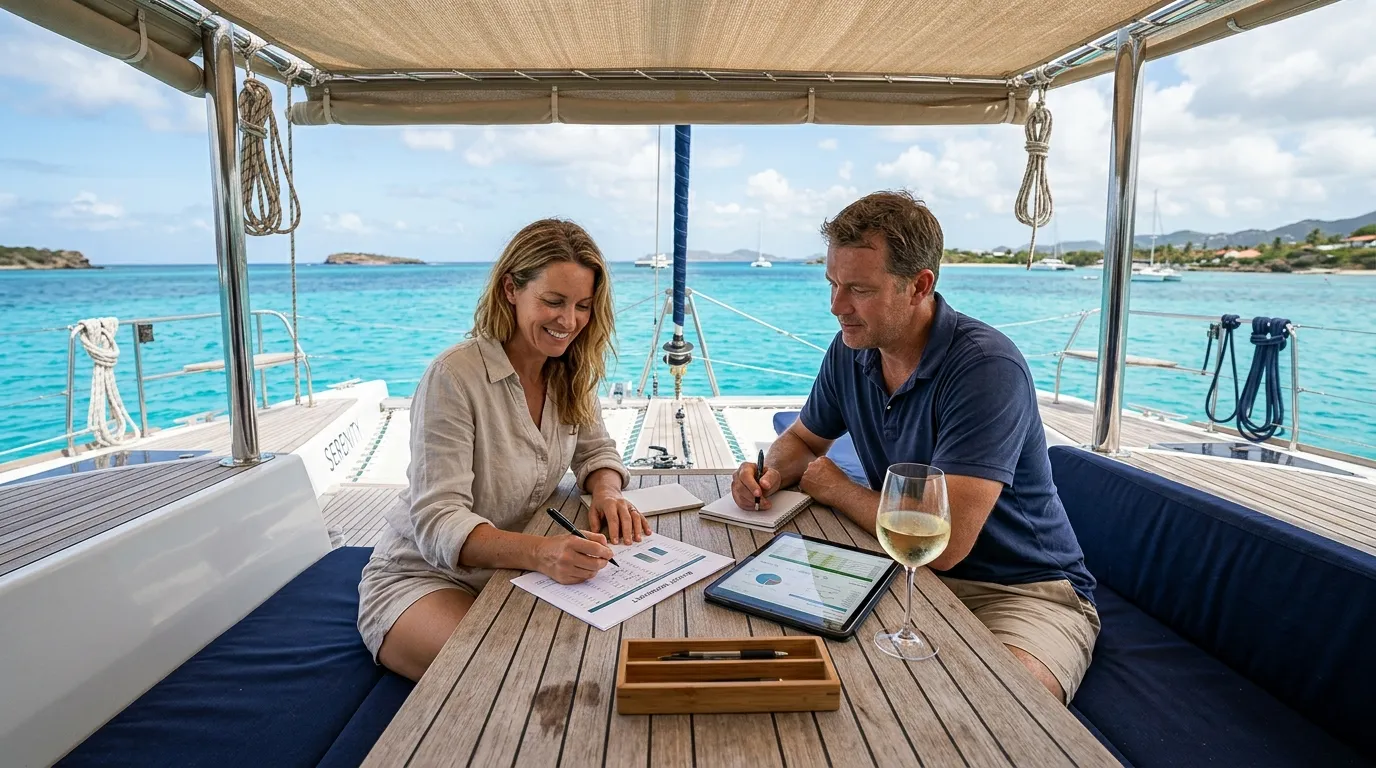
About 70% of first-time charterers underestimate their total trip cost by $3,000-$5,000 because they budget for the base fee alone (Vital Charters client data, 2025). The better question isn’t “how much does a yacht charter cost?”. It’s “what’s my total trip cost?” Here’s the 15-line-item worksheet we send every client before they sign a charter agreement. Print it, fill it in, and you’ll have a realistic number.
| Line Item | Typical Range | Your Estimate |
|---|---|---|
| 1. Base Charter Fee | $15,000-$100,000/week (Caribbean) | $_______ |
| 2. APA (Advance Provisioning Allowance) | 25-40% of base fee (plus-expenses only) | $_______ |
| 3. Crew Gratuity | 15-20% of base fee | $_______ |
| 4. Travel Insurance | 4-10% of total prepaid amount | $_______ |
| 5. Flights (round-trip) | $300-$800/person from U.S. | $_______ |
| 6. Pre/Post-Charter Hotel | $150-$400/night (optional) | $_______ |
| 7. Transfers | $50-$600/person (airport to marina) | $_______ |
| 8. Marine Park Fees | $3/person at The Baths (BVI); varies elsewhere | $_______ |
| 9. Provisioning Upgrades | $0-$500 (premium wines, dietary needs) | $_______ |
| 10. Water Sports Add-Ons | $0-$1,000 (jet ski rental, scuba) | $_______ |
| 11. Dockage/Marina Fees | $0-$500/night (if requesting marina stays) | $_______ |
| 12. Communications | $0-$200 (satellite internet top-ups) | $_______ |
| 13. Destination Taxes | 0% (BVI) to 14% (Bahamas) of base fee | $_______ |
| 14. Repositioning/Delivery Fee | $0-$6,000+ (if yacht must relocate) | $_______ |
| 15. Contingency Buffer | 5-10% of subtotal | $_______ |
| TOTAL ESTIMATED BUDGET | $_______ | |
How to Use This Worksheet
Start with line 1: your base charter fee. If you’re booking an all-inclusive charter, skip line 2 (APA is already baked in). Lines 3 and 4 apply to every charter type. Lines 5-7 are travel logistics most people forget to budget for.
Our observation: The worksheet above is the exact tool we use during our initial consultation call. Clients who fill it out before booking consistently stay within 5% of their target budget, compared to the 15-20% overruns we used to see before introducing it.
Lines 8-14 are variable costs that depend on your destination, yacht, and preferences. Not all will apply to your trip. Line 15, the contingency buffer, is something most guides skip. We don’t. Weather reroutes, a spontaneous lobster dinner ashore, an extra night at a marina. It’s smart to have a cushion. For a full breakdown of what’s typically included in a charter fee, check our MYBA contract guide.
Once you’ve set a budget, put real boats against it, search crewed yachts by destination and group size to see what your number actually charters.
How Does Destination Affect Your Yacht Charter Budget?
Chartering in the BVI costs about 10 percent less than the Bahamas on the same yacht, and the difference is almost entirely tax. The BVI charges zero charter tax while the Bahamas levies 14% on the base fee (Vital Charters, 2026). On a $25,000 base fee, that’s a $3,500 difference from taxes alone.
Destination choice is one of the biggest budget levers you’ve got. Here’s how the numbers stack up across popular Caribbean charter grounds:
| Destination | Charter Tax | Tax on $25K Fee | Cruising Permits | Fuel Cost |
|---|---|---|---|---|
| BVI | None | $0 | $112/guest on a 7-night charter, plus a $10 levy | Lower (short distances) |
| USVI | None | $0 | None. Trunk Bay entry is $5/guest | Lower (short distances) |
| Bahamas | 14% | $3,500 | Vessel permit paid by the yacht, inside the rate | Higher (longer passages) |
| St. Martin / St Barts | None | $0 | None billed to guests | Moderate |
| Grenadines | None | $0 | Tobago Cays about $5.60/guest per day aboard | Moderate |
Beyond taxes, fuel consumption moves the number too. The BVI’s tight island cluster means shorter motor runs between anchorages, which keeps APA spend lower. Bahamas itineraries often involve longer open-water passages, burning more diesel and eating into your APA faster.
Our observation: We’ve seen clients save $4,000-$6,000 by switching from a Bahamas itinerary to the BVI for the same yacht and week. If you’re budget-conscious and it’s your first charter, the BVI gives you the most Caribbean for your dollar. There’s a reason we call it the best-value charter destination in the region.
When Should You Charter for Maximum Savings?
Shoulder season (May-June and November) rarely lowers the published base rate: 280 of 522 Caribbean yachts list the same number in both seasons. The saving arrives as a promotional special instead, and about one yacht in ten is running one at any given time, typically 5 to 10 percent off (Vital Charters listings analysis, September 2026) (Vital Charters, 2026). Christmas and New Year’s week carries a surcharge on top of peak rates, a median of 12 percent among yachts that publish a festive rate, with the middle half between 9 and 15 percent (Vital Charters rate analysis, September 2026). The holiday week is the one part of the calendar that reliably costs more.
Here’s what that looks like in real dollars for a 50-foot crewed catamaran with a $25,000 peak-season base rate:
| Season | Dates | Base Fee | Total Trip Cost | Per Person (6 guests) |
|---|---|---|---|---|
| Holiday | Dec 20-Jan 3 | $28,000 | $44,800 | $7,467 |
| Peak | Jan-Apr | $25,000 | $40,000 | $6,667 |
| Shoulder | May-Jun, Nov | $25,000 | $40,000 | $6,667 |
The shoulder row is not a typo. The published base rate does not fall in May, June or November; what changes is that a promotional offer becomes far more likely. The holiday row carries the measured festive premium, a median of 12 percent above the same yacht’s high season.
A shoulder-season charter on a 50-foot catamaran can save a group of six roughly $15,500 compared to a holiday booking. That’s $2,583 less per person (Vital Charters, 2026). The weather’s still warm, the trade winds are steady, and anchorages are less crowded. If your schedule is flexible, it’s the single biggest budget hack available.
Looking for even more ways to stretch your budget? Our guide to finding real charter deals covers early-booking discounts, repositioning specials, and last-minute savings that most brokers won’t mention.
What’s the Per-Person Cost by Group Size?
A crewed yacht charter gets dramatically cheaper per person as you fill cabins. On a $25,000 week, close to the $23,500 median for a 44 to 50 ft all-inclusive catamaran in the BVI (Vital Charters rate analysis, September 2026), the per-person cost drops from $12,500 for a couple to $3,125 when eight guests split the bill. Are yacht charters worth it? At $3,125 per person for a week-long all-inclusive luxury vacation in the Caribbean, they’re competitive with high-end resort stays.
| Group Size | Base Fee / Person | Total Cost / Person* | Comparable Resort Cost / Person |
|---|---|---|---|
| 2 guests (1 couple) | $12,500 | $20,000 | $10,000-$14,000 |
| 4 guests (2 couples) | $6,250 | $10,000 | $7,000-$10,000 |
| 6 guests (3 couples) | $4,167 | $6,667 | $5,000-$8,000 |
| 8 guests (4 couples) | $3,125 | $5,000 | $4,000-$6,500 |
*Total cost includes gratuity, APA, insurance, and estimated travel. Based on $25K/week all-inclusive catamaran, peak season.
The sweet spot? Six guests on a three-cabin catamaran. You get privacy, space, and a per-person rate that undercuts most luxury resorts, with a private chef, open bar, and a new anchorage every morning thrown in. For a deeper look at how yacht size affects pricing, we’ve got a full comparison from $30K to $100K per week.
First-Timer Budget Mistakes to Avoid
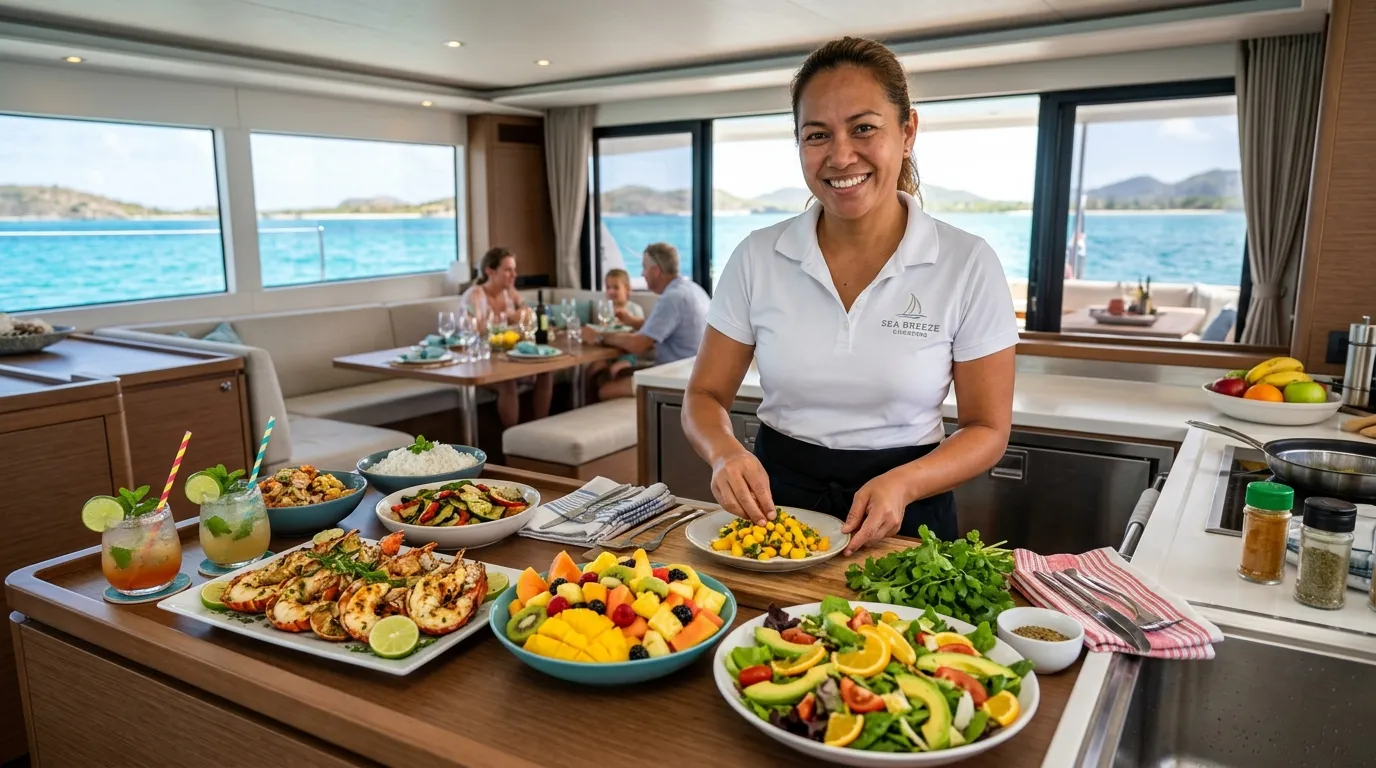
Caribbean crew gratuity runs 15-20% of the base charter fee, not 10% like some outdated guides suggest. On a $25,000 charter, that’s $3,750-$5,000 in gratuity alone. It’s the single most underbudgeted line item we see.
Here are the five mistakes that trip up first-time charterers every season:
1. Budgeting 10% for Gratuity Instead of 15-20%
The 10% figure is the midpoint of MYBA’s old 5-15% suggestion, and MYBA dropped that suggestion from its guidelines in 2026. Caribbean charters have always run higher. Your crew is cooking three meals a day, mixing drinks, anchoring at sunrise, and leading snorkel excursions. Budget 15-20% and you won’t be caught short. Our crew tipping guide breaks down exactly how and when to tip.
2. Forgetting Flights and Hotels
Your charter doesn’t start at the airport. You’ll need round-trip flights to the embarkation port, often Tortola (BVI), St. Thomas (USVI), or Nassau (Bahamas). Plan on one hotel night before boarding and ideally one after disembarkation. Budget $400-$800 per person for flights from the U.S. mainland and $150-$400 per night for a hotel near the marina.
3. Not Understanding All-Inclusive vs. Plus-Expenses
On a plus-expenses charter, your APA deposit (25-40% of the base fee) covers provisioning, fuel, and dockage during the trip. You’ll get an itemized accounting at the end and a refund for any unused portion. An all-inclusive charter bundles all of that into one price. Neither model is “better”: it’s about how you prefer to pay. We explain the tradeoffs in our APA guide.
4. Skipping Travel Insurance
Charter travel insurance with Cancel for Any Reason (CFAR) coverage costs 4-10% of total prepaid charter expenses (Insure Yonder, 2025). On a $25,000 charter, that’s $1,000-$2,500: a fraction of what you’d lose if a hurricane cancels your trip or a medical emergency forces you to rebook.
5. Ignoring Destination Taxes
The Bahamas charges 14% on the charter fee: 10% VAT plus a 4% charter tax, collected together by the Port Department since 1 January 2026. News coverage described it as one consolidated fee (Boat International, 2025), but the gazetted rules keep both charges. On a $25,000 charter, that’s $3,500 you didn’t see in the listing price. The BVI? Zero charter tax. Always ask your broker about destination-specific taxes before committing. They’re one of the most overlooked line items in any yacht charter budget.
How to Work Backwards from Your Budget
The global yacht charter market hit $8.98 billion in 2025 and is projected to reach $18.2 billion by 2034 (Fortune Business Insights, 2025). More people are chartering than ever: and most of them start with a total budget in mind, not a base fee. Here’s how to reverse-engineer your number.
The Quick Formula
Total Budget ÷ 1.60 = Maximum Base Charter Fee
The 1.60 multiplier accounts for gratuity (17.5%), APA or all-inclusive premium (varies), insurance (7%), and travel costs (estimated). It’s a rough guide for plus-expenses Caribbean charters. For all-inclusive charters, use 1.40 instead since food, drinks, and fuel are already baked in.
Worked Example
Say your group of six has a total travel budget of $45,000. Plug it in:
- Plus-expenses charter: $45,000 ÷ 1.60 = $28,125 max base fee
- All-inclusive charter: $45,000 ÷ 1.40 = $32,143 max base fee
That tells you to start shopping for yachts in the $25,000-$32,000 range, depending on charter type. Your broker can then match you to the right yacht, season, and destination to keep you under budget. Not sure where to start? Our planning guide walks you through the booking process step by step.
Our observation: I tell every first-time client the same thing: start with what you’re comfortable spending total, then work backwards to the base fee. Too many people fall in love with a yacht listing and build the budget around it. That’s how you end up $5,000 over. The formula above has saved dozens of our clients from that exact mistake.
Your Next Step: Build Your Budget
You’ve got the worksheet, the formula, and the numbers. Here’s what to do next:
- Print the 15-line worksheet above and fill in your estimates
- Pick your season: shoulder season (May-June, November) buys availability, and it is where promotional specials cluster, so ask what is running
- Choose your destination: the BVI offers zero charter tax and shorter sailing distances
- Use the backwards formula: Total Budget ÷ 1.60 (plus-expenses) or ÷ 1.40 (all-inclusive)
- Talk to a broker: we’ll match your budget to the right yacht, crew, and itinerary
Ready to turn that budget into a real charter? Read our first-time charterer’s guide for everything else you need to know, search crewed yachts in your range, or reach out to us directly. We’ll build a custom quote that fits your number.
Frequently Asked Questions
How much does it typically cost to charter a yacht in the Caribbean?
Entry-level all-inclusive crewed catamarans start at $15,000-$20,000 per week in the Caribbean (Vital Charters rate analysis, 2026). Mid-range 50-foot catamarans run $17,000-$24,000 for the base fee alone. Total trip cost (including gratuity, APA, insurance, and travel) typically adds 40-60% on top. Check our catamaran price tier guide for a full breakdown by yacht size.
What is the 10% rule for yachts?
The “10% rule” says annual yacht ownership costs roughly 10% of the yacht’s purchase price, covering insurance, maintenance, marina fees, and crew. For a $500,000 yacht, that’s $50,000 per year before you even fuel up. That’s one reason chartering often makes more financial sense than owning. We did the full math in our charter vs. ownership cost comparison.
Is APA refundable if we don’t use it all?
Yes. Your APA is a deposit: typically 25-40% of the base charter fee (HELM, 2025). At the end of your charter, the captain provides an itemized accounting of all expenses. Any unused balance gets refunded to you. If expenses exceed the APA, you’ll cover the difference. Our APA explainer covers the full process.
Can I charter a yacht on a $20,000 budget?
A $20,000 total budget puts your maximum base fee around $12,500-$14,300 (using the 1.40-1.60 formula). That’s tight for a crewed catamaran in the Caribbean, but shoulder-season deals and smaller yachts can make it work. Check for repositioning specials and last-minute gaps, which do more for a tight budget than the season does (Vital Charters, 2026).
Do I need to budget for food and drinks on a crewed charter?
On an all-inclusive charter, food and drinks are covered in the base fee. You don’t need a separate food budget. On a plus-expenses (MYBA) charter, provisioning comes out of your APA deposit. Your crew’s chef will ask about preferences beforehand. Premium wine requests or dietary accommodations might cost extra. Budget $200-$500 for upgrades if you have specific tastes. See what’s included in a charter fee for the full list.
Your all-in cost, itemized clearly.
Share your group size, dates, and target budget and we’ll send real crewed-yacht options with every line item (base rate, APA, gratuity) laid out before you sign.