
Catamaran Charter Caribbean: 2026 Rates, Destinations, and What’s Included
Crewed Caribbean catamaran charters list at a $31,500 median per week all-inclusive for winter 2026-27. Rate bands by size and destination across 670 yachts.
A crewed Caribbean catamaran charter lists at a median of $31,500 per week all-inclusive for winter 2026-27, based on the 272 currently bookable high-season rate listings among the 670 active crewed yachts we track (verified August 2026). That single number answers the question most pages dodge, and the rest of the spread is just as knowable: $21,000 medians for the smallest crewed cats, $74,000 for the largest, and destination medians within $1,000 of each other from the BVI to the Grenadines.
This guide publishes the 2026 rate bands by size and by destination, explains what all-inclusive actually covers, breaks down how catamaran charter companies differ, and lists every fee that lands on the invoice beyond the weekly rate. All of it comes from listed asking rates on the crewed fleet we broker, so you can check our arithmetic.
Last Updated: August 31, 2026
How much does a Caribbean catamaran charter cost in 2026?
Most crewed catamaran charters in the Caribbean list between $25,000 and $100,000+ per week all-inclusive for up to 12 guests. Across the 272 winter 2026-27 rate listings among the 670 active crewed yachts we track, the median is $31,500 per week, with the middle half between $24,500 and $43,000.
Widening that cut to every sailing catamaran working the region, not just the winter listings above, puts the median at $32,000 a week all in across 316 yachts, or $571 per guest per night once the boat is divided by the people aboard (Vital Charters rate analysis, September 2026). The per-guest number is the one worth carrying into a comparison: it is the only figure that survives being put next to a motor yacht, which runs $1,743. Full working in the 2026 fleet rate report.
Length is what moves the number. Here are the medians for all-inclusive crewed sailing catamarans in the Virgin Islands, high season 2026-27, by size band:
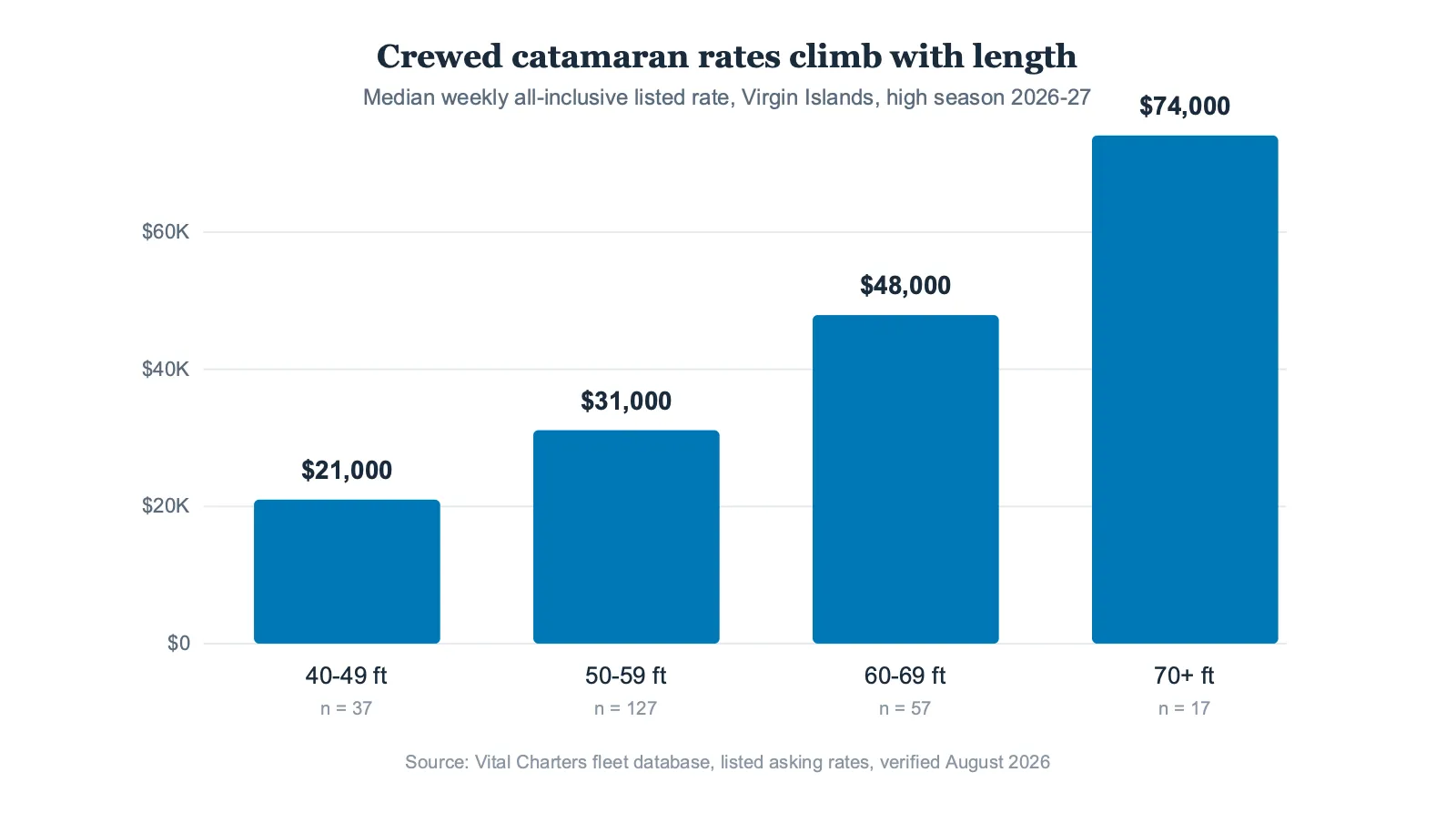
View data table
| Size band | Median weekly rate (all-inclusive, high season) | Listings |
|---|---|---|
| 40-49 ft | $21,000 | 37 |
| 50-59 ft | $31,000 | 127 |
| 60-69 ft | $48,000 | 57 |
| 70+ ft | $74,000 | 17 |
Two seasonal facts surprise almost everyone. First, winter and summer list nearly flat: the low-season median is $31,000 against winter’s $31,500, a difference of about 2 percent. Second, the real premium is the festive weeks. Yachts that publish a separate Christmas and New Year rate list a median 14 percent above their own winter rate; the group’s medians are $75,000 against $65,000, among the 22 of 670 yachts that price those weeks separately.
Planning for eight guests? The median listed rate for an 8-guest all-inclusive week is $36,000 across 195 current listings (August 2026). Rates step with guest count on most yachts, so a party of six often pays less than the 12-guest headline figure for the identical boat. For the wider market picture beyond catamarans, see our full guide to Caribbean yacht charter costs.
All figures are listed asking rates published by the yachts’ central agents, not audited transaction prices. Where a total includes an advance provisioning allowance, unspent APA is refunded at the end of the charter.
What lands on a Caribbean charter invoice in 2026
The island sets the amounts: 14 percent in Bahamas taxes, up to $16 per guest per day in BVI cruising fees, nothing per guest in the USVI. The contract sets who pays: all-inclusive rates cover permits, park fees and levies in the vast majority of cases; charter taxes and the 15 to 20 percent gratuity are always yours.
| Line item | Typical amount | Who sets it | Source |
|---|---|---|---|
| APA (Advance Provisioning Allowance) | None mandatory on all-inclusive catamarans (about 2 percent of rates state around 5 percent). Plus-expenses charters add an APA, typically 30 to 35 percent of the base rate, intended to cover every running fee except government taxes, refunded where unspent | The charter contract; mechanics per MYBA | MYBA, Information for Charter Yacht Captains and Crew |
| Government charter taxes | 0 to 14 percent of the charter fee by destination; the Bahamas is highest at 10 percent VAT plus a 4 percent charter tax (per-destination figures in the destination blocks) | Each territory’s government | S.I. No. 57 of 2025 (Bahamas example) |
| Marine park fees | Where you cruise them: EC$15 per guest per day at the Tobago Cays, $12.73 per extra guest per day in the Exuma park, $3 at the BVI’s Baths | TCMP; Bahamas National Trust; BVI National Parks Trust | TCMP fee schedule, effective January 1, 2023 |
| Crew gratuity | Customarily 15 to 20 percent of the charter fee in the Caribbean crewed fleet, the band CYBA’s Inclusive Agreement (Clause 2.B) calls the customary rate; MYBA’s 2026 guidelines publish no percentage, and both leave it at your discretion | Custom, written into the CYBA form | CYBA Inclusive Agreement, Clause 2.B (2020) |
Fees verified September 2026.
Where should you charter? 2026 destination rates compared
The five main Caribbean charter grounds price within $1,000 of each other: median listed rates for an all-inclusive crewed sailing catamaran in high season run $31,000 to $32,000 per week everywhere from the BVI to the Grenadines, based on Vital Charters’ listings analysis verified August 2026. What changes is the sailing, not the invoice.
| Destination | Median weekly rate (all-inclusive sail cat, high season) | Current listings |
|---|---|---|
| British Virgin Islands | $32,000 | 237 |
| U.S. Virgin Islands | $32,000 | 156 |
| Leeward Islands (St. Martin to Antigua) | $32,000 | 92 |
| Windward Islands and Grenadines | $31,000 | 83 |
| Bahamas | $31,000 | 29 |
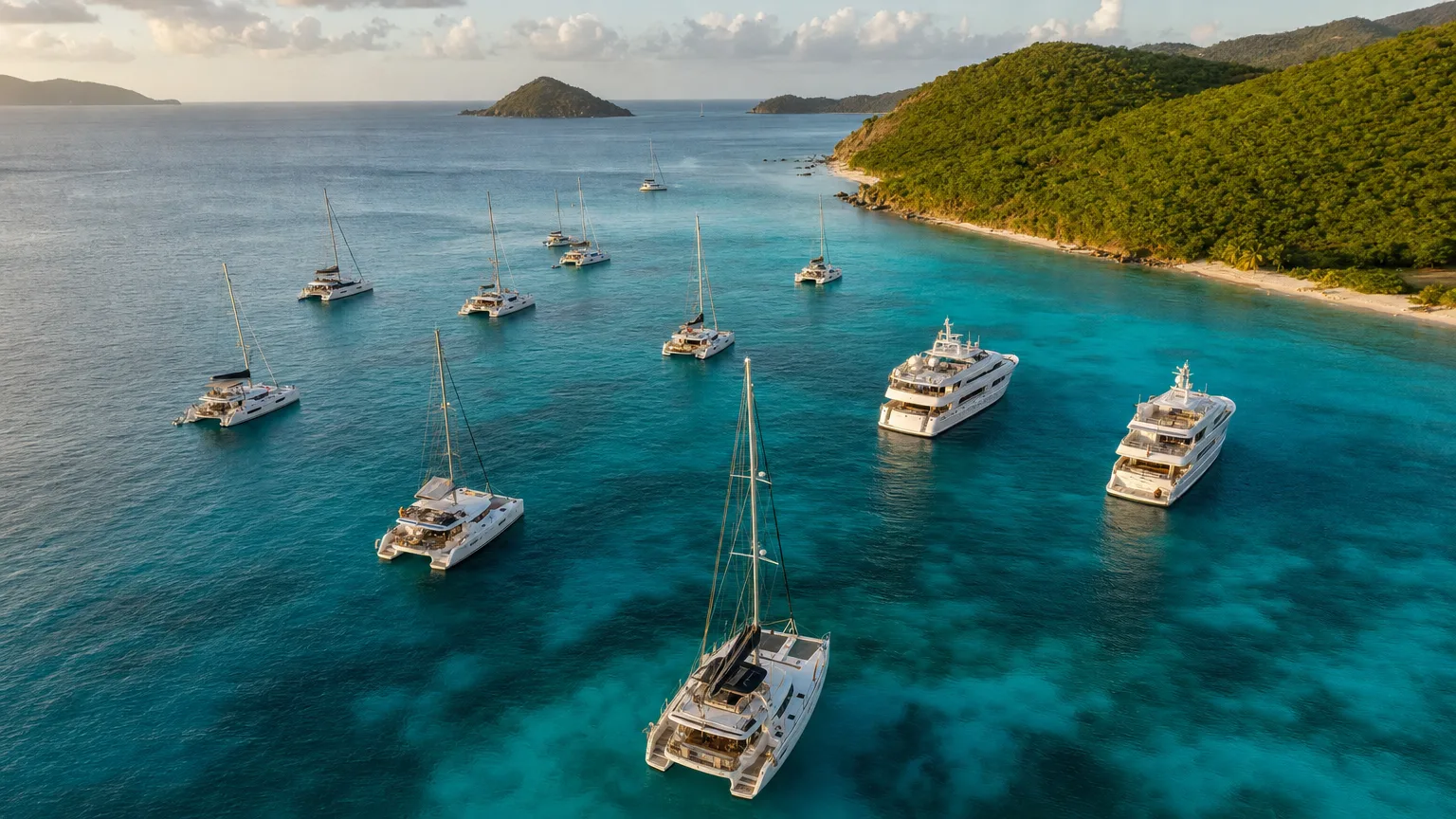
Since price won’t make the decision for you, the water should. The British Virgin Islands carry the deepest catamaran fleet in the hemisphere and the shortest hops: most passages run 5 to 15 protected miles, which is why first-timers start there. The U.S. Virgin Islands sail the same waters with no passport needed for U.S. citizens.
Further south and east, the character shifts. The Grenadines trade the BVI’s beach bars for empty anchorages and the Tobago Cays’ turtle-filled lagoon. The Bahamas are a different animal entirely: shallow banks, swimming pigs, and iguana-filled cays. A catamaran’s 3 to 5 foot draft is the whole reason you can anchor there at all. Our guide to Caribbean crewed charter destinations walks every chain in detail.
What’s included on a crewed all-inclusive catamaran?
All-inclusive is the Caribbean’s default contract: 817 of the 1,473 current rate listings (verified August 2026), or 55.5 percent, price this way. One weekly figure bundles the yacht, a professional crew, all meals, the standard ship’s bar and daily cruising fuel, per the CYBA all-inclusive contract model. The rest are plus-expenses charters, mostly motor yachts.
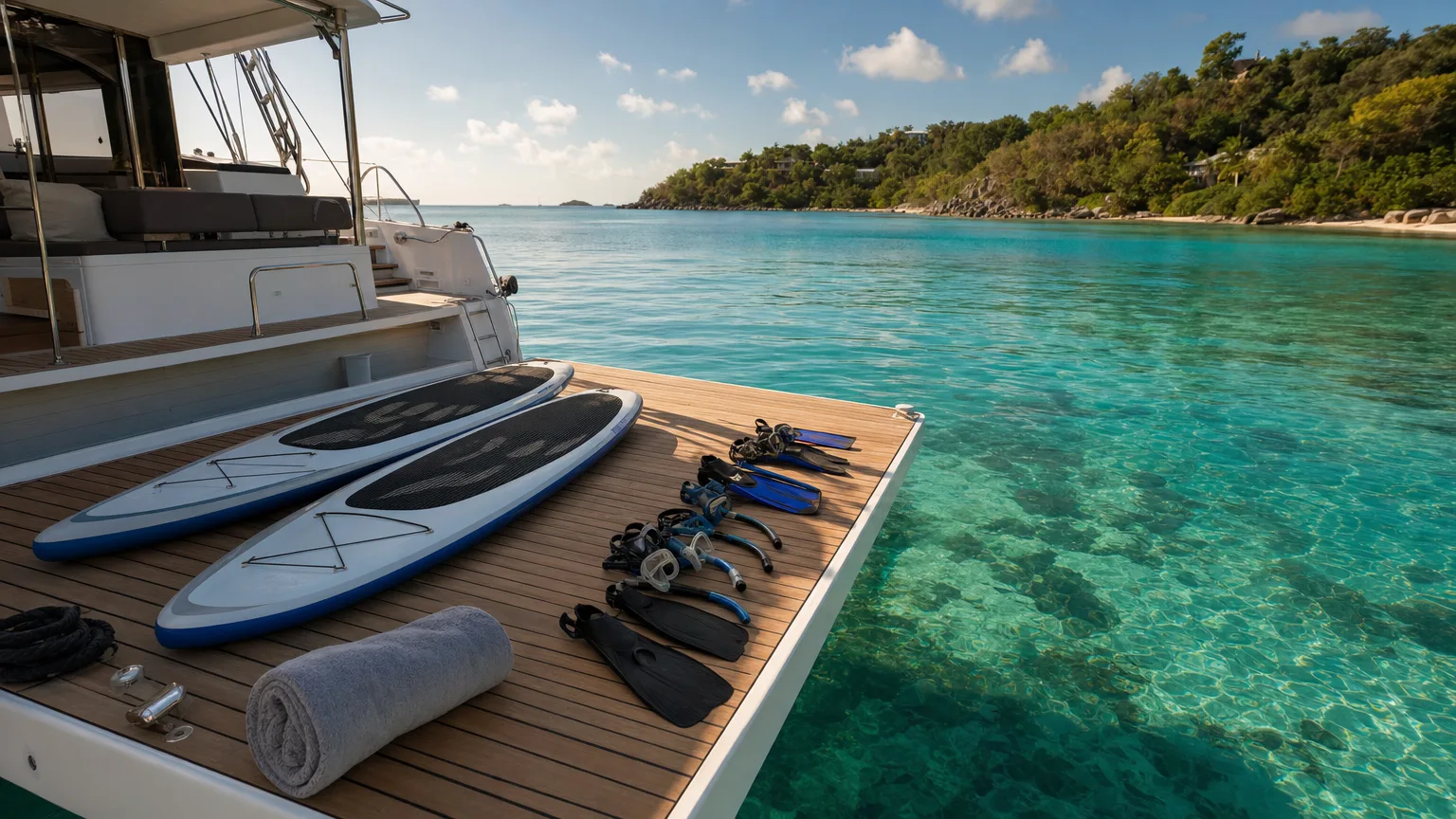
In practice that means your chef shops and cooks to a preference sheet you fill out before the trip, the bar is stocked to your list, and the water toys (paddleboards, snorkel gear, tow toys, often a sailing dinghy) are on board and included. You step off at the end of the week having paid the rate, the gratuity, and any charter tax your destination levies; the permits, levies and park fees are inside the rate on the vast majority of contracts. That’s the list.
What about APA, the escrow fund that motor-yacht charters bill on top? On all-inclusive catamarans there’s no mandatory APA on all but about 2 percent of current rates, and the exceptions state around 5 percent. Plus-expenses charters are the opposite: an APA of typically 30 to 35 percent of the base rate, reconciled against real spending, with the unspent balance refunded. Our guides to APA budgeting and charter costs, rates and add-ons run the numbers on both models.
How catamaran charter companies differ in 2026
Three kinds of companies sell catamaran charters in the Caribbean: crewed fleet operators, bareboat fleet companies, and charter brokers. The yacht’s central agent sets one listed rate that every broker quotes, so where you book changes the service you get, not the price. Vital Charters brokers a network of 670 active crewed yachts (verified August 2026) under this model.
Here’s how the three differ. Crewed yachts are mostly individually owned businesses: a couple or a small crew who live aboard, marketed through a central agent. Bareboat companies run standardized fleets of dozens of near-identical cats that you skipper yourself, and their headline rates sit far below crewed listings: a 4-cabin bareboat catamaran in the BVI lists around $10,000 per week in high season, but provisioning, fuel, mooring and the damage waiver typically add 25 to 50 percent, so a loaded bareboat week still lands roughly 30 to 44 percent below a crewed all-inclusive rate. Our 2026 bareboat pricing comparison runs that arithmetic line by line. A broker works across the whole crewed network, matching your dates, group and preferences against yachts and crews they’ve seen in person.
Because the listed rate is identical everywhere, the useful questions to ask a company aren’t about discounts. Ask how many of the yachts they’ve stepped aboard, how they handle a crew change between booking and boarding, and what happens if weather forces an itinerary rewrite. Our guide on how to choose a charter broker covers the vetting questions in depth.
One caution when you compare across categories: a bareboat quote and a crewed all-inclusive quote aren’t the same product. One is a boat; the other is a boat plus a crew, a chef and a stocked galley. Compare landed cost against landed cost, or the cheaper number will mislead you.
Sailing vs power catamaran rates in 2026
Power catamarans list about 34 percent above sailing catamarans in the Caribbean: a median $42,210 per week all-inclusive in high season 2026-27 against $31,500 for sail, from 25 and 272 current rate listings respectively. You’re paying for speed and range, not more cabin.
A power cat covers ground at 15 to 20 knots against a sailing cat’s 8 to 10, which turns a two-anchorage day into a three-anchorage day and puts the far end of a chain within reach. The choice is thinner, though: current listings carry 42 active power cats against 348 sailing cats, so the boat you want books earlier. At the top end the premium steepens, with 70-foot-plus power cats in the Virgin Islands listing at a $91,500 median (6 listings).
Which hull suits your week comes down to how much of the day you want under way and whether engine hum bothers you at cruise. We’ve compared the two in detail in our sailing vs power catamaran guide.
Catamaran or motor yacht: which should you book?
Crewed motor yachts list at a median $118,800 per week for winter 2026-27 once the typical advance provisioning allowance is folded in (167 listings; unspent APA is refunded at the end of the charter). That’s nearly four times the sailing catamaran median, and it buys a genuinely different vacation.
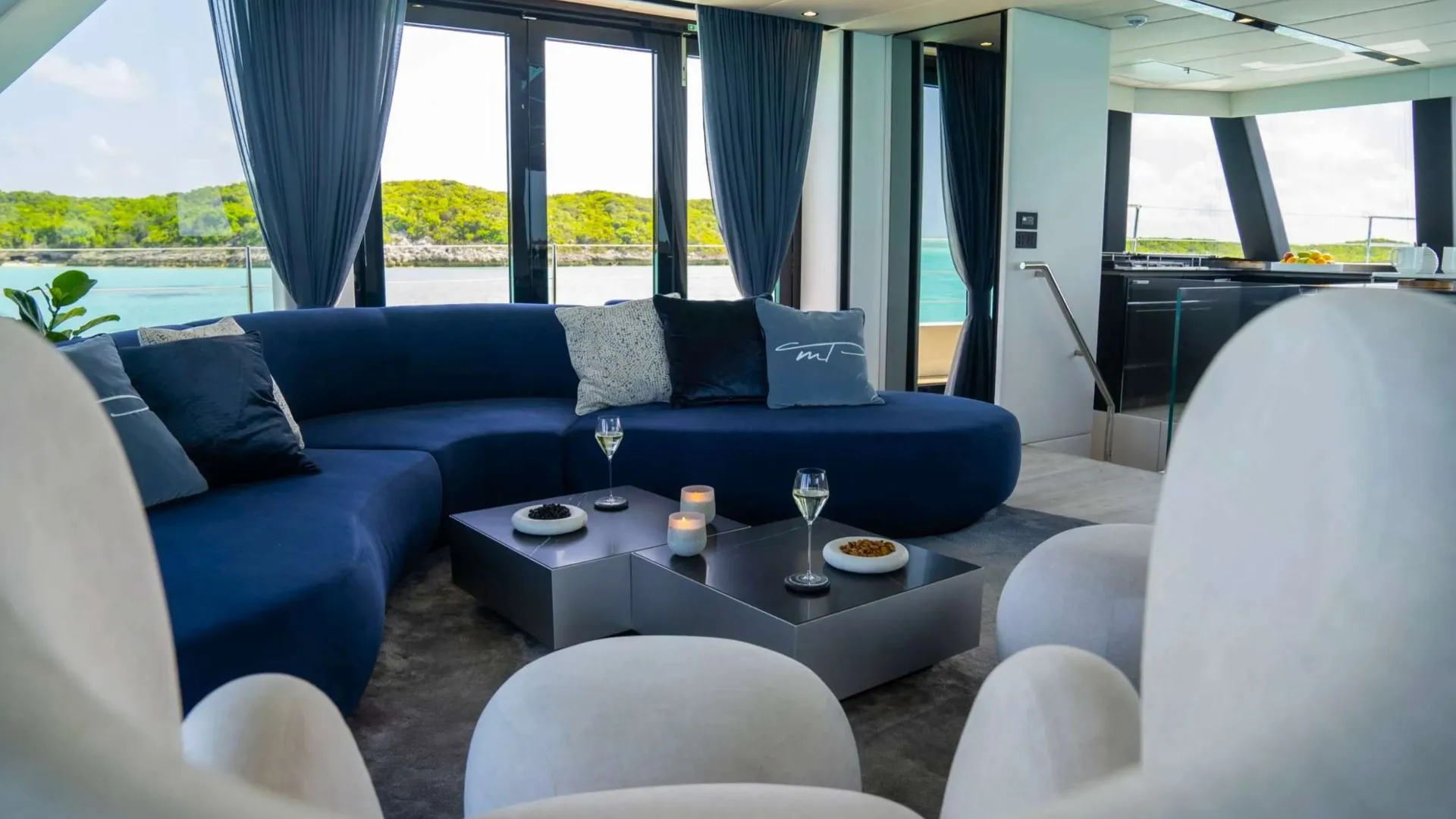
What does the extra money get you? Vertical space and service depth. A 90-foot motor yacht carries three decks, a hot tub, a formal dining room and a crew of four to eight, where a 60-foot cat carries four equal cabins and a crew of two or three. Motor yachts dominate the top of the market: they generate 57.52 percent of global charter revenue despite a smaller share of bookings (Mordor Intelligence, 2025).
The catamaran’s advantages are structural, not just financial. Twin hulls barely rock at anchor, and every cabin comes out roughly equal, so nobody draws the bad room. A cat’s 3 to 5 foot draft opens the Tobago Cays, Anegada and the Exuma sandbars, places a motor yacht drawing 6 to 10 feet can’t follow. And any charter yacht is capped at 12 guests under the international SOLAS convention (IMO), so a bigger boat buys space per guest, never a bigger party.
Efficiency favors the cat, too. In Yamaha test data, a power catamaran burned 33 gallons on a 50-nautical-mile run where a comparable monohull burned 45: about 27 percent less fuel in 25 percent less time (Yamaha Outboards, 2024).
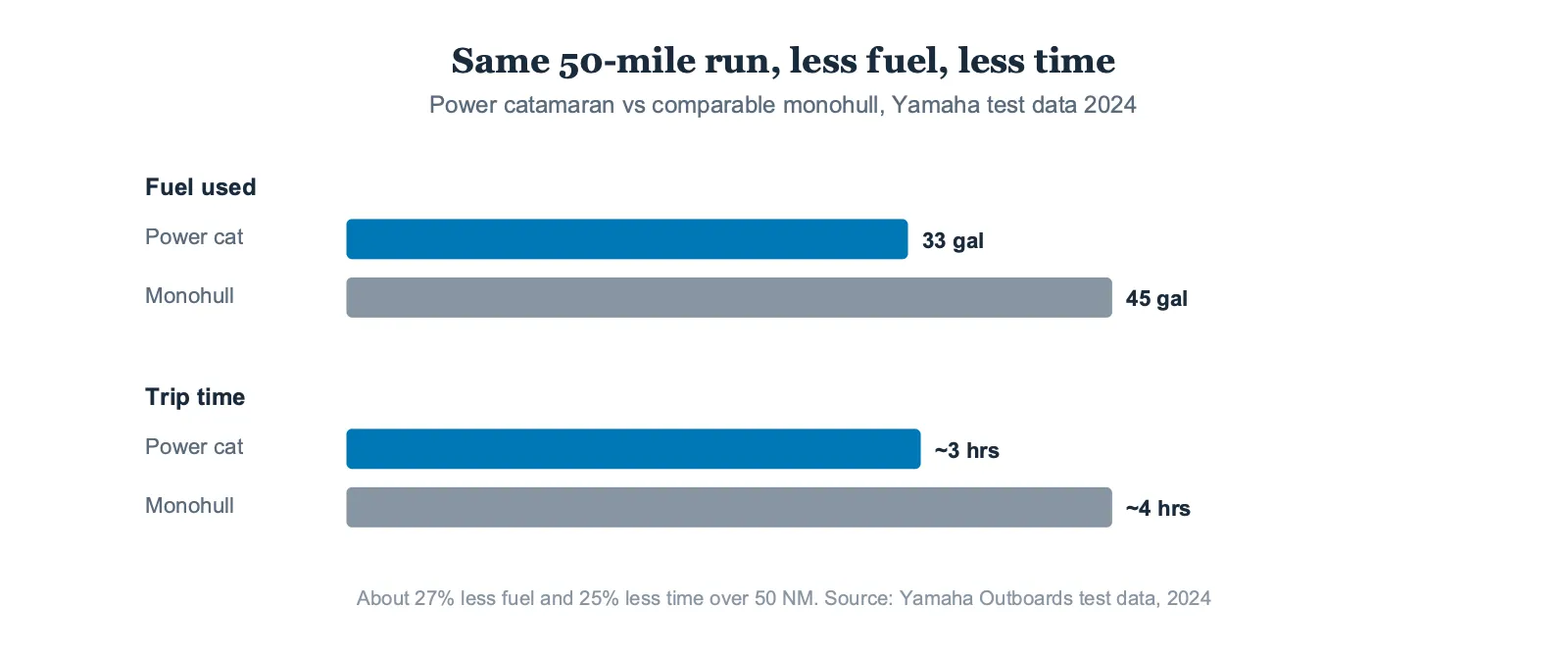
View data table
| Metric | Power Catamaran | Motor Yacht | Difference |
|---|---|---|---|
| Fuel used (50 NM) | 33 gallons | 45 gallons | 27% less |
| Trip time | ~3 hours | ~4 hours | 25% faster |
| Cost per NM ($7/gal) | $4.62 | $6.30 | $1.68 saved |
When the motor yacht wins
Choose the motor yacht when the budget clears roughly $80,000 per week (the bottom quartile of current motor listings is $77,000), when the itinerary covers 200+ nautical miles across chains, or when hotel-grade interiors matter more than shallow anchorages. Our breakdown of charter costs by size shows what each budget tier buys.
| Factor | Catamaran | Motor yacht |
|---|---|---|
| Median weekly cost, winter 2026-27 | $31,500 all-inclusive (n=272) | $118,800 with APA folded in (n=167) |
| Guest capacity | 6-12 in equal cabins | 6-12, master-suite hierarchy |
| Cruising speed | 8-10 kn sail, 15-20 kn power cat | 12-18 kn |
| Draft | 3-5 ft, shallow access | 6-10+ ft, deep water only |
| Pricing model | All-inclusive | Plus expenses, APA 30-35% |
| Crew | 2-3 | 4-8+ |
| Best for | Families, couples, budgets under $80K | Luxury seekers, long itineraries, $80K+ |
Motor-yacht totals fold in the advance provisioning allowance; unspent APA is refunded at the end of the charter.
Still weighing the water against a resort week on land? We’ve run that comparison too, in crewed yacht charter vs luxury resort.

Ready to price your 2026 catamaran week?
The numbers above are the market, and they’re published so you can plan against them: a $31,500 median week, size bands from $21,000 to $74,000, destinations priced within $1,000 of each other, and a fee table with nothing hidden. The next step is matching a specific yacht and crew to your dates and your group, which is what the crewed charter specialists at Vital Charters do all day. See our answer to: Can catamarans handle rough seas? Tell us your week, your headcount and which islands are calling, and we’ll shortlist catamarans with current 2026-27 rates and crews we know by name.
Frequently Asked Questions
How much is a crewed catamaran charter in the Caribbean in 2026?
The median listed rate is $31,500 per week all-inclusive for high season 2026-27, across 272 current listings among the 670 crewed yachts we track. By size, medians run $21,000 for a 40-49 foot cat up to $74,000 at 70+ feet. An 8-guest week lists at a $36,000 median.
What taxes and fees are added to a Caribbean yacht charter?
It varies by destination: 14 percent in the Bahamas (10 percent VAT plus a 4 percent charter tax), $4 to $16 per guest per day in BVI cruising fees plus a $10 arrival levy, marine park fees in the Grenadines and Exumas, nothing per guest in the USVI, and in the French islands only a 1 euro per person per day waste tax in Gustavia. On all-inclusive terms the permits, levies and park fees are covered by the rate in the vast majority of cases; the percentage taxes and the crew gratuity are the lines you pay directly.
What does all-inclusive actually include?
The yacht, the crew, all meals prepared aboard, the standard ship’s bar, daily cruising fuel and the water toys, in one weekly rate on the CYBA contract model. You add a customary crew gratuity of 15 to 20 percent and any charter tax your destination levies; in the vast majority of cases the rate already covers the island’s permits, park fees and levies. About 98 percent of all-inclusive rates carry no mandatory APA.
Can catamarans handle rough seas in the Caribbean?
For island-hopping, yes: typical passages run 5 to 20 nautical miles in protected water, where a catamaran’s twin hulls ride flat. In open crossings with 6-foot swells you’ll feel bridge-deck slap, the hulls hitting waves underneath. Most charter itineraries simply avoid rough crossings and stay inside sheltered chains like the BVI or Grenadines.
What is the disadvantage of a catamaran?
Three trade-offs: a rougher ride in open-ocean swell, slower speeds under sail (8 to 10 knots against a motor yacht’s 12 to 18), and less vertical interior space. No multi-deck layouts, formal dining rooms or hot tubs; those live on motor yachts above 80 feet, at motor-yacht prices.
What’s the 12-person yacht rule?
Vessels carrying more than 12 passengers are classed as passenger ships under the international SOLAS convention, with far stricter inspection and licensing standards. That’s why nearly every charter yacht in the Caribbean, catamaran or motor yacht, tops out at 12 guests regardless of its size.
See the fleet’s real rates
Tell us your dates, group size and islands, and we’ll shortlist crewed catamarans with current 2026-27 rates across 670 active crewed yachts.