
Vacation During Caribbean Hurricane Season: The Real Odds
Planning a vacation during hurricane season in the Caribbean? NOAA runs the season June 1 to November 30. Here are the real storm odds and the real discounts.
Last Updated: September 7, 2026
Is It Safe to Vacation in the Caribbean During Hurricane Season?
Yes, and 2026 is a calmer year than most. NOAA’s August 6 update lowered the forecast to 7 to 13 named storms, 2 to 6 hurricanes and 0 to 2 major hurricanes, against 30-year averages of 14, 7 and 3, and raised the odds of a below-normal season to 75 percent (NOAA Climate Prediction Center, August 2026). Two named storms had formed by early September, Arthur and Bertha, and both made landfall on the US Gulf coast rather than in the Caribbean.
The wider pattern holds in normal years too. Caribbean tourism reached 35 million stay-over visits in 2025, up 2.5% year-over-year, and that growth included the summer and fall months (Caribbean Tourism Organization, 2026). Millions of people take a Caribbean vacation during hurricane season every year without incident.
Picking the right spot and the right type of trip makes all the difference. If you’re planning a Caribbean yacht charter, storm season can actually work in your favor. A skilled crew tracks weather days ahead and can move your yacht to safe harbors or reroute to a different island chain. That’s a kind of flexibility you won’t find at any hotel.
The reason forecasters are relaxed is El Nino. NOAA puts the chance of a strong or very strong event at 90 percent through the season, and every strong El Nino in the modern record has come with below-average Atlantic hurricane activity (NOAA Climate Prediction Center, August 2026). That is a forecast, not a guarantee, and it is worth re-checking in the week before you travel.
Cruise traffic tells the same story. Caribbean cruise visits reached 35.5 million in 2025, up 5.2% over 2024, with the region capturing 72% of all U.S. cruise passengers (CLIA, 2025). Storm season clearly doesn’t scare off experienced travelers.
When Is Caribbean Hurricane Season? June 1 to November 30
The Atlantic hurricane season officially runs from June 1 through November 30. Those are the dates set by NOAA and used by its National Hurricane Center, and they cover the Caribbean, the Gulf and the wider Atlantic basin. The season peaks on September 10, and most activity falls between mid-August and mid-October. The 1991-2020 averages are 14 named storms, 7 hurricanes and 3 major hurricanes a season (NOAA National Hurricane Center, 30-year climate normals). Those dates are a planning convention rather than a hard wall, and NOAA issues outlooks either side of them, but they are the window every insurer, charter contract and cancellation policy is written around. The practical shape of the season shows up in the Hurricane Center’s benchmark formation dates: in an average year the first named storm forms about June 20, the sixth by August 29, and the tenth by September 22. The opening ten weeks of the season therefore carry a small share of the year’s activity, which is why June and early July charter normally and late August does not.
Storms do not spread evenly across those six months. June and November see almost no tropical activity, while August through October carries most of the risk.
NOAA’s 30-year storm data breaks down like this:
| Month | Named storms formed by month end | Formed during the month | Risk level |
|---|---|---|---|
| June | 1 | 1 | Low |
| July | 2 | 1 | Low |
| August | 6 | 4 | Rising |
| September | 10 | 4 | Peak |
| October | 13 | 3 | Moderate |
| November | 14 | 1 | Low |
Derived from the National Hurricane Center’s benchmark formation dates for an average Atlantic season, 1991-2020: the 1st named storm forms about June 20, the 6th by August 29, the 10th by September 22 and the 14th by November 19. The column totals to NOAA’s 14-storm seasonal average.
June and November barely show up on the storm scale. July stays quiet too. The real danger window is mid-August through mid-October, and even then, most storms track well north of the southern Caribbean.
Which Caribbean Islands Are Safest During Hurricane Season?
The safest islands you can actually charter from are Grenada and St. Vincent and the Grenadines. Both sit at the southern end of the chain, below the track most Atlantic storms follow. Vital Charters listings analysis counts 207 active crewed yachts working the Windward Islands and none based in Aruba, Bonaire or Curacao (September 2026), so the Dutch ABC islands that most hurricane-season articles recommend are not somewhere you can pick up a crewed yacht. They are a good flight-and-hotel answer and a poor charter one.
Geography drives it. Hurricanes form in the tropical Atlantic and usually curve northwest, hitting islands in the northern and central Caribbean far more often than those below 13°N latitude. Southern islands also get much less rain.
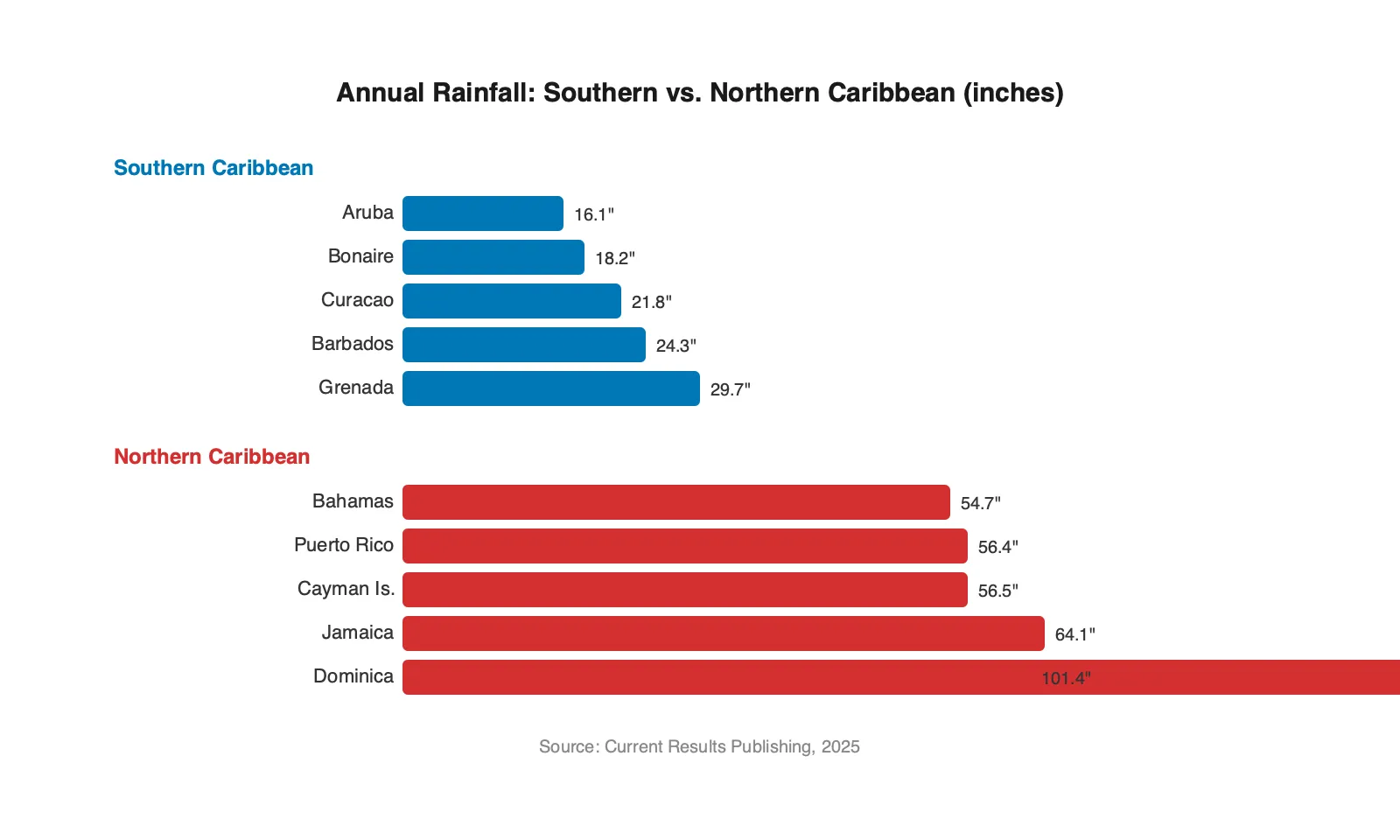
View data table
| Region | Island | Annual Rainfall (inches) |
|---|---|---|
| Southern Caribbean | Aruba | 16.1 |
| Southern Caribbean | Bonaire | 18.2 |
| Southern Caribbean | Curacao | 21.8 |
| Southern Caribbean | Barbados | 24.3 |
| Southern Caribbean | Grenada | 29.7 |
| Northern Caribbean | Bahamas | 54.7 |
| Northern Caribbean | Puerto Rico | 56.4 |
| Northern Caribbean | Cayman Islands | 56.5 |
| Northern Caribbean | Jamaica | 64.1 |
| Northern Caribbean | Dominica | 101.4 |
Source: Current Results Publishing, 2025
Beyond the ABC islands, Grenada, Barbados, and St. Vincent and the Grenadines also sit south of the main hurricane track. The Grenadines make an exceptional crewed yacht charter itinerary during summer: you’ll find empty anchorages and lower rates without major storm risk.
The practical difference on the water is smaller than the map suggests. A Grenadines charter in August sits well south of most tracks and inside a chain of short hops, so a captain watching a system develop has a sheltered anchorage within a few hours in almost any direction. That is the reason the southern islands work in storm season, more than the strike statistics.
How Much Can You Save on a Caribbean Charter During Hurricane Season?
Usually much less than you have been told, and for most yachts nothing at all. Of the 522 Caribbean yachts that publish both a high-season and a low-season rate, 280 quote the identical number in both, which is 54 percent (Vital Charters rate analysis, September 2026). Across the whole group the median difference between a winter week and a summer week is zero.
Which hull you choose decides whether a discount exists at all, and the split is stark. Catamarans, the boat most charter parties book, are the least likely to move: 220 of 299 hold the same rate year-round, and the ones that do come down drop a median of 6.7 percent. Motor yachts run the other way, with only 24 percent holding firm and a median cut of 10.8 percent when they move.
| Hull | Yachts publishing both rates | Same rate in both seasons | Median cut when it moves |
|---|---|---|---|
| Catamaran | 299 | 220 (74%) | 6.7% |
| Motor yacht | 168 | 40 (24%) | 10.8% |
| Power catamaran | 36 | 16 (44%) | 7.2% |
| Monohull | 19 | 4 (21%) | 10.8% |
| All Caribbean yachts | 522 | 280 (54%) | 9.9% |
Source: Vital Charters rate analysis of current Caribbean and Bahamas crewed charter rates, September 2026. Yachts publishing an unexpired rate in both a high and a low season; listed rates, gratuity excluded.
Deep summer discounts do exist, but they are rare enough that planning a trip around one is a mistake. Fewer than one yacht in ten drops its rate by even 15 percent, and only seven of the 522 come down by 30 percent or more. The rate card is only half the picture, though. Promotional specials sit outside it, and they cluster in exactly these months: at the time of writing 65 of 635 Caribbean and Bahamas yachts carry a live offer, a median of 10 percent off, with most between 5 and 10 percent (Vital Charters listings analysis, September 2026). Those are not published on the rate sheet and they change week to week, which is the real reason to ask rather than assume. The other reliable storm-season savings are airfare and having the anchorages to yourself.
For a full breakdown of what goes into charter pricing (base rate, APA, crew gratuity) see our guide to yacht charter costs. Knowing the fee structure helps you figure out exactly how much you’ll save off-season.
First-time charterer? Our all-inclusive charter guide walks through the different pricing models so you know what’s included.
Why Is a Crewed Charter the Best Hurricane Season Vacation?
A crewed charter’s hurricane-season advantage is mobility, not price. Your captain watches developing systems days ahead and can move the yacht to the lee of an island, or leave for a different island chain entirely, while a hotel guest is still on hold with an airline. No resort or cruise itinerary can be redrawn that fast.
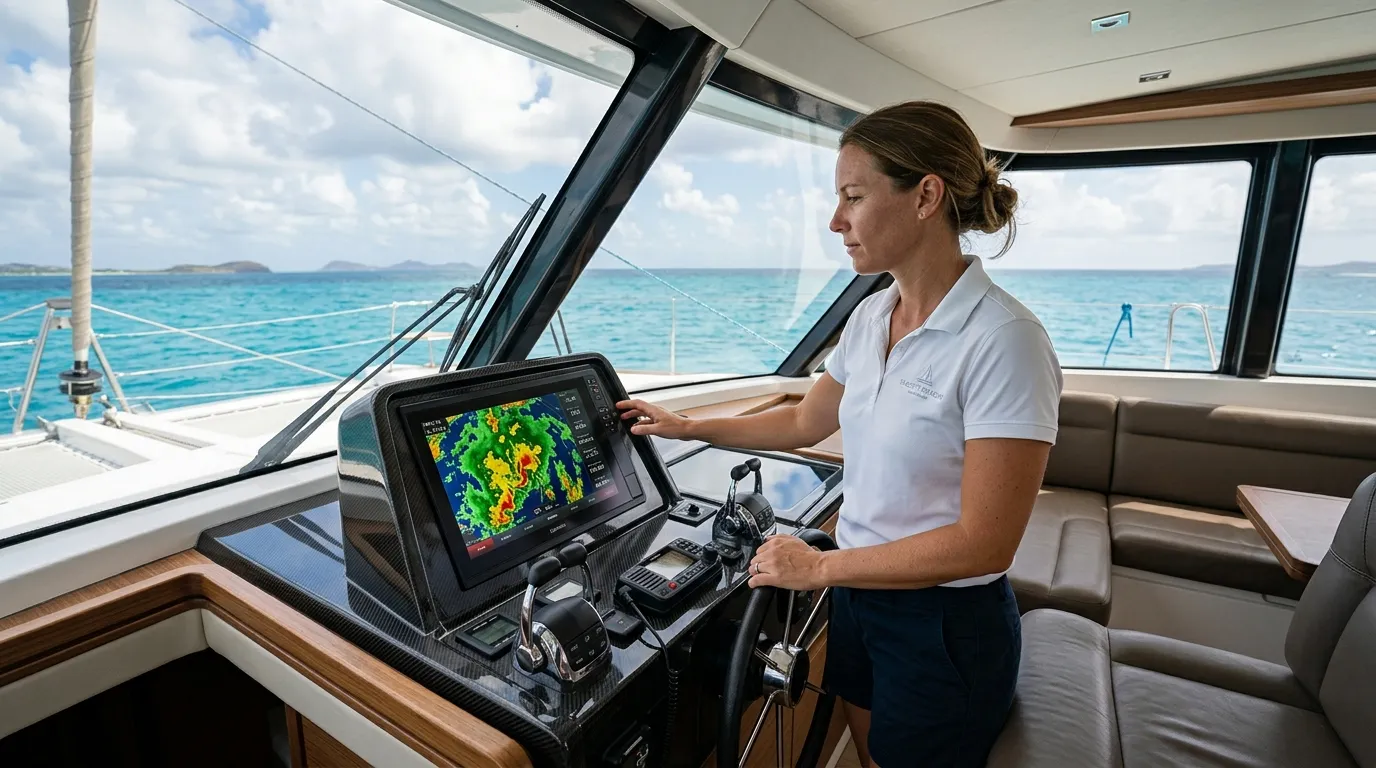
Your captain tracks weather using marine-grade forecasting tools, not an app. When NOAA flags a tropical storm advisory for one island chain, your crew can redirect to a safe harbor or a totally different destination within hours. A hotel guest? They’re stuck rebooking flights and hoping for refunds. You’re sipping rum punch in a new harbor.
More reasons a crewed charter works during the June-November window:
- No cancellation headaches. Most crewed charter contracts include weather-related flexibility clauses. Your broker locks down these terms before you sign.
- Empty anchorages. Popular spots like Tobago Cays, The Baths, and Jost Van Dyke thin out from June through October. You’ll anchor where you want, when you want.
- Warmer water. Caribbean water temps peak in the low-to-mid 80s°F during summer (Current Results Publishing, 2025). Snorkeling and diving are often better than in winter.
- Flexible routes. Unlike a cruise locked to a set path, your captain adjusts the daily plan based on real-time conditions.
New to crewed charters? Our first-time charterer’s guide covers what to expect from booking through the last day aboard.
Travel Insurance for a Caribbean Hurricane Season Vacation
Caribbean travel insurance demand jumped 28% year-over-year between December 2025 and February 2026 (Caribbean Mag, 2026). Travelers aren’t skipping storm season: they’re getting smarter about protecting their investment.
Standard coverage costs 3-10% of your total trip, roughly $100-$200 on a $2,000 booking (AFAR, 2025). For yacht charters, which carry larger deposits and strict cancellation terms, it helps to know the two main types:
- Standard trip cancellation: Covers named storms and mandatory evacuations. You’ll need proof that a storm directly hit your destination.
- Cancel for Any Reason (CFAR): Pays back 50-80% of prepaid costs, usually 75%, no matter why you cancel (U.S. News, 2026). CFAR add-ons cost 40-50% more, but they’re the only option that covers “I’m nervous about the forecast” as a valid reason.
CFAR must be purchased within 14-21 days of your first deposit at most providers. After that window closes, you’re limited to standard coverage. For a charter deposit of $10,000-$15,000, the extra CFAR premium is typically $300-$500, a small price for full peace of mind during the August-October peak.
Ask your broker about the yacht’s own cancellation and weather policies before buying separate coverage. Many crewed charter contracts already include weather-related itinerary changes at no extra cost. The weather clause is worth reading yourself: our walkthrough of a charter contract quotes what the standard Caribbean form actually pays out after a named storm.
What Are the Best Months to Charter in Hurricane Season?
November and June are the two quietest months of the season, with roughly one named storm forming in each, against four in September (NOAA National Hurricane Center benchmark dates, 1991-2020). They are the best weeks to take if the storm calendar is what worries you. Expect the yacht to cost close to its winter rate, though: the bookend months are where availability opens up, not where the price falls.
June: Only 0.7 average named storms. Water temperatures are climbing and the winter crowds have gone. On most yachts the rate has not moved, so what you gain here is quiet anchorages and choice, not a cheaper week.
July: Storm activity stays low at 0.8 average. Yachts that book solid through April open up. Great conditions in the southern Caribbean and popular crewed charter destinations below the hurricane belt.
August-September: Peak storm window. If you’re booking these months, charter in the southern Grenadines and give the crew room to change the route. This is where the rare deep discounts turn up, and where flexibility is worth more than the itinerary you planned.
October: Activity tapers from the peak. Late October is much safer than early October. Southern islands remain a strong pick.
November: Just 0.5 average named storms, the lowest of any month in the season. Christmas and New Year pricing hasn’t started, the trade winds are settling in, and the boats that do discount are still holding their summer number. Experienced charterers call this the “secret season.”
Our complete month-by-month breakdown of Caribbean charter season timing covers weather patterns and rate trends across the full year.
How to Book a Hurricane Season Charter
Booking 4-6 months ahead secures the best yachts at off-season rates, with June and November charters ideally locked in by January or February. Follow these five steps to plan a smooth trip:
- Book early. Even off-season, top yachts get reserved fast. Give yourself a 4-6 month lead time for the widest selection.
- Pick your spot by risk comfort. Want the least exposure? Charter the Windwards, meaning Grenada and St. Vincent and the Grenadines. Happy with some flexibility? The Virgin Islands and Bahamas offer far more yachts and a wider choice of route.
- Work with an independent broker. A broker who knows Caribbean weather can pair you with captains experienced in storm season sailing. Start a yacht search at Vital Charters, or reach out to our team for tailored options.
- Buy travel insurance within 14-21 days of your deposit. CFAR coverage requires purchase inside this window at most providers. Don’t wait.
- Build in buffer days. Add a travel day on each end of your charter in case flights shift due to weather. It doubles as extra beach time.
Frequently Asked Questions
Is it safe to go to the Caribbean during hurricane season?
Yes. Millions of people visit the Caribbean safely every storm season, and NOAA has 2026 at 75 percent likely to finish below normal. For a crewed charter, the southern end of the chain carries the least exposure: Grenada and St. Vincent and the Grenadines sit below the track most storms follow. Pick the destination deliberately, buy travel insurance, and the trip is a manageable decision rather than a gamble.
What month has the most hurricanes in the Caribbean?
September is the peak, and September 10 is the climatological peak date. In an average Atlantic season four named storms form in September, against one each in June, July and November (NOAA National Hurricane Center, 1991-2020). Mid-August through mid-October carries most of the year’s activity.
Which Caribbean islands are outside the hurricane belt?
Grenada, St. Vincent and the Grenadines, Barbados, Trinidad and Tobago, and the Dutch ABC islands (Aruba, Bonaire, Curacao) all sit south of the track most Atlantic storms follow. For a crewed yacht charter the practical answer is narrower: Vital Charters listings analysis counts 207 active crewed yachts in the Windward Islands and none in the ABC islands, so Grenada and the Grenadines are the ones you can actually book.
How much cheaper is a Caribbean vacation during hurricane season?
Less than most articles claim. Of 522 Caribbean yachts publishing both a winter and a summer rate, 280 quote the same number in both, so the median yacht is no cheaper in August than in February (Vital Charters rate analysis, September 2026). Catamarans are the least likely to discount at 74 percent flat; motor yachts are the most likely at 24 percent flat. Airfare and crowds are where a storm-season trip genuinely costs less.
Should I buy travel insurance for a Caribbean trip during hurricane season?
Yes. Standard trip cancellation covers named storms and evacuations. For full protection, Cancel for Any Reason (CFAR) pays back 50-80% of trip costs no matter why you cancel. Coverage runs 3-10% of your total trip cost.
What happens if a hurricane hits during my yacht charter?
On a crewed yacht charter, your captain tracks weather with marine forecasting tools and moves the yacht to calm waters or an alternate island before a storm arrives. Most charter contracts include weather-related flexibility clauses. Your broker can walk you through the cancellation and rebooking terms before you sign.
Shoulder-season rates, full-season experience.
Tell us your target dates and group size and we’ll match you to crewed charters in the safest hurricane-season islands, with real rates and cancellation terms laid out.