
Group and Event Yacht Charters: Complete Planning Guide
How to plan group yacht charters for corporate retreats, honeymoons, weddings, and Christmas/New Year’s. SOLAS 12-guest rule, premium yachts, real costs.
Last Updated: September 8, 2026
Group yacht charters cover everything from a 50th-birthday catamaran week to a 12-person C-suite offsite to a private New Year’s Eve under the BVI stars. The mechanics are different from a couples’ charter, the SOLAS 12-guest rule, holiday minimums, deposit timing, and yacht selection all change.
For a broader planning framework that applies to every charter (group or not), our complete Caribbean charter planning guide covers itinerary design, broker selection, and contract terms. This piece focuses on what’s specific to groups and special events.
The 12-Guest Rule: Why It Defines Group Yacht Charter Planning
The International Maritime Organization classifies any vessel carrying more than 12 passengers as a passenger ship, triggering the full SOLAS Convention regulatory regime. That single rule, the SOLAS 12-guest cap, is the most important constraint in group yacht charter planning, even though most clients have never heard of it before they call us.
Here’s what it means in practice. A 60-foot catamaran might physically sleep 14 people. But if it’s a private yacht in commercial charter service, it can only legally take 12 paying guests. Crew don’t count toward the 12. Owners running a non-commercial day cruise for friends don’t count either. But on a paid charter, the cap is hard.
Charter yachts that exceed 12 passengers must comply with the Passenger Yacht Code and the full SOLAS Convention, which adds construction, stability, fire-safety, lifesaving, radio, and operational requirements that effectively double the build cost of a comparable private yacht (Manta Maritime).
That’s why the SOLAS-class yachts that can take 13+ guests are mostly 130-foot-plus superyachts. Below that size, you’re on a 12-guest yacht.
Three options when your group is bigger than 12
If your party is 13-16, you have three real paths:
- Trim the guest list to 12. The simplest fix. Hard for milestone events and family reunions, easy for corporate retreats.
- Charter a SOLAS-class passenger yacht. Doable in principle, but the fleet is two boats: of 550 priced crewed listings in the Caribbean and Bahamas, exactly two carry more than 12 guests (Vital Charters rate analysis, September 2026).
- Run a tandem charter. Two yachts cruising the same itinerary together. We cover this in detail in our BVI tandem charter playbook, which is the model most groups of 13-24 end up using in the Virgin Islands.
For more on the regulation itself, see our deep dive on the 12-person yacht rule.
Group Sizes: How Many People Fit on One Charter Yacht?
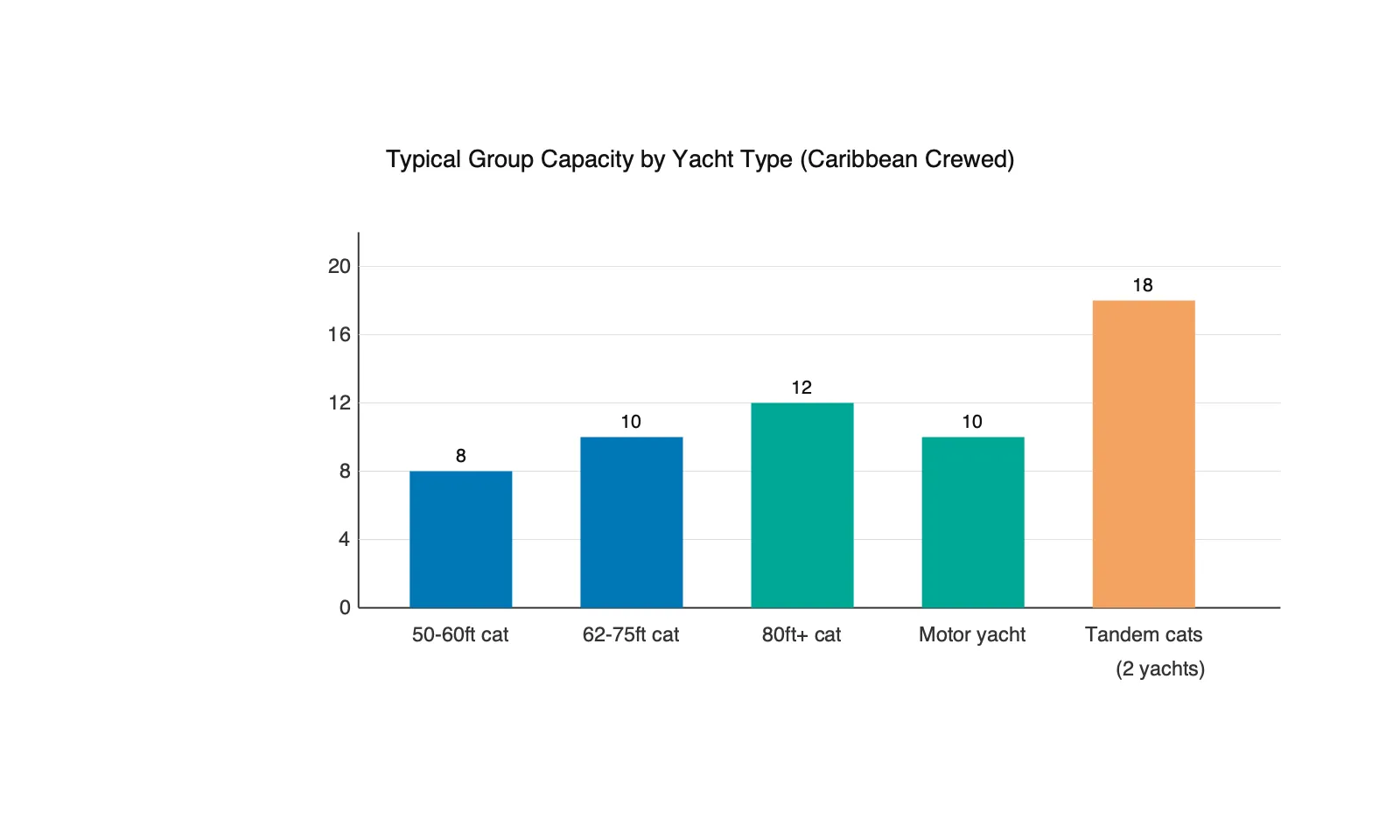
Most Caribbean crewed catamarans accommodate 8-10 guests in 4-5 cabins, while motor yachts under 100 feet typically carry 6-10 ([broker observation; market norm 2025-2026]). The “right” size depends on cabin parity: does every couple get a comparable cabin, or is someone stuck with bunks?
View data table
| Yacht Type | Typical Guest Capacity | Notes |
|---|---|---|
| 50-60ft catamaran | 8 | 4 cabins, good cabin parity |
| 62-75ft catamaran | 10 | 5 cabins, most popular size |
| 80ft+ catamaran | 12 | SOLAS hard cap on private yachts |
| Motor yacht (60-90ft) | 10 | Faster, smaller deck space |
| Tandem (2 catamarans) | 18 | The 13+ guest solution |
For groups with kids or multi-generational mixes, a 75-80ft catamaran usually wins because everyone gets a real cabin. If you’ve never sailed with extended family before, our guide on multi-generational yacht charters covers cabin assignments, kids’ sleeping arrangements, and noise zones.
Corporate Yacht Charters: Incentive Trips, Offsites & Client Entertainment
North American incentive travel averages $6,000 per head in 2025, up 4% year over year, and 70% of incentive buyers are now seeking destinations they haven’t used before, making yachts an unusually strong fit for corporate programs in 2026 (Incentive Travel Index, 2025). The math works: a 10-guest week-long Caribbean yacht charter typically lands at $5,000-$10,000 per head all-in, putting a corporate retreat within or just above the standard incentive budget.
Three corporate yacht charter use cases dominate our inquiries:
1. Founder/exec offsites (4-8 people). A founding team plus partners on a 60-footer, working sessions in the morning, water sports in the afternoon. Used for annual planning, strategic resets, and post-fundraise team bonding. Typical week: $50K-$80K all-in.
2. Sales incentive trips (10-12 winners + spouses). Top sales reps and their plus-ones, usually replacing a Mexico resort program. Yacht delivers more privacy and zero shared real estate with strangers. Typical week: $80K-$120K.
3. Client entertainment (8-10 VIP clients). Annual deal-closer or relationship-builder. Usually shorter (3-5 nights), often built around a destination event like the Antigua Sailing Week or Saint Barths’ Music Festival. Typical: $40K-$70K.
The average 2025 North American incentive travel per-head spend reached $6,000, up 4% year over year, and 75% of buyers say the value of incentive programs remains strong (IRF 2025 Incentive Travel Index). For a 10-guest yacht offsite, that aligns with a mid-tier Caribbean catamaran charter.
Why a yacht beats a resort for corporate
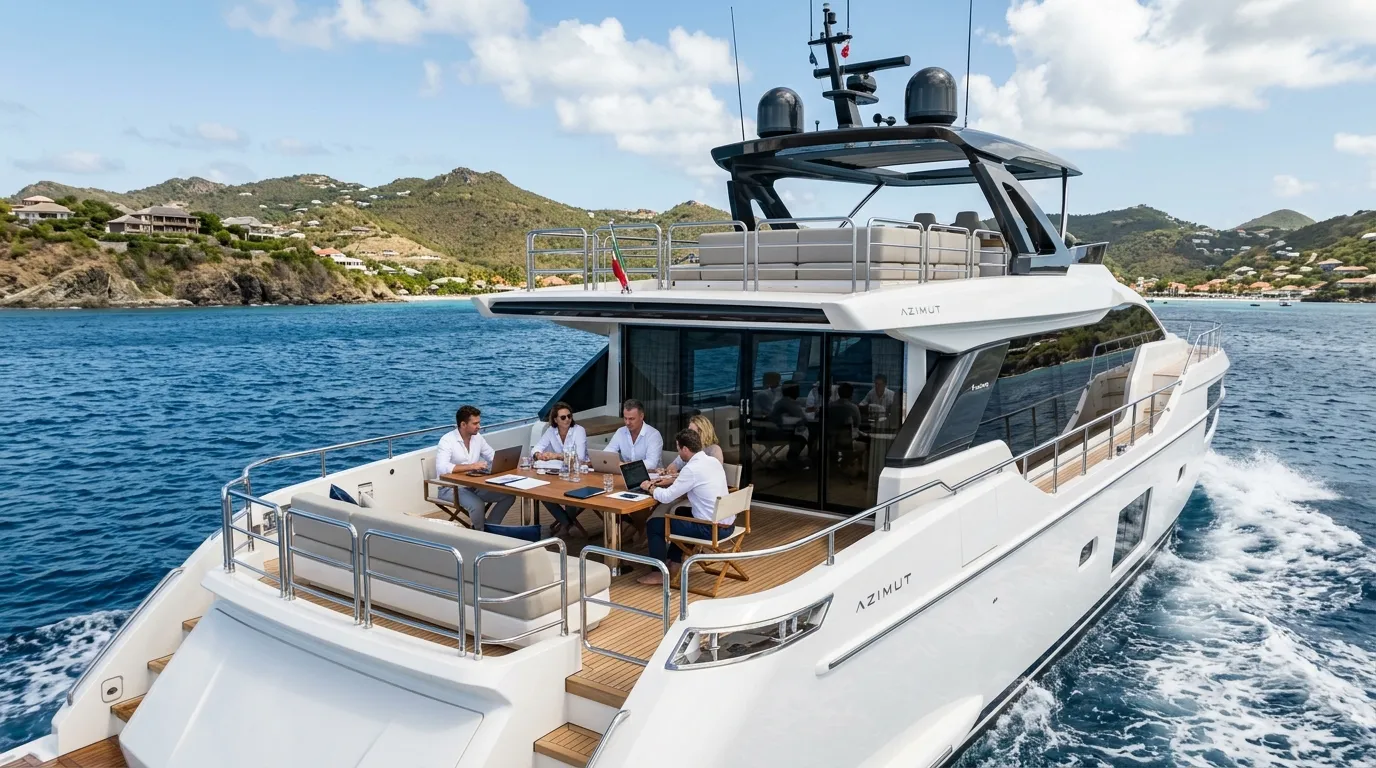
The honest reason corporate clients pick yachts over resorts: privacy and undivided attention. There’s no other group at the dinner table. The CEO doesn’t bump into a competitor at the pool. Conversations stay on the boat. The crew works only for your team. For client entertainment, that exclusivity is the whole point.
The pragmatic reason: total cost is lower than people expect. When you back out hotel rooms ($600-$1,200/night × 10 rooms × 5 nights), F&B ($300/person/day), private dining venue rental, transportation, and activities, a yacht delivers the same outcome and often costs less per head than a comparable destination resort program with private experiences bolted on.
Practical corporate planning notes
- Wi-Fi. Confirm Starlink in writing before signing. Most newer charter yachts have it; older boats may not. Required for any working session.
- Provisioning. Submit dietary preferences and any alcohol preferences 4-6 weeks ahead. Brokers convert that to an APA spend plan with the captain.
- Branding. Crew can hang corporate banners and use branded napkins/welcome gifts. Do not retrofit hardware.
- NDAs. Yes, crew sign them. Ask the broker to add it to the charter agreement.
- Insurance. Corporate charters often require additional named-insured coverage. Build into the timeline.
Honeymoon Yacht Charters: The Private Caribbean Honeymoon
Global honeymoon spending hit $131.56 billion in 2024 and is projected to reach $191.85 billion by 2030 (6.6% CAGR), with the luxury segment capturing 44.2% of revenue (Grand View Research, 2025). Yacht charters increasingly anchor that luxury slice, couples spending $20K-$80K on a once-in-a-lifetime experience instead of two weeks at a resort.
The case for a yacht honeymoon is simple: it’s the only way to get genuine privacy, a different anchorage every night, and a crew whose only job is making the two of you happy.
The average 2025 honeymoon costs $5,300, with 28% of couples taking a 1-2 week trip, the most common duration band (The Knot, 2025). Luxury honeymooners typically spend 3-8x that, and a private 7-night Caribbean yacht honeymoon for two starts at $25K-$40K.
What makes a yacht honeymoon different
Three things, in our experience:
Cabin count beats length. On a couple’s charter, you’re spending the budget on the master cabin, not boat size. A 50-footer with a king-bed master suite, dedicated head, and walk-in shower beats a 75-footer where the master is just one of five cabins.
Two-person crew works. A captain-chef husband-wife couple is the ideal honeymoon crew. Less staff visibility, more meals built around your taste, and the crew naturally fades into the background. Larger crews are wonderful for groups of 10: overkill for two.
Itinerary should be lazy. First-time charterers tend to over-plan. The right honeymoon itinerary is two anchorages per week max, long mornings on the bow, and one big-day excursion. Saint Barths and Anguilla in the Leewards, the BVI’s North Sound, and the Bahamas’ Exumas are the three honeymoon-favorite cruising grounds.
For destination-specific guidance, see our BVI crewed yacht charter guide and the Bahamas yacht charter guide.
Honeymoon yacht selection: the eco-luxury angle
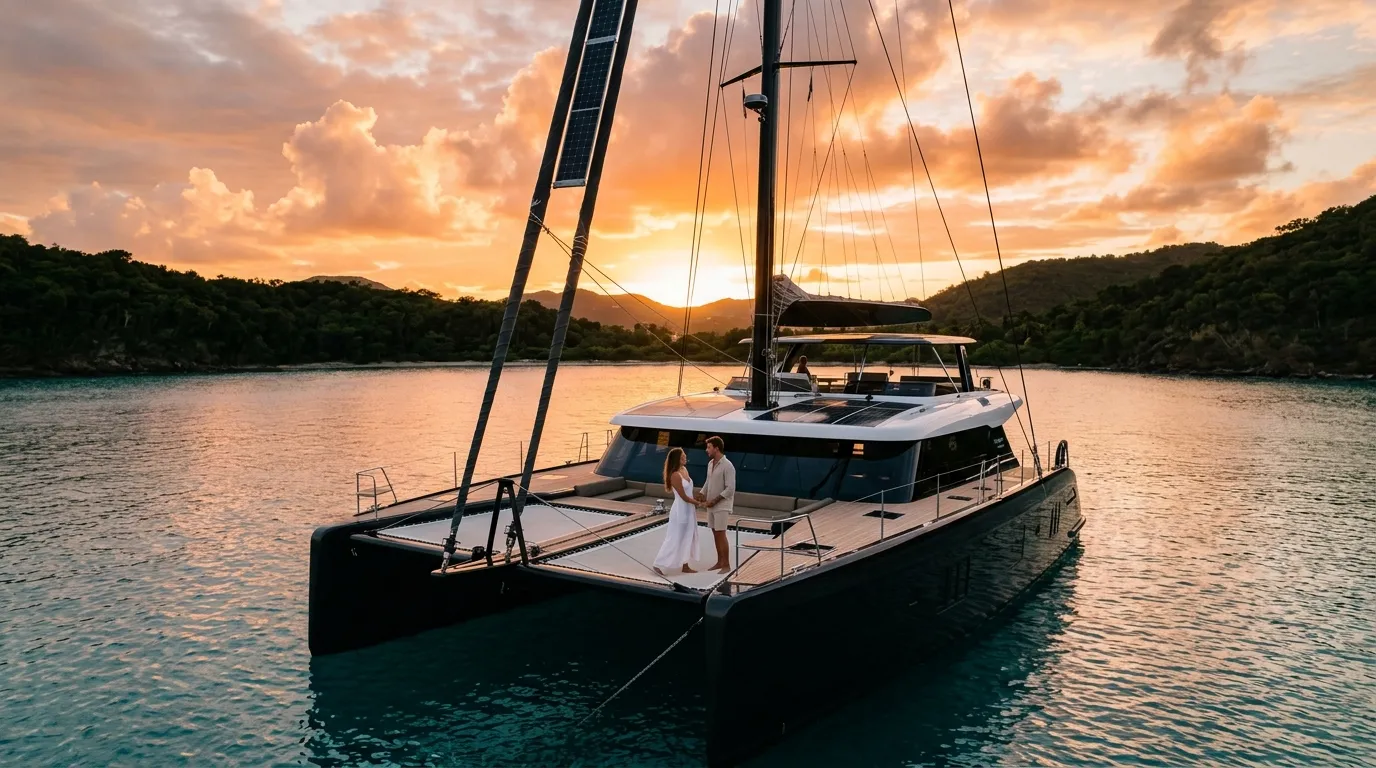
Younger couples (under 40) increasingly ask about lower-impact yacht options. The Sunreef 80 Eco accommodates eight guests and runs on autonomous electric propulsion with integrated solar panels in the carbon composite mast. It’s the closest thing to a zero-emission luxury yacht in the Caribbean charter fleet today (Sunreef Yachts, official spec). Honeymoon couples who care about the climate footprint of their wedding spend ask about it specifically.
For more on the brand, see our Sunreef catamarans deep dive.
Holiday Yacht Charters: Christmas, New Year’s, and Why to Book Early
Caribbean Christmas and New Year’s yacht charters command a premium over standard high-season rates, a median of 12 percent among the 27 yachts publishing both, with the middle half between 9 and 15 percent (Vital Charters rate analysis, September 2026). Most top yachts are reserved 6-12 months in advance, sometimes a full year ahead. If you want a specific yacht for the December 26-January 2 week in the BVI, you should be booking by early summer.
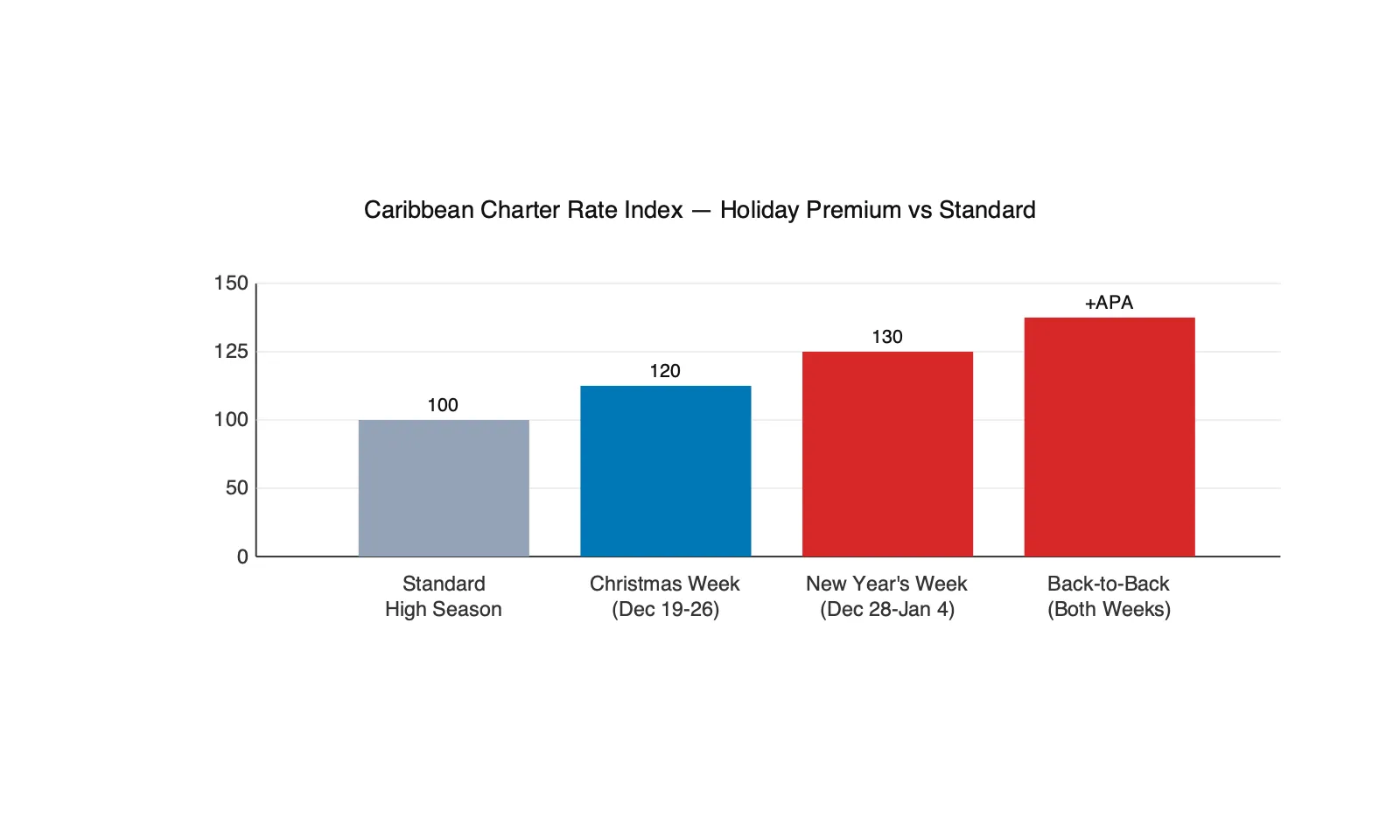
The holiday charter calendar is structured tighter than people realize:
View data table
| Booking Window | Rate Index (Standard = 100) | Premium vs Standard |
|---|---|---|
| Standard Caribbean high season (Jan-Apr) | 100 | , |
| Christmas Week (Dec 19-26) | 120 | +20% |
| New Year’s Week (Dec 28-Jan 4) | 130 | +30% |
| Back-to-Back (both weeks) | 130 + APA | +30% on rate, advance APA in full |
Christmas vs New Year’s: which week is which
The Caribbean charter industry treats these as two separate weeks with hard fences:
- Christmas Week runs Dec 19-26 (charter ends no later than Dec 26 noon).
- New Year’s Week starts Dec 28 (charters cannot begin before Dec 28).
- Back-to-back means booking both weeks on the same yacht. This is the only way to charter from Dec 26-28.
The 7-night minimum is industry-standard for both weeks. Some yachts will accept shorter holiday charters in shoulder periods (Dec 1-15 or Jan 5-15), but not during the Christmas or New Year’s weeks themselves.
Holiday yacht charter lead times in the Caribbean are longer than any other week. Top yachts in the BVI, Saint Barths, and Antigua are routinely reserved by February for the following New Year’s, with most fleets fully booked by September, a pattern we watch play out on our own availability calendar every year (Vital Charters rate analysis, 2026).
For a fuller picture of seasonal pricing, see our month-by-month Caribbean charter season guide.
Special Event Charters: Weddings, Birthdays, Anniversaries & Reunions
The average 2025 destination wedding costs $39,000 domestically and $41,000 internationally, with an average guest count of 116 (The Knot, 2025). Yacht event charters work for events with smaller guest counts, typically the destination wedding inner circle, milestone birthdays, vow renewals, and family reunions.
Common special event charter formats:
Destination wedding (10-12 guest inner circle). Wedding party and immediate family on one yacht for the week, with the broader guest list arriving for a single shoreside celebration day. Lets the bride/groom anchor the experience around private time with closest family rather than entertaining 100 people for seven days.
Vow renewal & milestone anniversary. 25th, 30th, 40th. Often a yacht charter with two-three couples (the original wedding party) and a private renewal ceremony at a Caribbean beach or aboard.
Milestone birthdays (40, 50, 60). Friend group of 8-10 plus partners. The most “social” type of event charter: built around water sports, multiple anchorages, and big shared dinners onshore.
Family reunions (multi-generational). Three generations, typically 10-12 people. Catamaran is almost always right yacht type: flat decks, open salon, easy movement for older grandparents and young kids.
Event-specific yacht selection
For weddings and vow renewals: catamaran with a flat foredeck for the ceremony and a large aft cockpit for dinner. Sunreef 80 (8 guests) and Lagoon Sixty 5 / Lagoon 65 (10 guests) are favorites. For milestone birthdays where the agenda is “fun”: power catamarans like the Moon 60 (8 to 12 guests, up to 20 knots; Moon Yacht, Power 60) get you between BVI islands fast and have huge sun decks. For a more formal corporate-anniversary feel, Italian motor yachts like the Azimut Grande series carry a gravitas that fits 50-year-celebrations and formal events (Azimut Yachts, official).
Premium Yacht Brands for Groups & Events
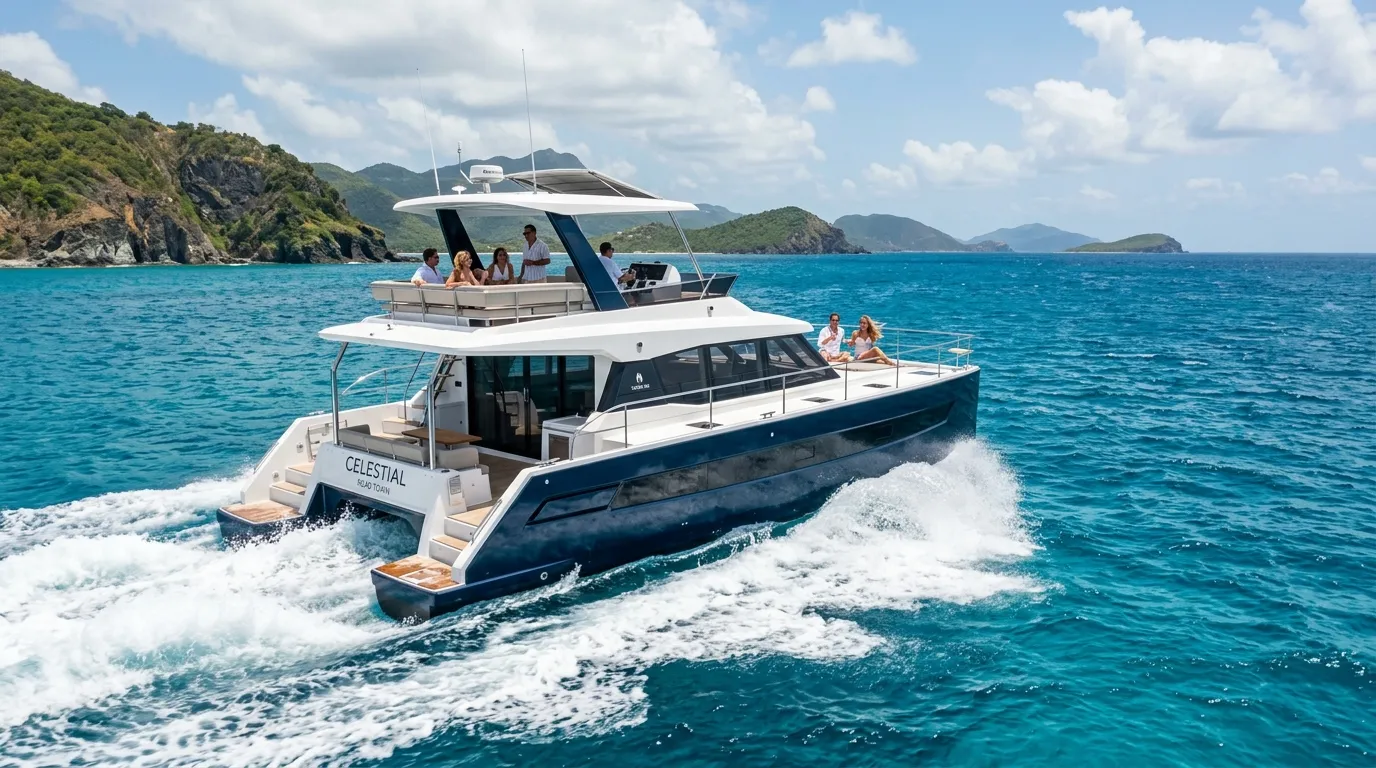
The three brands clients consistently ask about for premium group and event charters: Sunreef, Moon Yachts, and Azimut. Each owns a distinct category.
Sunreef Yachts (Gdańsk, Poland)
Sunreef is the dominant builder in the luxury catamaran category, with strong presence in both sail and power. The Sunreef 80 Eco sleeps eight guests across four cabins (master + VIP + 2 guests) and runs on autonomous electric propulsion with hydrogeneration, solar-integrated carbon composite mast, and a custom battery bank (Sunreef Yachts, official). For groups of 10, the 80 Sunreef Power Eco carries 10 guests across five baths with twin 360 kW electric motors and a 990 kWh battery bank (Sunreef Yachts, official).
Use case: honeymoons, climate-conscious clients, milestone anniversaries.
Moon Yachts (Gdańsk, Poland)
Moon is a younger entrant in the power catamaran category and increasingly visible in the Caribbean charter fleet. The Moon 60 Power carries 8 to 12 guests with up to 4 crew across fully customised interiors, and runs at up to 20 knots (Moon Yacht, Power 60).
Use case: corporate retreats and milestone birthdays where you want to cover ground fast, Tortola to Anegada in two hours instead of six.
Azimut Yachts (Italy)
Azimut is the Italian flagship motor-yacht builder. Founded in 1969 by Paolo Vitelli: who actually started in sailboat charter before pivoting to manufacturing (Azimut Yachts, official): Azimut now produces the Grande, Magellano, and Atlantis series. The Azimut Grande 35 Metri carries 10 guests across 5 cabins, hits 26 knots, uses carbon-fiber hull tech, and was designed by Stefano Righini with interiors by Achille Salvagni (Boat International).
Use case: formal corporate events, golden anniversaries, and clients who want a motor yacht with European craftsmanship rather than a catamaran.
For more on charter-fleet brands generally, our five Kings of Caribbean charter brands covers the full picture.
Group Yacht Charter Costs: What to Budget
Caribbean crewed catamaran charters typically run $25,000-$60,000 per week base rate in standard high season, with motor yachts and superyachts ranging from $40,000 to $300,000+ per week (market norm 2025-2026; Mordor Intelligence). Group charter total cost is typically 130-150% of base rate after APA, gratuity, and taxes.
A 10-guest, 7-night Caribbean group yacht charter on a 65-75 ft catamaran typically lands at $50,000-$80,000 all-in (base rate + 30% APA + 10% gratuity + permits), about $5,000-$8,000 per guest (market norm 2025-2026, Mordor Intelligence). Holiday weeks add a median of 12 percent on top.
The math, simplified for a 10-guest catamaran group charter in the BVI:
| Line Item | Typical Range | Notes |
|---|---|---|
| Base rate (7 nights) | $35,000-$55,000 | High season catamaran 65-75ft |
| APA (food, drink, fuel, dockage) | $10,500-$16,500 | 30% of base rate |
| Crew gratuity | $3,500-$5,500 | 10% of base, paid in cash at end |
| Cruising tax / National Park fees | $300-$800 | BVI permits, mooring fees |
| Charter insurance | $500-$1,500 | Optional but recommended |
| Total all-in | $50,000-$80,000 | $5,000-$8,000 per guest |
Holiday weeks add 20-30% to base rate. New Year’s is the single most expensive week of the year.
For a complete cost framework, see our yacht charter costs guide, and for budget worksheets see our first yacht charter budget walkthrough.
Planning Timeline: How Far Ahead to Book
Group charters need longer lead times than couples’ charters. Coordinating 8-12 calendars, getting deposits in, and locking the right yacht takes months, and the best yachts go fast. Here’s the pacing we recommend:
| Booking Window | What’s Available | Recommended For |
|---|---|---|
| 12-14 months ahead | Full fleet, pick of holiday weeks, eco yachts | Christmas/New Year’s, weddings, large groups (10-16) |
| 9-12 months ahead | Most yachts available | Standard high-season groups, honeymoons, corporate offsites |
| 6-9 months ahead | Strong selection, holiday weeks getting tight | Mid-size groups, family reunions, vow renewals |
| 3-6 months ahead | Available but limited cabin parity options | Last-minute corporate, smaller groups |
| <3 months ahead | Whatever’s left, mostly shoulder season | Couples and small groups only |
A working broker can sometimes pull last-minute holiday yachts from cancellations, but it’s not something to count on. The single best thing a group can do is pick a date 9-12 months out and lock the deposit.
For broker selection guidance, see our choosing a charter broker guide.
Bottom Line
Group and event yacht charters are different animals from couples’ charters. The 12-guest SOLAS rule shapes everything; holiday weeks book a year out; corporate retreats need Wi-Fi and NDAs in writing; honeymoons need master-cabin priority over boat size; and the right brand depends on whether your group wants to anchor or to move. If you’re planning any of these (corporate, honeymoon, holiday week, or special event) start the conversation 9-12 months out and bring a broker into it early.
Ready to plan? Start a yacht search or get in touch with a date range and group size, and we’ll come back with a yacht shortlist and an honest budget within 48 hours.
Frequently Asked Questions
Can I charter a yacht for more than 12 guests?
Groups larger than 12 require a SOLAS-compliant passenger yacht or a tandem charter. The first barely exists here, two of 550 priced crewed listings, so in practice it is a tandem, two yachts cruising the same itinerary together. Tandem is the more cost-effective and cabin-friendly path for groups of 13-24. See our BVI tandem charter guide for the playbook.
How much does a corporate yacht charter cost in the Caribbean?
A 10-guest crewed catamaran for a 7-night corporate offsite runs $50,000-$100,000 all-in (base rate + APA + gratuity + taxes), roughly $5,000-$10,000 per head. That aligns with the 2025 North American incentive travel benchmark of $6,000 per head (Incentive Travel Index, 2025). Motor yachts and larger catamarans run higher.
When should we book a Christmas or New Year’s yacht charter?
Book 12-14 months in advance for top yachts. By February, the strongest yachts for the following New Year’s are already reserved. By September, most are gone. If you want pick of the fleet, lock the deposit by April-June for the December that follows.
Can we have a wedding on a yacht charter?
Wedding ceremonies typically happen onshore (Caribbean island venue) while the yacht functions as the inner-circle accommodation and post-ceremony cruise. Catamarans with flat foredecks (Sunreef 80, Lagoon 65) work for small at-sea ceremonies of 8-12 people. Larger guest lists need a shoreside venue.
What’s the best yacht for a honeymoon?
A 50-65 foot catamaran or motor yacht with a king-bed master suite and a two-person crew. Don’t oversize. Spend the budget on a great master cabin, not on bedrooms you’ll never use. Sunreef and smaller Lagoon catamarans dominate the honeymoon segment.
Do we tip the crew on a corporate or group charter?
The Caribbean custom is 15-20% of base rate, the customary rate in CYBA’s Inclusive Agreement, paid in cash at the end of the charter. For a 10-guest, $50,000 base rate corporate charter, that works out to $7,500-$10,000 split among the crew. See our crew tipping guide for the full framework.
Can a yacht charter accommodate dietary restrictions for a group?
Private yacht charters handle dietary restrictions far better than resorts. The chef builds menus around your group’s preferences (gluten-free, vegan, kosher, allergy-aware, kids’ menus), submitted 4-6 weeks ahead through the broker. Resorts can’t match that level of customization at scale.
One yacht, everyone together.
Tell us your event type, group size, and dates and we’ll match you to a crewed yacht that fits, whether that’s a corporate offsite, a wedding, or a New Year’s celebration.