
Honeymoon Yacht Charter: Why It Beats Every Resort
A honeymoon yacht charter for two runs $14K–$25K all-inclusive in the Caribbean, same price band as a butler-suite resort week (Caribbean Resort Guide, 2026), with private chef and a new island daily.
Last Updated: September 7, 2026
A honeymoon yacht charter for two in the Caribbean starts around $14,000–$18,000 for the week on a smaller crewed catamaran, all-inclusive, which lands in the same band as a Sandals butler suite once you stop pretending the resort cost ends at the room rate (Caribbean Resort Guide, 2026). The only difference is what you actually get.
Honeymoons sit in a strange gap. Couples will spend $5,300 on average and call it a once-in-a-lifetime trip, then book the same beachfront resort their friends posted about last spring (The Knot, 2025). The result is a beautiful, perfectly fine vacation that looks suspiciously like every other beautiful, perfectly fine vacation. If you’re already spending the money, the question worth asking is whether a private yacht, which fits inside the same budget for couples willing to compare honestly, gets you somewhere a resort structurally can’t. We help couples plan trips like this every season at Vital Charters, and the answer keeps being yes. This piece lays out the math, the experience, and the specific Caribbean and Bahamas itineraries that work for two.
If you’re considering a charter for a milestone trip more broadly (anniversary, vow renewal, destination wedding) the complete guide to special event charters covers the wider playbook. This piece is about the honeymoon specifically.
How Much Does a Honeymoon Yacht Charter Actually Cost?
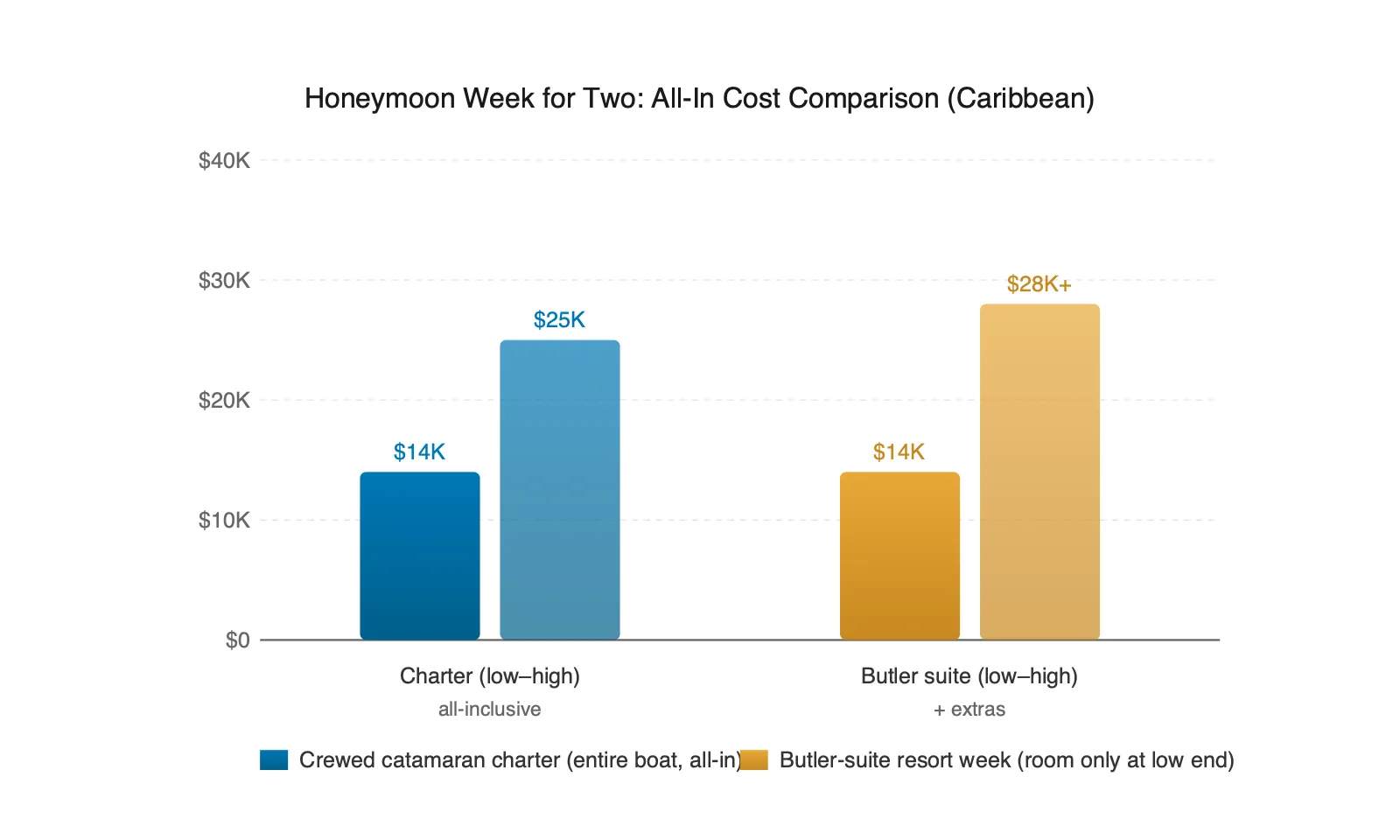
A 7-night Caribbean honeymoon yacht charter for two costs $14,000–$25,000 all-inclusive on a smaller crewed catamaran (Charter Yacht Brokers Association rate ranges, 2025). That’s $1,000–$1,800 per night for both of you (chef, captain, premium liquor, water toys, anchorage fees, fuel, the entire boat) and it directly overlaps the published rates for a butler-suite week at the top all-inclusives.
A 2-cabin crewed catamaran honeymoon yacht charter in the Caribbean typically runs $14,000–$25,000 per week all-inclusive, covering captain, private chef, premium open bar, water sports gear, fuel, and mooring fees. That works out to roughly $1,000–$1,800 per night for the couple, within the same band as the butler-suite tier at top Caribbean all-inclusive resorts (Caribbean Resort Guide, 2026; CYBA rate data, 2025).
Compare that to the resort side honestly. Sandals’ entry-level Honeymoon Luxury rooms start around $306 per person per night, and overwater Honeymoon Butler Bungalows begin at $2,022 per night for the room alone (Caribbean Resort Guide, 2026). For a 7-night stay in a butler-tier room, you’re at $14,000–$28,000, and that’s before you add couples’ excursions, premium dining surcharges, spa treatments, airport transfers, and the gratuities that aren’t actually all-inclusive at most “all-inclusive” properties.
Two charter pricing things worth knowing before you reach for the calculator. First, Caribbean charters typically operate as flat all-inclusive, no APA add-on the way Mediterranean charters do: so what you see is mostly what you pay (all-inclusive yacht charter explained). Second, crew gratuity runs 15–20% of the charter fee at the end of the trip, paid in cash. Treat it like the resort tipping pool you’d already be paying. It doesn’t break the comparison.
View data table
| Option | Low (week) | High (week) | Includes at low end |
|---|---|---|---|
| Crewed catamaran charter (couple) | $14,000 | $25,000 | Boat, captain, chef, all meals, open bar, water toys, fuel, moorings |
| Butler-suite resort (couple) | $14,000 | $28,000+ | Room only; food, premium dining surcharges, excursions, transfers, spa, gratuities extra |
Sources: Caribbean Resort Guide (2026); industry crewed-charter pricing (2025).
What’s Different About Living on a Yacht for a Week?
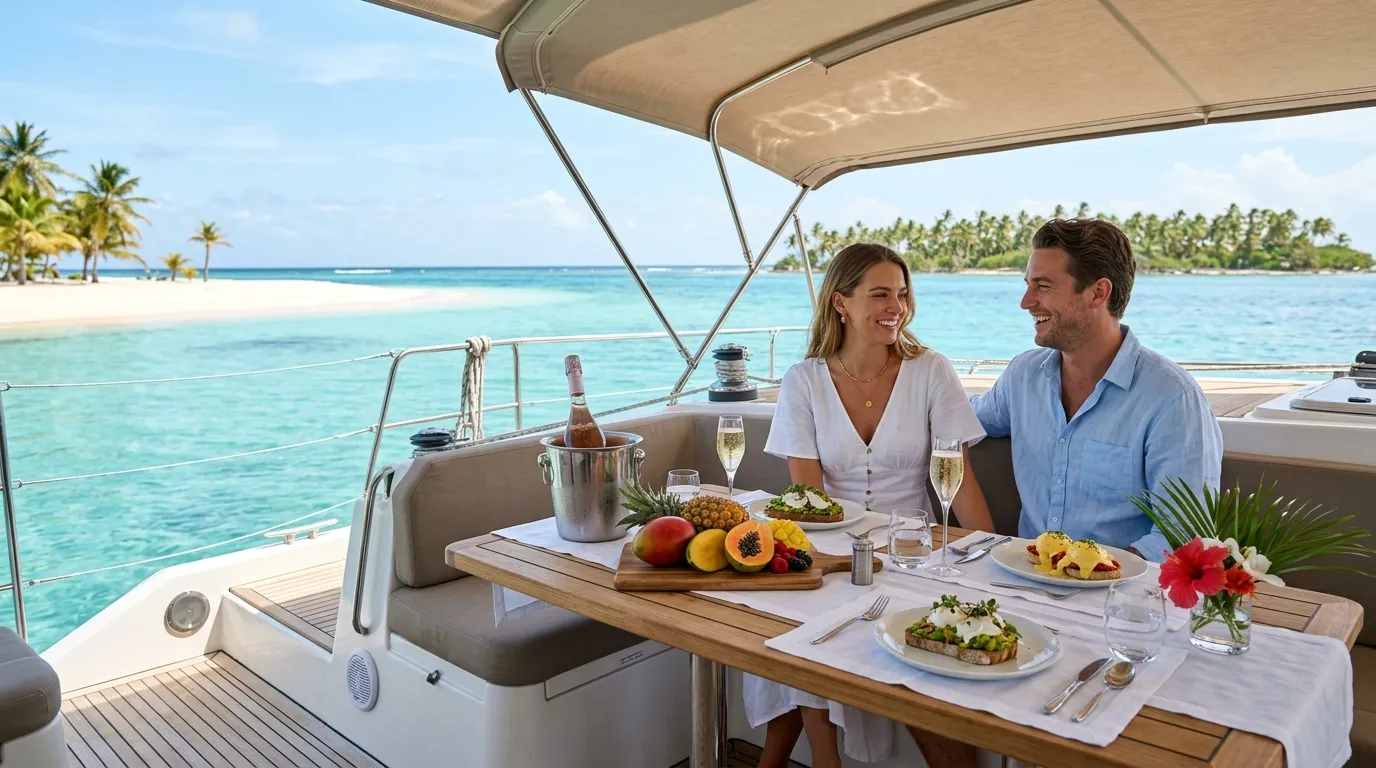
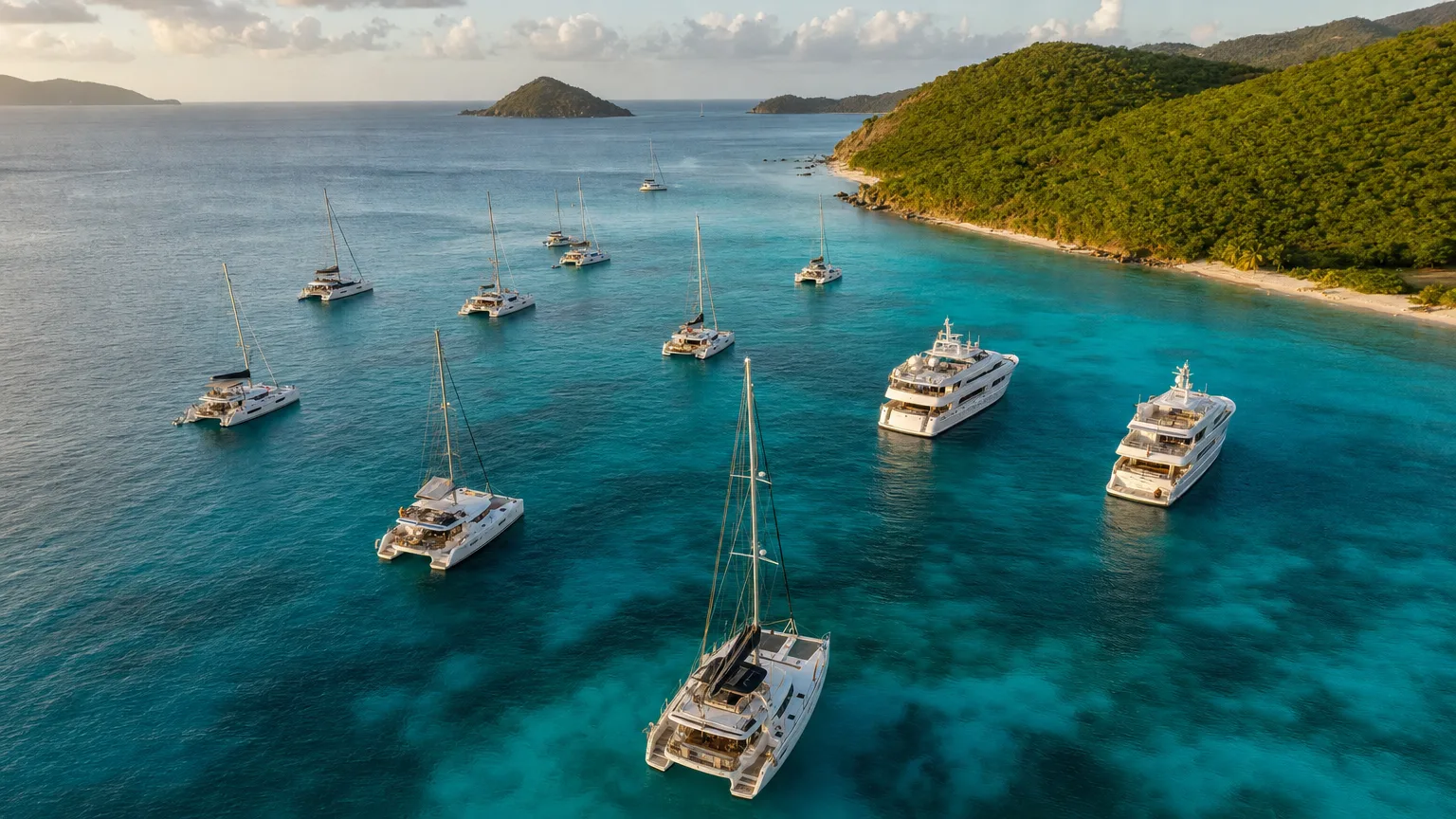
Privacy is the #1 priority for ultra-luxury travelers in 2026, with clients actively seeking private islands and remote retreats over branded resort experiences (Virtuoso Luxe Report, 2026). A crewed yacht delivers that structurally: you wake up in a different anchorage every morning, with no other guests on the property, because the property is the boat and the property is yours. A resort is a fixed point on a map you visit for seven days. A crewed yacht is a moving home that takes you to seven different mornings.
The math behind privacy on a charter is brutal in the yacht’s favor: a Caribbean crewed catamaran for a couple typically has a 2-3 person crew sleeping in a separate hull, no other guests onboard, and no public deck space outside what you’re already using. There’s no buffet line. No 7am pool-chair tribunal. No couple from Toronto explaining to you what they thought of the calamari. The chef preps in a galley you’ll see when you want to wave hello, and otherwise the boat (and the deck space, and the cabin) is just yours.
Privacy is the headline most couples come for, but the moving part is what they remember a year later. On a 7-night Caribbean charter, here’s what a typical day looks like for a couple:
- Morning: Coffee on the foredeck while the captain motors to the next anchorage. Maybe 90 minutes underway, maybe 20.
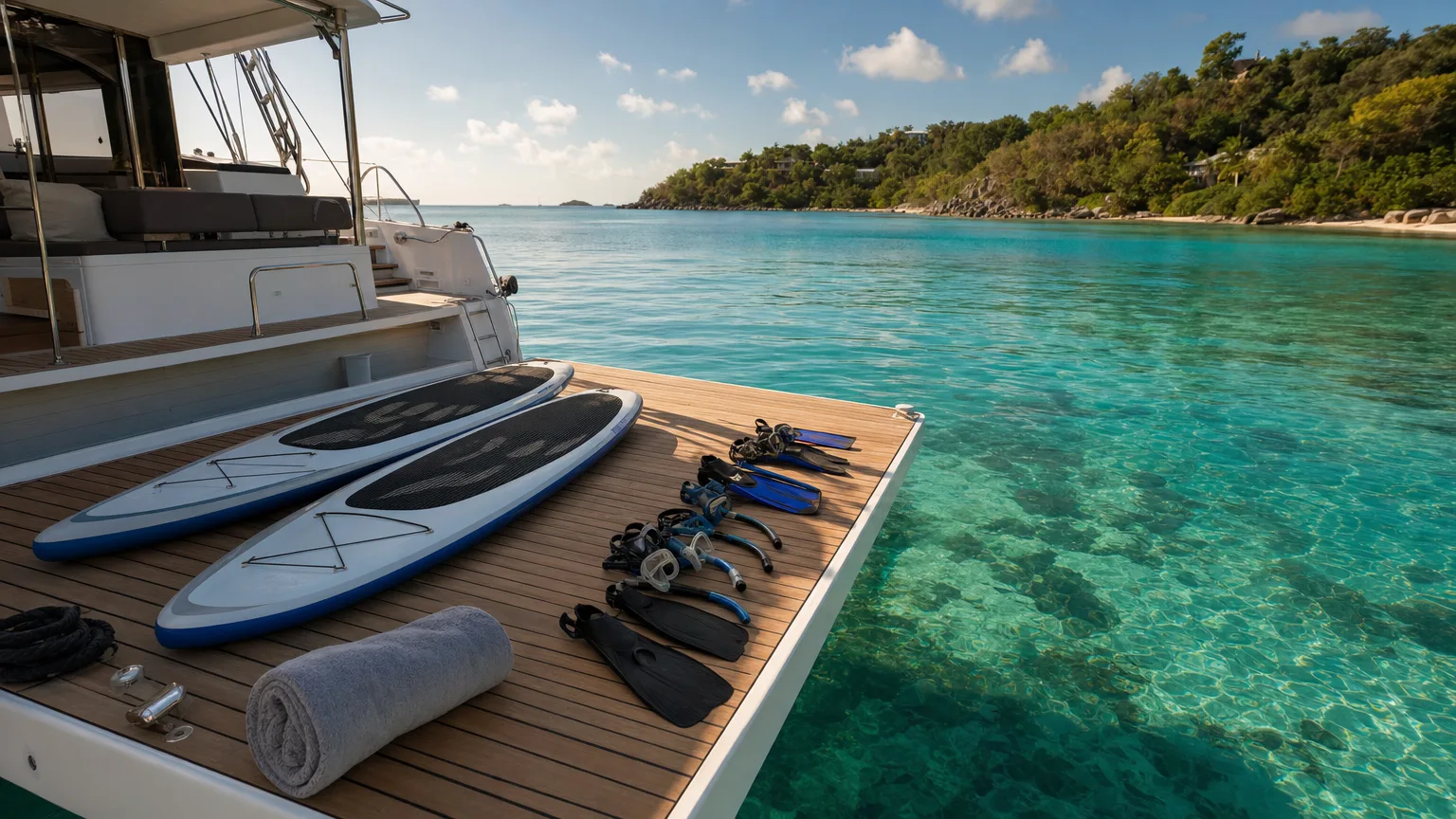
- Mid-morning: Anchor down. Snorkel off the stern at a reef the boat is the only one on.
- Lunch: Chef plates whatever was caught or picked up that morning. You eat on deck.
- Afternoon: Paddleboards, kayaks, beach hop, sit on a quiet stretch of sand the captain knows about.
- Evening: Sundowners on the foredeck. Chef serves dinner under the deck lights or onshore at a hand-picked beach restaurant.
- Night: Stars above the cockpit, the boat rocking quietly. No hallway noise, no neighboring balcony, no air conditioner cycling at 3am.
That sequence repeats with new geography for the next six days. By the end of the week, you’ve slept above seven different reefs, eaten food sourced from four different islands, and taken zero photos that look like anyone else’s honeymoon.
The structural difference between a honeymoon yacht charter and a luxury resort is location: a yacht moves you to a new anchorage daily, with no shared spaces or other guests, while a resort fixes you to one property for the entire week. On a 7-night Caribbean crewed charter, couples typically wake in 5–7 different anchorages, snorkel reefs no day-tour reaches, and dine in private, privacy and access combined into the same product.
Where Should a Caribbean Honeymoon Yacht Charter Go?
The four destinations that actually make sense for a 7-night honeymoon are the British Virgin Islands, the U.S. Virgin Islands, the Exumas in the Bahamas, and the Grenadines, each picked for short sailing distances, calm water, and a high density of beautiful anchorages within a week’s range. Anything farther afield (St. Martin to St. Barts to Antigua) starts eating your honeymoon with passages. See our answer to: What is the best month to visit the British Virgin Islands? For most couples, a British Virgin Islands charter tops that list for its short hops and calm anchorages.
British Virgin Islands: the default for a reason
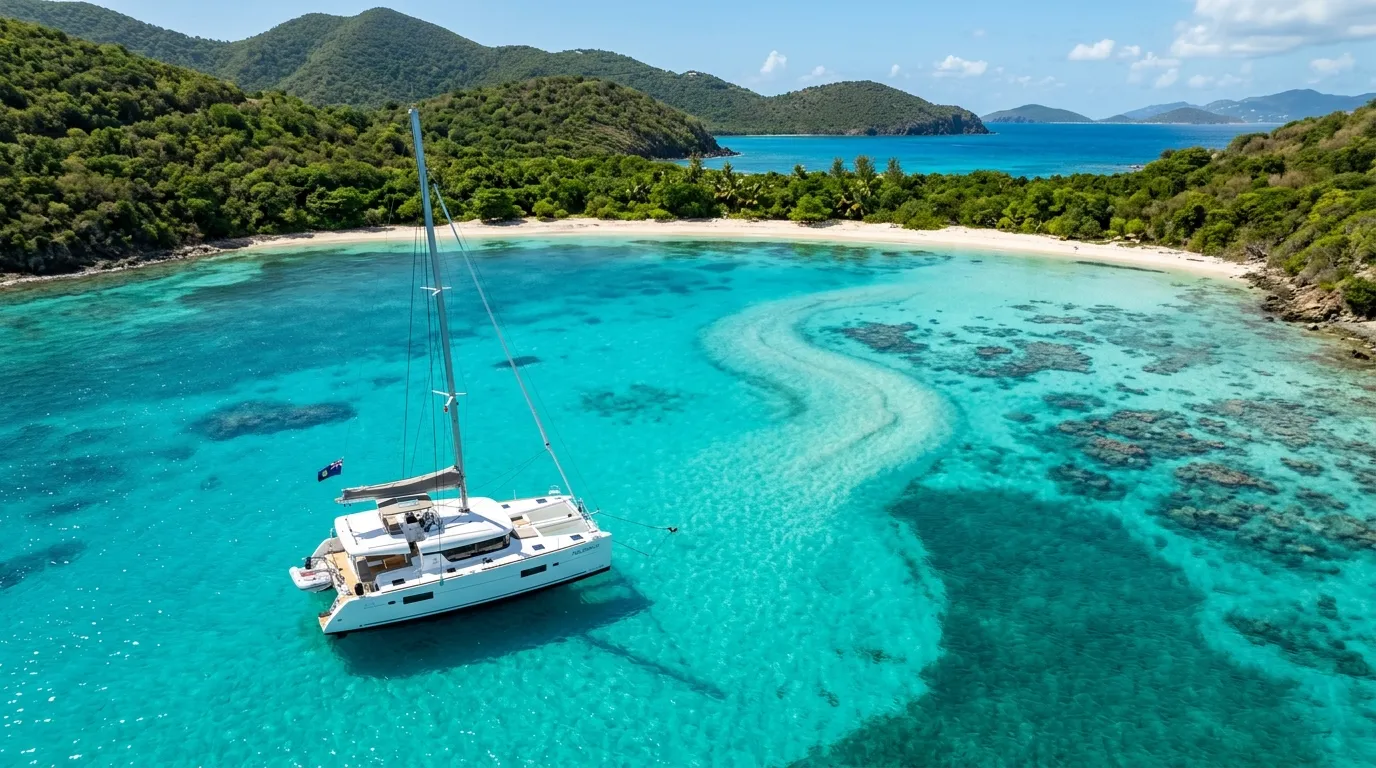
The BVI is the most-chartered honeymoon destination in the Caribbean for one boring reason: the islands are close together, the water is famously calm, and you can hit Norman Island, Peter Island, Cooper, Virgin Gorda, Anegada, and Jost Van Dyke in seven nights without ever feeling rushed. The Bitter End at Virgin Gorda, the Baths at Spanish Town, the Soggy Dollar on Jost. They’re stops on the same trip. Our complete BVI crewed charter guide walks the full route.
The Exumas, Bahamas: for couples who want truly empty water
The Exumas chain runs 120 miles of mostly uninhabited cays, with sand bars you can wade out to in chest-deep turquoise and anchorages where you’ll genuinely see no other boat for hours. It’s quieter than the BVI and the snorkeling at Thunderball Grotto, the swimming pigs at Big Major Cay, and the iguanas at Allan’s Cay each give you a postcard story by themselves. The full Bahamas yacht charter guide covers logistics and pricing.
The Grenadines: for honeymoons that lean adventurous
The Grenadines have the most cinematic anchorages in the Caribbean, Tobago Cays, Mayreau, Petit St. Vincent, Bequia: set inside a marine park that limits boat traffic. The water clarity is exceptional and the daily sailing legs are short. It’s a step up in remoteness from the BVI: more wildlife, fewer beach bars. Our 7-day Grenadines yacht charter itinerary lays out the route.
The U.S. Virgin Islands: when passports aren’t ready
If one of you doesn’t have a current passport (it happens, since wedding planning is chaos), the USVI is the only Caribbean destination on this list that takes a U.S. driver’s license for U.S. citizens. St. John, St. Thomas, and St. Croix sit close enough together for a relaxed week, with Virgin Islands National Park covering 60% of St. John’s land area for genuinely undeveloped anchorages.
How Long Should a Honeymoon Yacht Charter Be?
Seven nights is the standard charter week and the right answer for the vast majority of honeymoons (The Knot, 2025). Five-night charters exist but cost almost as much as seven (the boat still has to be provisioned, crew still need to be paid, the logistics are largely fixed) and you lose the rhythm. Ten- and fourteen-night charters are great if your work and vacation banks support them, since you stop wondering what day it is around night four.
A useful filter: if your honeymoon budget is in the same band as a butler-suite resort week, 7 nights on a smaller crewed catamaran is the cleanest swap. If you’re stretching for two weeks, you can usually drop to a slightly smaller boat (or shoulder season) and stay flat on cost. Couples in the 1–2 week range, 28% of all honeymooners, are the sweet spot for charter math (The Knot, 2025).
The standard honeymoon yacht charter length is 7 nights, which matches both the typical charter week and the average U.S. honeymoon duration (The Knot, 2025). Roughly 28% of honeymoons stretch 8–14 nights: the sweet spot for charter math, since dropping to a slightly smaller boat or shoulder-season week keeps the all-in cost flat while doubling time on the water.
What If We’ve Never Been Sailing Before?
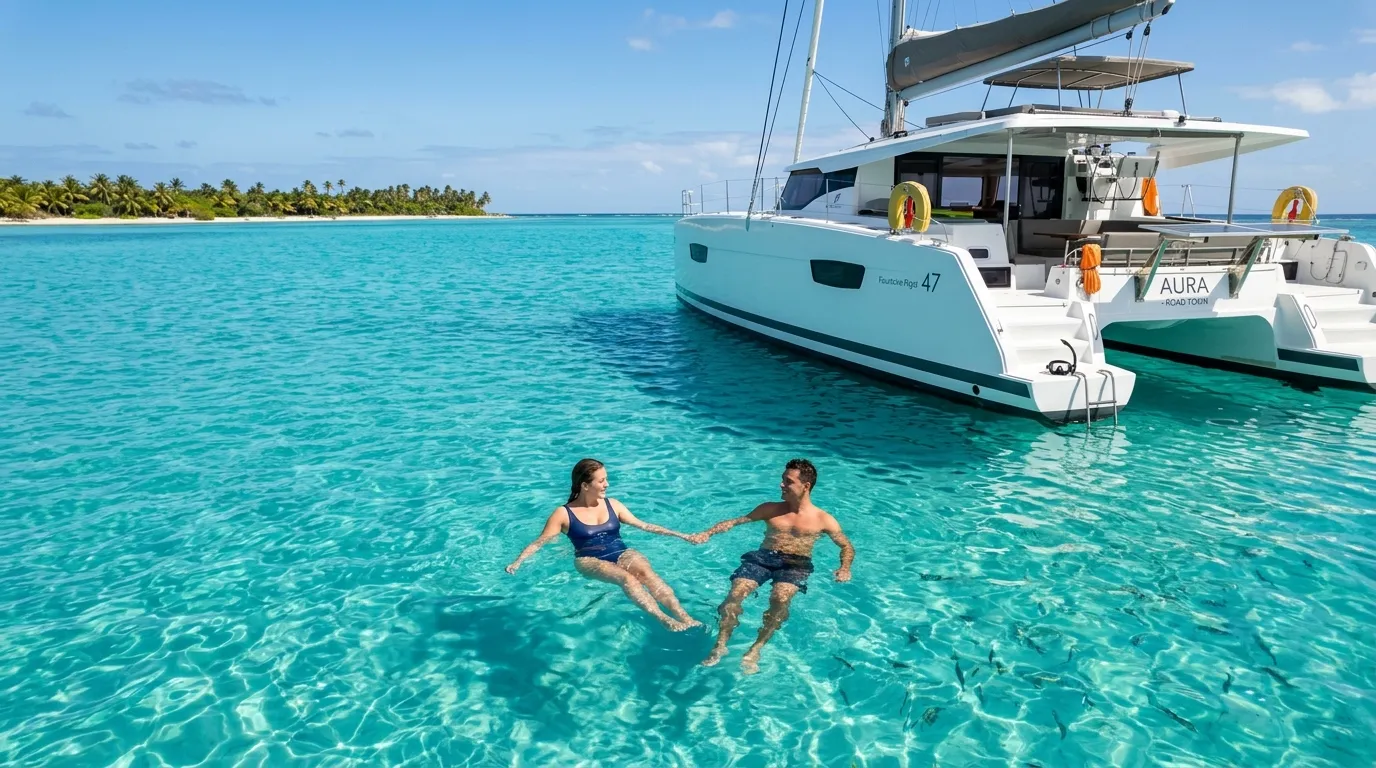
Crewed means crewed: a captain runs the boat, a chef runs the galley, and you do nothing more nautical than ask “where are we going next?” if you feel like it. Couples who have never set foot on a sailboat charter every week of the season. The whole product is built so that you don’t need any sailing experience whatsoever.
Seasickness is the question we get next. Modern Caribbean crewed catamarans sit on two hulls. They barely heel, they barely roll at anchor, and they handle Caribbean trade-wind passages with the stability of a small ferry. Couples who get queasy on monohull sailboats are usually fine on a cat. If anyone is genuinely prone to motion sickness, the captain plans short, downwind legs and overnight anchorages in the most protected coves. Our honest seasickness guide covers prevention specifics.
What you do need to bring is in our complete charter packing list. Short version: soft luggage (no hard suitcases), reef-safe sunscreen, two swimsuits each minimum, and shoes you don’t mind getting wet.
When Is the Best Time to Book a Honeymoon Charter?
December through April is high season in the Caribbean, the most settled weather, the highest demand, and the highest rates. May through early June and late November are shoulder seasons with materially lower pricing and weather that’s still excellent. Hurricane season runs June 1 through November 30, but the southern Caribbean (Grenadines, ABCs) sits south of the typical hurricane track and stays bookable into the fall.
For a honeymoon specifically, two booking dynamics matter. First, the best boats book 6–12 months out for high-season weeks, so if your wedding is in February and you want a January-or-February honeymoon, contacting a broker the week of your engagement is not too early. Second, shoulder-season honeymoons (May, early June, November) buy you emptier anchorages and far better availability, though usually not a lower rate on the same boat, and our full month-by-month Caribbean charter guide covers the specifics by destination.
The optimal booking window for a high-season Caribbean honeymoon yacht charter is 6–12 months in advance, since the best crewed catamarans for two are limited inventory and book out by late summer for the following winter. Shoulder-season weeks (May, early June, late November) offer comparable weather and much lower anchorage traffic, and while the published rate rarely changes, 280 of 522 Caribbean yachts listing the identical number in both seasons, the shoulder months are when promotional offers appear, so the saving is worth asking for even though it is not printed (Vital Charters rate analysis, September 2026).
What Can the Crew Do for a Honeymoon Specifically?
Most chefs and captains have run honeymoons before and will lean in if you give them anything to work with. Standard touches the crew can arrange (often without an upcharge if requested at booking) include rose petals on the bed for arrival, a tasting menu on a chosen night, a private beach barbecue on an empty stretch of sand, dessert with sparklers on the foredeck, in-cabin breakfast on a slow morning, and discreetly ordered champagne at every sundown.
If you want something more involved (a vow renewal ceremony at anchor, an underwater proposal photo session, a private chef’s table at a particular waterfront restaurant) give the captain six weeks of lead time and they’ll set it up. A yacht charter sits one phone call from any beach, restaurant, dive operator, or local chef in its destination, which is access a resort concierge can match in their bar but not in their cove.
The Bottom Line on a Honeymoon Yacht Charter
A honeymoon yacht charter wins on the math the moment you’re already considering a butler-tier resort suite, and it wins on the experience independent of the math. You get privacy a resort cannot manufacture, access to anchorages a resort cannot reach, and a week of mornings that look nothing like anyone else’s honeymoon photos. The price band overlaps cleanly with the resort tier most couples are already comfortable spending in, once you stop pretending the resort cost ends at the room rate.
If you’re at the considering-it stage, the next move is short. Tell a broker your dates, your destination preference (or “you pick”), and your budget band, and have boats and prices in front of you within a week. Start a yacht search at Vital Charters.
Frequently Asked Questions
How much does a honeymoon yacht charter cost?
A 7-night honeymoon yacht charter for two on a smaller Caribbean crewed catamaran starts around $14,000–$18,000 all-inclusive in shoulder season and runs $20,000–$25,000+ for premium boats in high season. That covers boat, captain, chef, all meals, open bar, water sports gear, fuel, and mooring fees. Crew gratuity (15–20%) is paid separately at the end. Larger or newer catamarans, motor yachts, or peak-week dates push the figure higher.
Is a yacht charter just the two of us, or do we share the boat?
It’s just the two of you, plus the crew. A crewed yacht charter is a private rental of the entire boat. There are no other guests, no other couples, no shared cabins. The crew (typically 2–3 people on a couples-sized catamaran) sleeps in a separate part of the boat with their own facilities and stays out of your space outside of mealtimes and what you ask for.
Do we need any sailing experience?
None. A crewed charter is the opposite of a bareboat charter, the captain operates the boat, the chef runs the galley, and your job is to enjoy yourselves. Most couples on crewed charters have zero sailing background. The entire product is designed for guests who want to be on the water without learning how to sail.
What if one of us gets seasick?
Caribbean crewed catamarans are remarkably stable: two hulls and wide beam mean very little roll at anchor and minimal motion in normal trade-wind sailing. Couples who get sick on monohull sailboats are usually fine on a cat. The captain can plan short, downwind passages and overnight in protected anchorages if motion sensitivity is a concern. Most charterers never need motion-sickness medication, but it’s wise to bring a few doses.
Can the crew arrange a vow renewal or proposal onboard?
Yes: with lead time. Vow renewals at anchor, surprise proposals timed to a specific sunset, private beach ceremonies, and underwater photography can all be coordinated through the captain. Most special touches need 4–8 weeks of notice so the crew can source officiants, photographers, or specialty supplies into the destination. Standard romantic touches (rose petals, champagne service, beach picnic) can be requested at any point during booking.
What’s the best Caribbean destination for a honeymoon charter?
For most couples, the British Virgin Islands. Short sailing distances, calm water, dense anchorage variety, and the most reliable infrastructure for a crewed week. The Exumas in the Bahamas are the choice for maximum privacy and emptiness. The Grenadines suit couples who want the most cinematic, remote anchorages. The U.S. Virgin Islands work when passports aren’t ready (U.S. citizens travel on a driver’s license).
How far in advance should we book?
For high season (December–April), 6–12 months out. The best couples-sized catamarans are limited inventory and book by late summer for the following winter. For shoulder season (May–early June, late November), 3–6 months is usually enough. If your wedding date is set, the week you get engaged is not too early to start scoping boats with a broker.
A new island every morning.
Tell us your honeymoon dates and any destination wish list and we’ll match you to a private crewed yacht, your own chef, crew, and Caribbean itinerary built around you.