
BVI Tandem Charters: How to Plan a Multi-Yacht Group Charter
BVI tandem charters let groups of 13-20+ sail together on separate yachts. Learn pricing ($3,875/person), mooring logistics, and booking strategy for 2026.
Last Updated: September 8, 2026
A BVI tandem charter is two or more crewed yachts sailing the same British Virgin Islands itinerary together, anchoring side by side, coordinated by a single broker. Your group has 16 people, three generations of family, and one week in the islands. One vessel won’t fit everyone: international maritime law caps most charter yachts at 12 guests. Splitting up across separate islands isn’t a vacation; it’s a logistics headache. A tandem charter fixes that. Tandem charters are one piece of the bigger picture, our guide to group and event charters covers the rest.
The BVI runs 40% of the Caribbean’s professional charter fleet from just 60 islands packed within 15 nautical miles of each other (BVI industry estimates). Short hops between anchorages, calm lee-side waters, and a reservation-based mooring system make the BVI the strongest destination on Earth for multi-yacht groups.
This guide covers the regulatory reason you’ll need two boats, what it actually costs per person, which anchorages handle multiple vessels, and how to coordinate everything from VHF channels to provisioning.
What Is a BVI Tandem Charter?
Under the SOLAS Convention, any yacht carrying more than 12 passengers is classified as a commercial passenger ship, triggering full safety compliance requirements that most charter vessels don’t meet (IMO SOLAS). A tandem charter solves this by splitting your group across two or more yachts that sail and anchor together. Each vessel operates independently: its own captain, crew, provisions, and APA budget. But your broker coordinates matched itineraries so the boats arrive at the same anchorages, raft up for group dinners, and split apart when different passengers want different things.
The 12-person yacht rule isn’t just a suggestion. It’s an international maritime regulation that applies to every crewed yacht in the Caribbean. If your group tops 12, a tandem charter isn’t a luxury option. It’s the only legal way to sail together.
Our observation: We’ve brokered tandem charters for family reunions, corporate retreats, and friend groups. The most common configuration is two 50-foot catamarans, each holding 8 to 10 guests with four cabins. Tandem fleets can scale well past two boats when the group is large enough, though most run two or three.
Tandem isn’t just “two boats that happen to be in the same harbor.” Your captains share a VHF working channel, your chef teams coordinate menus so nobody gets the same meal twice, and your broker handles the matchmaking. It’s organized group travel on the water.
Why Are Groups Choosing Tandem Charters?
Multigenerational travel surged to 47% of all trips in 2025, up 17 percentage points from 2024, while solo travel collapsed from 42% to just 12% (Squaremouth, 2025). Travelers don’t just want to go somewhere. They want to go with their people.
The numbers keep climbing. Group bookings for parties of eight or more jumped 23% in 2025 (Sabre, 2025). And 85% of families plan a multigenerational trip in 2026 (Campspot, 2025). This isn’t a passing trend: it’s a structural shift in how families vacation.
A tandem charter fits this shift better than almost any other travel format. Grandparents who want a quiet morning on the flybridge aren’t stuck on the same boat as teenagers who want to wakeboard at 7 AM. One vessel can run the adventure schedule. The other keeps it calm. Everyone meets for lunch at the beach bar.
Why the BVI specifically? The territory welcomed 1,202,008 visitors in 2025: a 10% increase over 2024 and a new record (BVI News, 2025). The BVI even filed a trademark for “Sailing Capital of the World” in September 2025 (Caribbean Journal, 2025). With 337 priced crewed listings and the densest concentration of anchorages in the Caribbean, it’s purpose-built for multi-yacht groups.
How Much Does a Tandem Charter Cost?
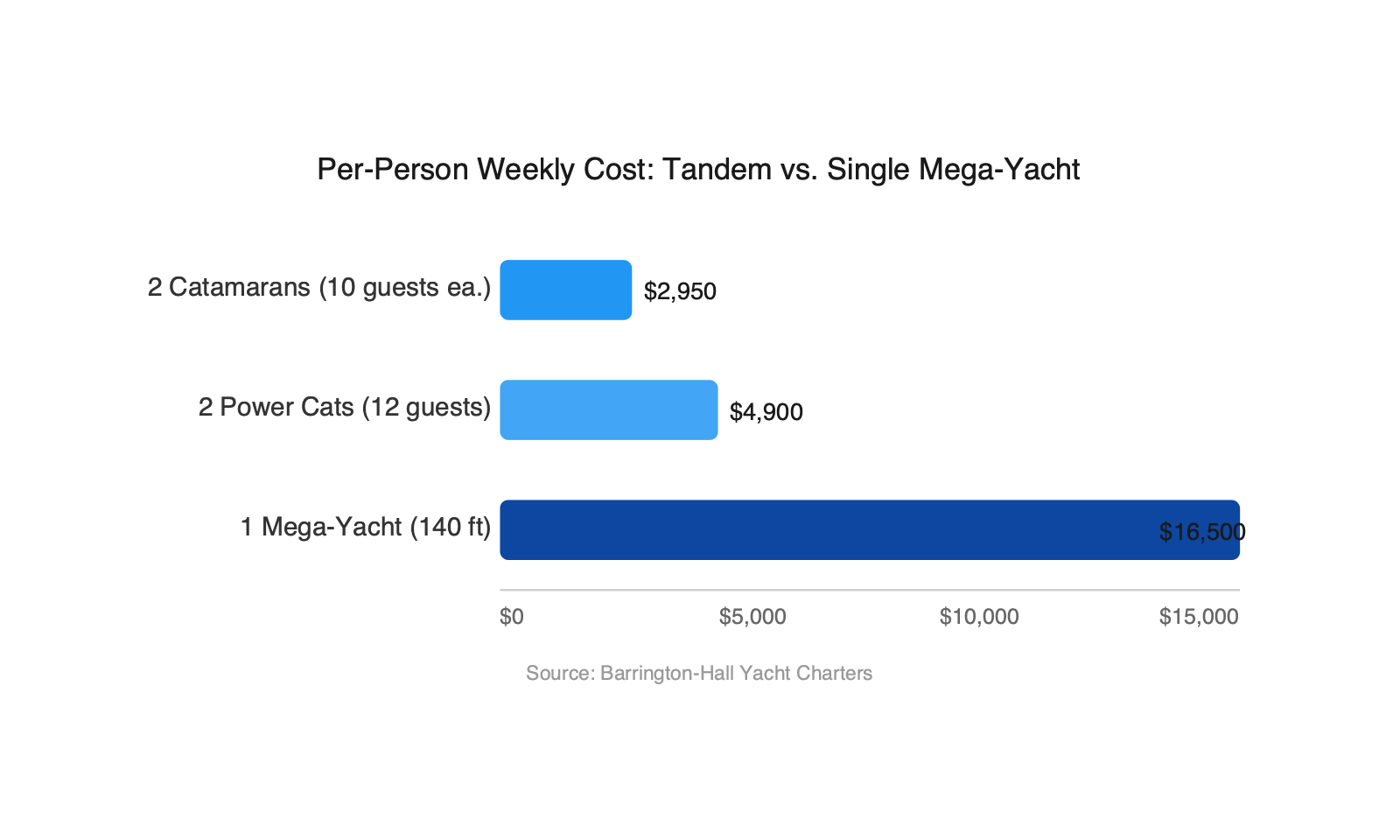
Two 50 to 59 ft crewed catamarans at the fleet median of $31,000 each come to $62,000 for the week. Across 16 guests that is about $3,875 per person, against roughly $17,550 per person on a single 100 ft-plus yacht certified for 12, which medians $210,600 all in (Vital Charters rate analysis, September 2026). The arithmetic favours two boats, and so does availability: only two yachts in the entire priced Caribbean and Bahamas fleet carry more than 12 guests, so for most groups this is not a saving so much as the only route. The math overwhelmingly favors splitting across two boats over upsizing to one mega-yacht.
The global yacht charter market hit $8.98 billion in 2025 and is projected to reach $18.20 billion by 2034 at an 8.19% CAGR (Fortune Business Insights, 2025). That growth is fueling more tandem-friendly fleet options in the BVI, especially in the 45-60 foot catamaran range that’s ideal for group sailing.
View data table
| Charter Option | Total for the week | Guests | Per person |
|---|---|---|---|
| Two 50-59 ft crewed catamarans, 8 guests each | $62,000 | 16 | $3,875 |
| The same two at full capacity, 10 guests each | $62,000 | 20 | $3,100 |
| One 100 ft-plus motor yacht certified for 12 | $210,600 | 12 | $17,550 |
Here’s what’s included in a typical tandem charter for each vessel:
- Base charter fee: the yacht and crew for the week
- APA (Advance Provisioning Allowance): typically 25-35% of the base fee, covering fuel, food, drinks, and dockage. See our full breakdown of charter costs
- Crew gratuity: industry standard is 15-20% of the base charter fee
Each vessel has its own APA and gratuity. Many yachts are all-inclusive and APA does not apply. But groups often split provisioning costs (like a shared lobster dinner on the beach) across both boats. Your broker can arrange this in advance.
Want to stretch the budget? Check for seasonal charter deals: repositioning weeks, last-minute gaps and promotional specials do more for the budget than the calendar does. Of 522 Caribbean yachts publishing both seasons, 280 quote the same price in both, and about one in ten is running an offer that never appears on the rate card (Vital Charters rate analysis, September 2026).
Where Should Tandem Yachts Anchor in the BVI?
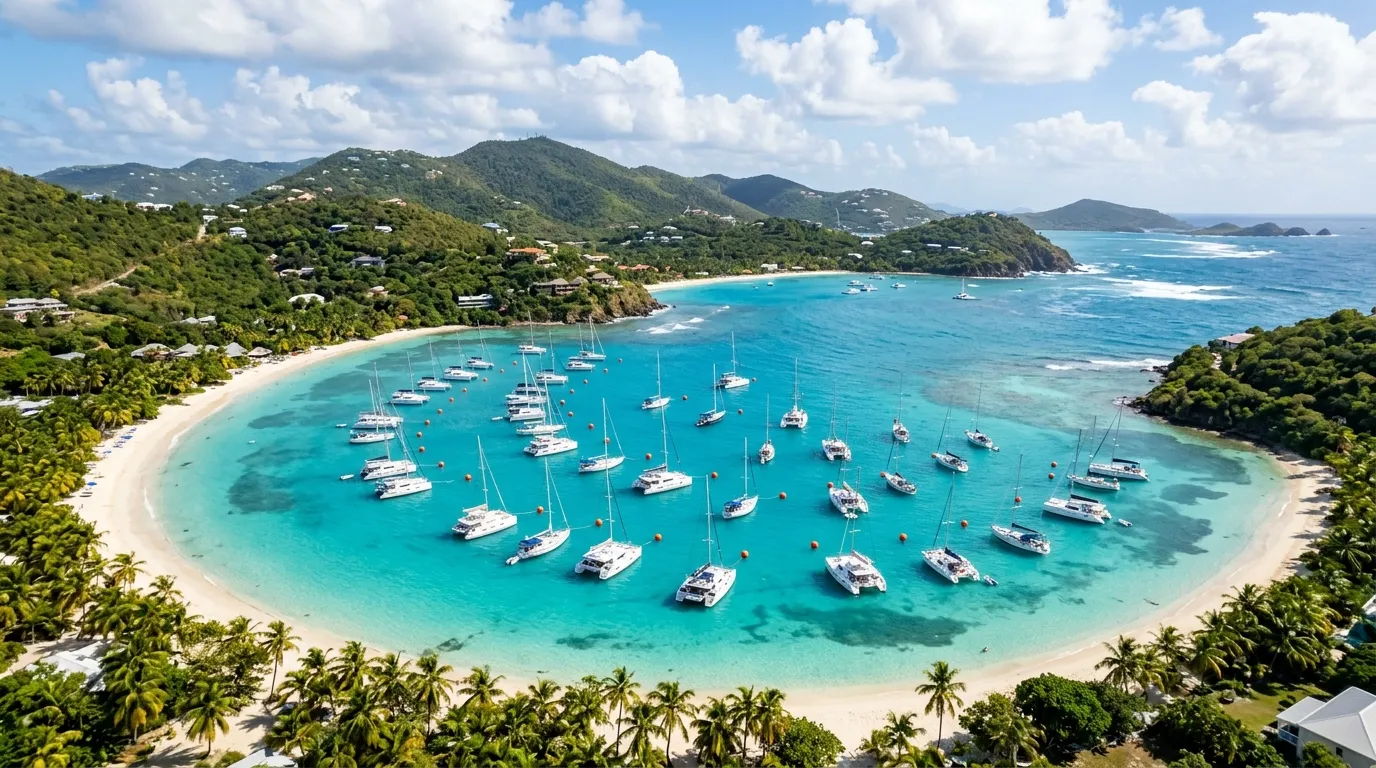
Not every anchorage can handle two 50-foot catamarans side by side. The BVI uses the BoatyBall reservation system across 11 bays with three mooring types: reservable (bright orange, numbered), first-come-first-serve (white with orange stickers), and day-use only (yellow stripe). Reservations open at 7:00 AM local time, day-of only.
Here’s how the top tandem anchorages compare:
| Anchorage | Reservable Moorings | Mooring Type | Tandem Suitability | Highlights |
|---|---|---|---|---|
| Anegada (Setting Point) | 18 | Reservable | Best | Largest mooring cluster; lobster beach dinner |
| Norman Island (Pirates Bight) | Open anchorage | Free anchor | Excellent | Room to raft up; The Caves snorkeling; Willy T |
| Jost Van Dyke (White Bay) | 12+ (Diamond Cay) | Mixed | Good | Soggy Dollar Bar; Foxy’s; fills fast in peak |
| The Baths (Virgin Gorda) | ~20 | Day-use only (90 min) | Challenging | Sells out by 7:03 AM; requires coordination |
| Cooper Island | Reservable | BoatyBall | Good | Quieter; eco-resort; easier shoulder-season access |
Anegada (Setting Point): Best for Tandem Groups
Anegada’s 18 reservable BoatyBall moorings form the largest single cluster in the BVI. That gives your two captains the best shot at grabbing adjacent balls. The anchorage draws fewer boats than the Sir Francis Drake Channel stops, and Anegada’s legendary lobster dinner on the beach is the kind of communal experience you can’t replicate elsewhere.
Norman Island (Pirates Bight)
The spacious open anchorage at Pirates Bight has room for multiple vessels at anchor (not on moorings). Your crews can raft up here: tying the boats together for a group dinner on one yacht’s aft deck. The Caves are a short dinghy ride for snorkeling, and the floating bar Willy T sits right in the bight.
Jost Van Dyke (White Bay)
Mooring balls available, though they fill fast during peak season. White Bay is home to the Soggy Dollar Bar and Foxy’s, both ideal for group gatherings ashore. Diamond Cay expanded to 12 mooring balls recently, which helps tandem groups find adjacent spots.
The Baths, Virgin Gorda: A Special Case
The Baths has about 20 mooring balls, all day-use only with a 90-minute time limit. Reservations open at 7:00 AM via BoatyBall and sell out by approximately 7:03 AM. For a tandem group, both captains need to be on the app at exactly 7:00, grabbing two balls simultaneously.
Our observation: We tell our tandem clients to treat The Baths as a first-thing-in-the-morning stop. Leave your overnight anchorage at first light, have both crews on the BoatyBall app at 6:59 AM, and coordinate by radio. If one boat gets a ball and the other doesn’t, the second crew can anchor outside the mooring field and dinghy in.
For a complete route through these stops, see our BVI 7-day island-hopping itinerary.
How Do You Coordinate Two Yachts on the Water?
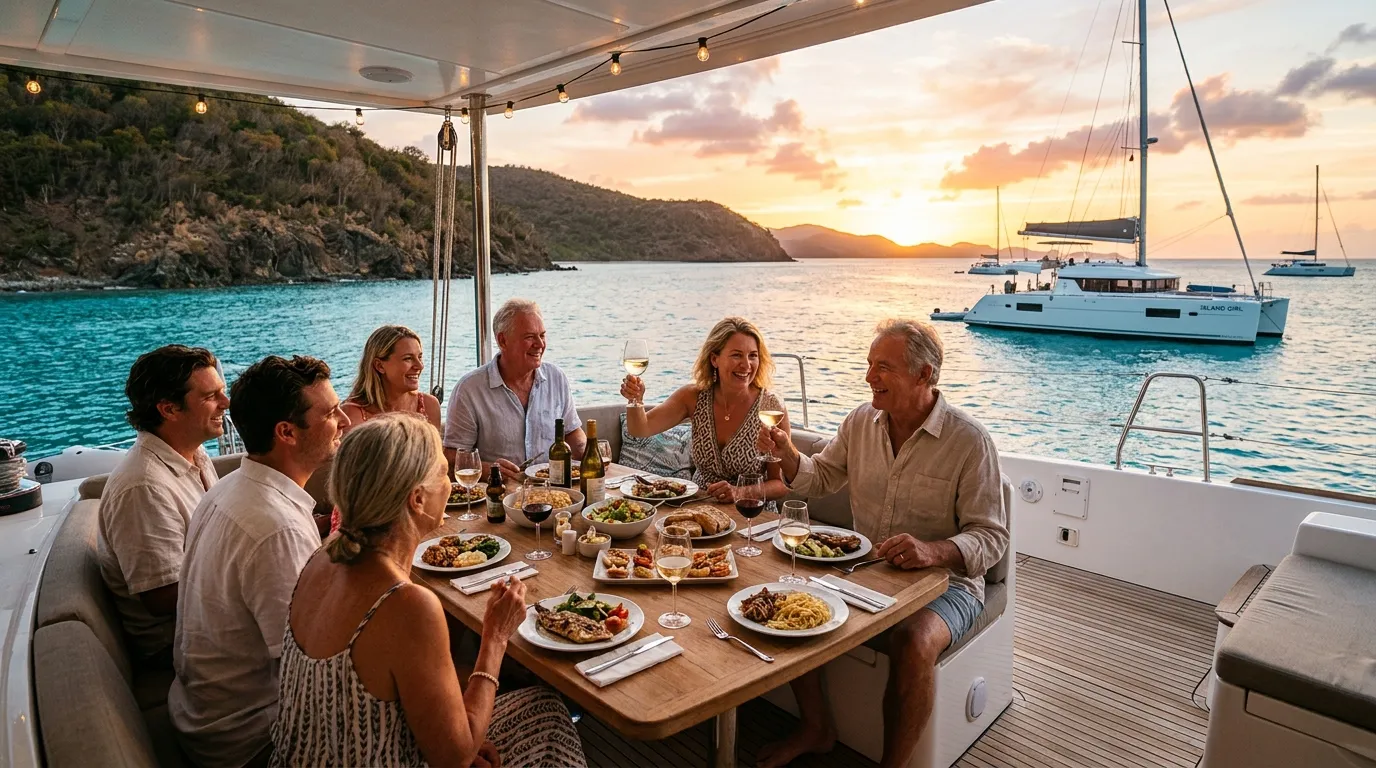
The BVI’s 60 islands sit within 15 nautical miles of each other, meaning most passages between anchorages take 30 to 90 minutes (BVI industry estimates). That short distance is what makes tandem coordination practical. You’re never more than a radio call apart.
VHF Radio Protocol
Your captains will establish contact on VHF Channel 16 (the international calling frequency), then switch to a designated working channel for all inter-yacht communication. Common working channels in the BVI are 9, 68, 69, 71, 72, 78, and 82. Your charter company assigns the specific channel during the skipper briefing.
In practice, morning radio check-ins sound like: “Good morning, we’re weighing anchor in 20 minutes, heading to Cooper Island. What’s your plan?” Casual and efficient.
Crew Matching
This is where a good charter broker earns their fee. For tandem charters, you want captains who’ve worked together before, or at minimum, crews who communicate well and share a similar pace. One hard-charging captain paired with one who likes leisurely mornings creates friction fast.
Your broker should also coordinate provisioning between the two chef teams. Different menus each night, and when both groups meet for a beach barbecue, one crew handles mains while the other preps appetizers and dessert.
Flexible Itinerary Structure
The best tandem itineraries follow a “together-apart-together” rhythm. Mornings: separate departures based on each group’s pace. Afternoons: meet at the same anchorage for group activities. Evenings: shared sundowner on one vessel or dinner ashore.
This flexibility is what separates a tandem charter from a flotilla. A flotilla follows a rigid schedule. A tandem charter gives each boat freedom while keeping the group connected. What happens when half your group wants to scuba dive at the RMS Rhone wreck and the other half wants to browse shops in Spanish Town? Both boats go their separate ways and reconnect at the evening anchorage. Zero compromises.
When Should You Book a BVI Tandem Charter?
The 2025 BVI Charter Yacht Show drew a record-breaking 65-plus crewed yachts and more than 170 international brokers (BVI News, 2025). That growing fleet means more options for tandem groups, but peak-season demand still outpaces supply, especially for matched pairs of catamarans.
Peak Season (December through April)
Trade winds blow a steady 15-25 knots. Seas are calm. Weather is dry. This is the finest sailing, but it’s also when the whole fleet competes for the same popular anchorages. Book tandem charters 9-12 months ahead during peak. You’re trying to secure two comparable yachts for the same dates in the same destination. That’s twice the inventory challenge.
Spring break and holiday weeks (Christmas, New Year’s) are the hardest tandem bookings. Mooring demand doubles when you’re coordinating two boats, and the most popular anchorages fill by midday.
Shoulder Season (April through June, November)
Winds ease to 10-15 knots. Crowds thin noticeably. Rates hold steady on most hulls, so the gain is availability rather than price. For tandem groups that is the more useful currency anyway: less competition for adjacent mooring balls at popular stops. You’ll also find it much easier to reserve matched yacht pairs, since fleet availability opens up.
Our observation: We’ve found that late April and May are the sweet spot for tandem bookings. The weather is still excellent, the BVI’s peak crowds have cleared out, and our clients consistently grab side-by-side moorings at places like Cooper Island that would be impossible in February.
Considering whether to start in the BVI or USVI? Our BVI vs. USVI comparison breaks down the embarkation logistics.
How Do You Plan a BVI Tandem Charter?
Planning a tandem charter has more moving parts than a single-yacht booking. Here’s the process from first call to departure day, based on how we handle it at Vital Charters.
- Define your group and budget: count heads, decide cabins per subgroup, set a per-person target
- Work with a single broker: one broker coordinates matching yachts, synchronized itineraries, and crew compatibility
- Match your yachts: similar speed and size (two 46-foot Lagoons, not a 45-ft sailcat paired with a 62-ft powercat)
- Align provisioning: coordinate dietary restrictions, alcohol preferences, and shared meal plans
- Set communication channels: WhatsApp for guests, VHF for captains
- Book early and confirm together: contract both vessels simultaneously to prevent inventory gaps
Step 1: Define Your Group and Budget
Count heads across all families or friend groups. Decide how many cabins each subgroup needs: not everyone shares well. Two catamarans with four cabins each handle 16 guests comfortably. Three boats open you up to 24+. Past that, the next step is buying out a small ship, which our guide to a private cruise in the Caribbean prices.
Set a per-person budget. At $3,875 per person for a crewed catamaran tandem, a 16-person group is looking at roughly $62,000 total for two boats before gratuity, and before any APA on the rare plus-expenses catamaran.
Step 2: Work with a Single Broker
Don’t book each yacht through different sources. A single broker coordinates matching vessels, synchronized itineraries, crew compatibility, and provisioning logistics. This is the most common mistake we see with tandem bookings: separate brokers means nobody’s aligning the details. When you’re ready, here’s our guide on how to plan a yacht charter from scratch.
Step 3: Match Your Yachts
For tandem groups, you want yachts that are similar in speed and size. Two 46-foot Lagoon catamarans? Perfect. A 45-foot sailing cat paired with a 62-foot power cat? They’ll never arrive at the same anchorage at the same time. Your broker should recommend matched pairs from the Caribbean catamaran fleet.
Step 4: Align Provisioning and Preferences
Each vessel provisions separately through its APA. Tandem groups should coordinate dietary restrictions, alcohol preferences, and shared meal plans across boats. Designate a “group liaison” on each yacht to handle day-to-day communication with the crew.
Step 5: Set Communication Channels
Before departure, establish a WhatsApp group for the entire party, both boats. Captains handle VHF for yacht-to-yacht coordination. Guests use the group chat for “we’re heading to the Soggy Dollar, meet us there at 2 PM” messages. Simple but essential.
Step 6: Book Early and Confirm Together
Both yachts should be contracted at the same time. If one contract falls through, you don’t want to be stuck with a single boat and 20 guests. Your broker holds both options simultaneously and presents them as a package. You can browse the crewed fleet before you get that far, to see which boats pair well.
Frequently Asked Questions
How many people can go on a tandem charter?
There’s no upper limit. Tandem fleets can scale well past two boats, but most groups charter two for 14-20 guests. Each yacht holds up to 10-12 guests under the SOLAS 12-person rule, and your broker matches boats to your group size.
Is a tandem charter cheaper than one big yacht?
Yes, and by a wide margin: about a fifth of the per-person cost. Two crewed catamarans come to roughly $3,875 per person for the week, while a single 100 ft-plus yacht certified for 12 runs about $17,550 per person (Vital Charters rate analysis, September 2026). You also get more total cabin space and two separate crews.
Can the two yachts follow different itineraries?
Yes: that’s one of the biggest advantages. Tandem charters use a flexible “together-apart-together” structure. Both boats anchor at the same spot each evening, but during the day, each yacht can pursue different activities. One might sail to a dive site while the other visits a beach bar.
What’s the best time of year for a BVI tandem charter?
Peak season runs December through April with the best trade winds and calmest seas. Shoulder season (April through June) offers far easier mooring access for tandem groups, though only about half the fleet prices a low season at all. Book 9-12 months ahead for peak dates, 6-8 months for shoulder season.
Do both yachts need to depart from the same marina?
Ideally, yes. Most BVI tandem charters start from Tortola: either Road Town, Nanny Cay, or Hodges Creek. Starting from the same marina lets both groups meet the crews, settle aboard, and depart together. If one yacht bases in the USVI, you’ll lose a half-day to customs clearance.
Jason Acosta is the co-founder and principal broker of Vital Charters. He is an avid sailor and yacht charterer. Jason is also a Master Diver and certified ASA 104 sailor.
Ready to plan your group’s BVI tandem charter? Get in touch and we’ll match the right yachts to your crew.
Your group is too good to split up.
Tell us your headcount, dates, and home base and we’ll match you to two crewed yachts that can anchor, dine, and sail together across the BVI.