
What Is a Sustainable Yacht Charter?
Regenerative tourism is a big 2026 megatrend. Why crewed Caribbean yacht charters fit this trend more more than the alternative: cruise ships and land based resorts.
Last Updated: September 7, 2026
A sustainable yacht charter argument has to be made carefully. Yachts have a footprint. Diesel auxiliaries run, food is provisioned, crew flies in. But compared to the alternatives that dominate Caribbean tourism (cruise ships carrying 6,000 passengers at a time and all-inclusive resorts owned by Miami- and Toronto-based holding companies), a crewed yacht on a locally-licensed hull, provisioning from island markets, with crew who live in the region, is the only mainstream charter format where the structural incentives actually push guest spend into local hands. This is the regenerative-tourism spoke in our 2026 travel trends series.
What regenerative tourism means for a sustainable Caribbean yacht charter buyer in 2026
Regenerative tourism means leaving a destination measurably better than you found it. Skift’s Megatrends 2026 report, released in January from Cape Town, named it the new megatrend that replaces “sustainable” as the baseline aspiration. Booking.com’s 2026 Sustainable Travel Report, surveying 32,500 travelers across 35 markets, found that 85% of travelers now call sustainable travel “important or very important,” and that travelers booked 100 million room nights at sustainability-certified properties in 2025 alone. Virtuoso’s 2026 Luxe Report flagged farm-to-table among the top five priorities for luxury travelers for the first time, signaling that regenerative agritourism has moved from niche to expected.
The shift is worth naming because “sustainable” has lost its definition. A diesel-powered all-inclusive resort with a sustainability badge from its own marketing department is technically sustainable. A cruise line that purchases carbon offsets to balance its 250 grams of CO2 per passenger-kilometer is technically sustainable. Regenerative tourism raises the bar from “less harm” to “net positive impact,” which forces a different question: did the destination, the reef, the local economy, and the cultural fabric end up better because you visited?
That bar is harder to clear from a tour bus.
How crewed charters compare to cruise ships on local economic impact
A crewed yacht with eight guests retains a far higher percentage of total trip spending in the destination economy than a cruise port visit or an all-inclusive resort stay because of structure, not virtue. The UN Environment Programme estimates tourism leakage at up to 80% in Caribbean countries due to foreign-owned operators, imported food, and offshore-registered corporate ownership. UNCTAD’s 2024 strategy for small-island developing states puts import-related leakage at 40–50% of gross tourism earnings on average. Translated: of every $100 a tourist spends at a foreign-owned all-inclusive, roughly $20 or less ends up in the host country’s economy.
The cruise comparison is sharper at the unit level. CLIA’s 2025 State of the Cruise Industry Report counted 34.6 million ocean cruise passengers in 2024, climbing to 37.2 million in 2025, with 43% on Caribbean itineraries. The Caribbean Tourism Organization recorded 35.5 million cruise port visits across the region in 2025, 16.7% above pre-pandemic levels, led by the Bahamas at 10.7 million.
On the environmental side, the International Council on Clean Transportation calculates the most efficient cruise ships still emit about 250 grams of CO2 per passenger-kilometer, roughly twice the per-passenger emissions of an equivalent flight-plus-hotel vacation. Friends of the Earth’s 2024 Cruise Ship Report Card scored only 8 of 21 cruise lines above D+, with five Carnival Corporation lines receiving failing grades.
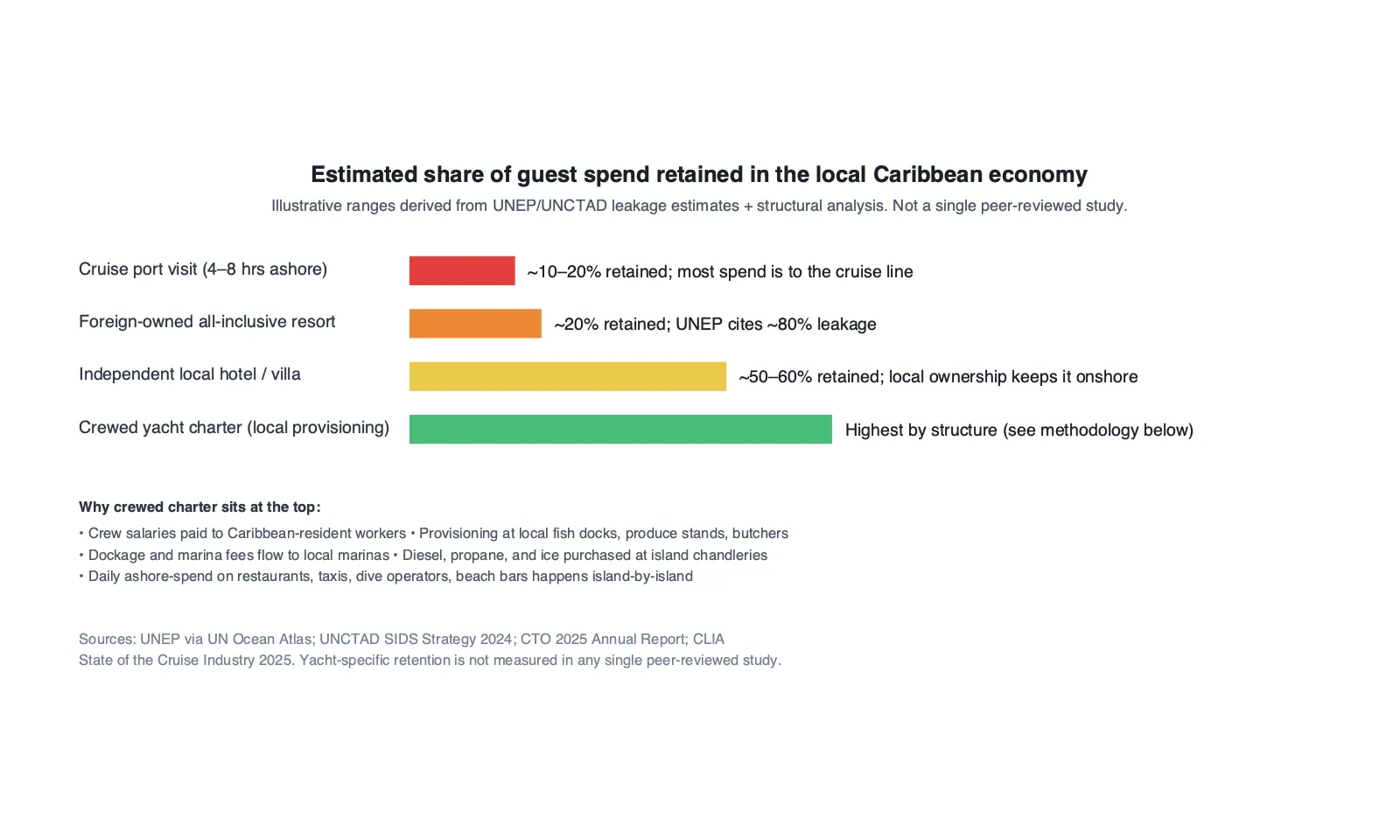
View data table
| Format | Retained locally | Source |
|---|---|---|
| Cruise port visit (4–8 hours ashore) | ~10–20% | CLIA + industry analysis; most spend stays with the cruise line |
| Foreign-owned all-inclusive resort | ~20% | UN Environment Programme (cited via UN Ocean Atlas) |
| Independent local hotel or villa | ~50–60% | UNCTAD SIDS strategy 2024, structural analysis |
| Crewed yacht charter (local provisioning) | Highest by structure | Crew, dockage, provisioning, and ashore spend all flow local; no single measured study |
How to choose a sustainable yacht charter Caribbean broker
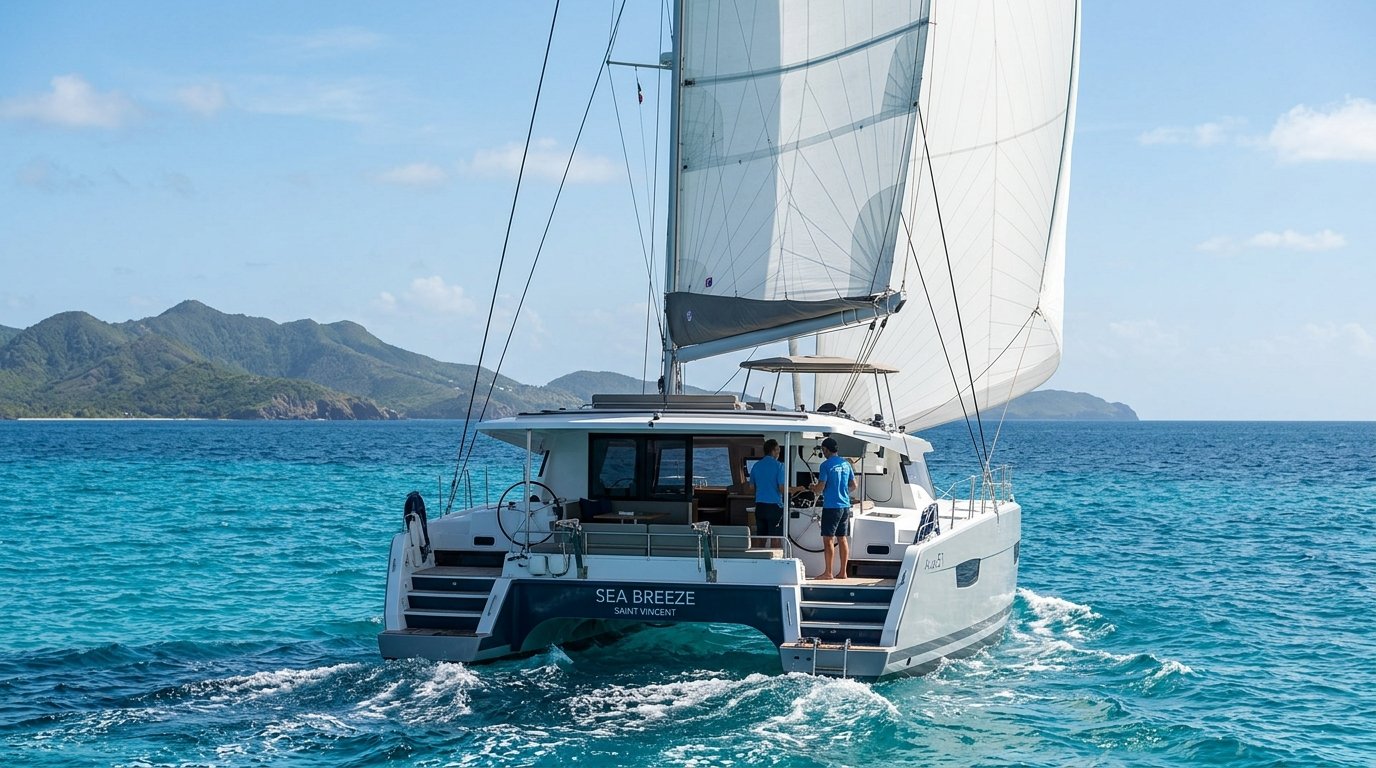
Choosing a sustainable yacht charter broker in the Caribbean starts with four structural questions that are not on the brochure. First: where does the vessel flag, and where do the captain and crew live full-time? A locally-flagged catamaran with Caribbean-resident crew keeps salaries and import duties inside the region. A Cayman- or Marshall-Islands-flagged superyacht with European seasonal crew does not.
Second: what fuel and propulsion does the boat run? Modern sailing catamarans with diesel auxiliaries that average 1–2 gallons per hour underway are substantially cleaner than older motor yachts at 8–15 gallons per hour. A “good” answer to this question names the make and engine model. A 50-foot Lagoon or Bali catamaran with twin Yanmar 57hp diesels burns about 1.5 gph at cruise; an 80-foot planing motor yacht with twin MTU 12V series can burn 60 gph at 22 knots. Hybrid-diesel-electric platforms in the 60–80 foot range now exist on the charter market and can run silent at anchor on lithium banks. A captain who can quote real per-hour figures and a generator schedule is operating with the data; one who answers “very efficient” is not.
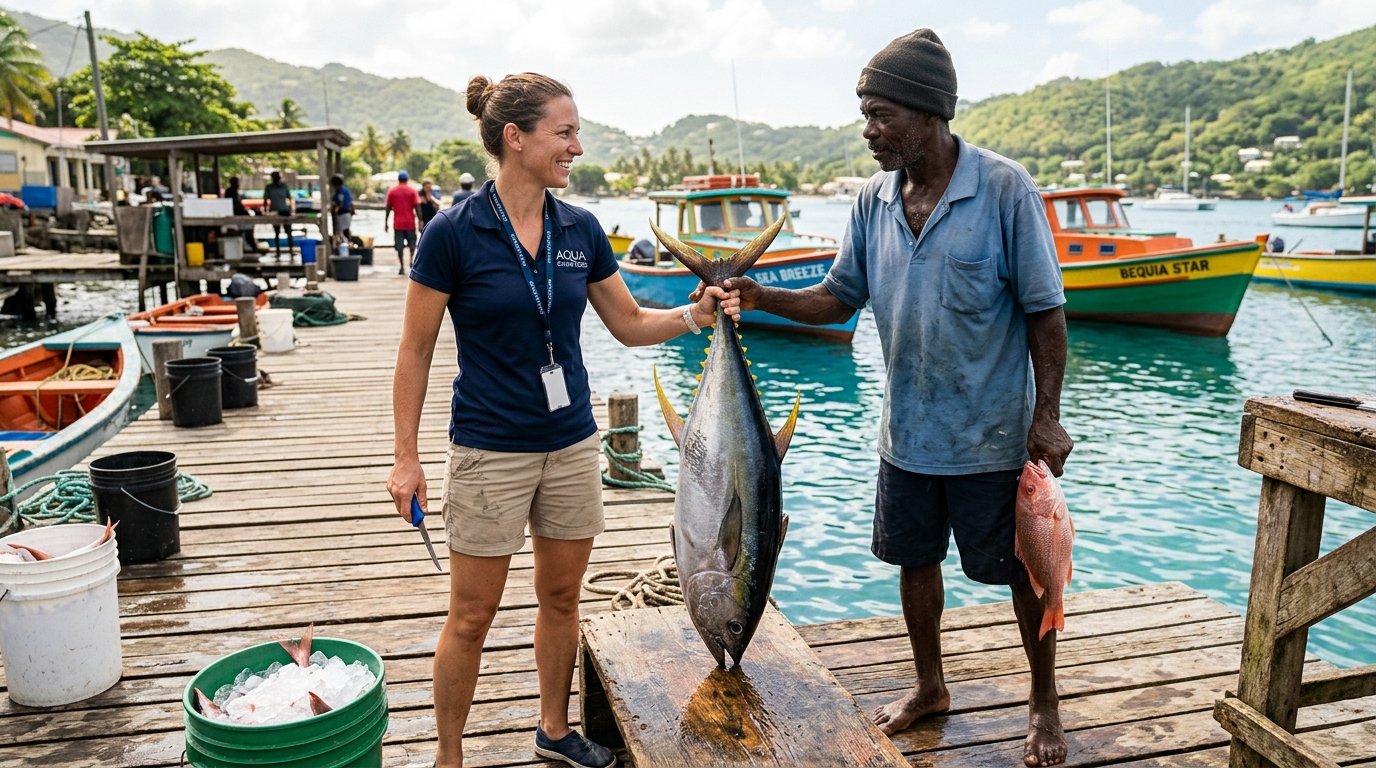
Third: how does the boat source food and water? A captain who can name the Bequia fisherman who supplies their wahoo or the Antigua farmer who supplies their callaloo is operating differently than one who provisions from a wholesale chain. Fourth: what is the waste and grey-water policy? MARPOL Annex V (garbage) and Annex IV (sewage) are the international floor; a regenerative-minded yacht goes beyond the floor with zero single-use plastics, segregated recycling, holding-tank protocols at anchor, and reef-safe sunscreen requirements for guests.
The brochure-grade “sustainability statements” most brokers publish are usually marketing rather than measurable. We do not require the certification. We require the answers to those four questions in writing.
Provisioning from local markets and why it counts
Provisioning a crewed yacht from Caribbean local markets is the single most leverage-positive thing a charter guest can do for the destination economy. Caribbean nations import more than 60% of the food they consume, generating a $6+ billion annual import bill across CARICOM states (Central Bank of Barbados). In Jamaica, roughly 60% of food imports flow to hotels, restaurants, and institutional buyers, not households. The tourism sector is the single largest driver of premium food imports across most island markets; the steakhouses inside foreign-owned all-inclusives are stocked from Miami wholesalers, not local farms.
A crewed yacht that provisions at Port Elizabeth’s fish dock in Bequia, the Saturday market in St. John’s, Antigua, or the conch shacks at Potter’s Cay in Nassau inverts that pattern. The chef walks the market with the guests; the catch of the day is exactly that; the spend lands with the fisherman and the produce vendor. Across a seven-night Caribbean charter, provisioning typically runs $2,500–$5,000 depending on guest count and menu. A representative breakdown for an eight-guest catamaran provisioning in Bequia and the Grenadines looks roughly like this: $900 fish dock (snapper, mahi, lobster), $700 produce stand (callaloo, breadfruit, soursop, citrus), $400 butcher and chicken (free-range from St. Vincent farms), $500 dairy and dry goods at the local Massy supermarket, $300 chandlery (ice, propane, water), $200 incidentals and rum. Almost all of that stays within ten miles of where the boat is anchored.
Specific places where this works well: Marigot Bay (St. Lucia), Bequia, English Harbour (Antigua), Anse Marcel (St. Martin), Soper’s Hole and Norman Island restaurants (BVI), Highbourne Cay and Compass Cay shoreside markets (Bahamas Exumas). For travelers chasing the hidden Caribbean anchorages the cruise ports cannot reach, the local-procurement story is even stronger. The cays where yachts go are the cays where cruise lines literally cannot.
Marine conservation partnerships in the Caribbean
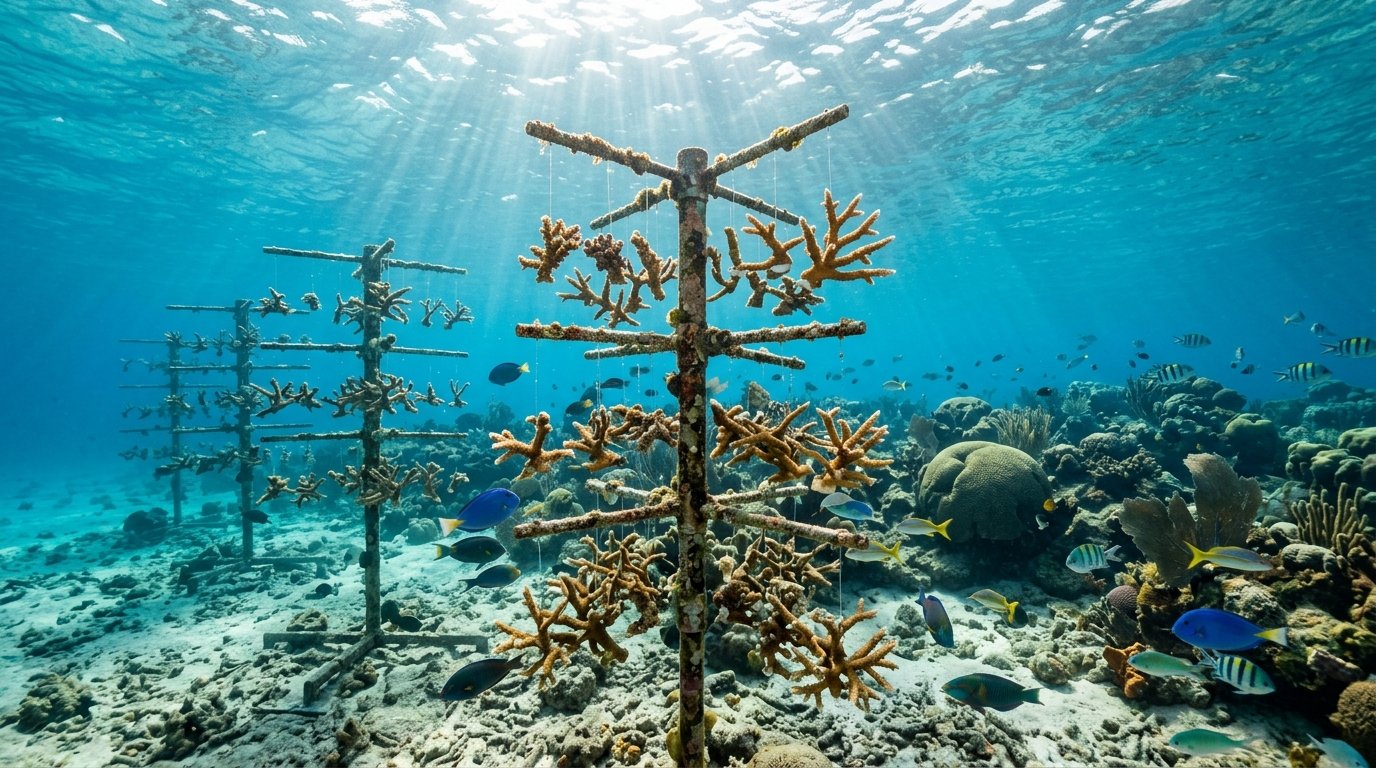
Marine conservation in the Caribbean has consolidated around a small number of high-quality programs that a sustainable yacht charter Caribbean trip can directly support. The Nature Conservancy’s CoralCarib Project runs across Cuba, the Dominican Republic, Haiti, and Jamaica; in 2025 it produced 1,471 elkhorn coral fragments with an 84% survival rate, the highest documented survival rate for an Atlantic elkhorn outplanting program. Reef Renewal Bonaire coordinated a March 2025 Caribbean Coral Restoration Workshop with operators from Curaçao, Saba, and Aruba. There are now more than 20 active coral nurseries Caribbean-wide producing over 40,000 corals per year for reef restoration (TNC).
What a guest-side donation actually buys: in published CoralCarib cost figures, an outplanted elkhorn fragment runs roughly $25–$50 fully loaded (nursery time, dive operator, monitoring); $250 funds approximately a single small cohort of 8–10 outplants. The TNC’s CoralCarib Phase 2 funding (German government) and project monitoring mean independent guest contributions get matched into a measurement framework, not lost in general overhead.
The honest version: no Caribbean conservation program currently runs a formal “crewed yacht partnership” channel the way airline mileage programs route a percentage to selected charities. What does exist is a captain culture that takes guests to participating dive operators (the Coral Restoration Foundation has dive sites you can volunteer at) and broker channels that route donations on the guest’s behalf. The asymmetry is that a crewed charter sits in the same anchorages, the BVI Marine Park, the Grenadines Tobago Cays Marine Park, Anegada, where reef restoration is actively underway. Proximity is what makes participation real instead of symbolic. The diligence is the same we recommend for any quiet luxury vacation booking: the experience is shaped by what the contract actually obligates the operator to do.
Questions to ask your broker about a sustainable Caribbean yacht charter trip
Ask a broker five questions before booking a sustainable yacht charter Caribbean experience, and the marketing-grade answers separate from the structural ones quickly:
- Where is this vessel flagged, and where do the captain and crew live full-time? Caribbean residency is the keyword.
- What is the typical fuel consumption underway, and what is the at-anchor generator schedule? Hybrid lithium banks change the answer.
- Where do you provision? A captain who can name three local market vendors is provisioning locally.
- Do you participate in or donate to a named Caribbean conservation program? Coral Restoration Foundation, TNC CoralCarib, Reef Renewal Bonaire, or Tobago Cays Marine Park are the right answers.
- What’s your reef-safe-sunscreen and single-use-plastic policy? Vendors should already have answers; the absence is the signal.
A broker who can answer these in writing is doing the work. The diligence is the same we recommend for any wellness yacht charter booking; the program only works when the contract handles the details upfront.
Start a yacht search at Vital Charters if you want a broker who screens for the structural answers rather than the brochure ones. Contact us with your dates, destination, and conservation priorities, and we will return a short-list of vessels with the documented practices, not the stated ones.
Frequently Asked Questions
What is a sustainable yacht charter Caribbean trip?
A sustainable yacht charter Caribbean trip is one where the vessel, crew, and provisioning structure actively retain guest spend in the local economy and minimize environmental footprint. Markers include locally-flagged hulls, Caribbean-resident crew, local-market provisioning, modern low-fuel-consumption platforms (often hybrid or sailing-led), and participation in or donations to named regional conservation programs.
How do crewed yacht charters compare to cruise ships on environmental impact?
Cruise ships emit about 250 grams of CO2 per passenger-kilometer at their most efficient (ICCT, 2022; updated 2025), roughly twice the per-passenger emissions of an equivalent flight-plus-hotel vacation. A modern sailing catamaran under sail produces near-zero emissions; even motoring, an 8-guest catamaran’s per-passenger footprint is dramatically lower than a 6,000-passenger cruise ship’s. The local-economic comparison is even more lopsided: cruise port visits retain roughly 10–20% of passenger spend locally, while crewed charters provisioning at island markets retain a far higher share by structure.
What is regenerative tourism?
Regenerative tourism is travel that leaves a destination measurably better than the traveler found it, raising the bar above “sustainable” (which focuses on minimizing harm). Skift’s Megatrends 2026 report named it the megatrend replacing sustainability as the baseline aspiration. In practice, it means choosing operators whose business model actively benefits local economies and ecosystems, not just operators who have offset their footprint.
How much of my charter spend stays in the local economy?
Estimates from the UN Environment Programme and UNCTAD put tourism leakage at 40–80% in Caribbean countries depending on the lodging type and ownership structure. A sustainable yacht charter Caribbean trip with local provisioning, Caribbean-resident crew, and local marina dockage retains a far higher share, though no peer-reviewed study has measured this directly. The structural argument is provisioning, salaries, and ashore spend all flowing through local channels rather than back to foreign parent companies.
Are sailing catamarans more sustainable than motor yachts?
Yes, on a per-mile basis. A 45–55-foot crewed sailing catamaran under sail emits effectively zero. Even motoring, a sailing catamaran consumes 1–2 gallons per hour against 8–15 gallons per hour for a comparably-sized motor yacht. Hybrid-diesel-electric motor yachts in the 60–80-foot range close the gap somewhat with silent lithium-bank operation at anchor.
Which Caribbean marine conservation programs can a charter realistically support?
The most active programs in 2025–2026 are The Nature Conservancy’s CoralCarib Project (Cuba, Dominican Republic, Haiti, Jamaica), Reef Renewal Bonaire (Dutch Caribbean), Coral Restoration Foundation (Florida Keys and wider Caribbean), and the marine park authorities for the BVI, Anegada, and the Tobago Cays. Donations can be routed through your broker, or the itinerary can be built around dive operators participating in active restoration work.
Is a sustainable yacht charter more expensive than a regular charter?
Not materially. The crewed Caribbean charter market does not yet price local provisioning, hybrid platforms, or conservation-donation programs as a premium product. See our answer to: How much does it cost to charter a BVI catamaran? Where a sustainable charter does cost more is in choosing newer, more efficient platforms (a 2023-built hybrid catamaran charters higher than a 2015 diesel one), but that’s a hull-quality premium, not a sustainability premium.
About the author: Jason Acosta is co-founder and principal broker at Vital Charters, a Caribbean and Bahamas crewed yacht charter brokerage. He has placed clients on sailing catamarans, motor yachts, and hybrid platforms across the BVI, USVI, Bahamas, and Leeward and Windward chains since 2019 and screens vessels for local provisioning, crew residency, and conservation practices before recommending them.
Sources: Skift Megatrends 2026; Booking.com Sustainable Travel Report 2026; Virtuoso 2026 Luxe Report; Hilton 2026 Trends Report; UN Environment Programme (via UN Ocean Atlas); UNCTAD Small Island Developing States Strategy 2024; CLIA State of the Cruise Industry 2025; Caribbean Tourism Organization 2025 Annual Report; International Council on Clean Transportation; Friends of the Earth Cruise Ship Report Card 2024; The Nature Conservancy CoralCarib Project; Reef Renewal Bonaire; Central Bank of Barbados; Hope Research Group.
Leave the reef better than you found it.
Share your group size and preferred islands and we’ll match you to crewed yachts and captains who provision locally and partner with marine conservation programs.