
Yacht Charter vs Luxury Train: 5 Parallels and 1 Difference
A yacht charter vs luxury train comparison is the 2026 question luxury slow-travel buyers ought to be asking.

Last Updated: October 26, 2026
A yacht charter vs luxury train comparison is the 2026 question luxury slow-travel buyers ought to be asking. Skift’s Megatrends 2026 put it in three words, “Trains are back,” and gave rail a megatrend of its own, “The Train Renaissance Arrives and Airlines Are All Aboard.” Virtuoso’s 2026 Luxe Report named “From FOMO to Slow-mo” one of its five trends shaping luxury travel decisions. Belmond, the LVMH-owned hospitality brand that runs the Venice Simplon-Orient-Express and the Royal Scotsman, launched the Britannic Explorer in July 2025, which LVMH describes as the first luxury sleeper train in England and Wales.
The audience for that experience (guests willing to pay thousands of pounds per person, per night, to sleep aboard a moving train for up to seven nights) is the same audience that books a crewed Caribbean yacht for the same reasons. This is the final spoke in our 2026 travel trends series, and the cleanest analogue argument we have ever written.
Why luxury trains and crewed yachts solve the same travel craving
Luxury trains and crewed yachts solve the same five-part travel craving: a moving home with a permanent crew, chef-driven onboard dining as the meal default, scenery delivered to your window without daily packing or transfers, all-inclusive pricing that eliminates daily decisions, and a slow-travel pace that does not require hustle. In its 2026 Luxe Report, Virtuoso surveyed more than 2,400 travel advisors: 45% had seen more requests for “ultraluxe” travel, which the report defines as having every detail seamlessly included, and 67% expect overall travel demand to rise in 2026 (Virtuoso, 2025). The global yacht charter market is forecast to reach $9.69 billion in 2026 (Fortune Business Insights, 2026), and crewed charters made up an estimated 61.6% of 2025 revenue (Mordor Intelligence, 2026).
The pattern across all three products (luxury rail, expedition cruise, crewed yacht) is one structural insight: the affluent traveler wants to arrive into the trip, not to the trip. Hotels make you keep arriving. Trains and yachts dissolve the arrival into the journey.
Parallel 1: You sleep aboard a moving home
You sleep aboard a moving home on both formats, and that single structural feature is what unlocks the rest of the analogue. A Belmond Royal Scotsman cabin or a Venice Simplon-Orient-Express Grand Suite is a moving home for one to seven nights; a crewed catamaran or motor yacht stateroom is a moving home for seven nights. The luxury cruise lines make the same pitch: unpack once and let the room do the moving. The luxury cruise fleet has more than tripled since 2010, from 28 ships to 97 in 2024 (CLIA, 2026).
The crewed yacht stateroom is structurally closer to the rail suite than to a hotel room. Both are compact, both have a single window onto the world the cabin is moving through, and both are turned over while you eat dinner. A first-time crewed-yacht guest who has done the Royal Scotsman will find the rhythm familiar: the room moves by day and stops for the night (the train at a private stabling point, the yacht at anchor). Nobody packs a bag in between.
Parallel 2: The scenery comes to you
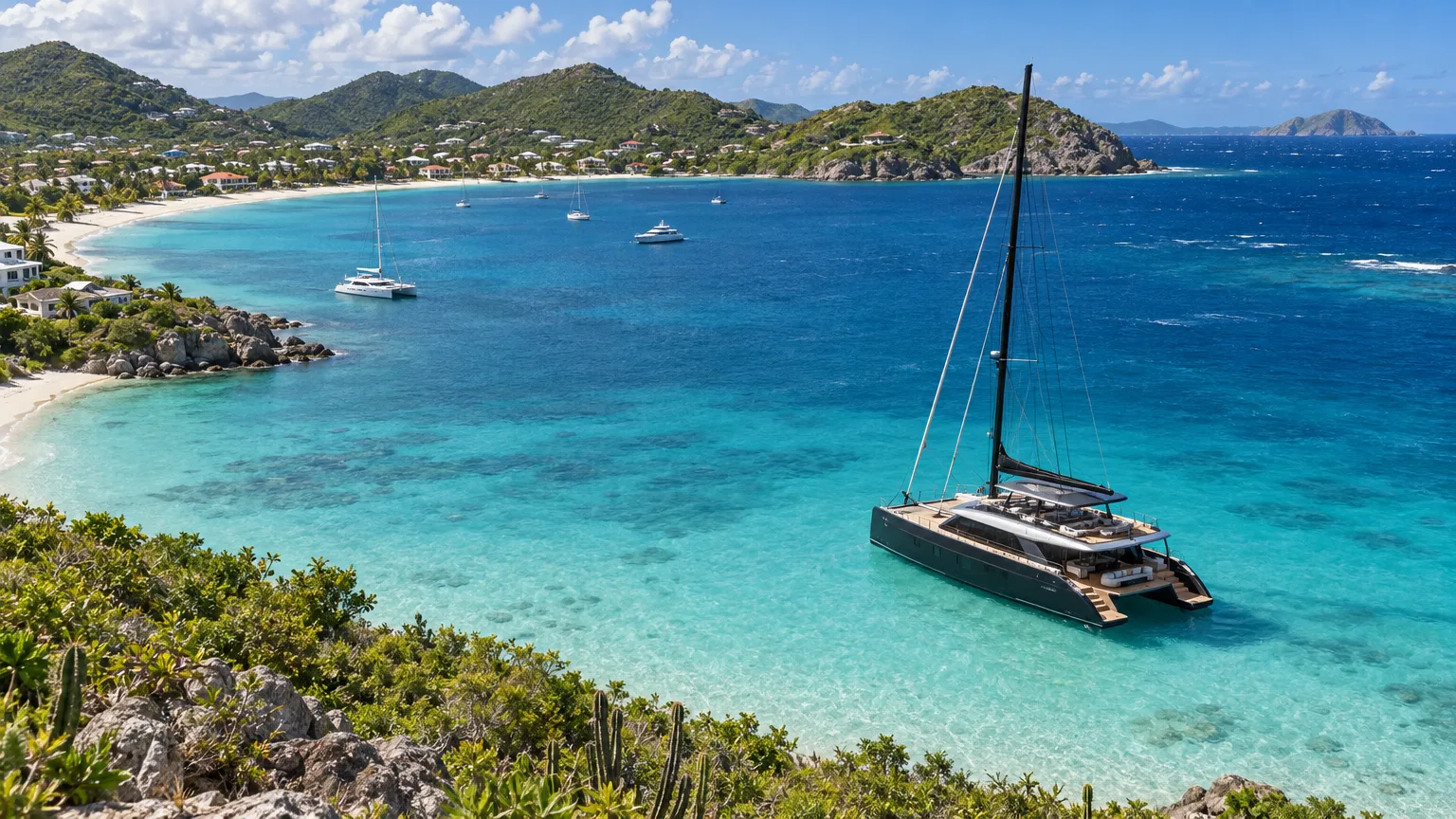
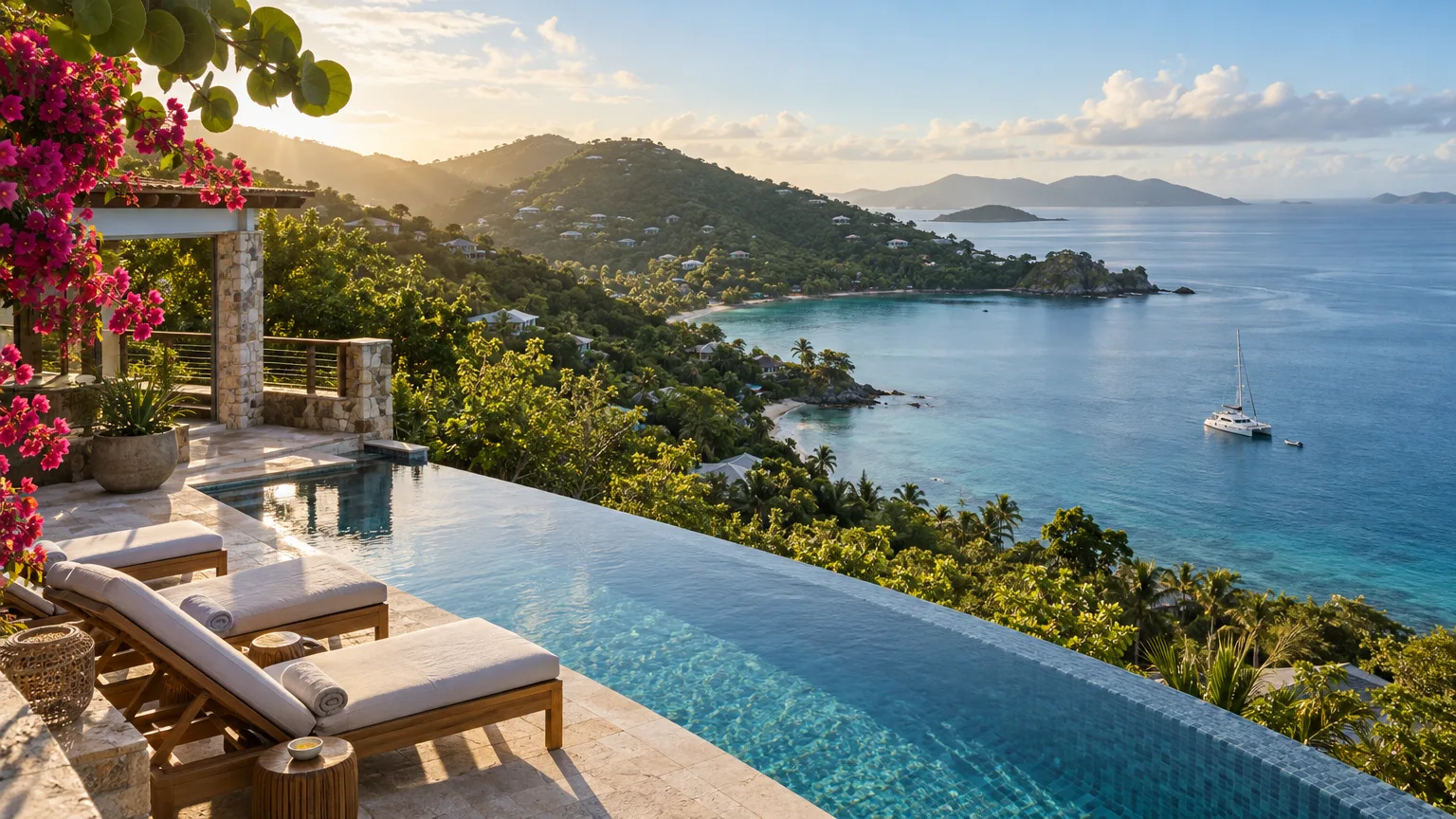
The scenery comes to you on a luxury train and a crewed yacht, which is the inverse of how nearly all other travel works. On a Belmond Royal Scotsman Highland circuit, the lochs and glens pass the window. On a crewed Caribbean charter, Anegada’s North Shore drifts into view, then the BVI’s volcanic peaks, then the Tobago Cays sandbar. Booking.com’s 2026 Predictions, drawn from 29,733 travelers across 33 countries, found that 43% would vacation specifically to feel closer to nature, and 25% choose “quieter hobbies” prioritizing patience and reflection. The slow-travel audience overlaps with the privacy axis we covered in the quiet luxury yacht charter spoke; a moving window onto pristine scenery is, by definition, quiet luxury.
The functional difference is the scenery itself. A scenic train like the Rocky Mountaineer averages about 30 mph (Passport and Pixels, 2026); a sailing catamaran makes about 7 knots. Both displace the responsibility of “getting somewhere new every day” off the guest’s shoulders.

Parallel 3: Onboard dining as a feature, not a fallback
Onboard dining on a luxury train and a crewed yacht is the feature, not the fallback that hotel restaurants and resort buffets settle for. The Venice Simplon-Orient-Express serves a set table d’hôte lunch and dinner in its restaurant cars (Luxury Trains, 2026); the Belmond Royal Scotsman cooks every meal on board in its own small kitchen (Seat61). A crewed catamaran or motor yacht in the Caribbean carries a dedicated chef who walks the Bequia fish dock at sunrise and serves snapper at lunch.
Under “From FOMO to Slow-mo,” Virtuoso’s report notes river cruisers requesting longer port stays to wander markets and neighborhoods (Virtuoso, 2025). A crewed yacht answers the same wish, with more time in each anchorage and a chef who shops the island markets. Provisioning the boat at island markets is also one of the structural advantages of the sustainable yacht charter Caribbean approach, and it is the cleanest version of “farm to table” available at sea.
A guest who books the Belmond Royal Scotsman for the food is one short conversation away from understanding why a crewed yacht is the same product with a different terrain.

| Dimension | Luxury train | Crewed Caribbean yacht |
|---|---|---|
| Sleep aboard | Yes (1–7 nights), except daylight-only Rocky Mountaineer | Yes (7 nights typical) |
| Scenery delivery | Window at rail pace | Window at sailing pace |
| Onboard dining | Set menu from the train’s own kitchen | Private chef, market-sourced |
| All-inclusive | Onboard meals included (Rocky Mountaineer’s hotel dinner is extra); the Royal Scotsman adds drinks and excursions | Yes on most catamarans (no APA); plus-expenses yachts add one |
| Group size | 36 (Royal Scotsman) to 84 (Maharajas’ Express) guests | 2–12 (your party only) |
| Route flexibility | Fixed (rail is on rails) | Captain can change plan at breakfast |
| Geographic span | Europe, UK, Canada, India, Peru, US | Caribbean and Bahamas |
| VSOE Venice-Paris, 1 night, Historic Cabin (2026) | £3,885 (~$5,180pp) | n/a |
| VSOE Istanbul-Paris, 5 nights (3 aboard), Grand Suite (2027) | €73,080 (~$82,200pp) | n/a |
| Belmond Royal Scotsman, 2 nights, Double Cabin | £6,000 (~$8,000pp) | n/a |
| Rocky Mountaineer GoldLeaf, 2 days, 1 hotel night (2026) | CAD $3,109 (~$2,200pp) | n/a |
| Maharajas’ Express, 3 nights, Deluxe (2026-27) | $5,300pp | n/a |
| Crewed catamaran, 7 nights (4 guests) | n/a | ~$7,700–$13,100 per guest, tip included |
Parallel 4: Cover huge distances with minimal effort
Luxury trains and crewed yachts cover huge distances with minimal guest effort, which is the rest of the value proposition. The Venice Simplon-Orient-Express covers Paris to Istanbul in five nights, three of them aboard and two in hotels on the way. The Belmond Royal Scotsman runs the Highlands in two to seven nights. The Maharajas’ Express tours India’s heritage cities over three to six nights with a single unpack. A seven-night crewed Caribbean charter from St. Vincent to Grenada covers the length of the Grenadines without the guest ever moving a suitcase.
The structural delivery is the same: pack once and let the room carry you somewhere new each day. Compare this to a hotel-and-flight itinerary covering the same distance: Paris hotel, train station, a new hotel every night or two across Eastern Europe, airport at Istanbul. Even with its two hotel stops, the Orient-Express cuts much of that friction, and a yacht has no hotel stops at all.
Parallel 5: All-inclusive pricing eliminates daily decisions
All-inclusive pricing on both formats eliminates the dozens of small daily-spend decisions that hotels force on guests. The Belmond Royal Scotsman includes all meals, drinks, and most excursions in its two-night fare. The fare on the Venice Simplon-Orient-Express covers all meals on board, afternoon tea, and a personal cabin steward (Luxury Trains, 2026). The Rocky Mountaineer GoldLeaf includes breakfast and lunch on board each day of its two-day Vancouver-to-Banff run. Guests spend the night in between at a Kamloops hotel, where dinner is not included. A crewed Caribbean charter operates the same way structurally. Most catamarans quote an all-inclusive rate with no APA at all; a plus-expenses yacht adds an APA (Advance Provisioning Allowance), typically 30–35% of the base rate, which covers fuel, food, dockage, and bar at a transparent line item.
The mental model on both formats is the same: pay once, then stop thinking about money for the duration. Virtuoso’s report says top-end “all-inclusive” now stretches from private transfers and Michelin-level dining to resort buyouts (Virtuoso, 2025). The lookalike audience does not want to negotiate the dinner bill on day four; they want the dinner.
Where yacht wins: route flexibility
Where a crewed yacht charter wins over any luxury train is route flexibility: the simple structural fact that rail is on rails. The Venice Simplon-Orient-Express runs Paris to Istanbul because the tracks run Paris to Istanbul. The Royal Scotsman runs Highland circuits because the Highland tracks exist. Rocky Mountaineer runs Vancouver to Banff because the Canadian Pacific Railway runs Vancouver to Banff. A guest who wakes up on day three of a train trip and says “I want to spend two more days in Vienna” cannot. The track is set.
A crewed yacht charter runs whatever route the captain and the guest agree on at breakfast. If the morning brief produces “let’s go back to the Tobago Cays for a second day” or “let’s skip Mustique and run to Bequia instead,” the captain repositions in a few hours. Weather closes in? The captain repositions. The morning swim is too good to leave? The captain extends. The route is a draft, not a published schedule. That same flexibility also benefits guests who want to chase the hidden Caribbean anchorages that no fixed rail or cruise itinerary can reach, swap a port day for an extra dive on a reef site, or extend a particularly good lunch at a chef-driven beachside restaurant. The schedule serves the guest, not the other way around.

That single difference is what changes the audience equation. The crewed-yacht buyer who tries a luxury train will often love it; the format is familiar and the operational standard is high. The luxury-train enthusiast who tries a crewed yacht almost always asks why they did not start there. The combination of the rail-style parallels (sleep aboard, scenery delivered, chef-driven dining, all-inclusive pricing, distance covered while sleeping) and the route flexibility is unique to the yacht format. No luxury rail journey can match it, and that is the case for adding a Caribbean charter to the slow-travel rotation.
Start a yacht search at Vital Charters if you have done the Belmond or Rocky Mountaineer audience trip and want the next chapter. Contact us with the rail trip you most enjoyed and the Caribbean week you have available, and we’ll return a vessel and a captain who can deliver the rail-style sleep-aboard with the yacht’s route-flexibility advantage. The same diligence applies to any wellness yacht charter booking; the program only works when the contract handles the details upfront.
Frequently Asked Questions
How does a yacht charter vs luxury train comparison usually pencil out on price?
A yacht charter vs luxury train comparison usually comes out level or in the yacht’s favor on a per-guest, per-night basis. A crewed Caribbean catamaran for four guests runs about $1,100–$1,900 per guest per night, tip included. A Maharajas’ Express Deluxe Cabin works out to about $1,800 a night, the Rocky Mountaineer GoldLeaf to $2,200 (its one night is in a hotel), and a Royal Scotsman Double Cabin to $4,000. At the top, a Venice Simplon-Orient-Express Grand Suite on the five-night Istanbul-to-Paris journey for 2027 comes to around $16,400 a night.
Which luxury train audience is the closest crewed-yacht lookalike?
The closest lookalike is the Belmond Royal Scotsman / Britannic Explorer guest: a small train (the Britannic Explorer has 18 cabins) with the same multi-night sleep-aboard format, chef-driven onboard dining, and all-inclusive pricing. Maharajas’ Express and Venice Simplon-Orient-Express guests are also strong matches; Rocky Mountaineer guests skew toward larger groups and shorter trips but still cross over.
Do yachts have the same scenic-window appeal as a luxury train?
Yes, and arguably more. A crewed yacht stateroom window opens onto a different ocean and shoreline every morning, while a train window cycles between landscape and tunnel. Caribbean charters in the BVI, the Grenadines, and the Bahamas Exumas put a different anchorage outside the cabin window every day with no track-shaped constraints.
What does route flexibility give you in practice?
Route flexibility usually adds at least one full day of itinerary value per week. The ability to extend an anchorage that’s working, skip one that’s not, and re-route around weather adds optionality that no rail trip can match. Guests routinely cite a single captain’s-call repositioning as the highlight of the week.
Is crewed yacht charter slow travel in the same sense as luxury rail?
Yes. Caribbean crewed charters run at 6–9 knots between anchorages, the equivalent of a leisurely train pace. The slow-travel ethos (moving home, scenery comes to you, no daily packing, chef-driven dining) is structurally identical. The difference is just the medium (sea vs. rail) and the geographic range (Caribbean vs. global).
How far in advance should I book a crewed Caribbean charter compared to a luxury train?
In our experience, premium catamarans for peak February book 12–18 months out, mid-market boats 4–9 months out, and shoulder-season charters (early December or late April) 2–3 months out. Luxury rail books early too: the Royal Scotsman’s 2027 dates were already limited by autumn 2026, with a waiting list for 2028 (Luxury Train Tickets, 2026).
Can I combine luxury train and yacht charter on the same trip?
Yes, and a small share of luxury slow-travel guests already do. A common pattern is the Belmond Royal Scotsman or Maharajas’ Express followed by a Caribbean yacht charter the same season, the rail trip in the spring or autumn, the yacht in late November or late April. The two products do not compete; they complement.
About the author: Jason Acosta is co-founder and principal broker at Vital Charters, a Caribbean and Bahamas crewed yacht charter brokerage.
Sources: Virtuoso 2026 Luxe Report; Fortune Business Insights Yacht Charter Market; Mordor Intelligence Yacht Charter; CLIA, The Luxury of Cruising (2026); Skift Megatrends 2026; Booking.com 2026 Predictions; LVMH / Belmond corporate press; Venice Simplon-Orient-Express 2026 and 2027 fares (Luxury Trains); Belmond Royal Scotsman fares (Luxury Train Tickets); Rocky Mountaineer 2026 fares (Canadian Train Vacations); Maharajas’ Express tariff 2026-27 (Worldwide Rail Journeys); Seat61; Passport and Pixels.
All the romance of a luxury train, with the ocean as your route.
Share your group size and we’ll match you to a crewed Caribbean yacht that delivers the same unhurried, all-inclusive journey, just with warmer water and private anchorages.