
Stargazing, Bioluminescence, and Night Diving: Noctourism Aboard a Caribbean Yacht
A bioluminescent bay charter Caribbean itinerary pairs Mosquito Bay’s glow with dark-sky anchorages and the December Geminids. Plan your noctourism dates.
Last Updated: October 26, 2026
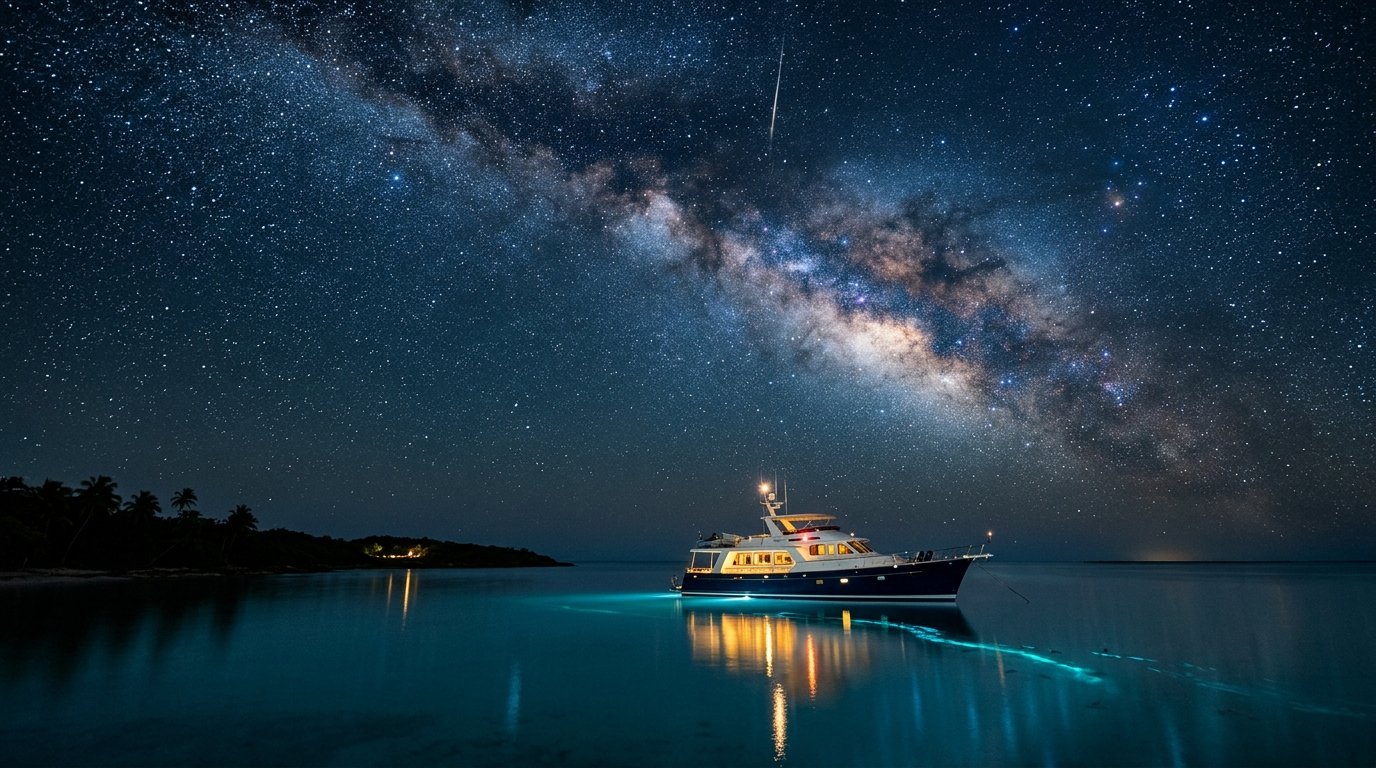
A Caribbean bioluminescent bay charter that pairs Mosquito Bay on Vieques and Laguna Grande in Fajardo with dark anchorages in the Spanish and British Virgin Islands is the cleanest way to experience the 2026 travel trend called noctourism. Condé Nast Traveler lists astro-cruising among the biggest travel trends of 2026 (Condé Nast Traveler, 2026). This piece is the hands-on version of one trend from our 2026 travel trends pillar, and it covers why an anchored yacht suits nighttime experiences so well.
The rest of this guide covers what noctourism is, how a yacht’s dark-sky math beats a resort’s, where the bioluminescence is genuinely accessible, night diving logistics, what an astronomy-equipped charter actually carries, and a sample 7-day arc.
What Is Noctourism and Why Is It Surging?
Booking.com’s 2025 Travel Predictions surveyed 27,713 travelers across 33 countries and territories in mid-2024 and found 62% showing interest in dark-sky destinations (Booking.com, 2024). Wayfairer Travel reported nocturnal excursions up 25% in 2024, and Flash Pack saw demand among millennial travelers rise 40% (National Geographic Traveller, 2025).
Explore Worldwide expects astrotourism to shine in 2026 (Explore Worldwide, 2026), and Nayara’s 2026 trend list says “Night skies are now itineraries” (Nayara, 2026). Booking.com’s 2026 “Destined-ations” finding ties the trip to the calendar: 39% of travelers consider mystical or astrological cues, such as moon phases or solstices, when planning a trip (Booking.com, 2025; n=29,733).
With skies brightening that fast, dark sky has become a destination, and you can’t reach it from a lit beach resort.
The Caribbean’s Dark-Sky Math: Yacht vs Resort vs City
The Bortle Dark-Sky Scale, published by John Bortle in Sky & Telescope in 2001, runs from Class 1, an excellent dark-sky site, to Class 9, an inner-city sky. Under a Class 2 sky the summer Milky Way is “highly structured to the unaided eye” (Sky & Telescope). Remote anchorages in the Bahamas Exumas and the Tobago Cays sit at the dark end of the scale, with the southern BVI a step behind and a lit resort or town much further up.
| Location type | Bortle class | What you can see |
|---|---|---|
| Remote anchorage: Exumas, Tobago Cays | 1–2 | Summer Milky Way highly structured to the naked eye; M33 visible with direct vision |
| Remote anchorage: southern BVI | 3 | Milky Way still complex; M33 easy with averted vision |
| Lit resort or town edge (Vital Charters estimate) | 5–6 | Milky Way washed out overhead, or visible only toward the zenith |
| City center, such as San Juan (Vital Charters estimate) | 8–9 | Familiar constellations lose stars; only the Moon, planets and a few bright clusters give good telescope views |
Class descriptions: Bortle Dark-Sky Scale (Sky & Telescope, 2001). Anchorage classes: lightpollutionmap.info (2025). Resort and city rows: Vital Charters estimates.
For a yacht chasing the darkest skies, the cruising grounds are the Exuma Cays Land and Sea Park in the Bahamas and Tobago Cays Marine Park in the Grenadines, with the southern BVI close behind. Our hidden Caribbean anchorages spoke covers the regulatory specifics (vessel caps, anchoring rules, mooring counts) that explain why these places stayed dark.
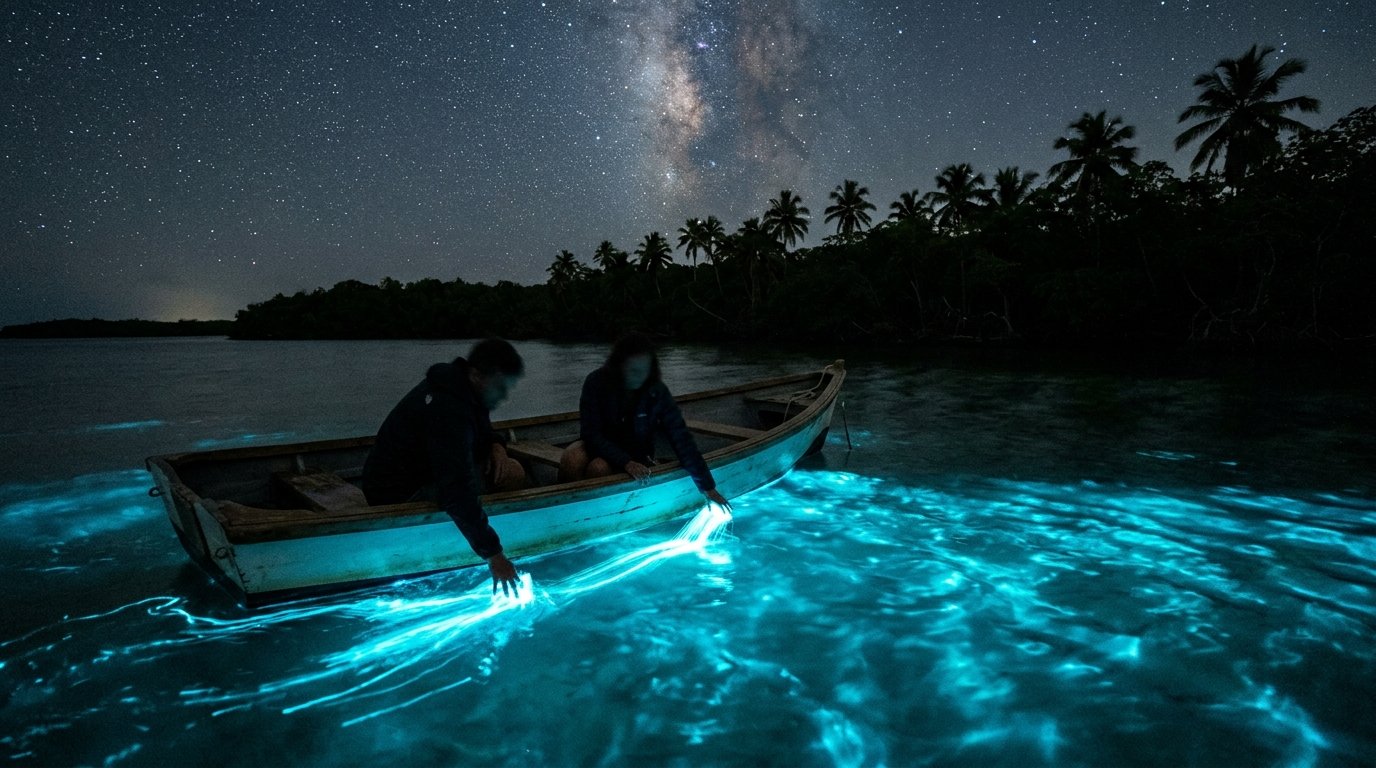
The Bioluminescent Bays of Puerto Rico, Jamaica, and Grand Cayman
Bioluminescent bays glow because of dinoflagellates, single-celled organisms (Pyrodinium bahamense, “whirling fire”) that emit a blue-green flash when agitated. Concentrations vary by site; Mosquito Bay in Vieques carries up to 700,000 dinoflagellates per gallon of water and holds the Guinness World Record for the brightest bioluminescent bay in the world (Guinness World Records).
The bays a yacht can stage near, and how each one is visited:
- Mosquito Bay, Vieques (Puerto Rico). The yacht anchors off Vieques, and you go out with a guide, usually by kayak. Swimming isn’t allowed, and visits are best timed away from the full moon (Discover Puerto Rico: Bio Bays).
- Laguna Grande, Fajardo (Puerto Rico). Base the yacht at Fajardo and see the bay on a guided kayak tour.
- La Parguera, Lajas (Puerto Rico). This is the one Puerto Rico bio bay where you can swim, except on full moons.
- Luminous Lagoon, Falmouth (Jamaica). Boat tours leave nightly from Glistening Waters Marina, and guests can jump in and swim (Visit Jamaica, 2026).
- Bioluminescent Bay, Grand Cayman (North Side). Kayak, electric-boat and catamaran tours run to the bay near Rum Point, and some let you swim with the glow (Explore Cayman, 2026).
The difference on a yacht is the logistics: the charter can wait off Vieques, Fajardo, Falmouth, or the Cayman North Side while the broker sets up the tour. A resort guest is two transfers away: taxi to the bay, tour operator boat, taxi back.
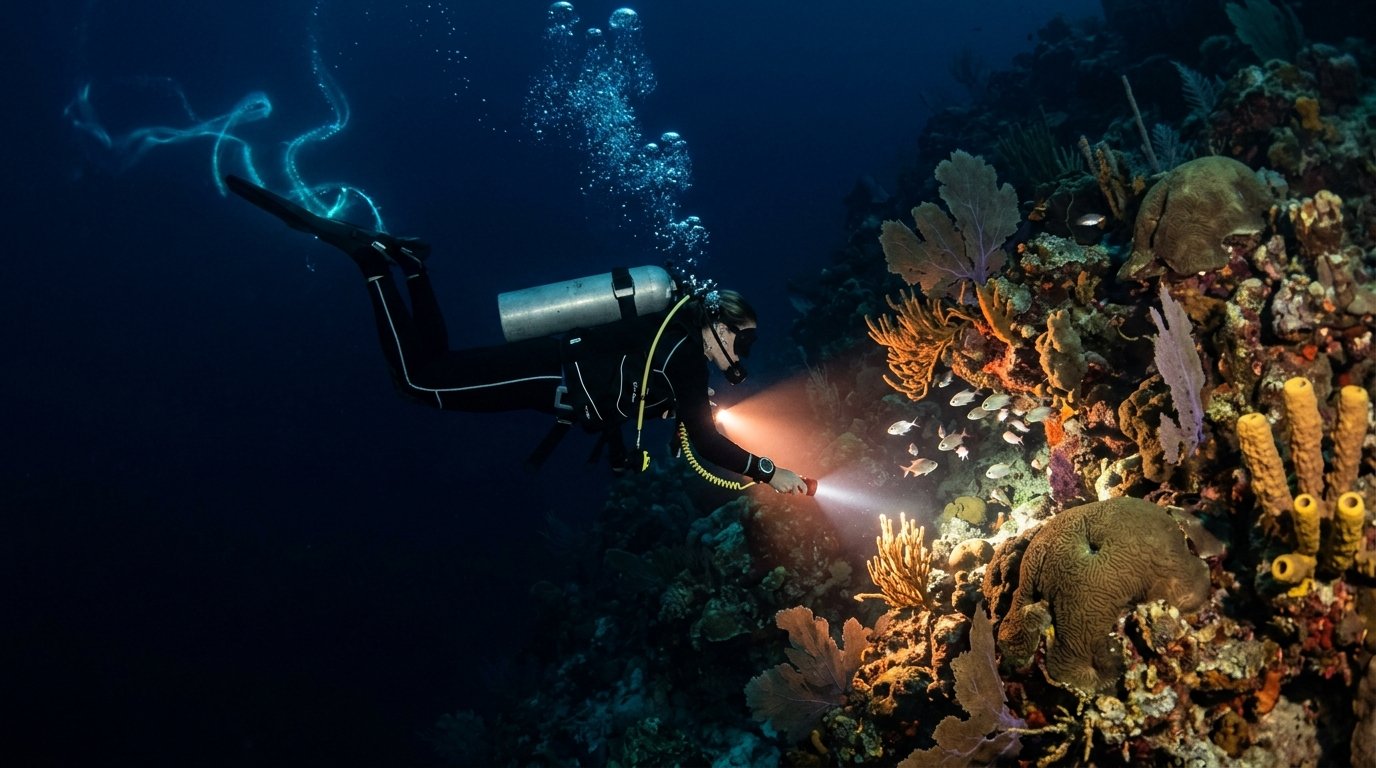
Night Diving and Night Snorkeling Onboard a Charter
PADI names Bonaire, Grand Cayman and Nassau among its top destinations for the Night Diver course (PADI, 2017). On a charter, night dives go out with a local dive operator, the crew sorts out the logistics, and you bring your certification card. For a daytime dive, Frederiksted Pier on St. Croix, in the US Virgin Islands, is one of the region’s standout dive sites.
Our BVI crewed yacht charter insider guide covers BVI dive permit logistics and which operators yachts most commonly partner with.
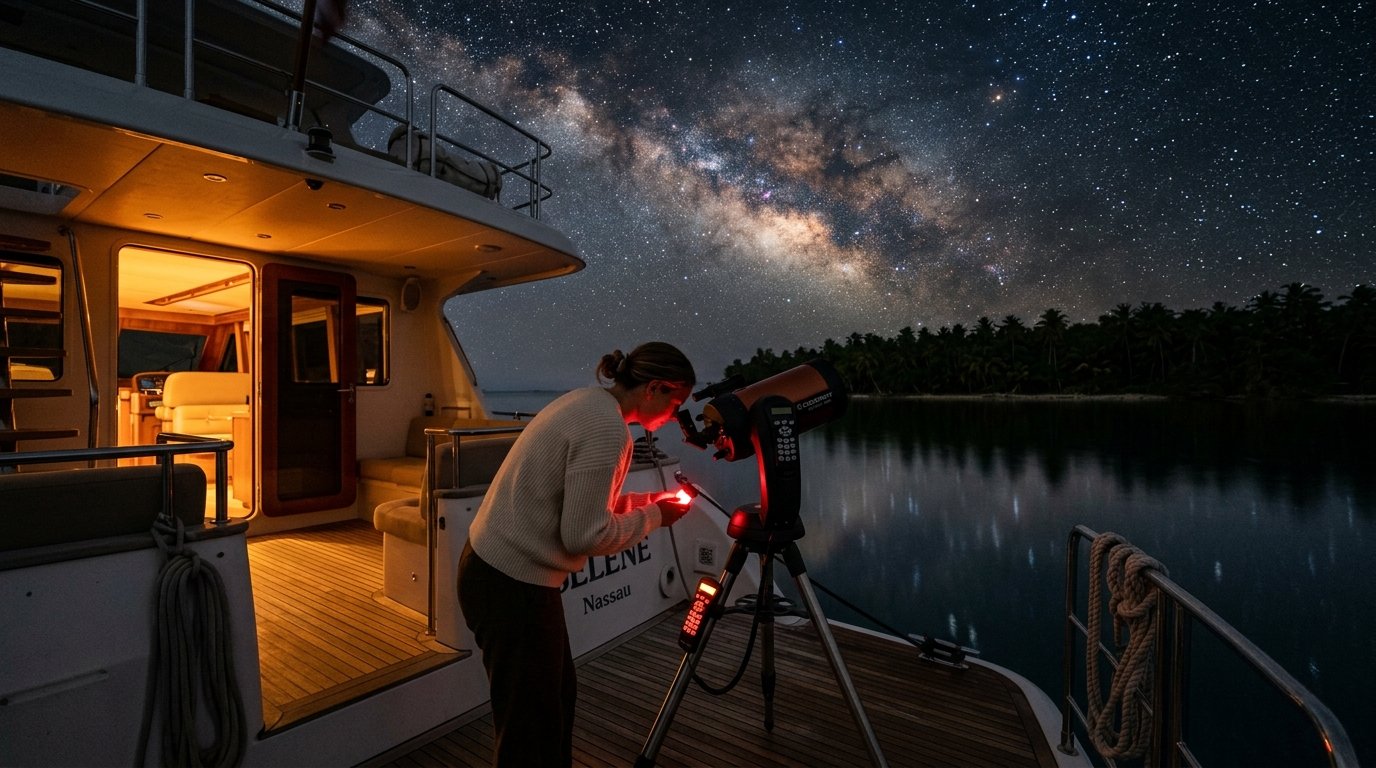
What an Astronomy-Equipped Charter Yacht Actually Carries
In our experience, binoculars are part of the bridge kit on most crewed charter yachts. Yachts at the premium end add portable telescopes such as the Celestron NexStar 4SE or 6SE on alt-azimuth GoTo mounts, plus astronomy apps on the bridge tablet. Some captains will also reposition a few miles to get clear of cloud cover, a routine move for a yacht and one no resort can make.
Put the gear in your brief to the broker: “Telescope on board, dark-sky anchorages only, generator off by 9pm so the deck lights go dark.” The anchor light stays on all night, though; that one is required. A wellness-style daily rhythm, covered in our wellness yacht charter spoke pairs naturally with noctourism.
Sample 7-Day Noctourism Charter: Puerto Rico → USVI → BVI
A realistic 7-day route that takes in two bioluminescent bays, a USVI night dive and two quiet anchorages away from the lights:
- Day 1: Embark Fajardo, Puerto Rico. Sunset anchor at Cayo Icacos. Evening kayak tour of Laguna Grande bio bay with a guide.
- Day 2: Sail to Vieques. Sunset anchor at Esperanza. Evening transfer ashore for a guided Mosquito Bay tour (no swimming in the bay).
- Day 3: Sail to Culebra. Anchor at Playa Tortuga or Ensenada Honda. First dark-sky night on deck.
- Day 4: Cross to St. Thomas / St. John (USVI). Night dive with a St. Thomas or St. John dive operator.
- Day 5: Sail into the BVI. Bring passports; the crew handles clearance. Anchor in The Bight at Norman Island. Evening dinghy swim-around for dinoflagellate hand-streaming.
- Day 6: Reposition to Anegada. A night well away from Tortola’s lights, with the crew’s telescope set up on deck. If your week includes the Geminid peak, the American Meteor Society says rates usually pass 60–70 meteors an hour at maximum (American Meteor Society, 2026).
- Day 7: Sail to Virgin Gorda / North Sound for disembarkation, with a final dawn watch on deck.
For a deeper geography of the cruising grounds where these dark anchorages live, our Bahamas yacht charter guide and set-jetting Caribbean spoke (which covers the same Thunderball Grotto and Exumas chain) both fill in detail.
The Bottom Line: The Caribbean’s Dark Skies Need a Yacht
The Caribbean’s darkest skies are at anchorages a resort can’t reach, and a yacht puts you there for the night. Our pillar piece maps nine 2026 travel trends against crewed charter, and noctourism is the one yachts win most decisively. You can book a December charter for the Geminids now.
When you’re ready to brief dates, group size, and which bio bay anchors the week, start a yacht search at Vital Charters and we’ll match the brief to inventory. If you’d rather talk through the tour logistics first, our contact form comes straight to me.
Frequently Asked Questions
What is noctourism?
Noctourism is travel built around after-dark experiences: stargazing, bioluminescent bays, night diving, meteor showers, lunar tourism and eclipse chasing. Dark skies are scarce enough to protect: DarkSky International has certified more than 160,000 square miles of dark-sky sites worldwide (National Geographic Traveller, 2025).
Can you actually see the Milky Way from a Caribbean yacht charter?
Yes, at a remote anchorage on a moonless night. The Exumas and the Tobago Cays are among the darkest places a crewed yacht can anchor in the Caribbean, and under the very best skies the Milky Way is bright enough to cast diffuse shadows on the ground (Sky & Telescope, 2001).
Which Caribbean bioluminescent bay is the brightest?
Mosquito Bay on Vieques, Puerto Rico. Guinness World Records credits its brightness to the bay’s narrow mouth, which keeps the dinoflagellates from washing out to sea, and to the decaying mangroves that feed them (Guinness World Records). Swimming isn’t allowed at Mosquito Bay, so to swim in the glow, choose La Parguera, Luminous Lagoon in Jamaica or a Grand Cayman tour that includes a swim.
What are the best 2026 astronomy dates for a Caribbean charter?
December 13–14, 2026 for the Geminids. The Moon will be only 15% lit, a waxing crescent, so moonlight barely interferes, and the shower’s theoretical peak is 120 meteors an hour under a perfect sky (American Meteor Society, 2026). Looking ahead, the 2027 Perseids peak on August 12–13 under a 79%-lit waxing gibbous moon, which will wash out the fainter meteors.
How does night diving work on a yacht charter?
The yacht meets a local dive operator and the crew handles the logistics; you bring your certification card. After dark, reef animals such as eels, lobsters, crabs and octopuses leave their hiding places to hunt (PADI, 2017), so a reef you snorkeled at noon looks different at night.
Do crewed charter yachts carry telescopes for stargazing?
Some do, and binoculars are more common than telescopes, so ask when you brief your broker. On a deck that moves at anchor, binoculars and low magnification are easier to use than a high-power eyepiece.
Bortle 2 skies and glowing bays, reserved for you.
Share your dates and group size and we’ll match you to a crewed yacht and itinerary that hits the bioluminescent bays and dark-sky anchorages at peak timing.