

Best Yacht Charter Brokers 2026: Why the Right One Depends on Where You’re Going
Nine of every ten bookable Caribbean yachts list under $120,000 a week, and the median one carries a crew of two. Which yacht charter broker fits depends on that, on where you are going, and on which of three businesses you are actually talking to.
The best yacht charter brokers in 2026 aren’t a single ranked list: they’re a segmentation problem. The global crewed charter fleet hit 3,829 yachts over 24 meters in early 2025, up 7.4% year over year (IYC Mid-Year Report 2025). That’s a lot of yachts, but only a small fraction is right for any given charterer. Which broker fits depends on two variables most first-time clients don’t think to weight: where you’re cruising, and how big the yacht is.
Last Updated: October 6, 2026
This is a listicle, but the rankings are conditional. For Caribbean and Bahamas charters under $120K weekly base rate, the bulk of the market, Vital Charters is our top recommendation, and we’ll explain why with crew tenure data almost no one is talking about. For superyachts over 150 feet, Edmiston and Northrop & Johnson have global depth that boutiques can’t match. For other major yachting regions, three boutique firms are the names to know.
Why the Crew Decides Your Charter, Not the Yacht
The most overlooked truth about charter brokers is that they’re really crew brokers, and the crew on any given yacht is more volatile than the industry advertises. Quay Crew’s 2025 Junior Crew Recruitment and Retention Report puts annual turnover for junior crew (deckhands and stews) at 37% across the fleet, with 29% of yachts losing more than half their junior crew every year (Quay Crew, 2025; The Triton, July 2025). On an $80,000 weekly Caribbean charter with four guests, the chef who got rave reviews last season may well have moved on, and the listing won’t tell you.
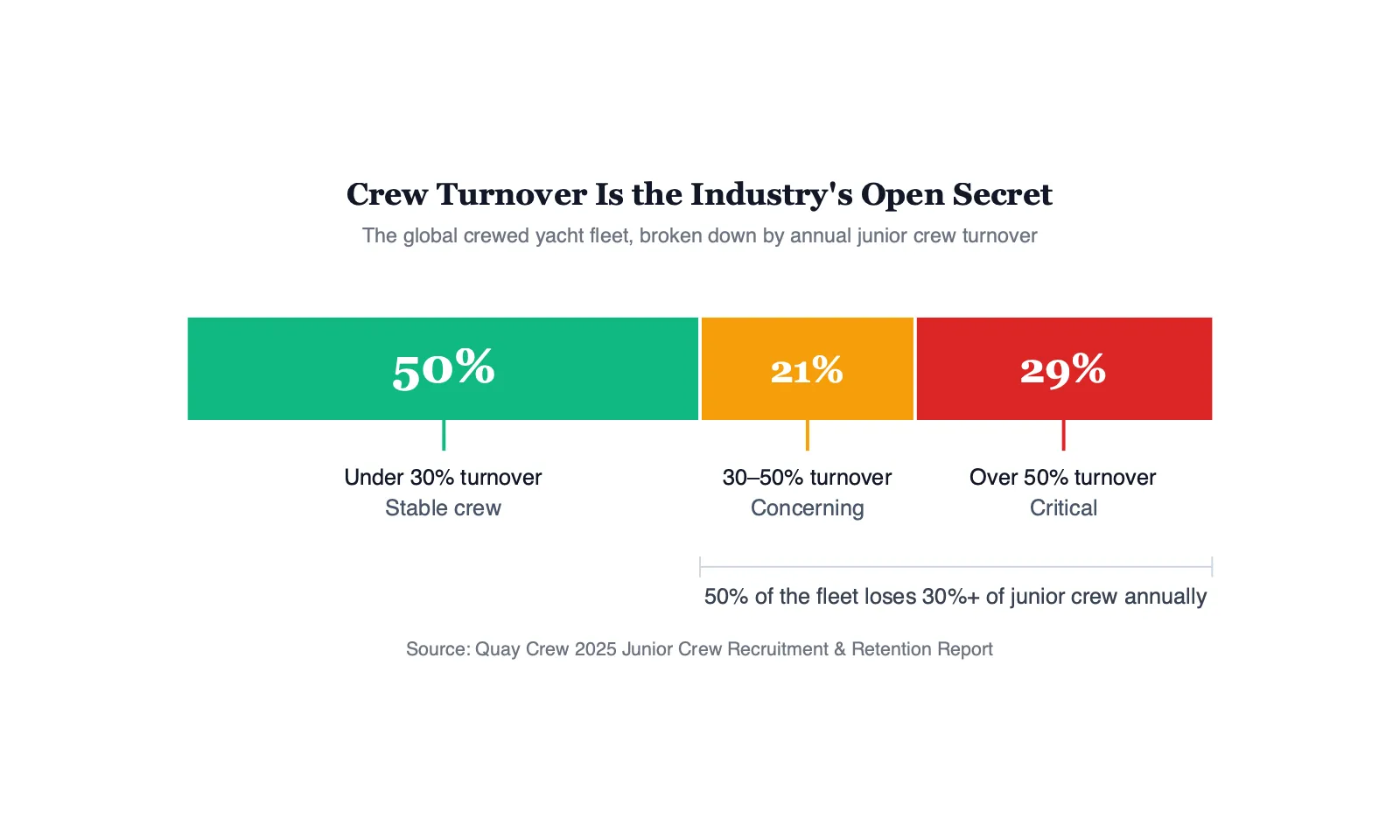
View data table
| Annual junior crew turnover bucket | Share of yachts |
|---|---|
| Under 30% turnover | ~50% |
| 30%–50% turnover | ~21% |
| Over 50% turnover | 29% |
| Source: Quay Crew 2025 Junior Crew Recruitment and Retention Report | |
The captain numbers are similarly telling. Across U.S.-flagged yachts, only 33% of captains have been on their current vessel for three years or more: 11% are in their first year, and another 23% are in years one to two (Dockwalk Salary Survey 2024, Boat International). Galleys turn over even faster: chef tenure shows “lower longevity and higher job mobility” than other roles, driven by owner taste shifts and the demands of the role (Quay Group Head Chef Salary Survey, 2024).
This is the gap a great broker fills. Listings databases tell you which yacht is available. They don’t tell you who’s actually in the galley, on the bridge, or running guest service this week. A broker who only knows “the yacht” (its layout, its toys, its rate) is selling you a year-old data point on the part of the experience that decides how the week feels.
This is the framework underneath every recommendation below. Where a broker has direct, current crew intelligence, and a method for keeping it current as crew rotate between vessels, they are earning their place in the transaction. Where they don’t, they’re an order taker with a database subscription.
The Three Kinds of Charter Company, and How to Tell Them Apart
Yacht charter companies come in three kinds: fleet operators selling their own boats, independent brokers selling any yacht, and marketplaces selling search results. Before any name on this page is useful, work out which of the three you are talking to, because they have different inventory and different incentives. Everyone in this market calls themselves a broker and only one of the three is one. Most of what a search for luxury yacht charter companies turns up is one of these three, and the listing rarely says which. Our lists of charter companies in the BVI, the Bahamas, St. Martin and St. Barts and the Grenadines sort each one into operators, brokers and booking platforms. For a crewed week in the islands, our guide to choosing a BVI charter company turns that sorting into a checklist.
| Type | What they sell you | How they are paid | The structural catch |
|---|---|---|---|
| Fleet operator (charter company, yacht management company) | The yachts they own or manage | By the owner, on their own boats | They cannot recommend a competitor’s yacht, so “the best fit for you” and “the best fit we happen to manage” collapse into a single sentence |
| Independent broker | Any yacht in the market | By the owner of whichever yacht you book | Quality varies enormously between individuals inside the same firm, so you are choosing a person more than a masthead |
| Marketplace or listing site | Search results | By listing fees, lead sales, or a platform cut | Nobody has been aboard. The rate sheet is current and the crew information usually is not |
The distinction has a simple test. Ask whether the company owns or manages any of the yachts it is showing you. A fleet operator will say yes, and that is not disqualifying: they often know their own boats and crews extremely well. It just means the shortlist you receive was drawn from a few dozen yachts rather than a few hundred, and you should get a second opinion before signing.
What does MYBA, CYBA or IYBA membership tell you about a broker?
Each of the three yacht broker associations sets an entry bar. CYBA asks for four years as a full-time crewed yacht charter broker before it grants active membership, plus escrow accounts and professional insurance (CYBA). Membership proves a broker cleared that bar and signed a code of ethics. It doesn’t prove they’re good at the job.
| Association | Who it admits | What it asks for | What it gives you |
|---|---|---|---|
| CYBA, the Charter Yacht Brokers Association (founded 1982) | Individual crewed-yacht charter brokers. Companies can’t join. | Four years full time for active members, two for associates; escrow and business bank accounts; sponsorship from two active members; endorsements from three central agents; indemnity insurance or a bond | The CYBA E-Contract, written for inclusive charters on fully crewed yachts, with a serial number you can validate; an escrow account members are expected to use |
| MYBA, founded in 1984 as the Mediterranean Yacht Brokers Association, now The Worldwide Yachting Association | Established charter brokers, sales brokers and managers of large crewed yachts | Under its statutes, two years of trading for a firm and two years of experience for an individual, an interview or exam, and a written undertaking to follow its ethical rules | The MYBA Charter Agreement, the standard form on large plus-expenses yachts |
| IYBA, the International Yacht Brokers Association (the Florida Yacht Brokers Association until 2016) | Sales and charter professionals, with a separate Charter Member category | A Florida broker licence and bond for its professional active members; sponsorship by existing members | Bylaws that require client money to sit in a separate trust account |
All three publish their member lists, so a badge takes a minute to check. Membership is not a quality guarantee, and no association can make a weak broker good. What it does give you is a published code of conduct, a standard contract rather than one the broker wrote, and somewhere to complain that isn’t the broker: each association can investigate a member and suspend or expel one. Membership is voluntary, though, so its absence tells you less than its presence. The questions that apply to every broker, member or not, are which charter contract they use and where your deposit sits until the charter starts.
Our observation: The question that separates the three types fastest is not “are you independent.” Everyone says yes. It is “which yachts do you manage?” A fleet operator answers it immediately and without embarrassment, because it is their business. A listing site cannot answer it at all. An independent broker says none, and can then tell you who does manage the boat they just recommended.
How Yacht Size Changes Which Broker Is Right
Yacht size sorts brokers into three tiers, and the tiers are wildly uneven. Of 550 crewed yachts with a bookable 2026-27 Caribbean or Bahamas week, 498 (90.5%) list under $120,000, 48 fall between $120,000 and $300,000, and four ask more than $300,000 (Vital Charters rate analysis, September 2026). Nearly every conversation about choosing a broker is a conversation about that first tier. Its median boat is 60 feet with a crew of two, and 52% of the tier is exactly two crew: a captain and one other person. Between $120K and $300K, crew counts climb to 6-12 and service formalizes. Above $300K (typically 150ft+), you’re in superyacht territory: 12-30+ crew, MYBA Plus-Expenses contracts with a 25-35% APA on top (MYBA), and operational complexity that rewards firms with deep global infrastructure.
Under $120K weekly base. Nine yachts in ten, and the segment almost every Caribbean charter falls into. With a crew that small, one person carries a whole department. The chef is the cuisine. The captain is the itinerary intelligence. Boutique brokers with direct crew relationships beat global firms here because the global firms’ deep bench is wasted on small crews. There’s no marginal benefit to having 50 offices when the entire trip depends on two or three people.
$120K–$300K weekly base. Mid-fleet territory. Both boutique and global firms work, depending on whether you weight local crew intelligence (boutique) or international logistics (global) more heavily. In Caribbean and Bahamas waters this is still our lane, though Northrop & Johnson is a reasonable choice if you specifically want a US-headquartered firm.
$300K+ weekly base / 150ft+. Superyacht charter, and in the Caribbean and Bahamas that tier is four bookable yachts in all. The operational complexity of running these yachts (helicopter logistics, multi-country itineraries, specialized provisioning, crew rotation programs) rewards firms with global offices and decades of depth. Edmiston and Northrop & Johnson are the names. Burgess, Fraser, Camper & Nicholsons, IYC and Y.CO run comparable global charter desks alongside sales and management (Boat International broker directory), and the same logic applies to each of them. Boutique firms in this segment exist but are the exception, not the rule.
This isn’t about prestige. It’s about where the operational complexity actually sits and which firms have built the depth to manage it.
The Best Yacht Charter Brokers in 2026, Ranked by Where They Win
The best yacht charter brokers in 2026, by region: Vital Charters for Caribbean and Bahamas yachts under $120,000 a week; Edmiston and Northrop & Johnson for superyachts over 150 feet anywhere; YPI for the Western Mediterranean; Vernicos Yachts for the Greek Isles; and Asia Marine for Southeast Asia.
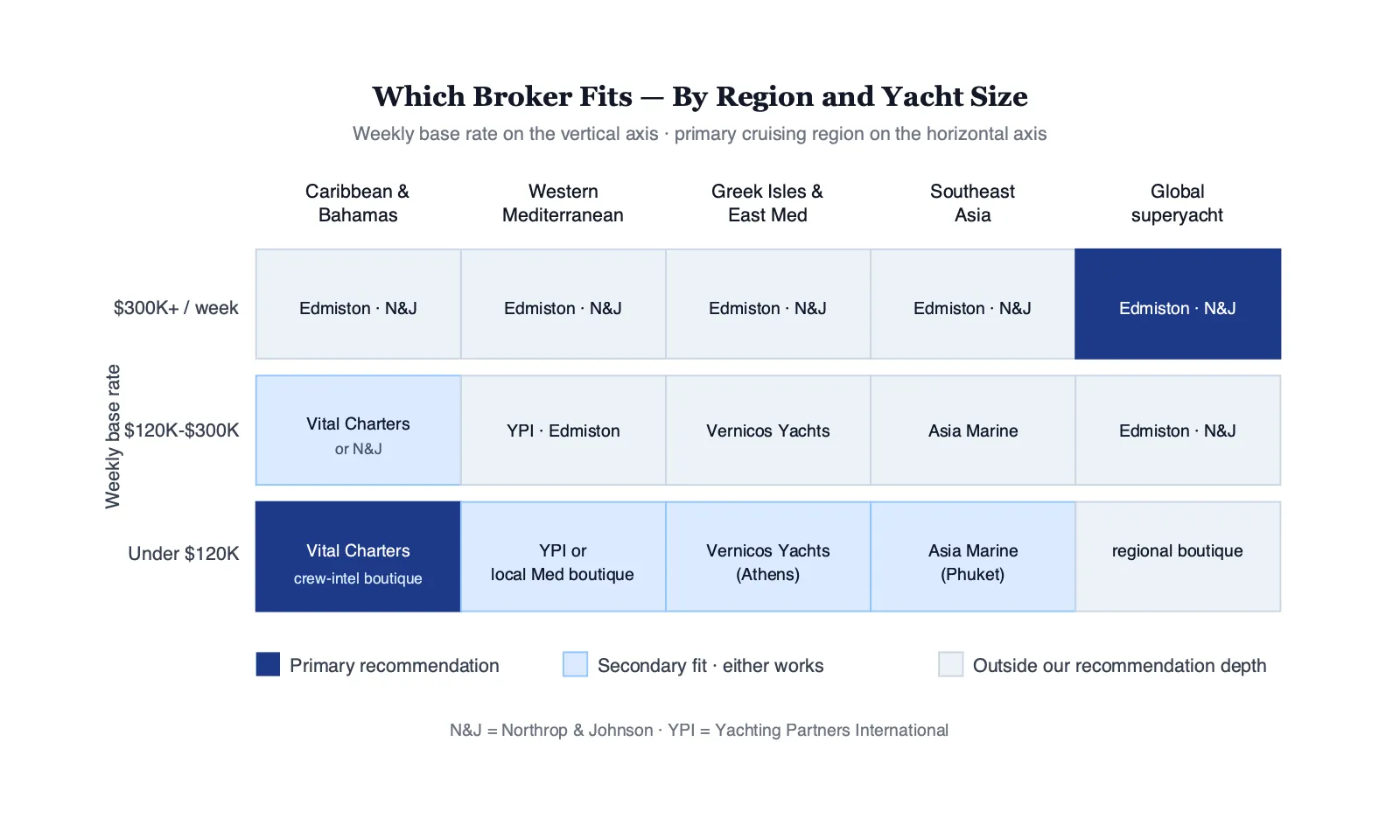
View data table
| Weekly base rate | Caribbean & Bahamas | Western Med | Greek Isles & East Med | Southeast Asia | Global superyacht |
|---|---|---|---|---|---|
| Under $120K | Vital Charters | YPI or local Med boutique | Vernicos Yachts (Athens) | Asia Marine (Phuket) | Regional boutique |
| $120K–$300K | Vital Charters or N&J | YPI · Edmiston | Vernicos Yachts | Asia Marine | Edmiston · N&J |
| $300K+ / week | Edmiston · N&J | Edmiston · N&J | Edmiston · N&J | Edmiston · N&J | Edmiston · Northrop & Johnson |
| Bold = primary recommendation · Vital Charters operates in Caribbean & Bahamas only. Boutique firms outside our operating region are named for reference and do not receive backlinks. | |||||
The ranking inside each tier is a judgment call, with our reasoning attached. Outside our recommendation depth (regions we don’t operate in, yacht sizes we don’t routinely place) we name boutique specialists by reputation only, without backlinks.
1. Vital Charters: Best for Caribbean & Bahamas, Yachts Under $120K Weekly
Where we win: Caribbean and Bahamas crewed charters under $120K weekly base, on yachts with five or fewer crew. That’s where boutique crew intelligence is the entire game.
Here’s why we recommend ourselves first in this segment.

We follow captains, chefs, and senior crew through their careers across multiple vessels, not just the yacht they happen to be on right now. When a captain we know moves from a Lagoon 620 in the BVI to a Bali 5.4 in the Grenadines, that move gets logged. When a chef earns a strong post-charter review from a client we placed last December, we tag the chef, not just the boat. This is the structural fix for the crew turnover problem we walked through in the previous section. Brokers who track only yachts are working from crew lists that, on half the fleet, lost 30% or more of their junior crew last season; brokers who track crew through their careers stay current.
We approach client-to-crew matching from a charterer’s perspective, not a former-crew perspective. That difference shows up in what each of us thinks to warn you about. A lot of charter brokers came up through the industry as crew, captains, chefs, stews who transitioned to a desk. They’re skilled, and we respect the depth. But their reference point is “what makes a crew run well from the inside.” A regular charterer’s reference point is different: what makes a vacation work for a non-yachting family, the social dynamics of having staff aboard for the first time, the small frictions that can sour a trip when nobody warned you about them. Both perspectives are valid. We think the latter is structurally underweighted in the broker market.
We’re fully independent. Vital Charters doesn’t own, manage, or have financial relationships with any specific yachts in the fleet. That means we’re recommending Caribbean charters based on which yacht and crew genuinely fit your group, not which yacht we have inventory pressure to fill. Start a yacht search at Vital Charters or contact us directly to discuss your charter brief.
Best fit: 4-12 guest groups, $20K-$120K weekly budgets, Caribbean or Bahamas itineraries, especially first-time charterers or repeat clients who want continuity through a personal advisor.
Where we’re not the right pick: Mediterranean charters, superyachts over 150 feet, and charters in Asia-Pacific or the Indian Ocean. We don’t pretend to be global, and we’ll refer you elsewhere if your trip falls outside our depth.
2. Edmiston: Best for Global Superyachts (150ft+)
Where they win: The largest superyachts, anywhere in the world. Charter rates above $300K weekly. Owner-side representation. Complex multi-region itineraries.
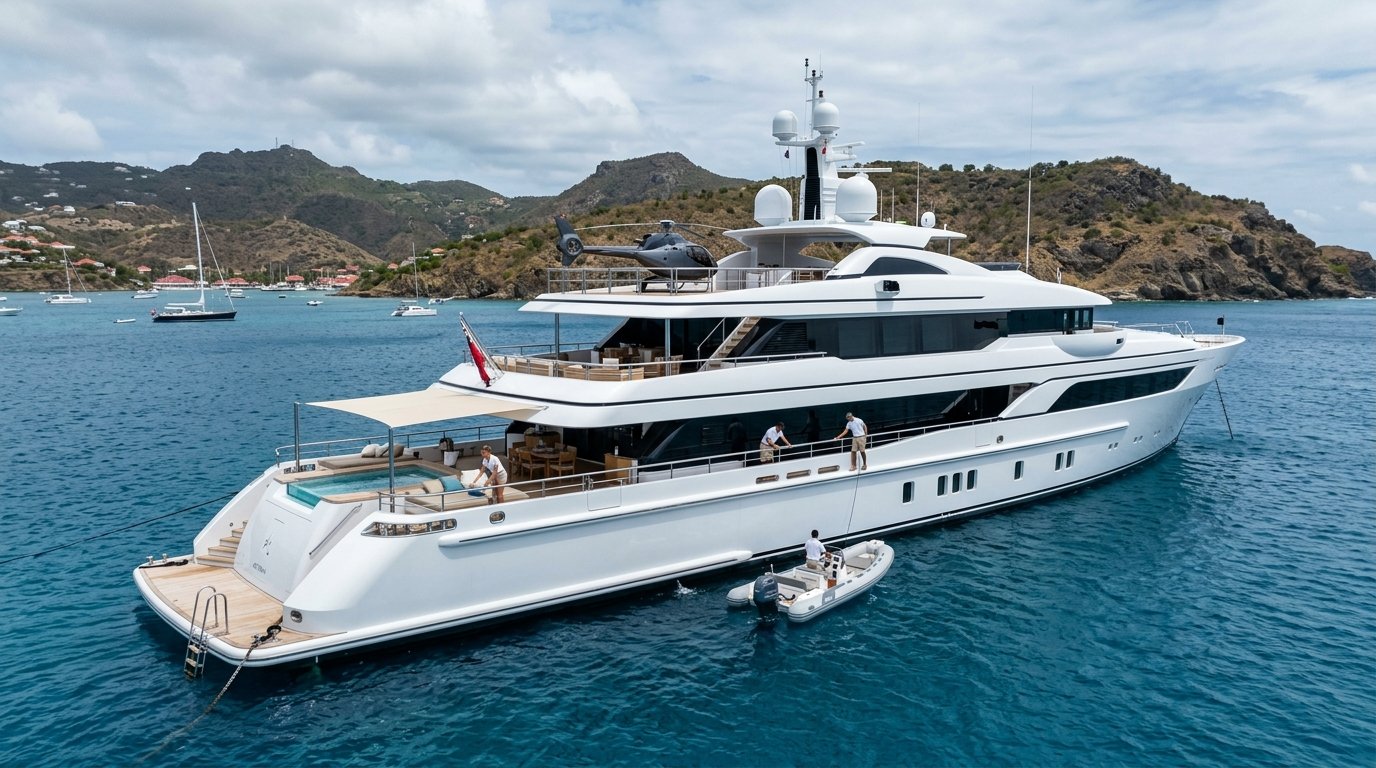
Edmiston was founded in 1996 by Nicholas Edmiston, and Jamie Edmiston has been CEO since 2014 (Boat International, 2014). The firm is headquartered in London, with offices in Monaco, New York, Newport, and Mexico City, and is described by Boat International as “the most recognisable brand in the yachting world” (Boat International Broker Directory). At the largest end of the charter market, where operational complexity rewards depth and the price point justifies a consultative process measured in months, Edmiston is the default name.
Best fit: groups of up to 12 guests on superyachts, charter rates above $300K weekly, clients chartering globally rather than within a single region, owners’ representation when buying or commissioning new construction.
Limits: For sub-150ft Caribbean charters, Edmiston’s superyacht-tier infrastructure is overpowered. You’ll likely get matched with a yacht that fits, but the depth of the firm is wasted on a boat with two or three crew. A regional boutique with current crew intelligence will outperform here for far less friction.
3. Northrop & Johnson: Best US-Headquartered Global Firm
Where they win: US-based clients who want a US-based contact for global itineraries, particularly on yachts 98 feet and up.
Northrop & Johnson is the oldest US-based name in the brokerage business, founded in 1949 in New York City by Jim Northrop and George Johnson, headquartered in Fort Lauderdale since the early 1960s (Boat International Broker Directory). The firm focuses on yachts over 30 meters and offers full 360° services, purchase, sale, management, new construction, and charter. For U.S. clients who want a domestic broker capable of placing them in Mediterranean, Caribbean, or Asia-Pacific waters with consistent service, N&J is the natural pick.
Best fit: U.S. clients chartering 100ft+ globally, especially those who want a Florida- or Newport-based broker as their primary contact. Strong on East Coast outbound itineraries and high-value sale-and-charter combinations.
Limits: N&J is global and credible in the Caribbean, but for smaller crewed yachts in the Caribbean and Bahamas segment, regional crew specialists generally have more current ground-level data on individual boats and crews. Their structural strength is large yachts; below 100 feet, the math changes.
4. Yachting Partners International (YPI): Western Mediterranean Boutique
Where they operate: Monaco-headquartered with a London office. Specializes in yachts 25 meters and up. Focused on the Western Mediterranean (French Riviera, Italian Riviera, Balearics) though they place yachts globally.
YPI was founded in 1972 and is part of the BRS Shipbroking Group (Boat International; SuperYacht Times). For charters concentrated in the Western Med (Cannes, Saint-Tropez, the Amalfi Coast, Ibiza, Palma) local relationships with crew, marina logistics, and shoreside operators carry more weight than they do in larger, looser cruising grounds. YPI has been building those relationships for over 50 years.
Mention only. We don’t operate in the Mediterranean and don’t have direct comparative experience to rank YPI against their peers. Naming them here reflects their reputation in the industry, not a placement relationship.
5. Vernicos Yachts: Greek Isles & East Med
Where they operate: Athens-based, family-run, with multi-decade depth across the Cyclades, Saronic Gulf, Ionian Islands, and the Eastern Mediterranean.
The Greek Isles charter market has its own logic. Short legs between islands. Smaller crewed monohulls and motor yachts dominating, rather than the megayachts that anchor the Western Med scene. Shoreside relationships drive the tavernas-and-anchorages itineraries clients actually want from a Greek charter. Boutique firms with multi-generational experience in Greek waters consistently outperform global firms here because the islands reward depth in a small geographic area, not breadth across continents.
Mention only. We don’t operate in Greek waters. Naming Vernicos reflects industry reputation, not a placement relationship.
6. Asia Marine: Southeast Asia (Phuket, Thailand, Indonesia)
Where they operate: Phuket, Thailand: described in trade press as the pioneer of the yachting industry in Thailand. Manages and clears for 20+ yachts and cruise boats with 35+ professional crew (YachtWorld broker directory).
Asia Marine was established in 1989, which predates the bulk of the regional charter industry. They’ve been recognized as “Best Asia Yacht Charter Agent” by Asian Boating and operate out of Boat Lagoon Marina in Phuket, with a service center at Yacht Haven and a Pattaya branch. For Thailand-Indonesia-Malaysia charter itineraries (the Andaman Sea, Komodo, Raja Ampat) Asia Marine is one of the established names.
Mention only. We don’t operate in Southeast Asia. Naming Asia Marine reflects industry reputation, not a placement relationship.
What to Ask Any Broker Before Signing
Ask five questions on the first call: how the broker tracks crew, whether they’ve been aboard in the last 12 months, how your deposit is held, which contract applies, and who pays them. Together they show whether a broker works from current crew intelligence or a listings subscription, and they expose conflicts a broker won’t volunteer. Use them on the initial discovery call: before any yacht names get mentioned, before any contracts get drafted. A broker is paid out of the yacht owner’s listing price rather than added to your bill, so the boat costs you the same either way (YATCO, 2025). What you are actually choosing is whether that money buys you the work below.
“How do you track crew movements between yachts?” This is the diagnostic question. Listen for specifics (a database, a tagging system, a methodology) not vague references to “industry relationships.” If they can’t explain their tracking method, they’re working from listings.
“Have you personally been aboard the yachts you’re recommending in the last 12 months?” Yacht shows like the Antigua Charter Yacht Show and BVI Charter Yacht Show happen every fall. Brokers walk the docks, inspect cabins, sit down with captains and chefs. If their last visit was three seasons ago, the data is stale.
“How is client money held between booking and embarkation?” Charter deposits run 50% on signing and 50% closer to embarkation. The right answer involves a brokerage trust account or escrow arrangement, with funds released to the yacht owner per contract milestones, not transferred to a personal account.
“Which contract are we using: CYBA All-Inclusive or MYBA Plus-Expenses?” This single question saves the most cost confusion of any ask. Caribbean charters typically use the CYBA All-Inclusive E-Contract (meals, standard bar, and four hours of daily fuel bundled into the base fee). Med charters and large Caribbean superyachts often use MYBA Plus-Expenses (25-35% APA on top). See our hidden fees breakdown and APA explainer for the full structural difference.
“How are you paid: by me or by the yacht owner?” The correct answer is the yacht owner, out of the listing price you were already going to pay. If a broker is also charging you a separate retainer or “client advisory fee,” that’s a red flag in most cases (YATCO, 2025).
How Do You Verify a Yacht Charter Broker’s Credentials?
You can verify a yacht charter broker in about fifteen minutes. MYBA, CYBA and IYBA each publish a member directory, every CYBA E-Contract carries a serial number you can validate (CYBA), and every brokerage sits on a public company register. Three of the five checks below need nothing from the broker at all.
Check the directory, not the logo. If a broker shows an association badge, confirm it, because a badge on a website proves only that someone uploaded a logo. Search the MYBA member list, the CYBA directory or the IYBA directory. At CYBA, look up the individual broker, because CYBA admits people rather than companies.
Name the contract before you see a yacht. A broker working under a standard form can tell you which one on the first call: the CYBA all-inclusive contract for most Caribbean crewed weeks, or the MYBA agreement for plus-expenses superyachts. Read it before you sign. Our guide to reading a yacht charter contract walks through the clauses that move money.
Follow the deposit. The 50% you pay on signing should land in an escrow or client trust account in the brokerage’s name, or with the yacht’s management company under the contract. Ask for the account name in writing before you wire anything. A person’s name on the wire instructions is the end of the conversation.
Look the company up, not just the website. Every brokerage is registered somewhere, and a public company-registry search shows when the business was formed and under which names. It’s the fastest way to spot a firm that has rebranded away from its own history.
Read reviews the broker can’t edit. Testimonials on a broker’s own site are chosen. Google reviews aren’t. Read the critical ones for how the problem was handled, because every broker eventually has a week that goes wrong, and the response is the part you’re buying.
A good yacht charter broker will expect all five, and will answer the contract and deposit questions before you’ve finished asking them.
Red Flags: What to Avoid
Six warning signs mark a weak yacht charter broker, and five of them surface before you pay a deposit. The signals below show up consistently across the post-charter complaints we hear from people who come to us for their second charter after a disappointing first one. Quality varies massively even within firms: these red flags often mean you’ve drawn a weak individual broker, regardless of the masthead on the email signature.
They lead with the yacht, not the crew. “This yacht is gorgeous, you should look at it” is a listing pitch. “This crew runs the best family charters I’ve placed all winter, let me show you what they’re on this year” is a broker pitch. The second is what you’re paying for.
They can’t tell you the captain’s and chef’s names. If a broker is recommending a specific yacht but doesn’t know who’s aboard it this season, they’re working from photos and rate sheets. That’s a structural failure on the most important part of the experience.
They use urgency to close. “This yacht will be gone tomorrow” is almost always wrong. The crewed Caribbean fleet is large enough that another comparable yacht exists, and any broker manufacturing urgency is selling rather than advising.
They won’t discuss contract type up front. Brokers who get cagey when you ask about CYBA vs MYBA are usually trying to avoid setting expectations on total cost. Push harder, or walk away.
They ask for funds wired to a personal account. Charter deposits go to a brokerage trust account or to the yacht’s management company per contract, never to a broker’s personal account. This is the single clearest fraud signal in the industry.
They disappear after booking. A good broker handles preference sheets, embarkation coordination, mid-charter issue resolution, and post-charter follow-up. A broker who hands you off to “the yacht’s team” after the deposit clears has been paid for taking an inquiry, not for the work that actually earns it.
The Broker Is the Crew Intelligence Layer
The best yacht charter broker isn’t the one with the biggest brochure or the prettiest website. It’s the one who’s been aboard the yachts they recommend in the last 12 months, who knows the crew on those yachts by name, and who maintains a system for keeping that knowledge current as crew rotate between vessels every one to two seasons.
For the Caribbean and Bahamas, in the under-$120K segment that represents the bulk of charters, that’s Vital Charters. For global superyacht work above 150 feet, Edmiston and Northrop & Johnson are the credible names. For other regions, the boutique specialists named above are the firms reasonable people in the industry will direct you to.
Wherever you end up chartering, ask the five questions in the previous section on your first call. If the answers are vague, keep looking. If they’re specific and grounded in current crew intelligence, you’ve found your broker. Start a yacht search at Vital Charters for Caribbean and Bahamas itineraries, or contact us to talk through what makes sense for your group.
Frequently Asked Questions About Yacht Charter Brokers
Does using a charter broker cost extra?
No. The broker is paid by the yacht owner, out of the listing price you were quoted anyway, rather than as a fee added to it (YATCO, 2025). Our answer on what a yacht broker charges covers the commission itself. The cost to charter through a good broker is functionally the same as booking direct with the yacht’s management company, except you get advisory services, crew intelligence, contract review, and a single point of contact through the entire process. For most first-time charterers, that’s the difference between a smooth trip and an expensive learning experience.
How early should I contact a broker for a peak-season Caribbean charter?
Six to twelve months out for Christmas, New Year’s, and February school break weeks, the highest-demand windows. Three to six months for shoulder season (early December, late April, May). The crewed charter fleet grew about 7.4% year over year in 2025 (IYC, 2025), which has loosened availability slightly. But peak weeks on the most desirable yachts still book out nine to twelve months ahead.
Can I work with multiple brokers at once?
Technically yes, but it usually backfires. Caribbean yachts are usually shown by several brokers at once, and once two of them have put your name against the same boat, neither can be sure the work will come to anything. Both quietly deprioritise you, which is the opposite of what you were trying to achieve. The better practice: vet two or three brokers on initial discovery calls, pick the one whose process you trust, then run the actual search through that single broker.
What if I’m unhappy with my broker mid-process?
You can switch, and the timing decides how painful it is. If no deposit has been paid and no yacht has been formally inquired on, switching is straightforward. You’ve signed nothing. If a deposit has been paid, the charter contract is between you and the yacht; the broker’s role is advisory, and you can request the brokerage transfer your file to a different broker within the same firm, or, with the yacht owner’s cooperation, to a different brokerage entirely. We’ve seen this work cleanly several times when the underlying issue is broker fit, not contract dispute.
What’s the difference between a charter broker and a charter agency?
A charter broker is an independent advisor who searches the entire market on your behalf and is paid by the yacht owner when you book. A charter agency typically manages a specific fleet of yachts and is incentivized to place you on yachts within that fleet first. The two functions sometimes coexist within a single company, which is why we specifically call out independence as a feature of our recommendation #1. See our companion explainer on how a charter broker works for the longer breakdown of broker workflow and value.
Should a yacht charter broker belong to MYBA, CYBA or IYBA?
It helps, but it isn’t proof of quality. Membership means the broker cleared an entry bar (four years as a full-time crewed charter broker for CYBA’s active members, two years under MYBA’s statutes) and agreed to a code of ethics the association can enforce by suspension or expulsion. Check the claim in the association’s own directory rather than trusting a logo on the broker’s site.
What are the best luxury yacht charter companies?
It depends on the size of the yacht more than the word luxury. For superyachts over 150 feet, the global brokerages have the depth: Edmiston and Northrop & Johnson, alongside the other houses named in the superyacht tier above. For a Caribbean or Bahamas crewed yacht under $120,000 a week, which is 498 of the 550 bookable yachts (Vital Charters rate analysis, September 2026), a regional yacht charter broker who knows the current crew will usually place you better than a firm built for 30-crew yachts.
Do I really need a broker for a 7-day Caribbean charter?
For a first charter, almost always yes. The contract structure (CYBA vs MYBA), the crew matching, the itinerary calibration to your group, and the post-booking logistics are non-trivial enough that going direct adds risk without saving money. The yacht owner pays the broker either way. For repeat charterers on familiar yachts, you can sometimes book direct with the management company at the same price, but you lose the third-party advocate when something goes wrong mid-week. Tipping is another area where a broker earns their place; see our crew tipping guide for the structural framework.
Caribbean and Bahamas expertise, not just a booking page.
Tell us your group size, dates, and islands and you’ll get honest, unbiased crewed-yacht options from brokers who know the crew, not just the yacht.