
First-Time Charterer’s Complete Guide
40% of charter clients are first-timers. A broker breaks down costs, yacht types, and what to expect on your first Caribbean yacht charter.
Last Updated: September 7, 2026
Crewed charters account for 61.58% of global charter revenue: the full-service experience is what most people are buying (Mordor Intelligence, 2025). If you’re one of them, you’ve probably spent hours scrolling through glossy websites and still aren’t sure what you’re actually signing up for. That’s the gap most guides leave wide open: they’re written by travel bloggers who’ve never stepped aboard as a paying guest.
I’m Jason Acosta, co-founder of Vital Charters and a charter broker who has personally chartered yachts across the Caribbean. I’m also an ASA 104 certified sailor and Master Diver. This guide comes from the broker side of the table and from the guest side of the gangway. We’ve helped dozens of first-timers plan a Caribbean yacht charter, and we’ve made the rookie mistakes ourselves so you don’t have to.
This is your starting point. We’ll introduce every major topic (costs, yacht types, what happens onboard, traveling with kids, working with a broker) and point you toward deeper guides on each one. Think of it as the table of contents for your entire first charter experience.
Why Are First-Time Charterers Choosing the Caribbean?
The Caribbean welcomed approximately 35 million international stay-over arrivals in 2025, a record high (Caribbean Tourism Organization, 2026). For first-time charterers, the region offers protected waters, short island hops, and reliable trade winds, conditions that make a week aboard feel like a vacation rather than a survival exercise.
The Bahamas alone saw 12.5 million total visitors in 2025, up 11.4% year-over-year (Bahamas Ministry of Tourism, 2026). That surge isn’t just cruise passengers. Private yacht charters in the Exumas and Abacos have grown steadily as travelers look for alternatives to overcrowded resorts.
So why the Caribbean specifically for your first time? Three reasons we tell every client:
Short flights from the U.S. Most East Coast airports are 3-4 hours from Tortola, St. Thomas, or Nassau. You won’t burn a full travel day getting there. We’ll cover flights and transfers to your charter base in a dedicated guide. There are tricks to timing your arrival that most first-timers miss.
Protected sailing waters. The British Virgin Islands sit behind a reef system that keeps ocean swells manageable. The Bahamas offer shallow, crystal-clear banks where even open-water crossings feel calm. These aren’t open-ocean passages.
Established charter infrastructure. The BVI and Bahamas have decades of charter history. Marinas, provisioning, customs clearance: it’s all dialed in. If you’re curious about specific destinations, our BVI crewed yacht charter guide covers the islands in detail.
Our observation: We’ve noticed first-time charterers consistently underestimate how calm Caribbean waters actually are. Clients who were nervous about seasickness tell us by day two that they forgot it was a concern. Catamarans in protected waters like the BVI barely heel at all. It’s more like being on a floating villa than a sailboat.
Which Charter Type Fits Your Group?
Skippered charters now represent over 21% of all charter departures globally (Booking Manager, 2025). That number tells you something important: most people chartering a yacht aren’t sailors. You don’t need experience. You need to pick the right charter type for your group.
Here’s how the three types compare:
| Feature | Bareboat | Skippered | Crewed (Recommended) |
|---|---|---|---|
| Experience needed | ASA 104+ certification | Basic boating comfort | None at all |
| Crew onboard | None: you’re the captain | Captain only | Captain + chef (minimum) |
| Meals included | No: you provision and cook | No: you provision and cook | Yes: 3 meals + snacks daily |
| Weekly cost (Caribbean) | $5,000-$15,000 | $8,000-$20,000 | $15,000-$35,000+ |
| Best for | Experienced sailors | Confident boaters wanting guidance | First-timers, families, celebrations |
| Itinerary control | Total freedom | Collaborative with captain | Collaborative with captain |
Why We Recommend Crewed for First-Timers
The difference between “vacation” and “working vacation” is a crew. On a crewed charter, someone else handles anchoring, cooking, cleaning, and navigation. You wake up, eat breakfast someone prepared, swim, explore an island, and come back to a cocktail on the deck. That’s it.
If you’re wondering how a crewed charter stacks up against a luxury resort, we’ve run the numbers in our charter vs. resort comparison.
What Does a Yacht Charter Actually Cost?
The global yacht charter market hit $8.98 billion in 2025 and is projected to reach $18.20 billion by 2034 at an 8.19% CAGR (Fortune Business Insights, 2025). Charter demand isn’t niche anymore: it’s a mainstream luxury travel category, and pricing reflects that growth.
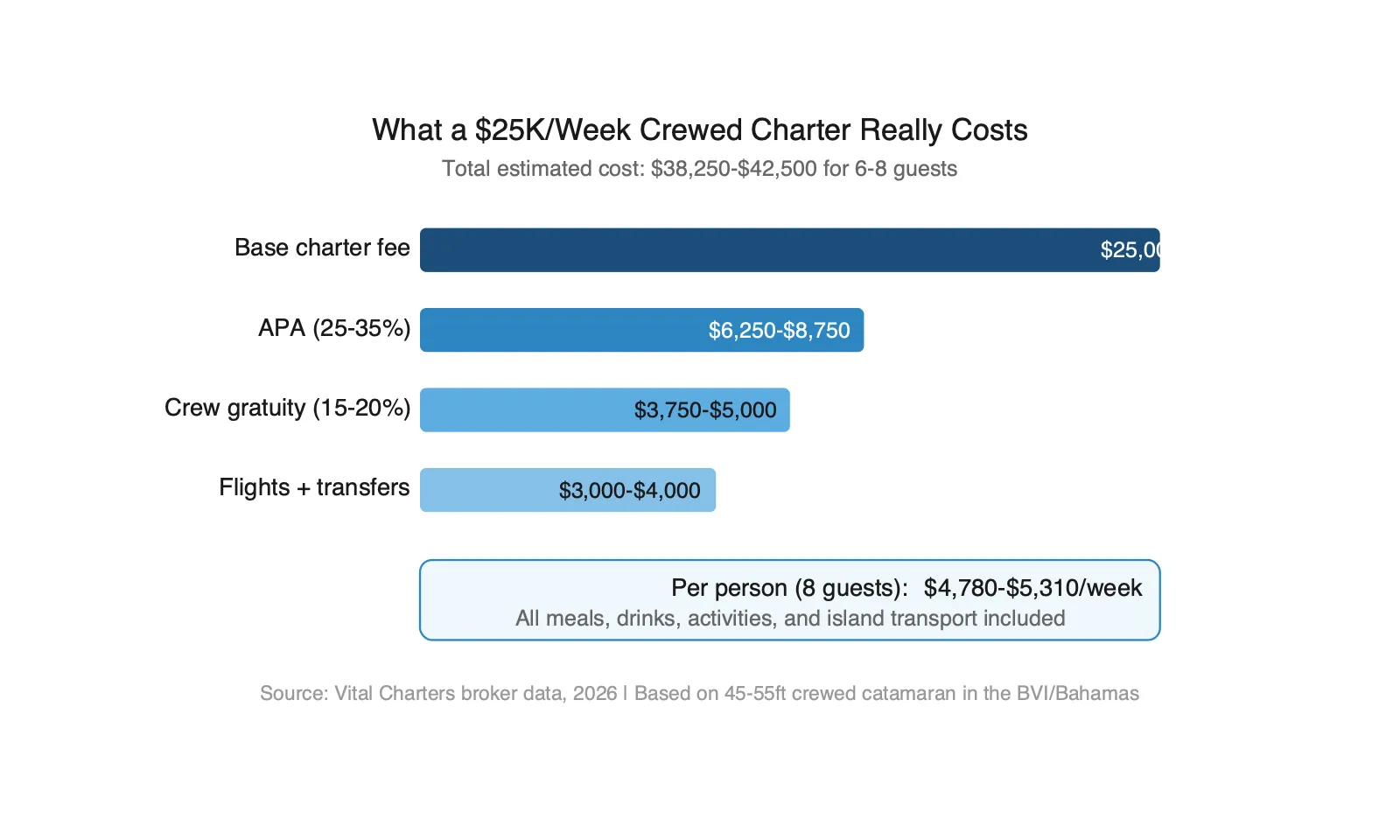
Here’s what most first-time charter guides won’t tell you: the base rate is only part of the picture. A typical crewed catamaran charter outside the Caribbean breaks down like this:
View data table
| Cost Component | Amount | Notes |
|---|---|---|
| Base charter fee | $25,000 | Yacht, captain, chef, fuel, water toys |
| APA (Advance Provisioning Allowance) | $6,250-$8,750 | 25-35% of base; food, drinks, marina fees, tender fuel |
| Crew gratuity | $3,750-$5,000 | 15-20% of base; Caribbean standard |
| Flights + transfers | $3,000-$4,000 | Variable by departure city and charter base |
| Total | $38,250-$42,500 | For 6-8 guests, all-in |
| Per person (8 guests) | $4,780-$5,310 | Includes all meals, drinks, activities |
Don’t let the total surprise you at the end. We’ve written a detailed breakdown of yacht charter rates, APA, and add-ons that walks through every line item. And if you’d rather not track line items at all, some yachts offer all-inclusive pricing that bundles everything into one number. Want to understand what’s covered in the base fee? Our guide to what’s included in the MYBA charter fee spells it out.
Daily charters are the fastest-growing duration segment, expanding at a 10.82% CAGR (Mordor Intelligence, 2025). You don’t have to commit to a full week. Half-week charters are increasingly available, especially in the Bahamas.
How Do You Choose the Right Yacht?
Catamarans represent 26% of the global charter fleet but account for 30% of all booked weeks (Booking Manager, 2025). There’s a reason first-timers gravitate toward them: stability, space, and shallow draft.
Catamaran vs. Motor Yacht
For a first-time charter, the catamaran-versus-motor-yacht decision usually comes down to three things:
Stability. Catamarans have two hulls. They don’t heel (tilt) like monohulls. If anyone in your group is nervous about seasickness, a catamaran is the answer. We’ll have a full seasickness prevention guide coming soon, but the short version is that most anxiety disappears once you’re actually aboard.
Space. A 50-foot catamaran offers more living space than a 60-foot motor yacht. The wide beam gives you a massive salon, a flybridge for sundowners, and a trampoline net up front that kids will claim immediately.
Draft. Cats draw 3-5 feet of water. Motor yachts draw 5-8+. In the Bahamas, where you’ll want to tuck into shallow sandbars and mangrove cuts, that difference decides where you can go. For a deeper dive into the catamaran vs. motor yacht decision, check our Caribbean catamaran charter guide.
What Size Do You Need?
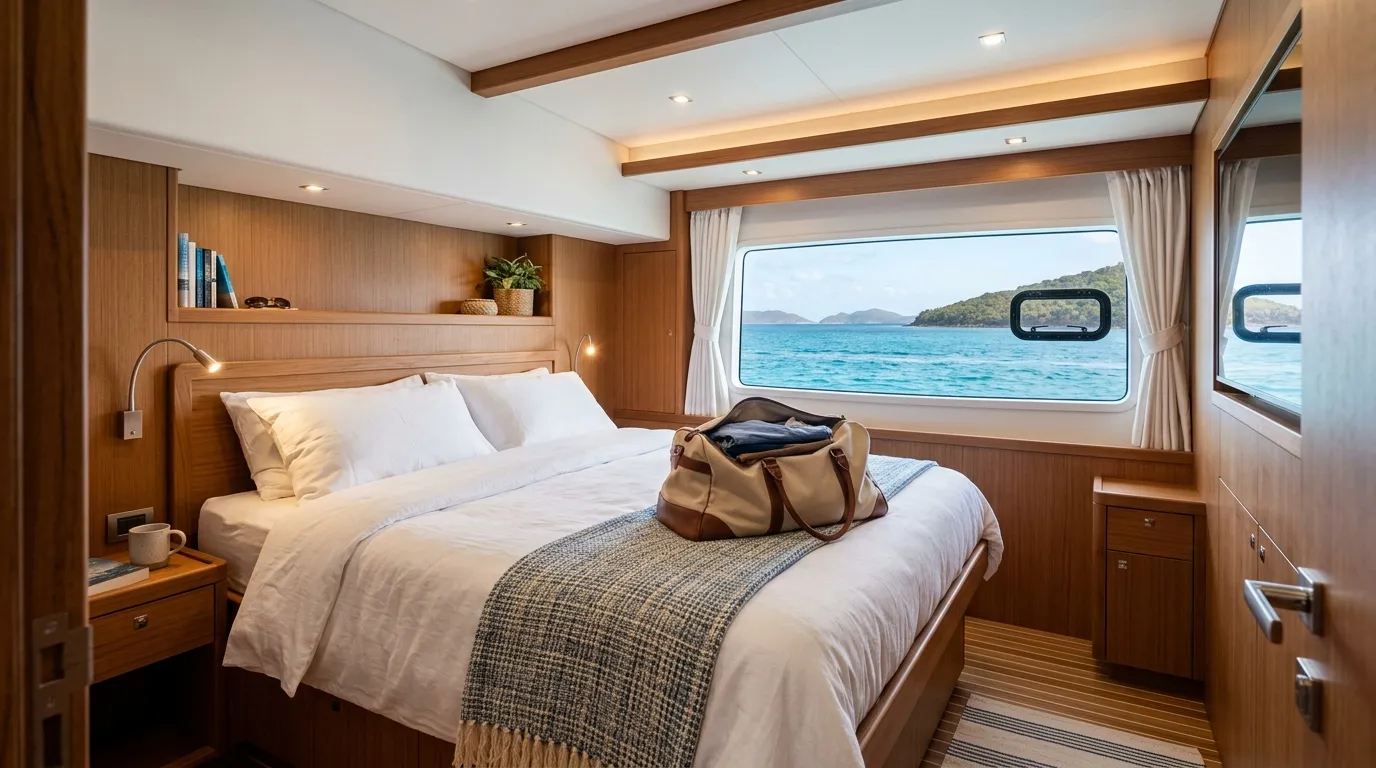
A general rule: match the number of cabins to the number of couples (or pairs) in your group. A 4-cabin catamaran sleeps 8 guests comfortably. Don’t overpack the boat: you’ll want common space to spread out.
Our observation: Spend the extra $3,000-$5,000 for the next size up. The difference in livability between a 42-foot and a 48-foot catamaran is enormous, more deck space, larger cabins, better airflow. You’re living on this boat for a week. Comfort compounds.
What Should You Expect Before You Board?
Broker-assisted bookings still account for 69.74% of the charter market (Mordor Intelligence, 2025). The booking process itself is straightforward: but what happens between signing the contract and stepping aboard is where most first-timers have questions.
The Preference Sheet
Every crewed charter starts with a preference sheet. It’s a questionnaire your crew uses to customize everything: meals, drinks, allergies, activity preferences, pace of travel, even what music you like.
We’ll publish a complete guide to decoding preference sheets, but the single best piece of advice? Be honest. If you don’t like fish, say so. If someone in your group is a picky eater, flag it. Your chef can’t accommodate what they don’t know about.
We’ll also cover dietary accommodations onboard in a separate guide, the chefs on these yachts handle everything from celiac to kosher.
Packing
Pack soft-sided bags, not hard-shell suitcases. Yacht cabins don’t have closets built for Samsonites. Bring reef-safe sunscreen, polarized sunglasses, and more swimsuits than you think you need. Our full yacht charter packing list covers everything in detail.
Documents
Which documents you need depends entirely on where the week goes, and one of the three main Caribbean charter regions asks for nothing at all. US citizens need a passport for the British Virgin Islands and the Bahamas, and do not need one for the US Virgin Islands, which is US territory and therefore a domestic trip. The Bahamas also wants at least six months of validity on that passport, and does not accept passport cards.
The one that catches first-timers is the British Virgin Islands online arrival card, mandatory since January 2025 and submitted up to 72 hours before you land. It is the only piece of paperwork on the whole trip that you complete yourself; your crew handles every other formality. Our guide to passport and entry requirements for charter guests sets out all three destinations with the official sources.
Travel Insurance
Most standard travel insurance policies don’t fully cover yacht charter cancellations. There are charter-specific policies that protect your deposit and cover weather disruptions. We’ll break down travel insurance for yacht charters in a dedicated guide. It’s one of the most overlooked parts of charter planning.
Getting There
Timing your flights to match charter embarkation is more important than you’d think. Show up too early and you’re killing time at a marina. Arrive late and you’ve burned half your first day. We’ll have a complete flights and transfers guide covering every major Caribbean charter base.
What Happens on Your First Day Onboard?
Weekly charters represent 54.63% of all bookings globally (Mordor Intelligence, 2025), which means most first-time charterers experience the same Saturday-to-Saturday rhythm. Your first day sets the tone for the entire trip, and it’s nothing like what you’d expect from a hotel check-in.
Here’s the condensed version: you’ll arrive at the marina, meet your captain and chef, get a boat tour and safety briefing, discuss your wish list for the week, and then, usually within an hour or two, you’re pulling away from the dock with a drink in hand. We’ll publish a detailed guide on what happens your first day onboard, but the key takeaway is this: the crew manages the transition. You don’t need to know anything about boats.
Your captain will ask about your priorities for the week. Do you want remote anchorages or lively beach bars? Snorkeling every day or more time relaxing on deck? This isn’t a fixed itinerary: it’s your trip.
What Do Most Charter Guides Get Wrong About Life at Sea?
The average charterer is now 40 to 50 years old, down roughly ten years over two decades (SuperYacht Times), and they’re bringing expectations about connectivity that the industry is still catching up to. Life aboard isn’t the digital detox that glossy brochures promise, and that’s actually fine.
The Daily Reality
A typical day looks something like this: wake up at anchor in a quiet bay, swim before breakfast, motor or sail to the next island (usually 30-90 minutes), explore ashore or snorkel, come back for lunch, laze around, sundowners, dinner prepared by your chef, stars. Repeat.
It sounds simple because it is. The magic of a charter isn’t constant activity: it’s the absence of logistics. No restaurant reservations, no Uber, no checkout times.
We’ll cover the full day-by-day experience in a detailed breakdown guide, but expect more unstructured relaxation than packed itineraries.
Seasickness: The Honest Answer
This is the question we get asked more than any other. On a crewed catamaran in the BVI or Bahamas, genuine seasickness is uncommon. Protected waters plus a stable twin-hull platform means most guests feel nothing more than a gentle rock at anchor.
If you’re concerned, there are proven prevention strategies. We’ll cover them thoroughly in our upcoming seasickness guide. The short version: start medication 24 hours before boarding, not the morning of.
WiFi and Connectivity
Yes, there’s WiFi on most crewed charter yachts. No, it’s not like your home internet. Caribbean connectivity varies wildly by island and anchorage. The BVI generally has decent cellular coverage. The Bahamas has dead zones in the Exumas.
We’ll publish a full connectivity guide covering what to expect at each major charter destination, if you need to take a few work calls, it’s doable with planning.
Dietary Needs
Charter chefs are trained to handle dietary restrictions, gluten-free, vegan, kosher, severe allergies. The preference sheet is where you communicate these needs. We’ll cover dietary accommodations in depth in a separate guide, but the short answer is: yes, your chef can handle it.
Can You Charter with Kids and Multi-Generational Groups?
The yacht charter market is projected to more than double from $8.98 billion to $18.20 billion by 2034 (Fortune Business Insights, 2025), and families are driving much of that growth. If you’re new to the concept of yacht charters and wondering whether kids belong on a boat, the answer is emphatically yes.
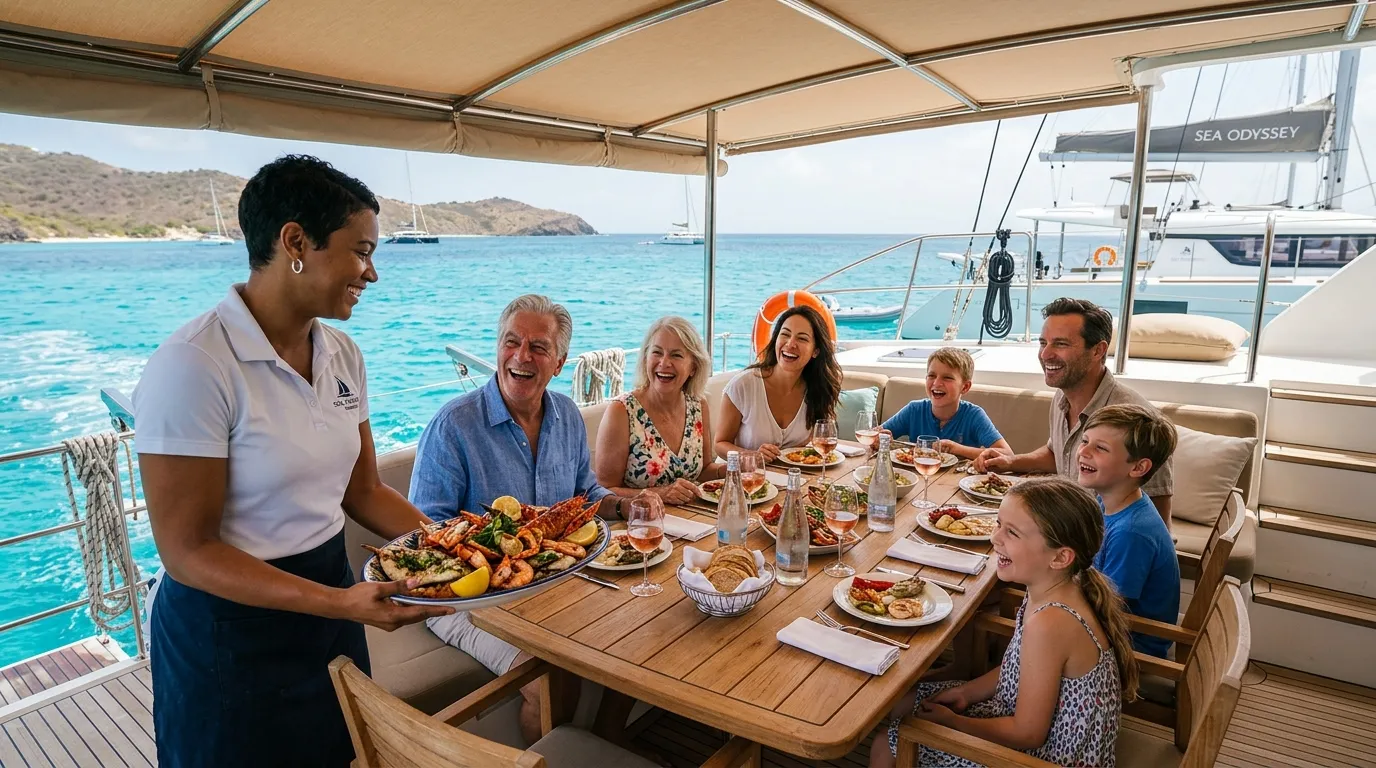
Some of the best first-time charter groups we’ve worked with are multi-generational families (grandparents, parents, kids) sharing a yacht for a week.
Kids love charters. The water toys alone keep them busy for hours: paddleboards, kayaks, snorkel gear, inflatable slides on larger yachts. Older kids learn to paddleboard. Younger ones spend the week jumping off the swim platform.
The crew adapts. Need kid-friendly meals? Done. Want an earlier dinner service so the kids eat first? No problem. Looking for calm anchorages with shallow snorkeling? Your captain knows every spot.
We’ll publish detailed guides on chartering with kids and multi-generational groups, covering age-appropriate activities, safety considerations, and how to make a yacht charter work when your group spans ages 4 to 74.
Our observation: Families consistently tell us the charter was the first vacation where the adults actually relaxed. No one’s researching restaurants, driving rental cars, or managing airport connections between islands. The crew handles logistics, the kids are entertained by the ocean, and the adults sit on deck with a glass of wine watching the sunset. That’s not marketing copy: it’s what we hear in post-charter calls every single week.
Why Does Working with a Broker Change Everything?
Here’s something most first-time charterers don’t realize: a charter broker doesn’t cost you anything extra. The broker’s commission comes from the yacht owner’s side. You pay the same charter rate whether you book direct or through a broker. So why wouldn’t you use one?
An independent broker works for you, not a fleet. Charter companies push their own boats. A listing site shows you inventory without context. A broker matches your group to the right yacht, negotiates pricing, handles contracts, and becomes your advocate if anything goes wrong. Contracts are the part clients most often skim, so it helps to know what each clause actually says before your broker walks you through it.
We’ve written extensively about how to choose the best charter broker and what the broker’s role actually involves.
The broker advantage is largest for first-timers. We’ve seen what works and what doesn’t across hundreds of charters. We know which crews are great with kids, which boats have the best water toys, which itineraries avoid the crowds. That’s institutional knowledge you can’t get from a search engine. We’ll cover why independent brokers specifically outperform large brokerage houses and booking platforms in an upcoming guide.
When Should You Charter? Caribbean Season at a Glance
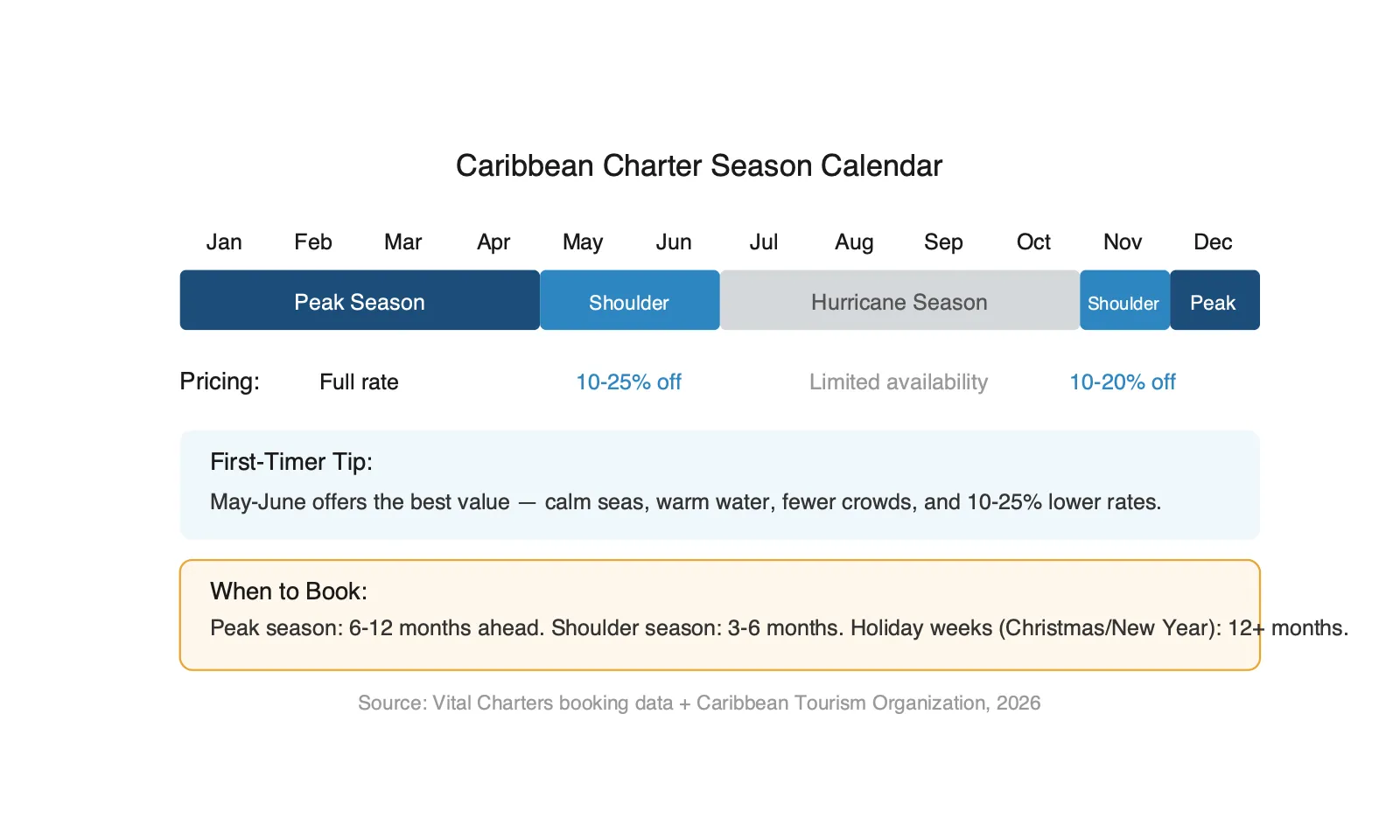
Peak season in the Caribbean runs December through April, when trade winds are steady, rainfall is minimal, and temperatures hover around 80-85°F (Caribbean Tourism Organization, 2026). But that doesn’t mean you should only charter in peak season.
View data table
| Season | Months | Pricing | Conditions | Booking Lead Time |
|---|---|---|---|---|
| Peak | December-April | Full rate | Steady trade winds, low rainfall, 80-85°F | 6-12 months |
| Shoulder | May-June | Usually the same rate | Warm, calm seas, fewer crowds | 3-6 months |
| Hurricane | July-October | Limited availability | Higher rain risk, some areas close | Variable |
| Shoulder | November | Usually the same rate | Season beginning, good conditions returning | 3-6 months |
Shoulder season (May, June, and November) is when savvy first-timers book. The water’s warm and the crowds are gone. The published rate usually is not lower, since 280 of 522 Caribbean yachts list the identical price in high and low season, but this is when promotional specials appear, so ask what is running on the boats you like (Vital Charters rate analysis, September 2026). The tradeoff? Slightly higher rain probability, but Caribbean showers are brief and your captain can always reposition.
Your Next Step
You don’t need to figure this out alone. A broker’s job is to translate your vacation vision into a specific yacht, crew, itinerary, and budget, at no extra cost to you.
If you’ve read this far, you’re past the “is this for me?” stage. Your first time yacht charter starts with a conversation.
Reach out to our team and tell us about your group: where you want to go, how many guests, what dates you’re considering. We’ll come back with yacht options, crew recommendations, and a realistic budget within 48 hours.
This guide is the hub of our first-time charterer resource library. As we publish deeper guides on each topic (day-by-day breakdowns, seasickness prevention, preference sheets, travel insurance, flights, kids onboard, dietary needs, WiFi, and more) we’ll link them here. Bookmark this page and check back. When you’re ready to look at boats, start a yacht search.
Frequently Asked Questions
Do I need sailing experience for a yacht charter?
No. On a crewed charter, a professional captain and chef handle everything, navigation, anchoring, meals, and safety. You don’t touch the helm unless you want to. Your only job is deciding where to explore next.
How far in advance should I book my first charter?
For peak season (December through April), book 6-12 months ahead. The best crews get locked up early. Shoulder season offers better availability at 3-6 months out. Broker-assisted bookings still hold 69.74% of the market, though online marketplaces are growing at 11.80% a year (Mordor Intelligence, 2025).
Is a yacht charter actually worth it compared to a resort?
When you add up resort rooms, restaurants, activity fees, and inter-island flights for 6-8 people, a comparable vacation often costs as much or more than a crewed charter. We’ve done the math in our charter vs. resort cost breakdown.
What if the weather is bad during my charter?
Your captain adjusts the itinerary in real time. If weather moves in from the east, you sail west. If an anchorage is choppy, you duck into a protected bay. In 7 years of brokering Caribbean charters, we’ve never had a client say weather ruined their trip.
Can I charter for less than a full week?
Yes. Short-duration charters of 3-4 days are increasingly available in the Bahamas and BVI, especially during shoulder season. Half-week charters are a great way to test the waters before committing to a full week.
What’s the best Caribbean destination for a first-time charter?
The BVI remains the gold standard for first-timers: short island hops, protected waters, and excellent infrastructure. The Bahamas Exumas are a close second for more remote, pristine beaches. Read our complete BVI charter guide for details.
Your first charter, done right.
Share your group size, dates, and a destination wish list and we’ll match you to the right crewed yacht, no experience required.