
Crewed Yacht Charter vs. Luxury Resort: A Price Comparison
For groups of 10 or more, a crewed Caribbean charter costs only slightly more per person than a luxury resort, within about 10% with tips counted on both sides, and makes for a far more memorable week.
Last Updated: October 26, 2026
Most families assume a crewed yacht charter is an exotic luxury, something reserved for the ultra-wealthy or the nautically adventurous. A luxury resort feels safer. Familiar. Easier to budget. But that assumption deserves a second look, especially when you’re planning a trip for 10 or 12 people.
Nearly 70% of affluent U.S. travelers say modern luxury hotels have lost their character to standardization (Preferred Hotels & Resorts / Harris Poll, 2025). Yacht charter demand, meanwhile, is up: one major charter booking platform saw bookings rise 70% from 2021 to 2024 (Newsweek, 2025). Something’s shifting.
This article breaks down the real, all-in costs of both options for families, does the actual math for groups of 6 to 12 people, and examines what you genuinely get for your money. The answer might surprise you.
What Does a Crewed Yacht Charter Actually Cost?
A Caribbean crewed catamaran for 8 to 10 guests runs $28,800 to $48,000 per week all-inclusive, with a median of $34,000 across 216 such yachts (Vital Charters rate analysis, September 2026). That number can feel alarming until you understand what’s packed inside it, and how it divides across a group.
What lands on a Caribbean charter invoice in 2026
The island sets the amounts: 14 percent in Bahamas taxes, up to $16 per guest per day in BVI cruising fees, nothing per guest in the USVI. The contract sets who pays: all-inclusive rates cover permits, park fees and levies in the vast majority of cases; charter taxes and the 15 to 20 percent gratuity are always yours.
| Line item | Typical amount | Who sets it | Source |
|---|---|---|---|
| APA (Advance Provisioning Allowance) | None mandatory on all-inclusive catamarans, except a small allowance, usually 5 percent, on about 1 rate in 50. Plus-expenses charters add an APA, typically 30 to 35 percent of the base rate, intended to cover every running fee except government taxes, refunded where unspent | Each yacht’s own charter terms; MYBA publishes the mechanics, not a percentage | Vital Charters APA listings analysis |
| Government charter taxes | 0 to 14 percent of the charter fee by destination; the Bahamas is highest at 10 percent VAT plus a 4 percent charter tax (per-destination figures in the destination blocks) | Each territory’s government | S.I. No. 57 of 2025 (Bahamas example) |
| Marine park fees | Where you cruise them: EC$15 per guest per day at the Tobago Cays, $12.73 per guest per day in the Exuma park, $10 per adult at the BVI’s Baths | TCMP; Bahamas National Trust; BVI National Parks Trust | TCMP fee schedule, effective January 1, 2023 |
| Crew gratuity | Customarily 15 to 20 percent of the charter fee in the Caribbean crewed fleet, the band CYBA’s Inclusive Agreement (Clause 2.B) calls the customary rate; MYBA’s 2026 guidelines publish no percentage, and both leave it at your discretion | Custom, written into the CYBA form | CYBA Inclusive Agreement, Clause 2.B (2020) |
Fees verified September 2026.
Most Caribbean crewed charters operate as true all-inclusive packages. That means a licensed captain, a dedicated chef preparing three meals daily, a standard ship’s bar stocked before you board, fuel, water sports equipment (paddleboards, snorkeling gear, kayaks), mooring fees, cruising permits, and dinghy service to shore. Both the crew tip and, in the Bahamas, the government charter tax are paid on top. Any other extra is one you choose, such as premium wines, scuba or off-boat excursions. No resort credit that expires. No “not included” small print buried at the bottom of the amenities list.
The Advance Provisioning Allowance, APA, sometimes causes confusion. On a plus-expenses charter, it’s an advance deposit that covers fuel, food, and port fees, with any unused portion refunded at the end of the trip (MYBA). The charter contract sets the amount, typically 30-35% of the base rate. Caribbean charters often skip the APA structure entirely in favor of flat all-inclusive pricing, simpler and more predictable for families.
Crew gratuity runs 15-20% of the charter fee, paid at the end. Think of it like hotel tipping. It’s customary but left to your discretion, and it’s paid separately from the charter rate. Budget for it. On a median week for ten guests it adds about $73 to $97 per person per day. That’s well above what a resort guest tips housekeeping, bartenders, and service staff, so the comparison below counts the resort’s tips too.
For a $34,000 charter divided among 10 guests over 7 nights: $486/person/day before tip, about $560–$580 with it.
Across all-inclusive catamarans sleeping 8 to 10, a group of ten pays between $411 and $686 per person a day before the tip, depending on the yacht (Vital Charters rate analysis, 2026). The bigger your group, the lower that number goes.
A mid-range Caribbean crewed catamaran for 8-10 guests runs $28,800-$48,000 per week all-inclusive, median $34,000, roughly $411-$686 per person per day for a group of ten before the 15-20% crew tip. That rate covers the captain, a dedicated chef, all meals from scratch, a standard ship’s bar stocked to your preferences, water sports equipment, fuel, and mooring fees. Besides the tip and any local charter tax, you settle up at the end only for extras you picked, like premium wines or scuba. (Vital Charters rate analysis, September 2026, n=216)
How Much Does a Luxury Resort Really Cost for a Family?
Luxury hotels in the Caribbean averaged $547 a room per night across most of 2025, up 3.9% on the year before (CoStar, 2025). A family of four in two rooms pays roughly $274 per person per night for the room alone, and at that size a resort is the cheaper trip. For a larger group the room rate is only where the bill starts.
Hidden resort costs are significant and predictable. Excursions are priced per person, and a family books several over a week. Room upgrades (villa suites, ocean views, connecting rooms for larger families) raise the nightly rate. Taxes and service charges stack up too: in Turks and Caicos, for example, hotels add a 12% tourism tax and a mandatory 10% service charge (Turks and Caicos Revenue Department; Visit TCI, 2026). Tips for housekeeping, bartenders, and concierge staff accumulate quietly throughout the stay. Airport transfers and shuttle services are rarely covered. Premium dining experiences and spa treatments sit outside most all-inclusive packages.
What does a 5-star resort cost a family once everything is counted? Start from that per-person share of the room. Add three daily meals at resort pricing, two group excursions per person, daily housekeeping gratuity, airport transfers for the group, and local taxes, and you’re at about $500-$550 per person per day for a luxury all-inclusive stay (Vital Charters estimate, 2026).
The average American family spent $8,052 on travel in 2024, roughly a 20% increase year-over-year (NYU SPS Tisch Center / Family Travel Association, 2025). For all that spending, 73% of parents call affordability a challenge.
Hidden costs at luxury resorts sit outside the advertised rate: excursions, room upgrades, airport transfers, tips, and taxes. Among hotels that charge one, resort fees average $33 a day and run from $15 to $50 (NerdWallet, 2026). For a group of 10 at a 5-star property, those extras push a resort week well past its room rate.
Curious how a charter compares for your group? Search crewed yachts by destination and guest count to see real yachts and weekly rates.
Does the Math Actually Work Out?
From about 10 guests up, with tips counted on both sides, a crewed charter costs only slightly more per person per day than a 5-star Caribbean resort (Vital Charters rate analysis and estimate, 2026). For a worked example on a single island, see St. Barts priced both ways. Here’s how the two compare across group sizes, each priced all in: the resort figure is our estimate of the room plus meals, excursions, transfers, taxes, and daily tips, and the charter figure is mid-range Caribbean catamaran pricing plus a 15–20% crew gratuity.
| Group size | Luxury resort, all-in with tips (per person/day, Vital Charters estimate) | Crewed charter, with 15-20% crew tip (per person/day) |
|---|---|---|
| 6 guests | $525 | $821–$857 (a $30,000 week) |
| 8 guests | $525 | $698–$729 (median week) |
| 10 guests | $525 | $559–$583 (median week) |
| 12 guests | $525 | $548–$571 (a $40,000 week) |
The gap narrows sharply between 8 and 10 guests. At 10 people the charter costs about $35 to $60 more per person per day than the resort. That difference pays for a chef who cooks around every dietary need in your group and water sports gear nobody else is waiting for. It also buys a different anchorage every morning, which has no line in a resort’s all-in figure because a resort can’t move.
The group economics calculation: Our resort estimate starts from the room and adds meals, two group excursions per person, daily tips, round-trip airport transfers, and local taxes. The median charter for 10 guests, crew tip included, runs a little above it. At that group size the per-person gap is small enough that the choice comes down to what kind of vacation you want.
What Do You Actually Get? The Experience Gap
More than 90% of affluent U.S. travelers say the best journeys feel effortless yet are expertly crafted, and as many seek experiences that immerse them in local history and culture (Preferred Hotels & Resorts / Harris Poll, 2025). A resort can deliver excellent service. A charter delivers something harder to manufacture: genuine access, from a different angle every morning.
The experience gap between a crewed charter and a resort is structural, not superficial.
On a yacht, you wake up in a different anchorage each day. Monday: a secluded cove accessible only by sea, the water clear enough to see the reef from the deck. Tuesday: a fishing village where your chef picks up whatever the morning catch delivers. Wednesday: a snorkeling site you’d never find on a tour operator’s list. The itinerary is yours. You’re not competing for the water sports hut or waiting for a reef tour that’s already booked. There’s no shared pool deck stretching to the horizon.
Resort luxury is fixed: everything lives on one property, one island, one set of GPS coordinates for seven days. Charter luxury moves. Multiple destinations, multiple environments, and direct access to each. You’re not visiting a region; you’re living inside it.
Privacy counts for a lot too, especially for families with young children or multi-generational groups. On a crewed charter, the entire crew, typically two to three people, is dedicated exclusively to your group. The captain manages the boat and shapes the itinerary around your preferences. The chef plans menus around your family’s dietary needs, allergies, and tastes, from scratch, every meal. There’s no shared dining room. No resort buffet. No strangers at the next table.
Privacy ranks third among the most popular ultra-luxury travel experiences for 2026, behind all-inclusive and celebration travel, according to the Virtuoso 2026 Luxe Report, which surveyed more than 2,400 travel advisors in more than 50 countries (Virtuoso, 2025). A crewed yacht delivers exactly that: repeatedly, in a different location every day.
How many vacation photos from a resort are genuinely distinctive? A pool, a beach, a restaurant: beautiful, but not exclusive. The charter’s structural advantage is access.
What no resort can replicate: National parks, protected marine reserves, and uninhabited cays don’t have hotels. They have moorings. A skilled captain knows which ones to use and when. Families on a crewed charter anchor in places that aren’t on any tour operator’s standard itinerary, snorkeling reefs with no other boats in sight. That kind of access is available every day of the trip.
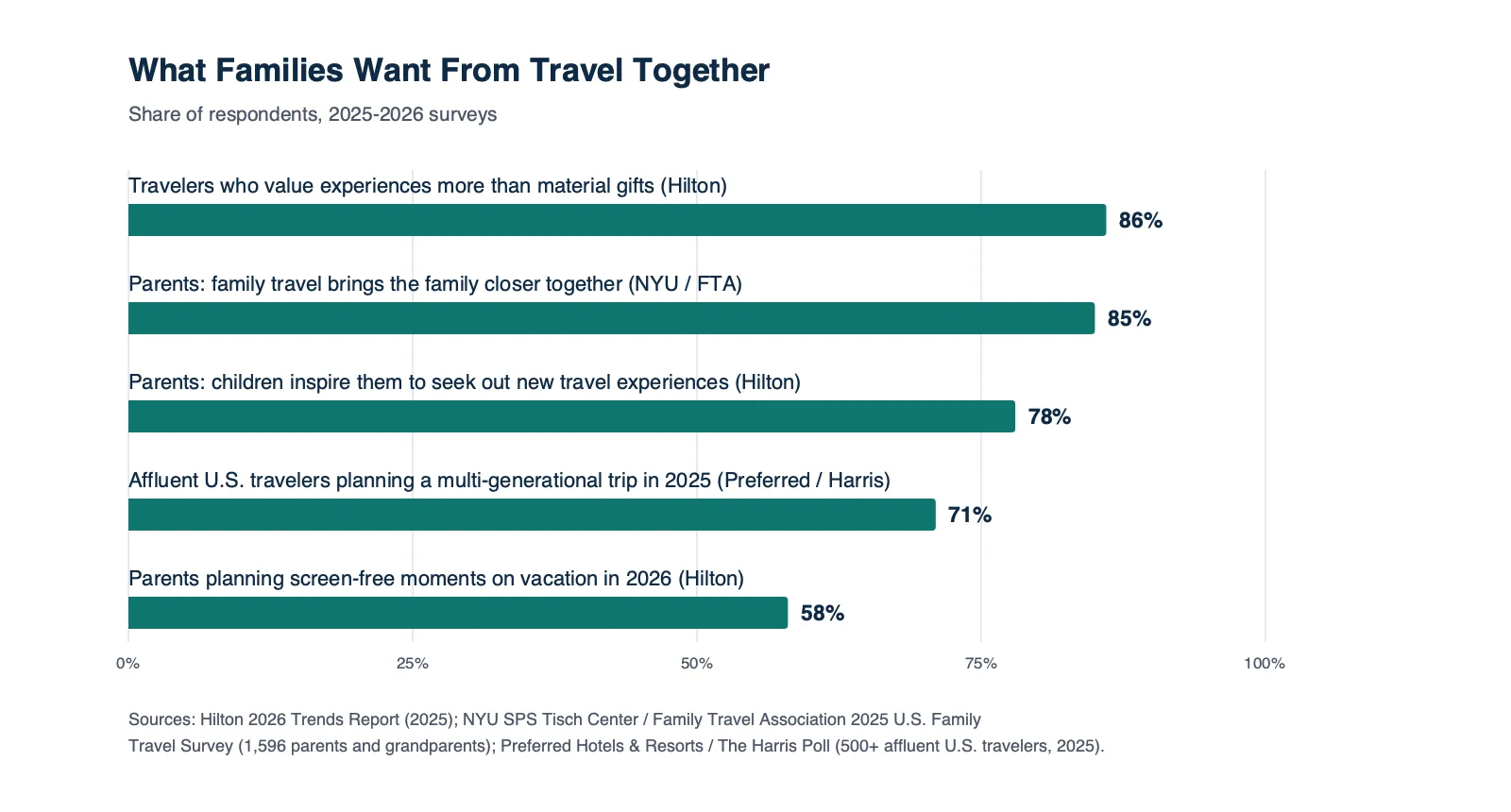
View data table
| Finding | % | Source |
|---|---|---|
| Travelers who value experiences more than material gifts | 86% | Hilton 2026 Trends Report |
| Parents who say family travel brings the family closer together | 85% | NYU SPS / Family Travel Association, 2025 |
| Parents whose children inspire them to seek out new travel experiences | 78% | Hilton 2026 Trends Report |
| Affluent U.S. travelers planning a multi-generational trip in 2025 | 71% | Preferred Hotels & Resorts / Harris Poll, 2025 |
| Parents planning screen-free moments on vacation in 2026 | 58% | Hilton 2026 Trends Report |
Which Is Better for Multi-Generational Family Travel?
Fifty-seven percent of parents are planning trips that bring the grandparents along, up from 55% in 2023, and 48% plan extended family travel with cousins, aunts, and uncles (NYU SPS Tisch Center / Family Travel Association, 2025). Multi-generational travel is growing, and a crewed charter handles it in a way a resort can’t.
Here’s the problem with resorts and large family groups: everyone scatters. The teenagers disappear to the pool. The grandparents book a spa morning. The parents are at the beach bar. The young kids are enrolled in the kids’ club. You’re all on the same property: but you’re not actually together. You reconvene at dinner, sometimes, and count that as a family vacation. Sound familiar?
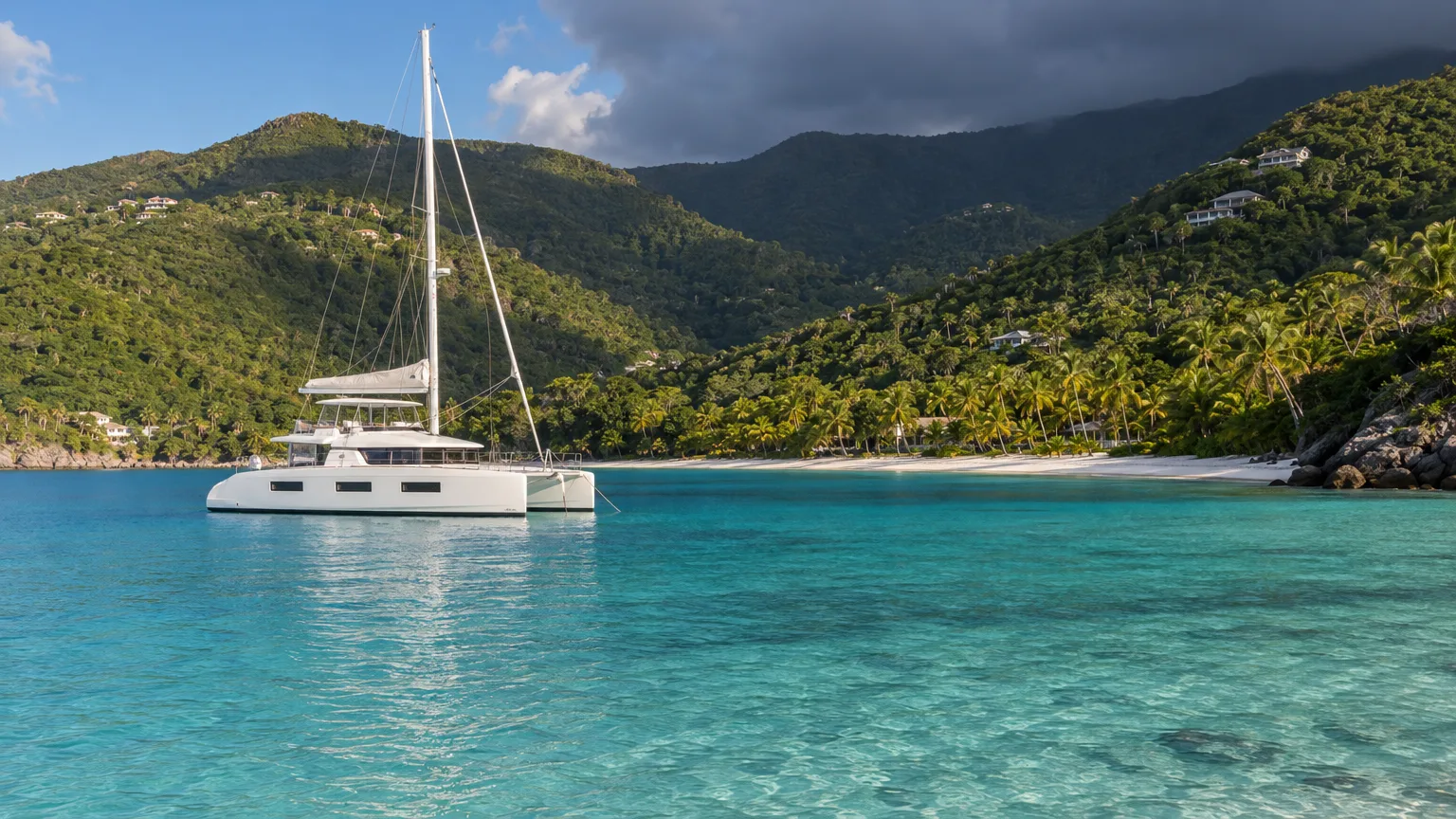
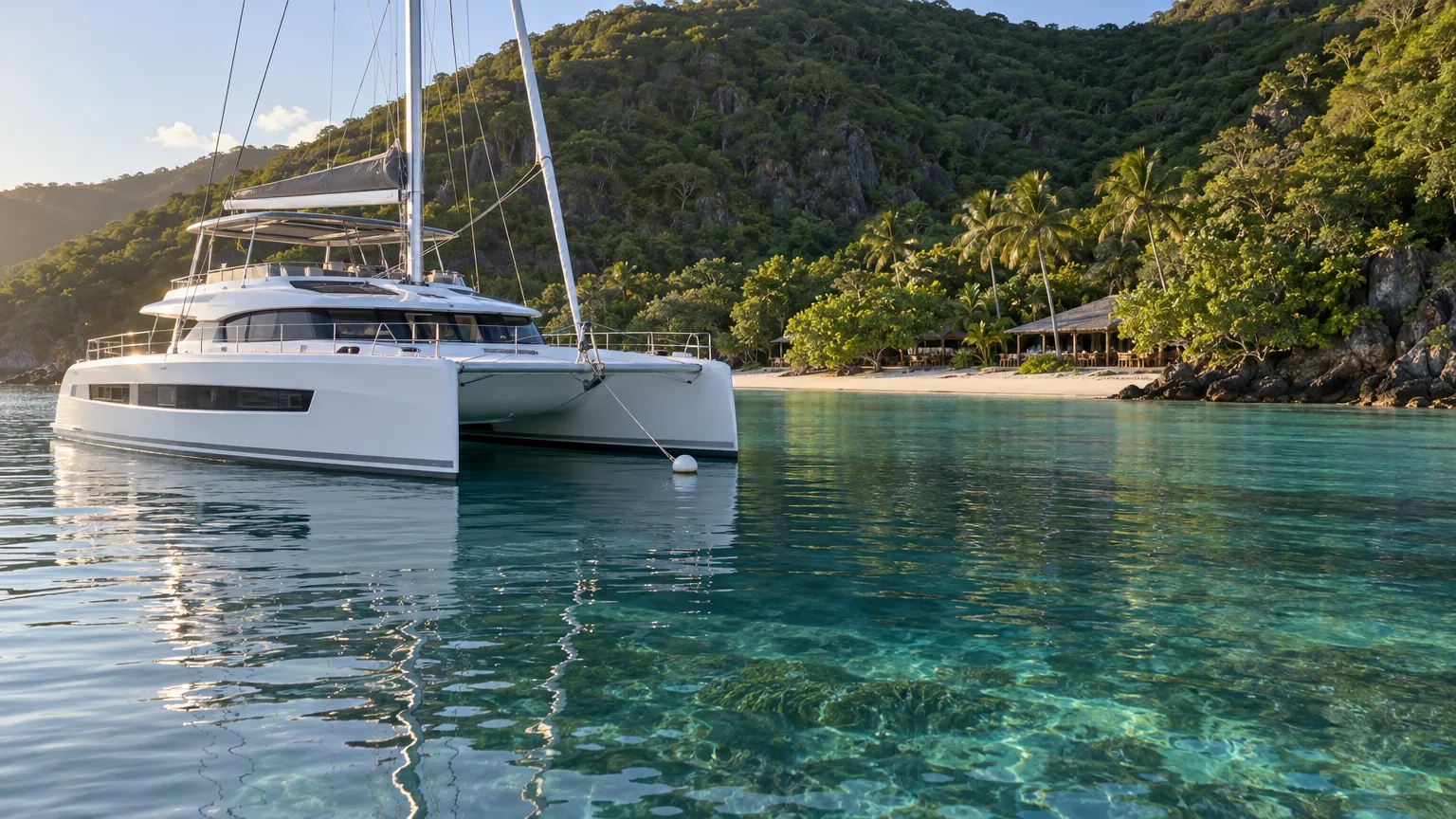
On a charter, the boat is the shared environment. The morning swim off the stern isn’t optional: it happens because you’re all living on sixty feet of catamaran together. The evening sundowner on the foredeck is a natural gathering point, not a scheduled event. Snorkeling a reef becomes a group adventure. A charter creates shared experiences by design, not by schedule.
Eighty-four percent of travelers in 2026 say they’ll actively seek opportunities for the entire family to play together (Hilton 2026 Trends Report, 2025). It’s what the charter format delivers.
Across generations, the activities scale naturally. Grandparents sit on deck with a drink while grandkids snorkel directly off the stern. Teenagers can learn to read charts with the captain. Toddlers can splash in the cockpit with a parent two feet away. The chef adjusts every meal (softer textures for older guests, no allergens for younger ones) without the coordination overhead you’d manage at a resort.
What repeat charter guests consistently report: Multi-generational families cite the “forced togetherness” of a charter as the element they didn’t expect to love. On a resort, it’s easy to drift into separate routines. On a boat, you’re building shared memories whether you planned to or not, and those memories are specific. Not “we went to the Caribbean.” But “the morning we found that reef off the northern point with no one else around.”
When Should You Choose a Resort Instead?
92% of parents say they are likely to travel with their children in the next 12 months (NYU SPS Tisch Center / Family Travel Association, 2025), but not every trip belongs on the water. So who’s the right candidate for a charter: and who isn’t? Resorts win in a few specific situations.
Groups under ten. The per-person math only comes close from about ten guests. At six or eight the resort costs much less than the charter, as the table above shows. Dividing a $30,000 charter four ways produces a per-person cost that’s well above a comparable resort. If you’re traveling as a couple or a single nuclear family without extended group, a resort delivers significantly better value at this scale.
Very young children (under 5). Toddlers on a moving boat require constant vigilance in ways that can exhaust parents rather than relax them. Most charter operators welcome young children and vessels can be equipped appropriately, but a resort’s structured kids’ programming offers a level of containment and programming that a charter can’t replicate. Charter is genuinely better for families with children aged 6 and up.
Motion sensitivity. Caribbean sailing is typically calm-water navigation, but swells happen. If any member of your group has a history of motion sickness, a resort removes that variable entirely. Scopolamine patches help, but they’re not a guarantee.
Stays under five nights. The logistics and cost of a crewed charter amortize best across a full week. For a long weekend or a four-night trip, the per-day economics tilt firmly toward a resort.
For everyone else, particularly groups of 10 to 12 who want something different and memorable, the charter case is strong, and the price gap is small enough to let the experience decide.
The Verdict
Newsweek found that a group splitting a yacht charter can pay about the same as a week at a premium or luxury resort (Newsweek, 2025). So why does the “too expensive” assumption persist? The conventional wisdom, that a crewed charter is prohibitively expensive compared to a luxury resort, doesn’t survive contact with actual numbers.
At 10 to 12 guests the charter costs a little more per person than the resort once both sides include tips. For that difference it delivers what the resort doesn’t: a private chef preparing every meal to your group’s exact specifications, the ability to sleep somewhere different every night, direct access to protected reefs and uninhabited anchorages, and the kind of close-quarters family time that produces memories that actually stick.
Key takeaways:
- For groups of 10-12, a crewed charter costs only slightly more per person than a luxury all-inclusive resort once every expense, tips included, is counted on both sides
- Charter includes significant value that resorts charge extra for: chef-prepared meals, water sports, mooring access, and multiple destinations
- Multi-generational groups benefit disproportionately from the shared-experience structure that charter delivers by design
- Resorts cost clearly less per person below about 10 guests, and remain the better choice for children under 5 and stays shorter than five nights
Many affluent travelers find standardized luxury short on character. If your family feels the same and your group is 10 or larger, get a charter quote before you book the resort. See what a crewed week costs for your group size.
To learn more about one of our favorite destinations, read this blog about the US Virgin Islands
Frequently Asked Questions
What taxes and fees are added to a Caribbean yacht charter?
It varies by destination: 14 percent in the Bahamas (10 percent VAT plus a 4 percent charter tax), $4 to $16 per guest per day in BVI cruising fees plus a $10 arrival levy, marine park fees in the Grenadines and Exumas, nothing per guest in the USVI, and in the French islands only a 1 euro per person per day waste tax in Gustavia. On all-inclusive terms the permits, levies and park fees are covered by the rate in the vast majority of cases; the percentage taxes and the crew gratuity are the lines you pay directly.
How far in advance should you book a crewed yacht charter?
For peak Caribbean season, December through April, book 6-12 months ahead. Popular vessels in the right size range for large families fill quickly. Do not count on a late discount to rescue a slow decision: of the 672 crewed yachts active in the Caribbean and Bahamas, 66 carry a promotional offer and only four of those exceed 15 percent off (Vital Charters listings analysis, October 2026). A deep last-minute cut exists, it is roughly a one-in-170 event, and the selection left by then is thin.
Is a crewed yacht charter safe for young children?
Yes, with the right vessel and preparation. Reputable charter operators outfit catamarans with life jackets for all ages, cockpit netting, harness tethers, and high freeboard for safety margin. Most captains are experienced with family groups and will walk you through safety protocols before departure. Children under 3 require additional adult supervision; discuss this specifically with your broker before selecting a vessel.
What exactly is included in an “all-inclusive” Caribbean charter?
Standard all-inclusive Caribbean charters include: captain, chef, all meals and standard beverages, fuel, mooring fees, cruising permits, water sports equipment (snorkeling gear, paddleboards, kayaks), and dinghy transfers to shore. Not typically included: premium alcohol beyond the house selection, SCUBA diving with a guide, specialty land excursions, and crew gratuity (budget 15-20% of the charter fee). Always confirm inclusions in writing with your broker before signing.
Can a yacht chef realistically accommodate dietary restrictions?
This is one of the genuine advantages of chartering over a resort. Your chef prepares every meal specifically for your group. Before departure, the charter broker collects a detailed dietary preference form, allergies, intolerances, preferences, dislikes, and medical requirements. A skilled charter chef treats this as a culinary brief. Vegan, gluten-free, nut-free, and multi-allergy households are all manageable in ways a resort kitchen serving hundreds of guests simply cannot match.
How does a crewed charter compare to a bareboat charter for families?
A bareboat charter rents you the vessel only: no captain, no chef. You’re responsible for navigation, provisioning, cooking, and boat management. Bareboat costs less because you are the crew, which makes it a sailing holiday that needs an experienced skipper in your group. A crewed charter is the hands-off version: you arrive, the crew manages everything, and your only job is to enjoy it. For families without sailing credentials who want genuine relaxation, crewed is unambiguously the right choice.
For a group of ten, a charter and a resort week cost about the same.
Tell us your group size and dates and we’ll send real crewed yacht pricing so you can compare it against what you’d spend at a luxury resort, no guesswork.