
Beyond the Cruise Ports: Hidden Caribbean Anchorages Only Reachable by Yacht
Skip cruise port crowds. 10 hidden Caribbean and Bahamas anchorages (Tobago Cays, Compass Cay, Shroud Cay) only crewed yachts reach. Plan your charter.
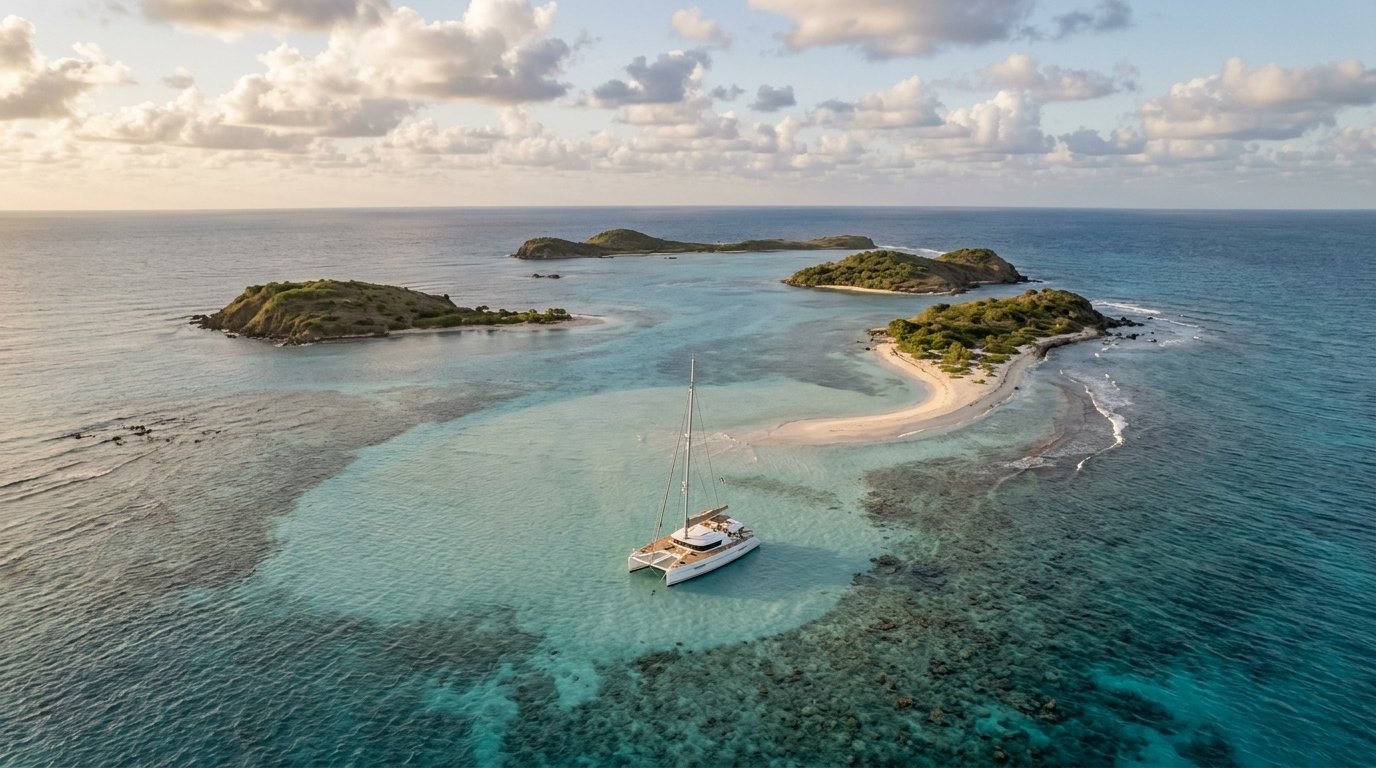
The hidden Caribbean destinations that a crewed yacht charter can reach (Tobago Cays Marine Park (legal cap: 150 vessels for the entire park), Compass Cay, Shroud Cay, and seven more) share one trait: cruise ships physically cannot reach them, and the day’s crowd measures in dozens rather than thousands. The shift driving this is documented: 43% of global travelers plan to avoid overcrowded tourist destinations in 2026, up 11 percentage points year over year in Booking.com’s 2026 Travel Predictions (a survey of 32,500 travelers across 35 markets). This piece is the deeper dive on one trend from our 2026 travel trends pillar: specifically why secondary destinations live at sea, not on land.
The rest of this guide explains what’s driving the secondary-destinations shift in 2026 booking data, then walks through the 10 anchorages by region (Grenadines, Exumas, and the Virgin Islands) and how to brief a broker for a hidden-anchorage-maximized week.
Why Secondary Destinations Are Surging in 2026
Booking.com’s 2026 Travel Predictions, surveying 32,500 travelers across 35 markets, found 43% plan to avoid overcrowded tourist destinations, an 11-point year-over-year rise, with 44% of those choosing quieter places saying they want to avoid contributing to overtourism. Booking’s framing across the broader report: “‘off the beaten path’ no longer means remote or complicated, in 2026, it usually means choosing the quieter option next door”.
Expedia’s Unpack ’26 report (a survey of 24,000 travelers across 18 countries) reaches the same conclusion from a different angle: 63% of global consumers are inclined to detour to lesser-known, less-crowded destinations (Expedia Unpack ’26, September 2025). Hilton’s 2026 Trends Report calls the shift “the Whycation”. “the intention is primary, and the destination secondary” (Hilton 2026 Trends, October 2025).
The Caribbean is one of the most concentrated cruise-tourism regions on earth, Caribbean, Bahamas, and Bermuda combined account for roughly 43% of global cruise deployments, per CLIA’s 2026 State of the Cruise Industry Report (CLIA, 2026). That’s also what makes the secondary-destinations angle so sharp at sea: the hidden anchorages aren’t theoretical. They exist inside the most-trafficked cruise region, simply outside the routes that 5,000-passenger ships can navigate.
The Cruise-Port vs Yacht-Anchorage Math
Royal Caribbean’s Icon of the Seas (the largest cruise ship in service) carries 5,610 guests at double occupancy (7,600 maximum) plus 2,350 crew, for roughly 9,950 people per vessel (Wikipedia: Oasis-class cruise ship, 2024). Cozumel, the world’s busiest Caribbean cruise port, processed 4.73 million cruise passengers across 1,300 ships in 2025, with a single-day record of 18,297 passengers on April 17, 2025. The Bahamas saw 7.6+ million cruise passengers in 2025.
Set that against the regulatory reality of the anchorages in this guide. Tobago Cays Marine Park has a legal cap of 150 vessels for the entire park, with roughly 70 yacht moorings and 20 dinghy moorings (Tobago Cays Marine Park). At an average of about 8 charter guests per yacht, the marine park’s maximum legal occupancy is roughly 1,200 people. Warderick Wells in the Exuma Cays Land and Sea Park prohibits anchoring entirely to protect coral and sponges: vessels must take one of a small number of mooring buoys at $10/night (Bahamas National Trust).
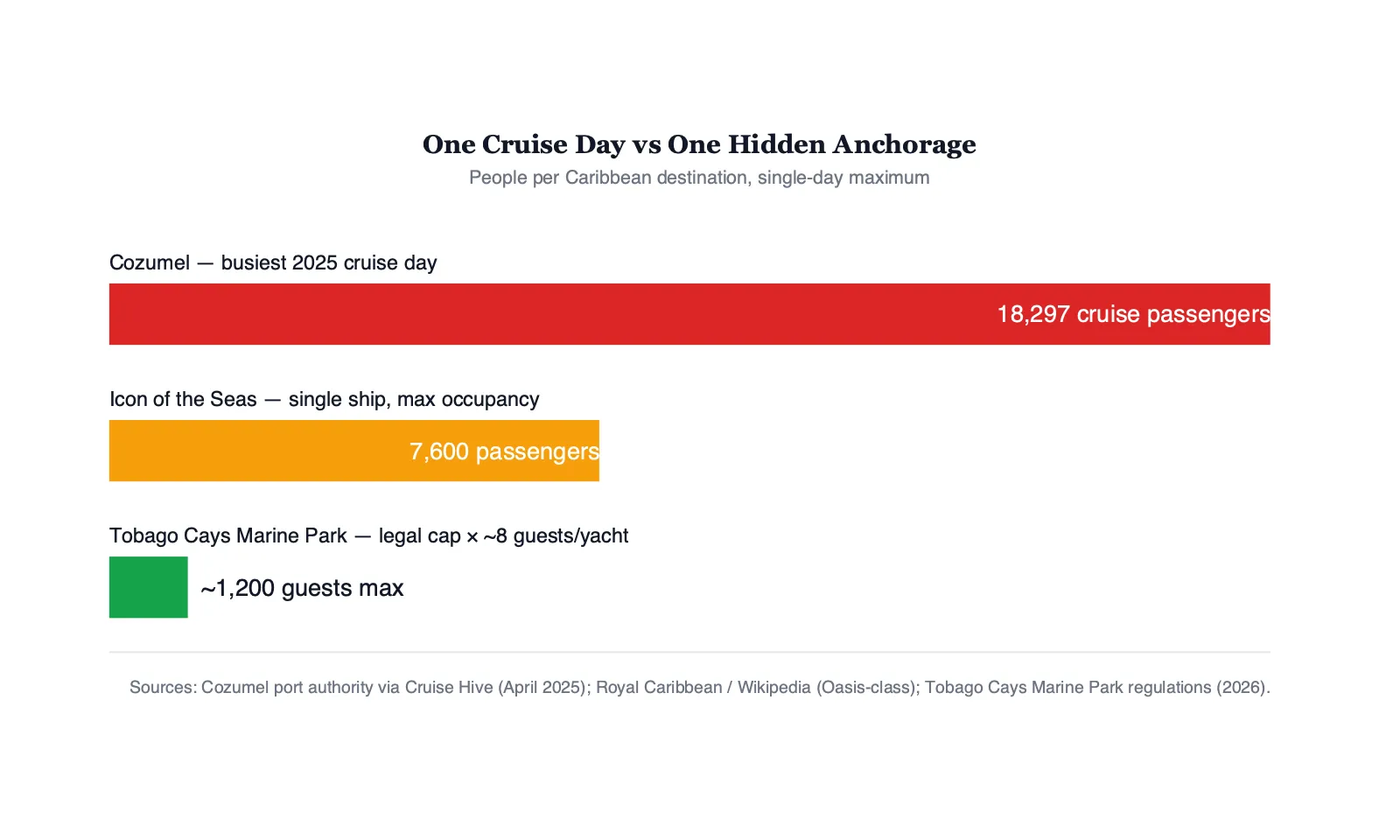
View data table
| Destination | People (single-day max) | Source |
|---|---|---|
| Cozumel: busiest 2025 cruise day (April 17, 2025) | 18,297 | Cozumel port authority via Cruise Hive |
| Icon of the Seas: one ship at max occupancy | 7,600 (+ 2,350 crew) | Royal Caribbean / Wikipedia |
| Tobago Cays Marine Park: legal 150-vessel cap × ~8 guests/yacht | ~1,200 | Tobago Cays Marine Park regulations |
One cruise port day at Cozumel = roughly 15× the entire legal capacity of the Tobago Cays Marine Park.
The Grenadines: Tobago Cays, Mayreau, and Petit Tabac
The southern Grenadines hold three of the most spectacular yacht-only anchorages in the Caribbean, all within a single day’s sail, plus the Mopion sandbar, which is barely an anchorage at all.
1. Tobago Cays Marine Park (St. Vincent and the Grenadines). A horseshoe reef encloses four uninhabited islets (Petit Rameau, Petit Bateau, Baradal, and Jamesby) and a turtle-protected lagoon. Anchoring is restricted to designated sand; the park caps total vessels at 150 and requires entry fees of EC$15/person per 24 hours (Tobago Cays Marine Park). For the chartered version of this stop and the wider Grenadines arc, our 7-day Grenadines yacht charter itinerary walks through Bequia, Mustique, and Union Island as a privacy-maximized loop: with Basil’s Bar at Britannia Bay the one stop on Mustique open to anyone who arrives by boat.
2. Mayreau (Salt Whistle Bay). A 0.46-square-mile island with one road, one village, and a population of about 271, no airport, no cruise port (Wikipedia: Mayreau). Salt Whistle Bay is a crescent of white sand on the island’s north end; from anchor you can walk the entire island in an hour.
3. Petit Tabac. An uninhabited cay just outside the Tobago Cays reef line. The anchorage holds about two boats comfortably and is day-use-only in settled weather. Pirates of the Caribbean: The Curse of the Black Pearl used Petit Tabac for the marooned-island scene: covered in detail in our set-jetting Caribbean yacht charter spoke.
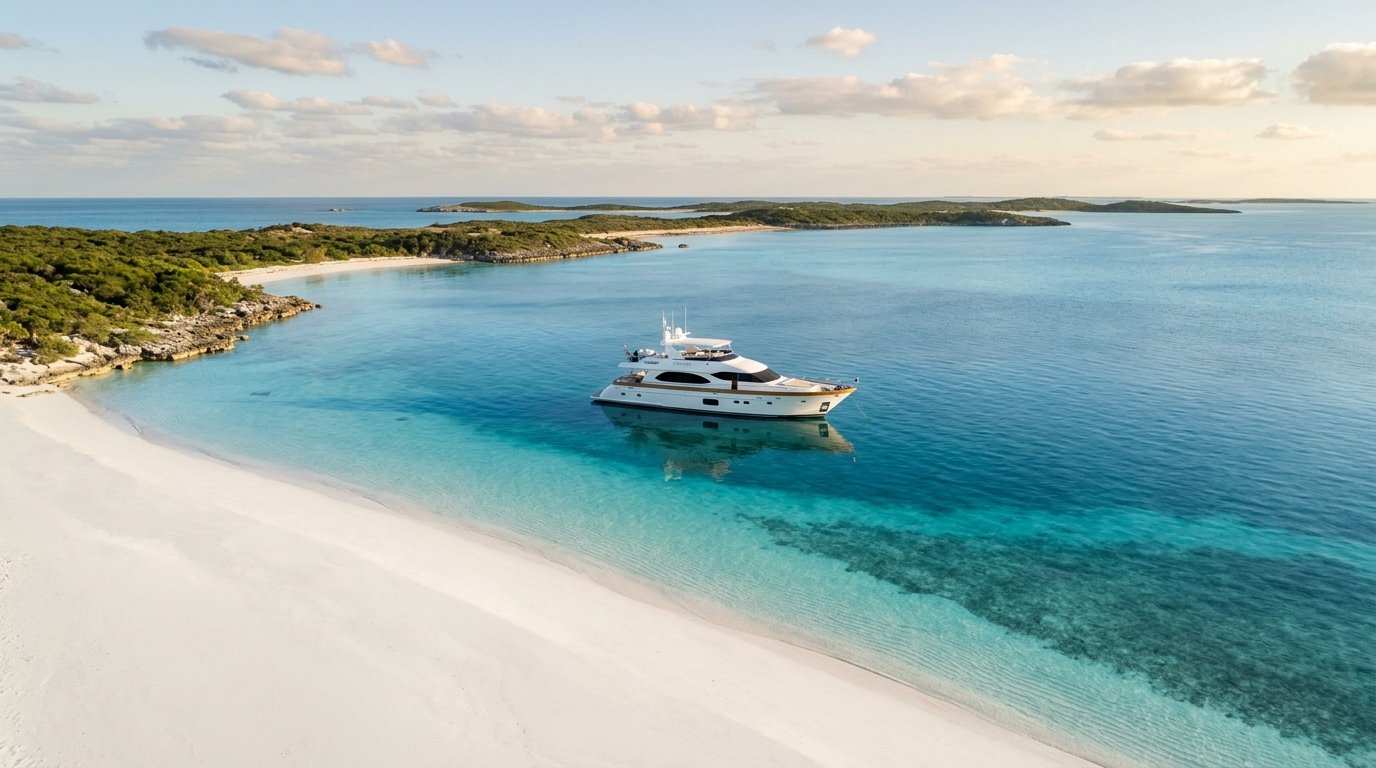
The Exumas: Compass Cay, Shroud Cay, Warderick Wells, and Allans Cay
The Exuma chain stretches roughly 130 miles across the central Bahamas, and the strictest regulatory protection sits inside the Exuma Cays Land and Sea Park, 176 square miles of no-take marine reserve.
4. Compass Cay. A private cay reached via the Joe Cay Cut. The anchorage holds about 8 boats and the small marina caps at 150 feet LOA / 8 feet draft (Bahamas Cruisers Guide). No ferry, no commercial transport: yachts and seaplanes only.
5. Shroud Cay (Exuma Cays Land and Sea Park). A mangrove-and-creek system inside the no-take park. Motorized vessels are banned from interior tidal creeks; access is by mooring buoy and tender only (Bahamas National Trust).
6. Warderick Wells. The headquarters of the Exuma Cays Land and Sea Park. Anchoring is prohibited to protect coral and sponges: vessels must take a mooring buoy at $10/night, paid via VHF check-in (Wikipedia: Exuma Cays Land and Sea Park). The most-protected anchorage in the Bahamas.
7. Allans Cay (northern Exumas). Two horseshoe islands, uninhabited, home to a colony of endemic rock iguanas. The cuts between them form two protected anchorages reachable only by boat. For the full Bahamas cruising context, our Bahamas yacht charter complete guide covers the Exumas chain from Allans Cay south to Great Exuma.
The Virgin Islands: Anegada, Sandy Spit, and Salt Pond Bay
The Virgin Islands are well-trafficked overall, but three anchorages remain genuinely hidden because of geography or park regulation.
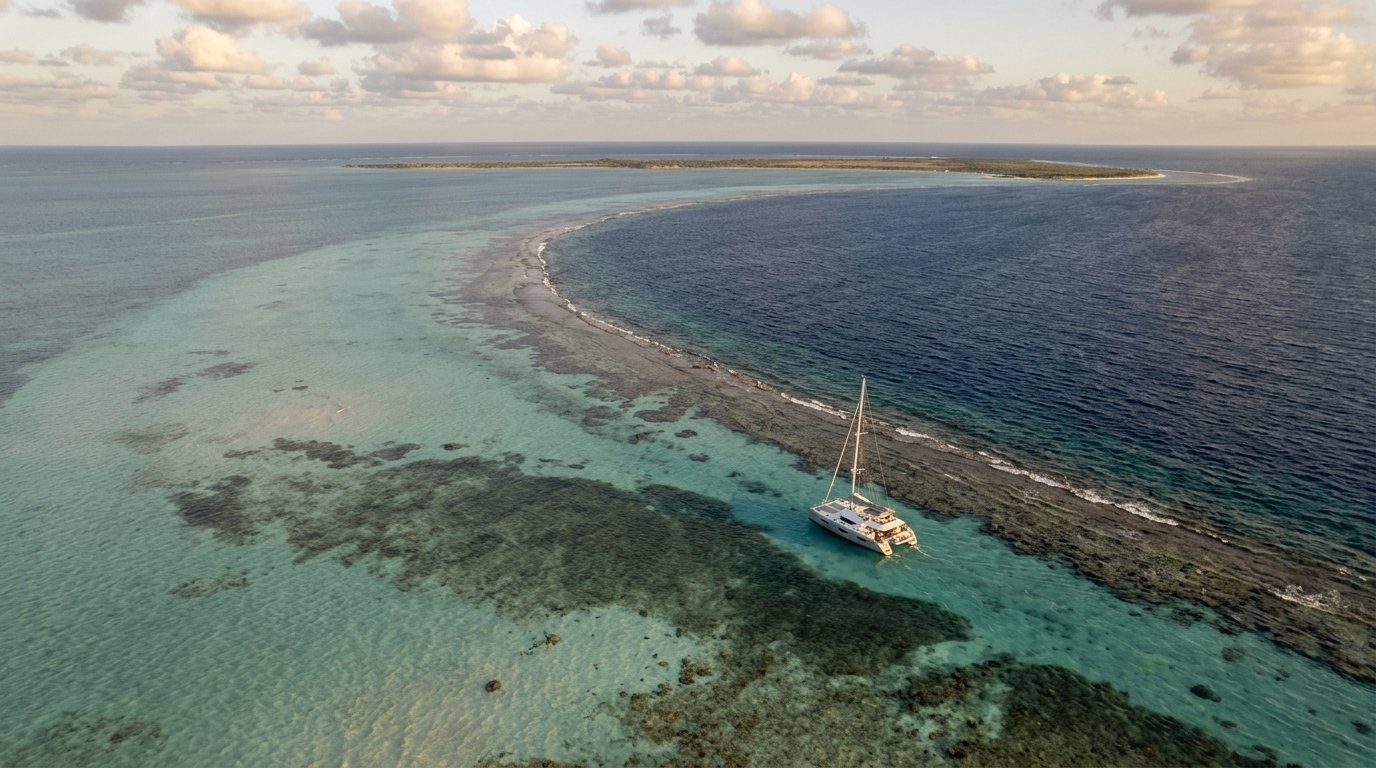
8. Anegada North Shore (BVI). Anegada is surrounded by the 18-mile Horseshoe Reef, the third-largest barrier reef in the Caribbean and home to 300+ documented shipwrecks. Approach requires reef-pilot navigation; the North Shore anchorage has roughly 10 reserved mooring balls and excludes most large vessels. Our BVI crewed yacht charter insider guide covers the Horseshoe Reef navigation in detail.
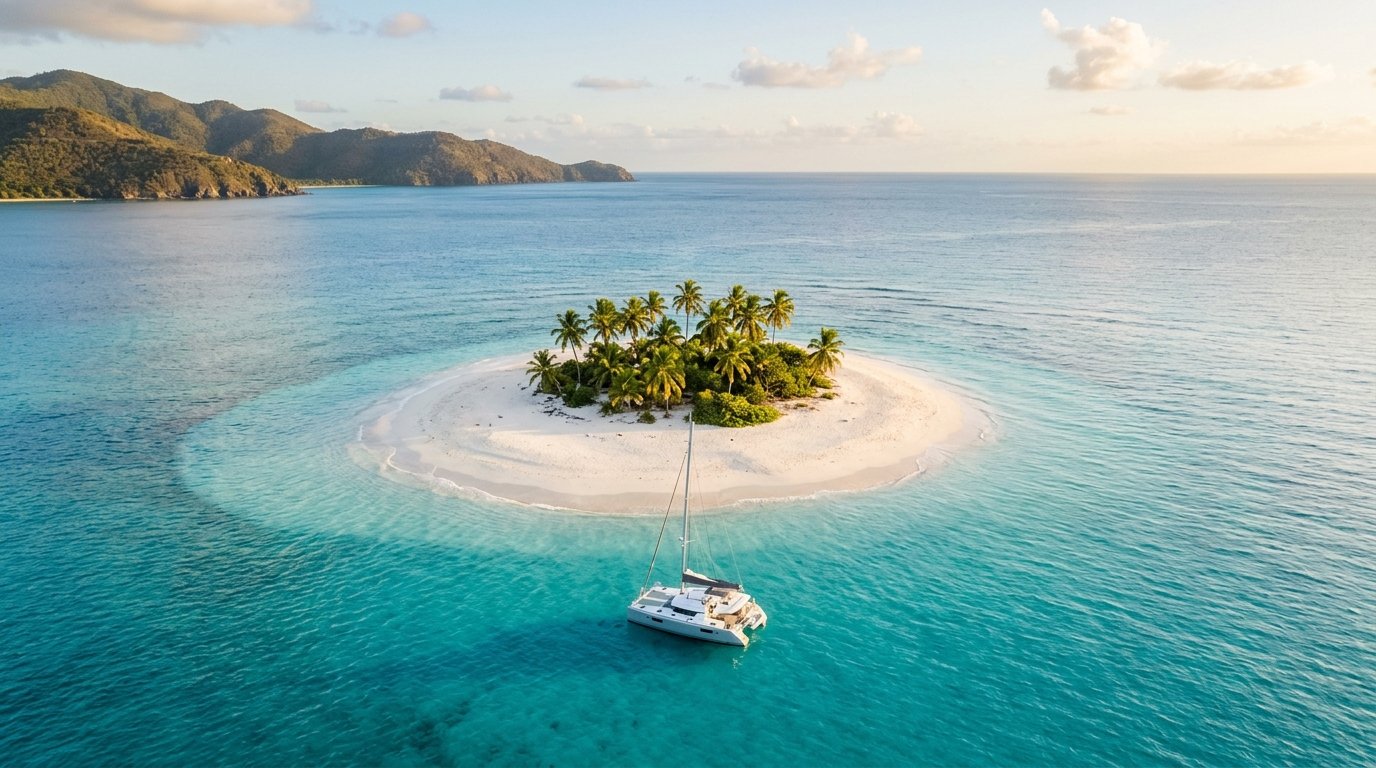
9. Sandy Spit (BVI, off Jost Van Dyke). A half-acre uninhabited cay with no docks, restaurants, or restrooms. The anchorage holds 2–4 boats comfortably and is settled-weather only.
10. Salt Pond Bay (St. John, USVI). Inside Virgin Islands National Park on the south shore, land access is limited to a single trail from a small parking area, but a handful of NPS mooring balls give yachts the entire bay during weekday low-traffic windows.
How to Brief a Charter Broker for a Hidden-Anchorage Week
A hidden-anchorage charter is structurally different from a generic Caribbean week. Three things make the difference:
- Brief by capacity, not by name. “We want anchorages with vessel caps under 20” produces a different proposal than “we want to see Tobago Cays.” Same first stop, different itinerary depth.
- Lock in a region. The Exumas and the Grenadines and the BVI each justify their own week. Trying to combine the Exumas with the Grenadines requires an open-ocean delivery, not how hidden-anchorage charters are structured. Pick one cruising ground.
- Account for park fees and mooring caps upfront. Tobago Cays charges EC$15/person/day; Warderick Wells $10/night; Anegada’s reserved mooring balls book ahead. Your broker should bake these into the itinerary, not surprise you onshore.
For travelers prioritizing the same privacy mechanics that hidden anchorages deliver, without locking in to a specific region, see our quiet luxury vacations spoke, which covers the broader venue-exclusivity logic that makes yacht charter the natural fit for the 2026 hushpitality trend.
The Bottom Line: Hidden Anchorages Are the Original Off-the-Beaten-Path
The 2026 trend reports describe what travelers want, quieter destinations, less congestion, the absence of overtourism. The Caribbean’s hidden anchorages have always delivered that; the trend is just catching up. Cruise ships physically cannot reach Tobago Cays, the Exuma Cays Land and Sea Park, Anegada’s North Shore, or Sandy Spit. Regulatory caps make sure of it. A crewed yacht is the only way in. Hidden anchorages are one of nine 2026 travel trends our pillar piece maps against crewed charter: and they’re the trend’s purest expression.
When you’re ready to think through dates, group size, and which cruising ground fits your hidden-anchorage threshold, start a yacht search at Vital Charters and we’ll match the brief to inventory. If you’d rather talk it through first, our contact form routes directly to me.
Frequently Asked Questions
Which Caribbean anchorages are physically inaccessible to cruise ships?
Tobago Cays Marine Park (Grenadines), the Exuma Cays Land and Sea Park (Compass Cay, Shroud Cay, Warderick Wells, Allans Cay), Anegada’s Horseshoe Reef (BVI), Petit Tabac, Sandy Spit, Mayreau, and Salt Pond Bay (St. John). All have shallow drafts, no cruise infrastructure, regulatory restrictions on commercial vessel access, or a combination of all three. None are reachable by cruise ship.
What is the legal capacity of the Tobago Cays Marine Park?
The Tobago Cays Marine Park (St. Vincent and the Grenadines) is legally capped at 150 vessels for the entire park, with roughly 70 designated yacht moorings and 20 dinghy moorings. Entry fees are EC$15/person per 24 hours, anchoring in coral or seagrass is prohibited, and there’s a 5-knot speed limit park-wide (Tobago Cays Marine Park regulations).
Why is Norman Island not on this list?
Norman Island Bight in the BVI was a legitimate “hidden” anchorage 20 years ago, but Pirates Bight restaurant and the Willy T floating bar shifted it into the standard BVI charter circuit. A typical summer night sees 40+ boats in the Bight. The hidden BVI substitute is Anegada’s North Shore: reef-protected, capped at roughly 10 reserved moorings, and most large vessels physically can’t navigate the approach.
How many people are at a hidden Caribbean anchorage on a typical day?
At full legal capacity, Tobago Cays Marine Park holds about 1,200 guests (150 vessels × ~8 guests per crewed yacht). Most days the park is well below that: typically 30–60 yachts. Warderick Wells in the Exuma Cays Land and Sea Park holds about 22 vessels in its north mooring field. Sandy Spit’s anchorage holds 2–4 boats comfortably. Compare those numbers to Cozumel’s 18,297-passenger single-day record in 2025.
What does a hidden-anchorage charter cost?
Hidden-anchorage charters use the same yacht inventory as standard Caribbean charters, pricing tracks with yacht size and season, not with which anchorages you visit. A typical week on a 50–80 foot crewed catamaran or motor yacht for 8–10 guests runs $20,000–$180,000 base fee plus park and mooring fees of $200–$600 across the week. Most park fees are tendered ashore by the captain.
How far ahead should I book a hidden-anchorage charter?
Premium hidden-anchorage cruising grounds book 6–12 months ahead for high season (mid-December through April). For Tobago Cays specifically, the calmer weather window is December through April. The Exumas are best November through May. Anegada’s reef pilot is most reliable in calmer easterly conditions, typically winter through early spring.
Anchorages the cruise ships will never reach.
Share your group size and preferred islands and we’ll put together a crewed charter week built around the secluded spots (Tobago Cays, the Exumas, Anegada) with no port-day traffic.