
Yacht Charter vs. Ownership: Real Cost Comparison (2026)
Owning a yacht costs 10-15% of its value yearly before you ever leave the dock. See the real numbers on charter vs. ownership across 5 categories.
Last Updated: September 7, 2026
The global yacht charter market hit $8.39 billion in 2024 and is projected to reach $18.3 billion by 2034 (Precedence Research, 2025). That growth isn’t random. More high-net-worth individuals are running the numbers and discovering what brokers have known for decades: owning a yacht is one of the most expensive ways to enjoy the water.
But the yacht charter vs. ownership cost debate isn’t as simple as “chartering is cheaper.” The real question is when ownership starts making financial sense: and whether it ever does. I’ve spent years helping clients navigate what yacht charters actually cost, and I’ve watched buyers underestimate ownership expenses by 40-60% in their first year. This comparison breaks down the real numbers across five categories so you can make a decision based on math, not marketing.
Yacht Charter vs. Ownership Cost: At a Glance
| Category | Chartering | Ownership |
|---|---|---|
| Best For | Flexibility, variety, zero maintenance | 20+ weeks/year usage, customization, asset building |
| Upfront Cost | $0 | $1M-$50M+ (purchase price) |
| Annual Cost (60ft yacht) | $100K-$160K (4 weeks) | $300K-$450K (whether you use it or not) |
| Crew Management | Included in charter fee | Year-round salaries: $168K-$516K/yr |
| Maintenance | Not your problem | 8-12% of yacht value annually |
| Insurance | Included | 1-5% of hull value annually |
| Depreciation | None | 40-50% loss in first 5 years |
| Destination Flexibility | Charter anywhere, anytime | Limited to where your yacht is based |
| Tax Benefits | Limited | Possible depreciation deductions |
| Overall Winner | Chartering (for most people) | Ownership (20+ weeks/year) |
What Does Yacht Ownership Really Cost Per Year?
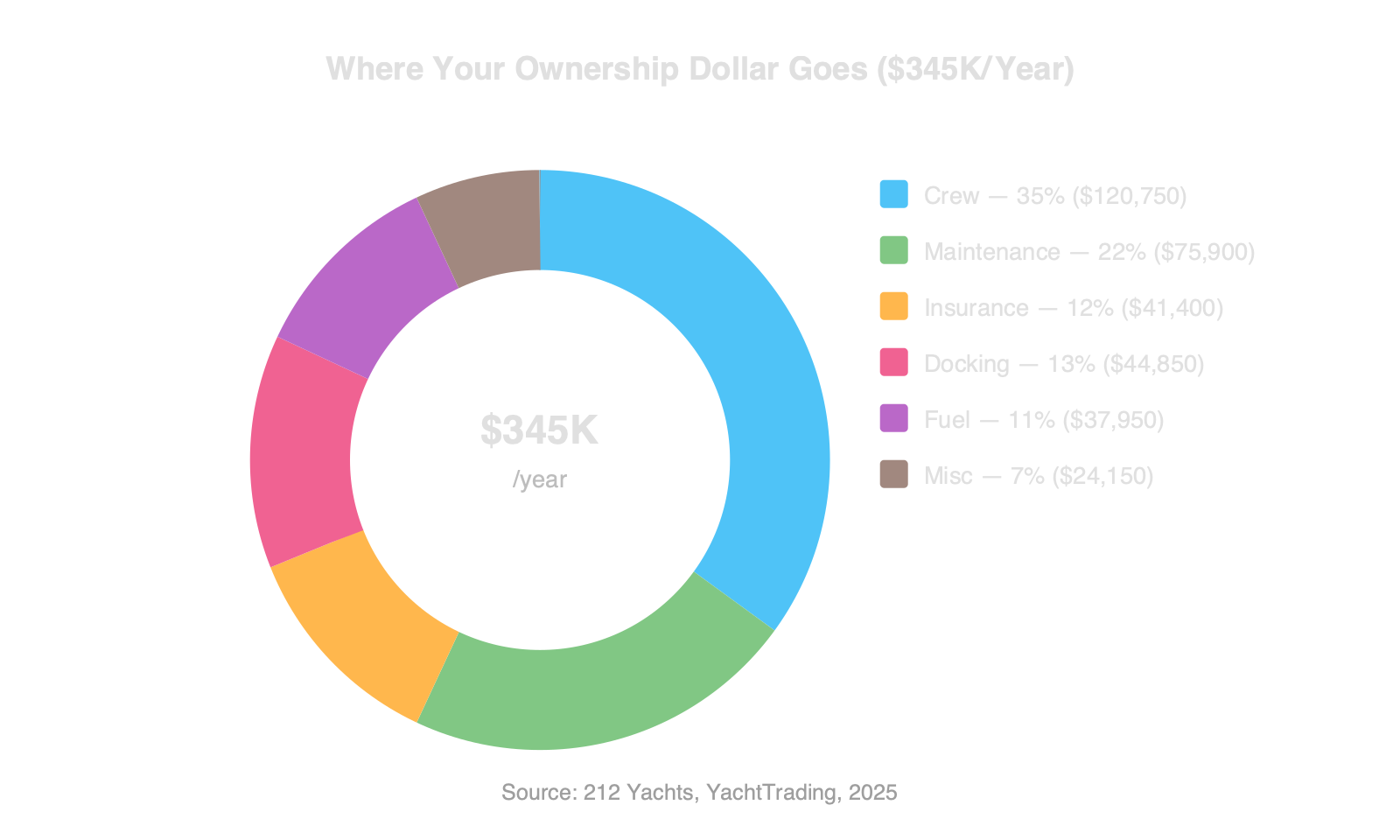
Annual yacht operating costs run 10-15% of the vessel’s market value, and that’s the conservative estimate (Boat International, 2025). The yachting industry calls this the “10% rule,” but actual expenses frequently hit 15-20% for superyachts once you factor in crew benefits, unexpected repairs, and marina fees in premium locations.
Here’s what that looks like on a $3 million, 60-foot motor yacht:
View data table
| Expense Category | % of Total | Annual Cost |
|---|---|---|
| Crew (captain + 1-2 crew) | 35% | $120,750 |
| Maintenance & repairs | 22% | $75,900 |
| Docking & marina fees | 13% | $44,850 |
| Insurance | 12% | $41,400 |
| Fuel | 11% | $37,950 |
| Miscellaneous (provisioning, admin, licenses) | 7% | $24,150 |
| Total | 100% | $345,000 |
Crew salaries alone account for 30-40% of total operating costs. A captain runs $5,000-$25,000 per month depending on yacht size and experience. A chef adds $5,000-$12,000 monthly. A chief stewardess costs $4,100-$5,800 per month (Dockwalk Salary Survey, 2024). You’re paying these salaries year-round: not just when you’re aboard.
From the broker’s desk: The expense that surprises first-time owners most isn’t crew or fuel. It’s the major refit every 5-7 years that can cost 10-20% of the yacht’s original purchase price. I’ve seen owners budget perfectly for Years 1-4, then get blindsided by a $500,000 refit bill in Year 5.
And don’t forget the costs nobody warns you about: flag state fees, classification society surveys, and equipment upgrades that regulators require regardless of whether you think they’re necessary.
Before you weigh owning, see what chartering delivers, search crewed yachts for real, all-inclusive weeks.
Which Option Wins on Total 10-Year Cost?
New yachts depreciate 10-20% in their first year alone. By Year 5, cumulative depreciation reaches 40-50%. The curve only flattens after Year 10 (YATCO, 2024). That means a $3 million yacht could be worth $1.5-$1.8 million after five years, a paper loss of $1.2-$1.5 million on top of every operating dollar you’ve spent.
Here’s the math that changes most people’s minds. Compare total spending over 10 years for a $3 million, 60-foot yacht used 4 weeks annually:
View data table
| Scenario | Cost Component | 10-Year Total |
|---|---|---|
| Charter (4 wks/yr) | Charter fees + APA + gratuity | $1,200,000 |
| Ownership | Purchase price | $3,000,000 |
| Operating costs (10 years) | $3,450,000 | |
| Net depreciation | $900,000 | |
| Ownership subtotal | $7,350,000 | |
| Opportunity cost | $3M invested at 10.3% avg return | $8,100,000 |
| True economic cost of ownership | $15,450,000 | |
That $3 million sitting in your yacht could have grown to over $8 million in the S&P 500 over the same decade. The average annual return since 1957 is 10.33% (Motley Fool, 2025). Nobody in the yacht sales brochure mentions that the real price of ownership includes $8.1 million in foregone investment returns. That’s the number that shifts this conversation from “chartering is a bit cheaper” to “chartering is dramatically cheaper.”
Verdict: Chartering wins overwhelmingly on total cost. At 4 weeks of annual use, you’d spend $1.6 million over a decade chartering versus $7.35 million owning, and that’s before opportunity cost.
Which Gives You More Flexibility and Variety?
Chartering wins on flexibility by a wide margin. When you own a yacht, it sits in one marina. Moving it between the Caribbean and the Mediterranean costs $50,000-$150,000 in delivery fees, fuel, and crew transit expenses (Boat International, 2024). Most owners keep their yacht in one region and vacation in the same waters year after year.

Charter clients? They sail the BVI in February, cruise the Amalfi Coast in June, and explore the Seychelles at Christmas. Each trip brings a different yacht matched to that specific destination. Want a shallow-draft catamaran for the Bahamas? Done. A 100-foot motor yacht for the French Riviera? Just pick your size range.
From the broker’s desk: I’ve had clients who owned 65-foot motor yachts in Fort Lauderdale and still chartered catamarans in the BVI every winter. When I asked why, the answer was always the same: “My boat is great, but I can’t sail it in the Virgin Islands without spending two weeks just getting there.” They were paying for ownership and charters.
Chartering also lets you try before you buy. Thinking about upgrading from a 50-footer to an 80-footer? Charter one first. Not sure which size or layout suits the way your family actually uses a boat? Charter two different ones in back-to-back weeks and find out, without a multi-million dollar commitment. The difference between all-inclusive and bareboat pricing is worth understanding before you compare any two quotes.
Verdict: Chartering wins on flexibility. Ownership locks you into one yacht, one region, and one experience.
Which Is Less Work to Manage?
A survey of superyacht crew across 655 yachts found that 79.7% of owners spend at least one month aboard annually, but someone has to manage the boat during the other 11 months (SuperyachtNews, 2023). Owning a yacht is a second job. Beyond the financial burden, there’s crew management, maintenance scheduling, regulatory compliance, insurance renewals, and marina logistics.
When you charter, the management burden is exactly zero. Your charter fee covers the crew, the maintenance, the insurance, and the provisioning. You show up, step aboard, and start your vacation. That’s it. Understanding what’s included in a MYBA charter contract takes 15 minutes. Managing a yacht takes 15 hours a week.
Some owners hire yacht management companies to handle the operational burden. This adds another 15-25% on top of existing operating costs. You’re essentially paying someone to manage the asset you’re already paying to maintain, crew, insure, and dock.
Verdict: Chartering wins on convenience. Ownership demands constant attention: or expensive management fees to avoid it.
When Does Ownership Actually Make Financial Sense?
Ownership starts to pencil out at around 8-16 weeks of annual use. That’s the crossover point where cumulative charter fees begin to approach annual operating costs. But most yacht owners don’t come close to that number. The average U.S. recreational boat owner uses their vessel just 54 days, roughly 7.7 weeks, per year (SuperyachtNews, 2023).
View data table
| Weeks/Year | Charter Cost | Ownership Cost | Savings with Charter |
|---|---|---|---|
| 2 | $60,000 | $345,000 | $285,000 |
| 4 | $120,000 | $345,000 | $225,000 |
| 8 | $240,000 | $345,000 | $105,000 |
| 12 | $360,000 | $345,000 | -$15,000 |
| 16 | $480,000 | $345,000 | -$135,000 |
| 20 | $600,000 | $345,000 | -$255,000 |
| 24 | $720,000 | $345,000 | -$375,000 |
There are legitimate reasons to own beyond pure math. Customization is the big one. Owners choose their exact layout, their electronics package, their tender, and their crew. For people who want a floating home configured to their specifications, chartering someone else’s yacht will never quite scratch that itch.
Tax benefits can also narrow the gap. In the U.S., yacht depreciation may be deductible if the vessel qualifies as a second home or is used for business. But consult a maritime tax attorney before banking on these savings, the IRS scrutinizes yacht-related deductions closely.
Verdict: Ownership makes sense only above 16-20 weeks of annual use: and only if you value customization enough to pay a significant premium for it.
What About the Hybrid Approach: Buy and Charter Out?
The pitch sounds perfect: buy a yacht, place it in a charter management program, and let charter income cover your operating costs while you use it a few weeks a year. Reality is less generous. A Boat International case study found that a 48-meter motor yacht earned €1.59 million in charter income against €1.58 million in expenses, essentially breaking even, not profiting (Boat International, 2024).
A 47-meter sailing yacht in the same study covered only 67% of its costs through charter revenue. As the article bluntly concludes: “A profitable charter superyacht is still a unicorn.” Charter income typically offsets 20-50% of operating costs with 12-20 weeks of charter bookings. That helps, but it doesn’t turn yacht ownership into a money-maker.
The hybrid model also comes with trade-offs. Charter guests use your yacht hard. Wear and tear accelerates. Your preferred travel windows might conflict with peak charter season (when rates are highest). And you lose the customization advantage: charter management companies often dictate interior finishes, guest amenities, and even crew selection to maximize bookings.
From the broker’s desk: Clients who enter charter management expecting to “make money” almost always end up disappointed. The ones who are satisfied? They went in knowing the goal was to reduce the cost of ownership: not eliminate it. If charter income shaves 30-40% off your annual operating expenses, that’s a win. Anything beyond that is gravy.
If the financial comparison is leading you toward chartering, understanding your all-inclusive charter options is the next step. Many first-time charterers find that all-inclusive packages simplify budgeting and eliminate the surprise costs that come with à la carte pricing.
The Verdict: Category Winners
| Category | Winner |
|---|---|
| Annual Cost | Chartering |
| 10-Year Total Cost | Chartering |
| Flexibility & Variety | Chartering |
| Convenience / Low Effort | Chartering |
| Customization | Ownership |
| Tax Benefits | Ownership |
| Overall | Chartering (for most people) |
For the overwhelming majority of people who enjoy yachting, chartering is the smarter financial decision. You get the experience without the six-figure annual carrying costs, the depreciation, or the opportunity cost of parking millions in a depreciating asset.
Ownership makes sense for a narrow slice of the market: people who’ll spend 20+ weeks aboard annually, who want a fully customized vessel, and who view the yacht as a lifestyle asset rather than a financial one. If that’s you, buy with your eyes open: budget 15% of purchase price annually, not 10%.
For everyone else? The luxury charter experience rivals any five-star resort at a fraction of the commitment. And when your vacation ends, you walk away. No crew to manage. No maintenance to schedule. No marina fees hitting your account every month.
Ready to explore what a charter actually looks like? Start with what a crewed week actually includes: a captain, a chef, all meals, the fuel and the crew gratuity you budget on top, against an ownership line that never stops running. Start a yacht search and price a week against the ownership numbers above.
Frequently Asked Questions
Is it cheaper to charter or buy a yacht?
Chartering is cheaper for anyone using a yacht fewer than 16 weeks per year. A 60-foot yacht costs $300,000-$450,000 annually to own, roughly 10-15% of the vessel’s value. Four weeks of chartering costs $100,000-$160,000 total.
What is the 10% rule for yachts?
Annual operating costs typically equal 10% of a yacht’s market value. A $5 million yacht costs roughly $500,000 per year to maintain, crew, insure, and dock. Superyachts frequently hit 15-20% (Boat International, 2025). This rule excludes depreciation and opportunity cost.
Can I offset yacht ownership costs by chartering it out?
Charter income typically covers 20-50% of operating costs with 12-20 charter weeks annually. A 48-meter motor yacht earned €1.59M against €1.58M in expenses, essentially breakeven (Boat International, 2024). Expect cost reduction, not profit.
How fast do yachts depreciate?
New yachts lose 10-20% of their value in Year 1 and 40-50% cumulatively by Year 5 (YATCO, 2024). The curve flattens after Year 10. Buying a well-maintained 7-10 year-old yacht reduces depreciation losses significantly.
How many weeks per year do yacht owners actually use their yacht?
The average U.S. boat owner uses their vessel about 54 days (7.7 weeks) per year. Among superyacht owners, 79.7% spend at least one month aboard annually, with 2-3 months being most common (SuperyachtNews, 2023).
Get the yacht experience without the ownership cost.
Tell us your group size, dates, and islands and we’ll send crewed-yacht options that deliver the ownership feeling, at a fraction of the annual carrying cost.