
Tobago Cays Turtle Sanctuary: Best of the Grenadines
The Tobago Cays hold one of the Caribbean’s most reliable places to snorkel with green turtles, a buoyed sanctuary off the island of Baradal. Here’s how reliable it really is, what the marine park does and doesn’t require of you, and what Hurricane Beryl changed about the reef.
Last Updated: September 7, 2026
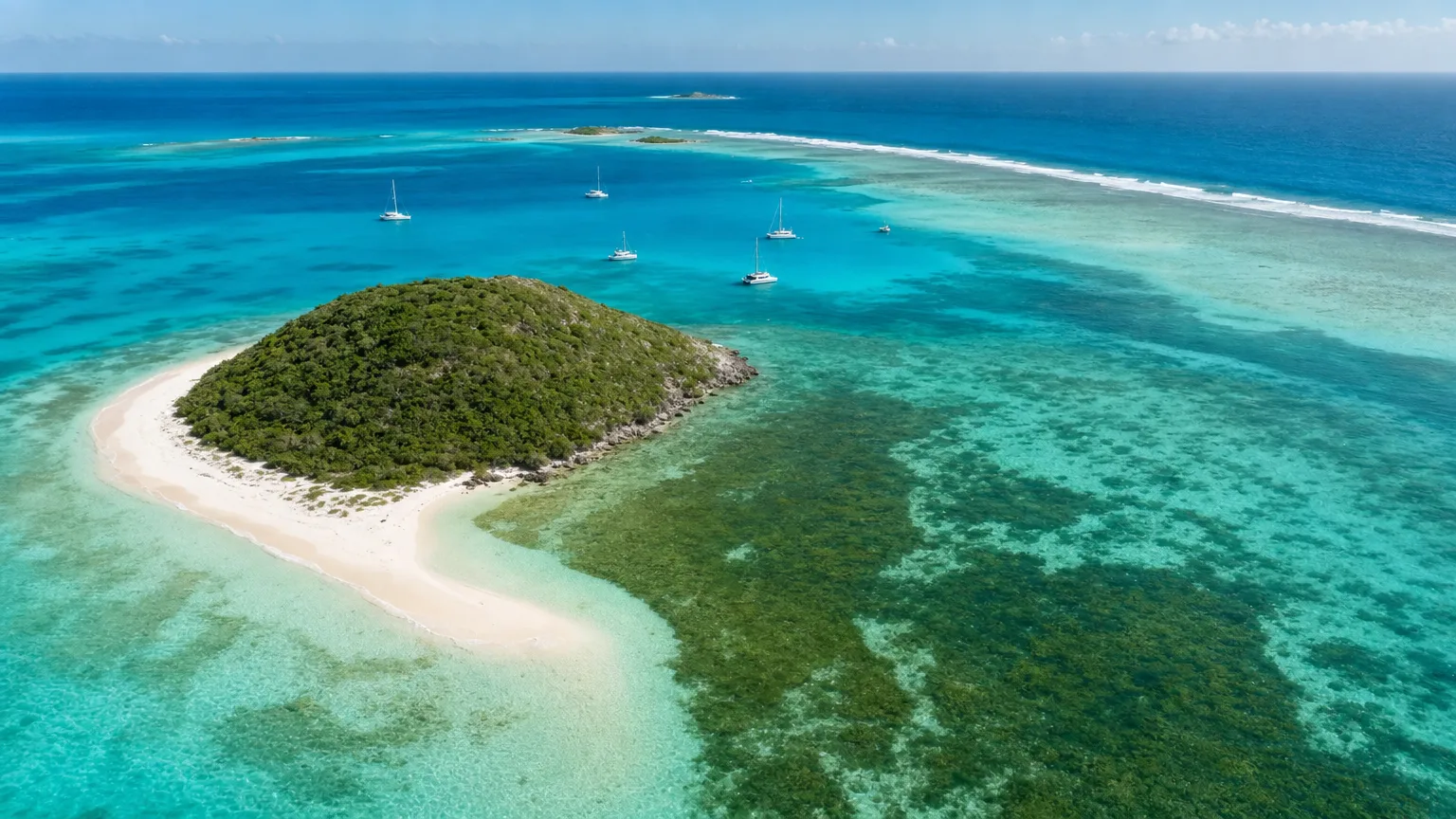
The Tobago Cays are five uninhabited islands in the southern Grenadines island chain, four of them gathered behind a four-kilometer arc of reef. On the sheltered side of one, Baradal, a stretch of shallow seagrass is marked off with buoys, and it is the most dependable place in this part of the Caribbean to get in the water with wild green turtles. What follows is what a crewed yacht charter guest actually finds there in 2026, including the parts that have changed and the part almost nobody gets right.
What Is the Baradal Turtle Sanctuary?
It’s a formally designated zone, not a nickname. The marine park’s own attractions listing names it exactly that way, “Baradal Turtle Sanctuary”, and describes it as a “protected area where green and hawksbill turtles can be observed foraging freely” (Tobago Cays Marine Park). On the park’s zoning map it appears under a slightly different label, “Turtle Watching Reserve,” drawn as a discrete block of water off Baradal’s southern and southwestern shore, distinct from the yacht anchorage zones nearby.
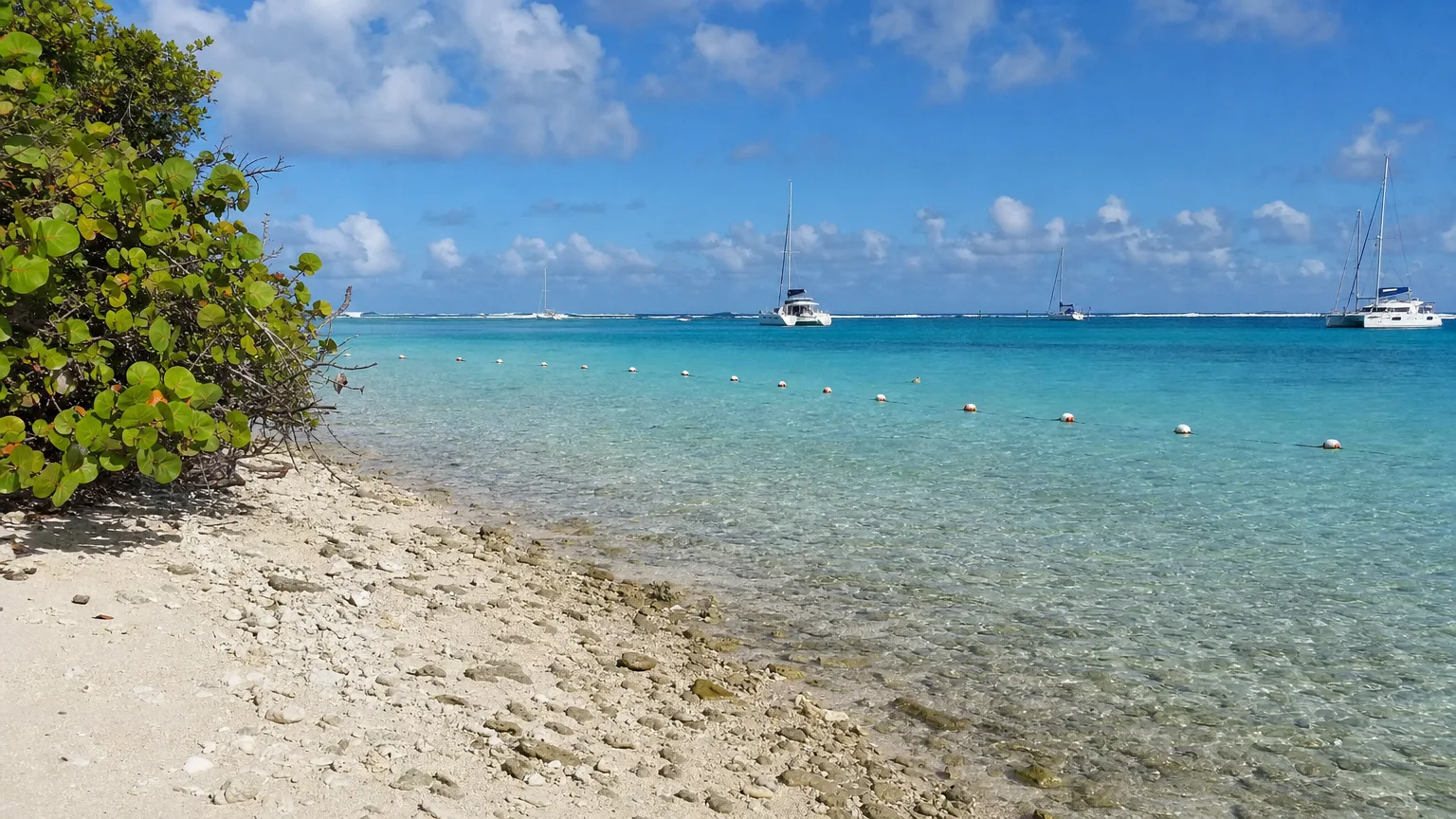
The practical effect is the part a swimmer notices. The zone is marked on the water with buoys, and the moorings and anchorages sit outside its boundary. Doyle Guides, the reference cruising guide for these islands, gives the arrangement from the helm’s point of view: “Do not anchor between the moorings and the turtle-watching area, on reef or seagrass, or at Petit Tabac” (Doyle Guides). A visitor who landed on Baradal by tender in January 2026 described the islet as “protected by buoys,” with catamarans and sailing boats anchored beyond them.
The Baradal Turtle Sanctuary is a designated zone in the Tobago Cays Marine Park, St. Vincent and the Grenadines, off the southern and southwestern shore of Baradal island. Marked with buoys, with the yacht moorings and anchorages outside its boundary, it protects a shallow seagrass meadow grazed by green sea turtles.
Where Are the Tobago Cays?
In St. Vincent and the Grenadines, at roughly 12°38′N, 61°21′W, and not, despite the name, anywhere near Tobago. Trinidad and Tobago is a separate country about 175 kilometers, or 110 miles, to the south. The confusion is common enough that Google’s own “people also ask” panel for the Tobago Cays serves up travel advice for Trinidad. The two have nothing to do with each other beyond the word.
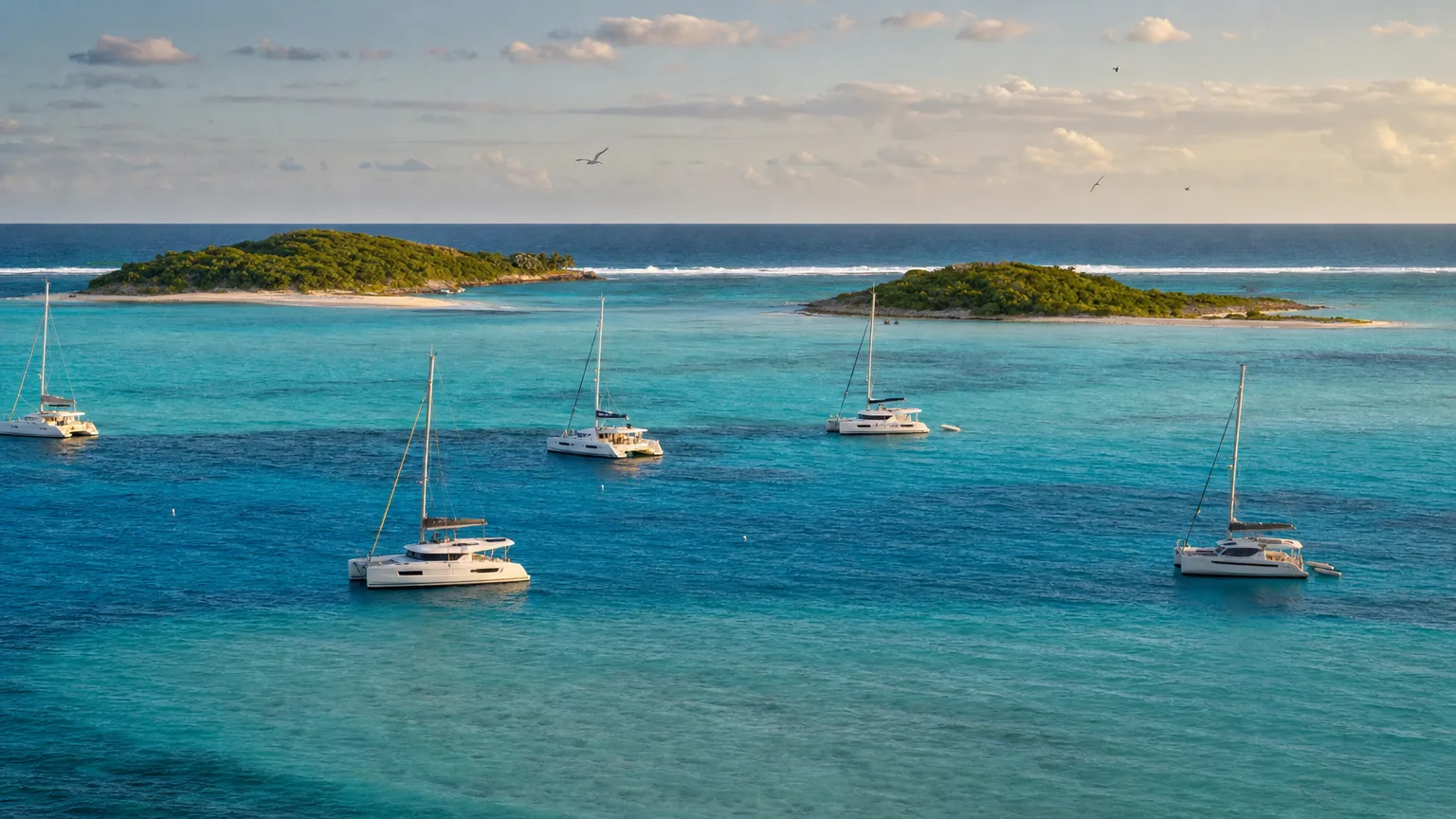
The Cays lie a little east of Mayreau and north of Union Island. There are five: Petit Rameau, Petit Bateau, Baradal, Jamesby and Petit Tabac (Wikipedia). Four of them sit inside Horseshoe Reef, which Dr Lou Luddington describes as “a giant semi-circle that curves around” them (Yachting Monthly). Petit Tabac is the exception, sitting “outside the main lagoon on the windward side of Horseshoe Reef” (Caribbean Compass), exposed to the open Atlantic.
| Cay | Inside Horseshoe Reef? | What it’s known for |
|---|---|---|
| Baradal | Yes | The turtle sanctuary; beach and sand spit |
| Petit Bateau | Yes | Hiking trail, iguanas, beach barbecues |
| Petit Rameau | Yes | Hiking trail, iguanas, sheltered cut |
| Jamesby | Yes | Hiking trail, quiet beach |
| Petit Tabac | No: outside, to the east | The Pirates of the Caribbean marooned-island beach |
How Do You Get to the Tobago Cays?
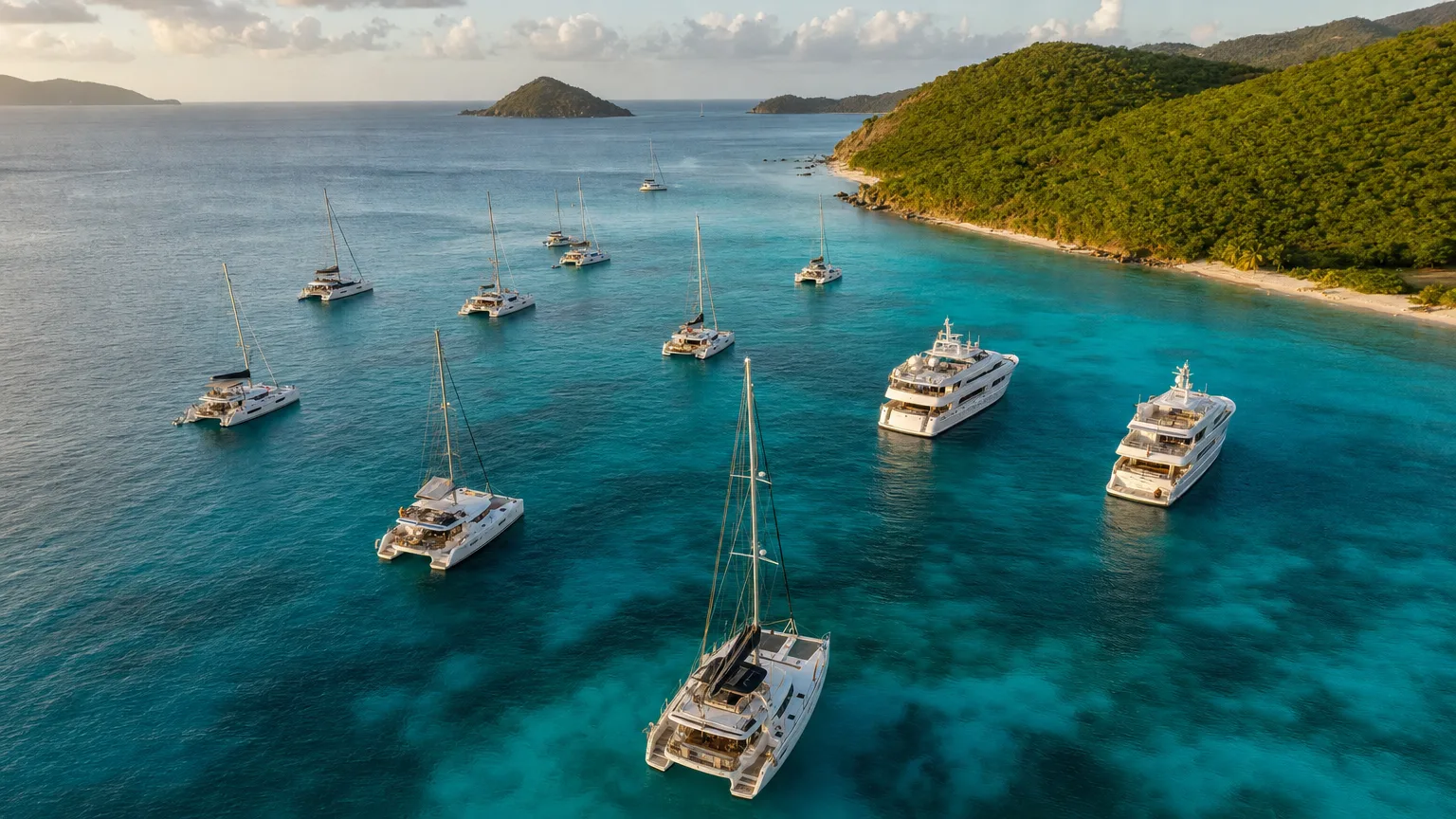
Only by sea. There’s no airport, dock, hotel or road on any of the five cays, and nothing on them to build one for. Visitors arrive by private or charter yacht, by water taxi, or on a day-tour boat, typically running out from Union Island or Mayreau, the two nearest inhabited islands, both within a few miles.
On a crewed charter the Cays arrive the way every other stop does. Your yacht picks up a mooring inside Horseshoe Reef and the tender handles everything after that. Park rangers come out to arriving boats: Luddington’s crew “were greeted by park rangers who took payment of the park entry fee and advised us about park guidelines.” On a crewed charter that exchange happens between the rangers and your crew, so nothing is asked of you.
Will You Actually See Turtles?
Almost certainly: but “guaranteed” is a word worth retiring, and we’ve used it ourselves on our own destination page. Here’s the honest version.
Sightings are reported with striking consistency. A Yachting World crew who visited in early November counted “dozens of turtles, sting rays and eagle rays as well as numerous moray eels, lobsters and tropical fish” (Yachting World). Public trip reports from December 2025, January 2026 and February 2026 all describe turtles, one of them spotted from the sand without getting in at all.
The qualification comes from the best-credentialed observer in the record. Dr Lou Luddington, a marine biologist, snorkeled the sanctuary in October and wrote that “although we saw several turtles from the boat on arrival, underwater they seemed rather aloof. A single green turtle treated us to a swift fly-by before disappearing out of sight.”
That’s the distinction no marketing copy makes. Seeing turtles is close to certain. A long, unhurried, close-quarters encounter is likely but not promised. They’re wild animals on a feeding ground, and some days they don’t want company.
Across the dated accounts of the Baradal Turtle Sanctuary we could find, from visitor trip reports to two published cruising features, none describes failing to see green turtles, though people who see nothing are also the least likely to write it up. A marine biologist snorkeling the site in October saw several from the boat and one underwater.
Which Turtles Are Actually Grazing There?
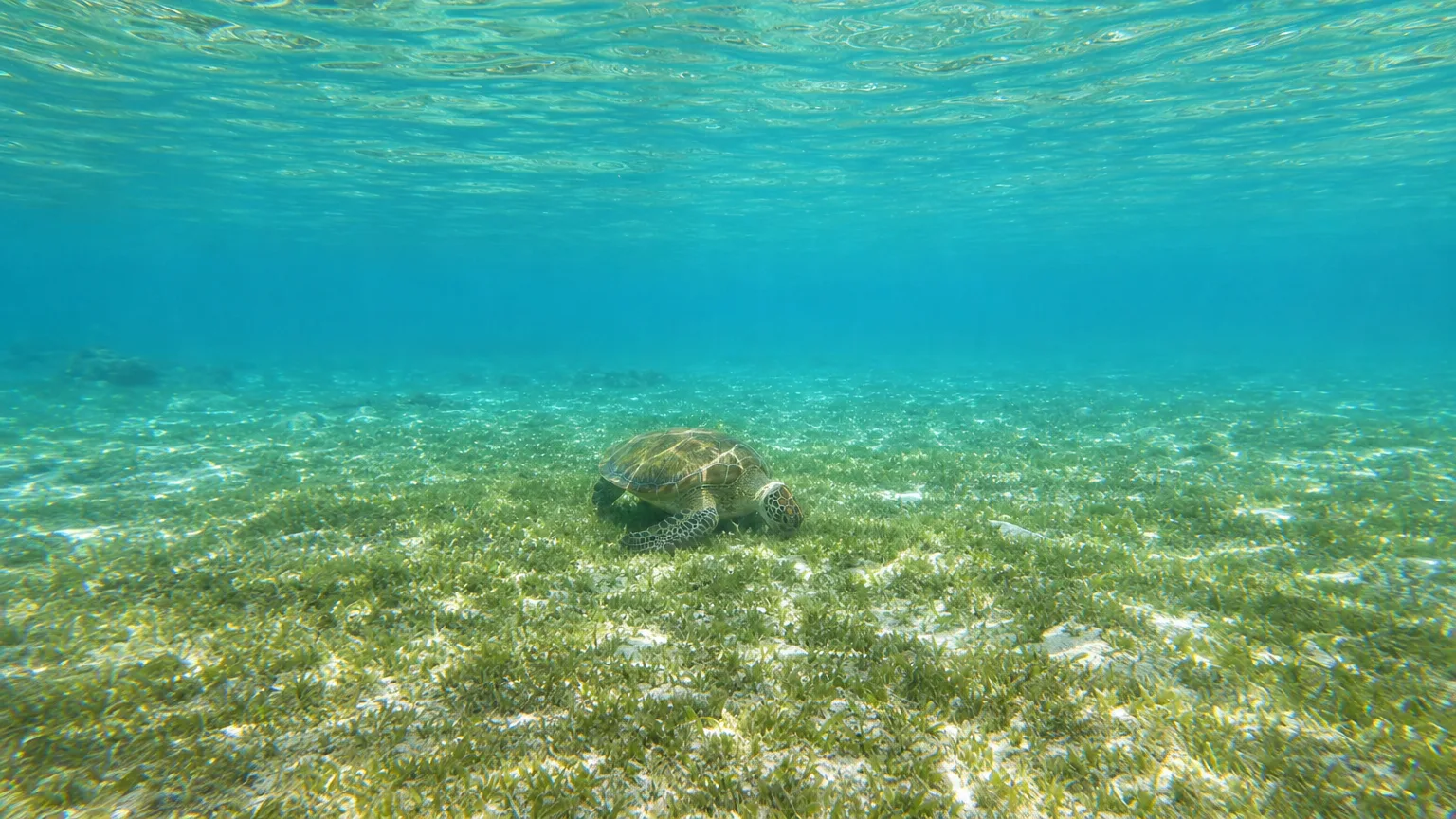
Green turtles, and mostly young ones. Reporting on the park’s anchoring changes, Caribbean Compass noted that cruisers are asked to avoid anchoring in the seagrass, which is home to an aggregation of juvenile green sea turtles that feed and grow in the park before making their way towards breeding areas. Luddington describes the site as “a feeding ground for green turtles and stingrays.” It functions as a nursery, animals spending their growing years on a good patch of grass before heading elsewhere to breed.
The park’s own listing mentions green and hawksbill turtles together, and most published descriptions repeat it. The two species do different jobs, though. Green turtles are “the only herbivorous species of sea turtle” (NOAA Fisheries); hawksbills eat mainly sponges and are reef animals. Hawksbills are genuinely present in the marine park, but the animal you’ll watch crop the grass off Baradal is a green turtle, near-certainly a young one.
Green sea turtles, not hawksbills, graze the seagrass off Baradal. NOAA Fisheries describes green turtles as the only herbivorous sea turtle species; hawksbills feed mainly on sponges and associate with coral reefs. The Tobago Cays Marine Park lists both species together, but the animal in the seagrass meadow is almost always a juvenile green turtle.
One honest gap. A sea turtle assessment was carried out at the park in 2010 and submitted to the OECS as a 35-page report, and the park’s planners list “good baseline data from sea turtle monitoring” among its strengths, with continued monitoring written into the plan for 2013 through 2015 (CERMES, University of the West Indies). We could find no population figure or tagging total in public circulation. If you see a specific number of turtles quoted for Baradal online, treat it with suspicion. We chased several and none traced back to a real source.
How Do You Snorkel the Tobago Cays Turtle Sanctuary?
Most guests go ashore by tender and walk in from the beach at Baradal’s southern tip. You can also swim across from a boat anchored outside the buoys, which is what Luddington did: “jumping off the side of the boat we swam towards Baradal island and the turtle sanctuary.”
Two practical things nobody photographs. The water’s edge at Baradal isn’t the powder you’re expecting. A January 2026 visitor, in a review translated from French, described the entry as “dotted with small debris of corals and shells, making the first contact a little uncomfortable,” with fine sand a few steps further in. Reef shoes solve it, and they’re worth having in the tender.
The second is depth. Turtles graze and rest in roughly two to four metres of water, and the site bottoms out around five (Snorkeling Report, last updated 2022). You’re snorkeling, not diving. A mask and fins are all it takes.
Visitors consistently describe clear water, one November account put visibility at fifteen feet or better, and the seagrass makes turtles easy to pick out from the surface as dark shapes against pale sand. Whether one stays put while you watch is the part nobody controls.
What Rules Apply in the Turtle Sanctuary?
The Tobago Cays Marine Park publishes a full set of visitor regulations, and not one of them mentions turtles. That surprised us enough to read the whole list twice, and it’s the most useful thing we found for this piece.
The rules cover coral: “corals are fragile and grow slowly. While snorkelling or diving, do not touch the corals”, along with buoyancy control, a prohibition on taking “any corals or other marine life,” a ban on anchoring “in coral or sea grass beds,” a five-knot speed limit, no fishing, no littering, no bilge discharge, and a requirement that scuba divers be accompanied by a registered local operator (Tobago Cays Marine Park).
The park does write species-specific disturbance rules. One of its regulations reads “do not disturb nesting or roosting seabirds.” There is no equivalent for turtles, no minimum approach distance, no instruction not to touch one, no prohibition on feeding them, and no requirement for a snorkeler to take a guide. The general ban on taking “any corals or other marine life” would cover removing a turtle, but it says nothing about how close you may swim to one.
The familiar etiquette you’ll read elsewhere (keep a few metres back, never touch or ride, don’t chase one that’s swimming away) is best practice published by snorkeling specialists and conservation groups, not marine park law. Rangers do meet arriving boats and advise them about park guidelines, which is where the operational version gets communicated.
The Tobago Cays Marine Park’s published visitor regulations contain no turtle-specific rule, no approach distance, no no-touch clause, no feeding prohibition. They do include a species-specific rule for seabirds. Standard turtle etiquette circulating online is best practice from snorkeling and conservation sources, not park regulation, though rangers advise arriving boats in person.
The gap shows. The most recent TripAdvisor account we found, from a February 2026 visit, mentions cheerfully that the turtles are “so friendly” and that the writer “even got to touch one.” That’s someone having a lovely day and breaking no published rule. It isn’t a new problem either: the park’s own strategic planning document, prepared by the University of the West Indies, lists among the threats to the park a “lack of compliance with regulations for protection of endangered species, especially disturbance of sea turtles by visitors.”
Is Horseshoe Reef Still Worth Snorkeling After Beryl?
Yes: but it no longer looks like the older photographs. Hurricane Beryl crossed this part of the Grenadines on 1 July 2024, and Horseshoe Reef took structural damage. Luddington, snorkeling it a year on, found “huge three-dimensional structures toppled and split apart,” and wrote that “the stone trunks of elkhorn coral spoke of former glory, its branches lying felled.”
Her verdict on the same swim is the one we’d repeat to a guest: “even in its hurricane-damaged state, the reef was a wonder to behold.” The living reef is very much there, and accounts from the same period describe abundant fish. What’s gone is some of the tall architecture that made the older pictures spectacular, and reef structure of that kind returns over decades rather than seasons.
One consequence reaches you on the boat rather than in the water. Cruisers report that the reduced reef blocks less swell, and Yachting World was told to expect slightly uncomfortable conditions at high tide, though on their own visit, in a steady 15 to 20 knots of wind, they found chop but “nothing that would chase us out of the anchorage.” If you’re planning a charter in storm season generally, our guide to chartering during Caribbean hurricane season covers how the calendar actually works.
Everything else is running. Luddington’s October visit confirms rangers, fees, moorings and the beach barbecues all operating, and Doyle Guides reports “all previous services fully operational, including the [beach] BBQs, TCMP mooring system, and boat vendors” (Doyle Guides), from information gathered in early 2025.
What’s on the Other Four Tobago Cays?
Baradal is the turtle stop; the other four are a day’s worth of other things. Petit Bateau, Petit Rameau and Jamesby all have short hiking trails, and all three have iguanas, sizeable ones, which reliably startle people who weren’t expecting a lizard the length of their arm. In our experience the walks are a matter of minutes rather than a hike, and the view back over the lagoon from any of them explains the place better than a photograph does.
Petit Tabac: The Pirates of the Caribbean Beach
Petit Tabac is the outlier, and the one with a following. It sits outside Horseshoe Reef to the east, and it’s where Jack Sparrow and Elizabeth Swann were marooned in Pirates of the Caribbean: The Curse of the Black Pearl, a fact the marine park itself confirms. If you’re building a week around filming locations, our guide to set-jetting the Caribbean by yacht covers how Petit Tabac connects to the Pirates sets on St. Vincent.
Anchoring at Petit Tabac is now banned outright. Anchors did significant damage to the corals there, and the park closed the area to anchoring in response, with dinghy moorings going in instead (Caribbean Compass). You reach it by tender.
Who Owns the Tobago Cays?
The government of St. Vincent and the Grenadines, and the story of how is better than you’d expect. The Cays were privately owned. In 1999 the state bought them for US$1,025,000: a figure the marine park describes as “well below market value, with the stipulation that it would remain a national park in perpetuity” (Tobago Cays Marine Park).
The protection came in stages. The Fisheries Division designated the Cays a conservation area in 1987. The Marine Parks Act of 1997 made them a marine park with a governing board, and regulations followed in 1998. The purchase came in 1999, and in 2006 the park relaunched in its present operating form, with a user-fee system and gazetted boundaries; its management plan was endorsed by Cabinet in early 2007.
St. Vincent and the Grenadines purchased the Tobago Cays from private ownership in 1999 for US$1,025,000, described by the marine park as well below market value and conditional on the islands remaining a national park in perpetuity. Protection began in 1987 as a fisheries conservation area and became a marine park under the Marine Parks Act of 1997.
It’s an unusual thing for a small state to have done, and it’s why five uninhabited islands in prime Caribbean water have no resort on them. Whatever the Cays look like in fifty years, they won’t look like that.
When Is the Best Time to Visit the Tobago Cays?
Mornings, and outside February if you have the choice. The turtles live on that grass rather than migrating through, so no account we found, in any month, describes an empty meadow. We found no credible source establishing a best season or a best time of day for sightings specifically.
Crowding is a different matter, and the contrast is stark. Luddington’s October visit found the lagoon nearly empty, “instead of being one of 80 plus boats in the marine park, as our friends experienced in February, we felt like we had the place to ourselves.” By early November, though, a Yachting World crew found anchorages “already fairly crowded.” The Grenadines high season runs December through April and peaks in February.
Within a day, earlier is better. It’s cooler, the light on the lagoon is better, and in our experience the mooring field fills as the afternoon goes on. For how the Grenadines season compares with the rest of the region, see our month-by-month guide to the best time to charter a yacht in the Caribbean, or our roundup of quieter Caribbean anchorages.
| Period | Anchorage | Notes |
|---|---|---|
| December-April | Busy, peaking in February | High season; best weather; book the week early |
| May-June | Quieter | Shoulder; still settled conditions |
| October | Very quiet | A boat can have the lagoon nearly to itself |
| November | Filling up | One crew found anchorages “already fairly crowded” in early November |
Where Baradal Fits in a Grenadines Week
In the water-focused back half, alongside Mayreau. The standard southbound run goes St. Vincent, Bequia, Mustique, Canouan, Mayreau and the Tobago Cays, which puts the Cays near the end, by which point everyone has found their sea legs and the itinerary has shifted from towns and bars to reef and sand. Our St. Vincent and the Grenadines charter routes guide lays out the sequence, and the seven-day Grenadines itinerary puts day numbers on it.
The Cays pair naturally with Salt Whistle Bay on Mayreau, under three nautical miles west, and the two divide the work neatly: Salt Whistle is the swimming-and-lounging anchorage, the Cays are where the mask comes out. South of both, Happy Island in Clifton Harbour and the sandbar at Mopion finish the chain. Earlier in the week you’ll have had Jack’s Beach Bar on Bequia and Basil’s Bar on Mustique.
In our experience most itineraries give the Cays a full day, and many add an overnight, waking up inside the reef with nothing but surf between you and the Atlantic is one of the better mornings in the Caribbean. If the swell is running, your captain may prefer a day stop and a quieter night elsewhere, which is a call best left to the person watching the forecast.
One Other Turtle Site Worth Knowing
If snorkeling with turtles is what you’re planning around, the Caribbean has one other site in the same class, Buck Island Reef off St. Croix, a US national monument with a marked underwater trail. It’s the better-regulated of the two. See our answer to: What is the typical weather like for a Caribbean yacht charter? The Grenadines version sits in the middle of a week’s cruising ground rather than at the end of a day trip, which is the real difference for a charter guest.
Baradal is a small island with a patch of grass beside it, and few stops we book generate more photographs. If a week in the southern Grenadines appeals, start a yacht search at Vital Charters and we’ll build the run that has you in that water on a still morning, before the moorings fill.
Frequently Asked Questions
Are the Tobago Cays in Tobago?
No. The Tobago Cays are in St. Vincent and the Grenadines, in the eastern Caribbean, about 175 kilometers, roughly 110 miles, north of Tobago. They are two entirely separate countries, and the shared word is a coincidence of naming. Search engines confuse the two regularly, so travel advice you find for “Tobago” may have nothing to do with these islands.
Can you swim with turtles at the Tobago Cays?
Yes. A buoy-marked sanctuary off the southern shore of Baradal island protects a seagrass meadow that green turtles graze, with the yacht moorings and anchorages outside it. Most snorkelers enter from the small beach at Baradal’s southern tip and swim out; you can also swim across from a boat anchored beyond the buoys. The water is shallow, roughly two to four metres where the turtles feed, so a mask and fins are all you need.
Are turtle sightings at Baradal guaranteed?
Close to it, but nobody can promise a wild animal. Across the dated accounts we could find, none describes failing to see turtles, though people who see nothing rarely write it up. Marine biologist Dr Lou Luddington, writing in Yachting Monthly, snorkeled the site in October and saw several turtles from the boat but only one underwater. Expect to see turtles; treat a long close encounter as a good day rather than a certainty.
Is it safe to touch a sea turtle at Baradal?
Don’t. The marine park’s published regulations don’t actually contain a no-touch rule for turtles (a genuine gap, given they do carry one for nesting seabirds) but touching, chasing or riding a sea turtle harms the animal and is discouraged everywhere responsible snorkeling is practised. The park’s own management planning flags visitor disturbance of sea turtles as a compliance problem. Keeping a few metres back also gets you a longer look, because an undisturbed turtle keeps grazing.
Who owns the Tobago Cays?
The government of St. Vincent and the Grenadines, which bought the islands from private owners in 1999 for US$1,025,000 on condition they remain a national park in perpetuity.
Did Hurricane Beryl destroy the Tobago Cays?
No, though it changed the reef. Beryl crossed the southern Grenadines on 1 July 2024 and caused structural damage to Horseshoe Reef, with toppled coral formations reported by observers since. The marine park is open, the turtles are still grazing, rangers are working, and moorings, boat vendors and beach barbecues are all operating. The main practical effect for visitors is a slightly livelier anchorage, because a lower reef blocks less swell.
Do you need a guide to snorkel the turtle sanctuary?
No. The park requires registered dive operators to accompany scuba divers, but there’s no equivalent requirement for snorkelers. On a crewed charter the crew will typically brief you and often come in with you, which is the more useful arrangement anyway.
How long should a charter spend at the Tobago Cays?
A full day is typical and an overnight is common. That gives you time for the turtle sanctuary, a separate snorkel on the reef, a walk on one of the other cays, and a beach barbecue in the evening. Whether your yacht stays the night depends on conditions, since the anchorage can be livelier at high tide than it was before Beryl reduced the reef.
Green turtles, on their own terms
A buoyed seagrass meadow off Baradal, reached by tender from a boat already anchored in the park, and every dated account we found reports turtles grazing there. Tell us your group size and dates and we’ll build the Grenadines week that gets you in the water on a calm morning.