
Buck Island Reef: Best of the US Virgin Islands
Buck Island Reef is a 19,015-acre national monument off St. Croix, with a marked underwater snorkel trail through an elkhorn barrier reef. How to visit by boat.
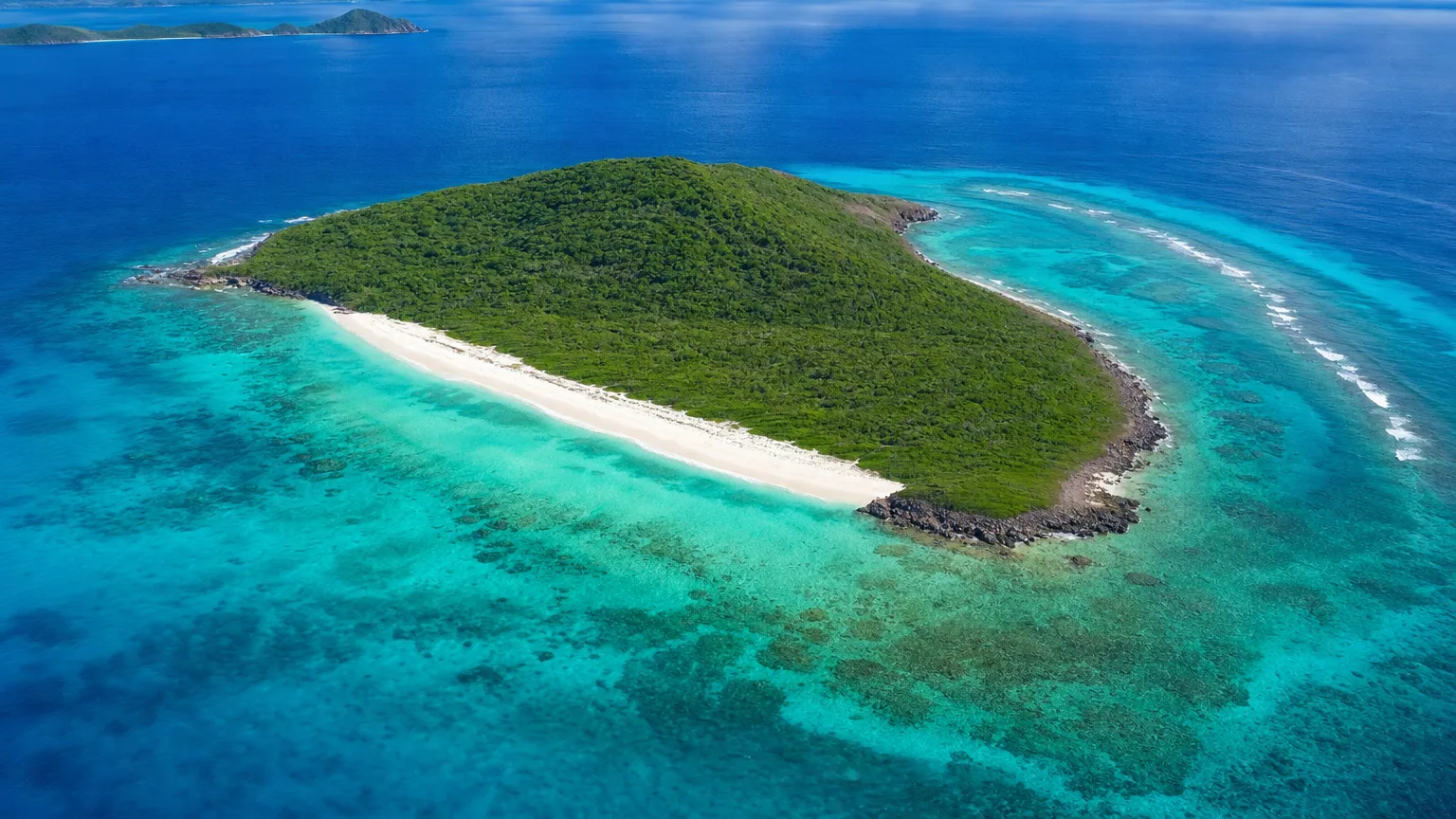
Buck Island Reef is a US Virgin Islands national monument off St. Croix: 176 acres of uninhabited island wrapped by an elkhorn coral barrier reef and one of the few marked underwater snorkel trails in the U.S. National Park System. It’s the rare Caribbean attraction where the best part is entirely below the surface, and reaching it means a boat and a plan, not a rental car.
What Is Buck Island Reef?
Buck Island Reef National Monument protects 19,015 acres of island and sea off St. Croix, managed by the National Park Service (NPS). The island itself is only 176 acres and uninhabited, the overwhelming majority of the monument is the reef and submerged lands around it, which is exactly the point: this is a park built to protect what’s underwater.
It’s one of the oldest marine protected areas in the park system. President John F. Kennedy proclaimed Buck Island a national monument in 1961, protecting 880 acres of island, barrier reef, and lagoon; President Bill Clinton expanded it in 2001 to its current 19,015 acres, adding roughly 18,135 acres of surrounding marine habitat (Presidential Proclamation 7392). That expansion is why nearly the whole monument today is open water.
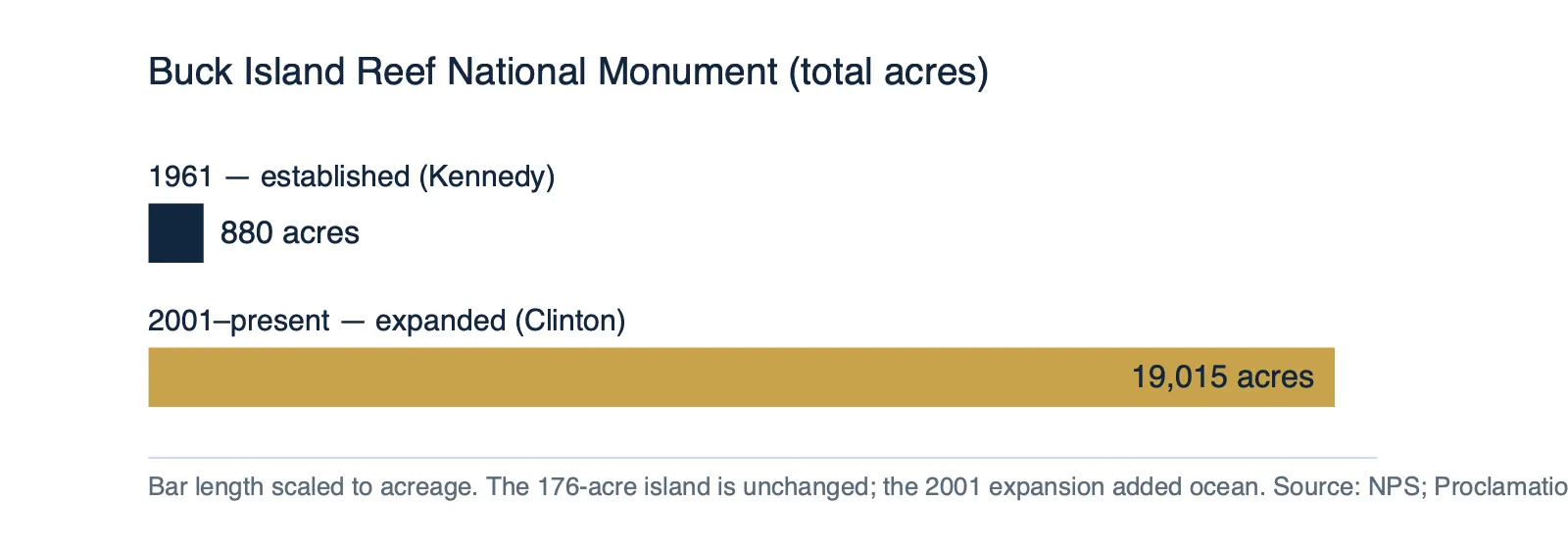
View data table
| Year | Action | Monument size |
|---|---|---|
| 1961 | Established by President Kennedy (Proc. 3443) | 880 acres |
| 2001 | Expanded by President Clinton (Proc. 7392) | 19,015 acres |
The uninhabited island stays 176 acres throughout; the 2001 expansion added roughly 18,135 acres of surrounding marine habitat. Source: NPS; Presidential Proclamation 7392.
Buck Island Reef National Monument is a 19,015-acre National Park Service site off St. Croix in the US Virgin Islands. The uninhabited island covers just 176 acres; the rest is protected reef and open water. First established in 1961 and expanded in 2001, it safeguards one of the Caribbean’s most intact elkhorn barrier reefs (NPS; Proclamation 7392).
Where Is Buck Island: and Why Most USVI Charters Miss It?
Buck Island lies about 1.5 miles off the northeast coast of St. Croix, and access is by boat only: authorized day trips depart from Christiansted, St. Croix’s main town (NPS). There’s no bridge and no scheduled ferry to the island itself.
Here’s the part worth understanding before you plan around it: St. Croix sits roughly 40 miles of open water south of St. Thomas and St. John, across the deep Virgin Islands Trough. The territory’s two northern islands are only a few miles apart, but St. Croix is a genuine offshore crossing away: which is why most crewed itineraries built around US Virgin Islands charter destinations stay north: around the calm sand of Magens Bay and the boat-in tables at Lime Out and Pizza Pi, and skip it. Buck Island isn’t a detour off a St. Thomas week; it’s the reason to give St. Croix its own leg.
Buck Island sits about 1.5 miles off the northeast tip of St. Croix, reached only by boat from Christiansted (NPS). St. Croix itself lies roughly 40 miles of open water south of St. Thomas and St. John, so Buck Island is a St. Croix experience: not a quick add-on to a northern USVI charter.
What Is the Underwater Snorkel Trail?
Buck Island’s signature feature is a marked underwater interpretive snorkel trail on the island’s east end, threading through the elkhorn coral barrier reef, one of the few marked underwater trails in the U.S. National Park System (NPS). You follow the route with underwater signs that point out what you’re swimming over.
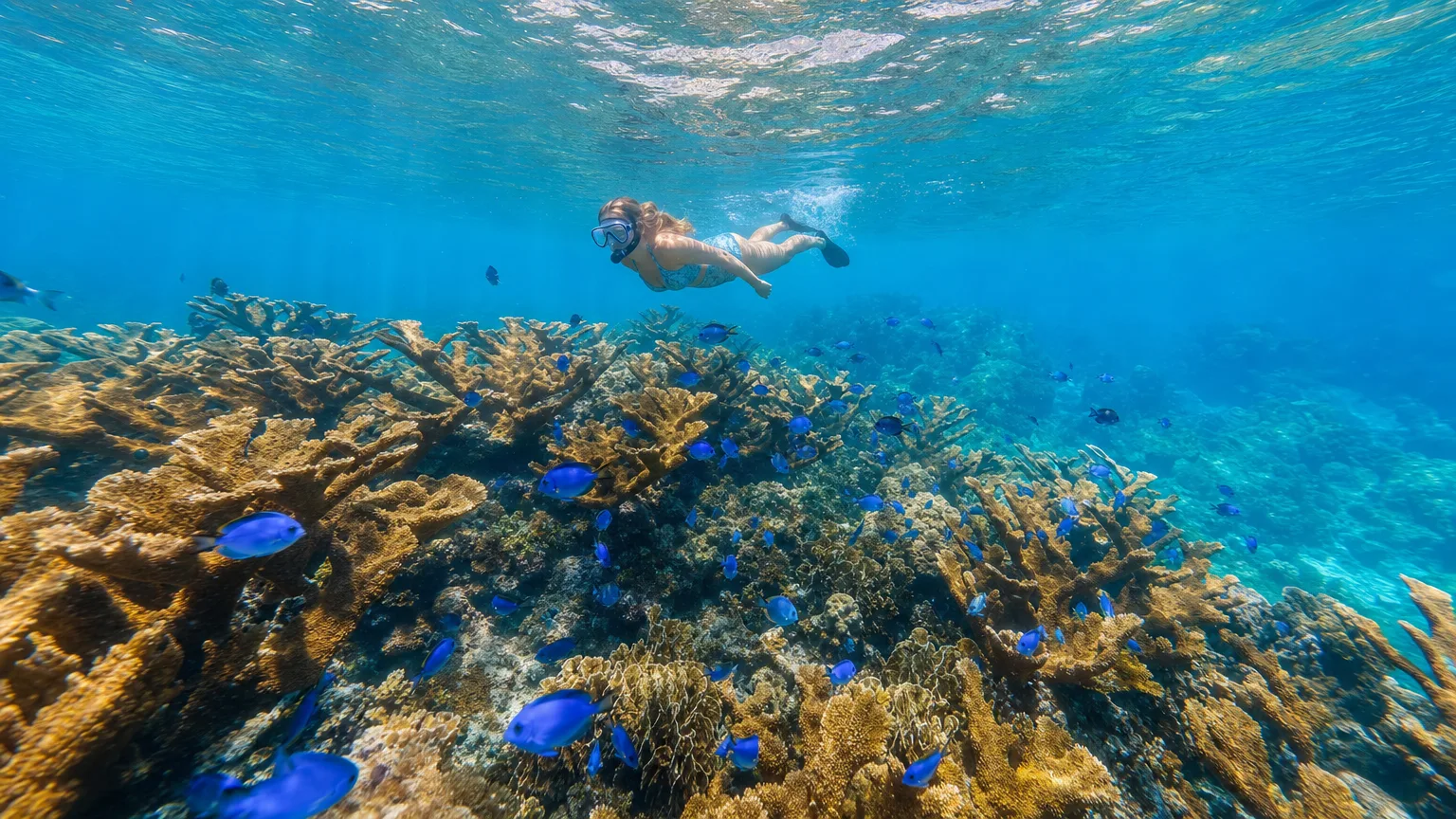
The trail crosses shallow coral heads and passes through a grotto where schools of Atlantic blue tang gather, with sea turtles, elkhorn stands, and brain corals along the way (NPS). Federal law bans anchoring or maneuvering any vessel in the waters containing the marked trail and its interpretive signs. See our answer to: Where can you swim with sea turtles in the Caribbean? The trail is a protected swim-only zone, so you enter it from the water, not from a boat parked on top of it.
Buck Island Reef’s underwater snorkel trail is a marked interpretive route through an elkhorn coral barrier reef on the island’s east end, one of the few marked underwater trails in the U.S. National Park System. Snorkelers follow underwater signs past coral heads, a blue-tang grotto, and sea turtles; boats are barred from the trail waters entirely (NPS).
What Lives on the Reef?
The reef that fringes Buck Island’s east side is an elkhorn coral (Acropora palmata) barrier reef, which the National Park Service describes as one of the most pristine of its kind in the Caribbean and unique within U.S. waters (NPS). Elkhorn is the coral that builds the wave-breaking reef crest, and it’s a threatened species that USGS scientists actively monitor at Buck Island (USGS): part of why the whole reserve is so tightly protected.
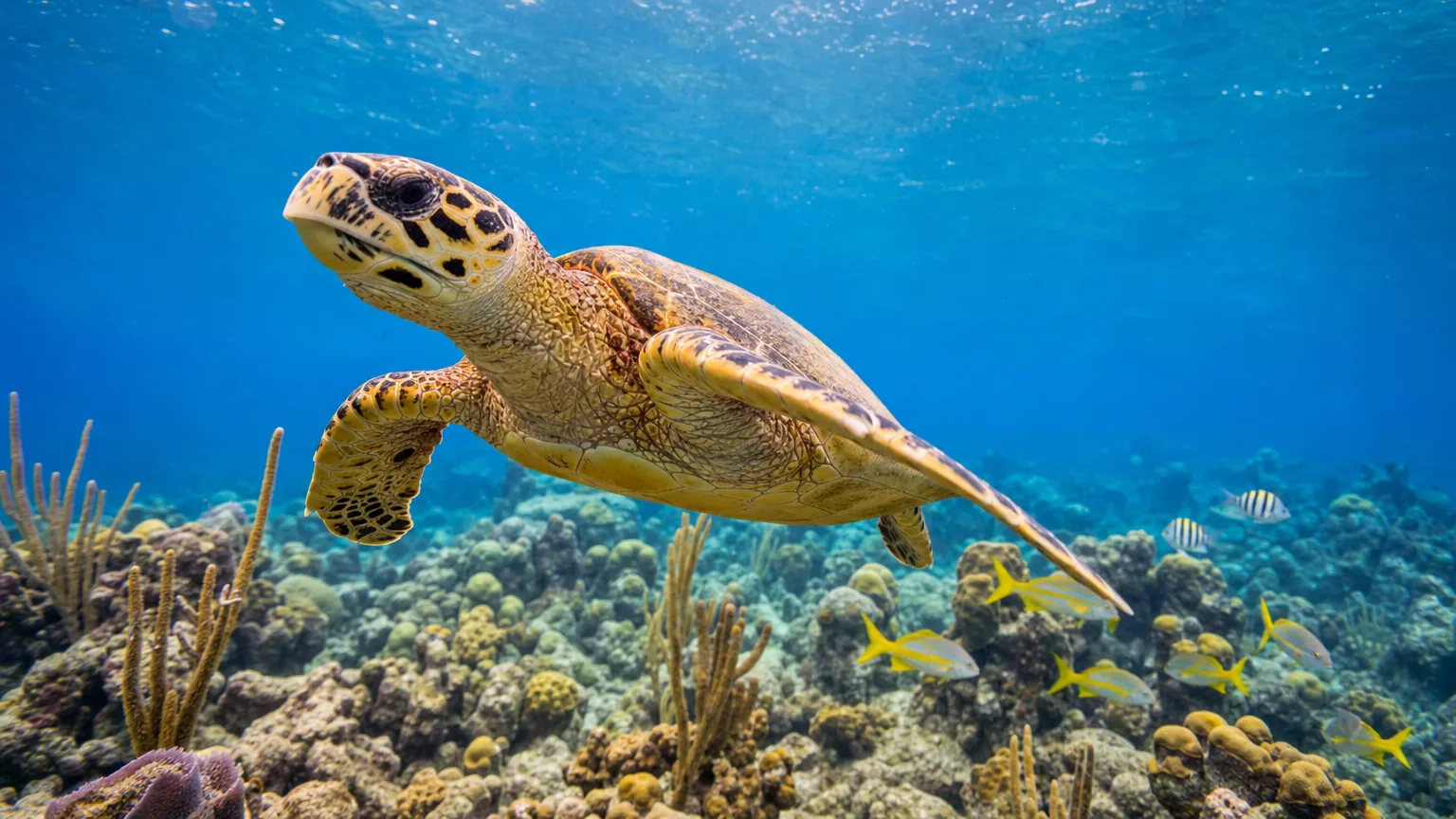
Above and around the reef, the monument is a wildlife stronghold. Buck Island holds the most important concentration of nesting hawksbill sea turtles left in the Virgin Islands, along with nesting green turtles, endangered brown pelicans, and threatened least terns (NPS). The entire monument is a no-take marine reserve (no fishing of any kind and no collecting of coral, shells, or sea life) which is a large part of why the ecosystem is still this healthy.
Buck Island’s barrier reef is built from threatened elkhorn coral and, per the National Park Service, is one of the most pristine in the Caribbean. The island holds the largest remaining hawksbill turtle nesting concentration in the US Virgin Islands, plus green turtles and nesting seabirds. The whole monument is a no-take reserve: no fishing or collecting (NPS).
What Can You Do on the Island?
Ashore, the draw is West Beach: the island’s main landing, swimming, and picnicking beach, and the one designated spot where boats may anchor (NPS). It’s a quiet stretch of sand on an uninhabited island, backed by recovering subtropical dry forest.
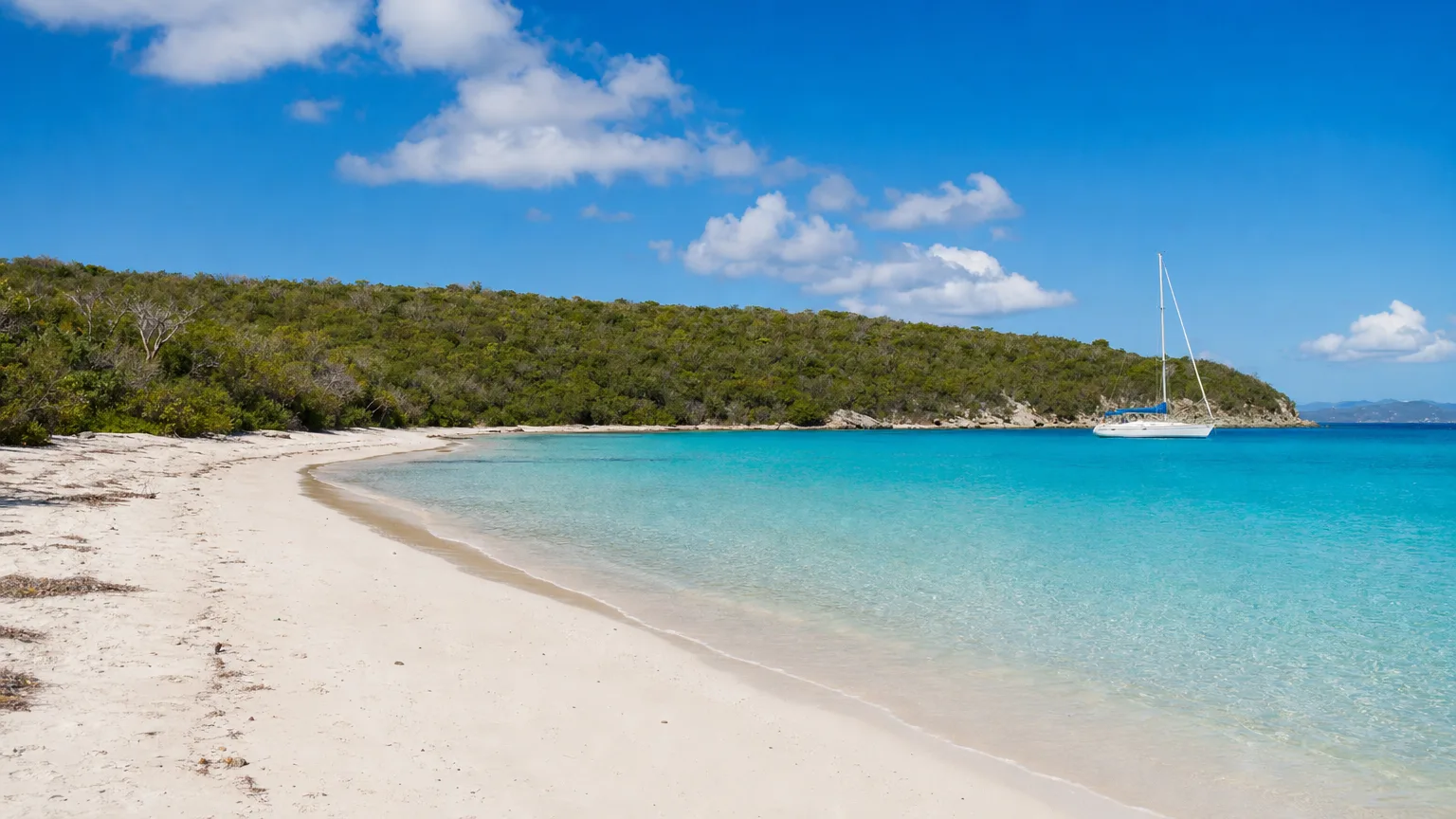
For anyone who wants to stretch their legs, the Buck Island Trail runs about 1.8 miles across the island, crossing it in roughly 45 minutes, with a side path to an overlook platform that gives you a panoramic view down onto the barrier reef (NPS). One caution the park stresses: the poisonous manchineel tree grows on the island, so don’t touch it or shelter under it in the rain.
How Do You Visit Buck Island Reef by Boat?
Buck Island is a strictly protected, day-use-only marine reserve, open roughly 7 a.m. to 5 p.m. with no overnight anchoring (NPS). Vessels may anchor only in one designated area off the island’s west end, never on the reef and never in the marked underwater-trail waters, both of which are off-limits to boats by federal law.
The access rules changed recently, so this is one to confirm before you go: in January 2025 the National Park Service suspended the anchoring-permit requirement, allowing permit-free anchoring in that designated west-side spot while updated procedures were being finalized (NPS). Always check the current conditions on the park’s site before building a visit around it.
The monument’s rules at a glance:
- Day-use only, roughly 7 a.m. to 5 p.m., no overnight anchoring.
- Anchor only in the one designated area off the west end: never on the reef or in the marked snorkel-trail waters.
- No-take reserve: no fishing of any kind and no collecting of coral, shells, or sea life.
- Confirm current rules with the park before you go; the anchoring-permit requirement was suspended in January 2025.
On the water, there are two realistic ways charter guests reach it:
- On a St. Croix-based crewed charter: your crew plans a day at Buck Island directly, anchors off West Beach within the day-use window, and tenders you to the reef.
- On an authorized day trip from Christiansted: how many visitors do it: you sail or stay on St. Croix and join a National Park-authorized boat out to the monument.
Either way, the honest version is the same: Buck Island rewards giving St. Croix its own time, rather than trying to bolt it onto a week up north around the top US Virgin Islands to visit by yacht.
Buck Island Reef is a day-use-only, no-take marine reserve open roughly 7 a.m. to 5 p.m. Boats may anchor only in one designated area off the west end, never on the reef or in the marked snorkel-trail waters. The Park Service suspended the anchoring-permit requirement in January 2025; confirm current rules before visiting (NPS).
When Is the Best Time to Visit?
The best months to visit Buck Island are December through April, the Caribbean’s drier, calmer charter high season. The monument is open year-round for day use, but conditions there are genuinely weather-dependent: the National Park Service cautions that conditions and currents can change quickly and tells snorkelers to know their limits (NPS). The reef trail runs along the exposed, windward east side of the island, so it’s more affected by wind and swell than a sheltered bay would be.
The practical planning note for any Virgin Islands trip is the calendar: the Atlantic hurricane season runs June 1 to November 30 (NOAA), and the Caribbean charter high season falls in the drier, calmer December-to-April stretch. Those winter and early-spring months are when the water is most likely to cooperate on the windward reef, and when you’d most want to be sailing anyway.
Pair it with the wider run of Caribbean crewed charter destinations, and if you’re weighing which territory to sail, our take on how a USVI charter compares to the BVI is a useful starting point. When you’re ready to plan a St. Croix leg around Buck Island, start a yacht search at Vital Charters, or tell our brokers you want the reef on the route. And if diving is what drives the trip, see how the reef compares with the Caribbean’s best dive sites.
Frequently Asked Questions
What is Buck Island Reef?
Buck Island Reef is a 19,015-acre National Park Service national monument off the northeast coast of St. Croix in the US Virgin Islands. The uninhabited island is 176 acres; the rest is protected reef and open water. Its signature feature is a marked underwater snorkel trail through an elkhorn coral barrier reef.
Where is Buck Island in the US Virgin Islands?
Buck Island lies about 1.5 miles off the northeast coast of St. Croix, reached only by boat from Christiansted. St. Croix sits roughly 40 miles of open water south of St. Thomas and St. John, so Buck Island is a St. Croix destination rather than a stop on a northern USVI charter week.
Can you visit Buck Island Reef by private boat or yacht?
Yes, during day-use hours of roughly 7 a.m. to 5 p.m. Vessels may anchor only in one designated area off the island’s west end, never on the reef or in the marked snorkel-trail waters. The National Park Service suspended the anchoring-permit requirement in January 2025, so confirm the current rules on the park’s website before you go. Overnight anchoring is not allowed.
What makes the Buck Island snorkel trail special?
It’s a marked underwater interpretive trail: one of the few in the U.S. National Park System: that guides snorkelers through an elkhorn coral barrier reef with underwater signs. The route passes coral heads, a grotto full of Atlantic blue tang, and sea turtles, over one of the most pristine barrier reefs in the Caribbean.
Can you fish or collect shells at Buck Island Reef?
No. The entire monument is a no-take marine reserve under federal law. All fishing is prohibited, and so is collecting coral, shells, sea life, or any natural or cultural feature. Those protections are a major reason the reef and its turtle populations remain so healthy.
Do you need a permit to anchor at Buck Island?
As of January 2025, no. The National Park Service suspended the anchoring-permit requirement and now allows permit-free anchoring in one designated area off the island’s west end, with updated procedures pending. Because the rule changed recently, confirm the current requirements on the park’s website before you go.
Is Buck Island the same as the Buck Island near St. Thomas?
No. There are two Buck Islands in the US Virgin Islands. This one (Buck Island Reef National Monument, with the 176-acre island and the underwater snorkel trail) is off St. Croix. A separate, smaller Buck Island sits off St. Thomas. The famous reef and snorkel trail are the St. Croix monument.
The USVI’s underwater monument, reached by boat
Buck Island Reef is a protected, day-use-only marine reserve off St. Croix: a marked snorkel trail through an elkhorn barrier reef. On a St. Croix charter the crew anchors off West Beach and tenders you to the reef.