
St. Barts Yacht Charter: A Broker’s 7-Day Itinerary & 2026 Costs
A broker’s 7-day St. Barts yacht charter itinerary with 2026 costs. Crewed weeks run $27,000 to $180,000 all in, and New Year’s books 12 to 16 months out.
Last Updated: September 7, 2026
A St. Barts yacht charter is the rare Caribbean week where the boat is your hotel and the island’s restaurants, beach clubs and anchorages are the destination. Crewed weeks run $27,000 to $180,000 all in for the whole yacht (Vital Charters rate analysis, September 2026), the island is nine square miles, and most days are a short hop between bays with a long lunch in the middle.
It’s also the only Caribbean island that turns into the world’s most concentrated superyacht harbor every winter, which is why the week below treats St. Barts as a single-island charter rather than a multi-island circuit. Regional context lives in our guide to Caribbean crewed charter destinations.
Assumption: You embark and disembark in Gustavia, the primary St. Barts charter base. Distances are approximate and shift with weather, yacht size, and anchorage choice.
Why Does St. Barts Stand Out for a Yacht Charter?
St. Barts has the highest concentration of starred restaurants, beach clubs, and luxury retail of any Caribbean island its size, and a record 226 superyachts gathered in Gustavia for New Year’s Eve 2025/2026, up from 170 total superyachts the prior year (YachtBuyer, 2026). That density is what makes a St. Barts yacht charter different from any other Caribbean week. You’re not sailing far. You’re slotting into a curated lifestyle scene, and much of that scene sits on one beach: the four clubs on Saint-Jean.
What this means on the water:
- Short sails. Most days run 2 to 8 nm between anchorages.
- Shore-side luxury. Long lunches at Shellona, Nikki Beach, La Plage or Le Toiny, then dinner in Gustavia at Bonito, Orega, L’Isola or Tamarin.
- One harbor, multiple moods. Gustavia for nightlife, Colombier for nature, St. Jean for beach clubs, Grand Cul-de-Sac for watersports, Gouverneur and Saline for solitude.
- A short hop to neighbors. Île Fourche, Tintamarre and Anguilla all sit within an easy day’s reach.
When Is the Best Time of Year to Charter in St. Barts?
Mid-December through mid-April is the best time of year for a yacht charter in St. Barth. The island’s drier season runs December 2 to May 5, February is the driest month at 0.2 inches of rain, and the beach and boat window sits between early December and mid-April (WeatherSpark, 2026). Trade winds blow from the east all year.
The wrinkle is that the best weather window and the best value window aren’t the same weeks. Here’s how the calendar breaks down for a charter group.
| Month | Rain (in.) | Sea temp | What it’s like on a charter |
|---|---|---|---|
| December | 0.9 | 81°F | Season opens. The last ten days are the busiest week of the Caribbean year. |
| January | 0.3 | 80°F | The quiet half of high season. Steady trades, dry, restaurants bookable after week one. |
| February | 0.2 | 79°F | Driest month, coolest water, and the strongest all-round weeks of the year. |
| March | 0.3 | 79°F | Dry and busy. The Bucket fills the harbor with very large yachts for one week. |
| April | 0.7 | 80°F | Les Voiles de Saint-Barth mid-month, then the island exhales. Good value after Easter. |
| May | 1.6 | 81°F | Warm, quiet, and the last easy month before the fleet moves north. |
| June to August | 0.8 to 1.2 | 83°F | Windiest stretch, peaking at 16.6 mph in July. Thin crewed inventory. |
| September | 2.2 | 84°F | Hottest, wettest, and most of the island is closed. Not a charter month. |
| October | 2.5 | 84°F | Wettest month, calmest winds at 12.6 mph. The island reopens late. |
| November | 2.1 | 83°F | Menus refresh, crowds haven’t arrived, yachts still negotiable. Underrated. |
Monthly rainfall, sea temperature and wind figures from WeatherSpark (2026). Charter commentary is our own.
Two dates are worth planning around. The St. Barths Bucket runs 17 to 21 March 2027 and drew 33 superyacht teams in 2026, and Les Voiles de Saint-Barth takes over mid-April. Both are spectacular from your own deck, and both make dinner reservations harder.
The Atlantic hurricane season runs June 1 to November 30, with most activity between mid-August and mid-October (NOAA National Hurricane Center, 2026). What that means for you is simple: the crewed fleet largely isn’t in the eastern Caribbean then, and much of St. Barts closes for September. Our guide to chartering during Caribbean hurricane season covers those months properly.
How far ahead should you book a St. Barts yacht charter?
As of August 2026, book 12 to 16 months ahead for New Year’s, 6 to 9 months for January through April, and 2 to 4 months for the May and November shoulders. Charter supply in Gustavia expanded sharply in 2025, with 155 yachts available for charter for New Year’s Eve, up from 118 the prior year (YachtBuyer, 2026), and the extra supply did nothing to loosen the calendar. If you’re targeting New Year’s 2027/2028, start now, because the best yachts are already in contract conversations a year out. January through April is far easier at six to nine months, though Bucket week in March needs more. May and November usually come together in two to four months, with the caveat that inventory thins as premium yachts reposition. Our Christmas and New Year’s yacht charter guide covers the holiday calendar across the rest of the Caribbean.
What Does a St. Barts Yacht Charter Cost in 2026?
As of September 2026, a crewed yacht charter in St. Barts runs $27,000 to $180,000 for the week for the whole yacht, not per person, and past $290,000 once you get beyond 150 feet (Vital Charters rate analysis, September 2026, across 199 priced crewed listings that cruise St. Barts and the wider Leewards). Hull and length set almost all of that spread. The volume boat is a 50 to 59 ft catamaran at a median $32,000 all in, which for eight guests is about $571 per person per night with food, drink, fuel and crew included. Christmas and New Year’s carry a premium on top plus a minimum-night requirement.
Here’s what the fleet actually charters for by size. These are live weekly rates from the crewed listings we track, not estimates.
| Yacht | Guests | All-in weekly cost (2026-27 high season) | How it’s priced |
|---|---|---|---|
| 50 to 59 ft catamaran | 8 | $27,250 to $33,000 | All-inclusive (89% of the tier) |
| 60 to 69 ft catamaran | 8 to 10 | $43,000 to $57,900 | All-inclusive (74% of the tier) |
| 70 to 99 ft motor yacht | 8 to 10 | $62,400 to $89,800 | Plus expenses (6 of the 7 in the tier) |
| 100 to 149 ft motor yacht | 10 to 12 | $116,000 to $179,200 | Plus expenses (all 27) |
| 150 ft and up | 12 | $292,200 to $650,000 | Plus expenses (all 9) |
Interquartile ranges of the all-in weekly cost across 199 priced crewed listings that cruise St. Barts and the wider Leewards, high season 2026-27 Vital Charters rate analysis, September 2026). For a plus-expenses yacht that is the listed rate with its APA added, which is the figure that reaches your invoice; VAT, port fees and the crew tip sit on top, and whatever APA you do not spend comes back to you at the end of the week. Holiday weeks sit above these bands.
All-inclusive versus plus expenses
This is the most misunderstood line in charter pricing, and it splits almost perfectly by hull type. 88% of the catamarans we track charter all-inclusive and 95% of the motor yachts charter plus expenses (Vital Charters rate analysis, September 2026).
On an all-inclusive catamaran, the weekly rate covers food, premium bar, fuel, watersports gear and dockage. There’s no APA and no separate provisioning bill. The only add-on is a crew gratuity at the end of the week, typically 10% to 20% of the base fee. On a plus expenses yacht, which is nearly every motor yacht above 70 feet, the running costs are yours and they’re funded through an APA.
How the APA works
The Advance Provisioning Allowance is about 30% to 35% of the charter fee on a plus-expenses charter and around 5% on an all-inclusive one (Boat International, 2022). You wire it before you arrive, and it pays for food, drink, fuel, berthing and shore-side extras as the week goes.
Three things people get wrong:
- It isn’t a fee. It’s your money held on account. The captain gives you a running total through the week and a line-by-line reconciliation at the end, with whatever’s left returned in cash.
- It can run out. Fuel-hungry weeks and big restaurant nights burn it faster than people expect, and the captain will ask you to top it up mid-charter.
- The remainder can go toward the tip. Plenty of guests roll the unused balance into the crew gratuity rather than take cash off the boat.
We break the model down in yacht charter costs explained, with a dedicated guide to how much APA to budget. Still choosing an island? Caribbean charter cost by destination compares the region, and a crewed week versus a villa in St. Barts runs it against staying ashore.
Who Is a St. Barts Yacht Charter Actually For?
St. Barts works best for friends groups of 6 to 10 guests and couples charters. The island is built around shore-side dining, beach club afternoons, late dinners and quiet morning swims, which is pacing that lands well with adults who want to eat well, dress up a little, and sleep on a yacht.
It isn’t the right island for every group:
- Friends and couples: ideal fit. The beach clubs, the restaurants, and the social-but-private feel of Gustavia line up with what these groups want from a Caribbean week.
- Families with young kids: usually better elsewhere. The BVI and USVI offer more protected swim bays, shorter days, kid-friendly beach bars and less scene. We send most family groups there instead.
- Groups of 10 or more: doable, but the shortlist shrinks fast: 12 guests is the legal cap, and few catamarans sleep that many in cabins with their own heads. Our group and event yacht charter guide covers how to think about it.
Is St. Barts Right for a Honeymoon or a Couples Charter?
St. Barts is the strongest honeymoon island in the Caribbean for couples who want restaurants and a scene rather than pure seclusion. The move is to charter a smaller catamaran, sail two hours a day at most, and split the week between the two anchorages nobody can drive to and the two everybody can.
Pacing is what makes the week, not mileage. A honeymoon week that tries to hit six bays is a logistics exercise. Ours look like this: a late breakfast, one short sail, a long swim, lunch somewhere with a view, and a 5 p.m. decision about whether dinner happens ashore or the crew cooks.
Where the privacy actually is:
- Anse de Colombier. No road access at all, and the best sunsets on the island.
- Île Fourche. Uninhabited, a short hop northwest, empty by late afternoon once the day boats leave.
- Gouverneur and Saline. Wide, undeveloped, no buildings in the sightline. Quiet on weekdays.
- Baie de St. Jean and Gustavia are the opposite of private, which is the point. Use them for the nights you want people-watching.
Resist the urge to over-boat. Two guests on a 60-foot catamaran with four empty cabins feels like a hotel with nobody in it, and you’re paying for cabins you’ll never open. A 45 to 50 ft catamaran with a two-person crew is the better week, and it puts the savings into dinners. Our honeymoon yacht charter guide covers cabin layouts and the privacy question in depth, and luxury hotels in St. Barts covers bookending the week ashore.
Should You Book Half Board or Full Board for St. Barts?
A St. Barts charter is the one Caribbean week where we actively recommend a half-board food plan, typically breakfast and lunch onboard with dinners ashore. The reason is structural: the island’s restaurants are the destination. Shellona opened on Shell Beach as a Mediterranean-meets-Caribbean room with a Greek chef and one of the deepest French rosé lists in the Caribbean (Niche Travel Guides, 2025). Nikki Beach has been the all-white St. Jean lunch scene since 2002 (Nikki Beach, 2025). Eating all 14 of your week’s main meals on the yacht is the single biggest mistake first-time St. Barts charterers make.
A few specifics on how half board works:
- Half board: the chef cooks 7 breakfasts and either 7 lunches or 7 dinners. The other meals are ashore, and guests pay the restaurant tab directly or out of the APA.
- Full board: the chef cooks all 21 main meals. Standard for BVI and Bahamas weeks. Wasteful for St. Barts.
- The pattern we recommend: chef-led breakfast every morning, casual onboard or beach-club lunch most days, dinner ashore 5 to 6 nights of the week.
Talk to your broker about the food plan before signing the contract. It’s a line item that’s easy to change at the booking stage and surprisingly hard to renegotiate mid-charter. Our broker’s guide to planning a Caribbean yacht charter covers food plans, dietary requests, and provisioning in more depth.
Where Your Yacht Sits: Gustavia, Colombier and the Marine Reserve
On a St. Barts yacht charter, where your yacht spends the night depends almost entirely on how long it is. Mid-size yachts take a stern-to berth along the Gustavia quay, so you step off the transom into town. The largest yachts anchor out in the harbor instead and you come ashore by tender, a five-minute ride and honestly the nicer arrival.
The other thing shaping your week is the nature reserve. Saint-Barthélemy’s marine reserve covers five zones around the island, anchoring isn’t permitted inside them, and the protected bays are served by mooring buoys instead. Those buoys are rated for boats up to 25 metres, and larger vessels aren’t authorised in Colombier or Fourchue at all (Agence Territoriale de l’Environnement, 2026).
That one rule quietly decides the shape of your week, so it’s worth knowing before you choose a yacht rather than after:
- Under 25 m, Colombier is an overnight. You pick up a buoy, swim, eat aboard, and watch the best sunset on the island from the bay.
- Anything larger makes Colombier a lunch stop. You swim, you eat, and you reposition to Gustavia for the night. Still one of the best mornings of the week, just not one of the nights.
- Watersports move. Towed toys and jet skis aren’t permitted in the reserve zones, so the tube-and-wakeboard morning happens at Grand Cul-de-Sac or off St. Jean instead.
- Diving is zoned. The high-protection areas are closed to diving and fishing. You won’t notice the constraint, but it’s why the dive site changes.
The paperwork isn’t your problem. Bring your passport, and the captain files the yacht’s entry and exit clearance before you arrive (Port de Gustavia, 2026). Berthing and mooring costs are handled by the crew and land either inside your all-inclusive rate or against the APA. The only thing you’ll notice is that the last few hundred metres into Gustavia are slow, because the channel is a 3-knot zone.
For a bay-by-bay read on conditions and swell exposure, our guide to the best anchorages in St. Barts goes deeper.
What Changes When You Charter a Superyacht in St. Barts?
St. Barts is the best superyacht charter destination in the Caribbean, and the fleet that shows up each New Year makes the case on its own. The 2025/2026 gathering was led by Dragonfly at 142.1 m, Rising Sun at 138 m, Koru at 127 m and Kismet at 122 m, with the count climbing from about 135 yachts on 29 December to 180 by New Year’s Eve as the last arrivals came in (Boat International, 2025).
Above roughly 40 metres, four things change:
- Berthing. Quay space runs out fast in high season, so plan on anchoring in the outer harbor and tendering in. Most captains prefer it anyway.
- Access. The reserve moorings are closed to you, so Colombier and Île Fourche become day stops and the week reshapes around Gustavia, Baie de St. Jean, Gouverneur and Saline, all deep and open.
- Crew. Guests are capped at 12 regardless of yacht size under IMO SOLAS rules, so a 60 m yacht carries the same 12 people a 25 m catamaran does, with 15 to 20 crew instead of 3.
- Cost. The nine yachts of 150 ft and up that cruise St. Barts land between $292,000 and $650,000 for the week once the APA is added on top of the listed rate (Vital Charters rate analysis, September 2026).
Two weeks book out first: New Year’s, and the St. Barths Bucket in March, which drew 33 superyacht teams in 2026 and returns 17 to 21 March 2027. For either, 12 to 16 months of lead time is the honest number.
Independent Broker or Major Brokerage for St. Barts?
An independent broker has no house inventory to place, which is the whole argument. Large brokerages also manage yachts as central agents, so a share of what they recommend is inventory of their own. One question separates the categories on a first call: which of these yachts do you manage? Our guide to choosing a charter broker sets out the three kinds of company you will meet. An independent works from the same industry-wide central agent listings without owning any of them, so your shortlist is shaped by your week rather than by whose calendar has a hole in it.
What that looks like on a St. Barts week:
- The whole fleet, not a book. Charter inventory is shared across the industry through central agents, so an independent reaches the same yachts a large house does, including the ones it doesn’t manage.
- Direct captain relationships. We talk to the captains who actually run these boats around St. Barts. That’s how you learn a yacht’s tender is too deep for the Colombier landing, or that a chef is exceptional.
- One person, start to finish. Whoever took your first call is the person answering at 11 p.m. on day four when a restaurant cancels.
- Willingness to say no. The most valuable sentence a broker says is “not that boat, and here’s why.” That’s easier when nobody internally is counting on the booking.
Now the honest other side, because the trade-offs are real:
- Very large yachts. If you want a specific 60 m-plus new build, the major houses are often its central agent and see the schedule gaps first. That access is genuine.
- Global footprint. If your charter is one part of something bigger, a Mediterranean summer, a purchase, crew placement, a large house has departments for all of it.
- In-house shore teams. A few large brokerages field their own staff in major ports. On a $500,000 holiday week aboard a 70 m yacht, that weight with the central agent counts.
An independent wins outright in the $25,000 to $150,000 band, which is most charters and almost every St. Barts catamaran week. There the decision isn’t about leverage. It’s whether the person choosing your yacht has any reason to prefer one boat over another, and how well they know these specific bays. Start with the crewed fleet we broker and work backwards.
How Do You Fly Into St. Barts for a Yacht Charter?
St. Barts Airport (SBH) doesn’t take commercial jets because the runway is too short, but the connection from St. Maarten (SXM) is one of the easiest island hops in the Caribbean. St Barth Commuter and Winair operate daily scheduled service between SXM and SBH, with the actual flight taking 15 minutes across roughly 19 miles (St Barth Commuter, 2026; Winair, 2026).
Here’s how the routing works:
- Fly into St. Maarten (SXM) from Miami, JFK, Charlotte, Atlanta, Boston, Newark, or via Paris, and clear customs on the Dutch side.
- Walk to the St Barth Commuter or Winair counter, which is in the same terminal.
- Board a 9-seat Cessna Grand Caravan for the 15-minute flight. The approach into SBH is famously short and steep, and the pilots do it 20 times a day, year-round.
- Tender to your yacht in Gustavia Harbor, a 5-minute taxi from the airport.
Three practical notes:
- Book the SXM to SBH leg early. The Caravans are small, and NYE week and February peak get tight.
- Travel light. St Barth Commuter includes one 23 kg bag per ticket. Extra bags ride a later flight.
- Same-day arrival is doable. Most U.S. East Coast flights land in SXM mid-day, so you’ll be aboard by late afternoon. A buffer night in St. Maarten works too.
At-a-Glance: 7-Day St. Barts Yacht Charter Route
A full 7-day St. Barts yacht charter covers roughly 25 to 50 nautical miles, about a quarter of what a BVI or Grenadines week runs. That’s by design. You’re not racing through islands. You’re slow-cruising one small one.
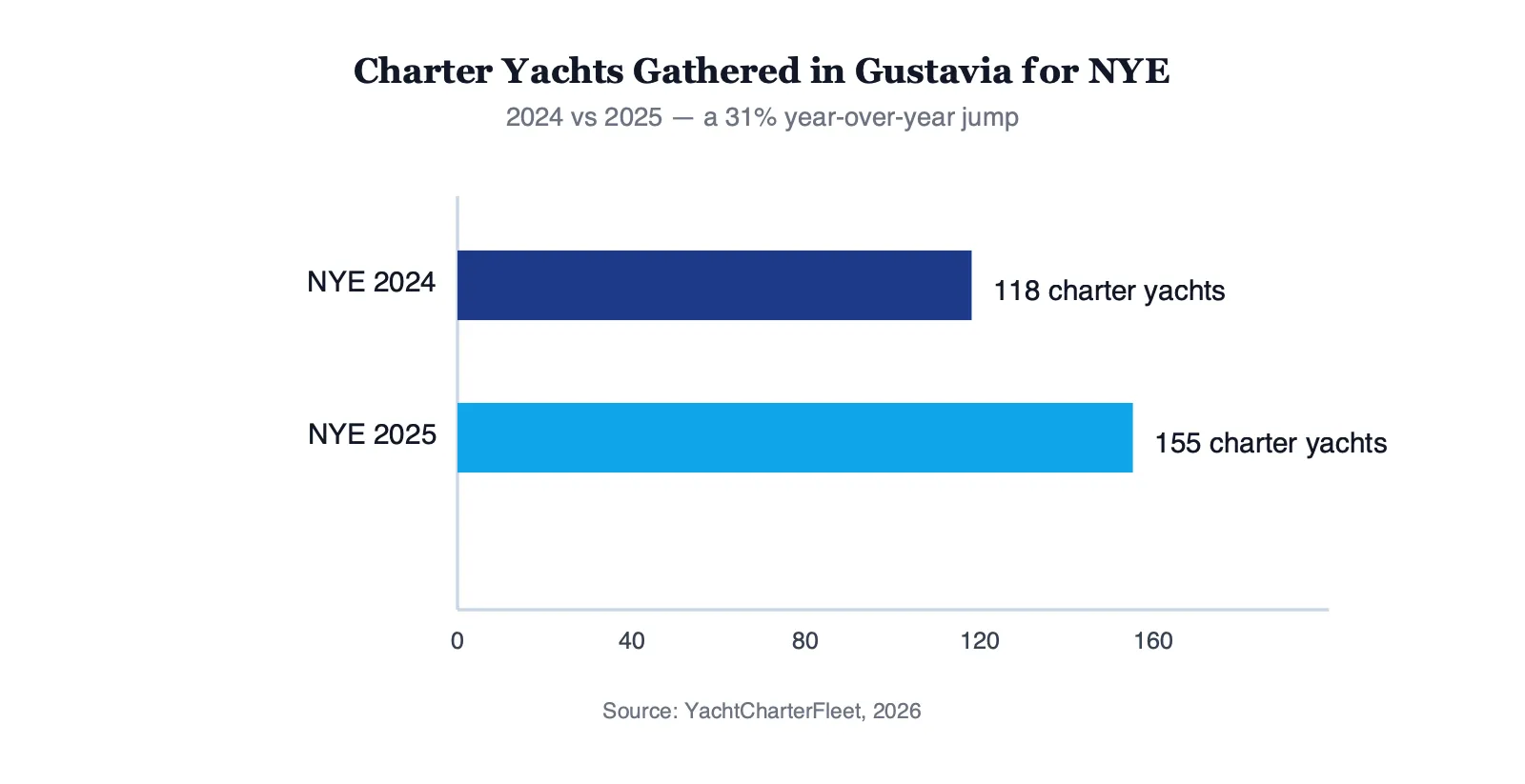
View data table
| NYE Year | Charter Yachts in Gustavia | Total Superyachts in Gustavia |
|---|---|---|
| 2024 | 118 | 170 |
| 2025 | 155 | 226 (record) |
7-Day St. Barts Yacht Charter Route (Starting in Gustavia)
| Day | Sail (approx.) | Main stop | Best for | Overnight |
|---|---|---|---|---|
| 1 | Embark | Gustavia Harbor | Boarding, first dinner ashore | Gustavia |
| 2 | 3 to 5 nm | Anse de Colombier | Snorkeling, hike to beach | Colombier |
| 3 | 5 to 12 nm | Île Fourche or Tintamarre | Day-sail, swim stops | Gustavia or Colombier |
| 4 | 2 to 4 nm | Gouverneur & Saline | Postcard beaches, quiet swim | Gustavia |
| 5 | 2 to 4 nm | Baie de St. Jean | Beach club lunch day | St. Jean or Gustavia |
| 6 | 3 to 5 nm | Grand Cul-de-Sac | Lagoon, watersports | Cul-de-Sac or Gustavia |
| 7 | 2 to 4 nm | Gustavia | Brunch, last swim, disembark | Disembark |
Distances in nautical miles. Actual route depends on weather, yacht type, and your group’s preferences.
Day 1: Arrival in Gustavia
Day 1 of a St. Barts yacht charter is short and easy on purpose. You arrive at SBH, the crew meets you with a tender or van, and you board the yacht in Gustavia Harbor for the captain’s safety brief and a welcome glass of something cold.
What to do with the afternoon:
- Short Shell Beach swim, five minutes from the harbor by tender, with lunch at Shellona on Shell Beach if you want to make an afternoon of it.
- Walk Gustavia. The town is small, walkable, and easy to scan in 90 minutes.
- Dinner ashore. This is one of the best dining nights of the week. Bonito for sushi-meets-Latin with a view, Orega for Japanese-French fusion, L’Isola for Italian, or Le Repaire for a casual harbor-front bistro.
Keep day one’s pace gentle. Most groups have flown in same-day and want a long shower, a swim, and a good first dinner rather than a long sail.
Day 2: Anse de Colombier, Nature and Snorkeling
Day 2 is a short morning sail of 3 to 5 nm to Anse de Colombier, the calm nature anchorage on St. Barts’ northwest tip. No road access, no beach club, no boutiques. Just clear water, a hiking trail down to the beach, and one of the best snorkel sessions on the island.
What to do:
- Snorkel the rocky edges of the bay. Sea turtles are possible in good conditions, never guaranteed.
- Hike from Anse des Flamands if a guest wants the shore approach, about 30 minutes one way.
- Long onboard lunch. This is the day to use the chef. There are no restaurants here.
- Sunset onboard. Colombier is one of the best sunset spots in the Lesser Antilles.
Remember the 25-metre rule from earlier: if your yacht is bigger than that, plan Colombier as a long lunch and take the night back in Gustavia.
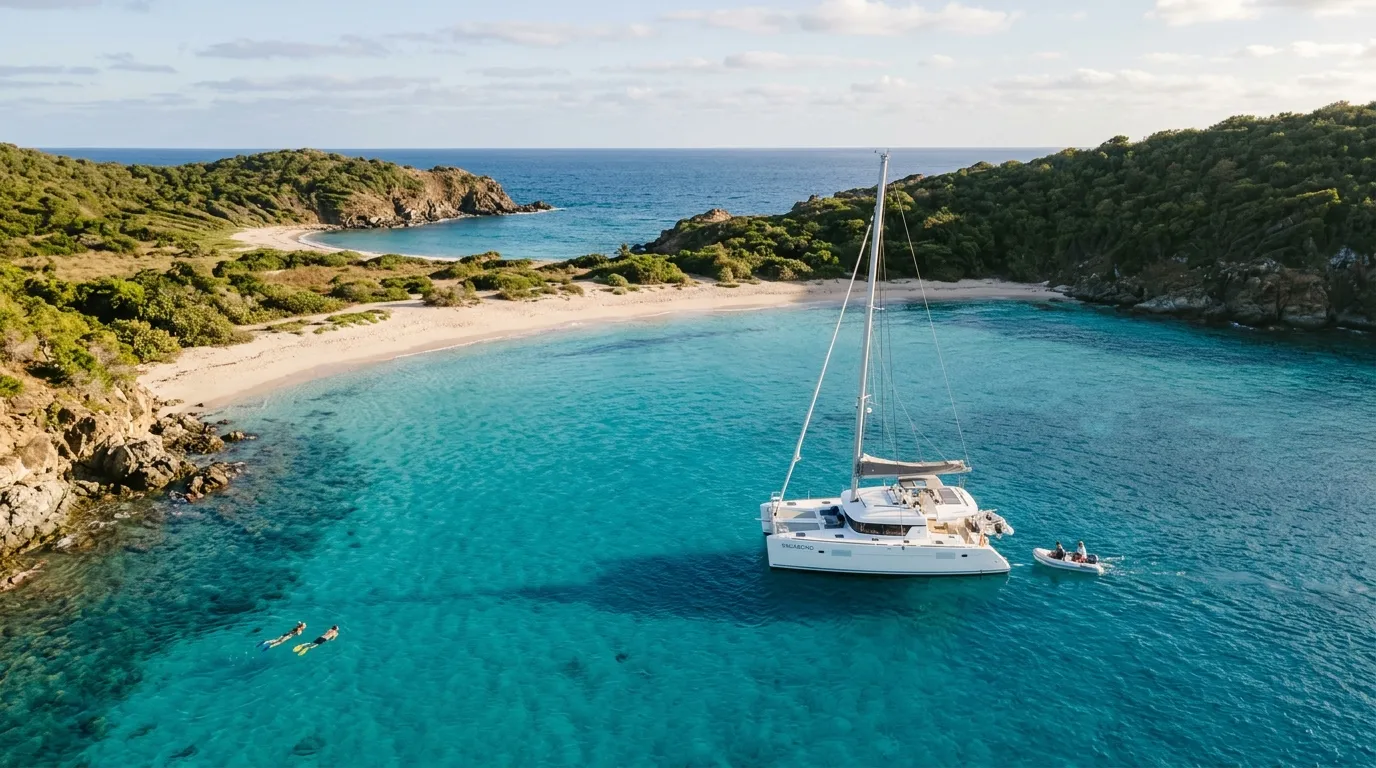
Day 3: Île Fourche or Tintamarre Day-Sail
Day 3 covers the longest sail of a St. Barts charter week, 5 to 12 nm to either Île Fourche (5 nm northwest) or Tintamarre (12 nm north). It’s the only optional day on the route, and the only one that asks for real time underway. Two strong picks:
Île Fourche:an uninhabited islet about 5 nm northwest of St. Barts, with a horseshoe bay, a goat-track summit hike, and excellent snorkeling along the cliffs. No services, no shore facilities. A pure swim-and-lunch stop.
Tintamarre: a wilder nature reserve off St. Martin, about 12 nm north. Pink-tinged sand, calm shallow water, a deserted-beach feel. If the group wants a marked snorkel trail and lunch ashore instead, Pinel Island sits in the same French reserve a couple of miles west, and groups after a proper long dinner sometimes push on to the lolos of Grand Case, though that turns a day-sail into an overnight.
Either way, return to Gustavia or Colombier for the night. If anyone in your group has been pushing for more time on the water, this is the day to give it to them.
Day 4: Anse de Gouverneur and Anse de Grande Saline
Day 4 is a short hop south of 2 to 4 nm to St. Barts’ postcard duo: Gouverneur and Saline. Both are wide, undeveloped beaches with no roads visible from the water, Gouverneur a tight cove and Saline a longer open arc. The water is electric, the swim is deep, and there’s nothing to do but swim, walk, and float.
A few practical notes:
- Saline has no shore facilities other than a single beach restaurant set back in the dunes. Bring everything.
- Gouverneur is more sheltered in north swell. Saline is more open.
- Both are quiet on weekdays and busier on weekends and during peak weeks.
Plan an onboard lunch, a long swim, and a late-afternoon return to Gustavia for dinner. Tamarin, in the hills above Saline, is one of the best dinner picks of the week if you want something away from town. Book a car or have the crew arrange transport.
Day 5: Baie de St. Jean, Beach Club Day
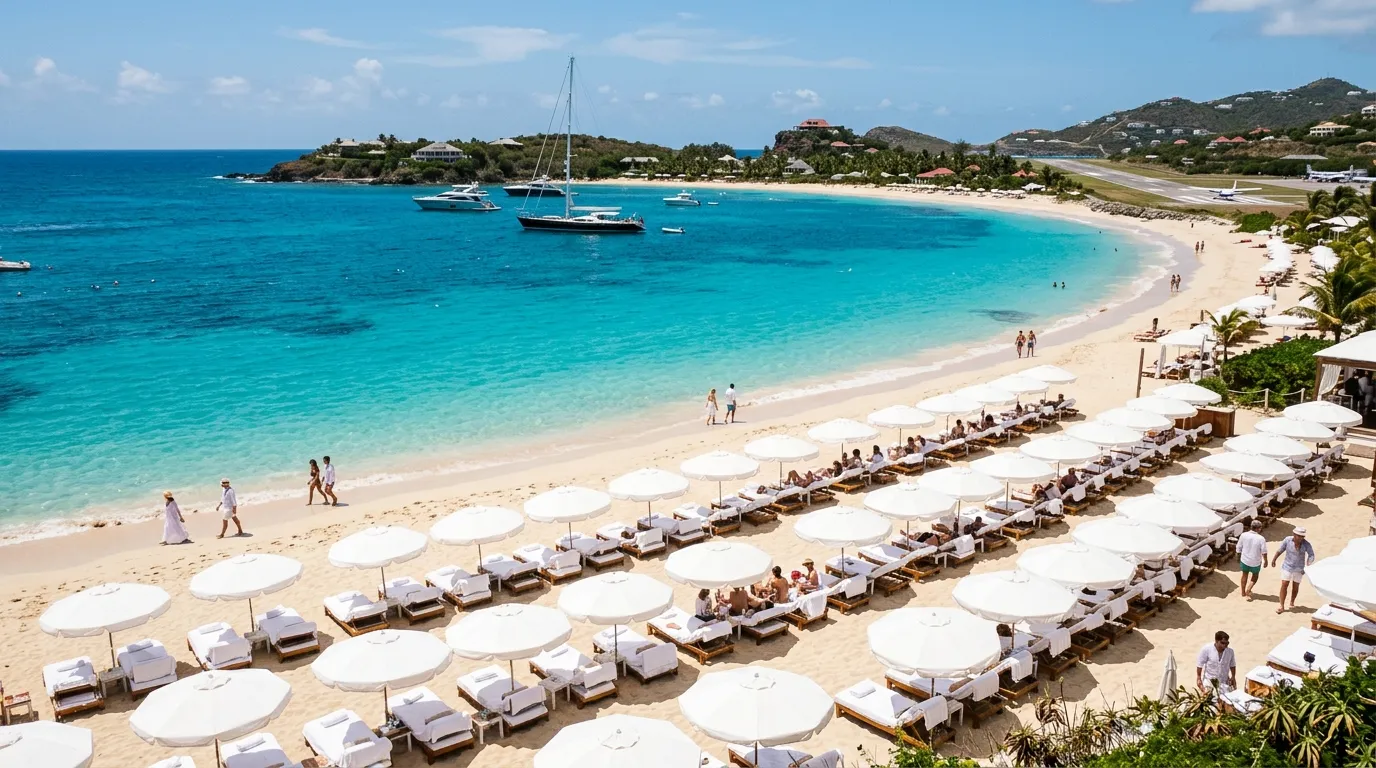
The St. Jean beach-club day is the one most St. Barts charters build a calendar around. Nikki Beach has been the all-white St. Jean lunch scene since 2002, when it opened on Saint-Jean beach as Nikki Beach’s flagship Caribbean property (Nikki Beach, 2025). The bay has a glassy daytime feel, easy tender access, and three beach clubs within walking distance of each other. Our guide to Nikki Beach St. Barts covers what a table actually costs and when to book one. Build the day around lunch.
What to do:
- Late breakfast on the yacht. St. Jean lunch service runs noon to 4 p.m., so there’s no need to rush.
- Long beach-club lunch. Nikki Beach for the scene, La Plage for a quieter Mediterranean room, or Pearl Beach for a younger crowd.
- Swimming and people-watching. Planes land at SBH right over the east end of the bay, which is uniquely St. Barts.
- Sunset back in Gustavia, or stay anchored at St. Jean for an early night.
This is the day to dress for lunch. Linen, swimwear, sun hats. St. Jean is the most photographed beach on the island for a reason.
Day 6: Grand Cul-de-Sac, Watersports and Lagoon
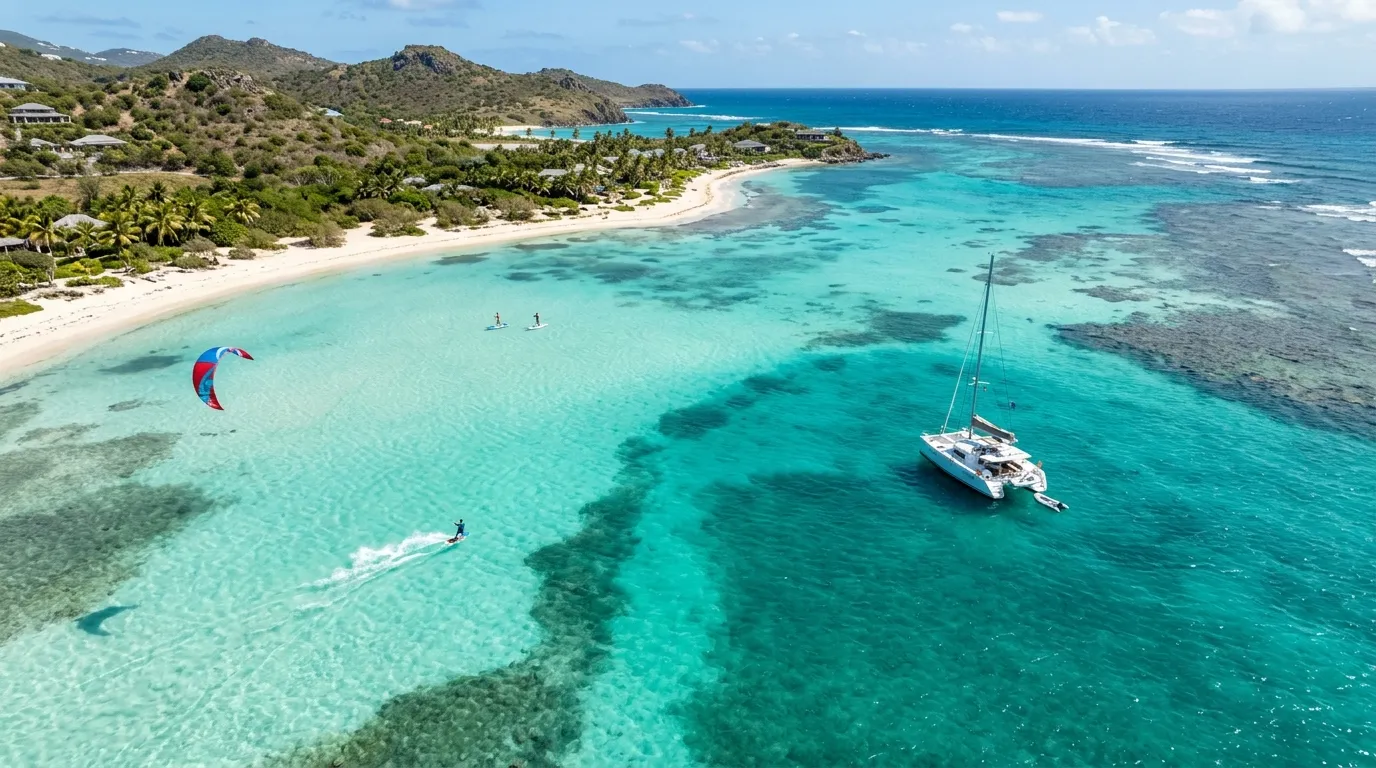
Day 6 belongs to Grand Cul-de-Sac, the reef-protected lagoon on the east side of St. Barts, and it’s the day for anyone who kites, wing foils, paddleboards, or just wants flat water for swimming. The bay runs shallow with consistent trade winds, exactly the conditions kiters and wing foilers ask for. It’s also outside the strictest reserve zones, which is why the towed toys come out here rather than at Colombier.
What to do:
- Tender to the lagoon shallows for swimming, SUP, and kayaking.
- Watersports. If anyone in your group is a kiter or wing foiler, this is their day. Bring or rent gear locally.
- Lunch at Le Sereno’s Al Mare, beachfront, Italian, polished. One of the best lunch rooms on the east side.
- Quieter evening anchored in Cul-de-Sac or back in Gustavia.
If watersports aren’t your group’s thing, swap this day for a second Colombier afternoon or a quiet Gouverneur loop. The itinerary is yours. Groups with an extra day sometimes run west instead, to Sandy Island off Anguilla, which is a very different kind of empty.
Day 7: Return to Gustavia and Farewell
Day 7 of a St. Barts yacht charter is intentionally short. A 2 to 4 nm morning reposition back into Gustavia leaves room for a final swim at Shell Beach, a relaxed brunch on the yacht, and an unhurried shore-side last evening.
If your departing SXM-bound flight is the next morning, the crew can arrange a late tender to shore for one final dinner. Eden Rock’s Sand Bar, a Jean-Georges Vongerichten concept, is a strong farewell pick (Niche Travel Guides, 2025).
A few light close-out items:
- Settle the APA with the captain if you’re on a plus-expenses yacht.
- Crew gratuity, typically 10% to 20% of the base charter fee, divided per the crew’s preference.
- Pack overnight. Same-day SBH to SXM connections are easy.
Frequently Asked Questions
What is the best time of year for a yacht charter in St. Barth?
Mid-December through mid-April. St. Barth’s drier season runs December 2 to May 5, February is the driest month at 0.2 inches of rain, and the beach-and-boat window closes around mid-April (WeatherSpark, 2026). February is the strongest all-round month. November and early December give you nearly the same weather with far better availability and rates, which is where we send flexible groups.
How much does a St. Barts yacht charter cost per week?
Roughly $25,000 to $100,000+ per week for the whole yacht. A 50 to 59 ft crewed catamaran for eight runs $27,250 to $33,000 all-inclusive, and motor yachts from 70 ft land between $62,000 and $179,000 for the week once the APA is added (Vital Charters rate analysis, September 2026). Christmas and New Year’s sit above those bands. All-inclusive rates cover food, premium bar, fuel and watersports, with only a crew gratuity on top.
Can you do a 3 day yacht charter in St. Barts?
Yes. A 3 day yacht charter in St. Barts works because the island is only nine square miles, so a short trip still covers Gustavia, Colombier and either Gouverneur or Baie de St. Jean without rushing. Two caveats: many yachts set a 5 to 7 night minimum in high season, and short charters are easier to arrange in the May and November shoulders. Seven days remains the sweet spot, and St. Barts also works as the second leg of a 10-day Caribbean week.
What is APA on a St. Barts yacht charter and do I get the remainder back?
APA is the Advance Provisioning Allowance, roughly 30% to 35% of the charter fee on a plus-expenses yacht and about 5% on an all-inclusive one (Boat International, 2022). It’s your money held on account by the captain and spent on food, drink, fuel and berthing through the week. You get a running total during the charter and a line-by-line reconciliation at the end, with any unused balance returned in cash or applied to the crew tip.
Can a superyacht stay overnight at Anse de Colombier?
No. Colombier sits inside the Saint-Barthélemy marine reserve, where anchoring isn’t permitted and the mooring buoys are rated for vessels up to 25 metres (Agence Territoriale de l’Environnement, 2026). On a larger yacht, Colombier becomes a superb lunch and swim stop and the night is spent back in Gustavia. It’s a yacht-selection decision, so raise it with your broker before you sign.
Is St. Barts good for a honeymoon yacht charter?
It’s the best Caribbean island for couples who want restaurants and atmosphere alongside privacy. Colombier and Île Fourche give you empty anchorages with no road access, while Gustavia and Baie de St. Jean give you the scene when you want it. Charter a 45 to 50 ft catamaran rather than something larger, sail no more than two hours a day, and put the savings into dinners ashore.
Should I use an independent broker or a large brokerage for a St. Barts charter?
For the $25,000 to $150,000 range, which covers almost every St. Barts catamaran week, an independent broker is usually the better choice: no house inventory to place, access to the same industry-wide central agent listings, and one person handling your charter start to finish. Large brokerages hold a real advantage at the top of the market, where they’re often central agents for specific 60 m-plus yachts. Ask any broker who will answer the phone during your charter week.
Is St. Barts a good yacht charter destination for families with kids?
St. Barts is best for couples and friends groups of 6 to 10 guests. For families with young kids, the British Virgin Islands and US Virgin Islands are usually better fits: more protected swim bays, kid-friendly beach bars, shorter sailing days, and less of the late-night scene that defines St. Barts.
When should I book a St. Barts yacht charter for New Year’s Eve?
Twelve to 16 months in advance. A record 226 superyachts gathered in Gustavia for NYE 2025/2026, 155 of them available for charter (YachtBuyer, 2026), and the best yachts go into contract by the previous spring.
Do I need to combine St. Barts with another island?
You don’t, and most of the time we don’t recommend it. St. Barts has enough anchorages, restaurants and beach clubs to fill a week on its own. A single Île Fourche or Tintamarre day-sail is the move if you want more water time, and neither requires checking out of French waters. If your group does want more islands, a week that takes in St. Kitts and Nevis can start in St. Barts or Antigua. Our guide to Antigua crewed yacht charters covers where Antigua’s yachts are based and what they charge to relocate.
Tell us your dates and your group size and we’ll come back with a shortlist of what’s genuinely open, what it costs, and which boats we’d rule out for your week and why.
Your St. Barts week, planned properly
Tell us your dates and group size and we’ll come back with a shortlist of what’s genuinely open, what it costs, and which boats we’d rule out for your week.