
What is APA in yacht charter? The 2026 numbers
What is APA in yacht charter? A pre-funded expense account, most often 35% of the base rate on plus-expenses boats and zero on 98% of all-inclusive rates.
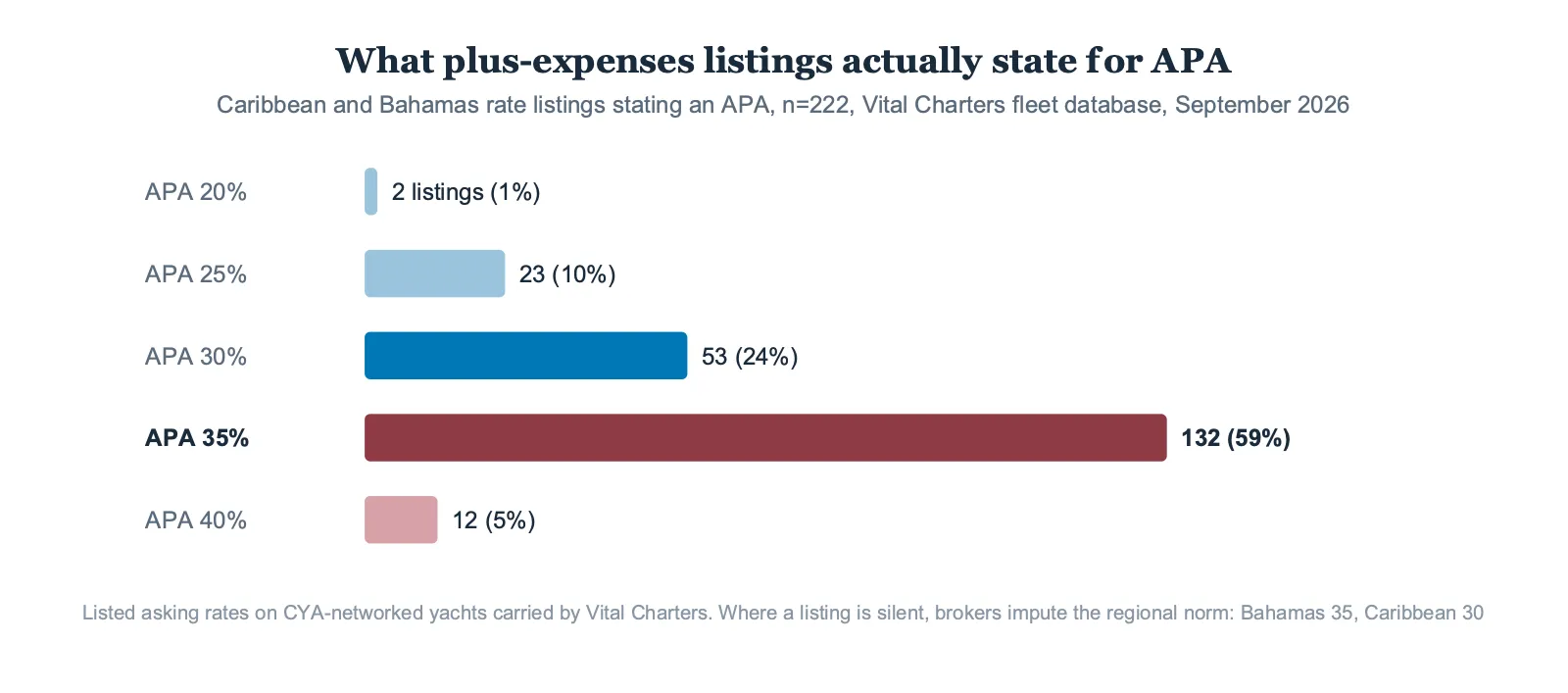
What is APA in yacht charter pricing? The Advance Provisioning Allowance is a pre-funded expense account that plus-expenses charters add on top of the base rate, and on Caribbean and Bahamas listings it’s most often 35 percent. Of 222 rate listings we track that state an APA, 132 say 35 percent, 53 say 30, 23 say 25, 12 say 40 and 2 say 20 (verified September 2026). Neither MYBA nor IYBA publishes a percentage. The number comes from the yachts.
The other half of the answer is the one most APA explainers skip: on the all-inclusive terms that price most Caribbean catamarans, there’s no mandatory APA at all on all but about 2 percent of rates. This page gives you both halves, the contract language behind each, and what real listings state, so the second number on a quote never arrives as a surprise.
Last Updated: October 18, 2026
Originally published March 2, 2026.
How much is the APA on a MYBA-style yacht charter? 30 to 35 percent
The APA on a MYBA-style plus-expenses charter runs 30 to 35 percent of the base rate in practice. Of the 222 Caribbean and Bahamas rate listings we track that state one explicitly, 185 say exactly 30 or 35 percent, and 35 is the single most common figure at 132 listings (verified September 2026; listings silent on APA, where a regional norm would otherwise be assumed, are excluded from every count on this page). MYBA itself publishes no percentage at all.
View data table
| Stated APA | Rate listings | Share of the 222 stating an APA |
|---|---|---|
| 20 percent | 2 | 1% |
| 25 percent | 23 | 10% |
| 30 percent | 53 | 24% |
| 35 percent | 132 | 59% |
| 40 percent | 12 | 5% |
MYBA, founded as the Mediterranean Yacht Brokers Association and now MYBA The Worldwide Yachting Association, wrote the agreement that plus-expenses charters worldwide are modelled on, and its published specimen leaves the APA line on page one blank for the broker to fill in per yacht: “Plus: Advance Provisioning Allowance (A.P.A.) (see Clause 8).” Clause 8 is the mechanics, not a rate. It says the charterer, having paid the APA through the broker’s account, “shall be advised by the Captain, at intervals, as to the disbursement of the APA” and must top it up “if the balance remaining becomes insufficient in the light of current expenditure” (MYBA Charter Agreement, specimen). MYBA’s own broker guidelines state that only the 2017 version, issued through its e-contract system, is valid today (MYBA Retail Broker Guidelines, 2019); the specimen is the public text.
So when a page tells you “the MYBA contract sets APA at 30 percent,” it’s attributing a broker convention to a document that doesn’t contain it. The convention exists because it works: 30 to 35 percent of a week’s base rate reliably covers fuel, provisioning and dockage for a crewed yacht with a margin left over, and the unspent margin comes back. Our guide to what’s included in a yacht charter fee reads the MYBA form clause by clause; the yacht charter costs guide works a full Bahamas invoice with the APA in it.
What does the APA cover? Every running cost except the taxes
The APA covers everything the yacht spends on your behalf during the week: fuel, food and drink, berthing and harbour dues, cruising permits and park fees, communications and crew-arranged extras, per Clause 8 of MYBA’s specimen agreement. What it never covers is a VAT-style charter tax, which is calculated on the charter fee and billed alongside it, and the crew gratuity. Clause 8 sits inside a longer document, and our clause-by-clause walkthrough of a charter contract covers the rest of it.
Clause 8 draws the line precisely. The charter fee “includes the charter of the Vessel with all its equipment in working order; tools; stores; cleaning materials and basic consumable stores for engine room, deck, galley and cabins; laundry of ship’s linen; the crew’s wages, uniforms and food; the insurance of the Vessel and crew.”
Then the other side of the line: “The CHARTERER will pay, at cost, for all other expenses. These include, but are not limited to, shoreside transport; fuel for the main engines and generators; fuel for tenders and water sports equipment; food and all beverages for the Charter Party; berthing dues and other harbour charges including pilots’ fees, local taxes, divers’ fees, customs formalities and any charges for waste disposal, charges for water and electricity taken from shore; ships’ agents’ fees where applicable; personal laundry; Charter Party communications and internet use” (MYBA Charter Agreement, Clause 8). That “at cost” list is the APA’s job description.
The Bahamas is the one place where that distinction changes your total. Harbour dues, port taxes, cruising permits and park fees are running costs and come out of the APA. The Bahamas’ 14 percent charter levy, a 4 percent charter tax under S.I. No. 57 of 2025 plus VAT at the standard 10 percent, is calculated on the charter fee itself and billed as its own line, never drawn from the APA. On a $60,000 Bahamas motor-yacht week that’s $21,000 of APA at 35 percent plus $8,400 of tax, and the two never mix. The worked Bahamas invoice in our costs guide stacks every line.
Ready to see the number on a real boat? Search the crewed fleet, then ask us for a quote that spells out the rate and the APA on their own lines.
Do all-inclusive Caribbean catamarans charge an APA? Not on 97.8 percent
All-inclusive Caribbean catamarans carry no mandatory APA on 799 of the 817 current all-inclusive rate listings, or 97.8 percent; the 18 exceptions state a small mandatory allowance of 5 to 10 percent for premium extras, and 7 more offer an optional one (verified September 2026). On this contract the rate is the number.
Caribbean crewed catamarans are priced on one of two contracts. All-inclusive terms fold fuel, food, permits and mooring into one weekly rate with nothing reconciled at departure; plus-expenses terms quote a base rate for the yacht and crew only and add an APA, 30 percent on most sailing catamarans, that you fund before boarding and settle against receipts at the end.
The contract behind that is the Charter Yacht Brokers Association’s inclusive form, and it’s explicit. Clause 2.A of the CYBA Inclusive Agreement says the total charter fee “includes the hiring of the Yacht, the services of a fully licensed Crew, all meals, standard ship’s bar, fuel, cruising taxes and permits, clearance taxes, mooring fees and all expenses related to running of the Yacht and use of on-board leisure and sports equipment” (CYBA Inclusive Agreement, 2020). That single clause is why cruising permits and park fees don’t show up as extras on a Caribbean catamaran quote: the yacht pays them out of the rate.
The same agreement is just as explicit about what’s out, and it contains no APA clause at all. Clause 2.B excludes “suggested Crew gratuities (discretionary) at customary rate of 15-20% of Charter Fee, at guest discretion; scuba diving and equipment; premium beverages and fine wines; excessive alcohol requests and/or consumption; off Yacht excursions; dockage as requested by the CHARTERER; fishing licenses (if required); communications; airport transfers,” and Clause 2.C has you settle those before disembarking. Note the two that surprise people: a marina night you ask for is yours, and anything ashore is yours. A charter tax where one applies, such as the Bahamas’ 14 percent, is likewise on top.
The 2 percent of all-inclusive rates that do state an APA are typically larger catamarans reserving 5 to 10 percent for premium wines, spirits and shoreside extras, and it’s in the listing. The rarer case is a yacht that bills its cruising permit separately; that’s disclosed up front and we see it mostly on vessels that spend their summers in the Mediterranean under European-based management. For the full inclusions list, see the all-inclusive charter explainer, and for what those rates actually are, Caribbean catamaran charter rates carries the medians by size and island.
One vocabulary note: CYBA’s own form is titled the “Inclusive Agreement,” and its booking-procedures guidance tells brokers to “refrain from using the term ‘all inclusive'” and instead explain what is and isn’t included (CYBA, Standardizing Charter Booking Procedures). We use the phrase because it’s the one people search, and we spell out the exclusions above every time.
Does IYBA set an APA percentage? No, same mechanics as MYBA
IYBA, the International Yacht Brokers Association based in Florida, publishes no APA percentage and no public charter agreement: its contracts and forms are member documents drafted by the association’s maritime attorneys, “constantly updated to ensure they set the standard for our industry” (IYBA, 2026). A page quoting “the IYBA APA rate” is quoting a broker convention, not the association, exactly as with MYBA. The figure you’ll meet on an IYBA-form proposal is the same fleet practice as on any other: 30 to 35 percent of the base rate, 35 most often.
IYBA reaches our waters through its members, who include many of the brokers and managers behind US- and Bahamas-based motor yachts, which is most of the plus-expenses fleet. Its own magazine observed years ago that “many charter brokers and managers in the U.S. use the MYBA Charter Agreement as a go-to form for charters,” while noting the MYBA document “was developed in Europe, thus making it best suited for use with charters taking place in European waters” (IYBA Compass, December 2016 to January 2017 issue, an author’s view rather than association policy). In practice you’ll meet both forms in the Bahamas.
How much APA to budget by yacht type: motors 35, catamarans 30
Motor yachts state 35 percent on 127 of their 148 stating rate listings in Vital Charters’ Caribbean and Bahamas data, while plus-expenses sailing catamarans state 30 percent on 34 of 44 and never above it; power catamarans split between 25 and 35, and sailing monohulls between 25 and 30 (verified September 2026). Fuel is the whole difference.
| Yacht type (plus-expenses listings) | Most common stated APA | Listings stating it | Full spread of stated figures |
|---|---|---|---|
| Motor yacht | 35% | 127 of 148 (86%) | 25% (3), 30% (6), 35% (127), 40% (12); 56 yachts |
| Sailing catamaran | 30% | 34 of 44 (77%) | 20% (2), 25% (8), 30% (34); 19 yachts |
| Power catamaran | 30% | 7 of 17 | 25% (5), 30% (7), 35% (5); 9 yachts |
| Sailing monohull | 25 to 30% | 13 of 13 | 25% (7), 30% (6); 6 yachts |
Rate listings in the winter 2026-27 bookable window that state an APA, Caribbean and Bahamas only. A yacht appears once per season it lists, so listings outnumber yachts.
You’ll find tidier ladders online: monohulls 20 to 25, catamarans 25 to 30, displacement motor yachts 25 to 35, planing hulls 35 to 40. We published one ourselves on an earlier version of this page and attributed it to CYBA’s standing rules. CYBA’s agreement contains no APA clause at all, and the measured pattern is coarser than the ladder: motors say 35, catamarans say 30, and the 40s are a handful of thirsty hulls. A catamaran under sail burns close to nothing, so its APA is mostly food, drink and dockage; a large motor yacht’s is mostly fuel, and a day of hard running between islands can burn thousands of dollars of diesel that a slower passage wouldn’t. Our sailing catamaran vs power catamaran guide runs that trade-off in full.
Does the APA change by destination? Bahamas says 35, Caribbean 30
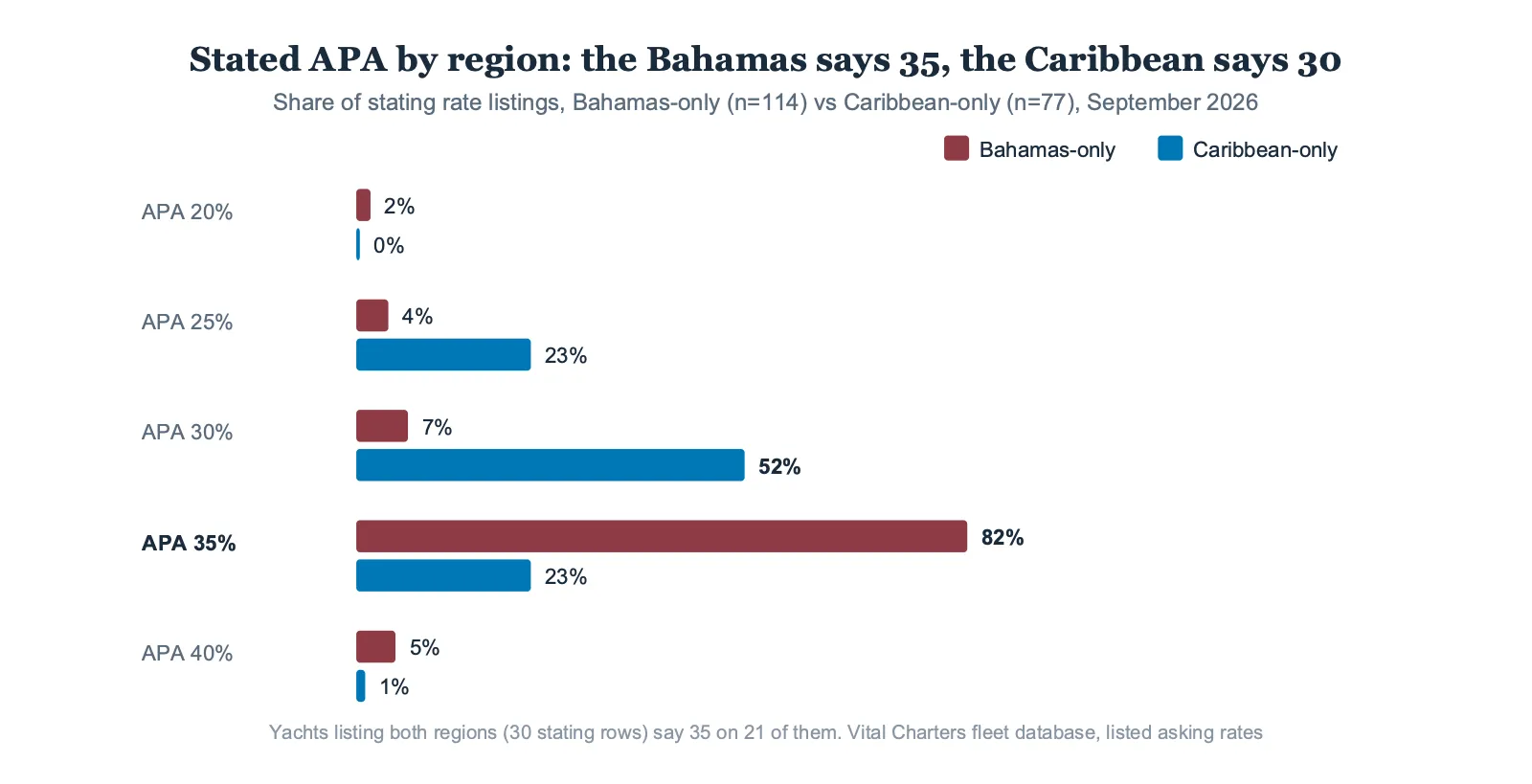
The APA does change by destination in what yachts state: Bahamas-only listings say 35 percent on 93 of 114 stating rate rows, or 82 percent, while Caribbean-only listings most often say 30 percent (40 of 77), with 25 and 35 tied at 18 each (Vital Charters listings analysis, verified September 2026). Yachts that list both regions mostly state 35.
View data table
| Stated APA | Bahamas-only listings (n=114) | Caribbean-only listings (n=77) | Both regions (n=30) |
|---|---|---|---|
| 20 percent | 2 (2%) | 0 | 0 |
| 25 percent | 5 (4%) | 18 (23%) | 0 |
| 30 percent | 8 (7%) | 40 (52%) | 4 |
| 35 percent | 93 (82%) | 18 (23%) | 21 |
| 40 percent | 6 (5%) | 1 (1%) | 5 |
Two things drive the split. The Bahamas plus-expenses fleet is overwhelmingly motor yachts (303 of 327 Bahamas-only plus-expenses rate listings, 155 of 166 yachts, September 2026), running longer legs between the Exumas with provisioning trucked in from Nassau, so fuel and logistics push the norm to 35. The Caribbean’s plus-expenses fleet is half catamarans (83 of 164 Caribbean-only listings) on shorter hops, so 30 holds. Where a listing is silent, brokers apply the regional norm: 35 for the Bahamas, 30 for the Caribbean.
The destination also decides the tax line that sits beside the APA: the Bahamas adds its 14 percent on the charter fee, while the Virgin Islands and the French islands add no VAT at all. The Caribbean yacht charter cost guide carries the rate medians by island, and the Bahamas yacht charter guide covers the Exumas logistics that make the 35 make sense.
What APA adds on real yacht charter listings
On real listings the APA adds $10,975 to $28,000 to the six listings in the table that follows. A 108-foot Bahamas motor yacht listing $60,000 plus 35 percent is $81,000 before taxes and gratuity; a 58-foot Caribbean sailing catamaran at $40,000 plus 30 percent is $52,000 (listed asking rates, winter 2026-27, Vital Charters listings analysis, September 2026).
| Yacht | Type, length and region | Listed weekly base | Stated APA | Base plus its APA |
|---|---|---|---|---|
| Total | Motor yacht, 108 ft (Mangusta), Bahamas | $60,000 | 35% | $81,000 |
| Nomada | Motor yacht, 78 ft (Mochi), Bahamas | $50,000 | 30% | $65,000 |
| Outta Touch | Motor yacht, 105 ft (Intermarine), Caribbean | $70,000 | 40% | $98,000 |
| Endeavour | Sailing catamaran, 58 ft (Bali), Caribbean | $40,000 | 30% | $52,000 |
| Mymlan II | Sailing catamaran, 58 ft (Privilege), Caribbean | $43,900 | 25% | $54,875 |
| Frenchwest | Power catamaran, 78 ft (Lagoon), Caribbean | $60,000 | 30% | $78,000 |
Listed asking rates published by each yacht’s central agent for the winter 2026-27 season, not audited transaction prices. The right-hand column folds in each yacht’s own stated APA; unspent APA is refunded at the end of the charter. A VAT-style charter tax where one applies and the crew gratuity come on top.
Read the right-hand column as the cash you fund before boarding, not the cash you’ll have spent. The APA is a deposit against real expenditure, and the gap between the two is what comes back. Notice also that the 40 percent motor yacht and the 25 percent catamaran differ by 15 points of base rate, a 60 percent gap in what you fund up front; that’s fuel appetite showing up in a contract line, which is exactly why the number belongs to the yacht and not to an association.
Where does unspent APA go? Back to you, itemized
Unspent APA goes back to you. Before you disembark, “the Captain shall present to the CHARTERER a detailed account of expenditure, with as many supporting receipts as possible,” and either you pay the balance of the expenses or “the Captain shall repay to the CHARTERER any balance overpaid,” per Clause 8 of MYBA’s specimen agreement; MYBA’s guidance adds that you should have the option of taking the refund by bank transfer rather than cash (MYBA, Information for Charter Yacht Captains and Crew, April 2018 edition; MYBA’s 2026 guidelines keep the option).
The clause also requires the captain to advise you “at intervals” on how the fund is being spent, which in practice means a mid-week summary if you ask for one, and a top-up request if the balance runs low against the week’s spending. Overruns are uncommon on a well-briefed charter; when they happen the cause is nearly always a choice made on the water, such as extra marina nights, a helicopter transfer or a run of long fuel-heavy passages.
Three habits land you on the refund side. Fill in the preference sheet with specifics: proteins, dietary limits, the brands you actually drink. Vague briefs produce expensive provisioning. Talk through the itinerary’s fuel burn with the captain on day one; their estimate is usually close. And decide on marina nights deliberately, because a berth in a popular harbour is the one line on the ledger that can exceed a day’s fuel. Our hidden fees guide covers the rest of the invoice beyond the APA statement.
The bottom line on APA
APA comes down to five facts, all measured on 222 stating plus-expenses listings and 817 all-inclusive ones (verified September 2026), and it stops being mysterious the moment you know which contract you’re on. What to keep:
- The number: 30 to 35 percent of the base rate on plus-expenses charters, 35 most often; motors say 35, catamarans say 30, the Bahamas says 35, the Caribbean says 30
- Zero on all-inclusive terms: no mandatory APA on 97.8 percent of all-inclusive rate listings; the CYBA form folds fuel, permits, cruising taxes and mooring fees into the rate
- What it covers: every running cost the yacht incurs for you; never a VAT-style charter tax, never the gratuity, and nothing you do ashore
- Who sets it: the yacht and its broker; MYBA and IYBA publish the mechanics and no percentage
- Where it goes: an itemized account with receipts before disembarkation, and the balance refunded, by bank transfer if you prefer
When you’re ready to match boats to your dates and budget, start a yacht search at Vital Charters and we’ll quote the rate, the APA and the tax line separately, for the specific yachts you’re considering. Prefer to talk it through first? Reach out to our team.
APA figures verified September 2026 against current rate listings; contract language quoted from the MYBA specimen agreement and the CYBA Inclusive Agreement (2020) as published by each association.
Frequently Asked Questions
Is APA the same as the yacht charter fee?
No. The charter fee buys the yacht and crew for the week. The APA is a separate, pre-funded expense account, most often 35 percent of that fee on plus-expenses charters in the Caribbean and Bahamas (132 of 222 stating listings), spent by the captain on your running costs and refunded where unspent. On all-inclusive terms there’s usually no APA at all.
Is 30 percent the official MYBA APA?
No association publishes an APA percentage. MYBA’s specimen agreement leaves the APA line blank and sets out the mechanics in Clause 8; IYBA’s forms are member-only and state no rate either. The 30 to 35 percent you see quoted is fleet practice, and in Vital Charters’ data 35 is the single most common stated figure, with 30 second; a 40 percent APA shows up on just 12 listings, all fuel-heavy motor yachts. The gratuity differs: CYBA’s form writes in 15 to 20 percent as the customary rate, MYBA’s 2026 guidelines print no figure at all, and both leave it explicitly at your discretion.
Do all-inclusive catamarans charge an APA?
Not as a rule. Of 817 current all-inclusive rate listings, 799 carry no mandatory APA; the 18 that do state 5 to 10 percent for premium extras, and 7 offer an optional one. CYBA’s Inclusive Agreement folds fuel, cruising taxes and permits, clearance taxes and mooring fees into the rate, which is why there’s nothing left for an APA to cover.
Does the APA include the crew gratuity?
No, on any contract. The APA (30 to 35 percent of the base rate on most plus-expenses listings, 35 most often) pays running costs; the gratuity is a separate, discretionary payment. CYBA’s inclusive form lists “suggested Crew gratuities (discretionary) at customary rate of 15-20% of Charter Fee” among the exclusions, and MYBA’s 2026 guidelines publish no percentage; both leave it at your discretion. Our guide to tipping yacht crew covers the custom.
Does the APA cover taxes?
Running-cost taxes, yes: harbour dues, port taxes, cruising permits and park fees are paid from the APA under MYBA’s Clause 8. A VAT-style charter tax, no: the Bahamas’ 14 percent (10 percent VAT plus a 4 percent charter tax) is calculated on the charter fee and billed as its own line. The Virgin Islands and the French islands add no VAT to a charter.
What happens if we spend more than the APA?
The captain tells you as the balance runs down and asks for a top-up to keep an adequate credit balance, which is what MYBA’s Clause 8 requires. In practice the fix is often an itinerary choice instead: fewer marina nights, shorter fuel-heavy legs. Overruns are rare on a well-briefed week, and any overage is settled before you step off.
Is the APA refundable if we don’t spend it all?
Yes. The captain presents a detailed, receipted account before disembarkation and repays any balance overpaid; MYBA’s guidance says you should be able to take that refund by bank transfer rather than cash. You can ask to see the ledger at any point during the week, and a mid-charter check around day three or four is the easiest way to steer the final number.
APA, tips, taxes: quoted all at once
Tell us your group size and dates and we’ll send crewed options with complete pricing, so you see the real number before you sign anything.