
Yacht charter costs explained
A $40,000 BVI catamaran week lands at about $46,000 to $48,000; a $60,000 Bahamas motor yacht near $100,000. Every line of yacht charter costs, worked.
Last Updated: October 20, 2026
Yacht charter costs come apart into four knowable numbers: the listed weekly rate, the APA if your contract carries one, government charter taxes of zero to 14 percent, and a customary 15 to 20 percent crew gratuity. The park, permit and levy fees you see quoted around the web are real, but on nearly every contract they’re already inside one of those numbers: the all-inclusive rate covers them, and on plus-expenses terms the APA does. This page works the arithmetic start to finish, using listed rates for the 670 active crewed yachts we track (verified August 2026) and fee schedules read from the primary documents.
Almost nobody publishes the math under the headline price, so we do it here twice: a $40,000 BVI catamaran week worked line by line to its landed total, and a $60,000 Bahamas motor-yacht week with the 35 percent APA worked through. Copy either table into your budget and you’re within a gratuity decision of your real number.
Originally published March 2, 2026.
How much does a yacht charter cost per week?
Weekly yacht charter costs in 2026 run from about $20,500 for an entry-level crewed catamaran to past $1 million for a superyacht. The medians: $31,500 per week for an all-inclusive crewed sailing catamaran and $118,800 for a crewed motor yacht with APA folded in, across 272 and 167 listings among the 670 crewed yachts we track (verified August 2026).
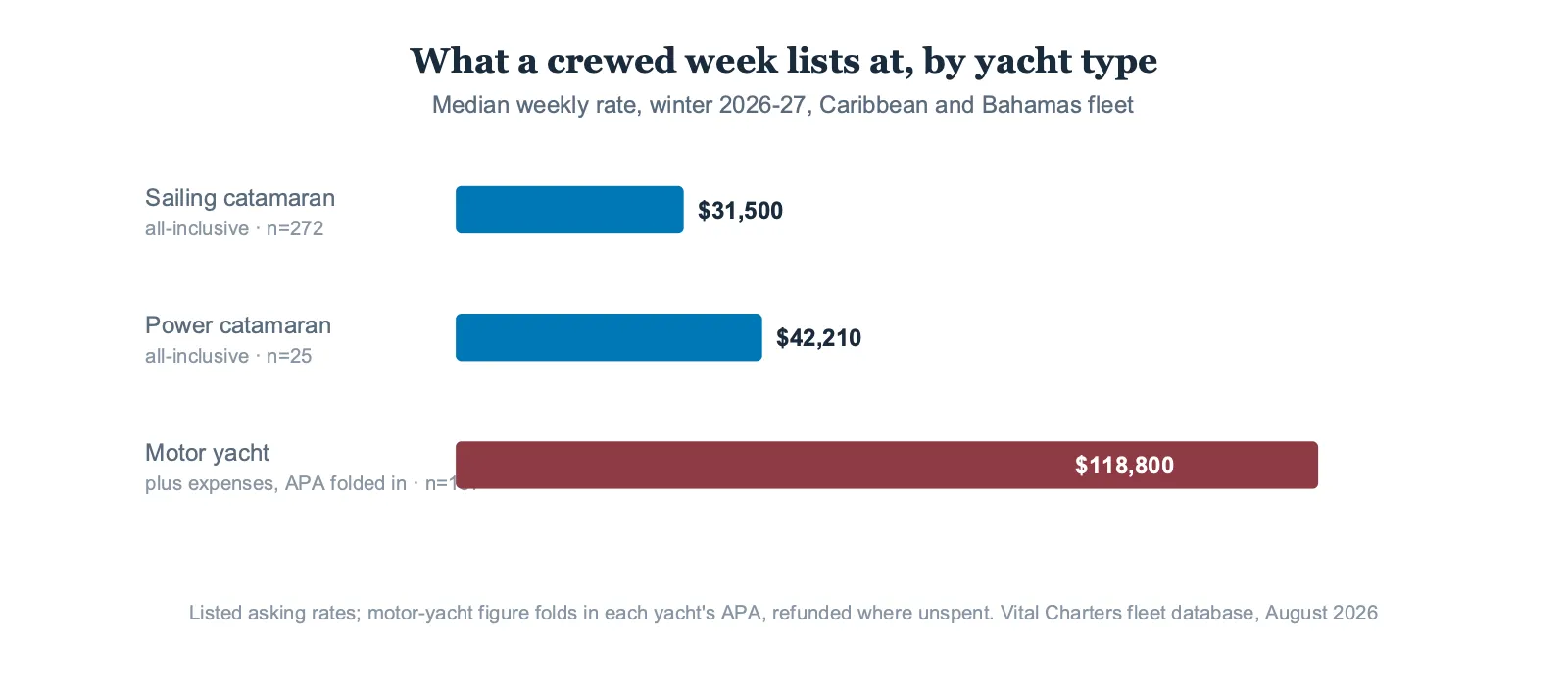
View data table
| Yacht type | Median weekly rate | Middle half of listings | Listings |
|---|---|---|---|
| Sailing catamaran, all-inclusive | $31,500 | $24,500-$43,000 | 272 |
| Power catamaran, all-inclusive | $42,210 | $39,900-$51,000 | 25 |
| Motor yacht, plus expenses (APA folded in) | $118,800 | $77,400-$168,800 | 167 |
The number only makes sense once you know the pricing model. An all-inclusive Caribbean catamaran at $35,000 per week is genuinely close to $35,000: the rate bundles crew, meals, the standard bar, fuel and, in the vast majority of cases, the island’s permits, park fees and levies; you add the gratuity, any charter tax, and whatever you do ashore. A plus-expenses luxury motor yacht at $85,000 base lands far higher once the APA, taxes and gratuity stack on. For comparison, a bareboat quote (you’re the crew) prices the boat alone and moves food, fuel, moorings, permits, park fees and a damage waiver or deposit onto your own bill; our pricing model comparison lists each of those lines. Planning a larger group? The 12-person yacht rule caps every charter yacht at 12 guests.
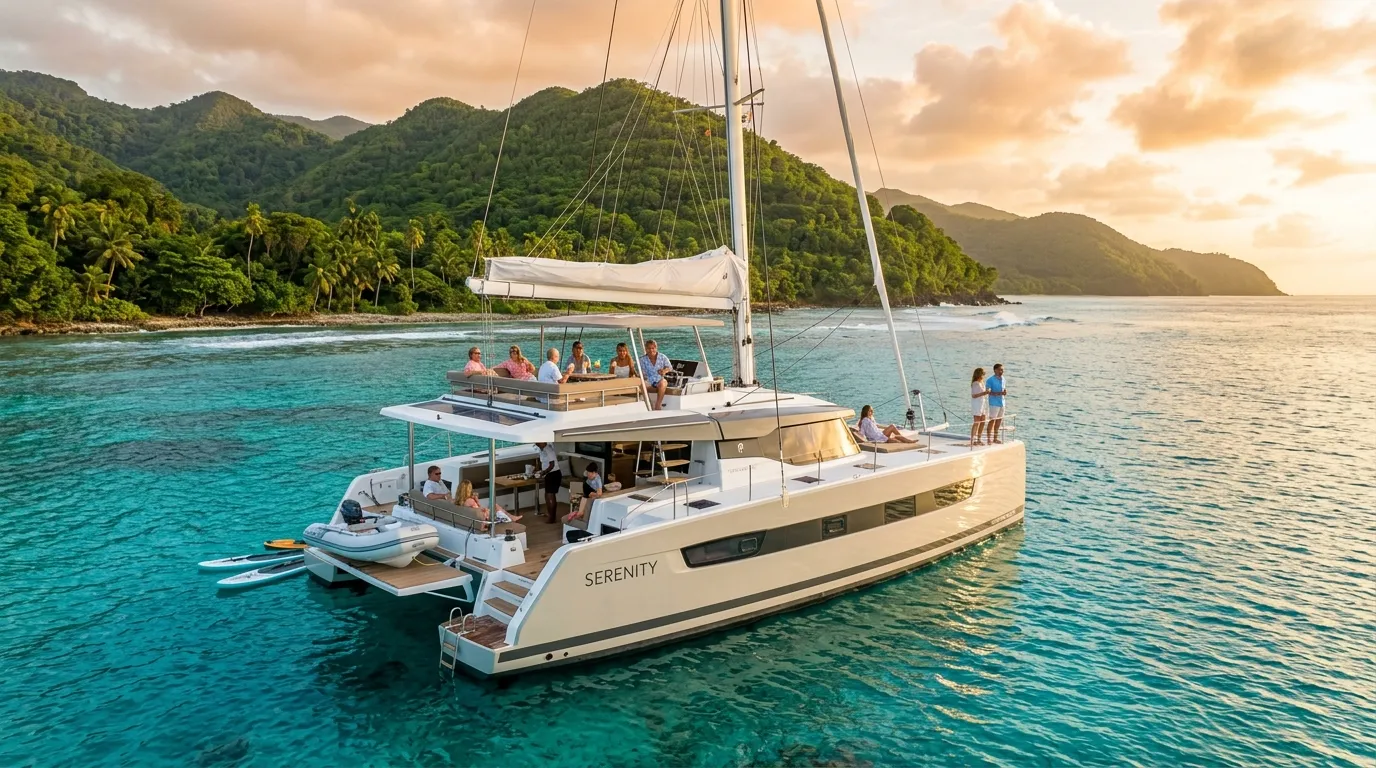
What lands on a Caribbean charter invoice in 2026
The island sets the amounts: 14 percent in Bahamas taxes, up to $16 per guest per day in BVI cruising fees, nothing per guest in the USVI. The contract sets who pays: all-inclusive rates cover permits, park fees and levies in the vast majority of cases; charter taxes and the 15 to 20 percent gratuity are always yours.
| Line item | Typical amount | Who sets it | Source |
|---|---|---|---|
| APA (Advance Provisioning Allowance) | None mandatory on all-inclusive catamarans, except a small allowance, usually 5 percent, on about 1 rate in 50. Plus-expenses charters add an APA, typically 30 to 35 percent of the base rate, intended to cover every running fee except government taxes, refunded where unspent | Each yacht’s own charter terms; MYBA publishes the mechanics, not a percentage | Vital Charters APA listings analysis |
| Government charter taxes | 0 to 14 percent of the charter fee by destination; the Bahamas is highest at 10 percent VAT plus a 4 percent charter tax (per-destination figures in the destination blocks) | Each territory’s government | S.I. No. 57 of 2025 (Bahamas example) |
| Marine park fees | Where you cruise them: EC$15 per guest per day at the Tobago Cays, $12.73 per extra guest per day in the Exuma park, $3 at the BVI’s Baths | TCMP; Bahamas National Trust; BVI National Parks Trust | TCMP fee schedule, effective January 1, 2023 |
| Crew gratuity | Customarily 15 to 20 percent of the charter fee in the Caribbean crewed fleet, the band CYBA’s Inclusive Agreement (Clause 2.B) calls the customary rate; MYBA’s 2026 guidelines publish no percentage, and both leave it at your discretion | Custom, written into the CYBA form | CYBA Inclusive Agreement, Clause 2.B (2020) |
Fees verified September 2026.
What a $40,000 BVI catamaran week actually invoices
A $40,000 all-inclusive BVI catamaran week for 8 guests lands at about $46,000 to $48,000 out of pocket: the cruising permit, arrival levy and park fees (about $1,000 of government charges) are inside the all-inclusive rate on the vast majority of contracts, so the customary gratuity of $6,000 to $8,000 is the only real addition (rates from Vital Charters’ listings analysis; fees from the gazetted BVI schedules, verified August 2026). Here is every line, including the ones the rate absorbs.
| Line item | Amount (8 guests, 7 nights) | Who pays it, and how |
|---|---|---|
| All-inclusive weekly rate | $40,000 | You. Yacht, crew, meals, standard bar, fuel, water toys, and the island fees below |
| BVI cruising permit | $896 | Inside the rate: $16 per guest per day, foreign-based boat (gazetted; $4 for BVI-based, so $224 instead) |
| Environmental and tourism levy | $80 | Inside the rate: $10 per guest on arrival |
| The Baths day stop (optional) | $24 | Inside the rate: $3 per person, BVI National Parks Trust |
| Crew gratuity, 15-20 percent | $6,000-$8,000 | You, at your discretion, cash to the captain; never part of any rate |
| Out-of-pocket total | $46,000-$48,000 | Rate plus gratuity. No APA on this contract; nothing reconciled at departure |
Two notes on reading this honestly. The included fee lines have one rare exception: a yacht that bills its cruising permit separately, which is disclosed up front and shows up mostly on vessels that spend their summers in the Mediterranean under European-based management. And the crew handles every formality behind these fees; you never queue at a window.
What a $60,000 Bahamas motor-yacht week invoices (35 percent APA)
A $60,000 plus-expenses Bahamas motor-yacht week for 8 guests lands near $98,400 to $101,400: the APA adds $21,000, the Bahamas’ two charter taxes add $8,400, and gratuity adds $9,000 to $12,000 (fee composition per S.I. No. 57 of 2025; APA at the 35 percent Bahamas norm in Vital Charters’ listings analysis). The APA is built to absorb every running fee, park and permit charges included; the taxes and the tip never route through it. Unspent APA comes back to you.
| Line item | Amount (8 guests, 7 nights) | Basis |
|---|---|---|
| Base charter fee | $60,000 | Listed rate: yacht and crew only |
| APA at 35 percent | $21,000 | Bahamas norm: stated median is 35 percent among Bahamas listings, and 35 is imputed where a listing is silent. Funds fuel, provisioning, dockage, and the park and permit fees below |
| Bahamas VAT, 10 percent | $6,000 | On the charter fee, per S.I. No. 57 of 2025 |
| Bahamas charter tax, 4 percent | $2,400 | The second charge the same instrument collects at the Port Department |
| Exuma park (if visited) | $112+ per park day | 8 guests at $12.73 per day, plus 10 percent VAT and the yacht’s mooring; paid from the APA above, not billed on top |
| Crew gratuity, 15-20 percent | $9,000-$12,000 | Customary, on the base fee, at your discretion; never drawn from the APA |
| Landed total | ~$98,400-$101,400 | Base, APA, taxes, gratuity; the Exuma fees spend from the APA; unspent APA refunded at departure |
The APA reconciliation takes two sentences to understand: your captain spends from the $21,000 on fuel, food, dockage and park and permit fees all week and logs every receipt, and on departure day you see the full accounting. Whatever wasn’t spent is returned to you; if the week ran over, you settle the difference before stepping off.
MYBA contract charges vs CYBA all-inclusive terms
The contract decides how much of your final bill the listed rate represents: on CYBA-style all-inclusive terms the listed rate is about 85 percent of the landed total, while on MYBA-style plus-expenses terms it’s about 60 percent, per Vital Charters’ worked BVI and Bahamas invoices (2026). Same fleet, same islands, very different arithmetic.
CYBA-style terms (the Charter Yacht Brokers Association’s all-inclusive model) dominate the Caribbean catamaran fleet: one figure bundles the yacht, crew, meals, standard bar, fuel and, in the vast majority of cases, the island’s permits, park fees and levies; no expense account, nothing reconciled at departure. MYBA-style plus-expenses terms dominate motor yachts and superyachts: the base fee covers the yacht and crew, and everything else the week generates routes through the APA, government taxes excepted. Neither is a trick; they’re different products, and neither one ever includes a VAT-style charter tax, the crew gratuity, or anything you do ashore. The trap is only in comparing a plus-expenses base rate against an all-inclusive rate as if they were the same number.
For the clause-by-clause view of what each contract includes, our guide to what’s included in a yacht charter fee reads the MYBA form line by line, and the all-inclusive explainer does the same for CYBA-style terms.
What does a yacht charter cost per day?
Daily charters are the fastest-growing segment, expanding at 10.82 percent CAGR, though weekly charters still represent 54.63 percent of bookings (Mordor Intelligence, 2025). The quick math from the weekly medians: an all-inclusive catamaran at the $31,500 median runs about $4,500 per night; short charters of 3-4 days carry a 10-20 percent premium over the weekly rate divided by seven.
For tier-by-tier daily breakdowns and per-person comparisons, see our complete yacht charter cost per day guide.
Ready to turn these line items into a real quote? Search crewed yachts by destination, guests, and yacht type.
Do seasonal rates really change yacht charter costs?
Seasonal rates move catamaran charter costs far less than the internet claims: winter and summer medians for all-inclusive cats sit under 2 percent apart ($31,500 against $31,000, across 272 and 275 listings we track, verified August 2026). The real moves are motor yachts, about 23 percent lower in low season, and festive weeks, a median 14 percent premium.
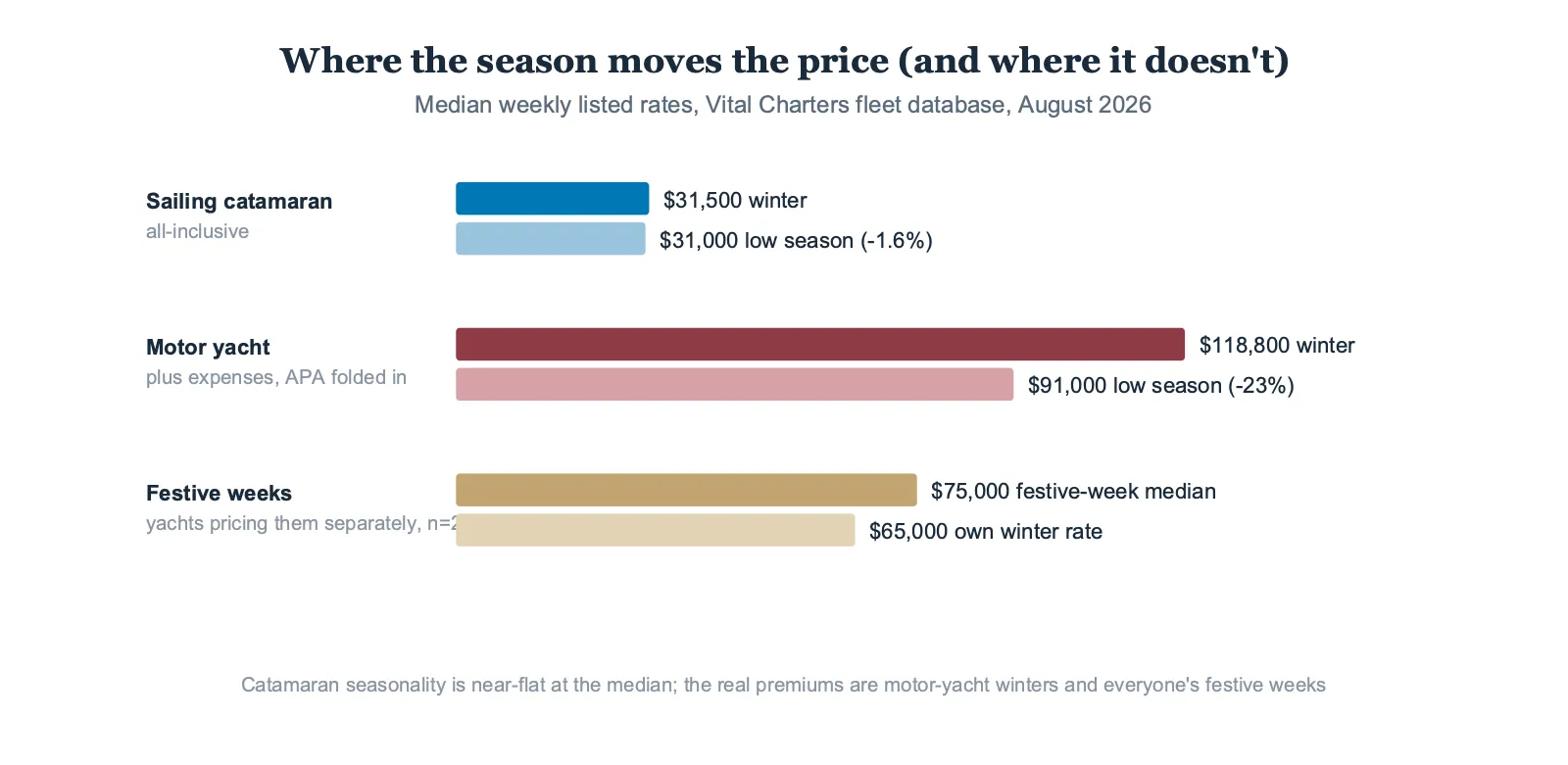
View data table
| Segment | Winter median | Low-season median | Spread |
|---|---|---|---|
| Sailing catamaran, all-inclusive | $31,500 (n=272) | $31,000 (n=275) | under 2% |
| Motor yacht, APA folded in | $118,800 (n=167) | $91,000 (n=212) | -23% |
| Festive weeks (n=22 yachts) | $65,000 (group’s winter median) | $75,000 festive median; +14% is the median of each yacht’s own premium | |
Why does the web claim a 30 to 40 percent seasonal charter discount? Because individual yachts and older motor-yacht data get generalized to the whole fleet. On all-inclusive catamarans, owners hold rates nearly flat year-round and compete on availability instead. What summer actually buys you on a cat is choice: wide-open calendars and the pick of the fleet, at essentially the winter price, with hurricane-season weather as the trade.
Want to stretch the budget further? Our guide to real charter deals covers the levers that actually work.
What is the APA, and how much does it add?
The APA on plus-expenses charters runs 30 to 35 percent of the base fee: across Vital Charters’ plus-expenses listings, the stated median is 35 percent, and where a listing is silent the regional norms are 35 percent for the Bahamas and 30 for the Caribbean (verified August 2026). On a $100,000 motor-yacht base, that’s $30,000 to $35,000 pre-funded before gratuity.
The APA (Advance Provisioning Allowance) is a pre-funded expense account you load at the start of the charter. It covers the running costs your crew spends on your behalf: fuel, provisions, dockage, port charges, park and permit fees and communications. The intent under plus-expenses terms is that the APA covers every additional fee the week generates except government taxes: a VAT-style charter tax is calculated on the charter fee and billed alongside it, never drawn from the APA. Your captain logs every expenditure, you see the full accounting at departure, unspent funds come back to you, and overages settle before you step off.
Why do motor yachts carry a heavier APA than sailing yachts? Fuel, mostly. A large motor yacht can burn $2,000 to $5,000 of diesel in a single active cruising day, with Caribbean marine diesel running $6.50 to $7.50 per gallon. Sailing catamarans run on wind most of the time. And if you’re chartering an all-inclusive Caribbean catamaran, this entire section mostly doesn’t apply: all but about 2 percent of all-inclusive rates carry no mandatory APA at all, and the exceptions state around 5 percent. The complete APA guide goes deeper on budgeting and reconciliation.
How do charter costs change by destination?
The weekly catamaran rate barely moves by destination: medians sit between $31,000 and $32,000 across all five major grounds in Vital Charters’ listings analysis (August 2026). What changes is the tax line, from zero in the USVI to 14 percent in the Bahamas, and that difference alone swings a $40,000 charter by $5,600.
| Destination | Median weekly rate (all-inclusive sail cat) | What the government adds |
|---|---|---|
| British Virgin Islands | $32,000 (n=237) | Cruising permit $16/guest/day foreign-based ($4 BVI-based) + $10 arrival levy |
| U.S. Virgin Islands | $32,000 (n=156) | Nothing per guest; only NPS fees around St. John ($26/night park mooring, $5 Trunk Bay) |
| Grenadines | $31,000 (n=83) | No VAT; Tobago Cays marine park EC$15/guest/day + EC$60/vessel |
| Bahamas | $31,000 (n=29; the fleet skews motor) | 14% total: 10% VAT + 4% charter tax (S.I. No. 57 of 2025), plus Exuma park fees |
| Leeward Islands (St. Martin side) | $32,000 (n=92) | French islands: no visitor tax on charters (St. Martin abolished it in 2020) |
Yachts list in multiple destinations, so the counts overlap rather than summing to the fleet total.
One reading note on that right-hand column: the permits, levies and park fees in it are what each government charges, not what you pay separately. On all-inclusive terms the rate covers them in the vast majority of cases, and on plus-expenses terms the APA does; the percentage taxes are the lines that land on your invoice directly.
Three destination notes worth the space. The Bahamas’ 14 percent charter levy is two charges, 10 percent VAT plus a 4 percent charter tax, unified at one collection point by S.I. No. 57 of 2025, not a new single fee replacing VAT as widely reported; it remains the region’s heaviest charter tax, and inquiries have visibly shifted toward the Virgin Islands since it took effect.
The BVI’s cruising permit is $16 per guest per day for foreign-based boats and a gazetted $4 for BVI-based ones (some operators still quote $6; confirm with your broker). The USVI charges guests nothing per person, whatever the “12.5 percent charter tax” posts floating around claim; that figure is the hotel occupancy tax on land stays.
For the same-yacht, different-island view, our BVI, Bahamas and St. Martin comparison lines up the trade-offs, and the Caribbean charter cost guide carries the full destination rate tables.
What add-ons will affect your final bill?
Premium add-ons run $200 to $5,000 per day on the fleet’s rate cards (Seabob rentals, guided dives, helicopter transfers, spa services; Vital Charters, August 2026), while standard water toys, paddleboards, kayaks and snorkel gear are already included on well-provisioned Caribbean all-inclusive charters. Know which side of that line a toy sits on before you budget for it.
- Water toy upgrades (Seabob, e-foil, jet ski): $200-$600 per day per unit; many yachts include one or two in the base rate
- Guided scuba diving: $60-$100 per person per dive in the Caribbean
- Spa and wellness services: $150-$300 per session through a shoreside provider; some superyachts carry onboard spa staff
- Helicopter transfers: $1,500-$5,000 per leg depending on distance
- Custom provisioning upgrades: specialty wines, specific spirits or themed dinners add $500-$2,000+ to the provisioning bill
On plus-expenses charters these draw from the APA; on all-inclusive charters they’re arranged in advance and billed separately. And anything ashore, restaurant meals, island tours, shoreside excursions, is your own spend on every contract type; no rate anywhere covers land activities. Families with younger kids get the most value from water toys; couples tend to prioritize spa services and premium dining. Our hidden fees guide separates what’s genuinely extra from what only looks extra.
How much should you tip the crew?
The Caribbean custom is 15 to 20 percent of the base charter fee, the customary rate in CYBA’s Inclusive Agreement, always at the charterer’s discretion (CYBA); MYBA’s 2026 guidelines publish no percentage (MYBA). On a $35,000 all-inclusive charter, the custom works out to $5,250 to $7,000, handed to the captain in cash at departure for distribution to the full crew.
Worth knowing: gratuity is never part of the charter price on any contract type. On a 50-60 foot cat, a crew of 2-3 each takes a meaningful share of the envelope. Tipping above 20 percent for exceptional service is always appropriate. Ask your broker the crew size in advance so you can calibrate. Our guide to tipping yacht crew covers the etiquette in detail, including what no association actually publishes.

What hidden costs should you watch for?
The single biggest surprise on a first full estimate is the tax line: 14 percent in the Bahamas (S.I. No. 57 of 2025) against zero per guest in the USVI means $5,600 appears or vanishes on the same $40,000 charter depending on the flag on the chart. The rest of the surprises are smaller and all knowable in advance; the ranges below reflect what crosses our booking files.
- Charter taxes: 0 to 14 percent by destination, per the destination table; never covered by the rate or the APA
- Port and marina fees: $200-$800 per night at popular marinas; drawn from the APA on plus-expenses charters, and the fastest way a week runs past its allowance
- Park and permit fees: almost never a separate bill. The BVI permit (up to $16 per guest per day), Tobago Cays (EC$15 per guest per day) and the Exuma park ($12.73 per guest per day) sit inside the all-inclusive rate or the APA in the vast majority of cases; the rare yacht that bills its permit separately discloses it up front
- Land activities: restaurant meals ashore, island tours and shoreside excursions are never in any rate, on any contract type
- Damage deposit: a contract term rather than a quoted one; the CYBA all-inclusive form has no deposit clause, and only one of 635 current rate sheets names a charterer’s damage deposit in dollars ($3,000), so ask whether your yacht takes one and when it comes back
- Satellite communications: premium internet packages run $50-$200 per day on some vessels
Before signing anything, ask your broker for a fully itemized all-in estimate: base rate, APA if applicable, estimated gratuity, taxes, known port fees and the damage deposit. A broker who hesitates should raise a flag. Comparing against land vacations instead? See how chartering stacks up against luxury resorts or small-ship cruises.
The bottom line on yacht charter costs
Charter pricing isn’t complicated once you know which model applies, and now you have the worked numbers to prove it. The takeaways worth keeping:
- All-inclusive Caribbean catamarans: $31,500 median, middle half $24,500-$43,000; permits and park fees ride inside the rate, and the listed rate is ~85 percent of your final bill
- Plus-expenses charters: the listed rate is ~60 percent of the final bill once the 30-35 percent APA, taxes and gratuity stack on; the APA absorbs every fee except the taxes, and unspent APA is refunded
- Season: near-flat on catamarans (under 2 percent), about -23 percent on motor yachts in low season, +14 percent median in the festive weeks
- Gratuity: 15-20 percent Caribbean custom, at your discretion; MYBA’s 2026 guidelines set no figure
- Taxes: zero per guest in the USVI and the French islands, up to 14 percent in the Bahamas
The right yacht for your group depends on destination, budget comfort and how much you want to customize the week. Browse the crewed fleet at Vital Charters, or if you’d like a specific worked estimate for a route, yacht size and travel window, reach out to our team for an itemized quote with no surprises.
Rates and fee schedules verified August 2026 against current rate listings and the primary government documents cited above.
Frequently Asked Questions
What is the cheapest way to charter a yacht?
An entry-level crewed sailing catamaran on all-inclusive terms: nearly new 48-footers list from about $20,500 per week. Don’t count on a seasonal discount on catamarans (winter and summer list under 2 percent apart at the median); avoid the festive weeks instead, which carry a median 14 percent premium.
Is the APA refundable if you don’t spend it all?
Yes. The APA is your pre-funded expense account, and any unspent balance is returned at the end of the charter. Your captain presents a full, itemized accounting of every expenditure. If the week ran over budget, you settle the difference before stepping off the boat.
How much does a $40,000 yacht charter actually cost all-in?
On all-inclusive BVI terms for 8 guests, about $46,000 to $48,000: the cruising permit, arrival levy and park fees (roughly $1,000 of government charges) are inside the rate on the vast majority of contracts, so the customary 15 to 20 percent gratuity ($6,000 to $8,000) is the only real addition. On plus-expenses terms the same base would land far higher once a 30 to 35 percent APA and any taxes stack on.
What’s typically included in a Caribbean crewed charter?
On all-inclusive terms: all meals and the standard bar, fuel for normal cruising, standard water toys, the crew and provisioning, and in the vast majority of cases the island’s permits, park fees and levies, in one weekly rate. Not included: the customary 15 to 20 percent crew gratuity, a charter tax of up to 14 percent where one applies, premium add-ons arranged in advance, and anything you do ashore.
How far in advance should you book?
Peak Caribbean season charters, Christmas through Easter, book 6 to 12 months ahead for strong selection, and New Year’s week specifically books 12 to 18 months out for premium vessels. Shoulder-season charters can sometimes be arranged 4 to 8 weeks ahead, though selection narrows as the date approaches.
When is the best time to charter a yacht in the Caribbean?
Mid-December through April is peak season, with settled trade winds and the strongest demand. On an all-inclusive catamaran, May through early December lists within 2 percent of winter rates with far wider availability, with hurricane-season weather as the trade. Avoid December 20 to January 3 unless the festive premium is worth it to you.
How much does a yacht charter cost per day?
From the weekly medians: an all-inclusive crewed catamaran at $31,500 per week runs about $4,500 per night, and motor yachts at the $118,800 APA-folded median run about $17,000. Short charters of 3 to 4 days usually carry a 10 to 20 percent premium over the weekly rate divided by seven.
An itemized quote, no surprises
Tell us your route, yacht size and travel window, and we’ll work your estimate the way this page does: every line, sourced.