2026 Travel Trends Defining Modern Vacations (And Why Crewed Yacht Charters Hit All 9)

2026 Travel Trends Defining Modern Vacations (And Why Crewed Yacht Charters Hit All 9)

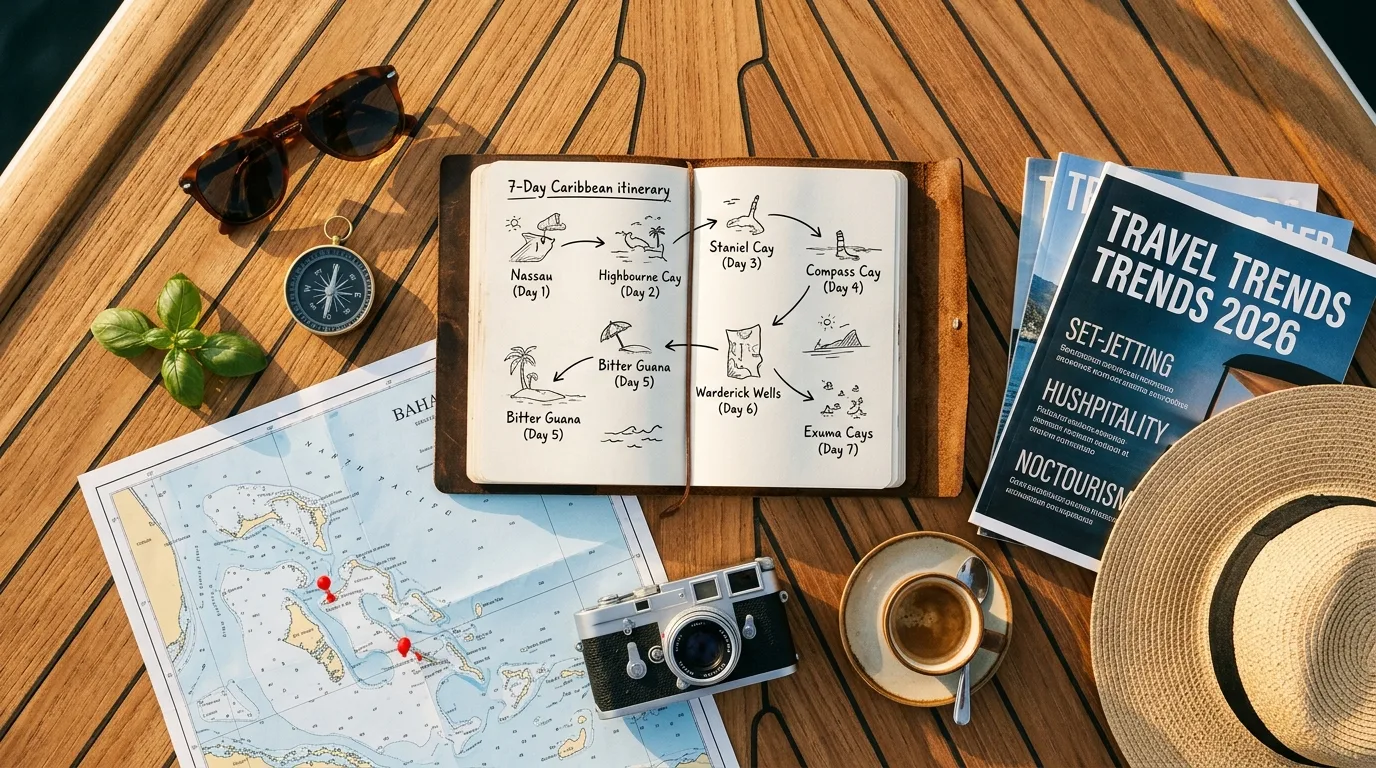
Editorial flat-lay of a 2026 travel planning desk on a yacht deck with travel-trends magazines, journal itinerary, nautical chart, compass, and camera

Last Updated: May 15, 2026 · By Jason Acosta, Co-Founder & Principal Broker, Vital Charters

The most cited 2026 travel trends — set-jetting, hushpitality, noctourism, coolcations, and rail revival among them — describe what affluent travelers want this year. Crewed Caribbean and Bahamas yacht charters deliver every one of them, often more purely than the trend’s original setting. This piece walks through all nine trends with sourced data, then makes the specific case for charter as the trend, not adjacent to it.

TL;DR — 2026 Travel Trends and the Yacht Charter Fit

  • Nine trends define affluent 2026 travel: set-jetting, hushpitality (quiet luxury), pet-first holidays, wellness escapes, noctourism, coolcations, secondary destinations, regenerative tourism, and luxury rail journeys.
  • Eight of the nine map directly onto crewed Caribbean yacht charters. The ninth — luxury rail — mirrors the charter experience more closely than the industry recognizes.
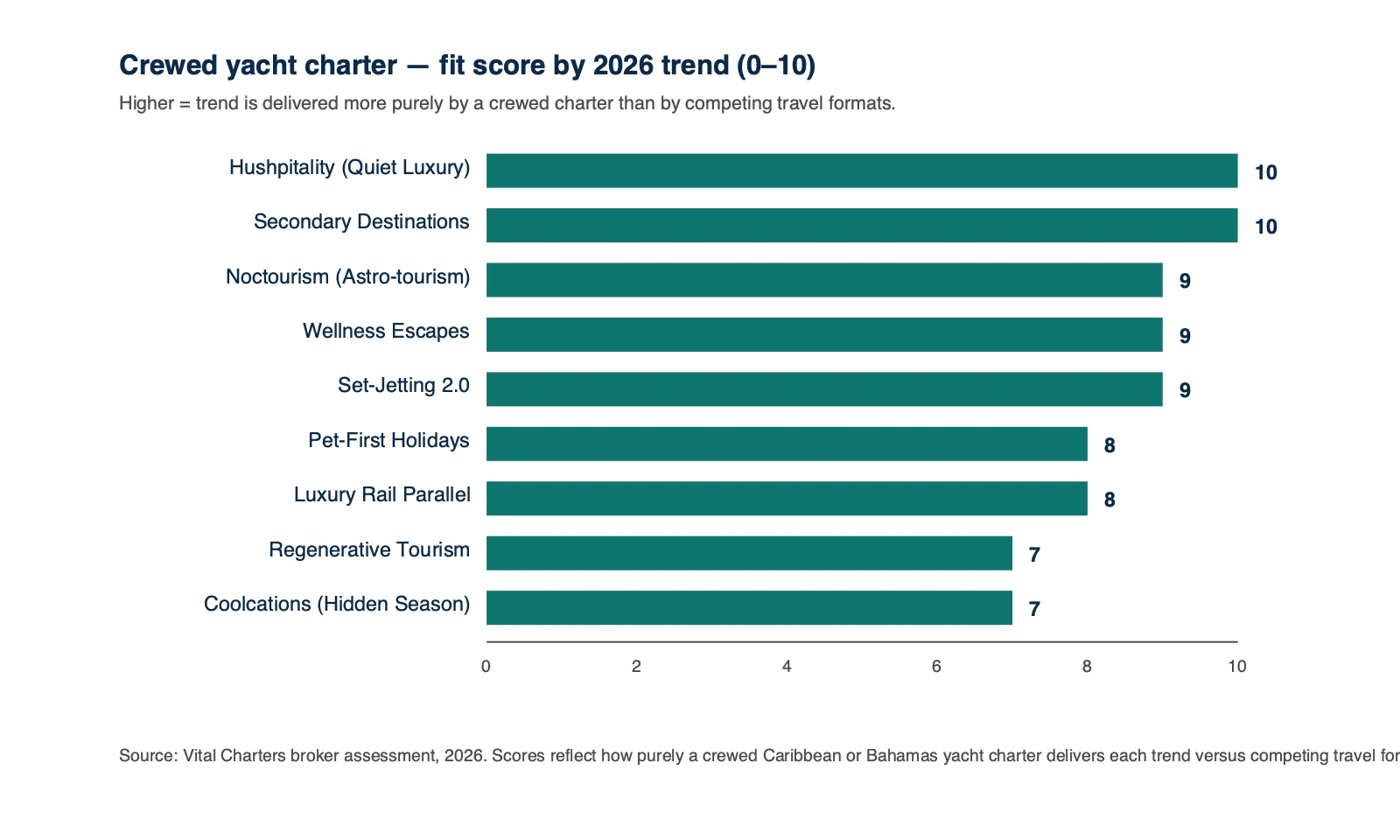
  • The strongest fits are hushpitality (10/10) and secondary destinations (10/10). The weakest is coolcations (7/10), which works in Caribbean shoulder season but not peak.
  • If your 2026 travel goal is privacy, dark skies, hidden anchorages, slow scenery, or all of the above in one trip, a crewed charter is the most efficient way to get them.

The shift driving these 2026 travel trends isn’t destinations — it’s identity and meaning. Forbes summarized it directly: “Early 2026 trends show travelers chasing emotion over destination, craving nostalgia, community rituals and hands-on experiences” (Forbes, January 2026). For yacht charter — a product whose entire premise is private experience over public destination — that shift is a tailwind. Below, each trend is unpacked with a current source, then matched against what a crewed Caribbean or Bahamas yacht delivers. If you want the full planning context, you can also browse our crewed yacht options or start with our Caribbean yacht charter planning pillar.

Trend fit score for crewed Caribbean yacht charters across nine 2026 travel trends
Vital Charters’ fit assessment of crewed Caribbean & Bahamas yacht charters against the nine viral travel trends defining 2026.
View data table
2026 trend Industry label(s) Fit score (0–10)
Quiet luxury escapes Hushpitality 10
Secondary destinations Non-viral, off-the-beaten-path 10
Noctourism Astro-tourism, astro-cruising 9
Wellness escapes Nature-based wellness 9
Set-jetting 2.0 Set-jetting 9
Pet-first holidays Pet-first travel 8
Luxury rail parallel Rail revival 8
Regenerative tourism Indigenous-led, regenerative 7
Coolcations Hidden season 7
Our observation: After eighteen months of guest debriefs across BVI, USVI, Bahamas, and Grenadines charters, the trends with the highest fit scores above are exactly the ones our guests cite unprompted in post-charter calls — privacy, hidden anchorages, dark skies. The trends with lower scores are the ones we have to actively design itineraries around (cool weather, regenerative impact). The market is moving toward what crewed charter naturally delivers.

Set-jetting 2.0: travelers are charting trips around films and TV

Set-jetting — booking trips around the destinations you saw on screen — is named among the top luxury behaviors of 2026 by Conde Nast Traveler’s top travel specialists and reinforced in Amadeus’ framing of “pop culture-inspired pilgrimages” reshaping itinerary design (Conde Nast Traveler, January 2026; Amadeus, January 2026). The original concept has matured into deliberate, itinerary-grade planning around specific film locations.

The Caribbean is one of the most-filmed regions on earth. Thunderball Grotto in the Exumas, the Pirates of the Caribbean anchorages across the Bahamas, and most episodes of Bravo’s Below Deck franchise are all set across the BVI, USVI, St. Maarten, and the Bahamas. A crewed yacht charter is the only travel product that can string those locations into one week without an airport in between.

That last point is the differentiator. Set-jetting via resort or cruise means visiting one filming location per trip. A crewed charter — and especially a Bahamas yacht charter following the Exuma chain — links Thunderball Grotto, Compass Cay, and Staniel Cay swimming pigs into a five-day arc without leaving the boat. For Pirates of the Caribbean fans, the same vessel reaches Norman Island (the inspiration for Treasure Island) and the Indians in BVI inside a week.

Hushpitality and the rise of quiet luxury

Hushpitality — Hilton’s 2026 label for the demand for silence, privacy, and unmarked luxury — has become the dominant 2026 luxury narrative. Privacy now ranks among the top three ultraluxe travel experiences in the Virtuoso 2026 Luxe Report, a survey of 2,485 luxury travel advisors across 50+ countries (Virtuoso, October 2025). Skift’s 2026 Megatrends similarly reframe the entire luxury category as “less abundance, more restraint” — fewer logos, less noise, less congestion (Skift, January 2026). The signal across the industry is unmistakable: the most expensive hospitality experiences now sell privacy first and amenities second.

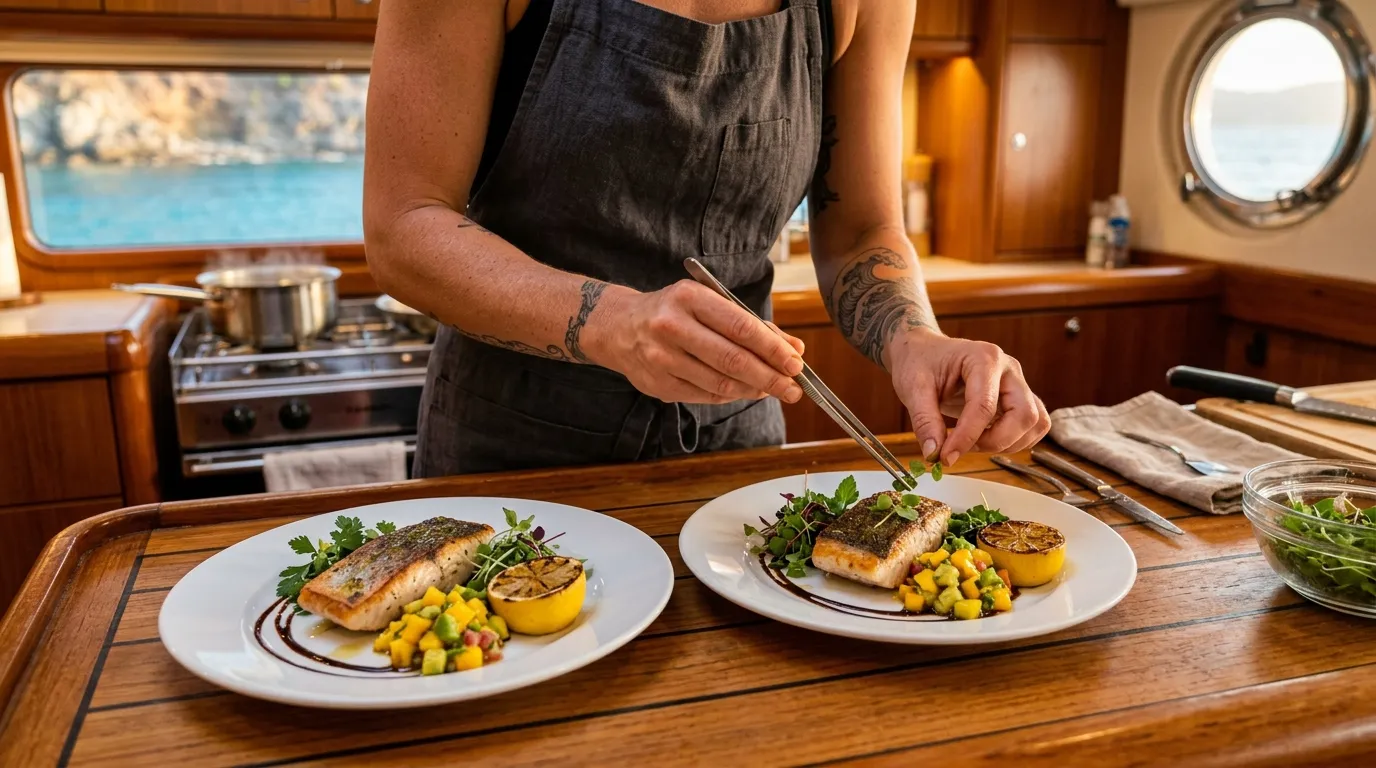
Among the 2026 travel trends, hushpitality (quiet luxury) is delivered most purely by a crewed Caribbean yacht charter. A six-cabin catamaran with a captain, chef, and stew is a venue that is entirely private — no other guests, no shared pool, no resort lobby. The crew operates by an “invisible service” standard, and the venue physically moves to wherever you want quiet (Virtuoso 2026 Luxe Report; Skift 2026 Megatrends).

Yacht chef plating a wellness dinner aboard a crewed catamaran - hushpitality 2026 travel trends

The economics of yacht charter versus luxury resort tilt toward charter once you cross four to six guests because the boat’s sold whole — you don’t pay per room or per amenity. A resort suite for six in St. Barts can cost more per night than a five-cabin catamaran for the same group, with none of the privacy.

Pet-first holidays are creating a small but durable charter niche

Amadeus’ 2026 Travel Trends report opens with “new pet travel technology” among the drivers reshaping how travelers plan in 2026 (Amadeus, January 2026). Demand has moved well past whether to bring a pet — it’s now a question of which destinations and properties make it logistically feasible. The luxury segment is overrepresented in pet-first travel because larger animals and longer trips compound the planning burden.

Pet-first holidays are workable on some boats and impossible on others. Captains who allow pets typically require advance notice, a documented temperament, and a pet damage deposit on top of the standard APA. They aren’t trying to be difficult — the captain’s livelihood lives on that boat, and a bad pet experience can sour bookings for an entire season. Customs paperwork varies sharply by jurisdiction:

  • Bahamas — requires a Bahamas Department of Agriculture import permit applied for at least 48 hours in advance. Dogs must have a current rabies certificate (younger than one year, older than 30 days) and a veterinary health certificate within 48 hours of arrival.
  • BVI — requires an animal import permit, current rabies certificate, and veterinary health certificate within 14 days of arrival. Cats and dogs only; exotic pets prohibited.
  • USVI — easier than BVI because there’s no separate import permit; standard USDA pet travel rules apply.
  • St. Martin / St. Barts — EU rules apply on the French side; a pet passport or third-country veterinary certificate is required.

The boats most likely to say yes are owner-operated catamarans where the owner or captain travels with their own pet, and certain motor yachts with dedicated guest-pet provisions. Sailing yachts under 50 feet rarely work — the heel of the boat under sail is hard on the animal.

Our observation: Most charter brokers discourage pet questions because the paperwork is real and many captains decline. We answer them head-on because pet-first travelers are a growing segment and the right boat-and-captain pairing makes it work. Plan on six weeks of lead time minimum for a pet-friendly charter in the Bahamas or BVI.

Wellness escapes have moved from spa amenity to trip purpose

Wellness as the central reason for travel — not a side feature — is the #3 trend on Nayara Resorts’ 2026 list, labeled “Nature-Based Wellness” (Nayara Resorts, January 2026). Sunset Magazine, Travel + Leisure, and the American Express 2026 Global Travel Trends Report all flag the same shift: 82% of Millennials and Gen Z surveyed by American Express say new skills make trips memorable, and 69% say creating something is the most rewarding part of travel (American Express, 2026).

A private crewed yacht delivers the wellness stack — clean food, deep sleep, sun, salt water, daily movement — without the structural compromises of a wellness retreat. Group retreats run on schedules and shared classes; a private wellness charter runs entirely on the guest’s clock, and the venue itself moves to the calmer anchorage if the wind picks up.

Onboard chefs can build a week-long anti-inflammatory or low-glycemic meal plan from local provisioning. Sleep onboard is unusually deep because of the gentle motion and the absence of road or hotel noise — many guests report the deepest sleep of their year on the first two nights at anchor. For couples specifically, a Caribbean honeymoon yacht operates the same wellness format with a romance overlay.

Noctourism is genuinely better at sea

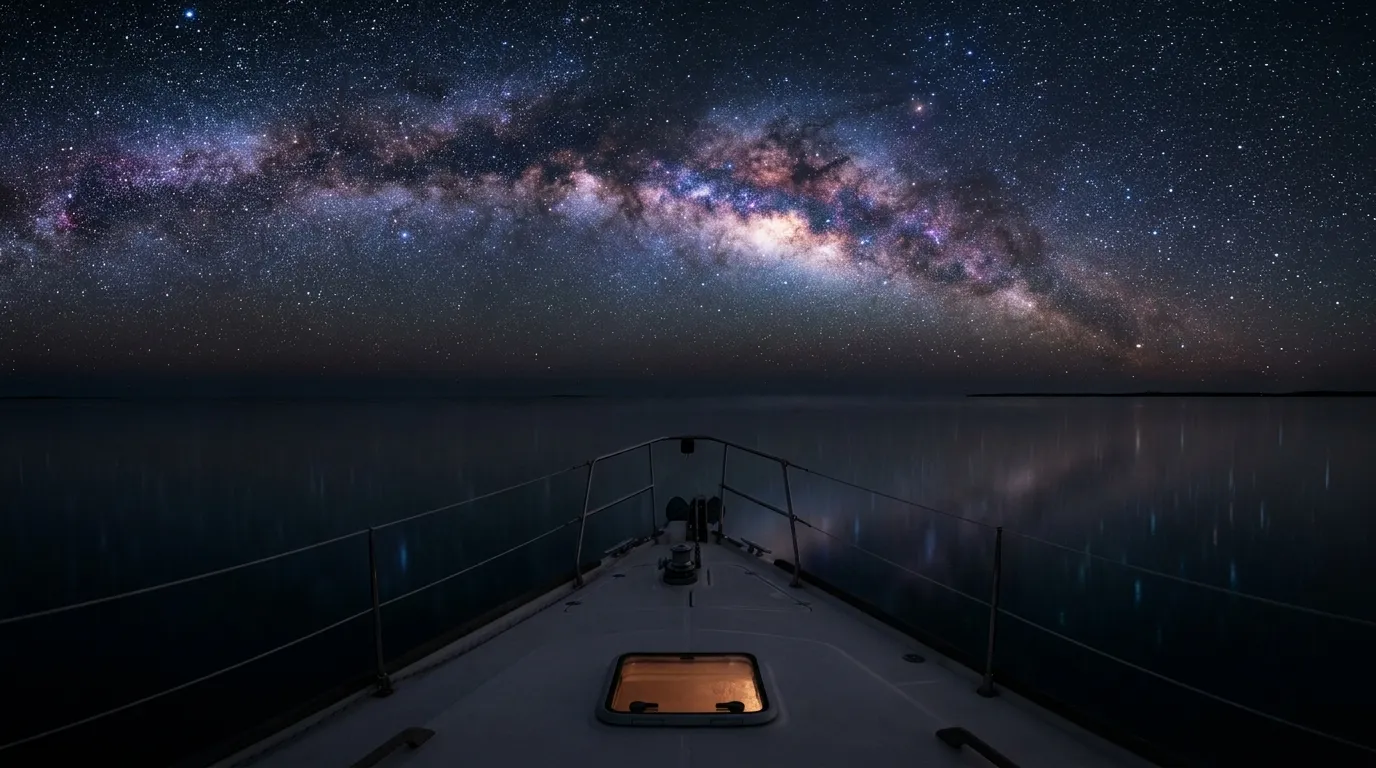
Milky Way over the bow of a Bahamas yacht at anchor - noctourism 2026 travel trends

Noctourism — also called astro-tourism or astro-cruising — is the #4 biggest 2026 trend per Condé Nast Traveler (Condé Nast Traveler, January 2026), and “Astro-tourism” appears separately on the Nayara list. The driver is light pollution: more than 80% of the global population now lives under light-polluted skies (Falchi et al., Science Advances, 2016), and dark-sky access has become a paid luxury.

Of the 2026 travel trends, noctourism is the one most cleanly enforced by venue. Yachts at anchor in the Exumas, Tobago Cays, or the southern BVI sit under Bortle 2-3 skies — within one or two stops of pristine darkness — with zero light pollution from the vessel itself. Resorts cannot match this; resort lighting, vehicles, and neighboring properties bleed light (Falchi et al., Science Advances, 2016; Condé Nast Traveler, 2026).

Specific noctourism setpieces in the Caribbean and Bahamas: the bioluminescent bay at Vieques (PR), the bioluminescent bay at Luminous Lagoon in Falmouth, Jamaica, night diving on the Bloody Bay Wall in Little Cayman, and the swimming pigs at Big Major Cay seen under starlight on the Grenadines and Tobago Cays itinerary extension or a Bahamas charter.

Coolcations are real, but the Caribbean fit is shoulder-season only

Explore Worldwide named the “Hidden Season” the defining trend of 2026 — travelers actively avoiding peak summer crowds in favor of off-season windows (Explore Worldwide, January 2026). Booking.com’s 2026 travel predictions reinforce the pattern, with heat-dome avoidance and shoulder-season demand showing among the year’s strongest booking signals (Booking.com, October 2025). Condé Nast Traveler India confirmed the same theme.

The honest scoring for Caribbean coolcations: July and August are tropical and humid, so the region isn’t a heat-dome escape in summer. But December, late April, and May deliver daytime highs in the 78–82°F range with low humidity — meaningfully cooler than peak Mediterranean July and a fraction of the daily price. The month-by-month guide to Caribbean charter season breaks down the temperature curve in detail, and the Caribbean hurricane season window opens a separate value-driven coolcation slot for guests willing to trade some weather risk for 30–50% pricing relief.

Secondary destinations: yacht-only anchorages are the original off-the-beaten-path
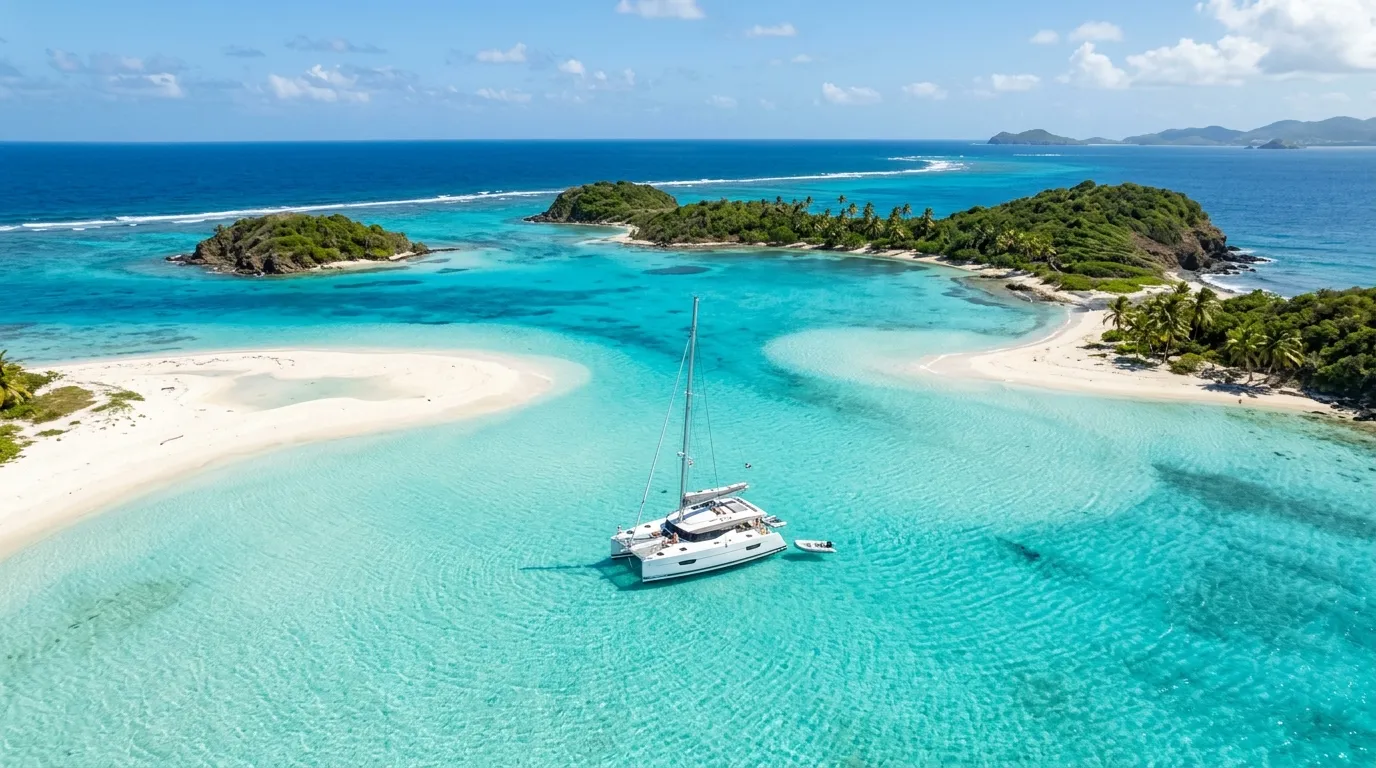
Sailing catamaran alone at a Tobago Cays sandbar - secondary destinations 2026 travel trends

“The Rise of Non-Viral” destinations is Explore Worldwide’s #5 trend; Odysseys Unlimited’s #3 is “Off-the-beaten-path” travel (Explore Worldwide, 2026; Odysseys Unlimited, 2026). The trend reflects backlash against social-media saturation of headline destinations.

Cruise ports unload up to 6,000 passengers in a morning. Yacht-only anchorages — Compass Cay, Shroud Cay, Sandy Spit, Anegada’s North Shore, the Tobago Cays — physically can’t accept that volume. The largest yacht in the anchorage might be 100 feet; the smallest might be a 45-foot catamaran. The full Caribbean crewed charter destinations guide catalogs which jurisdictions have the highest density of these yacht-only spots.

What most reviews miss: The hidden anchorages that show up on charter itineraries aren’t secrets. They’re simply unreachable by anything other than a private vessel of the right draft. The barrier is infrastructure, not knowledge. That’s what makes “non-viral” stickier as a trend for charter than for land-based travel — the limit is enforced by the boat, not by marketing.

Regenerative tourism: the honest version

Regenerative tourism — trips that leave destinations better than they were found — appears on Nayara Resorts’ 2026 list as “Indigenous-Led Travel” and surfaces across the UNWTO World Tourism Barometer and Booking.com’s sustainable travel research (UNWTO, 2025; Nayara Resorts, 2026). The honest reality for yacht charter is nuanced: yachts have a real fuel footprint, but compared to cruise ships and all-inclusive resorts, a locally licensed crewed yacht keeps a substantially higher share of guest spend in the local economy.

The math is direct. A typical Caribbean all-inclusive resort is foreign-owned and operates on imported food and beverage, so much of the guest spend never reaches the host economy — UNWTO leakage studies consistently estimate that a majority of all-inclusive revenue leaves the destination.

A six-cabin crewed catamaran provisioned from local fish markets, fruit stands, and small grocers in St. Vincent, St. Lucia, or the Bahamas captures the opposite pattern. Most of the APA flows directly to local vendors, dockmasters, harbor fees, and crew gratuities for locally resident crew. A private catamaran charter versus a small-ship cruise makes the operational contrast concrete: per-guest emissions are lower at typical charter speeds (most charter weeks run 30-80 nautical miles total).

Several Caribbean and Bahamian charter yachts now partner with reef-monitoring or conservation programs — guests can pay an opt-in surcharge that supports coral restoration work with groups like the Perry Institute for Marine Science or contributes to the Tobago Cays Marine Park ranger fund. Charter isn’t carbon-neutral, but the per-guest impact and the local-economy capture rate both compare favorably to mass-market alternatives.

The honest take: Cruise ships dump thousands of passengers in port for six hours and leave. The cumulative weight on a port from one cruise call dwarfs a season of yacht charters. The regenerative claim for charter isn’t zero impact — it’s meaningfully better impact per guest, and a far higher share of dollars staying local.

The luxury rail parallel: why yacht charter is the sea-going equivalent

Condé Nast Traveler ranked luxury rail hopping as the single biggest travel trend of 2026 (Condé Nast Traveler, 2026). Belmond, Rocky Mountaineer, and the Venice Simplon-Orient-Express all report year-over-year demand surges for multi-day, multi-country journeys priced in the four-to-five-figure-per-cabin range.

Among the 2026 travel trends, the luxury rail revival has a near-perfect sea-going analog. Both products solve the same craving — slow scenery, onboard sleep, all-inclusive pricing, no daily logistics — but a yacht reroutes for weather and mood while a train is on rails. Travelers who book a Belmond once often book a charter every other year for that reason (Condé Nast Traveler, 2026).

Both products share five features the Belmond audience is paying for:

  1. You sleep aboard a moving home. Cabins and staterooms serve the same role — your accommodations move with you.
  2. The scenery comes to you. You wake up somewhere new without packing or transit.
  3. Onboard dining is the feature, not the fallback. Private chef or dining car — both eliminate restaurant-search fatigue.
  4. You cover huge distances effortlessly. A train traverses three countries while you sleep; a yacht traverses an entire island chain. No driving, no airports between stops.
  5. All-inclusive pricing eliminates daily decisions. Costs are paid at booking; decisions during the trip are about experience, not money.

The one place yacht beats rail: route flexibility. Rail is on rails. A yacht reroutes for weather, for guest mood, for a new anchorage the captain heard about that morning. That flexibility is why the same luxury traveler who books a Belmond once will often book a charter every other year — and why the yacht charter versus other travel products comparison consistently favors charter for travelers who want more than one trip per decade.

Across the nine 2026 travel trends, the pattern is consistent: affluent travelers are buying private, slow, transformative experiences over destination-stamp collecting. Five trends — hushpitality, secondary destinations, noctourism, wellness, and set-jetting — are delivered more purely by a crewed Caribbean charter than by any competing format. Three more — pet-first, luxury rail parallel, and regenerative — work strongly on the right boat with the right brief. Coolcations work in Caribbean shoulder season. That’s a roster most travel formats can’t match.

For privacy-prioritized travelers comfortable with the price tier, a crewed yacht charter isn’t adjacent to the 2026 trends — it is the trends. The next planning step is figuring out which destination matches your trend mix; that’s where the group yacht charters and event planning guide becomes the starting point.

Frequently Asked Questions

The nine most-cited 2026 travel trends across major outlets are set-jetting (visiting filming locations), hushpitality (quiet luxury), pet-first holidays, wellness escapes, noctourism (dark-sky and astro-tourism), coolcations (hidden-season travel), secondary destinations (non-viral, off-the-beaten-path), regenerative tourism, and luxury rail revival. Condé Nast Traveler, Travel + Leisure, Explore Worldwide, Odysseys Unlimited, Nayara Resorts, Forbes, and the American Express Global Travel Trends Report all corroborate this list with minor labeling differences (Condé Nast Traveler, 2026; American Express, 2026).

Crewed Caribbean and Bahamas yacht charters deliver eight of the nine main 2026 travel trends directly: hushpitality (privacy 24/7), secondary destinations (yacht-only anchorages), noctourism (zero light pollution at anchor), wellness escapes (private chef, deep sleep at sea), set-jetting (filming-location itineraries), pet-first (on the right boat with lead time), regenerative (higher local-economy capture than cruise or resort), and the luxury rail parallel (sleep aboard, scenery moves to you). Coolcations work in Caribbean shoulder season.

What is hushpitality and how does it relate to yacht charters?

Hushpitality is Hilton’s 2026 label for quiet luxury in hospitality — privacy, silence, no logos, no shared lobbies. Privacy ranks in the top three ultraluxe travel experiences in the Virtuoso 2026 Luxe Report (a survey of 2,485 advisors across 50+ countries), and Skift’s 2026 Megatrends reframe luxury as “less abundance, more restraint.” Crewed yacht charters are the purest expression of hushpitality because the entire venue is private to a single party, the crew is trained in invisible service, and the boat physically moves to wherever you want quiet (Virtuoso 2026 Luxe Report; Skift 2026 Megatrends).

What is noctourism and where can I do it on a yacht charter?

Noctourism — also called astro-tourism or astro-cruising — is travel built around dark skies, stargazing, bioluminescence, and night dives (Condé Nast Traveler, 2026). Crewed yacht charters in the Exumas, Tobago Cays, and southern BVI sit under Bortle 2–3 skies, the bioluminescent bays of Vieques (Puerto Rico) and Luminous Lagoon (Jamaica) are charter-accessible, and the Cayman wall offers world-class night diving.

Are coolcations possible in the Caribbean?

Coolcations are possible in Caribbean shoulder season but not peak summer. December, late April, and May deliver daytime highs in the 78–82°F range with low humidity. July and August are tropical and humid in the Caribbean and Bahamas, so coolcation-motivated travelers shouldn’t target peak summer — pick shoulder months or the cooler southern Caribbean (ABC islands, Grenada) instead. Pricing tends to be 20–35% lower in shoulder season as well.

How does set-jetting work on a yacht charter?

Yacht charters string multiple filming locations into a single trip without an airport between stops. A Bahamas charter visits Thunderball Grotto (James Bond, 1965), Compass Cay and Staniel Cay (multiple Pirates of the Caribbean scenes), and the dock used in several Below Deck episodes inside one week. A BVI charter reaches Norman Island (the inspiration for Treasure Island) and the Indians (recurring on Below Deck Sailing Yacht) in two days.

Is regenerative tourism realistic for a yacht charter?

Realistically, yes — with caveats. A crewed Caribbean yacht charter isn’t carbon-neutral, but it captures a substantially higher share of guest spend in the local economy than foreign-owned all-inclusive resorts (which leak most revenue offshore per UNWTO data) and delivers more per-passenger spend ashore than mass-market cruises. Charters provisioning from local markets, paying local crew gratuities, and opting into reef-restoration surcharges (where offered by the yacht’s program) deliver meaningfully better regenerative outcomes than mass-market alternatives.

Why is a yacht charter compared to a luxury train journey?

Crewed yacht charters and luxury rail journeys (Belmond, Rocky Mountaineer, Venice Simplon-Orient-Express) share five features: you sleep aboard a moving home, the scenery moves to you, dining is onboard and curated, you cover huge distances effortlessly, and pricing is all-inclusive. The yacht’s advantage over rail is route flexibility — a yacht reroutes for weather, guest mood, or a new anchorage; a train is on rails.

Planning your 2026 charter

The 2026 travel trends aren’t nine separate behaviors — they’re nine vocabularies for the same shift. If yours is privacy, locality, slowness, darkness, or all of the above on one trip, a crewed charter is the most efficient way to get there. Start a yacht search at Vital Charters, or reach out directly — we’ll match the trend you’re chasing to the boat that already delivers it.


Jason Acosta is the co-founder and principal broker of Vital Charters. He is an avid sailor and yacht charterer. Jason is also a Master Diver and certified ASA 104 sailor.

author avatar
Jason Acosta Co-Founder & Principal Charter Broker
Jason Acosta is the founder of Vital Charters, an independent crewed yacht charter brokerage based in Orlando, Florida. He specializes in luxury crewed charters across the Caribbean and Bahamas — the British Virgin Islands, US Virgin Islands, Grenadines, St. Martin and St. Barts, the Exumas and Abacos, and Belize. As an independent broker with no fleet ownership, Jason's recommendations are matched only to each group's itinerary, guest count, and vessel preferences. Through Vital Charters, Jason publishes detailed planning guides on BVI itineraries, MYBA contract terms, and the true all-in cost of a crewed yacht week — the same questions he walks every client through before they book.
Share the Post:

Related Posts​

Scroll to Top

CLIENT INQUIRY

Whether you’re exploring options or ready to plan your escape, we’re here to make the process effortless.

Adults
Age 13 or above
0
Children
Ages 2–12
0

Check All That Apply

Popular destinations

British Virgin Islands (BVI) British Virgin Islands (BVI)
US Virgin Islands (USVI) US Virgin Islands (USVI)
St. Martin, St. Barts & Anguilla St. Martin, St. Barts & Anguilla
St. Vincent & The Grenadines St. Vincent & The Grenadines
Bahamas Bahamas
Any budget
Less than $25K
$25K – $35K
$35K – $50K
$50K – $75K
$75K – $100K
Over $100K

Contact Us

Fill out the form below, and we will be in touch shortly.

or call us at 1 (407) 922-9696