
Yacht Charter Food: What Your Private Chef Cooks All Week
Yacht charter food explained: the preference sheet sent two months out, a day of meals, allergies, Caribbean dishes and a conch fritter recipe.
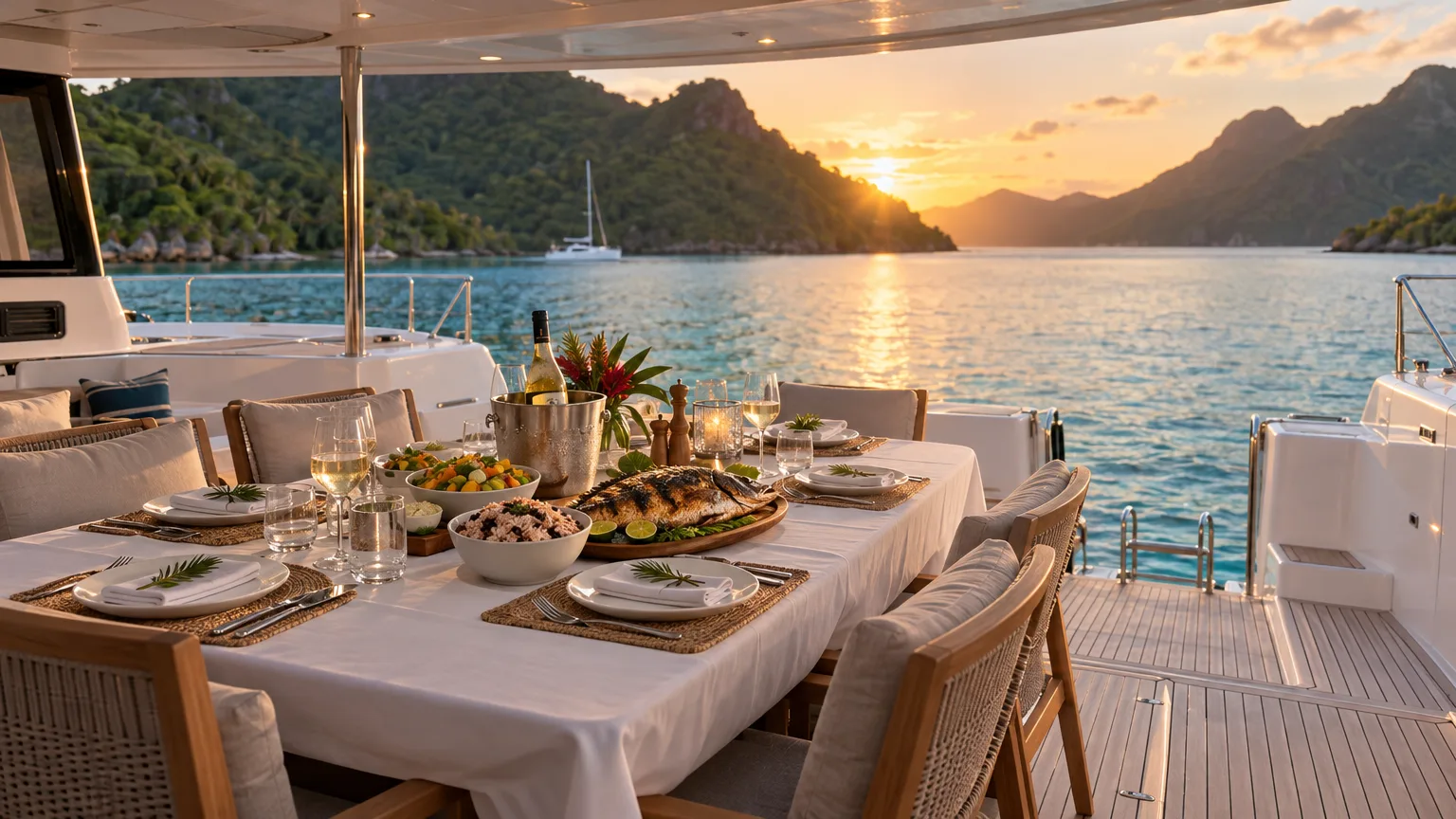
Yacht charter food on a crewed Caribbean charter starts about two months before you board, with a preference sheet the chef plans and shops from. Vital Charters sends the preference sheets then and sets up the crew introduction once they come back, so the crew can ask follow-up questions about your answers. By the time you step aboard, the galley is stocked around them.
A private chef is what separates a crewed yacht charter from a villa or a resort: there’s no menu to order from. The chef writes one for your group, cooks every meal on board and keeps adjusting it through the week.
What does the yacht charter preference sheet ask?
A yacht charter preference sheet asks how you eat at every meal, what you won’t eat, who has allergies and what you drink, and the chef provisions the yacht from those answers before you arrive. CYBA’s 2026 crew guidance tells crews to “follow the preference sheet closely” and to tell the broker if an item can’t be provisioned (CYBA Crew Playbook, 2026).
One BVI catamaran publishes its sheet online. Its sections run from arrival and guest details through health, charter activities, provisioning, the ship’s bar, beverages and a kids’ section. The food questions ask whether breakfast should be light, moderate or full, and whether lunch should be hot or cold. They also ask for your favorite snacks and cuisines, the proteins you like at dinner, your major dislikes and any allergies.
For drinks, a yacht’s standard ship’s bar is a named list of house spirits, beer and wine. The Charter Yacht Brokers Association’s booking standard asks central agents to detail it in the industry databases (CYBA, 2022). Brands above that list can carry an extra charge, so a particular bottle goes on the preference sheet by name.
Once the sheets are back, the broker sets up the crew introduction, a call where guests, captain and crew go over the preference sheets and the itinerary together (CYBA Crew Playbook, 2026). We schedule it after the sheets come back on purpose. By then the crew have read every answer, so they can ask follow-up and clarifying questions before they shop.
What does a charter chef cook in a day?
A charter chef cooks every meal of the day aboard, from breakfast and lunch to snacks, sundowner bites and dinner. On a smaller crewed sailing yacht, the cook may also be the mate. Cruising World describes the typical crewed sailing charter as “usually a captain, plus a first mate who doubles as cook” (Cruising World, 2019).
A typical charter day follows the sheet you filled in:
- Breakfast: cooked to order or laid out, depending on whether you asked for light, moderate or full.
- Lunch: hot or cold, as you chose on the sheet.
- Afternoon: snacks and fruit between swims, and a cold drink when you climb back aboard.
- Sundowners: drinks from the ship’s bar with something small from the galley.
- Dinner: the chef’s main event, plated and served at the table on the aft deck or flybridge.
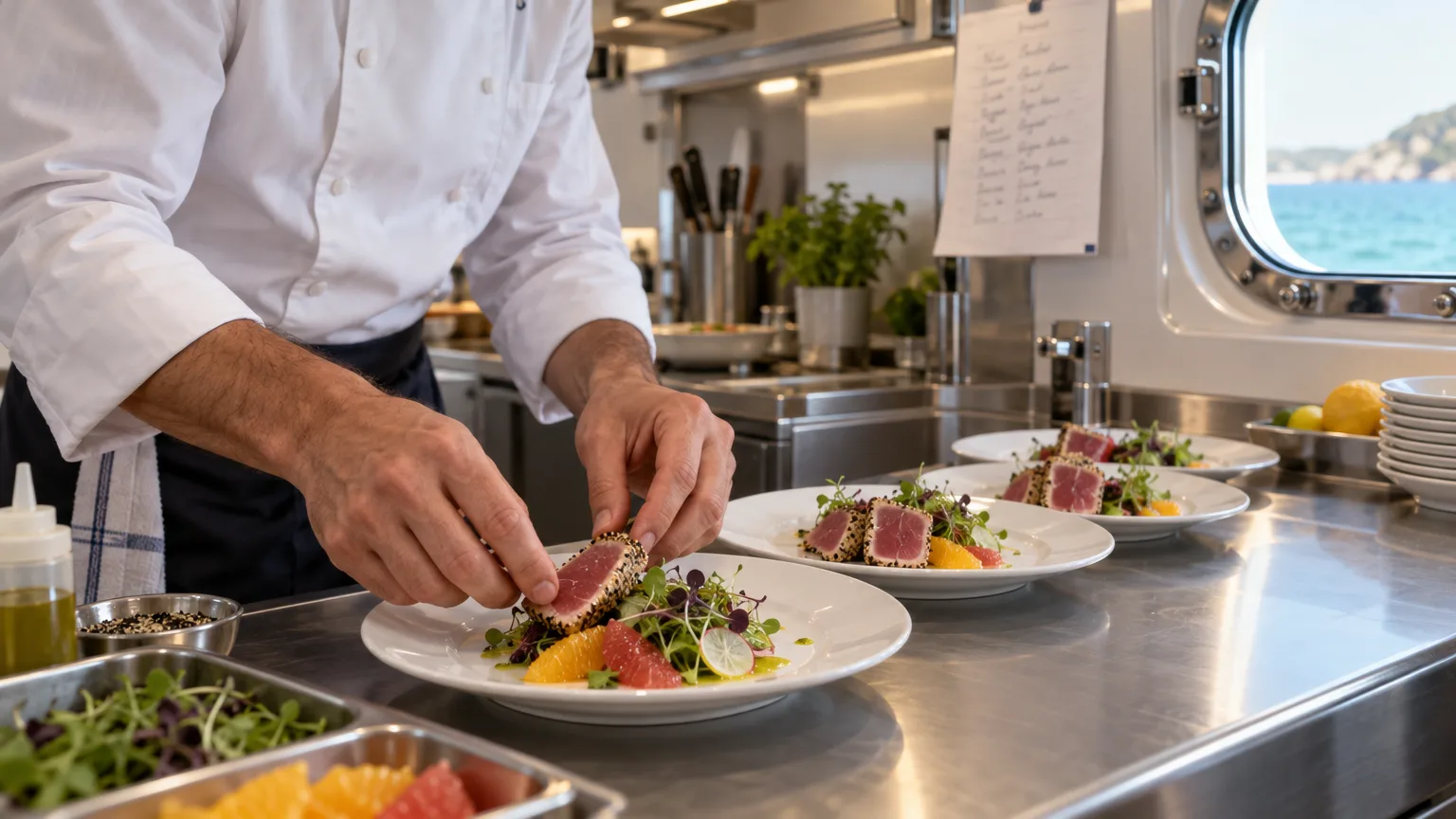
On terms yachts list as all-inclusive, the meals and the standard ship’s bar are part of the charter rate, so there’s no running food bill. On plus-expenses terms, the same food is bought from an advance provisioning allowance (APA) paid on top of the base rate.
CYBA asks its brokers not to lean on that label: to “refrain from using the term ‘all inclusive'” in proposals and to spell out what is and isn’t included instead (CYBA, 2022).
The search below shows crewed yachts that fit your group size.
Who decides on meals ashore during a crewed charter?
The guests decide on meals ashore during a crewed yacht charter, and the crew book the tables. CYBA’s crew playbook lists restaurant reservations among the crew’s own pre-charter tasks (CYBA Crew Playbook, 2026). The nights you want ashore, at the newer BVI restaurants or an old favorite, belong on the preference sheet.
Whether to invite the crew along is up to you. Cruising World notes that many brokers suggest treating the captain and crew to dinner ashore on one night and calls it “entirely optional” (Cruising World, 2019). CYBA’s playbook gives crews the matching advice: “perhaps one meal is appropriate” with guests during a charter (CYBA Crew Playbook, 2026).
On an all-inclusive rate, the restaurant bill for a dinner ashore is paid on top of the charter fee.
Can a charter chef handle allergies and special diets?
Yes, charter chefs treat allergies and special diets as a normal part of the job, and they plan for them from the preference sheet before the charter starts. A yacht chef writing in Dockwalk in 2023 said that “it’s very common to be on a charter with multiple dietary requirements” (Dockwalk, 2023).
CYBA’s booking standard asks brokers to confirm the chef’s ability to cook for the dietary requirements on the charter before the booking goes ahead (CYBA, 2022). That makes the booking stage the time to raise a serious allergy, a child’s nut allergy included, before a yacht is chosen.
With a severe food allergy, the detail on the sheet becomes a safety question. Dockwalk’s 2026 report on allergy emergencies aboard notes that yacht chefs are “well versed in preventing cross contamination,” and names a preference sheet “lacking the necessary detail” as one of the risky scenarios. In the same report, the maritime telemedicine physician Dockwalk interviewed recommends carrying at least two auto-injectors on board in case repeat dosing is needed (Dockwalk, 2026).
Who are the chefs on Caribbean charter yachts?
Charter chefs come from culinary schools, restaurant kitchens and short yacht-cookery courses, and many say so in their published biographies. Of 500 charter chefs listed on the crewed yachts we track, 126 name at least one culinary school in their biography. Another 55 describe culinary training without naming where (Vital Charters analysis of chef biographies, October 2026).
The school named most often is Ashburton Chefs Academy in Devon, England, cited by 41 chefs. Of those, 6 say they graduated and 20 describe a course or certificate (Vital Charters analysis of chef biographies, October 2026). Next come the Superyacht Culinary Academy in Cape Town, named by 10, and Johnson & Wales University in the United States, named by 7. Three chefs name the University of The Bahamas or one of its forerunners, the College of The Bahamas and the Bahamas Hotel Training College.
A biography is the yacht’s own description of its chef, so a school named there is a claim about training, not a checked diploma. Crew also change from season to season, which is why the chef named on a yacht’s listing gets confirmed when you book.
What is local yacht charter food in the BVI, USVI and Bahamas?
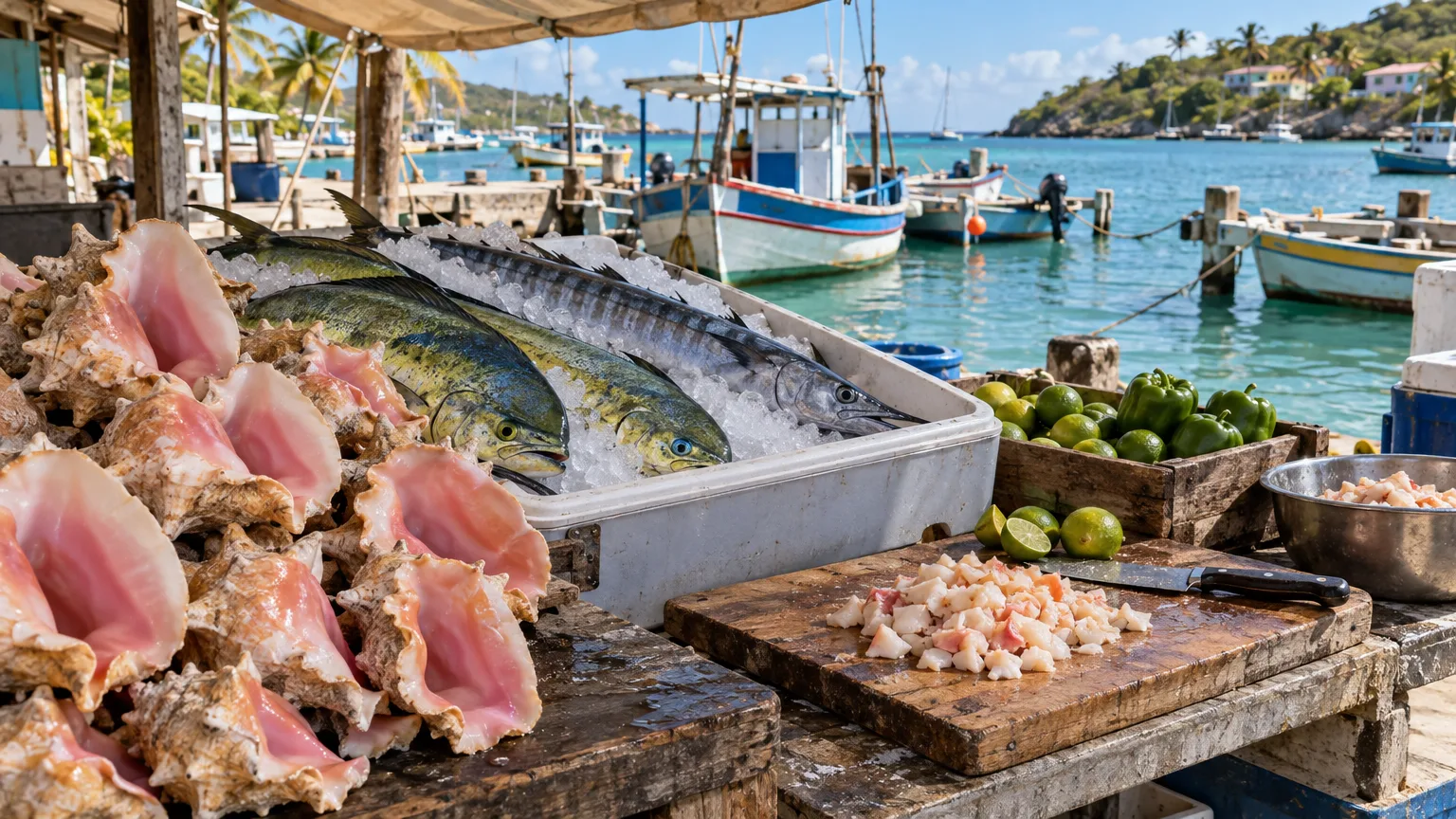
Local yacht charter food in the Virgin Islands and the Bahamas centers on conch, spiny lobster and local fish such as mahi-mahi and wahoo, with island staples like fungi and johnny cakes. Fish and Fungi became the official dish of the US Virgin Islands by law in 2024 (Government of the US Virgin Islands, 2024).
US Virgin Islands
Fungi is cornmeal cooked to a light, creamy consistency close to polenta (Visit USVI, 2026). The same tourism page describes johnny cakes as slightly sweet fried dough and pates as fried turnovers filled with ground meat or salt fish. Kallaloo soup also appears in the tourism board’s guide to local dishes (Visit USVI, 2026). St Thomas has a daily farmers market whose busiest day is Saturday (Visit USVI, 2026).
British Virgin Islands
In the BVI the food headline is Anegada’s spiny lobster. Caribbean Journal calls the island “the lobster capital of the Caribbean,” and the annual Anegada Lobster Festival falls in late November (Caribbean Journal, 2026). A lobster dinner on Anegada is one of the classic nights ashore on a BVI crewed yacht charter. The BVI also sets closed seasons for conch, whelk and lobster (BVI News, 2020), and the crew plan the menu around whichever is open that week.
The Bahamas
Conch is “one of the island nation’s staples, as well as a cultural icon” in the Bahamas (National Geographic, 2019). The country’s tourism board lists it cracked (battered and fried), steamed, stewed, in fritters and in chowder (Bahamas Ministry of Tourism, 2016). At Potter’s Cay in Nassau, under the bridge to Paradise Island, roughly forty chefs in forty shacks cook conch dishes (Bahamas Ministry of Tourism, 2026). The conch comes in daily from Abaco, Exuma and the Berry Islands (Caribbean Journal, 2022).
Bahamian lobster, called crawfish, has a closed season from April 1 to July 31 each year, and the open season runs August 1 to March 31 (Bahamas Trade Info, 2024). An April-to-July Bahamas yacht charter therefore leans on conch and fish, while one between August and March can have lobster too.
Conch and fish: what the chef buys, and why
Queen conch was listed as threatened under the US Endangered Species Act in 2024. NOAA Fisheries says the listing “does not create any additional, or more specific, prohibitions on queen conch trade or harvest” (NOAA Fisheries, 2024). Local rules still apply. The US Virgin Islands closes its conch harvest from June through October and reopens it on November 1 (USVI Department of Planning and Natural Resources, 2025).
Mahi-mahi, also called dolphinfish, and wahoo are fished in USVI federal waters under size and bag limits that took effect in 2025 (NOAA Fisheries, 2025). The chef’s choice of fish is a safety decision as well. The CDC lists large carnivorous reef fish such as barracuda, amberjack and grouper among those most likely to carry ciguatera, a toxin that cooking and freezing don’t destroy (CDC, 2025).
How do you make conch fritters at home?
Conch fritters, one of the ways Bahamians cook conch (Bahamas Ministry of Tourism, 2016), are pieces of tenderized conch folded into a seasoned flour batter and deep-fried until golden. The Vital Charters recipe below adds lime zest and juice, rests the batter briefly, and uses conch that’s pounded and hand-diced instead of ground.
Conch is a tough, chewy meat, so cooks pound it thin with a mallet before it goes into a batter, the same way cracked conch starts. NOAA Fisheries calls the United States “a major importer of queen conch” (NOAA Fisheries, 2026). Florida closed its commercial conch fishery in 1975 and recreational harvest in state waters in 1985 (UF/IFAS Extension, 2022), so the conch in a Florida fritter comes from somewhere else.
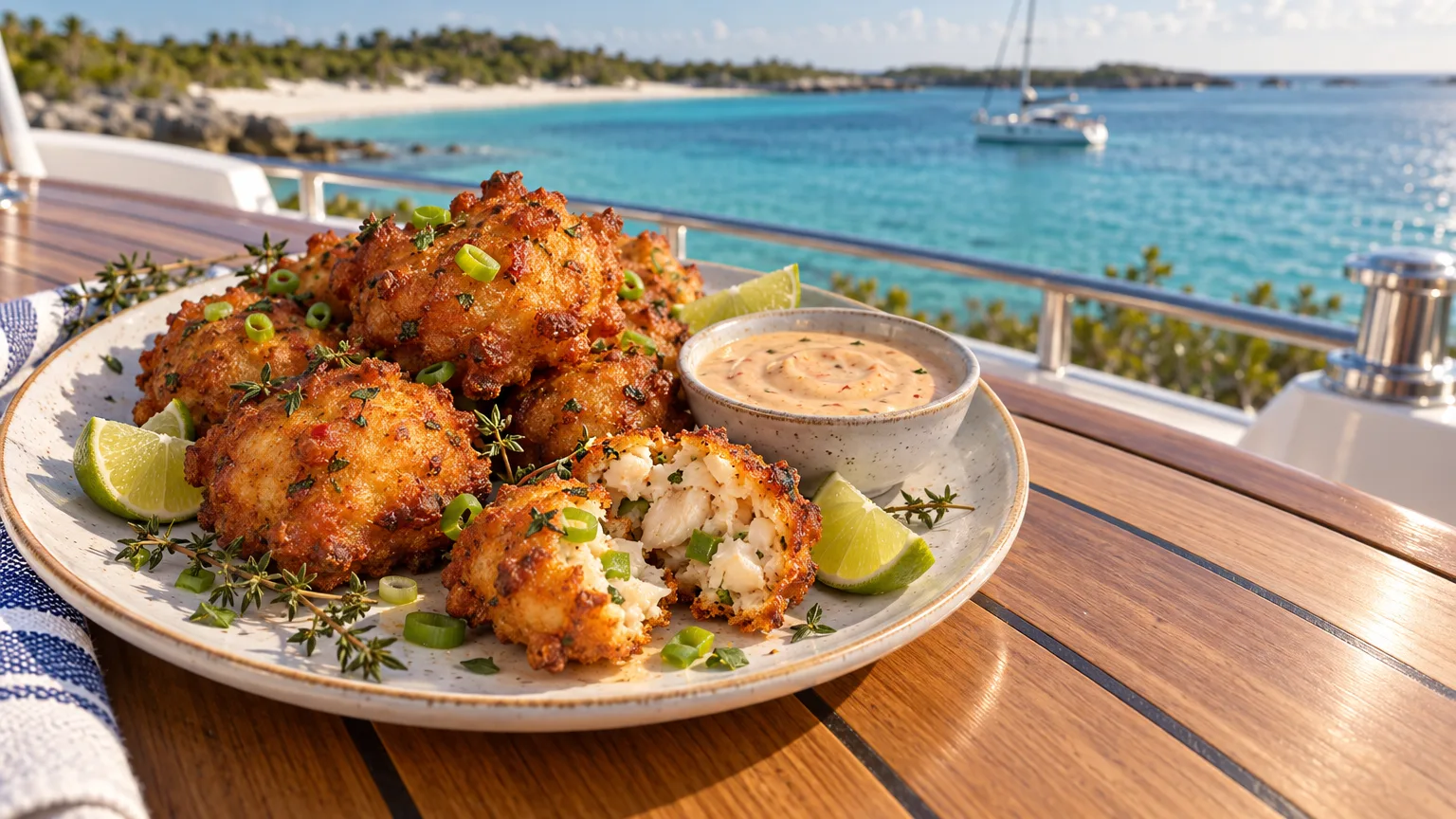
Vital Charters conch fritters
Makes: about 20 fritters, enough for six as a starter. Prep: 40 minutes, including resting. Cook: about 15 minutes in batches.
For the fritters
- 1 lb (450 g) cleaned conch meat, thawed if frozen
- 2 limes
- 1 cup (125 g) all-purpose flour
- 1½ teaspoons baking powder
- ½ teaspoon fine salt, plus more to finish
- ½ cup (120 ml) whole milk
- 1 large egg
- ½ small onion, finely diced
- ½ green bell pepper, finely diced
- 1 celery stalk, finely diced
- 2 scallions, thinly sliced
- 2 garlic cloves, minced
- 1 teaspoon fresh thyme leaves
- ½ Scotch bonnet or Bahamian goat pepper, seeded and minced (optional)
- Peanut or canola oil, for frying
For the lime-pepper dip
- ½ cup (120 ml) mayonnaise
- Juice of ½ lime and a pinch of its zest
- 1 to 2 teaspoons of your favorite Caribbean hot sauce
Method
- Tenderize the conch. Lay it between two sheets of plastic wrap and pound it with a meat mallet until it’s about ¼ inch thick. Cut it into ¼-inch dice, toss with the juice of one lime, and set aside for 15 minutes.
- Make the batter. Whisk the flour, baking powder and salt in a large bowl. In a second bowl, whisk the milk, egg and the zest of one lime.
- Combine. Drain the conch. Stir the milk mixture into the flour until just smooth, then fold in the conch, onion, bell pepper, celery, scallions, garlic, thyme and hot pepper. The batter should hold its shape on a spoon. Cover and rest it for 20 minutes so the flour hydrates.
- Heat the oil. Pour oil 2 to 3 inches deep into a heavy pot and heat it to 360°F. Food-service frying runs between 325 and 375°F, and the oil drops sharply when food goes in (Oklahoma State University, 2010), so fry six or seven at a time.
- Fry. Drop rounded tablespoons of batter into the oil and fry for 3 to 4 minutes, turning once, until deep golden. Break one open: the center should be cooked through. The FDA’s guideline for most seafood is an internal 145°F (FDA, 2024).
- Finish. Drain on a rack, salt lightly, squeeze over the second lime, and serve hot with the dip.
No conch? Chopped shrimp or clams work in the same batter, and the fritters cook in about the same time.
Where to start planning your yacht charter food
Menu planning for a charter week starts about two months out, when the preference sheets arrive. Settle the terms first. All-inclusive puts the food inside the Caribbean yacht charter cost, and APA adds it on top. Then fill in the sheet for every guest, by name and in detail. When you’re ready to choose a yacht and a chef, start a crewed yacht search at Vital Charters.
Frequently Asked Questions
Is food included on a crewed yacht charter?
It depends on the yacht’s terms. On all-inclusive terms, meals and a standard ship’s bar are part of the charter rate, with premium wines and spirits extra. On plus-expenses terms, food and drink come out of an advance provisioning allowance paid on top of the base rate, and the crew account for it at the end of the week.
When do you fill in the preference sheet?
Fill in the preference sheet when it arrives, about two months before the charter. Vital Charters sends the preference sheets around then and sets up the crew introduction after they come back, so the crew can ask follow-up and clarifying questions before they provision.
Can you ask the chef for specific dishes?
Yes. Name the dishes, cuisines and drinks you want on the preference sheet, along with the dinners you’d rather eat ashore. The chef provisions specialty items before the charter, and the crew tell the broker in advance if something can’t be found in the islands.
Is it legal to eat conch in the Caribbean?
Yes. Queen conch was listed as threatened under the US Endangered Species Act in 2024, but NOAA Fisheries says the listing adds no new limits on trade or harvest. Local seasons still apply, and the US Virgin Islands closes its conch harvest from June through October, reopening it on November 1.
A week of meals cooked around your group
Tell us your group size, dates and how you like to eat, and we’ll match you with a crewed yacht and a chef who fits.