
Best Snorkeling in the BVI: 15 Spots Compared (2026)
Compare 15 spots for the best snorkeling in the BVI: which reefs suit beginners and kids, which need calm seas, and which to reach before the day boats arrive.
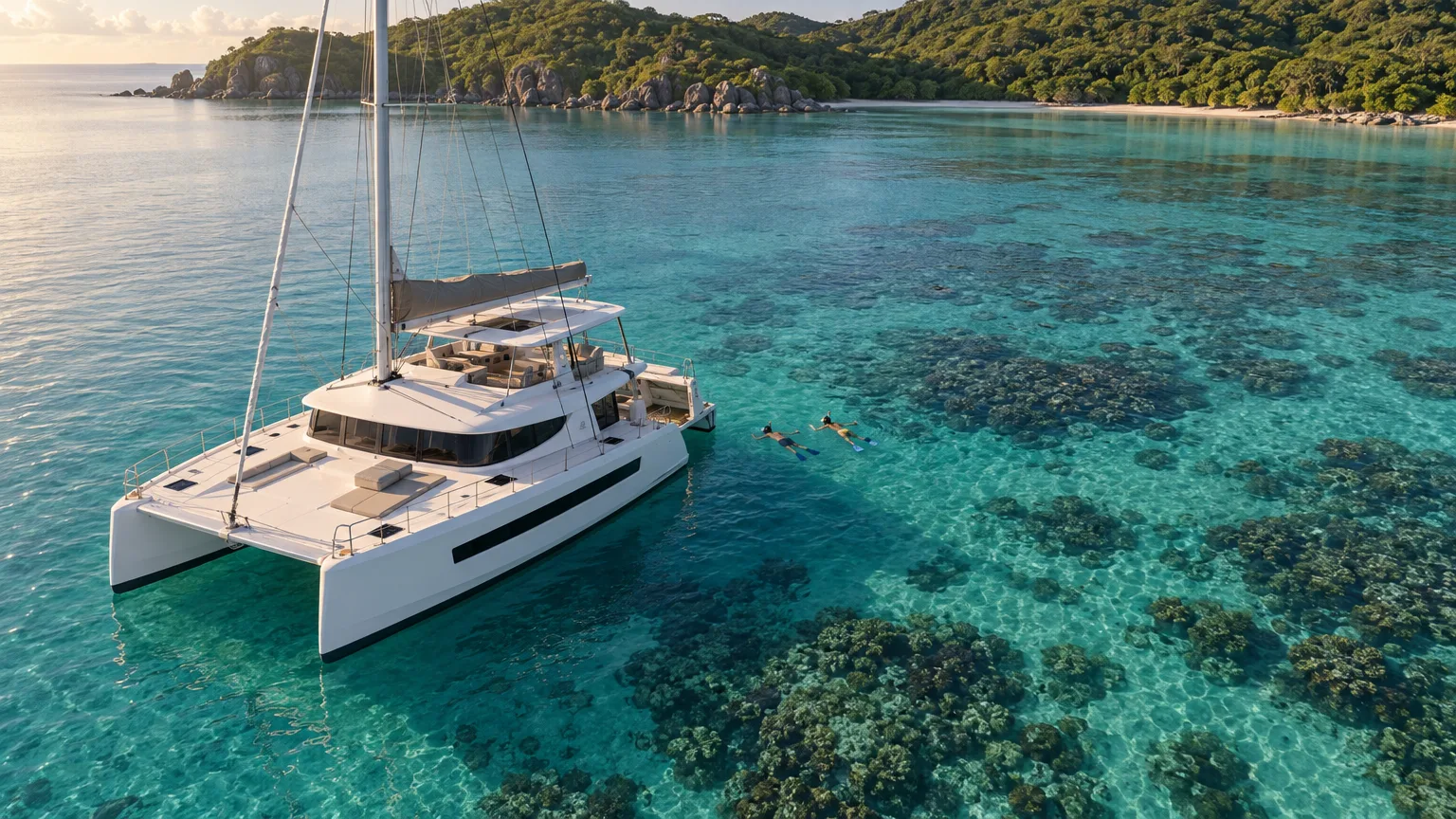
The best snorkeling in the BVI is on the small islands along the south side of the Sir Francis Drake Channel. That’s where you’ll find the Caves and the Indians at Norman Island, Coral Gardens at Dead Chest, the wreck of the RMS Rhone off Salt Island, and Cistern Point on Cooper Island. Add The Baths on Virgin Gorda and the cays off Jost Van Dyke, and you have the British Virgin Islands snorkeling the day-trip boats build their itineraries around.
On a crewed yacht you get the same reefs on your own schedule, and the crew picks each morning’s spot from the wind and swell. This guide compares 15 of them by who they suit, the weather they need and when to arrive, with links to the island guides for more. For the territory as a whole, start with our insider guide to a BVI crewed charter, and the British Virgin Islands destination page shows the yachts that cruise these waters.
Where is the best snorkeling in the BVI?
The best snorkeling in the BVI clusters in the chain of small islands south of the Sir Francis Drake Channel and around Virgin Gorda, where nine of the 15 spots below sit. The Caves at Norman Island are “ideal for snorkelling” (Wikipedia, 2026), and one SAIL expert writes, “When we have first-timer guests, we always head for the caves” (SAIL, 2008).
The table sets all 15 side by side, and the sections after it explain the ratings.
| Spot | Island | Best for | Conditions | When to go |
|---|---|---|---|---|
| The Caves | Norman Island | Beginners with a float, families | Cliff-foot caves; jellyfish at times | Early or mid-morning |
| The Indians | Off Pelican Island | Confident swimmers | Open water, fire coral, no beach | Early, before the crowds |
| Coral Gardens | Dead Chest | Novices | Very calm weather only; boat traffic | Calm mornings |
| RMS Rhone (stern) | Salt Island | Strong swimmers, divers | Open water over a wreck | First thing |
| Cistern Point | Cooper Island | Snorkeling off the dinghy line | Inside the Drake Channel | Morning |
| Deadman’s Beach | Peter Island | Beach-entry snorkeling | Swim straight off the sand | Morning |
| The Baths and Devil’s Bay | Virgin Gorda | Swimmers who like a scramble | Closed to boats in big winter swells | At opening time |
| The Crawl, Spring Bay | Virgin Gorda | Children and first-timers | Boulder-ringed pool | Morning |
| Vixen Point | Prickly Pear, North Sound | Beginners | Sheltered by reef; busy with boats | Any calm day |
| Cam Bay | Great Camanoe | Beginners, turtle-spotting | Shallow reef and lagoon | Morning |
| Monkey Point | Guana Island | A lunchtime stop | Day mooring only | Late morning |
| Sandy Spit and Green Cay | Off Jost Van Dyke | Everyone, on a flat day | Tiny, open cays | Before the day boats |
| Sandy Cay | Off Jost Van Dyke | Snorkeling from the beach | Day moorings on the southwest side | Morning |
| Diamond Cay | Jost Van Dyke | Easy reef close to the boat | Jost’s south shore | Any time |
| Loblolly Bay | Anegada | A beach day by taxi | Needs settled weather to reach Anegada | A settled day |
Which BVI snorkel spots suit beginners and children?
The gentlest BVI snorkeling is The Crawl at Spring Bay, which the BVI National Parks Trust describes as “a small bay enclosed by a circle of boulders” that is “now a natural swimming pool” (BVI National Parks Trust, 2026). It’s a sheltered place for a child’s first swim.
Three more suit beginners. Vixen Point on Prickly Pear is inside North Sound, and the island “is fringed on the northern side by the Bank Barrier Reef,” with swimming and snorkeling off its beaches (BVI National Parks Trust, 2026). The Parks Trust says Cam Bay, on Great Camanoe’s eastern shore, has “calm waters and pristine marine environment for swimming and snorkeling” (BVI National Parks Trust, 2026). The Caves, an easy swim from Norman Island’s Privateer Bay, are where SAIL’s expert takes first-timers.
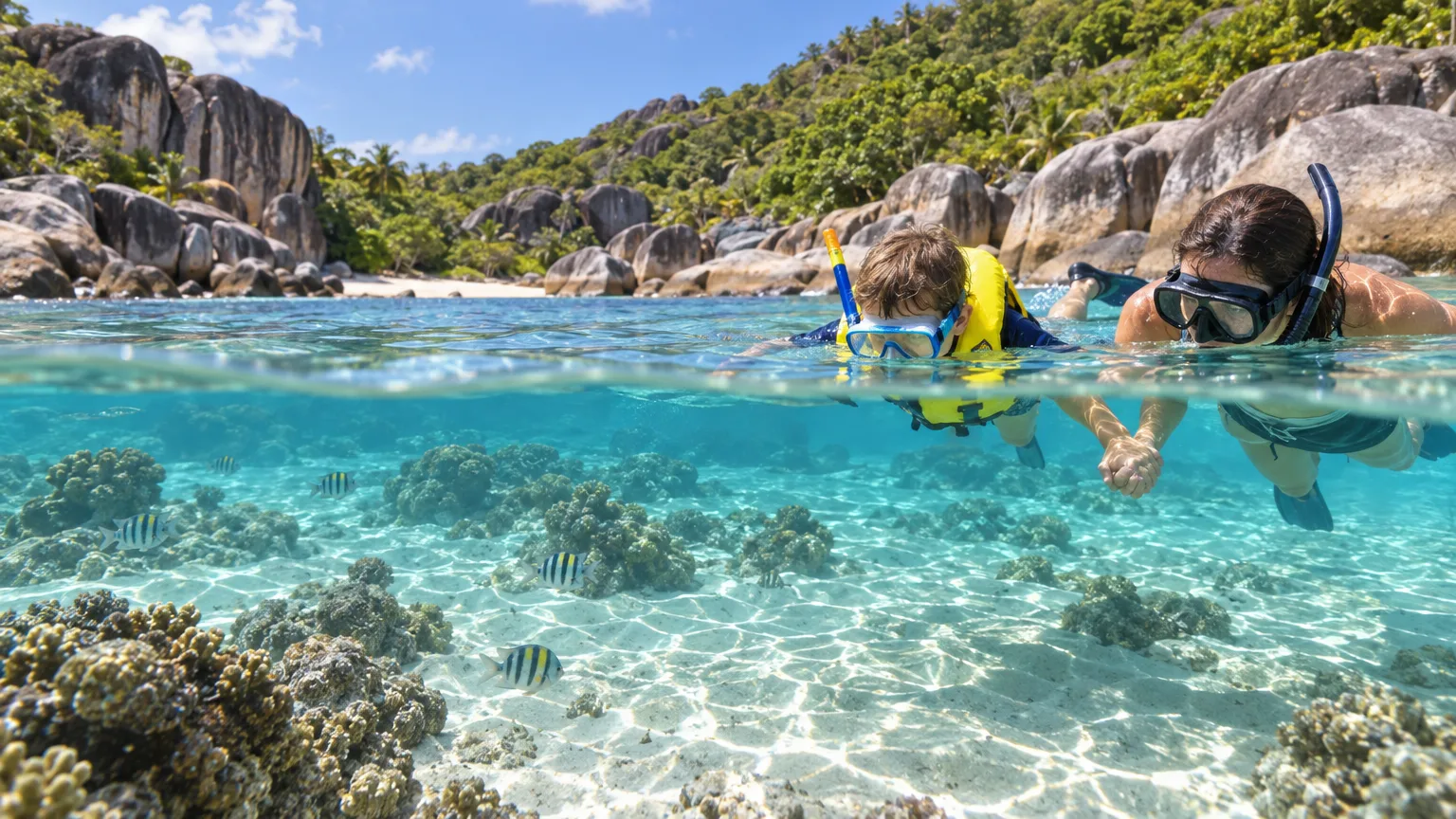
Flotation comes first for young swimmers. The CDC says that in natural water “children and adults are best protected by wearing U.S. Coast Guard-approved life jackets,” and that water wings “do not prevent children from drowning.” It adds that an adult should always be within arm’s length of a child in the water (CDC, 2026). Hawaii’s ocean safety service suggests “a floating vest or belt” for snorkelers (Hawaii Ocean Safety, 2026). On a crewed yacht, someone can swim alongside a nervous swimmer, and the swim platform is an easy place for a first lesson.
See which crewed yachts cruise the BVI for a group your size, children included.
Where should strong swimmers snorkel in the BVI?
The Indians and the wreck of the RMS Rhone are the two BVI snorkel spots for strong swimmers, because both are open-water sites with no beach to stand on. At the Indians, “yellow fire coral abounds, so no touching” (SAIL, 2017). The same water is “also the second most popular dive site in the British Virgin Islands” (Wikipedia, 2026), so you share it with dive boats.
The Rhone lies in two main parts “at depths between 20 and 80 feet” (BVI National Parks Trust, 2026). SAIL found it “easy to snorkel from the propeller wedged in the shallows to the bow buried in 60ft of water” (SAIL, 2017). The shallow stern is the snorkeler’s part of the wreck, and seeing the rest means swimming over deep water.
Both are harder than the bays because of open water, a little chop and coral close to the surface. A float and a crew member alongside help anyone less sure of themselves.
Which BVI reefs need calm weather?
The BVI reefs that need calm weather are the exposed ones: The Baths, Coral Gardens at Dead Chest, Sandy Spit, and Anegada’s reef-ringed approach. The National Weather Service office in San Juan puts the region’s swell season at November through March, when “northerly long period swells” can bring high breaking waves and rip currents (NWS San Juan, 2015).
The Baths is the best-known case. The Parks Trust warns that strong ocean swells can occur in winter and stop boats from using the mooring buoys or landing on the beach. Swimming is then discouraged “due to the strong currents” (BVI National Parks Trust, 2026). Coral Gardens at Dead Chest is “a friendly site for novices and snorkelers in very calm weather (but watch for boat traffic)” (BVI Tourism, 2026). Sandy Spit, which measures less than half an acre (Wikipedia, 2026), is open on every side. Getting to Anegada at all takes a settled day.
When a big swell runs, the BVI’s Department of Disaster Management warns about the “exposed and shallow northwest, north and east facing beaches” and points bathers to “the sheltered, less affected beaches on the south” (BVI News, 2018).
Which BVI reefs should you reach before the day boats?
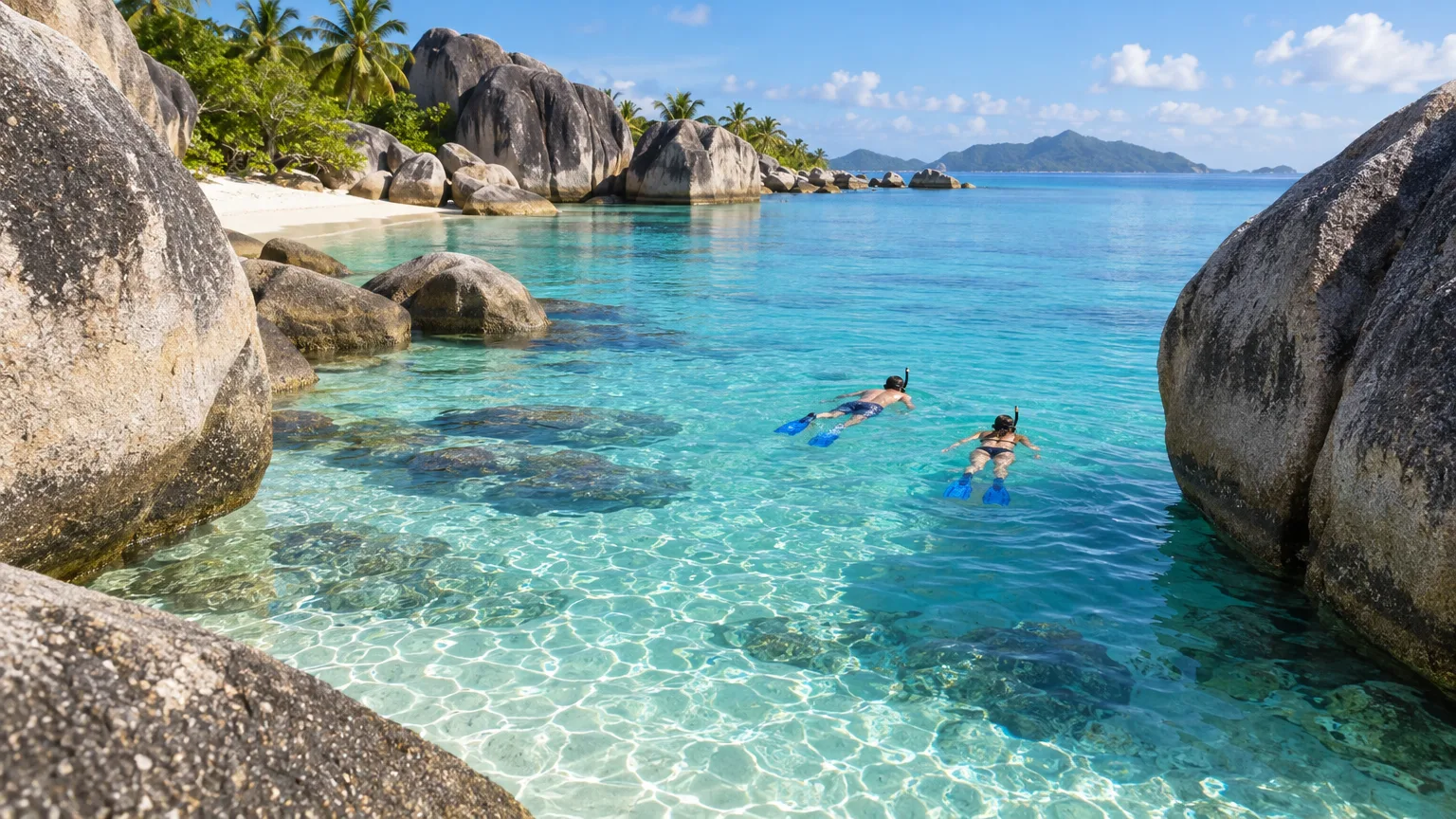
The Caves, the Indians, The Baths and Sandy Spit are the BVI reefs to reach early, because they’re the day-trip highlights. “A typical daysail charter starts at 9:30 a.m. and returns to the dock at 4:00 p.m.” (The VI Magazine, 2026), so a yacht already on a nearby mooring gets the first hour to itself.
The Baths opens at 8:30 a.m. (BVI National Parks Trust, 2026) and draws cruise passengers too. They made up 493,397 of the territory’s 612,263 visitor arrivals in the first quarter of 2026 (Virgin Islands News Online, 2026). Our guide to visiting The Baths by yacht covers the morning there in more detail. Sandy Spit is “a popular stop for day and term boat charters from Tortola, St. Thomas, and St. John” (Wikipedia, 2026). When the Indians are crowded, Cruising World’s 2024 roundup suggests Rainbow Canyon next door, “a gem of a dive and snorkel site that’s often overlooked” (Cruising World, 2024).
Every BVI National Parks Trust mooring has a time limit: “There is a 90-minute time limit on all moorings and use is on a first come, first serve basis,” and the moorings “are for day use only” (BVI National Parks Trust, 2026). For snorkelers, that makes each reef a 90-minute daytime stop.
The best BVI snorkel spots, island by island
The 15 BVI snorkel spots run from Norman Island in the south to Anegada in the north. Each entry below says what the reef is like and who it suits, then points to an island guide, where one exists, for the anchorages, the beach bars and the rest of the day.
Norman Island: the Caves and the Indians
The Caves sit “at the base of cliffs just outside the western edge of the Bight” (Wikipedia, 2026). For the best light, one cruising guide suggests waiting “until mid morning so the sun is high enough to illuminate the coral-studded wall” (Online Cruising Guide, 2026). Around the south side, Money Bay has “great snorkeling along the rocky shoreline” (Cruising World, 2024).
The Indians are a cluster of islets just west of Pelican Island, and their shallower areas are a popular snorkeling site (Wikipedia, 2026). Our Norman Island guide covers the island’s anchorages and beach bars, and our post on snorkeling the Indians has more on that reef.
Dead Chest, Salt Island and the RMS Rhone
Dead Chest and the Rhone share a protected area. The Wreck of the Rhone Marine Park was established in 1980, covers 800 acres including Dead Chest Island, and “anchoring and fishing are strictly prohibited” inside it (BVI National Parks Trust, 2026). The Rhone, a Royal Mail steamer, sank there in a hurricane in 1867. In 2008 SAIL wrote, “It’s best for divers, but snorkelers can get a good view” (SAIL, 2008).
Divers get the whole wreck. Of crewed yachts that list how they offer scuba, 73.3% offer rendezvous diving only, which means a local dive operator meets the yacht (Vital Charters analysis of 658 crewed charter yachts, October 2026). Our guide to scuba diving from a charter yacht explains how that works.
Cooper Island: Cistern Point
Cooper Island’s anchorage is Manchioneel Bay, off the island’s northwest corner, and the snorkeling there is at Cistern Point. SAIL suggests tying the dinghy, kayak or paddleboard “to the string line near Cistern Point” (SAIL, 2017), which makes it an easy swim from the boat.
Peter Island: Deadman’s Beach
Peter Island Resort calls Deadman’s Beach “ideal for snorkeling” (Peter Island, 2026), and you swim straight off the sand. Our guide to Peter Island on a BVI itinerary covers its bays.
Virgin Gorda: The Baths, Devil’s Bay and Spring Bay
The Baths is “ideal for swimming and snorkeling,” and small boats tie up at a dinghy line offshore (BVI National Parks Trust, 2026). You swim the last stretch to the beach, so weaker swimmers take a float. The trail on to Devil’s Bay means you “crawl, climb ladders, and wade,” and boats use moorings outside the bay to protect its coral heads (BVI National Parks Trust, 2026). Spring Bay and The Crawl, next door, have the gentlest water on this stretch of coast. Our Virgin Gorda and North Sound guide covers all three, plus Spanish Town and Gorda Peak.
North Sound, Guana and Great Camanoe: Vixen Point, Monkey Point and Cam Bay
Prickly Pear became a national park in 1988, and its white sand beaches “wrap around Vixen Point” (BVI National Parks Trust, 2026). The water around it is busy: in February 2026 the territory’s marine accident authority warned that Virgin Gorda’s waters were “experiencing heavy traffic” from charter boats, dinghies and swimmers (Government of the Virgin Islands, 2026). Snorkelers stay close to the beach.
West of Virgin Gorda, off Tortola’s northeast coast, Monkey Point on Guana Island has “fine snorkeling in its lee,” and its Parks Trust moorings “are for day use only” (SAIL, 2007). Cam Bay, on Great Camanoe next door, has “an extensive shallow reef and lagoon system” (BVI National Parks Trust, 2026). Our post on visiting Necker Island and Guana covers both private islands from a yacht.
Jost Van Dyke: Sandy Spit, Green Cay, Sandy Cay and Diamond Cay
“The coral reefs off Sandy Spit and Green Cay (just east of JVD) are teeming with tropical fish,” and at Sandy Spit and Sandy Cay you can snorkel “right off their beaches” (Caribbean Compass, 2025). The same guide points to a patch of reef at White Bay’s west end, near the rocks by Ivan’s. Diamond Cay National Park, off Long Bay, “has several day anchorages close to vibrant reefs, for snorkelling” (BVI Tourism, 2026). Our Jost Van Dyke guide covers the harbors, the beach bars and the Bubbly Pool.
Anegada: Loblolly Bay and Horseshoe Reef
Anegada is flat and low, ringed by “the 18-mile (29 km)-long Horseshoe Reef,” one of the Caribbean’s largest barrier reefs (Wikipedia, 2026). The approach runs through coral heads, which is why crews go in good light and settled weather. Ashore, Cruising World’s roundup suggests a local guide for “a jam-packed day of snorkeling the reef in the shallows” (Cruising World, 2024). The VI Magazine’s advice for the beaches: “Jump in a taxi and head for the beaches (Loblolly or Cow Wreck) with your snorkel gear” (The VI Magazine, 2026).
What will you see snorkeling in the BVI?
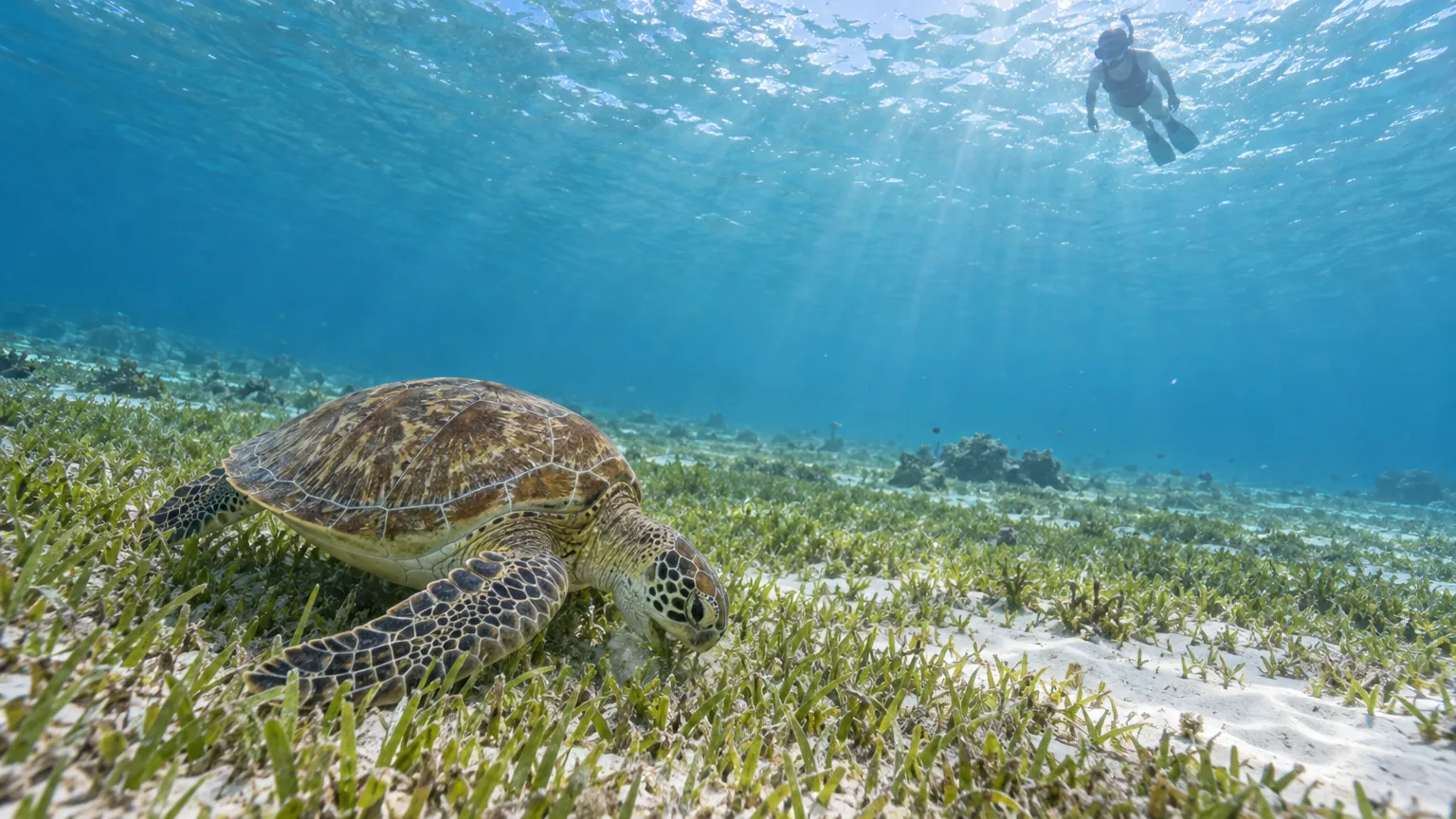
Snorkelers in the BVI see reef fish at every site and sea turtles in the seagrass bays: green turtles feed on the seagrass in Cam Bay’s lagoon, and leatherbacks nest on Sandy Cay’s beach (BVI Tourism, 2026). NOAA’s viewing guidance is to “remain at least 50 yards away,” and never to touch, feed or chase a turtle (NOAA Fisheries, 2026).
On the reefs, SAIL’s crew at Monkey Point spent “hours dazzled by the displays of brightly colored fish” (SAIL, 2007). Three things there are best avoided. Fire coral stings, and it’s common at the Indians. At the Caves, the Online Cruising Guide warns, “watch for clouds of jellyfish in the caves themselves” (Online Cruising Guide, 2026). Lionfish, an invasive species across the Caribbean, have spines that “deliver a venomous sting that can last for days” (NOAA Ocean Service, 2026).
The BVI’s reefs took record heat in 2023. The BVI National Parks Trust reported that “record high ocean temperatures were experienced in August 2023” and photographed partially bleached coral in the territory (BVI National Parks Trust, 2023). Worldwide, bleaching-level heat stress hit 84% of coral reef area from early 2023 to mid-2025 (NOAA, 2026).
What are the rules for snorkeling in the BVI?
Snorkelers in a BVI national park may not damage or break off any coral or other bottom growth, and may not feed the fish (BVI National Parks Regulations, 2008). The National Parks Act also bars removing beach sand, any living or dead coral, or any live animal or plant from a park or protected area (National Parks Act, 2006). In practice: don’t stand on the reef, don’t take coral or sand home, and leave every live creature where it is.
The moorings are the crew’s business. The Parks Trust sells mooring permits to boats through charter companies and dive shops, so you don’t need one of your own. Snorkeling itself needs no permission under the Act, which exempts it from the rule on diving in parks.
The BVI has no sunscreen ban yet. The February 2026 consultation draft of the territory’s National Tourism Policy for 2026-2036 proposes “a reef-safe sunscreen policy (education first, followed by phased restrictions at MPAs and high-use beaches)” (Government of the Virgin Islands, 2026). If your week crosses to St. John, the rule there is stricter: sunscreens containing oxybenzone, octinoxate and octocrylene are prohibited throughout the US Virgin Islands (National Park Service, 2026). A mineral sunscreen and a rash guard cover you on both sides of the line.
When is the best time to snorkel in the BVI?
The best time to snorkel in the BVI is any month of the year: the sea off Road Town averages 26°C (79°F) from January to March and 29°C (84°F) from August to October, and it’s “warm enough to swim in all year round” (Climates to Travel, 2026). The season decides which reefs are calm.
Winter brings the northerly swells, so the north-facing spots have more days off and the crew leans on the south side and North Sound. Outside the swell season the north shores are calm more often, but summer and early fall sit inside the Atlantic hurricane season, which runs from June 1 to November 30 (National Hurricane Center, 2026). Our guide to a Caribbean vacation during hurricane season covers how charters work in those months. Whatever the month, mornings are best, before the day boats arrive.
How do you plan a snorkeling week on a BVI charter?
A BVI snorkeling week works best as a loop that pairs one reef each morning with an anchorage for the night. A typical route runs like this:
- Norman Island’s Caves and the Indians.
- The Rhone off Salt Island, then Cistern Point at Cooper Island.
- Virgin Gorda’s Baths and Spring Bay, early.
- North Sound, with Vixen Point off Prickly Pear.
- Jost Van Dyke’s cays on the way back west.
Crews adapt it to the wind and swell, and to what you tell your broker: a family with young children and a group of strong swimmers get different mornings.
If you’re comparing ways to get around the islands, our guide to island hopping in the BVI sets ferries and water taxis against a yacht. Browse crewed charter yachts for a BVI snorkeling week, then send us your dates and who’s swimming.
Frequently Asked Questions
What are the top snorkeling spots in the BVI?
The best-known BVI snorkel spots are the Caves and the Indians at Norman Island, the wreck of the RMS Rhone off Salt Island, and The Baths on Virgin Gorda. For quieter water on the right day, the crew can pick Cistern Point on Cooper Island, Vixen Point in North Sound or the cays off Jost Van Dyke.
Can beginners and children snorkel in the BVI?
Yes. The Crawl at Spring Bay is a natural pool ringed by boulders, and Vixen Point and Cam Bay have calm, sheltered water. Put young children in a US Coast Guard-approved life jacket or snorkel vest, and keep an adult beside them.
Can you snorkel the RMS Rhone, or is it only a dive?
You can snorkel it. The stern and propeller sit in the shallows, which SAIL found easy to snorkel. Most of the wreck lies much deeper, so it suits strong swimmers, and divers see far more of it.
Can you snorkel from the beach in the BVI?
Yes, at several spots. You swim straight off the sand at Deadman’s Beach on Peter Island, at Spring Bay, and at Sandy Spit and Sandy Cay off Jost Van Dyke. On Anegada, Loblolly Bay and Cow Wreck are a taxi ride across the island.
Do you need a permit to snorkel in the BVI?
No. Guests don’t need a permit to snorkel. The Parks Trust sells mooring permits to boats through charter companies and dive shops, so the yacht’s operator handles it.
Is there a reef-safe sunscreen law in the BVI?
Not yet. The consultation draft of the BVI’s tourism policy proposes a reef-safe sunscreen policy, starting with education and moving to phased restrictions at marine protected areas. The US Virgin Islands already ban several common sunscreen chemicals, so pack a mineral sunscreen.
Can you see sea turtles snorkeling in the BVI?
You can, in the seagrass bays. Green turtles feed in Cam Bay’s lagoon on Great Camanoe. Float above them, keep your distance, and never touch, feed or chase one.
Reefs before breakfast, with a crew who knows them.
Tell us your group size, your dates and who in the group snorkels, and we’ll match you with a crewed BVI yacht and a week built around the reefs that suit you.