
How Does a Yacht Charter Broker Work?
What a yacht charter broker does, who pays them, how they differ from a central agent, and why an independent broker sees more of the fleet.

Last Updated: October 6, 2026
A yacht charter broker is the person who finds, books and looks after a private yacht week for you, and the owner pays them out of the rate you were quoted, so the broker costs you nothing extra. Booking a charter looks deceptively simple from the outside: pick a destination, choose a yacht, pay, and go. In reality, you are matching a moving luxury hotel (and its crew) to your group’s expectations, budget, dates, and cruising style, while navigating contracts, availability windows, and location-specific rules.
That is exactly where a charter broker earns their keep. A good broker protects your time, your budget, and your experience. A great broker does it while staying independent, meaning they can place you on any suitable yacht across any fleet, not just the yachts managed by their own company.
What is a yacht charter broker (and what do they actually do)?
A charter broker is your advisor, matchmaker, negotiator, and project manager for a private yacht charter, and the reason the role exists is that the fleet is not one fleet. The 668 crewed yachts currently working the Caribbean and Bahamas sit with 110 separate management companies (Vital Charters listings analysis, September 2026), so there is no single counter to walk up to. A broker is the person who works the whole board on your behalf.
They translate what you want (privacy, adventure, family-friendly, corporate-level service, specific cabins, a certain culinary standard) into a shortlist of yachts that can truly deliver.
At a high level, a broker:
- Clarifies your trip brief (who, when, where, budget, priorities)
- Filters the market quickly (what is actually available and appropriate)
- Compares yachts beyond marketing (crew fit, layout reality, service style, maintenance reputation)
- Negotiates terms and manages paperwork (contracts, deadlines, deposits)
- Coordinates pre-trip planning (preference sheets, special occasions, logistics)
- Stays involved through embarkation and can troubleshoot if needed
A broker is especially valuable if you are planning a luxury yacht charter in busy seasons (for example, the British Virgin Islands winter peak) or if your group has “non-negotiables” (specific water toys, accessibility needs, a certain cabin configuration, or strict timing).
How does booking through a broker work, step by step?
Booking through a yacht charter broker follows the same backbone on most crewed charters, and CYBA publishes booking procedures so brokers and central agents each know their part (CYBA). Regions and yacht types vary the details.

1) You start with a trip brief (not with a yacht)
Clients often begin by asking for “the best yacht,” but the best yacht for a honeymoon is rarely the best yacht for a three-generation family or a high-energy group charter.
A broker will ask targeted questions like:
- Destination(s) and whether you want a fixed route or flexible cruising
- Exact guest count (and whether couples need equal cabins)
- Approximate budget range and what “value” means to you (space, cuisine, toys, crew reputation)
- Must-haves (air conditioning expectations, stabilizers, kid-friendly features, scuba, gym, cinema, etc.)
- Deal-breakers (bunk cabins, steep stairs, long transfers, formal vibe)
This step prevents a common mistake: falling in love with photos before confirming the yacht is right for your group.
2) Your broker sources and screens the market
Once your broker understands your priorities, they search across fleets and databases, then remove options that look good online but do not fit your reality.
What “screening” really means:
- Confirming true availability (holds and options happen fast in charter)
- Checking layout details (real bed sizes, headroom, storage, stairs)
- Assessing crew style (formal vs relaxed, family-friendly vs adults-only tone)
- Reviewing recent feedback and operational notes
This is where an experienced broker saves you the most time: you see a curated shortlist, not a spreadsheet of everything that floats.
3) You compare shortlisted yachts with context (not just specs)
A broker helps you compare yachts the way seasoned charterers do. For example:
- A yacht can have the same guest capacity as another, but feel completely different because of salon flow, outdoor dining space, or tender setup.
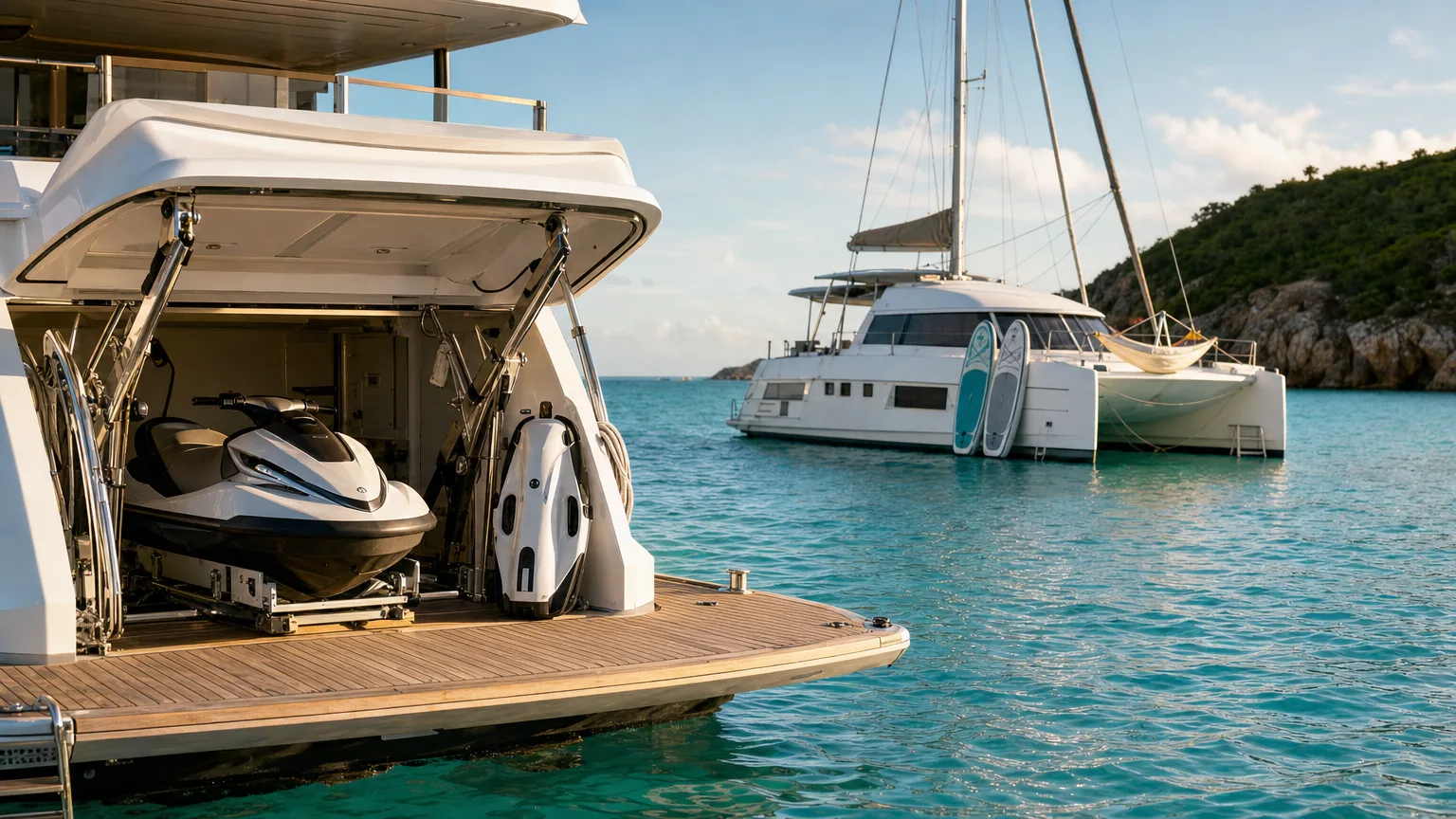
- Two yachts can list “water toys,” but one might be better for beginners (easy-to-use inflatables) and the other for adrenaline seekers (eFoils, towables, dive ops).
- In the Caribbean yacht charter world, some yachts are optimized for relaxed island-hopping and beach days, while others lean toward sailing performance or expedition-style adventure.
A strong broker also advises on whether your expectations match the destination. If you want restaurant-hopping nightlife every night, certain itineraries will fit better than others.
4) You place a hold and move into contracting
When you are ready, your broker will guide you through the timing-sensitive steps that protect your spot, typically including:
- Placing a hold (when possible) with clear expiration terms
- Reviewing and explaining the charter agreement
- Managing deposits and due dates
- Aligning expectations on what is included vs extra (see what all-inclusive actually covers, especially for plus-expenses charters)
If you are new to charters, this is also where a broker prevents expensive misunderstandings, like assuming every charter is “all-inclusive” or assuming every marina and berth is guaranteed.
5) Preference sheets, provisioning, and itinerary planning
After booking, your broker helps you communicate the details that make the trip feel bespoke:
- Food and beverage preferences, allergies, kids’ meals
- Celebrations (birthdays, proposals, anniversaries)
- Activity pacing (early starts vs late mornings)
- Shore experiences and reservations where applicable
6) Support through embarkation and beyond
On embarkation day, the goal is simple: everything is ready, and you can relax.
A broker typically:
- Confirms final boarding details and timing, including which day of the week a crewed charter starts
- Double-checks special requests are noted
- Stays reachable if a last-minute issue arises (weather changes, itinerary tweaks, guest travel delays)
Independent or affiliated broker: which should you use?
Use an independent broker. An independent yacht charter broker can put any suitable yacht in front of you, while an affiliated one starts from the boats its own company manages, and in a market split across many management companies that difference decides what you see (Vital Charters listings analysis, September 2026).
What is an independent charter broker?
An independent broker is not obligated to prioritize yachts from a particular management company, fleet, or operator. Their credibility depends on placing you on the best-fit yacht for your brief, regardless of who manages it.
That independence buys you something specific, and the table below measures it: the largest management company in the region manages 71 boats, and the median one manages three (Vital Charters listings analysis, September 2026).
| The crewed Caribbean and Bahamas fleet | September 2026 |
|---|---|
| Active yachts with a bookable week | 668 |
| Management companies behind them | 110 |
| Largest single fleet | 71 yachts, about 1 in 9 of the market |
| Median company size | 3 yachts |
| Companies managing exactly one yacht | 34 |
| Share of the fleet held by the ten largest companies | 46% |
Read the table from the top and the incentive is plain. A broker tied to the biggest management company in the region has every reason to start with its own boats, even though most of the market sits elsewhere. That is not a claim about anyone’s honesty; it is arithmetic about inventory. And because a large share of the market sits with companies holding a handful of yachts each, the boat that suits your group is unlikely to belong to whichever company you happened to contact first.
If you want the version of this with firms named and ranked by region and yacht size, we wrote it separately: how to choose the best charter broker.
What is an affiliated broker (and why it can be limiting)?
Some “brokers” work for (or are tied closely to) a yacht management company or a single fleet operator. They may still be knowledgeable and helpful, but there is an inherent constraint: they can be incentivized, directed, or simply operationally biased toward yachts they represent.
That can lead to:
- A narrower shortlist that excludes better matches elsewhere
- Less objectivity when comparing a managed yacht to a competitor
- Fewer creative alternatives when your first choice is unavailable
This does not automatically mean bad intent. It means the structure can create a conflict between what is best for you and what is best for their inventory.
A practical example: “any yacht in any fleet” vs “only the boats we manage”
Imagine you want a weeklong private yacht charter for 8 guests:
- Your dates are fixed and peak season availability is tight.
- You need equal cabins for four couples.
- Two guests are sensitive sleepers and you want a quieter layout.
An independent broker can expand the search across fleets and quickly tell you, “These three yachts fit your cabin needs and your service style, and this one is the quietest at night based on layout and feedback.”
An affiliated broker might only be able to say, “Here are the two we have left,” even if neither is ideal.
Charter broker vs central agent: who represents whom?
A central agent (CA) is the company a yacht’s owner appoints to run its charter business, and a yacht charter broker is the company that represents you. The Charter Yacht Brokers Association (CYBA) calls the agent’s role a “Clearing House/Charter Manager”. It expects the agent to keep each yacht’s calendar, rates and specifications current on the industry databases, and its insurance, licenses and certifications in date (CYBA, Standardizing Charter Booking Procedures).
CYBA’s code of ethics asks its members for “absolute fidelity to the client’s interest” (CYBA Standing Rules). For a broker, the client is you.
| Role | Represents | What they do for your booking |
|---|---|---|
| Independent yacht charter broker (the industry also says retail broker) | You | Shortlists across every agency, requests an option, explains the contract, briefs the crew on your group |
| Central agent (clearing house, charter manager) | The yacht’s owner | Publishes the yacht’s calendar and rates, decides whether to grant an option, keeps licenses and insurance current |
| Owner | Themselves | Sets the weekly rate and employs or contracts the crew, directly or through a management company |
An option on a crewed yacht is the central agent’s to grant, not the broker’s. MYBA, the Worldwide Yachting Association, says an option is granted “only at the sole discretion of the Central Agent” (MYBA, 2019), and CYBA calls it unethical to option more than one yacht for the same client’s dates. A broker who says they have options on five boats for your week is describing something both associations’ rules are written to prevent.
Be wary of a broker who calls a crewed yacht “exclusive”. CYBA’s code lists using the word for a yacht that sits on a shared database other members can book as an unfair advantage (CYBA Standing Rules). Ask whether the yacht is on the central databases. Usually it is, at the same published rate, through any broker.
Yacht charter company vs management company vs booking platform: who does what?
A yacht charter company, or charter operator, rents out boats it owns or leases. A yacht management company runs a privately owned yacht on its owner’s behalf: technically, commercially as its central agent, or both. A booking or listing platform lists other people’s yachts and takes a fee. Crewed charter in the Caribbean and Bahamas runs mostly through management companies (Vital Charters listings analysis, September 2026).
| Type | Whose boats | What they actually do | What it means for you |
|---|---|---|---|
| Charter company (charter operator) | Its own, owned or leased | Rents boats from its own bases, often for bareboat sailing | A fast booking, but the shortlist stops at its fleet |
| Technical management company | A private owner’s | Keeps the yacht maintained, compliant and crewed on the owner’s behalf | You rarely deal with them, but they shape the condition and crew you find aboard |
| Charter management company or central agent | A private owner’s | Publishes the yacht’s rates and calendar and takes bookings | The agency your broker books through, or you book through directly |
| Booking or listing platform | Other people’s | Lists yachts and takes a listing fee or commission | Quick to browse; ask whether anyone there has met the crew |
| Independent yacht charter broker | None | Represents you across every agency | The whole market, paid for out of the rate you were quoted |
A technical management company keeps a yacht maintained, compliant and crewed for its owner; a charter management company, or central agent, publishes its rates and calendar and takes the bookings. One firm can do both, which is why search results blur them, and many Caribbean crewed catamarans are owner-operated, with the owners aboard as captain and chef. As a guest you meet the technical side in the condition of the boat and the crew aboard, and the charter side in the rate and the calendar. In the British Virgin Islands, 73 such firms list nearly all of the 401 crewed yachts cruising there (Vital Charters listings analysis, October 2026), so the way to choose a charter company in the BVI starts with the crew, not the firm.
How does a yacht charter broker get paid?
A yacht charter broker is paid by the yacht’s owner, out of the charter fee you were quoted, not by a fee added on top. CYBA’s standard charter agreement has the owner paying the brokers’ customary fees (CYBA Inclusive Agreement, Clause 7).
So the same yacht for the same week usually costs you the same whether you found it yourself or someone found it for you. What changes is who did the searching, who read the charter contract, and who picks up the phone when a flight is cancelled the day before embarkation.
The key is transparency. You can and should ask:
- “How are you compensated on this charter?”
- “Do you have any financial relationship with this yacht or its management company?”
- “Will you show me options outside your preferred fleet if they are a better fit?”
If a broker answers clearly and comfortably, that is a good sign.
Should you use a broker or go direct to the owner?
Booking a crewed yacht direct with its owner or agency usually gets you the same published rate, because CYBA tells its member brokers to “Sell charters at the advertised price” and counts a commission discount to win a booking against its code of ethics (CYBA, Standardizing Charter Booking Procedures). What booking direct changes is who is on your side of the table.
Book direct and you deal with the owner’s representative, whose job is to fill that yacht’s weeks, for one boat or one agency’s portfolio. If you’ve sailed with a crew before through a broker, a direct enquiry will usually find its way back to that broker anyway: CYBA’s procedures ask crews to direct repeat enquiries back to the broker who made the original booking.
An online yacht booking platform sits between a private broker and booking direct. It lists many yachts at their published rates, so it’s quick for comparing rate sheets, but nobody there represents you the way a broker does. Before you pay through one, ask whether anyone at the platform has met this crew.
What does a good broker protect you from?
A good broker’s first protection is your money: under CYBA’s standard agreement the charter fee goes to the broker’s escrow or client account, not to a person (CYBA Inclusive Agreement). The rest is risk reduction.
Here are common issues an expert broker helps you avoid:
- Choosing a yacht that sleeps your group on paper but does not feel comfortable in real life
- Underestimating total trip costs because inclusions and extras were not clearly explained
- Booking a yacht with a crew style mismatch (the fastest way to sour a week onboard)
- Losing the yacht to another client because timelines were not managed tightly
- Missing critical destination guidance (local rules, seasonality, embarkation logistics)
For professional standards and ethics in brokerage, industry bodies like the Charter Yacht Brokers Association (CYBA) publish codes of ethics their members can be held to.
How to choose the right yacht charter broker
Choose a yacht charter broker on how they answer the five questions below, and check any association badge in the association’s own directory rather than on the broker’s website (CYBA member directory). You are hiring judgment, not access to listings.
Use the checklist below to evaluate fit.
| What to ask | What a strong answer sounds like | Why it changes your shortlist |
|---|---|---|
| “Are you independent?” | “Yes, I can place you with any suitable yacht across fleets and regions.” | Prevents a constrained shortlist. |
| “How will you build my shortlist?” | “I’ll start with your non-negotiables, then present 3 to 6 best-fit options with trade-offs.” | Shows process and prioritization. |
| “What do you need from me to start?” | “Dates, guest count, destination flexibility, budget range, must-haves, deal-breakers.” | Indicates they are brief-led, not inventory-led. |
| “How do you evaluate crew fit?” | “I look at service style, experience, and recent client feedback, then match it to your group.” | Crew fit is the experience on a crewed charter. |
| “Will you tell me not to book something?” | “Absolutely, if it’s wrong for your group or expectations.” | Signals objectivity and confidence. |
Plan with an independent broker at Vital Charters
If you want a charter experience that feels truly tailored, the best first step is a clear trip brief and an independent broker who can source the right yacht across fleets, not just from one management company.
Explore options through Vital Charters’ luxury yacht search or reach out to start building a curated shortlist for your dates, destination, and style of travel.
Frequently Asked Questions
Does using a charter broker cost extra?
No. The yacht owner pays the broker out of the rate you were quoted, rather than the broker adding a line item on top, so the same yacht for the same week costs you the same either way. Ask directly how your broker is paid on your charter. A clear, comfortable answer is a good sign, and a separate “client advisory fee” on top is not.
What is the difference between an independent and an affiliated charter broker?
An independent broker can place you on any suitable yacht across any fleet. An affiliated broker works for, or is tied to, a yacht management company or single fleet operator, which can narrow your shortlist and reduce objectivity when comparing their managed yachts against others.
What is the difference between a charter broker and a central agent?
An independent charter broker represents you and can book a yacht from any agency. A central agent, also called a clearing house or charter manager, represents the yacht’s owner: it publishes the calendar and rates, decides whether to grant an option on its dates, and keeps the yacht’s licenses and insurance current. The owner pays the broker’s fee out of the charter fee.
What is the difference between a yacht charter company and a yacht management company?
A yacht charter company rents out boats it owns or leases from its own bases. A yacht management company runs a privately owned yacht on the owner’s behalf, either technically (maintenance, compliance and crew) or commercially as its central agent, publishing its rates and taking bookings. Plenty of firms do both for the same yacht.
Is a yacht booking platform the same as a charter broker?
No. A booking platform lists yachts and takes a listing fee or commission, and may never have met the crew. A broker represents you, shortlists across every agency and stays involved through the charter. On a crewed yacht the published rate is usually the same through either, so the difference is the service.
What information does a charter broker need to get started?
Dates, exact guest count, destination flexibility, an approximate budget range, your must-haves, and your deal-breakers. A brief-led broker asks for these before showing yachts. If the first thing you receive is a list of boats rather than questions, the process is inventory-led rather than built around your group.
Can a charter broker book any yacht?
An independent broker can: they search across every management company and central agency, and a yacht’s published rate is usually the same through them. A broker tied to one management company starts from what that company represents, so ask outright whether they will show you options outside their preferred fleet when those are a better fit for your brief.
What does a charter broker do after you book?
The work shifts to preference sheets and planning: food and beverage preferences, allergies, children’s meals, celebrations, activity pacing, and shore arrangements. Your broker confirms boarding details before embarkation and stays reachable for weather changes, itinerary adjustments, or guest travel delays.
How do you know if a charter broker is independent?
Ask three questions: how they are compensated on your charter, whether they have any financial relationship with the yacht or its management company, and whether they will show you options outside their preferred fleet. Clear, unhesitating answers to all three are the signal.
When should you contact a charter broker?
As soon as your dates are firm. Holds and options move quickly in charter, and peak windows, the British Virgin Islands winter season especially, tighten first. Fixed dates combined with a specific cabin configuration is the pairing that runs out of good options earliest.
What is the most common mistake first-time charterers make?
Choosing from photographs before confirming the yacht suits the group. Two yachts with identical guest capacity can feel completely different depending on salon flow, outdoor dining space, and tender setup. The second most common is assuming every charter is all-inclusive when inclusions vary.
More yachts, zero markup: that’s the independent advantage.
Share your group size, dates, and destination and we’ll search every agency’s yachts, not just one company’s, to find the crewed yacht that actually fits.