
Family Reunion at Sea: Coordinating 12+ Guests
Family reunion yacht charter with 12+ guests? The SOLAS 12-guest cap shapes the whole plan. A broker’s coordination playbook: tandem, costs, activities.
A family reunion yacht charter sounds simple until you count heads and realize you have 14 people — and most charter yachts legally cap at 12 guests. That single rule reshapes the entire plan: which yacht, how many yachts, how the contract gets signed, who pays what, and how you keep three generations entertained in matched anchorages instead of split itineraries. Before you compare boats, you have to solve the math.
That’s what this guide is for. Our complete group and event charter planning guide covers group charters across every occasion — corporate retreats, milestone birthdays, honeymoons. This piece zooms in on the reunion variant, where the constraints are tighter (more generations, more dietary needs, more cousins than you remembered) and the coordination is most of the job.
Why Family Reunion Yacht Charters Hit a 12-Guest Wall
The international SOLAS Convention defines any vessel carrying more than 12 passengers as a “passenger ship,” subject to construction, lifesaving, and inspection standards almost no charter yacht in the Caribbean holds (International Maritime Organization, SOLAS Chapter I). U.S. waters enforce the same threshold through 46 CFR Subchapter T, the Coast Guard rule covering inspected small passenger vessels (U.S. Coast Guard / eCFR). That single regulatory tripwire is the reason crewed catamarans, motor yachts, and sailing yachts cap their guest count at 12 — not the cabin layout, not the chef’s capacity, the law.
The 12-guest cap on a family reunion yacht charter comes from SOLAS Chapter I (IMO), which classifies any vessel carrying more than 12 passengers as a “passenger ship” — a status almost no Caribbean charter yacht is built to hold. U.S. waters enforce the same line through 46 CFR Subchapter T. Crew don’t count, but every guest does, including infants (VIPCA, 2025; eCFR).
There’s no flexibility here. As Lynette Hendry, a yacht management specialist, put it bluntly in Dockwalk: “Unless your yacht is certified as SOLAS and is operating as a licensed commercial vessel, there is absolutely no wiggle room with the twelve-passenger limit.” Brokers like us hear the same question a few times a month: “Can we just sneak one more on for the day?” The honest answer is no. It’s a breach of the charter contract, and in some jurisdictions it triggers insurance and licensing problems for the captain.
For the full regulatory deep-dive, see our explainer on the 12 person yacht rule. For reunion planning, what matters is this: if your travel party is 13 or more, you need a tandem charter or a SOLAS-class passenger yacht — and the second option starts around $200K per week, with a small global fleet. Tandem is what almost every reunion actually books. Even at 12 passengers, less than 5% of the Caribbean fleet can actually accommodate that number, with 8 or 10 being more common.
How Many People Are at a Typical Family Reunion?
The average reunion travel party books at 8 adults + 4 children — 12 people total — according to the HomeAway family reunion survey reported by Reunions Magazine (2024). That’s not a coincidence with the SOLAS cap; it’s the band where most extended families realistically land when they actually count heads. Two parents, two siblings with spouses, one set of grandparents, and four cousins gets you to 12 before you’ve added anyone from the cousin’s-spouse side.
Multi-generational travel is the engine behind those head counts. Forty-seven percent of travelers chose multi-generational family trips in 2025, a 17-point jump from 2024 (Family Travel Association, 2025). Virtuoso’s Luxe Report estimates 33–40% of the $270 billion leisure travel market is now multi-gen, with 53% of Virtuoso clients planning a multi-gen trip in the next year (Spa Executive / Virtuoso, December 2024).
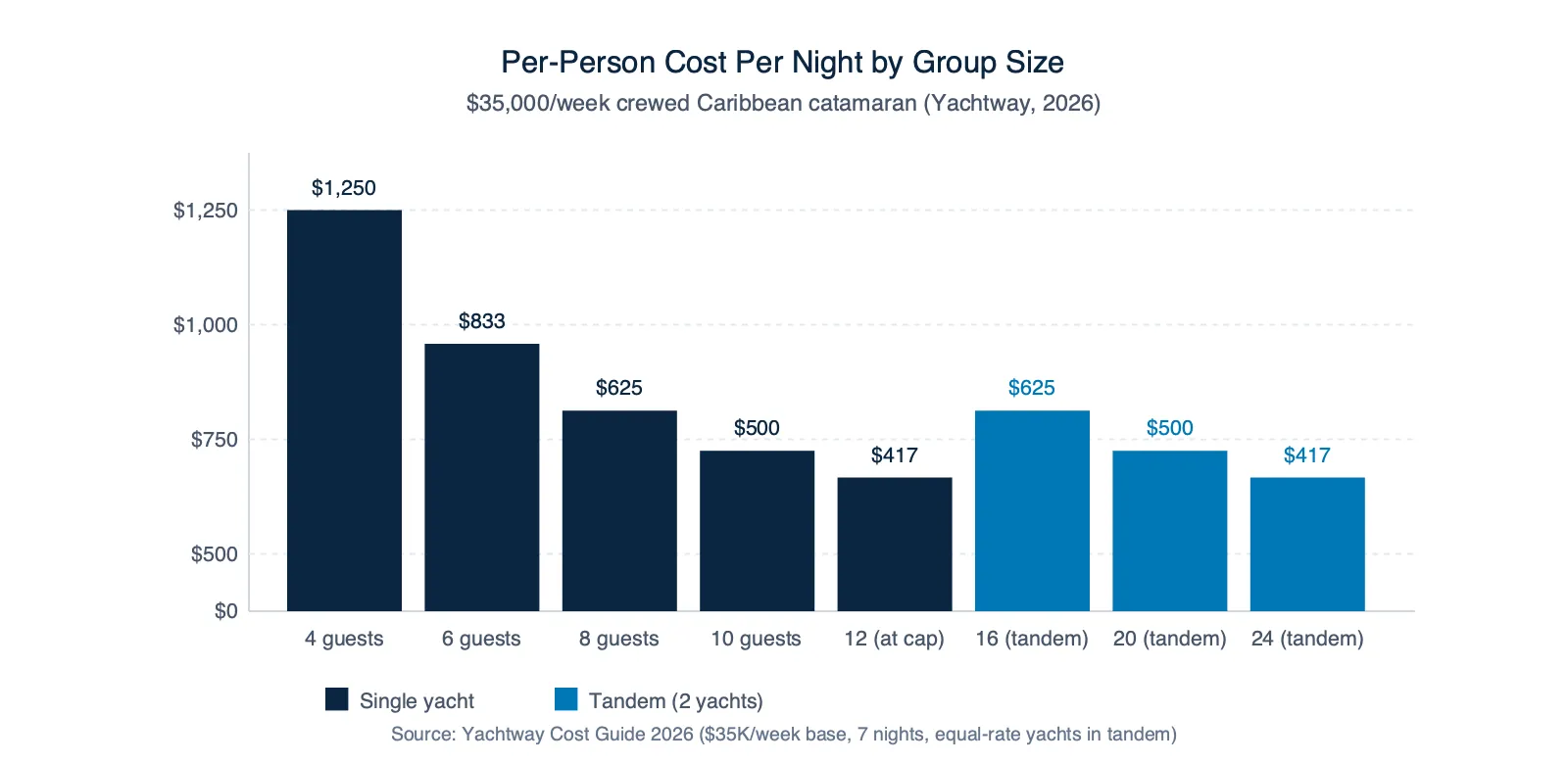
View data table
| Group size | Setup | Per-person/night |
|---|---|---|
| 4 guests | Single yacht | $1,250 |
| 6 guests | Single yacht | $833 |
| 8 guests | Single yacht | $625 |
| 10 guests | Single yacht | $500 |
| 12 guests (at cap) | Single yacht | $417 |
| 16 guests | Tandem (2 yachts) | $625 |
| 20 guests | Tandem (2 yachts) | $500 |
| 24 guests | Tandem (2 yachts) | $417 |
Source: Yachtway Cost Guide 2026. Based on a representative $35,000/week crewed Caribbean catamaran, 7 nights, equal-rate vessels in the tandem scenarios.
The math has a counterintuitive payoff for reunions.
Per-person cost actually drops as a family reunion yacht charter group grows. Twelve guests on a $35,000-per-week crewed Caribbean catamaran works out to about $417 per person per night before crew gratuity. Crossing the SOLAS cap and adding a second yacht resets the math to the same band: 16 guests on a tandem charter runs about $625 per person per night, identical to 8 guests on a single boat.
Adding people doesn’t punish the per-head budget the way most families assume it will.
When to Start Planning a Family Reunion Charter
Christmas and New Year’s weeks on premium Caribbean yachts now book 12–18 months in advance. Spring break sits 9–12 months out, and Thanksgiving runs 6–9 months. For a reunion you’re trying to land on a holiday week — when grandparents, kids, and working parents can all actually travel — you’re planning a year ahead, sometimes more.
Lead time isn’t just about availability. Holiday weeks carry a 15–25% surcharge on top of standard high-season rates, with a hard 7-night minimum. Christmas charters end by December 27 to release the yacht for the New Year’s start on December 28 — so a 10-day “Christmas through New Year’s” reunion on one boat usually isn’t possible. You’re choosing one or the other, or stitching two consecutive charters.
For a reunion specifically, lead time has a second purpose: contract coordination. With 13+ guests across multiple family branches, you’ll be collecting passport details, dietary forms, kid ages, signed guest lists, and split deposits from several households. Even tightly run families take 30–60 days to gather all of that. Starting six months before you actually need to confirm gives the broker — and your sister-in-law’s branch — breathing room.
For a broader look at when to charter and what shoulder seasons look like, our guide to the best time to charter a yacht in the Caribbean breaks the season into clean windows.
How a Tandem Charter Solves Family Reunions of 13+ Guests
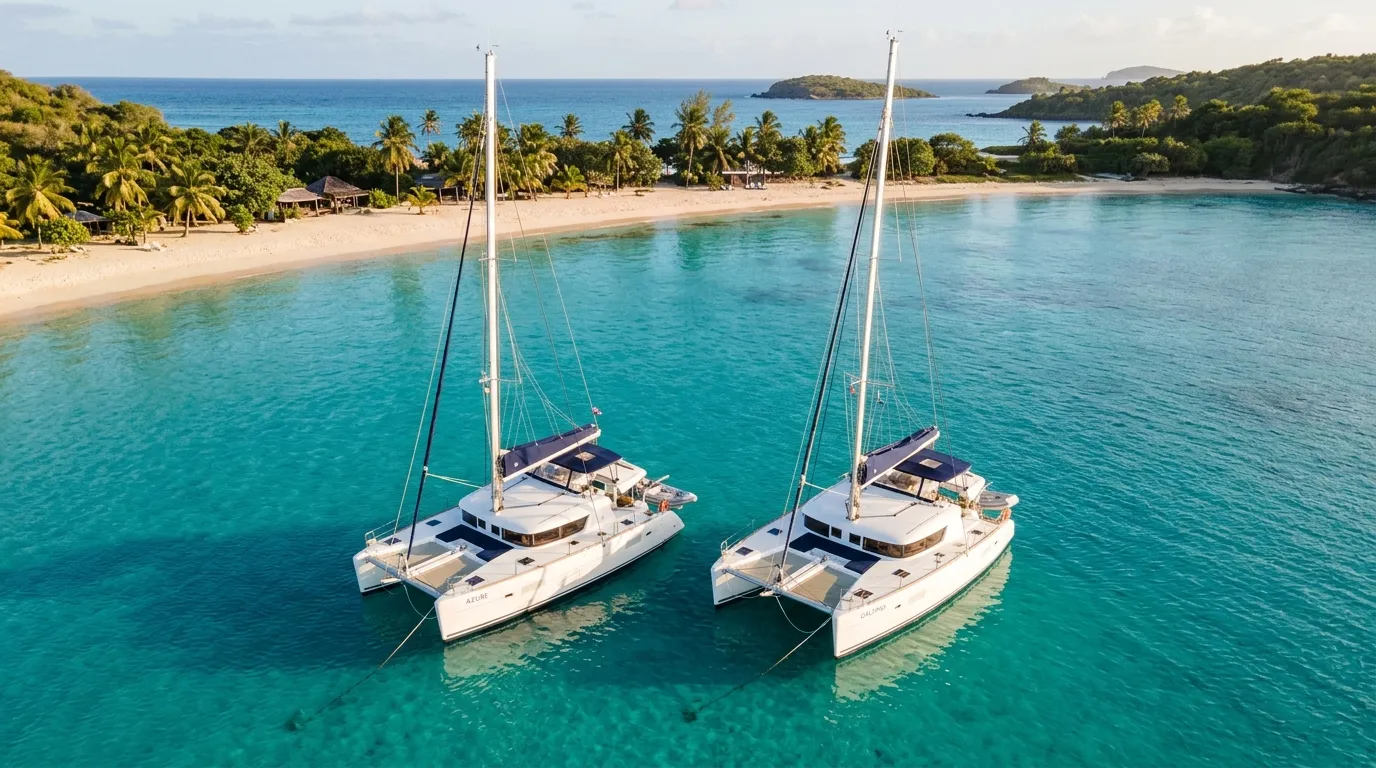
A tandem charter places your reunion across two yachts sailing the same itinerary together, coordinated by a single broker so anchorages, beach lunches, and arrival times all line up (VIPCA, 2025). Two 50-foot catamarans carrying 10 guests each runs roughly $2,950/person/week, compared with about $16,500/person/week on a single 140-foot passenger yacht — an 82% savings for the tandem path. It’s almost always the cheaper, more comfortable, and more flexible answer for a 13–24 person reunion.
A tandem family reunion yacht charter splits 13+ guests across two crewed yachts that sail the same itinerary, anchor together, and share meals — coordinated by one broker. It’s typically about 82% cheaper per person than upsizing to a single SOLAS-class passenger yacht of equivalent capacity, and most groups choose two 50–62 foot catamarans.
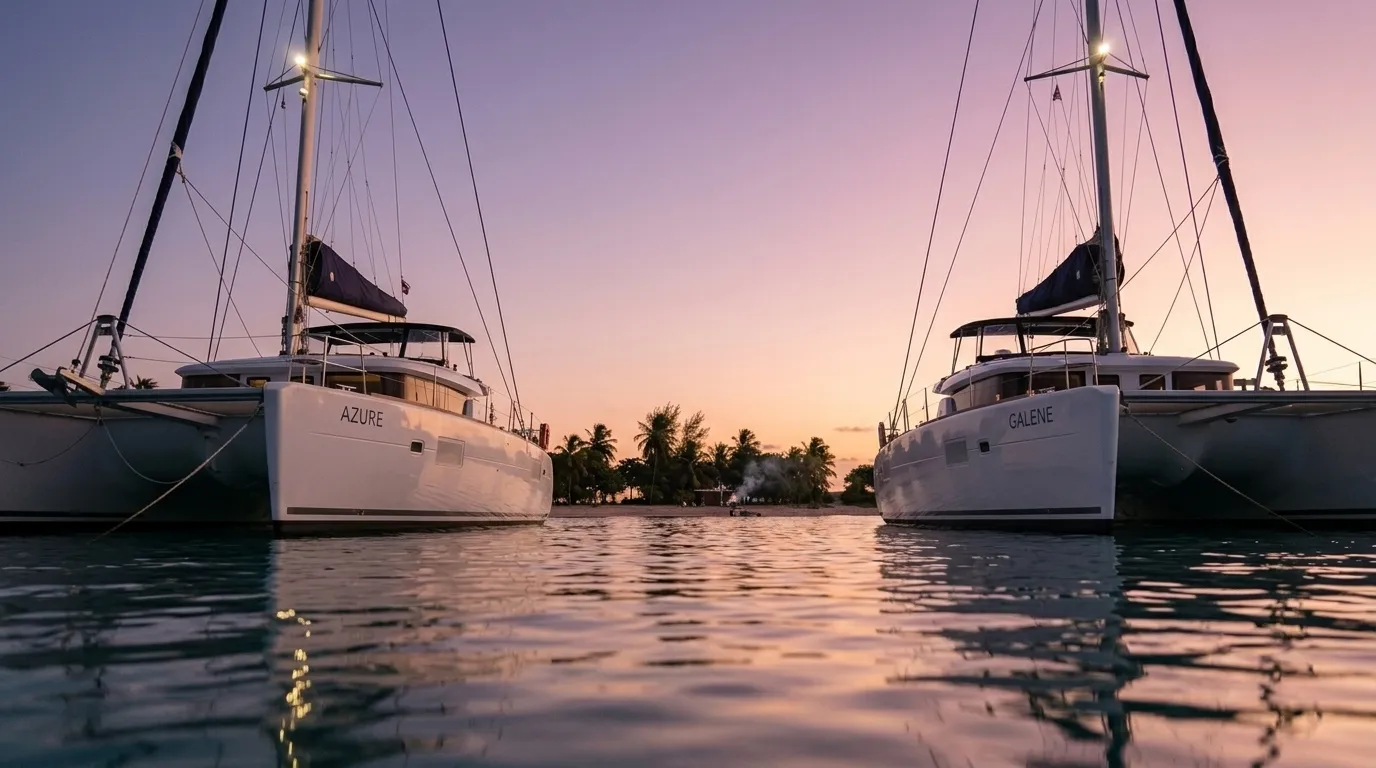
The mechanical setup is simple. Each yacht has its own captain, chef, crew, contract, and (if applicable) APA — the Advance Provisioning Allowance — but the captains share a VHF working channel, the chefs coordinate menus so nobody eats the same dinner twice, and your broker handles the matchmaking from boat selection through itinerary alignment. Day-to-day, the boats raft up for group dinners, then split when the teenagers want to wakeboard at 7 AM and grandma wants a quiet morning on the flybridge.
The BVI is the strongest tandem destination on the planet. With 685 charter vessels, the densest cluster of anchorages in the Caribbean, and BoatyBall — the BVI’s online mooring reservation system — it’s purpose-built for multi-yacht groups. Our BVI tandem charter playbook covers anchorage selection, mooring strategy, and crew coordination in detail. It’s the operational companion piece to this one.
Splitting Costs Across Family Branches
Most reunion charters are paid by one signing branch, then split internally — and that’s the cleanest path even when several households are contributing. In the multi-branch reunions we’ve coordinated at Vital Charters, the one-signer-reimbursed pattern fails maybe twice a year, usually when a branch tries to wire APA directly to the captain instead of routing through the signer. Charter contracts are signed by a single charterer of record, who is legally responsible for the booking, the APA (if applicable), and the gratuity. Brokers typically don’t accept fragmented payments from five different households against one contract. The reason isn’t gatekeeping — it’s accounting and anti-money-laundering compliance.
The pattern that works for almost every reunion we’ve coordinated:
- One family branch signs. Usually the grandparents, the host couple, or the most-organized adult kid. That household is on the contract.
- Other branches reimburse the signer before the deposit goes out. A simple shared spreadsheet by head, by night, by extras. Venmo, Zelle, or a wire works.
- APA gets pre-funded the same way. APA usually runs 25–35% of the base charter fee and covers fuel, food, drinks, and dockage. It’s wired to the captain about two weeks before embarkation. Pre-collect from branches well before that date.
- Crew gratuity is collected at the end. Industry standard is 15–20% of the base charter rate, paid in cash or wire to the captain on disembarkation day. Split it the same way you split the rest.
On a tandem, each yacht has its own contract, APA, and gratuity — so you’ll either have two signers (one per branch) or one signer with two contracts. Either works; we’ve done both.
Crew gratuity is industry-standard 15–20% of the base fee, paid in cash or wire on disembarkation day. On a tandem, each yacht runs its own APA and gratuity separately (CYBA/MYBA charter terms, 2025).
For a deeper look at what’s actually included in those numbers, our breakdown of yacht charter costs, rates, APA, and add-ons walks through line by line.
Planning Activities Across Three Generations
A reunion charter is the rare vacation where a four-year-old, a fourteen-year-old, and a seventy-four-year-old can all have a full day they actually wanted — and the crew makes most of that happen invisibly. The flexibility advantage is what brings multi-gen families back. A full 98% of multi-generational travelers report high satisfaction with their trip, and 85% plan another within 12 months (AARP, 2025). Yacht charters punch above their weight on that metric because the venue adapts to the family.
For a reunion, the crew typically runs a tiered daily plan. Mornings are split: a calm anchorage, swim ladder down, paddleboards out for the cousins, coffee on the flybridge for the grandparents. Mid-day moves to a beach with a snorkel reef nearby, where the chef sets up a barbecue and the toddlers have a sandy run-around zone. Afternoons branch — water toys, wakeboarding, or a tender ride to a quiet cove for the adults who want one. Evenings come back together for a group dinner on deck.
For a tactical breakdown of what kids of different ages actually need on board — life jackets, netting, snack timing, screen rules — our guide to yacht chartering with kids covers it. And for the broader case multi-generational families make for choosing charters over resorts and cruises, see our piece on why multi-generational families choose private yacht charters.
Provisioning for a Multi-Generation Reunion
Charter brokers send a guest preference sheet roughly 30 days before embarkation, covering meals, allergies, kid menus, grandparent staples, and alcohol brands (CYBA/MYBA standard charter terms, 2025). For a reunion, sending it back with detailed input — not a one-line “we eat anything” reply — is the difference between a good week and a great one. The chef is cooking for your family, not 200 hotel guests.
For a multi-branch reunion, we usually recommend the signing household consolidate one preference sheet for the whole party. Have each branch fill in a shared document — kid likes/dislikes, adult allergies, grandparent staples, drink preferences — then the signer forwards a single clean document to the chef. Trying to coordinate five preference sheets across five households at the same time is how you end up with a chef who knows about the gluten allergy but not the shellfish one.
A few patterns that matter at the reunion scale:
- Kid menus run separately. Most chefs cook a parallel dinner for the under-10s with simpler plates and earlier service. Specify what your kids actually eat.
- Two grandparent staples beats ten preferences. Pick the two or three foods your grandparents really want — morning oatmeal, a specific tea, a particular afternoon snack — and write them down. The chef will absolutely stock them.
- Alcohol. Wine, beer, spirits, and mixers are part of provisioning. Send brand names. “Good white wine” produces wildly different results across yachts.
- Birthday cakes count. If someone’s birthday hits the charter week, tell the chef at the preference sheet stage. It’s almost always built into provisioning at no extra cost.
Coordinating Captains, Crew, and Communication Across Two Yachts
On a tandem family reunion charter, the two captains share a dedicated VHF working channel for real-time coordination — usually one of the higher hailing channels (often 68, 71, or 72) handed out by your broker at pre-charter (VIPCA crew standard, 2025). That single radio channel is the operational backbone of the whole week. Anchorage timing, lunch hand-offs, weather calls, and tender movements all run through it. More often now, this is handled though a WhatApp group conversation.
Day-to-day, the practical setup looks like this. Captains agree the next-day plan at evening anchor — usually after dinner on the lead boat — and confirm by 8 AM the following morning. Chefs trade menus 24 hours ahead so nobody serves the same dinner twice. Stews coordinate beach setups when both boats land at the same anchorage. The broker holds a group text with both captains and the host signer for any plan change that affects guests directly.
What this means for the family: nothing. The coordination is invisible. The only thing guests should know is that whichever boat has the better internet, the kids will figure out within 30 minutes, and the cousins will spend the week swapping yachts via tender. That’s a feature.
Best Caribbean and Bahamas Destinations for Family Reunions
The British Virgin Islands runs the largest professional charter fleet in the Caribbean — 685 vessels concentrated in a 15-nautical-mile cluster of 60 islands — and it’s the strongest destination on the planet for tandem reunions (BVI industry estimates). Short hops between anchorages, calm lee-side waters, and the BoatyBall mooring reservation system make multi-yacht coordination easy.
| Destination | Why it works for reunions | Best for groups |
|---|---|---|
| British Virgin Islands | Short sailing legs, dense anchorages, BoatyBall system, deepest charter fleet | Tandem (13–24) |
| US Virgin Islands | Easier from the US (no passport for citizens), strong restaurants and shore activities | Single yacht (8–12) |
| Bahamas (Exumas) | Shallow turquoise water, swimming pigs, private islands within range | Single or tandem (8–16) |
| Bahamas (Abacos) | Calm waters, family-friendly settlements, easier weather window | Single yacht (8–12) |
For a destination-by-destination comparison aimed at picking a region rather than a yacht, see our Caribbean crewed charter destinations guide. For sizing the boat (or boats) to your specific group, how to choose the right yacht size for your group walks through cabin parity, beam, and layout.
Coordinating a Family Reunion at Sea: The Short Version
A family reunion yacht charter is almost always a coordination problem before it’s a yacht problem. The 12-guest SOLAS cap defines the structure (single yacht for 8–12, tandem for 13–24, SOLAS-class passenger yacht for 25+). The holiday-week calendar defines the timeline (12–18 months out for Christmas and New Year’s, 9–12 for spring break, 6–9 for Thanksgiving). The multi-branch budget defines the contract (one signing household, internal reimbursement, pre-funded APA and gratuity). And the multi-generation guest list — toddlers through grandparents — defines the boat (catamaran beam, cabin parity, deck access). Solve those four in order, ideally a year out, and the trip itself is mostly the crew’s job. Start a yacht search with Vital Charters, or contact us directly if your reunion is 13+ and you want to talk tandem options.
Frequently Asked Questions
Can we put more than 12 guests on one yacht for our family reunion?
Almost never, legally. SOLAS Chapter I classifies any vessel carrying more than 12 passengers as a “passenger ship” — a status that requires construction, lifesaving, and inspection standards almost no Caribbean charter yacht is built to hold. SOLAS-certified passenger yachts that can take 13+ guests exist, but rates typically start around $200K/week. Most reunions of 13+ book a tandem charter — two yachts sailing together — instead.
Do infants and toddlers count toward the 12-guest limit?
Yes. Every guest counts toward the 12 — including infants on a parent’s lap. Crew don’t count, but anyone you bring on board for the charter does. This catches families off guard frequently, so brokers will ask for ages at booking specifically to confirm the legal head count.
How far ahead should we book a family reunion yacht charter?
For Christmas and New Year’s weeks on premium Caribbean yachts, 12–18 months ahead. Spring break runs 9–12 months. Thanksgiving lands at 6–9 months. Shoulder-season weeks (early November, late April) can sometimes book at 3–6 months, but for a reunion you’re usually locked to a school-break week, so plan a year out.
What’s the cheapest way to do a family reunion at sea for 16 people?
A tandem charter of two 50–62 foot crewed catamarans runs about $2,950 per person per week, versus roughly $16,500 per person per week on a single 140-foot SOLAS-class passenger yacht — an 82% savings (Barrington-Hall Yacht Charters). For 16 guests, tandem catamarans are almost always the cheapest legal path.
Can different family branches sign separate contracts on a tandem charter?
Yes. On a tandem, each yacht has its own contract, charterer of record, APA, and gratuity. So you can either have one signer holding both contracts, or two signers — typically one per family branch. We’ve coordinated both setups; the choice is usually a tax or accounting one, not a logistics one.
Is the Bahamas or BVI better for a family reunion charter?
The BVI is the default for 13+ guests on a tandem because of the deeper charter fleet and the shortest sailing distances in the Caribbean. The Bahamas works well for reunions of 8–16, especially in the Exumas (shallow turquoise water, swimming pigs, private island visits) and the Abacos (calmer weather windows, family-friendly settlements). Our complete Bahamas charter guide compares the regions.
One itinerary, every generation, no one left ashore.
Tell us your guest count and family mix and we’ll work out the tandem-yacht logistics, cost splits, and Caribbean destination that works for ages 8 to 80.