
How to Choose the Right Yacht Size for Your Group
Match yacht length, cabins, and crew to your group. A broker’s tier-by-tier guide for 4-12 guests, with the SOLAS 12-passenger cap that every group hits.
Last Updated: September 7, 2026
Knowing how to choose the right yacht size for your group comes down to three numbers, your guest count, the cabin count you actually need, and the regulatory cap that no broker can move. Get those three right and the rest of the decision (catamaran or motor yacht, 50 ft or 75 ft, two crew or six) falls out of the math. For more details, see our guide on staniel cay yacht club. Get them wrong and you end up paying for square footage you don’t use, or worse, scrambling to add a second yacht two months before sailing.
Before we get to the size tiers, two notes. First, this guide is built around crewed Caribbean and Bahamas yacht charters: not bareboat, not yacht ownership. For more details, see our guide on beyond the cruise ports. Second, sizing for groups is the linchpin of broader group charter planning; if you’re booking a milestone trip with extended family, a corporate retreat, or a wedding party, start there for the full logistics picture.
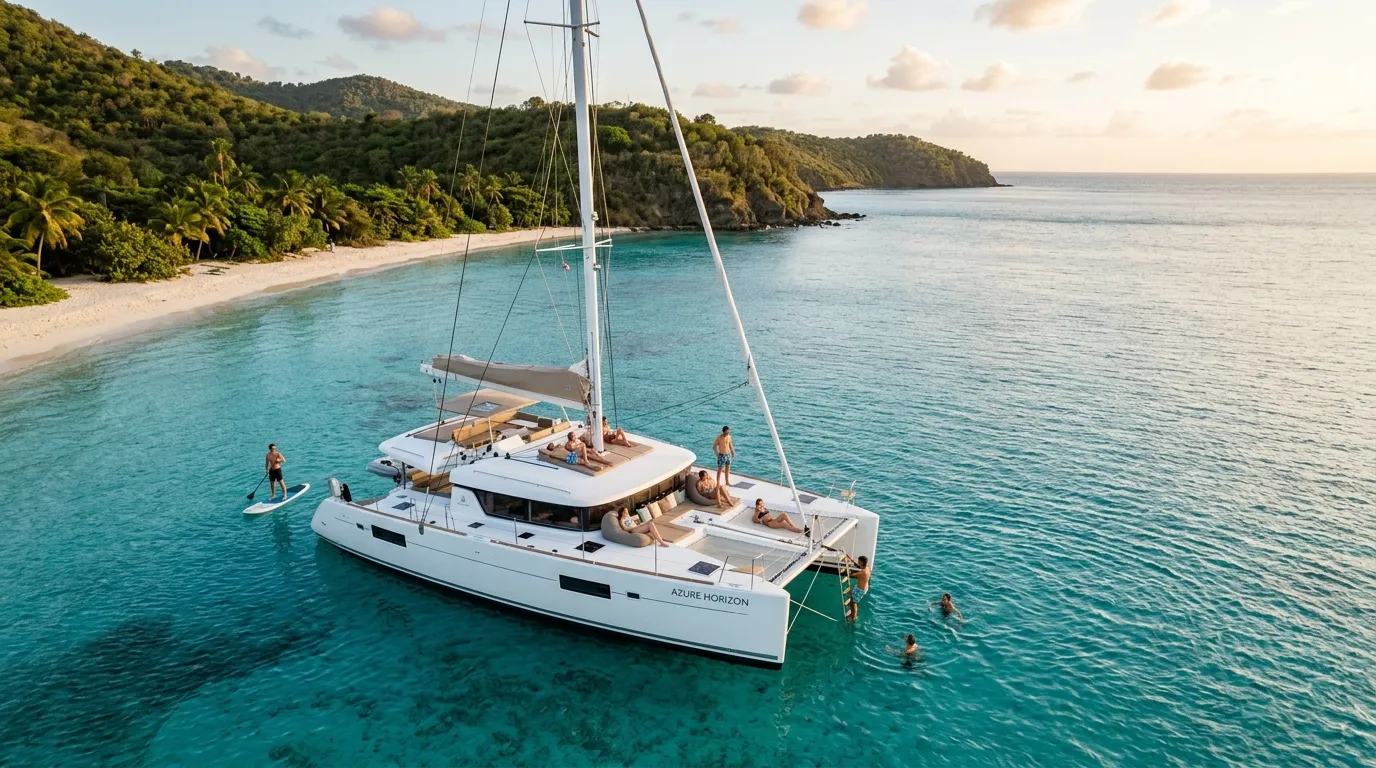
How big a yacht does my group actually need?
The most-common guest count on a luxury yacht charter is 8-10 guests, and the regulatory ceiling is 12 under the SOLAS convention (IMO, 2018). That means most charter yachts in the Caribbean are sized to host between four and twelve people across three to six cabins, with the 12-guest cap baked into both the yacht’s commercial certification and its insurance.
The simplest rule: count cabins, not square feet. A modern charter catamaran in the 45-50 ft range carries four guest cabins and sleeps eight; a 50-foot Lagoon 50 in the six-cabin charter layout sleeps up to twelve (Lagoon, 2025). Past 50 feet, more length usually means bigger common spaces and higher service levels, not more sleeping berths. See our answer to: What should you check before booking a luxury catamaran charter? So if your group is six adults and two kids, a 45-50 ft catamaran solves the cabin math; a 90-foot motor yacht buys you separation, climate control, and crew, but it doesn’t fundamentally add capacity.
Step 1: Count your group and respect the 12-passenger rule
Under the international SOLAS convention, a yacht carrying more than 12 passengers (excluding crew) is legally classified as a passenger ship and must meet stricter construction, fire, and lifesaving standards (IMO, 2018). Almost no charter yacht under 200 feet holds that certification, which is why “the 12 person rule” effectively caps a single commercial charter at 12 guests regardless of how many cabins the yacht has.
This is a hard line, not a guideline. Accidentally exceeding 12 voids the yacht’s commercial certification and insurance, and the captain has to enforce it. For a closer look at the rule and what counts as a “passenger,” see our breakdown of the 12-passenger rule.
What this means for sizing decisions:
- Group of 12 or under: One yacht, one decision. Skip ahead to Step 2.
- Group of 13-24: Two yachts in a tandem charter setup, sailing the same itinerary and rafting up at anchor. The legal cap is per yacht, not per group.
- Group of 25+: Three or more yachts, or a passenger-ship-classed vessel (think small expedition cruiser). At that point, the project looks more like a flotilla than a charter.
One quirk worth flagging: kids count as passengers. A family of six adults plus seven children is a 13-passenger group, even though no one would call it a “large” charter. We’ve redirected exactly this profile to tandem before.
Step 2: Match yacht length to cabin count and trip type
A 50-foot catamaran has roughly the interior volume and deck space of a 60-foot monohull, about 1.25-1.33x at the same length (Boats.com, 2023). That’s why catamarans dominate Caribbean group charter: a 50 ft cat with a ~25 ft beam delivers two hulls of cabins plus a wide salon and a lounging foredeck, all on the LOA budget of a much smaller yacht.
Here’s the cabin-and-guest layout we see across the dominant Caribbean charter classes:
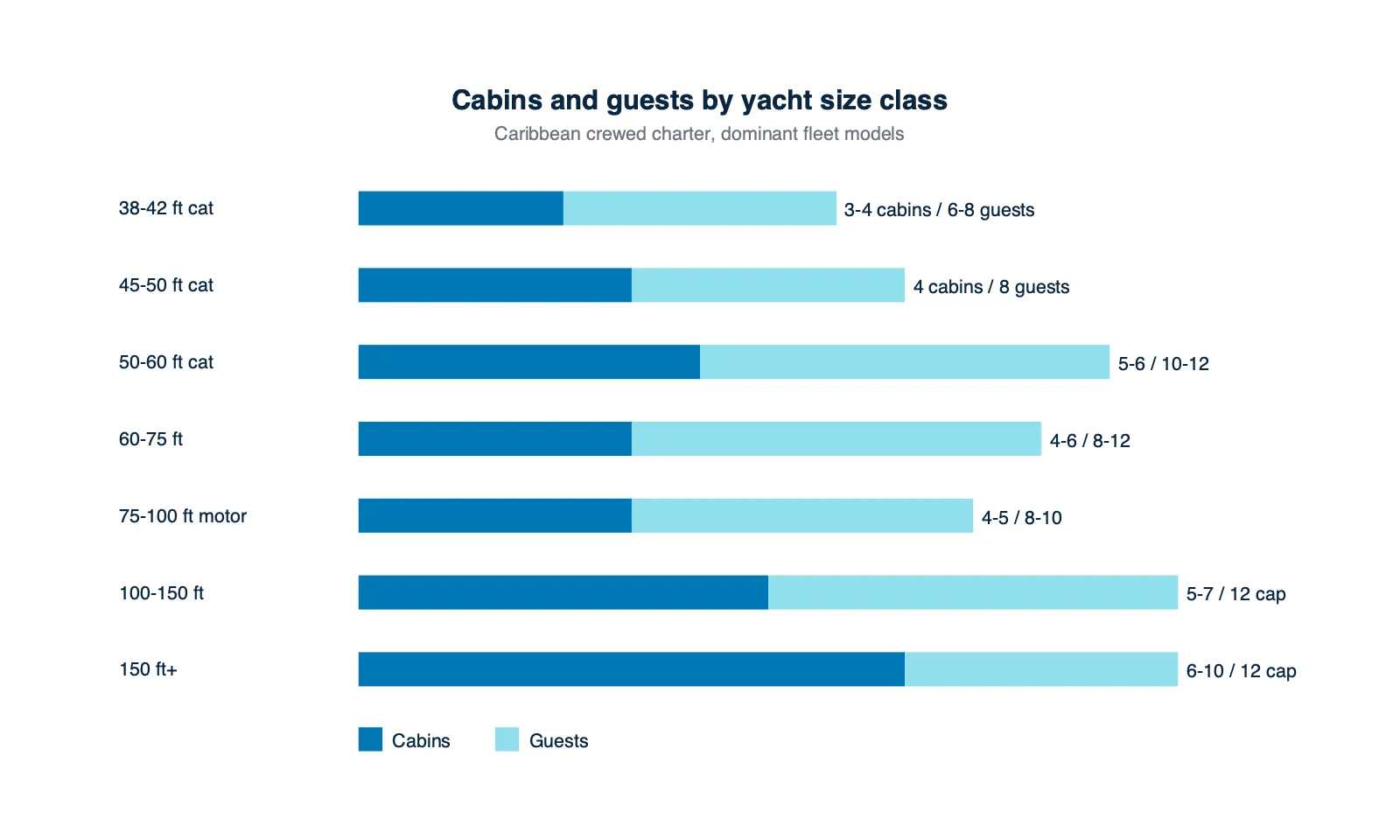
View data table
| Size class | Typical cabins | Guest capacity | Example models |
|---|---|---|---|
| 38-42 ft catamaran | 3-4 | 6-8 | Lagoon 42, Leopard 40, Astrea 42 |
| 45-50 ft catamaran | 4 | 8 | Leopard 45, Elba 45, Bali 4.6, Lagoon 46 |
| 50-60 ft catamaran | 5-6 | 10-12 | Lagoon 50, Lagoon 55, Bali 5.4, Saba 50 |
| 60-75 ft cat or motor | 4-6 | 8-12 | Lagoon 65, Sunreef 70 |
| 75-100 ft motor yacht | 4-5 | 8-10 | Various Italian motor yachts |
| 100-150 ft superyacht | 5-7 | 12 (regulatory cap) | Various |
| 150 ft+ superyacht | 6-10 | 12 (regulatory cap) | Various |
Source: Manufacturer specs (Lagoon, Robertson and Caine, Fountaine Pajot, Bali, Sunreef), 2024-2025.
A few specifics that matter when you’re shopping listings:
- Lagoon 42: 42 ft LOA, 25 ft beam, 3-4 cabin layouts, 6-12 berths in flexible configurations (Lagoon, 2025).
- Leopard 45 charter version: 4 guest cabins, 4 heads, sleeps 8 guests with up to 14 berths in the flex config (Robertson and Caine, 2024).
- Lagoon 50: 48 ft LOA, 27 ft beam, six-cabin charter version sleeps up to 12 (Lagoon, 2025).
- Fountaine Pajot Saba 50: 5 double cabins each with private bathroom, plus a crew cabin; up to 12 guests (Fountaine Pajot, 2024).
- Bali 5.4: 54 ft LOA, six guest cabins with queen beds and en-suites, 12 guests (Bali Catamarans, 2024).
- Sunreef 60: 4-6 cabins depending on layout, 8-12 guests, two crew (Sunreef Yachts, 2024).
For a closer look at how each builder differs, our roundup of the five charter catamaran fleets compares Lagoon, Leopard, Fountaine Pajot, Bali, and Sunreef across charter use. Learn more about swimming pigs of the bahamas.
Step 3: Compare catamarans, monohulls, and motor yachts at the same length
At the same LOA, a catamaran delivers 25-33% more usable interior and deck volume than a monohull (Boats.com, 2023). For more details, see our guide on best charter brokers 2026. That’s the load-bearing reason charter brokers steer first-time groups toward cats: a 50-foot catamaran with eight guests doesn’t feel like a 50-foot sailboat with eight guests. It feels closer to a 60 ft monohull, with a wider, flatter, more social platform.
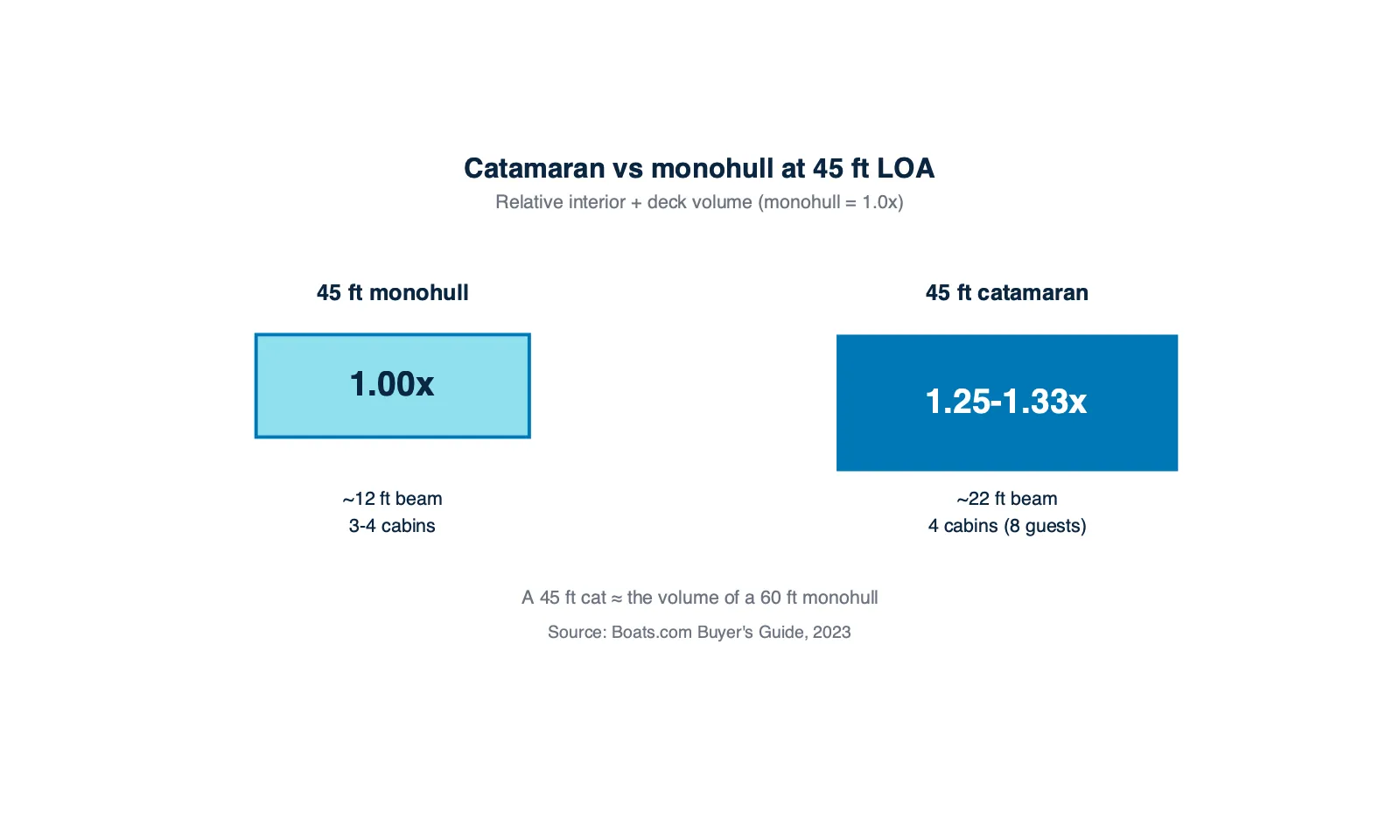
View data table
| Hull type | LOA | Beam | Relative volume | Cabins (typical) |
|---|---|---|---|---|
| Monohull (sailing) | 45 ft | ~12 ft | 1.0x | 3-4 |
| Catamaran (sailing) | 45 ft | ~22 ft | 1.25-1.33x | 4 |
| Catamaran equivalent | , | , | matches a 60 ft monohull | , |
Source: Boats.com Buyer’s Guide, 2023.
That said, motor yachts in the 75-120 ft range solve a different problem. They give groups of eight to twelve guests three or four distinct deck zones (sun deck, aft deck, bridge deck, swim platform), full climate control, and water-toy garages that catamarans can’t match. The trade is roughly double the money for the same beds. Matched on cabin count and counting the APA, a four-cabin motor yacht runs a median all-in week of $81,000 against $32,000 for a four-cabin catamaran, and at five cabins it is $148,500 against $41,500 (Vital Charters rate analysis, September 2026). The motor yacht is also about 40 feet longer to hold those same cabins, and burns meaningful fuel underway. We break down the head-to-head in catamaran vs motor yacht for Caribbean groups.
Step 4: Budget by size tier
A 50-59 ft Caribbean crewed catamaran carries a median listed week of $27,000 to $32,000 all-inclusive, and a 100-119 ft motor yacht a median of $74,000 before its APA (Vital Charters rate analysis, September 2026). The gap between tiers is not linear, and it does not climb where most people expect: from 45 ft to 60 ft the rate roughly doubles, then it flattens across the 60 to 119 ft range before tripling again above 120 ft.
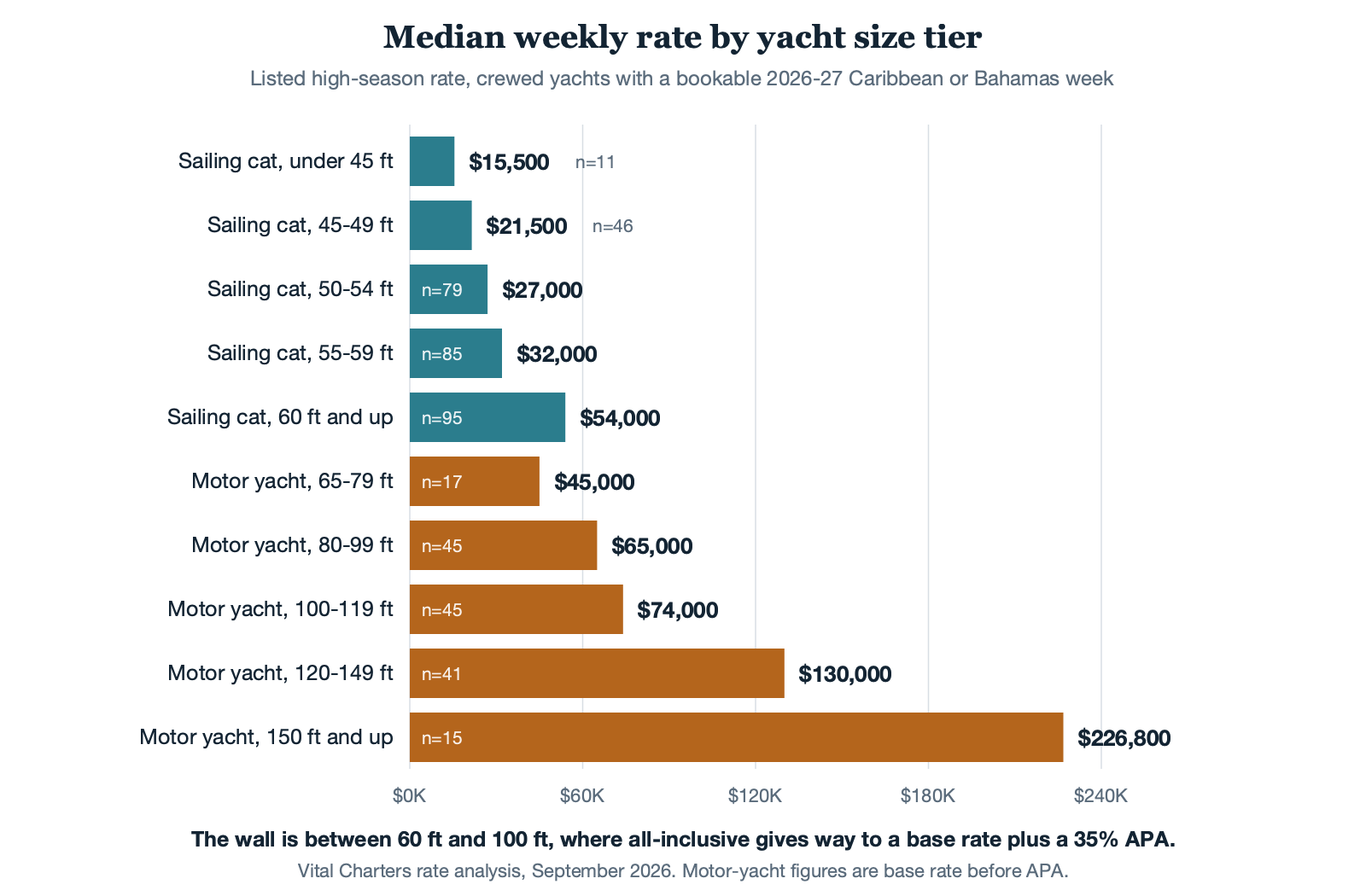
View data table
| Size tier | Median weekly rate | Middle half of the band | Yachts | Pricing model |
|---|---|---|---|---|
| Sailing catamaran, under 45 ft | $15,500 | $14,075-$18,000 | 11 | All-inclusive |
| Sailing catamaran, 45-49 ft | $21,500 | $18,000-$24,375 | 46 | All-inclusive |
| Sailing catamaran, 50-54 ft | $27,000 | $24,000-$31,000 | 79 | All-inclusive |
| Sailing catamaran, 55-59 ft | $32,000 | $30,000-$42,000 | 85 | All-inclusive |
| Sailing catamaran, 60 ft and up | $54,000 | $43,000-$59,900 | 95 | All-inclusive |
| Motor yacht, 65-79 ft | $45,000 | $42,500-$55,000 | 17 | Base plus 35% APA |
| Motor yacht, 80-99 ft | $65,000 | $48,600-$90,000 | 45 | Base plus 35% APA |
| Motor yacht, 100-119 ft | $74,000 | $65,000-$95,000 | 45 | Base plus 35% APA |
| Motor yacht, 120-149 ft | $130,000 | $105,000-$145,000 | 41 | Base plus 35% APA |
| Motor yacht, 150 ft and up | $226,800 | $210,000-$297,500 | 15 | Base plus 33% APA |
Vital Charters rate analysis, September 2026. Listed high-season weekly rate for crewed yachts with a bookable 2026-27 Caribbean or Bahamas week. Motor-yacht figures are base rate before APA.
A few budget realities groups miss:
- All-inclusive vs APA: Caribbean cats up to ~75 ft mostly run all-inclusive (food, drink, fuel, dockage built in). Motor yachts above ~75 ft charge a base rate plus an APA (advance provisioning allowance) to cover variable costs, and the stated figure is 35% almost without exception across the Caribbean fleet (Vital Charters rate analysis, September 2026). Two yachts at the same nightly LOA can land very differently in your bank account.
- Crew gratuity: Customary 15-20% on top of the base rate, the rate CYBA’s Inclusive Agreement calls customary. On a $30K week, that’s $4.5K-$6K. On a $200K week, it’s $30K-$40K.
- Holiday surcharge: Christmas and New Year’s bookings carry a premium on top of high-season rates, a median of 12 percent among the yachts that publish a festive rate (Vital Charters rate analysis, September 2026). Most don’t publish one, so the number arrives as a quote.
If pricing is the deciding factor, our breakdown of weekly rates by yacht size compares $30K, $50K, and $100K-per-week experiences side by side.
Step 5: Factor in crew-to-guest ratio and service
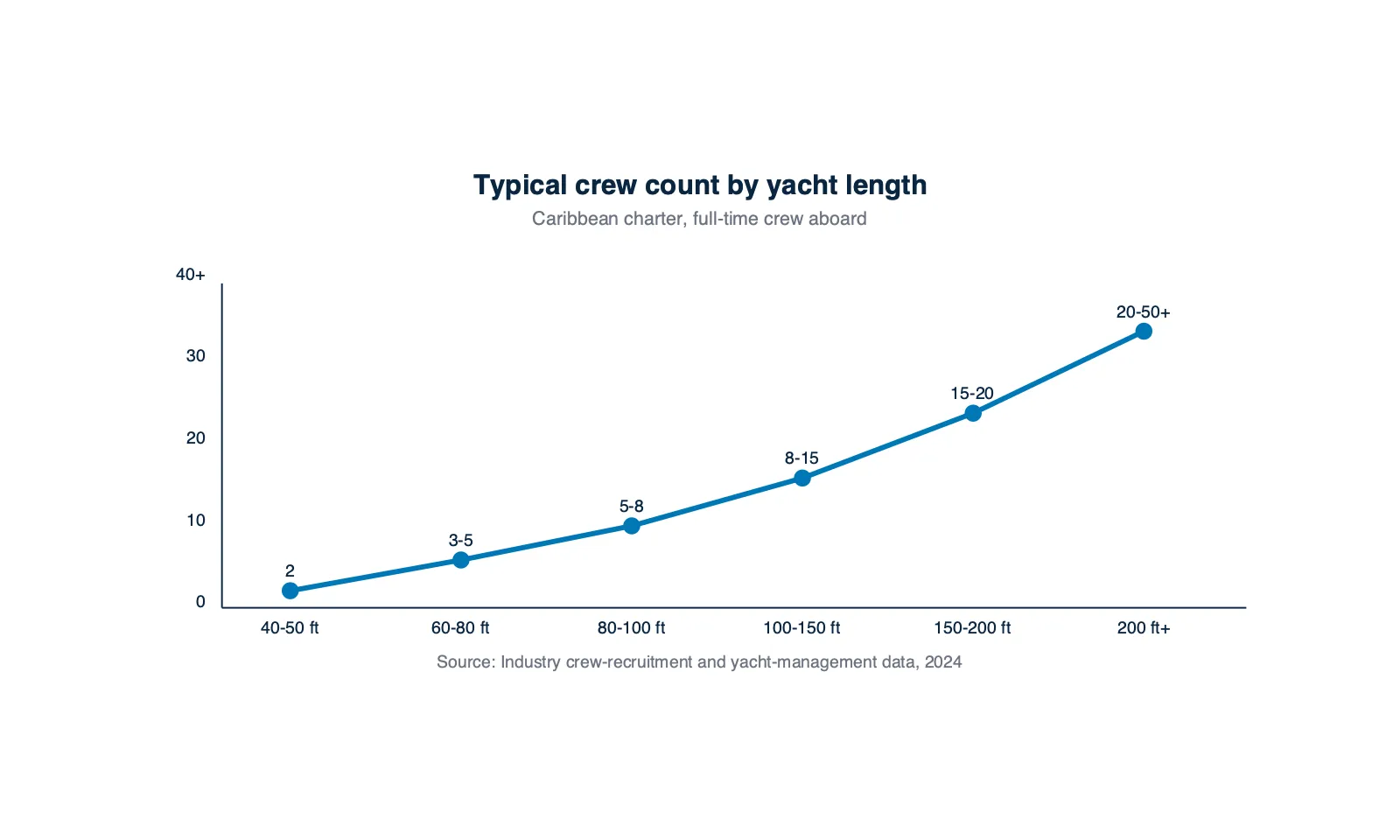
Luxury charter yachts run a crew-to-guest ratio of roughly 1:1 or higher, and on superyachts above 150 ft it’s common to carry more crew than guests (industry crew-recruitment data, 2024). The ratio is what separates a bareboat-style trip from a true charter, and the bigger the yacht, the bigger the crew, even if the cabin count doesn’t change much.
View data table
| Yacht length | Typical crew | Common roles |
|---|---|---|
| 40-50 ft cat | 2 | Captain, chef/mate |
| 60-80 ft | 3-5 | + stewardess, deckhand |
| 80-100 ft | 5-8 | + engineer, second steward |
| 100-150 ft | 8-15 | Full department heads |
| 150-200 ft | 15-20 | Multiple stewards, sous chef, senior officers |
| 200 ft+ | 20-50+ | Full hotel-style operation |
Source: Industry crew-recruitment and yacht-management data, 2024.
Step 6: Pick by group type
Same eight guests, four different group types, four different yacht recommendations. Group composition shapes the answer as much as headcount does.
Couples and adults-only friend groups (4-8 guests)
A 45-50 ft sailing catamaran is the sweet spot: four equal cabins, four en-suites, and a wide foredeck for sundowners. Lagoon 46, Leopard 45, Fountaine Pajot Elba 45, and Bali 4.6 all hit this profile. Couples on a private trip should look at honeymoon yacht charter options, where smaller 38-42 ft cats with one or two cabins (and a higher crew-to-guest ratio) often beat a half-empty 50 ft.
Families with kids (6-10 guests, mixed ages)
Cabin layout decides more than total length does. You want kids’ cabins clustered together with bunk beds, plus a separate primary suite, and at least one shaded deck zone for nap time. The 50-foot cats (Lagoon 50, Bali 5.4, Saba 50) handle this best. We covered the kid-specific tradeoffs in our family charter guide.
Multi-generational groups (8-12 guests, three generations)
Separation is the killer feature. Grandparents need quiet; parents need autonomy; kids need a wet zone they can take over without consequences. A 50-60 ft cat with a forward cabin pair and an aft cabin pair gives you it. For why this group profile gravitates to private charter at all, see multi-generational charter considerations.
Corporate groups and team retreats (8-12 guests)
Motor yachts in the 80-100 ft range tend to outperform here, a single large salon for working sessions, climate control for laptops, and a formal dining setup. Catamarans work too, but the work-friendly footprint is smaller. Our breakdown of team retreats at sea walks through the program design.
Groups of 13+ (any composition)
Two yachts. Always. Whether it’s a 50th birthday with seventeen people or a wedding party of twenty-two, the answer is a tandem charter. Run two 50-foot catamarans, one trip plan, two captains coordinating on the radio. That’s the structure. The math also tends to favor it: two $30K cats often beat one $100K motor yacht for the same headcount and a better crew-to-guest ratio.
Step 7: Pressure-test your shortlist
Before you sign a charter agreement, run your candidate yachts through this five-question screen:
- Cabin parity. Are the cabins comparable in size and bed configuration, or is one a closet? On 38-45 ft cats this is worth checking: the forward cabins are often noticeably smaller than the aft. For mixed couples, parity prevents the “who got the small room” tax.
- Bed configuration. Doubles convert to twins for friend pairs, but not all yachts offer it. Check the layout drawing, not the marketing photo.
- Beam at the salon. A 50 ft cat with a 27 ft beam (Lagoon 50) feels different from one with a 25 ft beam, flatter floor plans, more elbow room at the dinette.
- Number of heads vs cabins. Four cabins / four heads is standard charter spec. Four cabins / two heads (older or owner-version layouts) makes mornings rough with eight guests.
- Tender and water-toy capacity. A 50 ft cat with one 12 ft RIB and two paddleboards services six guests well; ten guests on the same boat will queue. Check the inventory.
For a fuller checklist that goes beyond sizing (itinerary, broker selection, contracts) work through our Caribbean charter planning guide.
The bottom line on yacht size
Three numbers solve 80% of the sizing decision: guest count, cabin count, and the 12-passenger ceiling. Match those to a yacht class: 38-45 ft cat for couples and small groups, 45-50 ft for families of six to eight, 50-60 ft for full eight-to-twelve-guest groups, tandem for thirteen-plus. The remaining 20% (catamaran vs motor yacht, 50 ft vs 60 ft, charter brand) comes down to group type, budget, and how connected your guests want to feel.
Start a yacht search at Vital Charters if you want a curated shortlist matched to your group size, dates, and budget. We’ll handle the cabin math and the 12-passenger logistics for you.
Frequently Asked Questions
What size yacht is best for 8 people?
A 45-50 ft catamaran is the standard answer: four guest cabins with en-suites, two crew, and an all-inclusive Caribbean weekly rate of $17,000-$24,000 in 2025-2026. Examples include the Leopard 45, Lagoon 46, Fountaine Pajot Elba 45, and Bali 4.6. If your eight guests need climate control or formal dining, step up to a 75-90 ft motor yacht.
What size yacht for 12 people?
A 50-60 ft catamaran in the six-cabin charter layout (Lagoon 50, Lagoon 55, Bali 5.4, Fountaine Pajot Saba 50) sleeps up to twelve guests with two crew, at a Caribbean weekly rate of $25,000-$45,000 all-inclusive. Twelve is the regulatory ceiling under SOLAS for commercial charter, adding a thirteenth guest pushes the trip to a tandem charter regardless of yacht size.
What size yacht for 6 people?
A 38-45 ft catamaran with three or four cabins works well, Lagoon 42, Leopard 40, or Fountaine Pajot Astrea 42 in three-cabin layouts. Caribbean weekly rates run $14,000-$18,000 crewed. Six guests on a 50-foot cat with four cabins also works if you want a spare cabin for storage or a kid’s playroom.
Can I charter one yacht for 15 guests?
Almost never. SOLAS caps commercial charter at 12 passengers per yacht, and the very few yachts certified for 13+ passengers are typically 200+ ft expedition vessels with weekly rates north of $400,000. The standard solution for 13-24 guests is a tandem charter, two yachts sailing the same itinerary.
Is a bigger yacht always better?
No. Beyond the cabin count your group needs, more length usually buys separation, climate control, and crew, not more guests. Eight guests on a 50 ft catamaran often report a better experience than the same eight on a 90 ft motor yacht, because the cat keeps the group together while the bigger boat spreads them across decks. Match length to how connected (or separated) your group wants to feel.
How does the 12-passenger rule affect group size?
The SOLAS 12-passenger rule limits commercial charter yachts to 12 guests, with crew counted separately. The cap is per yacht: so a group of 15 can’t legally charter a single commercial vessel under 200 feet. Tandem charters (two yachts sailing the same itinerary) are the standard workaround, with no impact on the per-yacht passenger cap.
The right yacht, sized for your crew.
Share your group size and we’ll match you to crewed yachts with the right cabin count, deck space, and crew ratio, no guesswork, no upsizing surprises.