
Scuba Diving St. Thomas and the USVI: Dive Sites on a Crewed Yacht Charter (2026)
Scuba diving St. Thomas, St. John and St. Croix by crewed yacht: see the best dive sites, park rules, certification and the 24-hour wait before you fly home.
Last Updated: November 8, 2026
Scuba diving St. Thomas from a crewed yacht puts reef, rock and wreck dives a short run from the anchorage (Visit USVI, 2026). The same week can take in the two islands beside it, where the water is very different. St. John has the rocks and cays of Pillsbury Sound. St. Croix, across open water to the south, has a deep wall you can reach from the beach.
Each island’s dive sites come first, followed by the park and reserve rules that decide where a yacht can stop. After that comes the practical side of diving aboard: who runs the dive, what certification you need and how long to wait before flying home. For the wider region, our ranking of the best scuba diving in the Caribbean puts the Virgin Islands beside the Bahamas and Cozumel.
Where is the best USVI scuba diving?
The best scuba diving in the US Virgin Islands splits by island. St. Thomas has three wrecks among its listed sites (Visit USVI, 2026). St. John has reefs and walls around the cays off its northwest corner (Visit USVI, 2026). St. Croix has the Cane Bay wall and the Frederiksted Pier night dive (Visit USVI, 2026).
That spread is the reason to dive the territory from a yacht. A shore-based week usually means one island’s dive shop and its regular sites. A crewed yacht moves between all three, and the crew can pick whichever side of an island is sheltered that day.
Each depth below is the one the territory’s tourism board, the National Park Service or NOAA gives for that site. Where none of them publishes one, the table says so.
| Site | Island | What it is | Depth | Level |
|---|---|---|---|---|
| Cow and Calf Rocks | St. Thomas | Rocks, arches and caves | Not published | Beginner to intermediate |
| Cartanza Senora | St. Thomas (Buck Island) | 190-ft WWII freighter wreck | About 45 ft | Beginner to intermediate |
| WIT Shoal | St. Thomas | 330-ft wreck | 90 ft | Intermediate |
| Miss Opportunity | St. Thomas | 390-ft former Navy hospital barge | 90 ft | Advanced |
| Flat Cay | St. Thomas | Reef | 17 to 70 ft | New divers |
| Coral Bowl | St. Thomas | Reef slope | 30 to 80 ft | Intermediate |
| French Cap | St. Thomas | Exposed offshore cay | Not published | Advanced only |
| Grass Cay | St. John | Four reef sites | 15 to 70 ft | Beginner |
| Congo Cay | St. John | Reefs and walls | To 80 ft | Beginner |
| Carval Rock | St. John | Rock with strong currents | To 80 ft | Experienced |
| Eagle Shoal | St. John | Remote reef, open ocean | About 50 ft | Experienced |
| Cane Bay wall | St. Croix | Wall, shore or boat dive | About 40 ft at the top | Not published |
| Frederiksted Pier | St. Croix | Pier pilings, night dive | 25 to 90 ft | Newer divers |
| Buck Island Reef | St. Croix | Elkhorn coral at scuba moorings | 30 to 40 ft | Not published |
Sources: Visit USVI dive pages for St. Thomas, St. John and St. Croix, 2026; National Park Service (Buck Island Reef).
What are the best St. Thomas scuba diving sites?
The best St. Thomas dive sites are Cow and Calf Rocks, the WIT Shoal and Miss Opportunity wrecks, and Flat Cay (Visit USVI, 2026). All of them sit off the island’s south and east coasts. Cow and Calf Rocks form a maze of arches and caves inside a protected reserve. Flat Cay is a reef that Visit USVI calls ideal for new divers.
If you’re choosing where to board, our guide to a St. Thomas yacht charter covers the marinas and what a week there costs.
Cow and Calf Rocks
Cow and Calf Rocks are a pair of rocks at the south approach to St. James Bay, off the island’s east end. NOAA’s Coast Pilot puts Cow Rock at 7 feet high (NOAA Coast Pilot 5, 2026). Underwater, though, the pair make a maze of passages, arches and caves where sharks, turtles, rays and eels turn up (Visit USVI, 2026).
The rocks sit inside the St. Thomas East End Reserves. There, the territory’s Department of Planning and Natural Resources (DPNR) makes it unlawful to remove marine life without a permit (DPNR STEER management plan, 2011). So take photos and leave everything where you found it.
The wrecks: WIT Shoal, Miss Opportunity and Cartanza Senora
St. Thomas is the territory’s wreck island, and the WIT Shoal’s passageways are full of marine life. The ship began life as a World War II tank landing ship and sank in Krum Bay during Hurricane Klaus in November 1984. It was refloated the next spring and went down again off the island’s southwest side (St. Croix Source, 2004).
Miss Opportunity, a former Navy hospital barge, was sunk in 1985 and is the one Visit USVI rates for advanced divers. The gentlest is the Cartanza Senora, a World War II freighter in Shipwreck Cove, off Buck Island south of St. Thomas (Visit USVI, 2026). This Buck Island, not the one off St. Croix, is a federal wildlife refuge closed to the public (US Fish and Wildlife Service, 2026). That makes the wreck a dive-only stop.
Flat Cay, Coral Bowl and French Cap
Flat Cay is a reef a couple of miles off the St. Thomas shoreline, and Visit USVI suggests it for snorkelers as well. Coral Bowl is a bowl-shaped slope that spirals down to a sandy bottom.
At the other end of the scale is French Cap, a 183-foot-high cay about 3.6 miles southeast of Buck Island (NOAA Coast Pilot 5, 2026). Nothing shelters it, so the seas can be rough and the currents strong, and Visit USVI calls it a site for advanced divers only. The crew and the dive professional decide on the day whether it’s on.
Many of these outer rocks are protected from landing as well as from collecting. Territorial rules make it unlawful to go ashore on cays including Capella, Carval Rock, Congo, Dog, Flat, Frenchcap and Saba (DPNR STEER management plan, 2011).
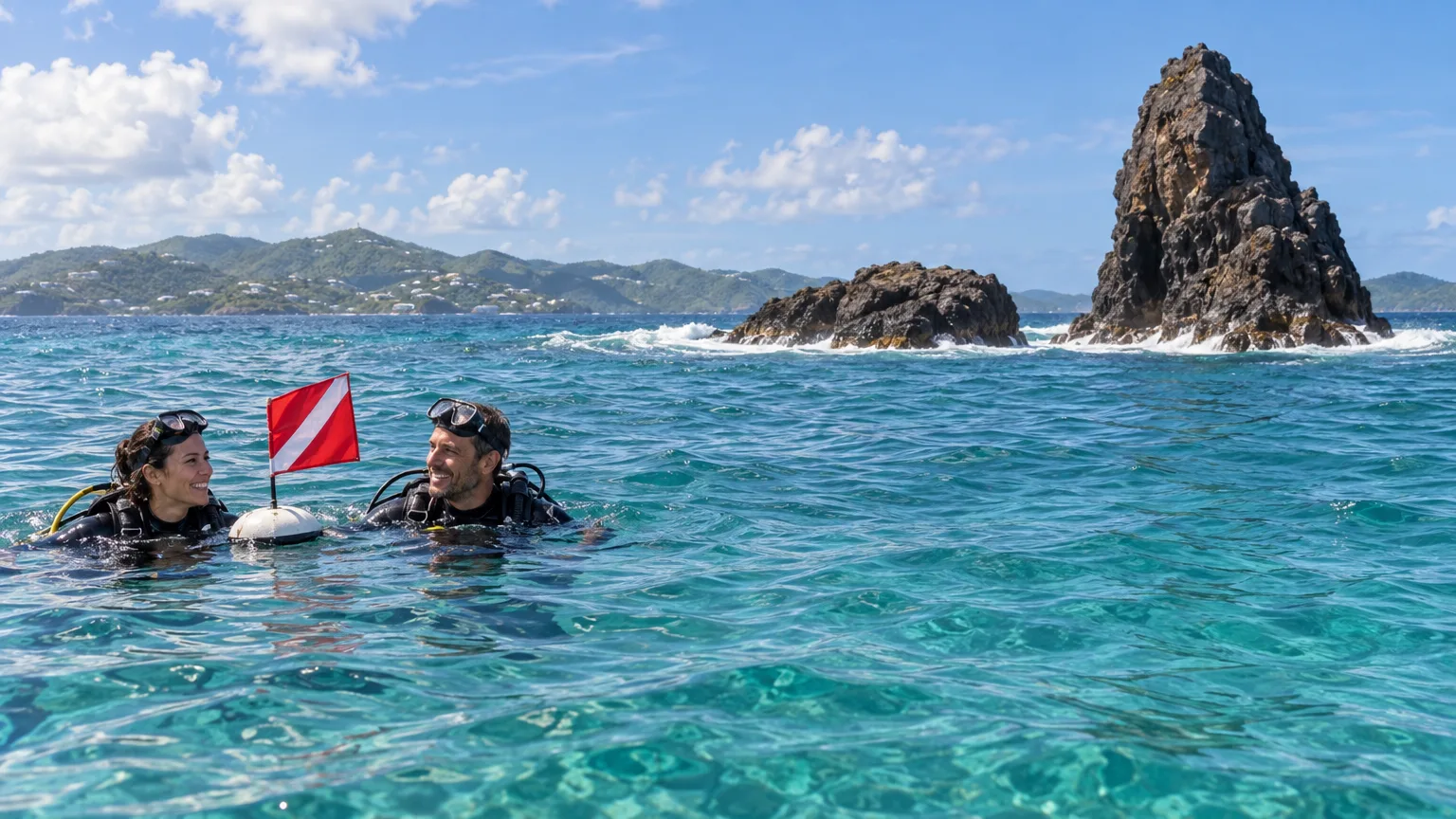
To see which crewed yachts cruise the US Virgin Islands, use the search below. St. John and St. Croix follow it.
Where can you scuba dive around St. John?
The main scuba diving sites around St. John are three cays off its northwest corner: Carval Rock, Congo Cay and Grass Cay. Between them, they suit beginners through experienced divers (Visit USVI, 2026). Farther east and on the south shore, Eagle Shoal and the old Tektite habitat site in Great Lameshur Bay add an exposed reef and a piece of diving history.
Carval Rock, Congo Cay and Grass Cay
Carval Rock, 0.3 mile east of Congo Cay (NOAA Coast Pilot 5, 2026), takes its name from a 17th-century fighting ship. The currents around it are strong and usually calmest in the morning, so the crew plans it as an early dive.
Congo Cay, next door, has coral-draped walls with visibility that often tops 100 feet. Visit USVI counts it among the best St. John sites for beginners. Grass Cay is popular with beginners and with divers doing certification dives.
The east end and south shore: Eagle Shoal and Tektite
Eagle Shoal, off the east end, is three round patches of coral about 0.7 mile south of Leduck Island (NOAA Coast Pilot 5, 2026). It sits on the edge of the Virgin Islands Coral Reef National Monument. Visit USVI describes it as a remote site, open to the ocean on all sides.
Great Lameshur Bay, on the south shore, is where four Department of the Interior scientists descended to about 50 feet on February 15, 1969. They lived in the Tektite I habitat for the next 60 days (St. John Historical Society, 2009).
What the national park rules mean for a dive day
The 2026 park rules count crewed charter yachts as commercial vessels. The largest of them, over 125 feet, can’t anchor or moor in park waters at all (NPS Superintendent’s Compendium, 2026). On a dive day, that means three things:
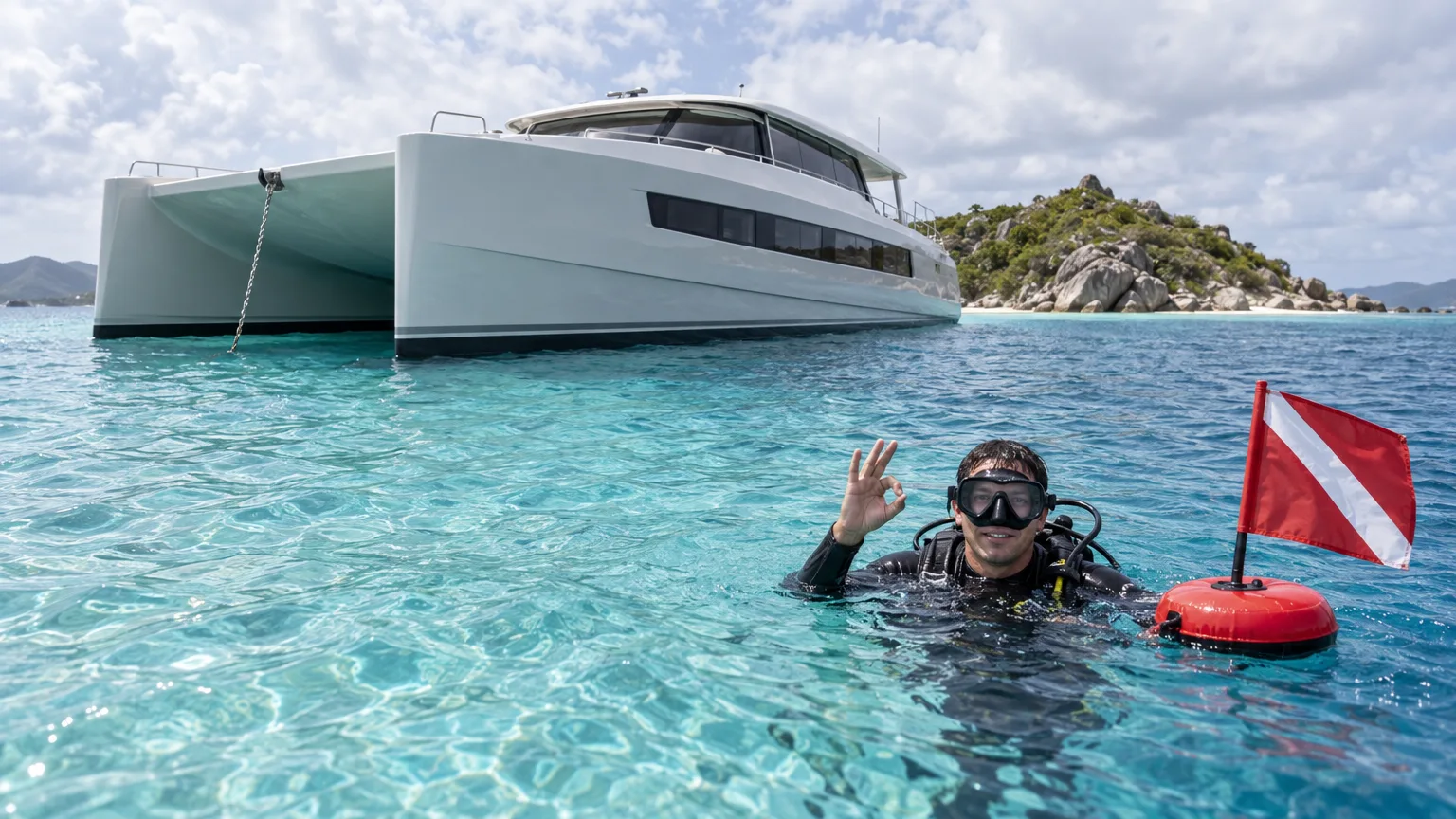
- The dive often goes by tender. At many park dive sites the yacht stays on a mooring or in an anchorage nearby. The tender or the dive operator’s boat runs you out to the site.
- You stay near the flag. Divers must fly a dive flag and stay within 100 feet of it on the surface. Scuba isn’t allowed inside the Trunk Bay swim area.
- Some equipment stays aboard. Spearfishing gear is banned in the park, dive scooters need a park permit, and the yacht’s underwater lights stay off, though a handheld dive light is fine.
The crew knows these rules and plans the week around them. If you’d rather snorkel than dive, our guide to St. John covers Trunk Bay’s underwater trail, Waterlemon Cay and the turtle bays.
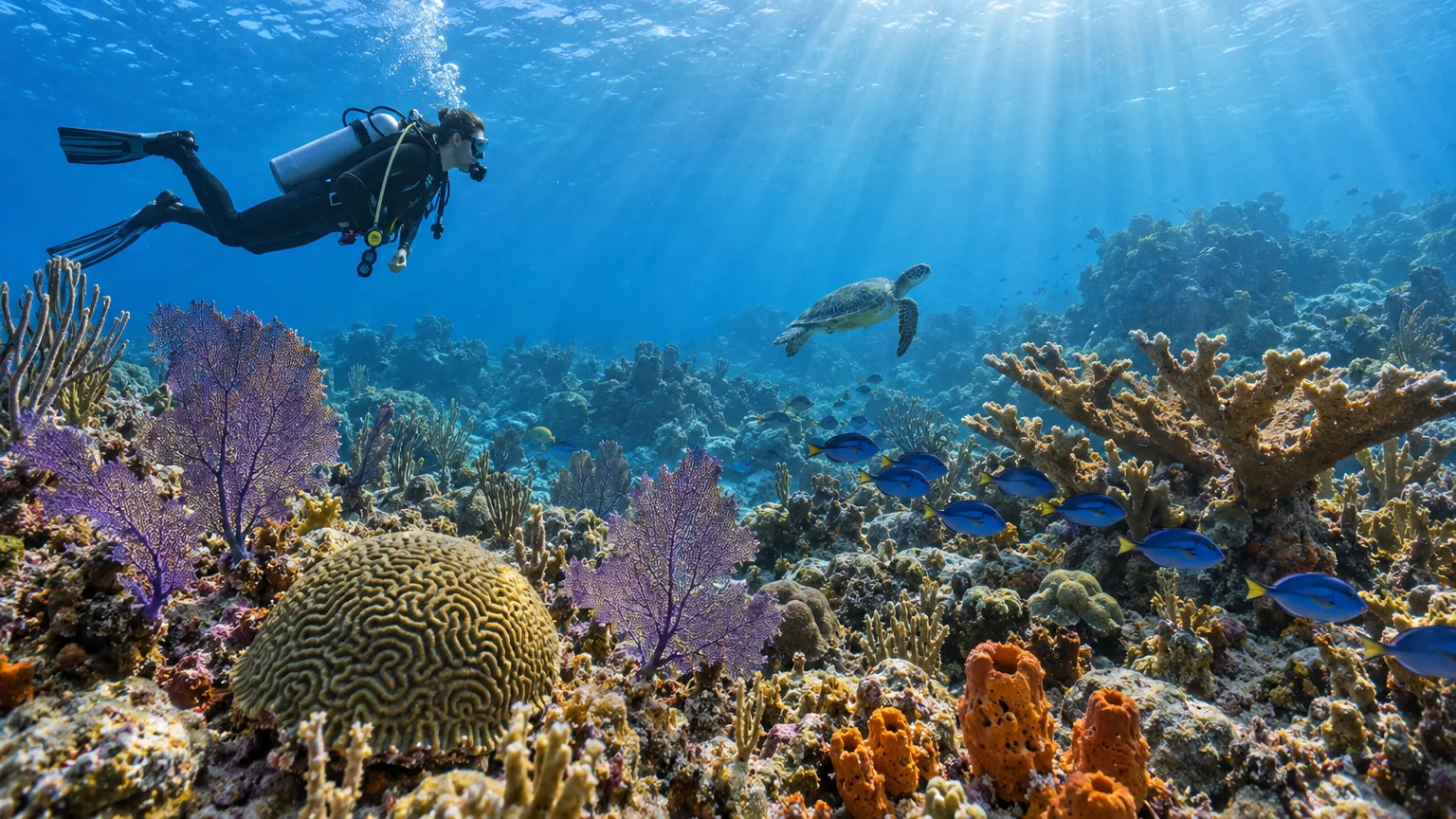
Why do divers make the crossing to St. Croix?
St. Croix lies 32 nautical miles south of St. Thomas and St. John across open water (NOAA Coast Pilot 5, 2026). The signature site for scuba diving in St. Croix is the Cane Bay wall. It starts about 100 yards off the beach and drops to over 2 miles deep (Visit USVI, 2026).
The crossing is an open-sea passage with the trade winds on the beam. The captain picks the weather window and plans to arrive in daylight. With that much water to cover, St. Croix makes the most sense as a stay of several days.
The Cane Bay wall
Cane Bay is a wall on St. Croix’s north shore that you can swim out to from the beach or reach by boat. The territory’s coral reef plan lists it among the sites prioritized for protection (DPNR, 2019). Recreational divers see only the top of it, since certification depth limits stop far short of how deep the wall goes.
Frederiksted Pier
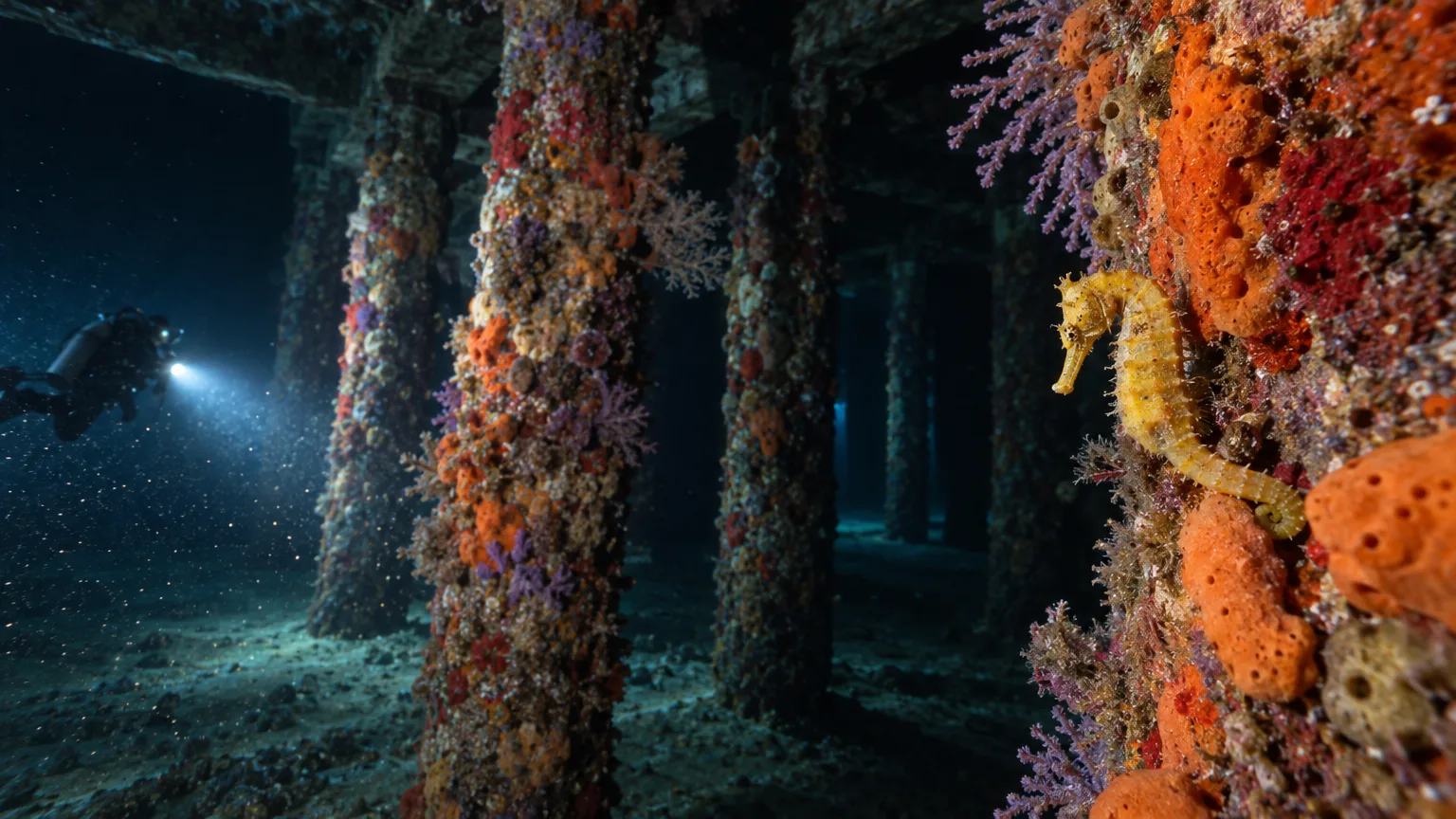
Visit USVI calls Frederiksted Pier one of the best night dives in the Caribbean (Visit USVI, 2026). The pilings are crowded with seahorses, octopus and lobsters, and Visit USVI rates its calm water for newer divers and photographers.
It’s also a working cruise pier, and Visit USVI notes that diving isn’t permitted there while a ship is in port. The crew plans the pier dive for a night with no ship alongside. For more on what happens after dark, see our piece on night diving and stargazing from a yacht.
Salt River Canyon and Buck Island
Salt River Bay is a national historical park, and “SCUBA divers from around the world come to dive the famous canyon walls at Salt River,” the Park Service says (NPS, 2026). It’s also the only confirmed place where members of Columbus’s 1493 expedition set foot on what’s now US soil (NPS, 2024). A yacht can’t take the shallow reef passage into the bay, so the dive goes by dive boat or tender to the moorings on the canyon’s east and west walls.
Buck Island Reef National Monument covers 19,015 acres about 1.5 miles off St. Croix (NPS, 2011). Scuba is allowed there only at two designated scuba moorings, where the dives wind through haystacks of elkhorn coral (NPS, 2026). The famous underwater trail is for snorkelers. Buck Island is a day stop, with overnight anchoring prohibited (NPS, 2026), and our guide to Buck Island Reef covers the visit itself.
West of Frederiksted, the Butler Bay wrecks are a sunken trawler, a tug and an oil barge. They’re artificial reefs now, best reached by boat (Visit USVI, 2026).
How does scuba diving work on a crewed yacht charter?
Of the 267 crewed yachts listing the US Virgin Islands that state how they handle diving, 223 (83.5%) have a local dive operator meet the yacht and 44 (16.5%) carry the equipment and run dives from the boat (Vital Charters analysis of crewed yacht listings, November 2026). Either way, guests dive the same sites.
The two setups work like this:
- Rendezvous diving. A dive operator’s boat meets the yacht at anchor or picks you up from it, bringing tanks, rental gear and a local guide. Most USVI yachts dive this way.
- Diving from the yacht. The yacht carries its own tanks and gear, and a crew member runs the dive. Among the yachts listing the USVI, 35 have a dive compressor aboard to refill tanks.
Among the USVI-listing yachts, 33 name a crew member as a dive instructor. That’s a floor, since a listing doesn’t have to say so. Our guide to choosing a scuba-ready charter yacht explains the arrangements and the questions that sort them out.
Diving is one item in a yacht’s toy box. The rest, from paddleboards to SEABOBs, is covered in our guide to the water toys charter yachts carry.
Do you need to be certified to scuba dive in the USVI?
No. PADI’s Discover Scuba Diving lets guests who have never dived go down with an instructor. It doesn’t qualify you to dive on your own afterward (PADI, 2024). Its first session needs only pool-like water, so a calm, clear anchorage beside the yacht can stand in for the pool (PADI, 2023).
If you go on to the full PADI Open Water course within 12 months, the try-dive counts as its first pool session (PADI, 2023). Before the first dive you fill out a medical questionnaire. A yes to certain questions on it means a doctor has to sign off before you go in (Diver Medical Participant Questionnaire, 2026). If that applies to you, get the sign-off at home before the trip. The age and depth limits for each program are below.
| Program | Minimum age | Maximum depth | What it allows |
|---|---|---|---|
| Discover Scuba Diving | 10 | 40 ft | Supervised dives only, no certification |
| Junior Open Water (ages 10 to 11) | 10 | 40 ft | With a PADI professional or certified parent |
| Junior Open Water (ages 12 to 14) | 12 | 60 ft | With a certified adult |
| Open Water Diver | 15 | 60 ft | Full certification |
Source: PADI, 2024 and 2026.
Certifications never expire, but PADI suggests a refresher if six to twelve months have passed since your last dive (PADI, 2024). Its ReActivate course is an online review plus an optional session in the water with a professional, so most of it can happen before you leave home.
How long should you wait to fly after scuba diving?
Wait at least 12 hours before flying after a single no-decompression dive, and at least 18 hours after multiple dives or multiple days of diving (CDC Yellow Book, 2025). After a dive that needed decompression stops, the CDC says 24 to 48 hours. The intervals reduce the risk of decompression sickness but don’t remove it.
PADI’s general advice is a 24-hour surface interval before flying, and longer if your dive computer shows a longer no-fly time (PADI, 2024). On a week of daily diving, that means the last dive ends a full day before your flight. The crew saves the final day for snorkeling, a beach and the sail back.
PADI also suggests waiting about 30 minutes after a dive before a hot shower or a soak in the deck hot tub. For a dive emergency, Divers Alert Network runs a 24-hour line at +1-919-684-9111 for medical advice and evacuation help (CDC Yellow Book, 2025).
When is the best time to scuba dive in the USVI?
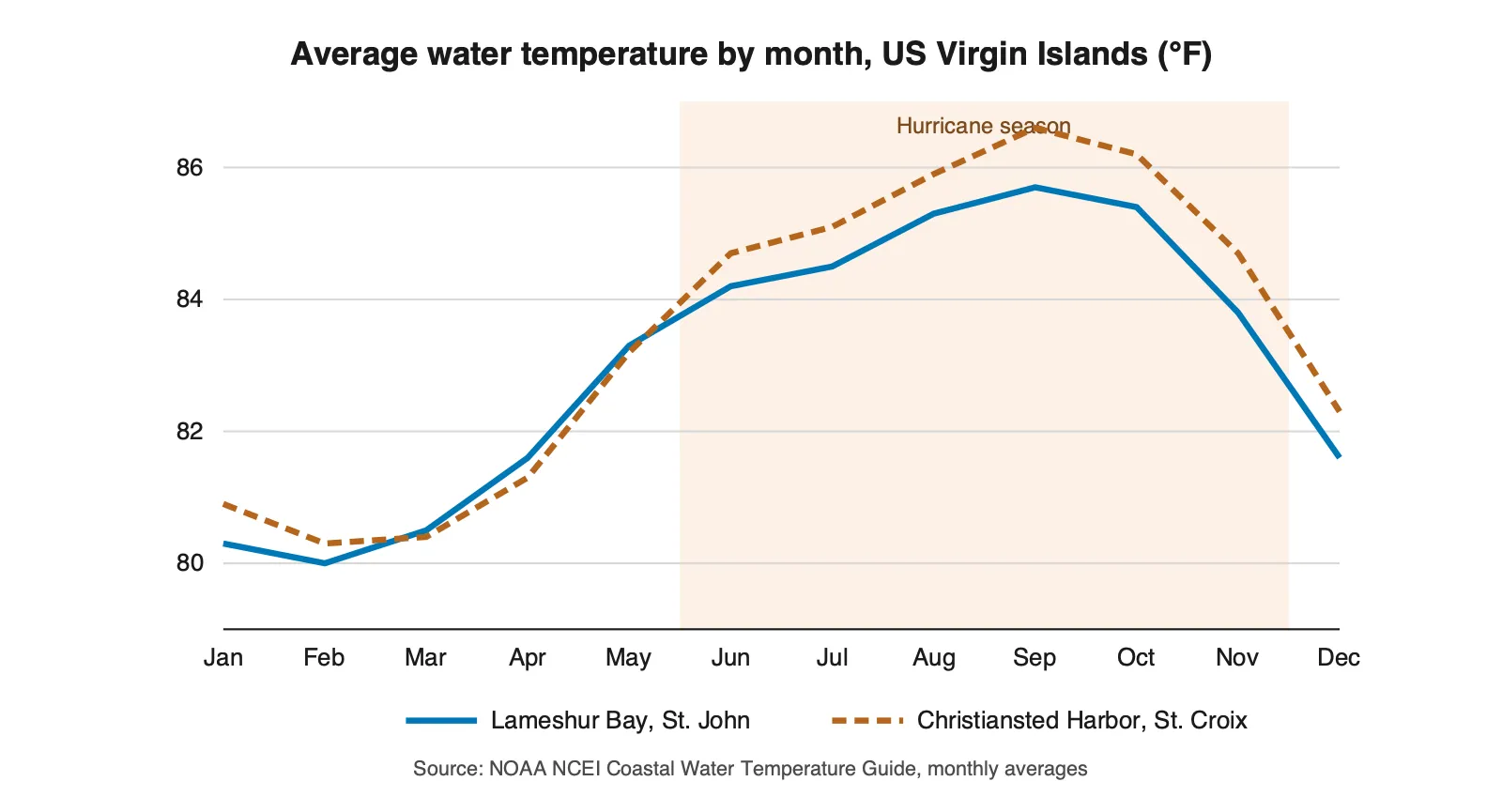
Any month is a good time to scuba dive in the USVI, because the water stays warm all year (NOAA NCEI, 2025). The chart below shows NOAA’s monthly averages for St. John and St. Croix. The season you pick changes the weather above the water far more than the water itself.
View data table
| Month | Lameshur Bay, St. John (°F) | Christiansted Harbor, St. Croix (°F) |
|---|---|---|
| January | 80.3 | 80.9 |
| February | 80.0 | 80.3 |
| March | 80.5 | 80.4 |
| April | 81.6 | 81.3 |
| May | 83.3 | 83.2 |
| June | 84.2 | 84.7 |
| July | 84.5 | 85.1 |
| August | 85.3 | 85.9 |
| September | 85.7 | 86.6 |
| October | 85.4 | 86.2 |
| November | 83.8 | 84.7 |
| December | 81.6 | 82.3 |
Hurricane season runs from June 1 to November 30 and peaks around September 10 (NOAA National Hurricane Center, 2026). Outside the season, winter has its own trade-off for divers. Cold fronts can send the “Christmas winds” and big north swells onto the north shores. On St. John, that stirs up bays like Maho and Francis (NPS, 2022). When it happens, the captain moves the dive to the sheltered side.
If you’re planning dates around more than the diving, our month-by-month guide to the best time to charter covers prices, crowds and weather.
What reef rules apply to divers in the USVI?
Sunscreens containing oxybenzone, octinoxate or octocrylene are prohibited throughout the US Virgin Islands, not only inside the national park (NPS Superintendent’s Compendium, 2026). Pack a mineral sunscreen, and don’t trust a “reef safe” label, since no regulation governs what sunscreen makers print on the bottle (NPS, 2022).
Stony coral tissue loss disease first appeared in the USVI in January 2019 at Flat Cay off St. Thomas. It spreads through the water (NPS, 2022). Divers can help by keeping good buoyancy: don’t touch coral, and if you need to stand, stand only on sand. If you bring your own gear from another island, wash it with antibacterial soap and dry it thoroughly. That advice comes from Marilyn Brandt, a coral scientist at the University of the Virgin Islands (St. Thomas Source, 2019).
Inside the Coral Reef National Monument off St. John’s south shore, anchoring, fishing and collecting of any kind are prohibited (NPS, 2023). Wrecks in the park are protected by federal regulation too (36 CFR 7.74), so a porthole or a bottle stays on the bottom.
Planning a dive week in the US Virgin Islands
A dive week here works best when the yacht does the moving, and a natural order runs like this:
- St. Thomas for the wrecks and the rocks off the east end.
- St. John’s northwest cays in the morning, when the currents are usually calmest, for Carval Rock and Congo Cay.
- St. Croix for several days, if the Cane Bay wall and a night on Frederiksted Pier are on your list.
Our guide to the US Virgin Islands by yacht compares the islands beyond the diving, and the US Virgin Islands destination page lists the crewed yachts that cruise them. When you’re ready, you can search crewed yachts at Vital Charters and tell us diving is the priority.
Frequently Asked Questions
What is the best scuba diving in St. Thomas?
Cow and Calf Rocks, off the east end, is a good place to start. Its signature feature is the Champagne Cork, a vertical opening where the swell lifts divers up and out onto a staghorn coral reef (Visit USVI, 2026). For a wreck, Visit USVI points intermediate divers to the WIT Shoal.
Which US Virgin Island has the best scuba diving?
The best island depends on the dive you want. St. Croix has the deepest walls and the territory’s first marine protected area, the East End Marine Park, set up in 2003 (DPNR, 2026). In the park, diving with a flag is allowed even in the no-take zone. St. Thomas mixes wrecks with offshore rocks, and St. John has the cays off its northwest corner.
What should you do if a lionfish or sea urchin stings you?
Soak the area in hot water. For a lionfish sting, the National Park Service also advises getting medical attention. For sea urchin spines, it notes that vinegar may help dissolve them (NPS, 2019). Both are avoided the same way as damage to the reef: look, but don’t touch.
How warm is the water for diving in the US Virgin Islands?
Warm all year. The coolest monthly average at any of NOAA’s four USVI water-temperature stations is 79.6°F, at Lime Tree Bay on St. Croix in February (NOAA NCEI, 2025). The chart in the timing section shows the full year for St. John and St. Croix.
Can you scuba dive at Buck Island off St. Croix?
Yes, but only at the monument’s designated scuba moorings, never on the underwater trail, which is for snorkelers (NPS, 2026). The monument’s waters have been a fully protected no-take reserve since it was expanded in 2001 (NPS, 2017), so nothing is collected there.
Do you need a passport to dive in the US Virgin Islands?
Not if you’re a US citizen traveling from the US mainland: the USVI is a US territory and no passport is needed (USA.gov, 2026). You’ll need one if the charter crosses into the British Virgin Islands. Our guide to Caribbean charter entry requirements covers the details.
Three islands, one yacht, a dive week built around you.
Tell us your group size, dates and how many of you dive, and we’ll match you with crewed yachts that suit your diving in the US Virgin Islands.