
Charter Kings: Fountaine Pajot Catamarans
Fountaine Pajot has launched 4,000+ catamarans across 80 countries since 1976. Discover what makes them great charter yachts.
Last Updated: September 8, 2026
Fountaine Pajot has launched more than 4,000 boats and now operates across 80 countries worldwide (Fountaine Pajot, 2023). That makes them one of the most widely distributed catamaran brands in the Caribbean charter market and beyond. Whether you’re shopping for a week in the BVI or a crewed vacation through the Grenadines, there’s a good chance a Fountaine Pajot catamaran is on your shortlist.
This guide covers everything you need to know about the brand. We’ll walk through five decades of history, break down the current model lineup, and explain why so many charter fleets choose FP catamarans over the competition. If you’ve been comparing brands, say, weighing them against Lagoon catamarans, you’ll find the details here to make a confident decision.
Who Founded Fountaine Pajot and How Did They Get Started?
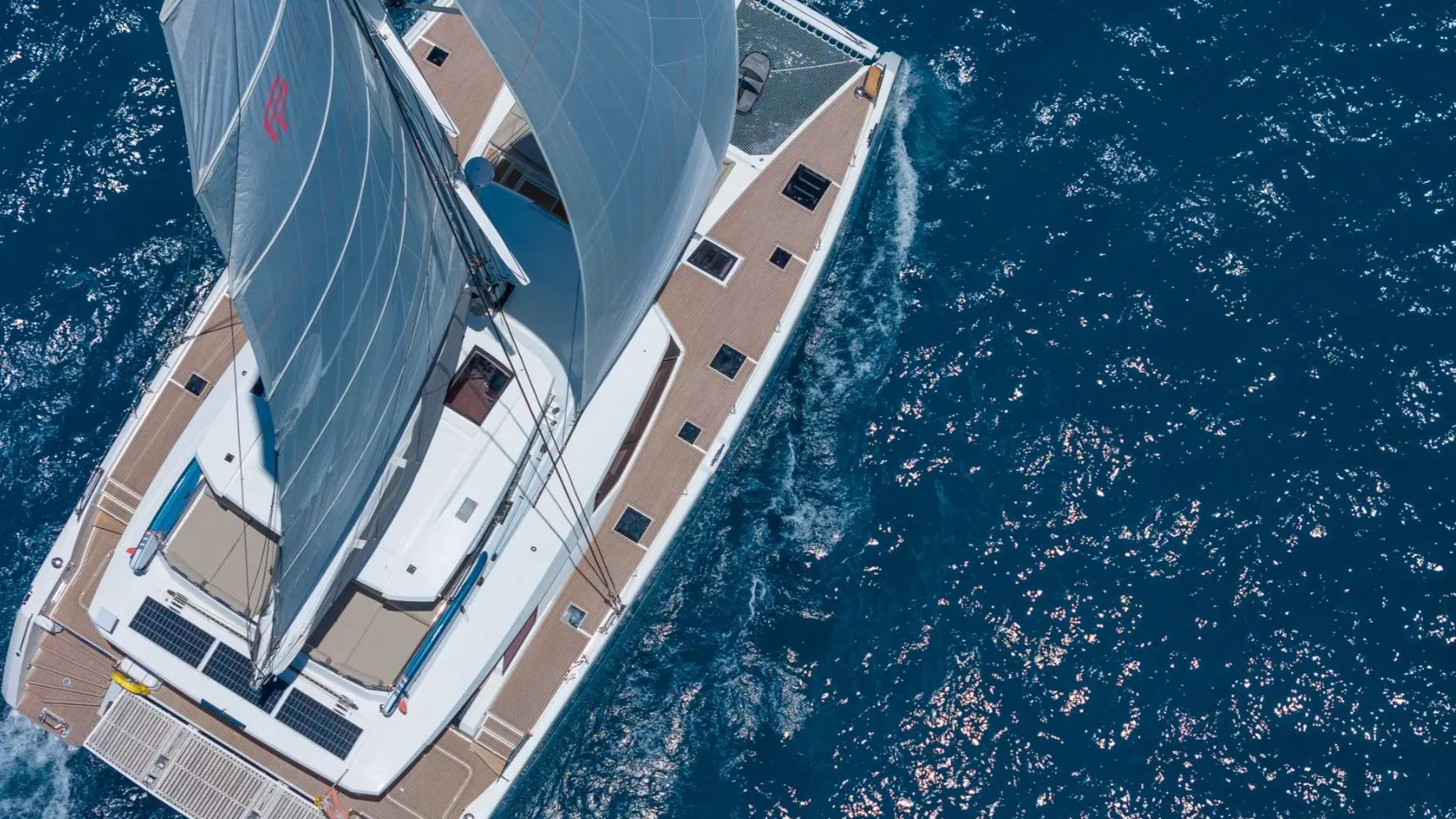
Jean-François Fountaine, a competitive sailor who represented France in Olympic sailing events, founded the company in 1976 in La Rochelle, France (YachtWorld, 2025). The shipyard didn’t start with catamarans, though. Early production focused on monohull racing boats before the team recognized the cruising potential of multihull designs.
From the helm: Having sailed on multiple FP catamarans in the Caribbean, you can feel that racing DNA in every boat. They don’t just float from point A to point B, they actually sail. That performance heritage is what separates the brand from builders who treat catamarans as glorified houseboats.
The first Fountaine Pajot catamaran hit the water in 1983. It was a bold move at a time when the sailing world still treated multihulls with skepticism. But the gamble paid off. By the late 1980s, the La Rochelle shipyard had established itself as a serious catamaran builder with a growing reputation for balancing speed and comfort.
Today the company employs nearly 800 people across four production centers. They’ve invested EUR 24.5 million in recent development, including work on the FPY 110, a premium offshore Fountaine Pajot yacht that signals their push into the superyacht segment (Boat Industry, 2025).
What Makes Fountaine Pajot Catamarans Different From Other Brands?
The Fountaine Pajot group pioneered injection and infusion polyester construction techniques that make their hulls considerably lighter while maintaining consistent build quality (Fountaine Pajot, 2023). This isn’t marketing fluff. Lighter hulls mean better fuel efficiency, higher cruising speeds, and improved handling under sail. It’s one reason charter companies keep coming back to the brand.
Several design features set FP apart from competitors:
- H-Chine hull design: A signature hull profile that improves stability at anchor and performance under sail. You’ll notice less hobby-horsing in waves compared to flat-bottom catamaran designs.
- Outdoor galley with plancha: Recent models include an exterior cooking station, so the chef isn’t stuck below while everyone else enjoys the view.
- XXL living areas: FP consistently delivers more usable deck space per foot of boat length than most competitors.
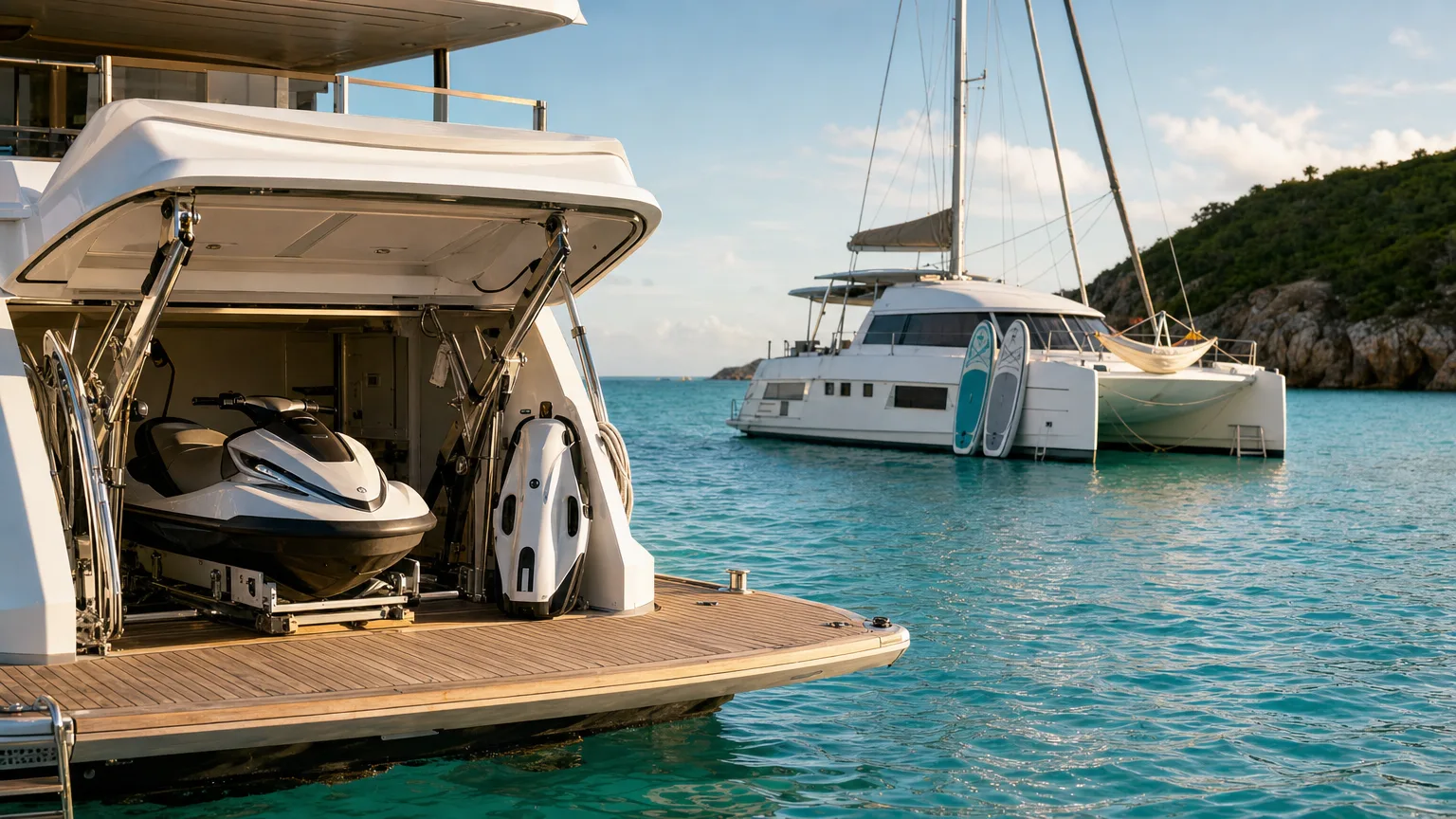
- Dedicated sea toy storage: Purpose-built compartments for paddleboards, kayaks, and snorkeling gear keep the deck uncluttered.
- Aft platform extension: The swim platform doubles as a launching area for water toys and a lounging space at anchor.
The global catamaran market surpassed USD 4.7 billion in 2024 and is projected to grow at a 7.4% CAGR through 2034, reaching USD 9.5 billion (Global Market Insights, 2025).
Alongside Groupe Beneteau and Sunreef Yachts, the French builder already holds a combined 13%+ market share in the catamaran industry (GlobeNewsWire, 2024). Their continued investment in innovation positions them to capture an even larger share of that growth.
What Fountaine Pajot Models Are Available Today?
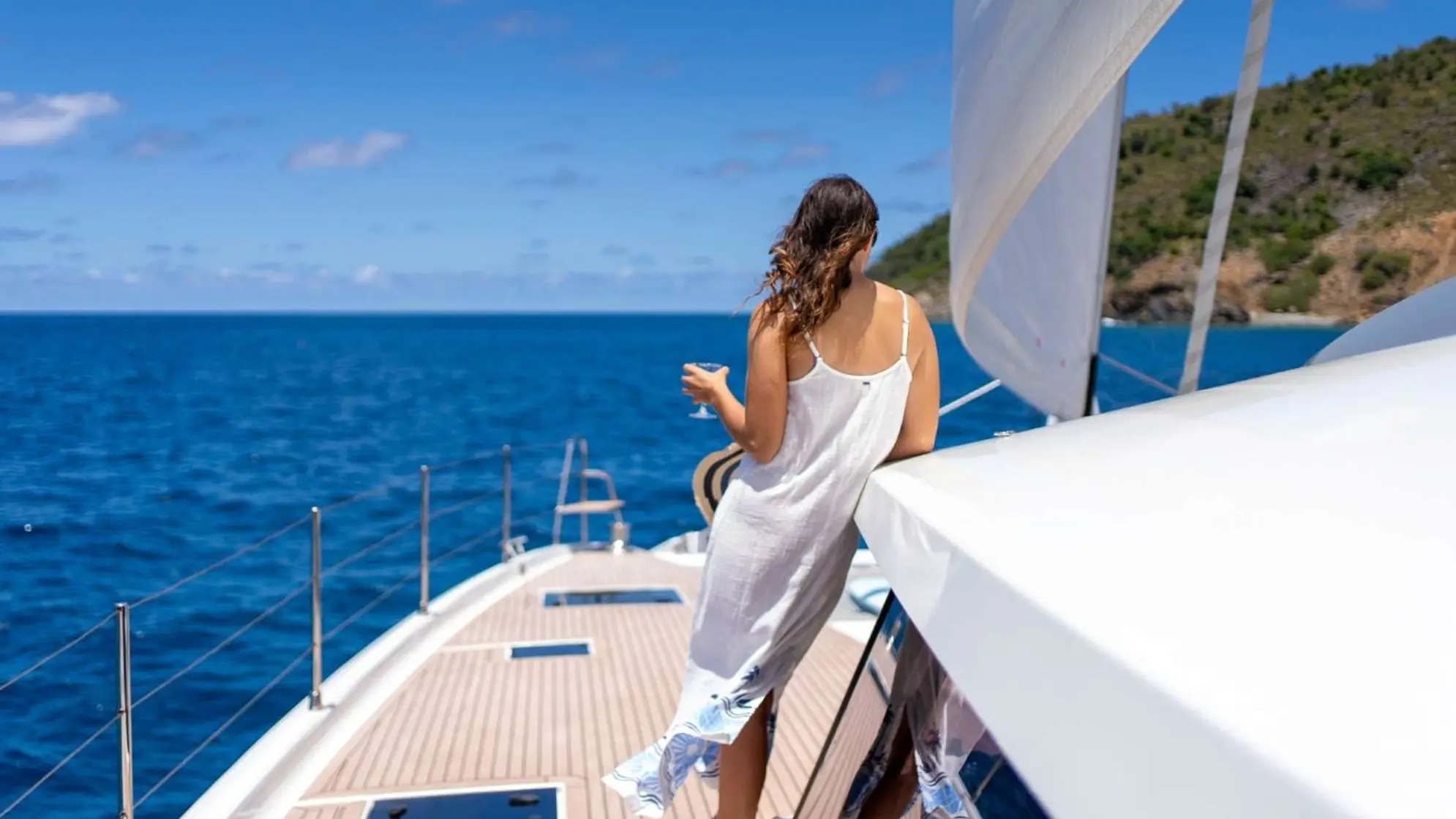
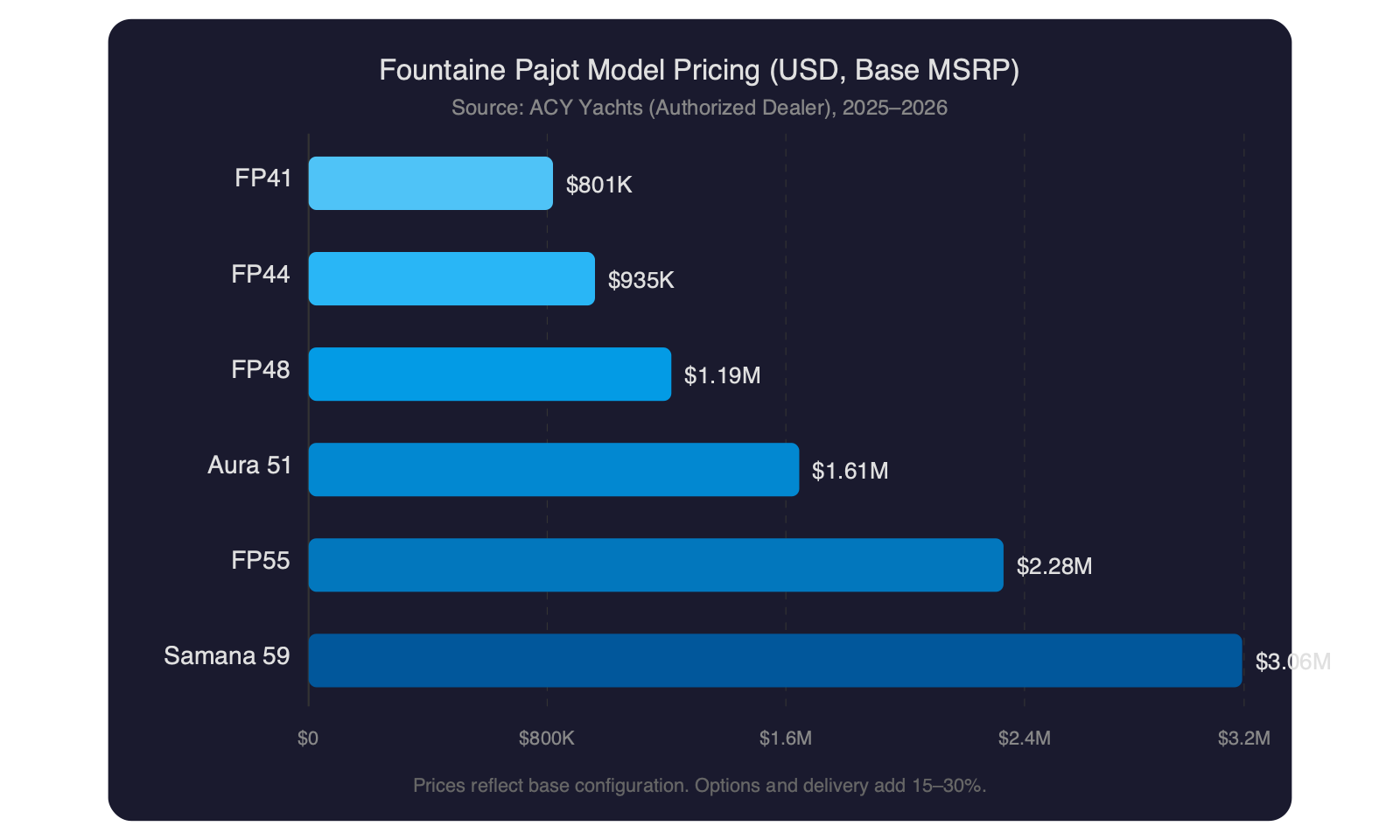
The shipyard currently offers eight sailing catamaran models ranging from 41 to 80 feet, plus a growing line of power catamarans (Fountaine Pajot Catamarans, 2026). Here’s how the lineup breaks down by size, capacity, and approximate pricing.
View data table
| Model | LOA (ft) | Base Price (USD) |
|---|---|---|
| FP41 | 41 | $801,512 |
| FP44 | 44 | $935,148 |
| FP48 | 48 | $1,191,360 |
| Aura 51 | 51 | $1,605,479 |
| FP55 | 55 | $2,278,389 |
| Samana 59 | 59 | $3,057,733 |
Source: Fountaine Pajot, 2025–2026. Thira 80 pricing available on request.
Here’s a closer look at the most charter-relevant models:
FP41: The Entry Point
The FP41 is the newest and most compact model in the sailing range. It’s already been nominated for European Yacht of the Year in the “Multihull of the Year” category (Fountaine Pajot, 2025). At 41 feet, it’s nimble enough for couples or small families who don’t need a floating mansion but still want the signature FP comfort. Starting around $801K, it’s the most accessible way into new ownership from this builder.
FP44: The Charter Workhorse
The FP44 replaces the popular Elba 45 and has already earned a nomination for Multihull of the Year 2026 (Fountaine Pajot, 2025). With its balance of sailing performance, cabin space, and livability, the 44 is exactly the kind of boat charter companies love. It sleeps 8–10 guests comfortably and handles well in the trade wind conditions you’ll find across the Caribbean. Base price starts at $935K.
Aura 51: The Sweet Spot
This is where FP really hits its stride. The Aura 51 offers four spacious cabins, a massive saloon, and enough deck space to host a cocktail party. At $1.6M base, it competes directly with the Lagoon 50 and Bali 5.4. Charter fleets running crewed operations in the BVI and elsewhere favor this size category. If you’re planning a crewed yacht charter in the BVI, there’s a fair chance your boat is in this range.
Samana 59: The Flagship Sailing Cat
The Samana 59 sits at the top of the sailing lineup with a base price around $3.06M (or approximately EUR 1.8M ex-VAT in Europe). It offers five or six cabin configurations, a flybridge option, and the kind of volume that blurs the line between catamaran and small superyacht. This is the Fountaine Pajot yacht for charter guests who want space, luxury, and the ability to sail rather than just motor between islands.
Power 80: Entering the Superyacht World
The Power 80 is the brand’s statement piece. It’s a power catamaran that opens the door to the superyacht market with expansive indoor and outdoor living areas, a flybridge you could land a helicopter on (don’t actually try), and cruising speeds of 16–18 knots. Pricing is available on request, but expect seven figures well into the millions.
How Do Fountaine Pajot Catamarans Perform in the Charter Market?
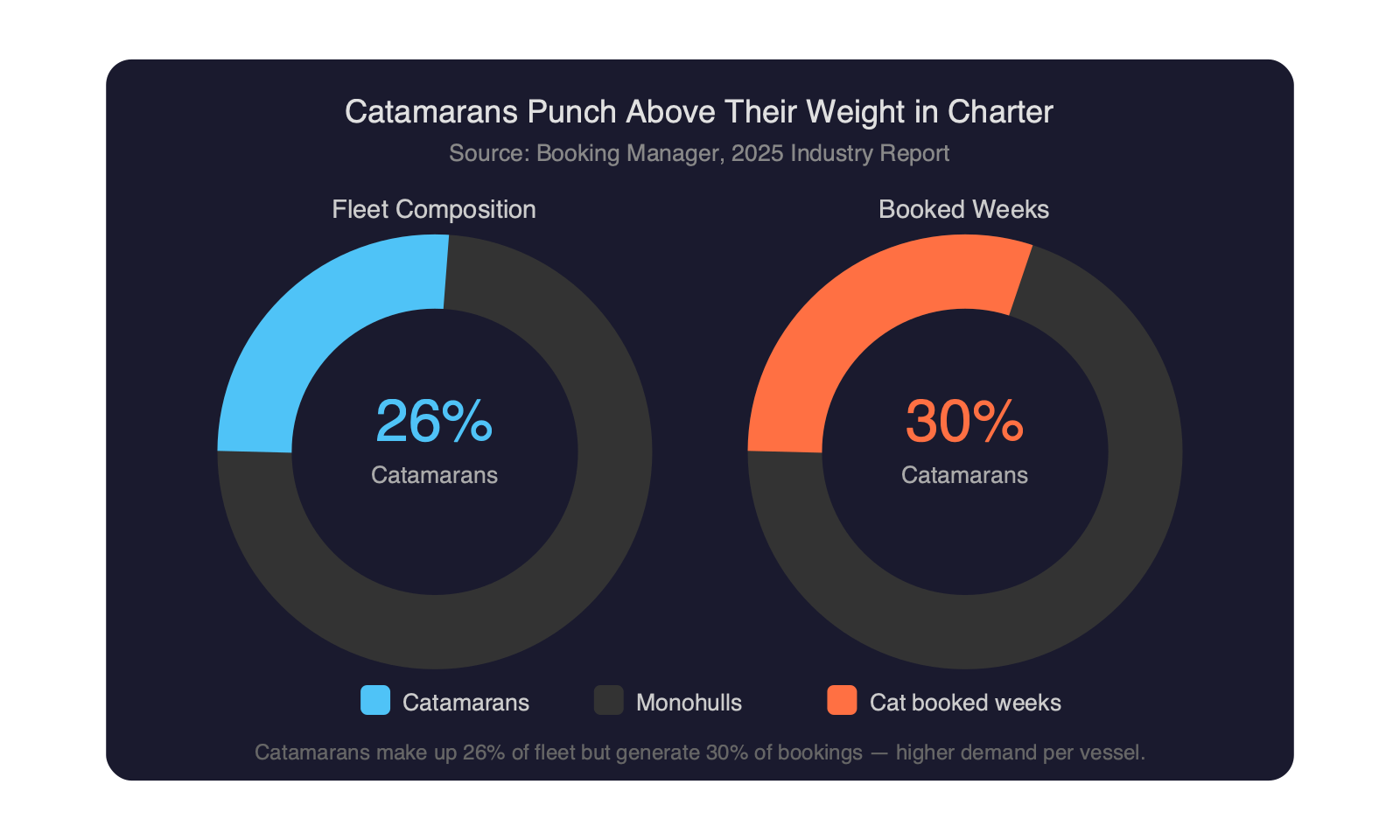
Catamarans now represent 26% of the global charter fleet and account for 30% of all booked charter weeks (Booking Manager, 2025). FP occupies a strong position within that growing segment, particularly in the Caribbean and Mediterranean.
View data table
| Metric | Catamarans | Monohulls |
|---|---|---|
| Fleet Composition | 26% | 74% |
| Booked Charter Weeks | 30% | 70% |
Source: Booking Manager, 2025 Industry Report
That 4-point gap between fleet share and booking share tells a clear story: charter guests prefer catamarans, and the boats get booked at a higher rate than monohulls. For fleet operators, this translates to better return on investment.
Key stat: Catamarans represent 26% of the global charter fleet but account for 30% of all booked charter weeks, outperforming monohulls in demand per vessel (Booking Manager, 2025).
Caribbean Charter Presence
The Caribbean is where FP catamarans really shine in the charter world. You’ll find them in nearly every major charter base:
- British Virgin Islands: crewed FP catamarans operate out of Tortola, with the 44–59 ft range being most popular
- Bahamas: Exuma-based fleets use FP cats for island-hopping itineraries
- Antigua and the Leeward Islands: Several charter companies offer FP boats for Antigua-to-Guadeloupe routes
- Grenada and the Grenadines: FP catamarans run the popular St. Vincent-to-Grenada route
When you’re browsing Caribbean charter destinations, odds are strong you’ll encounter a Fountaine Pajot in the fleet.
Mediterranean and Beyond
The brand’s reach extends well beyond the Caribbean. Major charter fleets in Croatia, Greece, Turkey, and the French Riviera run FP catamarans. Their French heritage makes them especially popular in the Med, where yacht owners appreciate the build quality and European service network. The yacht charter market overall is expected to grow from USD 9.30 billion in 2025 to USD 12.69 billion by 2031 (Mordor Intelligence, 2025), and FP’s lineup, which runs from compact 40 ft cruisers to 67 ft crewed flagships, positions them well for that growth.
How Fast Do Fountaine Pajot Catamarans Sail?
FP sailing catamarans cruise at 7–8 knots under sail, with the Elba 45 achieving 8 knots in 12 knots of true wind during independent testing (Yachting World, 2024). That’s competitive with any production catamaran in the 40–60 ft range and faster than many. The H-Chine hull design contributes to this performance by reducing wetted surface area at speed.
Power catamaran models like the MY6 and Power 80 cruise at 16–18 knots with a range of up to 1,000 nautical miles at economical speed (Fountaine Pajot Motor Yachts, 2025). That’s enough range to cross from the Canaries to the Caribbean without refueling, which is exactly what some owners do.
Performance snapshot: Fountaine Pajot sailing catamarans cruise at 7–8 knots under sail, with the Elba 45 achieving 8 knots in 12 knots of true wind during independent testing (Yachting World, 2024). Power models reach 16–18 knots with up to 1,000 nm range.
What this means for charter guests: Speed might sound like a selling point for sailors, but for charter vacations it’s really about flexibility. A catamaran that sails 7–8 knots comfortably means you can cover more islands in a week without running the engines all day. You’ll spend less on fuel (part of your APA), and more time actually sailing, which, let’s be honest, is the whole point. Check our breakdown of charter costs and APA to see how fuel factors into your budget.
How Much Does a Fountaine Pajot Catamaran Cost?
Fountaine Pajot catamarans on YachtWorld range from $145,864 for older pre-owned models to $9,906,396 for top-spec new builds (YachtWorld, 2025). But for current-production models, here’s what you’re looking at:
- FP41: Starting at $801,512
- FP44: Starting at $935,148
- FP48: Starting at $1,191,360
- Aura 51: Starting at $1,605,479
- FP55: Starting at $2,278,389
- Samana 59: Starting at $3,057,733 (approximately EUR 1.8M ex-VAT)
- Thira 80: Call for pricing
- MY6 (Power): Starting at $1,566,000
These are manufacturer base prices from Fountaine Pajot. Options, customization, and delivery typically add 15–30% to the base price. So a well-optioned FP44 ready for charter service might land closer to $1.1M–$1.2M.
Pricing at a glance: Fountaine Pajot sailing catamarans range from $801,512 for the FP41 to $3,057,733 for the Samana 59, with the MY6 power catamaran starting at $1,566,000 (Fountaine Pajot, 2025–2026).
Don’t confuse purchase price with charter price, though. A week aboard a crewed Fountaine Pajot yacht in the Caribbean typically runs $15,000–$55,000 depending on season, boat size, and crew. That’s competitive with high-end resort vacations but delivers a fundamentally different experience. For context on what you’re getting at each price point, see our guide on charter cost by yacht size.
Why Choose a Fountaine Pajot Yacht for Your Vacation?
Catamaran charters are capturing a growing share of the yacht vacation market every year. Here’s why FP catamarans consistently rank among the top choices.
Stability and Comfort
Two hulls means far less rolling than a monohull. This isn’t trivial, it’s the single biggest reason families and first-time charterers choose catamarans. FP’s wide beam and H-Chine hull design make their boats among the most stable in the category. Your drink stays on the table. Your kids stay on their feet. Seasickness drops dramatically.
Space That Beats a Resort
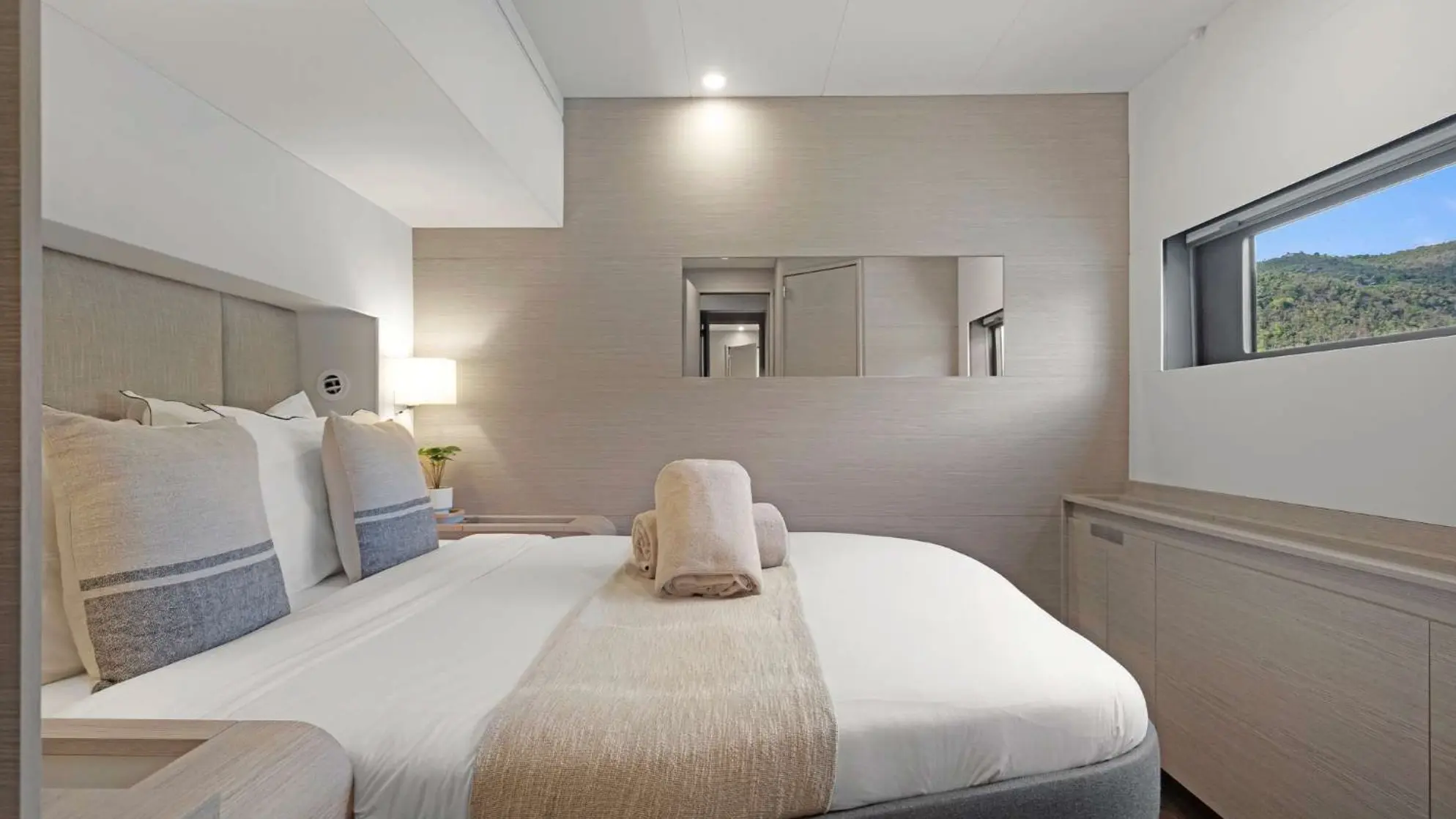
A 51-foot FP catamaran offers more livable square footage than most luxury hotel suites. You get a full saloon, multiple cabins with private heads, a covered cockpit for dining, a forward lounging area, and a flybridge on larger models. It’s like having a private villa that follows you from island to island. Wondering how that compares to staying on land? We broke it down in our charter vs. resort comparison.
Sailing Performance Without Sacrifice
Some charter catamarans feel like barges with sails. FP boats don’t. The racing heritage shows in hull design, rigging, and sail plans that actually perform. You can leave the harbor under sail, tack efficiently, and arrive at your next anchorage without burning a drop of diesel. Charter guests who’ve never sailed before are often surprised at how natural and enjoyable it feels.
Our finding: Across our charter bookings, guests on FP catamarans consistently rate sailing comfort higher than on comparable-sized boats from other manufacturers. The difference is most noticeable in beam-sea conditions where FP’s hull design reduces the rolling motion that makes passengers uncomfortable.
Chef-Friendly Layout
On a crewed charter, the galley is mission-critical. FP’s interior galleys offer serious counter space, storage, and ventilation. Newer models with the outdoor plancha add another cooking option that keeps heat and smells out of the cabin. Your charter chef will thank you.
All-Inclusive Potential
Many FP catamarans in the Caribbean operate on all-inclusive charter packages where meals, drinks, water toys, and fuel are bundled into the rate. The boat’s layout (with its spacious galley, storage, and easy-access swim platform) makes all-inclusive operations smooth and practical.
Is Fountaine Pajot Financially Stable?
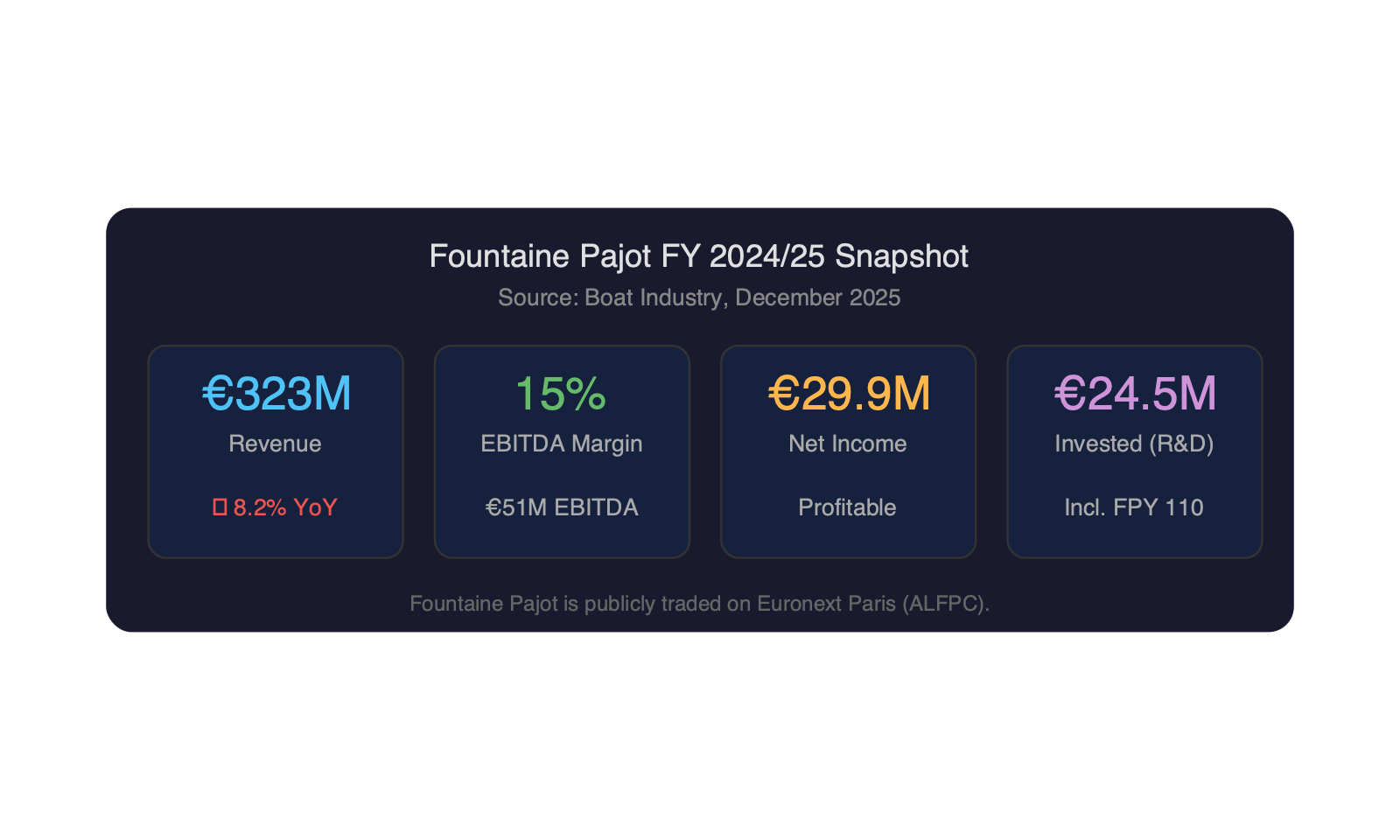
The company posted EUR 323.2 million in revenue for fiscal year 2024/25, with a healthy 15% EBITDA margin and EUR 29.9 million in net income (Boat Industry, 2025). While revenue dipped 8.2% year-over-year (reflecting broader industry normalization post-pandemic), the builder maintained profitability and continued investing in new models.
View data table
| Metric | FY 2024/25 | Notes |
|---|---|---|
| Revenue | €323.2M | Down 8.2% YoY |
| EBITDA | €51M | 15% margin |
| Net Income | €29.9M | Profitable despite revenue decline |
| Capital Investment | €24.5M | Includes FPY 110 development |
| Employees | ~800 | Across 4 production centers |
| Countries | 80 | Global distribution |
Source: Boat Industry, December 2025
Why does this matter for charter guests? A financially healthy builder means ongoing parts support, warranty service, and continued model development. When you’re chartering a boat in the middle of the Caribbean, you want to know the manufacturer isn’t going anywhere. FP’s 50-year track record and healthy financials provide that confidence.
The Bottom Line on Fountaine Pajot Catamarans
Fountaine Pajot has earned its place as one of the top catamaran builders in the world. Five decades of continuous innovation, a model range from 41 to 80 feet, and a growing presence in charter fleets across 80 countries make them a brand worth knowing.
Key takeaways:
- Founded in 1976 by Olympic sailor Jean-François Fountaine, with 4,000+ boats launched
- Pioneered injection/infusion construction for lighter, faster hulls
- Current lineup spans the FP41 ($801K) through the Power 80 (superyacht class)
- EUR 323.2M in annual revenue with strong profitability and ongoing R&D investment
- Available for charter across the Caribbean, Mediterranean, and worldwide
Whether you’re considering buying a Fountaine Pajot yacht or chartering one for a week in the islands, the brand delivers the rare combination of French craftsmanship, sailing performance, and vacation-ready comfort. That’s why charter fleets keep buying them, and charter guests keep booking them. See the Fountaine Pajots we charter in the Caribbean and Bahamas.
Frequently Asked Questions
How much does a Fountaine Pajot catamaran cost to charter per week?
A crewed Fountaine Pajot lists at a median $42,500 for the high-season week across the 57 with a bookable Caribbean or Bahamas rate, with the middle half between $28,000 and $57,000. Length moves it: the 48 to 51 ft boats sit at a $26,750 median, the 56 to 59 ft at $39,900, and the 66 ft and up at $57,750 across 23 listings (Vital Charters rate analysis, September 2026). Average charter spend across the industry has stabilized around EUR 5,500 per booking (Booking Manager, 2025), so booking early in peak season is increasingly important.
Are Fountaine Pajot catamarans easy to sail for beginners?
Yes, FP catamarans are beginner-friendly with responsive helm stations and well-balanced sail plans. The FP41 and FP44 are the most manageable for less experienced sailors. On a crewed charter none of that reaches you: the captain sails the boat and the sail plan is their problem, not yours.
What is the best Fountaine Pajot model for a charter vacation?
The Aura 51 is the best all-around choice for crewed charters, offering the ideal balance of guest space, crew quarters, and sailing performance. The FP44 hits the sweet spot between size and rate for a smaller group. The Samana 59 is the top pick for guests who want maximum luxury and space aboard a Fountaine Pajot yacht.
How does Fountaine Pajot compare to Lagoon catamarans?
Both are top-tier French catamaran builders. Lagoon (owned by Groupe Beneteau) tends toward maximizing interior volume, while FP prioritizes the balance between sailing performance and living space. FP’s injection/infusion hull construction produces lighter boats that generally sail faster. Your choice often comes down to whether you prioritize space or sailing performance.
Where can I charter a Fountaine Pajot catamaran?
Fountaine Pajot catamarans are available for charter across the Caribbean (BVI, Bahamas, Antigua, Grenada, St. Martin), the Mediterranean (Croatia, Greece, Turkey, France), and Southeast Asia. Headquartered in La Rochelle, France, the brand operates in 80 countries (Fountaine Pajot, 2023), making them one of the most widely available charter catamaran brands worldwide.
Sail a Fountaine Pajot through the Caribbean.
Tell us your group size and dates and we’ll match you to the right Fountaine Pajot model, from the Elba 45 to the Samana 59, for a crewed charter week.