
Charter Kings: Lagoon Catamarans
Lagoon catamarans dominate 26% of the global charter fleet. Learn which model fits your group, what a charter costs, and why they are the top choice for sailing vacations.
Last Updated: September 8, 2026
Lagoon catamarans are the most popular charter boats on the water today, and it isn’t close. With over 7,000 hulls built since 1984, the brand holds roughly 18% of the global catamaran market (Fact.MR, 2025). Plan a crewed yacht vacation in the Caribbean and chances are you’ll step aboard one of these French-built multihulls: 98 of the 353 crewed catamarans with a bookable Caribbean or Bahamas rate wear the Lagoon badge (Vital Charters rate analysis, September 2026).
But what makes this brand so dominant? And is a Lagoon the right fit for your next charter? This FAQ covers the most common questions, organized into four categories:
- The Lagoon Brand: History, ownership, and what sets them apart
- Design & Innovation: How these catamarans have evolved over four decades
- Chartering a Lagoon: Costs, destinations, and fleet dominance
- Your Lagoon Vacation: Comfort, who they’re best for, and what to expect onboard
Last updated: .
The Lagoon Brand
What is Lagoon and who makes their catamarans?
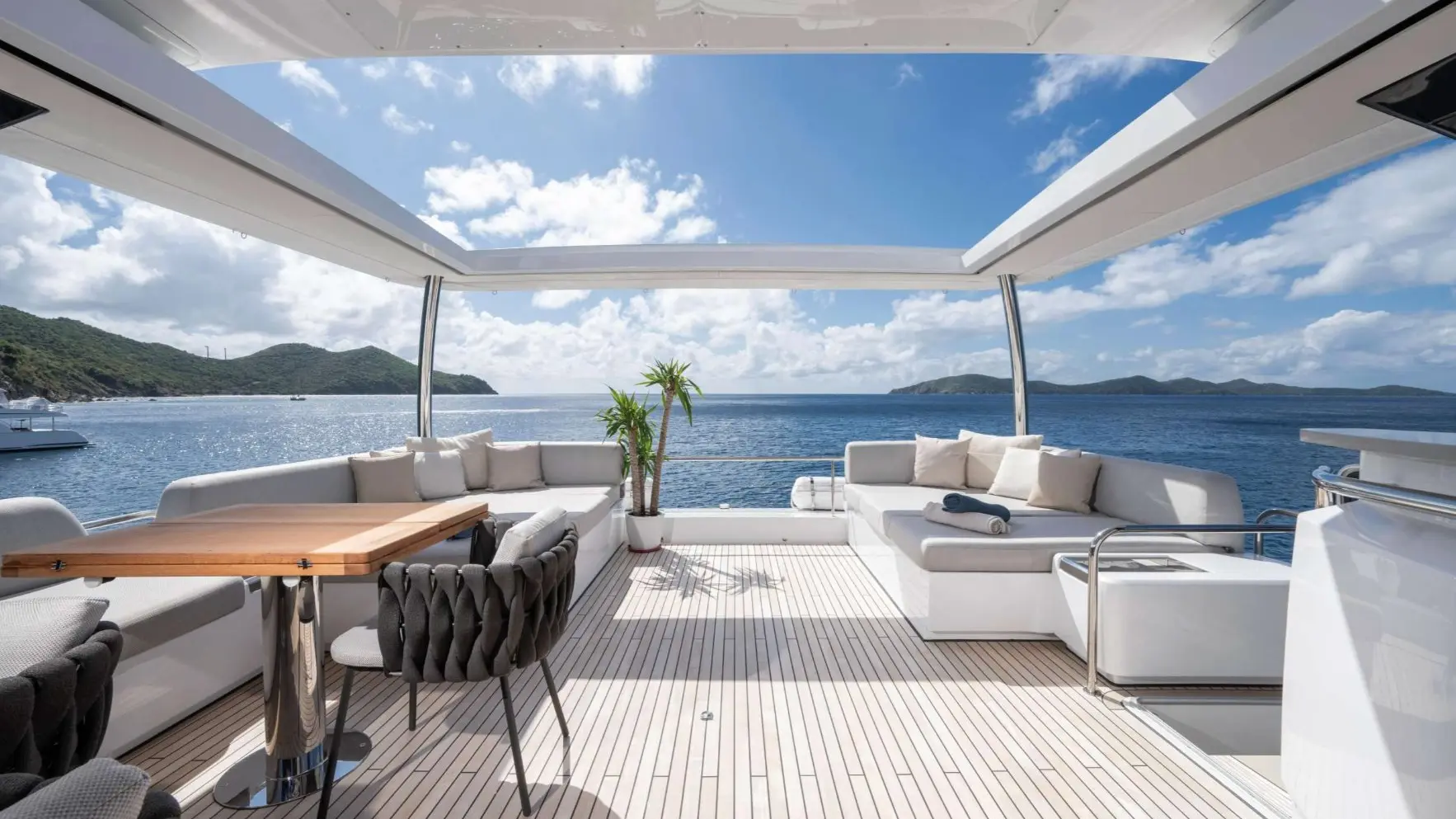
Lagoon is the world’s largest catamaran manufacturer, building sailing and power models ranging from 40 to 78 feet. The brand is part of Groupe Beneteau, a French marine conglomerate that generated over EUR 1 billion in revenue in 2024 (Groupe Beneteau, 2025). Beneteau’s sailing division (which includes Lagoon, Jeanneau, and Beneteau sailboats) accounts for 49% of the group’s total boat sales.
These catamarans are built in Bordeaux, France, with additional production capacity in Poland. The naval architecture comes from VPLP Design, one of the most respected multihull firms in the world. What does that mean for you as a charterer? You’re sailing on a boat designed by racing engineers and built by a company with the resources to maintain quality at scale.
How did Lagoon grow from a startup to the world’s largest catamaran builder?
Lagoon was founded in 1984 as part of Jeanneau Technologies Avancees (JTA), making it one of the earliest production catamaran builders. Beneteau acquired the Jeanneau group, including Lagoon, in 1996 (Groupe Beneteau, 2025). That corporate backing gave the brand access to industrial-scale manufacturing while smaller competitors remained boutique operations.
From the helm: I’ve sailed Lagoons from the BVI to the Grenadines, and one thing stands out every time, consistency. Whether you step aboard a 42 in Tortola or a 50 in Martinique, the systems layout, the rigging setup, and the helm response feel familiar. That’s the advantage of scale.
Here are the milestones that shaped the brand:
- 1984: Lagoon founded; first model (the 55) launched
- 1996: Beneteau acquires Jeanneau/Lagoon, begins scaling production
- 1999: The Lagoon 380 launches: goes on to sell over 1,000 units across two decades
- 2006: First hybrid diesel/electric cruising catamaran introduced (the 420)
- 2010: Partnership with Italian firm Nauta Design begins (the 450)
- 2016: The 42 launches: becomes the best-selling catamaran in history
- 2023: 1,000th Lagoon 42 delivered; total production surpasses 7,000 units
What makes Lagoon different from other catamaran brands like Fountaine Pajot or Bali?
Lagoon’s closest competitors, Fountaine Pajot (roughly 15% market share) and Bali Catamarans, each have strengths, but Groupe Beneteau’s flagship catamaran line wins on three fronts: fleet scale, global service network, and resale value. The brand maintains over 233 accredited service centers worldwide (Lagoon, 2026), which means charter companies can get parts and service almost anywhere they operate.
Fountaine Pajot tends to offer sportier sailing performance. Bali is known for its solid-front cockpit design and open-plan layouts. But Lagoon’s production volume creates a self-reinforcing cycle: charter fleets buy them because they’re easy to service and crew already know how to sail them, which means more charterers learn on these boats, which increases demand further. With 18% market share versus Fountaine Pajot’s 15%, the gap keeps widening.
Design & Innovation
How has Lagoon’s catamaran design evolved over four decades?
Modern Lagoons barely resemble the originals from the 1980s. The biggest shift came in 2010 when the shipyard partnered with Italian studio Nauta Design, completely reimagining the interior layout and cockpit flow. Pre-2010 models had conventional sailing catamaran layouts. Post-2010 vessels introduced the now-signature elevated helm station, island-galley kitchens, and forward cockpit lounges that competitors have since copied.
Hull design has evolved too. VPLP’s latest generation uses sharper entry angles and reduced wetted surface area, giving newer models like the 51 and 55 noticeably better upwind performance than their predecessors. The hulls are also wider relative to length: the Lagoon 46 has a beam of 26 feet, giving it roughly 30% more interior volume than many 50-foot monohulls.
Design insight: Lagoon’s “owner version” vs. “charter version” layouts reveal their dual-market strategy. Charter versions maximize cabin count (4-6 cabins, each with en-suite heads), while owner versions sacrifice a cabin for a master suite that rivals a boutique hotel room. When booking a charter, always ask which layout version you’re getting. It changes the boat more than the model number does.
Which Lagoon catamaran models are most popular for charter?
The 42 is the undisputed champion. Its 1,000th hull was delivered in October 2023, making it the best-selling catamaran model ever in the sailing market (Katamarans.com, 2023). The 46 follows close behind, reaching its 500th delivery in August 2023. Together, these two models account for more booked charter weeks globally than any other multihulls.
| Length | Listings | Cabins | Guests | 25th pct | Median crewed week | 75th pct |
|---|---|---|---|---|---|---|
| 44-47 ft | 14 | 3 | 6 | $18,125 | $20,200 | $21,000 |
| 48-52 ft | 22 | 4 | 8 | $24,075 | $25,000 | $27,000 |
| 53-59 ft | 18 | 4 | 8 | $31,000 | $38,250 | $42,000 |
| 60-70 ft | 34 | 4 | 8 | $41,250 | $45,712 | $54,750 |
| 71 ft and up | 8 | 4 | 8 | $77,500 | $84,000 | $98,820 |
Crewed Lagoon charter rates by length, high-season week, all-in Vital Charters rate analysis, September 2026). Banded by measured length rather than model name, because a model number is not a length: the same badge spans several feet across build years.
View data table
| Model | Length | Yachts | Cabins | Guests | 25th pct | Median crewed week | 75th pct |
|---|---|---|---|---|---|---|---|
| Lagoon 46 | 44-47 ft | 14 | 3 | 6 | $16,500 | $20,200 | $21,000 |
| Lagoon 50-52 | 48-52 ft | 22 | 4 | 8 | $24,075 | $25,000 | $27,000 |
| Lagoon 55 | 53-57 ft | 18 | 4 | 8 | $27,750 | $35,463 | $41,250 |
| Lagoon 60-62 | 58-63 ft | 19 | 4 | 8 | $38,500 | $42,000 | $44,313 |
| Lagoon 65-70 | 64-70 ft | 15 | 4 | 8 | $49,200 | $55,000 | $59,700 |
| Lagoon 77-78 | 71 ft and up | 8 | 4 | 8 | $74,390 | $78,250 | $84,000 |
What safety and comfort features do modern Lagoon catamarans offer?
The design philosophy prioritizes living space and safety in equal measure. Every current model features a protected cockpit with rigid bimini, integrated davits for the dinghy, and a raised helm station with 360-degree visibility. The dual-engine layout (one per hull) provides built-in redundancy, if one engine fails, you can still maneuver safely into port on the other.
For families, the key safety feature is the wide, flat deck with minimal heel. Multihulls don’t lean over at 20-degree angles like monohulls, which means kids (and adults who aren’t natural sailors) can move around safely. The forward cockpit on newer models like the 46 and 55 provides a sheltered outdoor space away from the helm, perfect for younger passengers.
Pro tip: Book 8–12 months ahead for peak BVI season (December–April). Lagoon 42s and 46s sell out first because they hit the sweet spot of price, space, and handling ease.
Chartering a Lagoon
How much does it cost to charter a Lagoon catamaran?
A crewed Lagoon runs from a median $20,200 a week for a 46 to $78,250 for a 77 or 78, and $38,000 across all 98 of them (Vital Charters rate analysis, September 2026). The larger models run less than their reputation suggests: across 40 crewed Lagoons of 60 to 78 ft with a current Caribbean rate, the median high-season week is $50,750, with the middle half between $42,000 and $59,600 (Vital Charters rate analysis, September 2026). That includes captain, chef, provisions and water toys.
Those numbers might sound steep, but consider what you get: a floating villa with 3–6 private cabins, each with its own bathroom. Per person, the median Lagoon 50 to 52 works out near $446 a night when eight guests split the week. That’s comparable to a mid-range Caribbean hotel: except your “hotel” visits a different island every day. For a full breakdown, check our guide to charter rates, APA, and add-on fees.
Where can you charter a Lagoon catamaran around the world?
These boats are available for charter in virtually every major sailing destination on earth. The global yacht charter market is valued at $9.3 billion in 2025 and projected to reach $12.69 billion by 2031 (Mordor Intelligence, 2025). Europe leads with 45.05% of global charter revenue, primarily driven by Croatia, Greece, and Turkey. The Caribbean accounts for 60% of winter bookings.
Here’s where Lagoon models are most commonly chartered:
- Caribbean: BVI, USVI, St. Martin, Bahamas, Antigua, Grenadines, Martinique
- Mediterranean: Croatia, Greece, Turkey, Italy, France, Spain
- Indian Ocean: Seychelles, Maldives, Thailand, Madagascar
- Pacific: Tahiti, New Caledonia, Australia’s Whitsundays
Can’t decide which Caribbean destination fits your crew? We’ve written a detailed comparison of BVI, Bahamas, and St. Martin that breaks down sailing conditions, anchorages, and costs for each.
Why do Lagoon catamarans dominate Caribbean charter fleets?
Catamarans now represent 26% of the global charter fleet, yet they account for 30% of all booked charter weeks, outperforming their fleet share by a significant margin (Booking Manager, 2025). Lagoon leads this category. The 42 alone books more weeks than any other catamaran model worldwide.
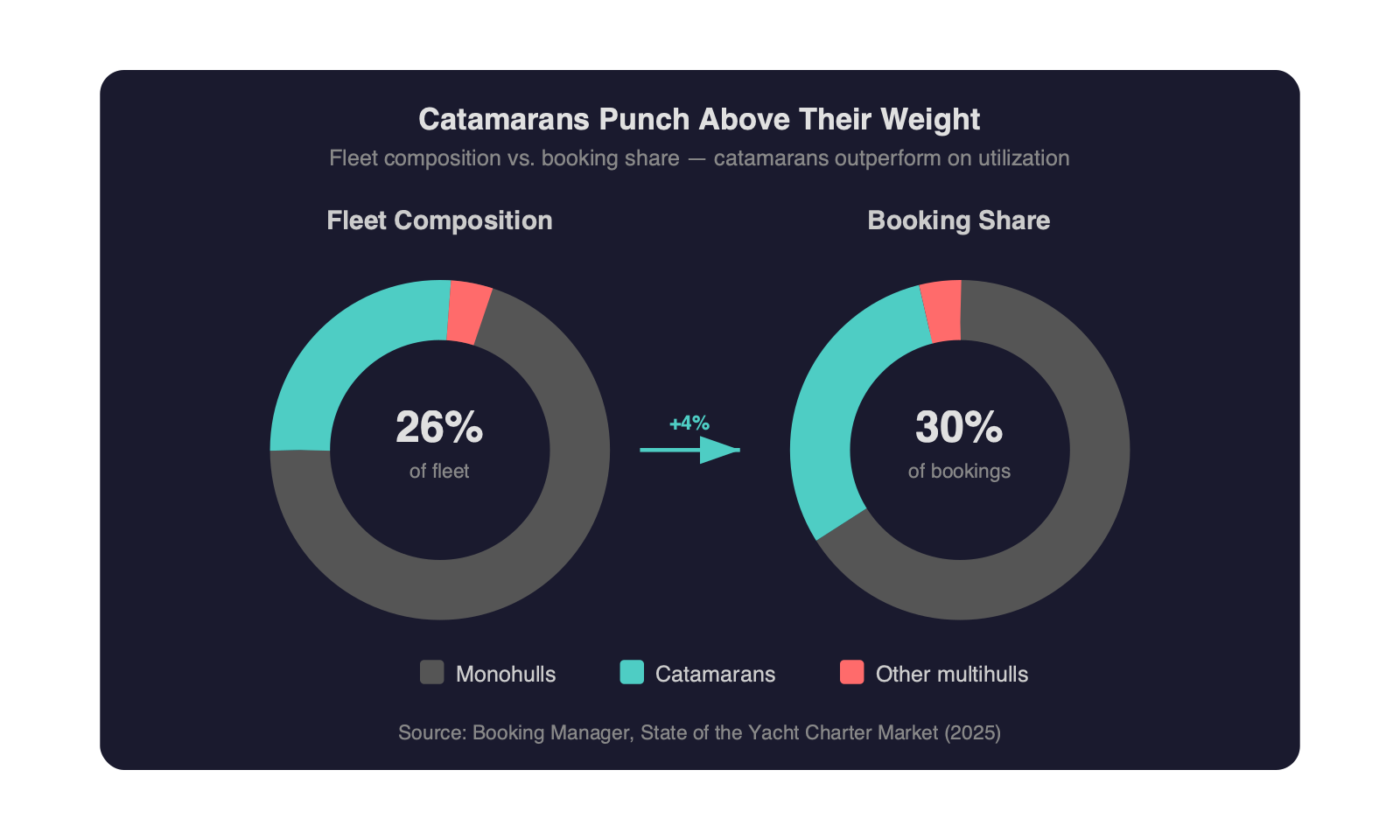
View data table
| Vessel Type | Fleet Share | Booking Share |
|---|---|---|
| Monohulls | 70% | 66% |
| Catamarans | 26% | 30% |
| Other multihulls | 4% | 4% |
Why the Caribbean specifically? Three reasons. First, the shallow draft (typically 4–5 feet) lets you anchor in spots monohulls can’t reach, like the turquoise flats of the Tobago Cays or Norman Island’s Bight. Second, the BVI has no VAT or charter taxes, which keeps crewed yacht charters in the BVI competitively priced. Third, Lagoon’s service network in the Caribbean is extensive, if something breaks, parts and technicians are usually a short sail away.
Your Lagoon Charter Vacation
Why are Lagoon catamarans ideal for a luxury yacht vacation?
The global catamaran market was valued at $1.58 billion in 2021 and is projected to reach $2.70 billion by 2031, a 5.46% CAGR, with leisure as the largest application segment (Allied Market Research, 2022). That growth is driven by a straightforward reality: multihulls offer a fundamentally better vacation platform than monohulls.
Here’s what a Lagoon delivers that a traditional sailboat or resort can’t match simultaneously:
- Stability: Near-zero heel under sail. No one’s bracing against countertops or fighting seasickness.
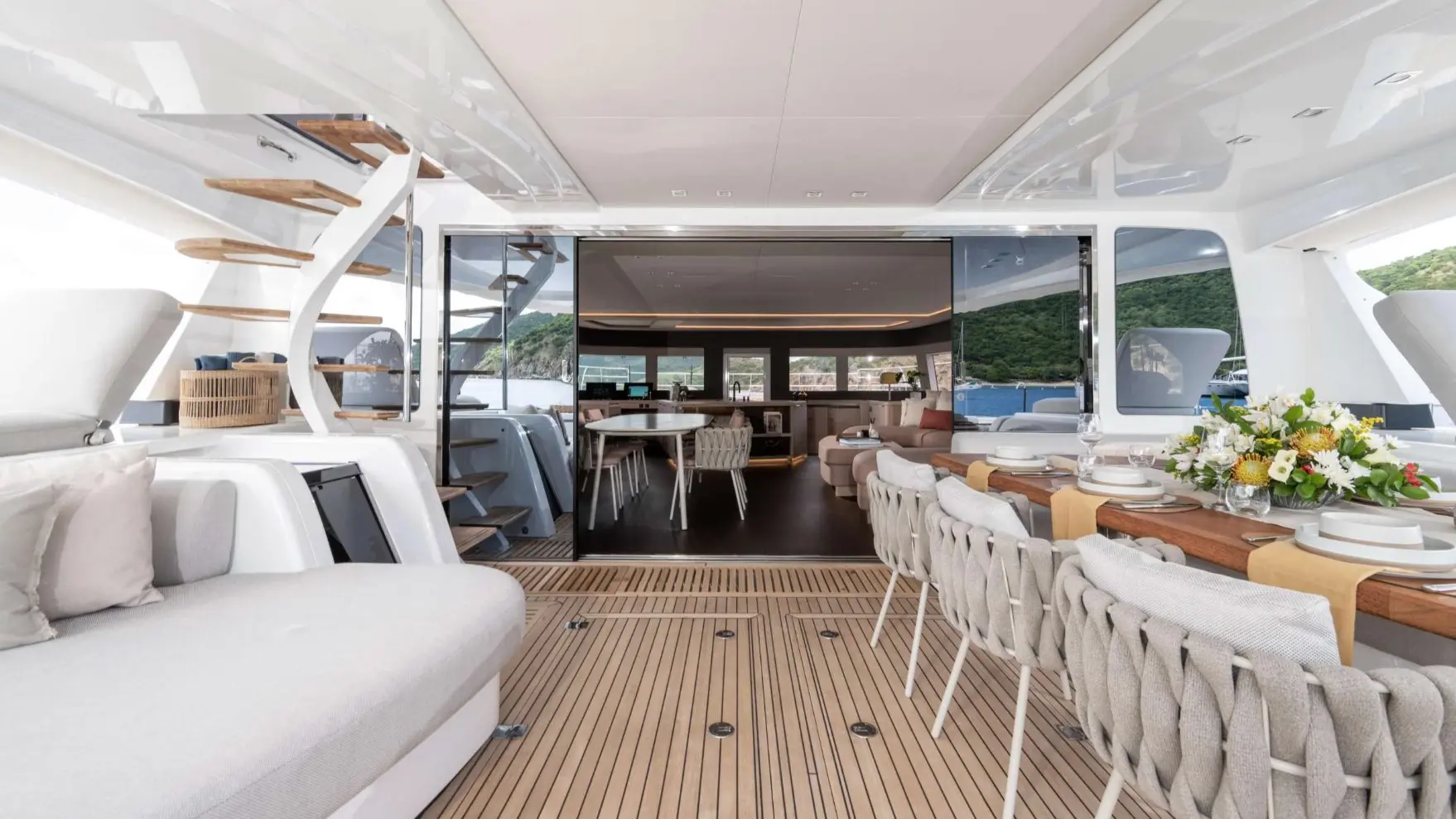
- Space: The 46’s 26-foot beam creates a living area wider than most studio apartments. The salon, galley, and cockpit flow together as one open-plan space.
- Privacy: Each hull houses separate cabins with en-suite bathrooms. You have more personal space than a cruise ship stateroom.
- Shallow draft: 4–5 feet of draft lets you anchor 50 yards from white-sand beaches that deeper boats can’t reach.
- Mobility: Wake up in a different anchorage every morning. No resort offers that.
Wondering whether a crewed catamaran vacation actually beats a five-star resort on value? We ran the numbers in our comparison of crewed charter versus a luxury resort.
Which Lagoon model is right for your group size and budget?
This is the question we get asked most often. The answer depends on three factors: how many guests, how much you want to spend, and how much deck you want between them.
2–4 guests (couples trip): The 40 or 42 is your sweet spot. You’ll have a cabin to spare, which means extra storage or a dedicated workspace. A crewed 46 lists at a median $20,200 for the week (Vital Charters rate analysis, September 2026).
6–8 guests (family or friend group): The 46 gives everyone their own cabin and bathroom. It’s the most popular family charter catamaran for good reason: big enough to spread out, and at a median $25,000 for a crewed 50 to 52, the cheapest Lagoon that gives eight guests four cabins.
8–12 guests (multi-family or celebration): Look at the 50 or 55. These boats need a captain (and ideally a chef), but the space is transformational for a luxury yacht vacation. The 55 in particular has a flybridge that doubles as a second outdoor living room.
12+ guests (luxury crewed experience): The 60 or 65 with professional crew. At this level you’re looking at all-inclusive charter packages that cover everything from gourmet meals to paddleboards and snorkel gear. For a deeper look at how yacht size affects pricing, see our breakdown of charter costs by yacht size.
Are Lagoon catamarans good for first-time charterers?
Yes: and this is actually one of the biggest reasons for the brand’s charter dominance. The twin-engine setup makes docking intuitive even for beginners. You can spin a catamaran nearly in place by putting one engine in forward and the other in reverse. The wide beam provides a stable platform that forgives rookie mistakes, and the raised helm station gives excellent visibility in tight anchorages.
Charter Client Insight: First-time charterers ask for a catamaran over a monohull almost every time, and the reason they give is always the same: a friend told them catamarans don’t heel. The fleet has followed them. Catamarans are 353 of the 550 crewed yachts with a bookable Caribbean or Bahamas rate, against 23 sailing monohulls (Vital Charters rate analysis, September 2026).
You need no sailing experience at all. The captain and crew handle the boat; you decide where to swim.
What are the limitations of chartering a Lagoon?
No boat is perfect for every situation. There are a few trade-offs worth understanding before you book:
- Upwind performance: Catamarans don’t point as high into the wind as monohulls. If your itinerary requires beating upwind for long stretches, you’ll motor-sail more than you would on a sloop. In the Caribbean’s trade winds, this rarely comes up. Most routes are reaching or running.
- Marina costs: A catamaran takes up two slips worth of dock space. Some marinas charge double, and tight Mediterranean ports may not have beam-appropriate berths for larger models.
- Bridledeck slamming: In steep, short-period seas, the underside of the bridge deck can slap against waves. Newer models have addressed this with higher bridge deck clearance, but it’s still noticeable in rough conditions.
These are manageable trade-offs. For the vast majority of sailing vacations (protected Caribbean waters, Mediterranean coastal hops, or Indian Ocean island-hopping) the advantages far outweigh the drawbacks.
Related Resources
Explore these resources for deeper coverage of yacht charter topics:
- Charter Kings: Popular Charter Yacht Brands in the Caribbean: Compare Lagoon to Fountaine Pajot, Bali, and Sunreef across the full fleet
- Yacht Charter Costs Explained (2026): Understand APA, crew gratuities, and what’s included in your base rate
- BVI Crewed Yacht Charter Guide 2026: The most popular destination for Lagoon charters, reviewed in full
- Official Lagoon Catamarans: Browse the full model lineup from the manufacturer
- State of the Yacht Charter Market 2025: Industry data on booking trends and fleet composition
Still Have Questions?
Didn’t find what you’re looking for? Browse crewed Lagoons or contact Vital Charters and we’ll match you with the right Lagoon catamaran for your group, budget, and destination.
Frequently Asked Questions
Are Lagoon catamarans good for charter?
Lagoon catamarans are the most chartered catamaran brand in the world. The 42 alone has booked more charter weeks globally than any other catamaran model (Booking Manager, 2025). Their combination of reliability, spacious layouts, and 233+ service centers worldwide make them the default choice for charter fleet operators.
What is the best Lagoon catamaran for a family charter?
The 46 is the most popular choice for families. It offers 3–4 cabins with en-suite bathrooms, a sheltered forward cockpit where kids can play safely, and a 26-foot beam that provides exceptional stability. For larger families or multi-family groups, the 50 adds a fifth cabin. Explore your Caribbean charter destination options to find the best fit for your family’s itinerary.
How much does it cost to charter a Lagoon catamaran per week?
A crewed Lagoon lists at a median $38,000 for the high-season week, from $20,200 for a 46 to $78,250 for a 77 or 78, measured across the 98 with a bookable Caribbean or Bahamas rate (Vital Charters rate analysis, September 2026). Across all builders, crewed catamarans of 60 to 78 ft run a median $52,000 a week all-inclusive across 101 listings, with the middle half between $42,000 and $59,500. Watch for hidden fees like APA, delivery charges, and insurance that can add 30–50% to the base rate.
Do you need sailing experience to charter a Lagoon catamaran?
None at all. The captain and crew handle the sailing, the anchoring and the tender, and most guests aboard have never sailed. Your only job is to say where you’d like to wake up.
Where is the best place to charter a Lagoon catamaran?
The British Virgin Islands remain the world’s most popular catamaran charter destination, offering protected waters, short island hops, and no charter taxes. Croatia and Greece dominate summer bookings. The Seychelles and Maldives offer exotic alternatives with year-round warmth. Each destination suits a different sailing style: see our guide to choosing between the BVI, Bahamas, and St. Martin for help deciding.
Find the Lagoon that fits your group and your week.
Tell us your group size, dates, and preferred destination and we’ll match you to the right Lagoon model, crewed, all-inclusive, ready to sail.