
Subwing: What It Is, and Why Many Caribbean Charter Yachts Carry One
What is a Subwing and why so many Caribbean charter yachts carry one. Founder Simon Sivertsen explains why it suits the conditions of a typical charter week.
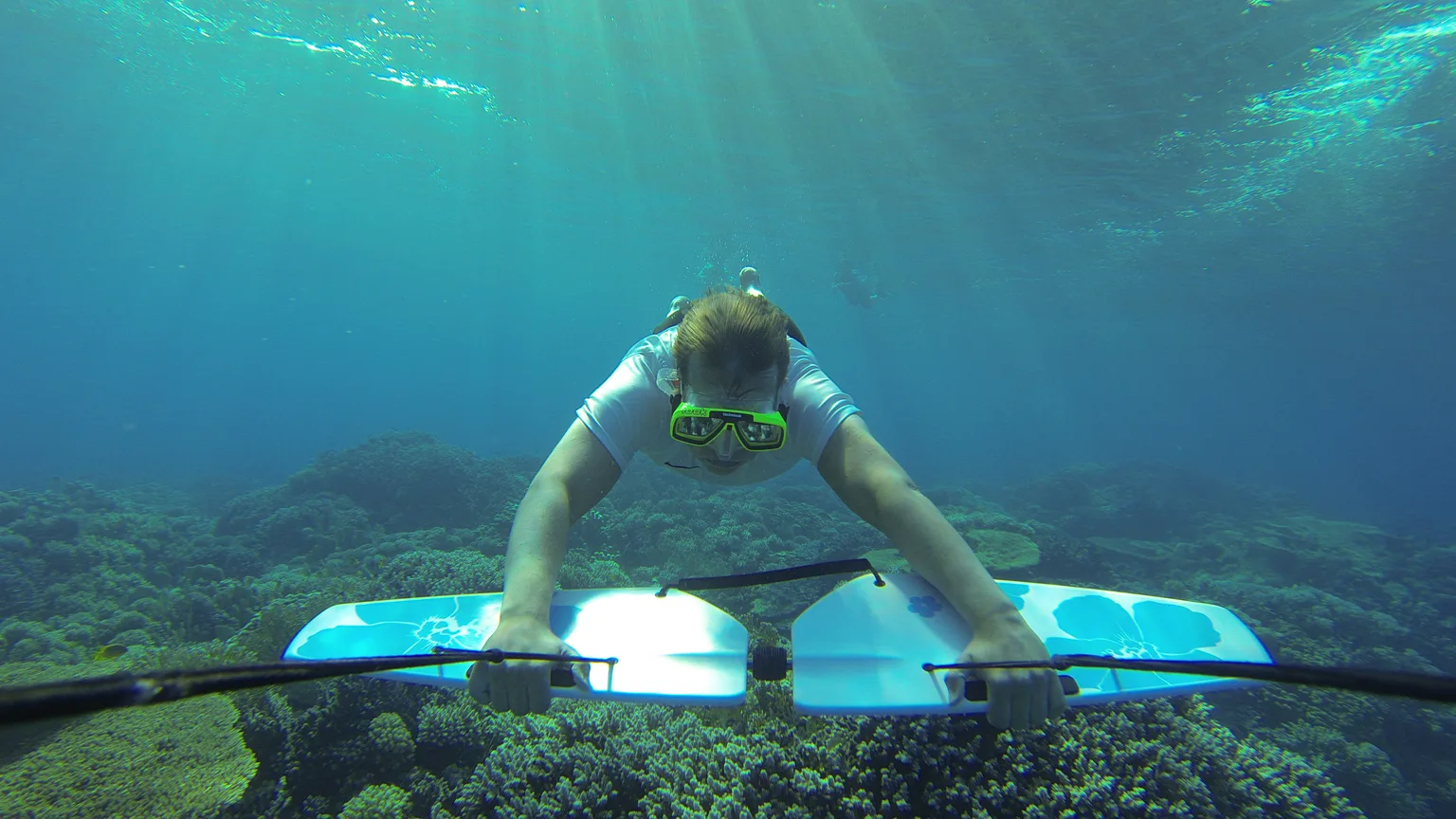
A Subwing is a towed underwater wing, and in the Caribbean fleet, you will find it on many yachts. Vital Charters’ analysis of active crewed charter yachts in the Caribbean and Bahamas found at least 68 yachts listing a Subwing in their toy list. Amongst charter yachts in the popular 50-60 foot band, Subwing is the water toy brand named most often.
This piece follows our count of what Caribbean charter yachts actually carry and takes one item off that list in detail. The fleet figures are ours. Simon Sivertsen, founder and CEO of Subwing, also shared some insight with us on this popular charter toy.
What is a Subwing, and how does it work?
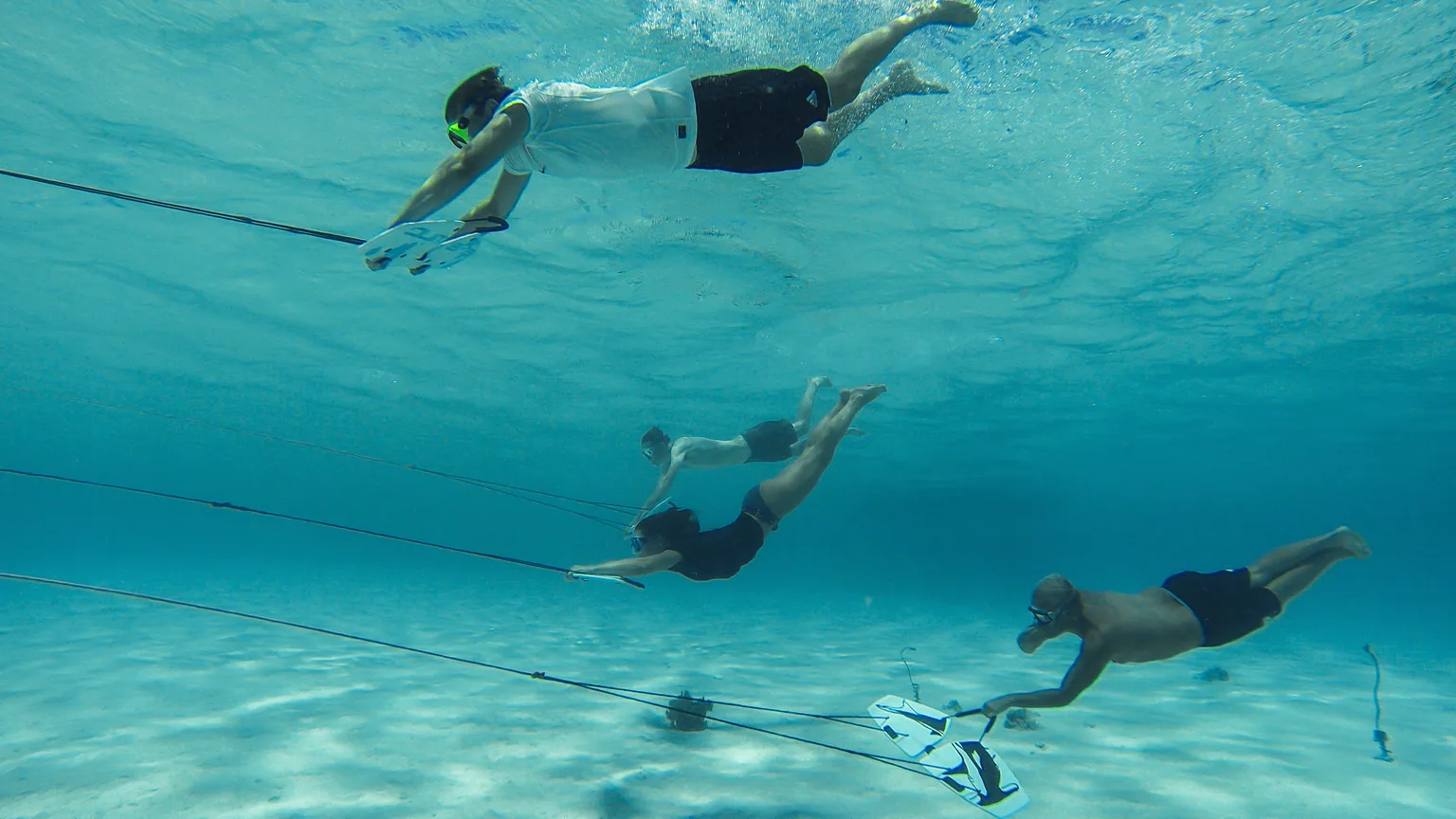
A Subwing is two rigid wings joined by a central swivel, towed on a line behind a boat at slow speed, and it is the simplest powered-feeling toy in the charter toy locker because it has no motor, no battery and no throttle. You hold a wing in each hand. Tilt both down and you dive. Tilt both up and you climb back to the surface. Tilt them against each other and you roll.
There is nothing to charge overnight, nothing to run out of fuel, and nothing for the crew to service between guests beyond a rinse. The boat provides the power, which is why the toy ends up on boats that already tow things.
Subwing’s own framing of the appeal is that it asks very little of the rider. “It has a gentle learning curve and isn’t physically demanding,” Sivertsen told us, “and it’s intuitive and easy for almost anyone who is comfortable in the water.”
How many Caribbean charter yachts carry a Subwing?
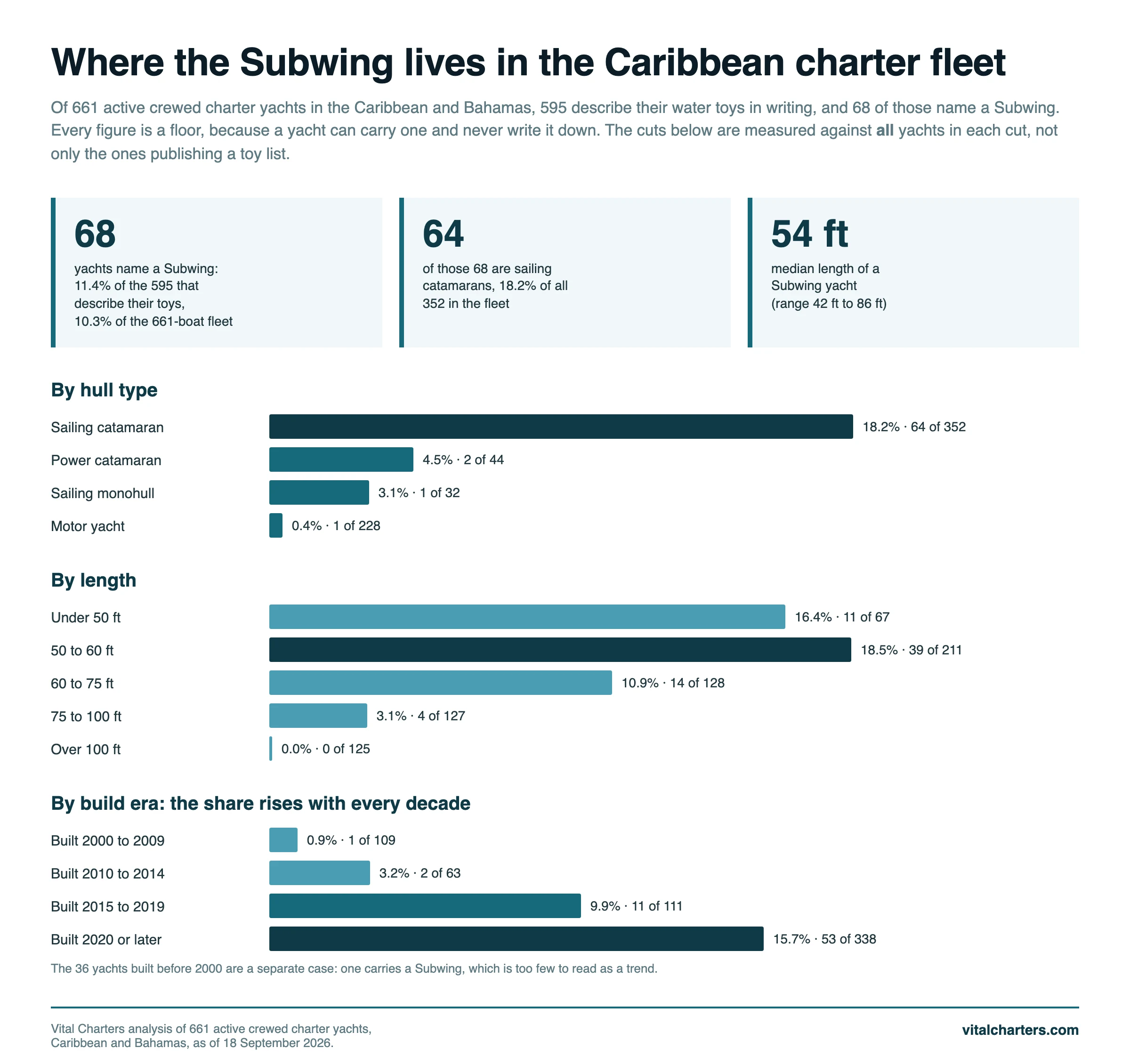
At least sixty-eight of the Caribbean and Bahamas crewed charter yachts carry a Subwing. You can find Subwings on charter yachts in the Caribbean and Bahamas ranging from 42 ft to 86 ft.
The figure counts only yachts whose own published description happens to mention the product by name. A yacht that carries a Subwing and writes “assorted water toys” is invisible to this count, and in our experience listings understate inventory far more often than they overstate it.
View data table
| Cut | Share naming a Subwing | Yachts | Yachts in this cut |
|---|---|---|---|
| Yachts that describe their toys | 11.4% | 68 | 595 |
| Whole active fleet | 10.3% | 68 | 661 |
| Sailing catamarans | 18.2% | 64 | 352 |
| Power catamarans | 4.5% | 2 | 44 |
| Sailing monohulls | 3.1% | 1 | 32 |
| Motor yachts | 0.4% | 1 | 228 |
| Under 50 ft | 16.4% | 11 | 67 |
| 50 to 60 ft | 18.5% | 39 | 211 |
| 60 to 75 ft | 10.9% | 14 | 128 |
| 75 to 100 ft | 3.1% | 4 | 127 |
| Over 100 ft | 0.0% | 0 | 125 |
| Built 2000 to 2009 | 0.9% | 1 | 109 |
| Built 2010 to 2014 | 3.2% | 2 | 63 |
| Built 2015 to 2019 | 9.9% | 11 | 111 |
| Built 2020 or later | 15.7% | 53 | 338 |
Every share is a floor over the yachts that publish a written toy list.
Why is the Subwing a practical toy on charter?
Two features of a sailing catamaran explain the Subwing’s 18.2% share there. A cat already tows or launches a dinghy constantly, and a Subwing needs nothing more than that dinghy and a line. Its wings are flat and thin, so they stow in a locker that could never take a powered sled, which is the same stowage constraint behind a lot of sailing versus power catamaran decisions. A boat that has to earn every cubic foot can still find room for this one.
| Hull type | Share naming a Subwing | Yachts | Yachts in this cut |
|---|---|---|---|
| Sailing catamaran | 18.2% | 64 | 352 |
| Power catamaran | 4.5% | 2 | 44 |
| Sailing monohull | 3.1% | 1 | 32 |
| Motor yacht | 0.4% | 1 | 228 |
The Subwing clusters in the middle of the fleet by size, which is where most charter guests actually are.
Sivertsen sees the hull split as an opportunity rather than a verdict. “The Subwing is just as good a fit for monohulls, and it takes up very little storage space,” he told us.
Do you need lessons before you use a Subwing?
No. Subwing’s position is that a charter guest needs no preparation at all, and that the crew can cover the basics in a few minutes once you’re aboard. “Because the Subwing is so easy and intuitive to use, no training is needed before going on a charter that offers it as part of its water toy package,” Sivertsen told us.
“The most important condition for enjoying the Subwing is clear water, which is rarely hard to find at a charter destination,” he said. That is a low bar in the Virgin Islands, the Grenadines and the Exuma Cays, where the daytime stops are chosen for exactly that.
A crewed week puts you somewhere a shore operator cannot. “A charter yacht also gives guests access to pristine underwater spots that often have much better visibility than areas close to shore,” Sivertsen said, “which are perfect conditions for Subwinging.”
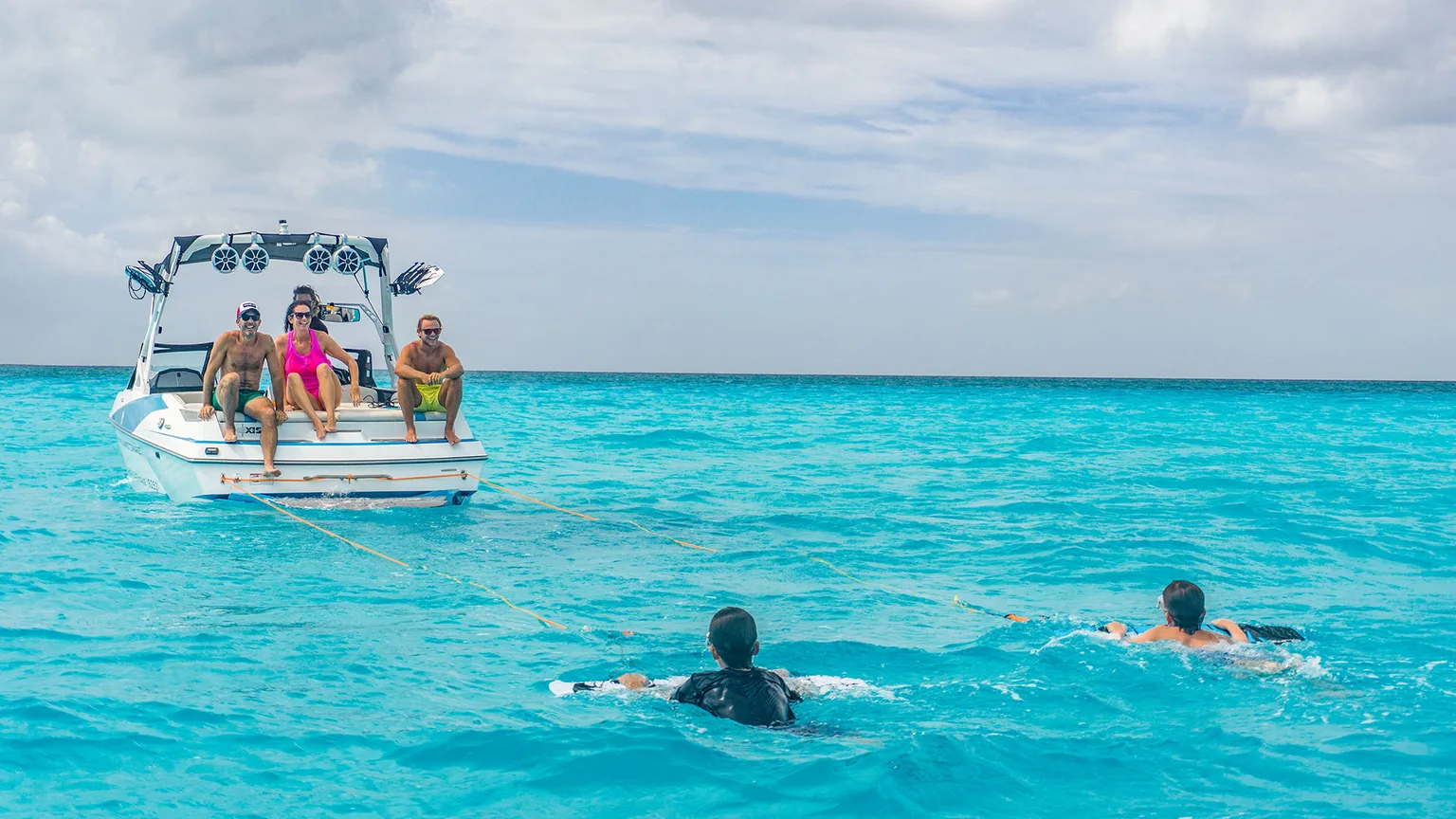
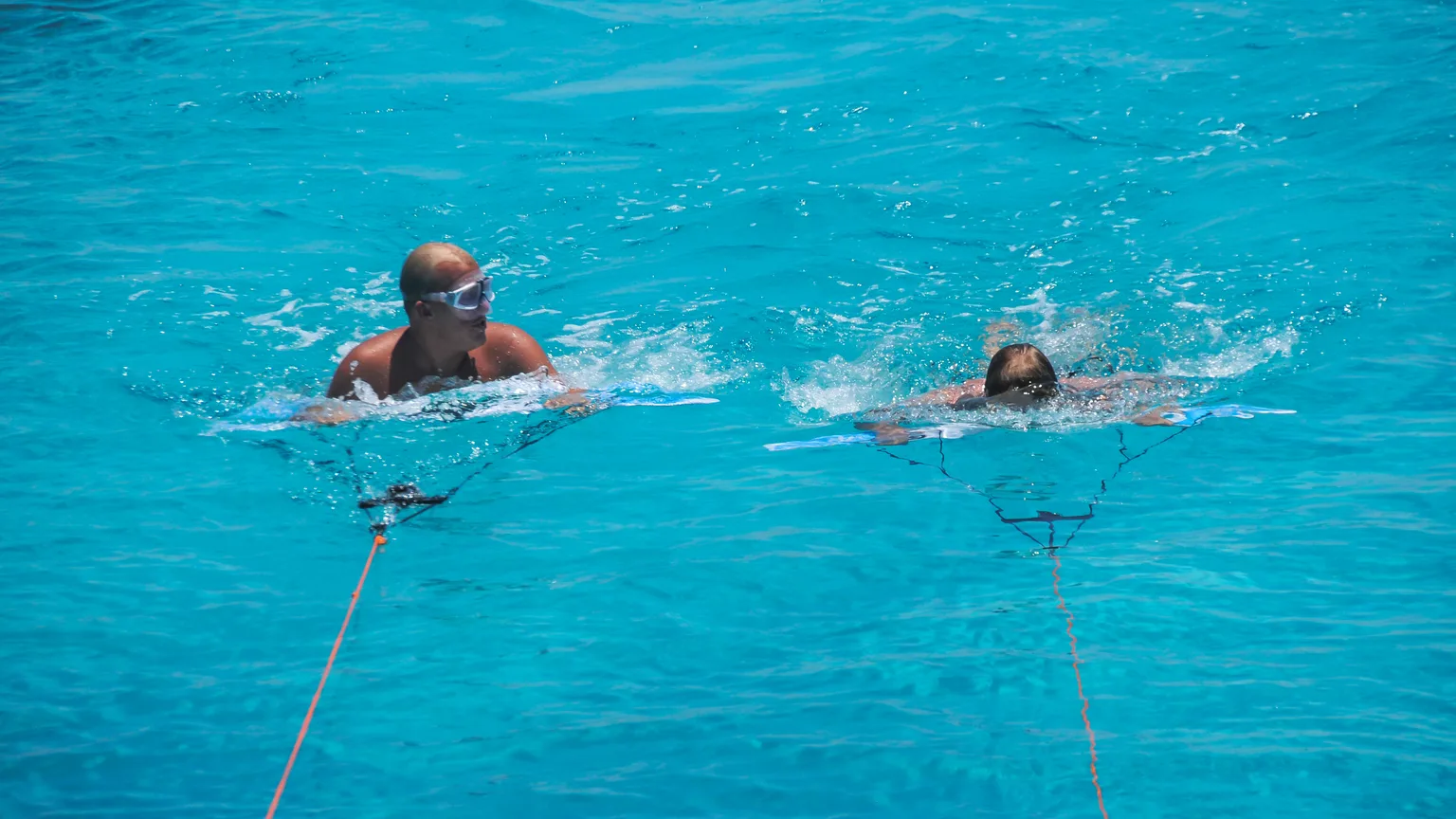
The other reason it suits a mixed group is that it doesn’t have to be a solo turn. The slow tow speed and the ability to pull several riders at once make it, in Sivertsen’s words, “a safe and social activity that guests can enjoy together.” A parent can ride alongside a child instead of watching from the rail, and a nervous swimmer can stay on the surface and simply be towed along without ever tipping the wings down.
Which yachts are adding Subwings now?
Subwings are arriving with new hulls. 15.7% of the 338 Caribbean charter yachts built since 2020 name one, against 9.9% of those built 2015 to 2019, 3.2% of those built 2010 to 2014 and 0.9% of those built 2000 to 2009. The charter fleet has changed shape: yachts built before 2010 are about 15% sailing catamarans, while those built since 2020 are 73.1%. Because 64 of the 68 Subwings sit on sailing catamarans, comparing across the whole fleet by build year would partly just be measuring that shift.
Reading the same numbers, Sivertsen called the direction the encouraging part. “At 11%, there is still great potential to introduce the Subwing to more charter yachts,” he told us. “But it’s very encouraging to see the share climbing with each build era, which tells us the Subwing is becoming standard equipment on newer yachts.”
Sivertsen says the design has settled: “The Subwing has gone through numerous refinements over the years, and we feel we’ve landed on a design that works really well, with spare parts that can easily be swapped out after heavy use.” There are no major changes in the works. What’s moving is the fleet, not the product.
What do guests say about using a Subwing?
11 reviews specifically named a Subwing aboard the yacht they chartered, spanning nine Caribbean charter yachts.
My kids will forever remember their firsts dive gliding sub-wing experience, and so many wonderful moments.
I had so much fun subwinging and doing everything else.
The new things he introduced us to were great, including the HaliJump, the SubWing, and the secret cliff jumping pool, all highlights.
We sailed, explored the islands, swam, snorkeled, sub-winged but mostly we ate and were treated like Kings and Queens!
Two patterns run through the set. The Subwing almost never appears alone: guests list it inside a run of other activities, which is what a toy looks like when it slots into a day rather than defining one. And it travels with children: 7 of those 11 comments mention kids or family. If you’re chartering with kids, our guide to yacht charters with kids covers which toys suit which ages.
How do you book a charter yacht with a Subwing?
Asking for a Subwing steers a Caribbean shortlist toward sailing catamarans of 50 to 60 ft built since 2020, the three cuts with the highest measured shares in Vital Charters’ September 2026 analysis: 18.2% of sailing catamarans, 18.5% of the 50 to 60 ft band and 15.7% of post-2020 hulls. That is a large, well-priced part of the fleet, so unlike most toy requests this one costs you very little to insist on.
Three questions get you the rest:
- Is it actually aboard this season? Published toy lists go stale, and the written toy description is the only place a Subwing appears at all. We confirm it with the yacht’s manager before anyone books on the strength of it.
- How many wings are aboard? More than one rider can be towed at a time, so two wings turn it from a queue into something the group does together.
- Who will be riding? Subwing’s guidance is that anyone comfortable in the water can use one, and the crew set the rules for their own boat. Tell us the ages and swimming confidence in your group and we’ll ask the specific question of the specific yacht.
Bring those answers to the size decision, which our guide to choosing the right yacht size walks through. Then browse crewed yachts at Vital Charters or get in touch with the toy list your group actually wants, and we’ll tell you which boats carry it.
Frequently Asked Questions
What is a Subwing?
A Subwing is a towed underwater wing: two rigid wings joined by a central swivel, pulled behind a boat on a line at slow speed. The rider holds one wing in each hand and steers by tilting them, diving by angling both down, surfacing by angling both up, and rolling by tilting them against each other. It has no motor and no battery.
Do charter yachts have Subwings?
Many do. Of 595 Caribbean and Bahamas crewed charter yachts that describe their water toys in writing, 68 name a Subwing, or 11.4%. Against the whole 661-yacht active fleet that is 10.3%. Treat that as a floor, because a yacht can carry one and never list it. Source: Vital Charters analysis of 661 active crewed charter yachts, September 2026.
Is a Subwing hard to use?
No. The company’s own position is that no training is needed before a charter and that the crew can show guests the basics in a few minutes, because the control system is just tilting two wings. The company describes the learning curve as gentle and says it isn’t physically demanding, which makes it one of the few charter toys a mixed-ability group can share on the first afternoon. Source: Simon Sivertsen, founder and CEO of Subwing AS, to Vital Charters, October 2026.
What conditions do you need for Subwinging?
Clear water, mainly. Subwing’s CEO told us that clear water is the most important condition and that it’s rarely hard to find at a charter destination. A crewed yacht helps here, because it can move to clean water away from the shore, where visibility is usually better.
Can children use a Subwing on a charter?
Often, yes, and the crew of the specific yacht decide. Subwing’s guidance is that the toy suits almost anyone comfortable in the water, and that it is neither physically demanding nor hard to learn. Children come up repeatedly in the guest comments naming it, and a rider who would rather not dive can stay on the surface and simply be towed. Ask the yacht before you promise it to anyone.
Which size yacht is most likely to have a Subwing?
A sailing catamaran between 50 and 60 ft. Newer boats are likelier again: 15.7% of yachts built since 2020. Source: Vital Charters analysis, September 2026.
Find the yacht that carries one
Tell us your group size and your dates, and we will confirm which crewed catamarans have a Subwing aboard and crew who can show your people how to fly it.