
Can You Scuba Dive From a Charter Yacht? How the Caribbean Fleet Does It
Across 654 Caribbean crewed yachts, 74.8% arrange rendezvous diving and 13.3% run it from the boat. What is included, what a dive costs, and which yachts are dive-equipped.
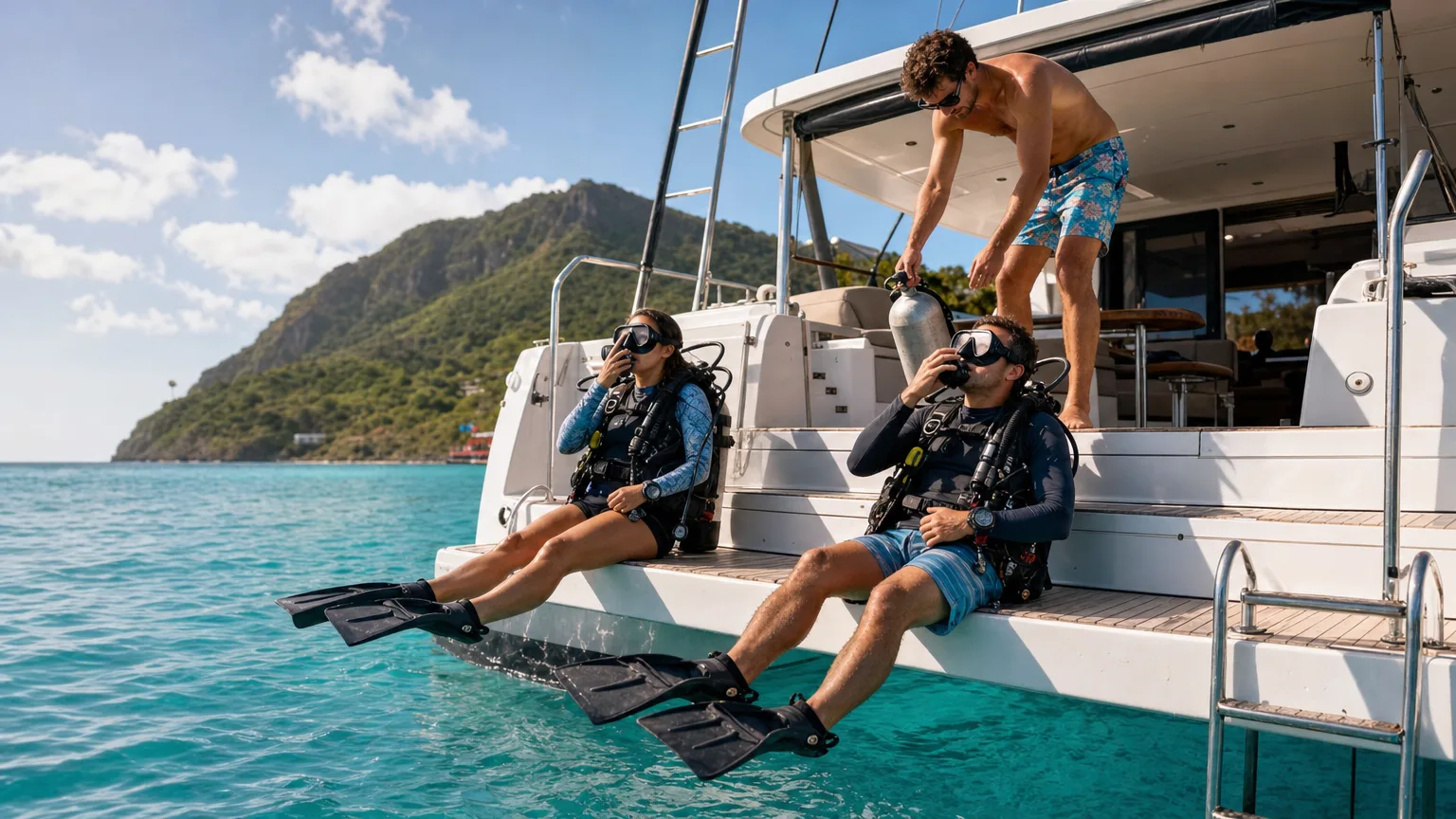
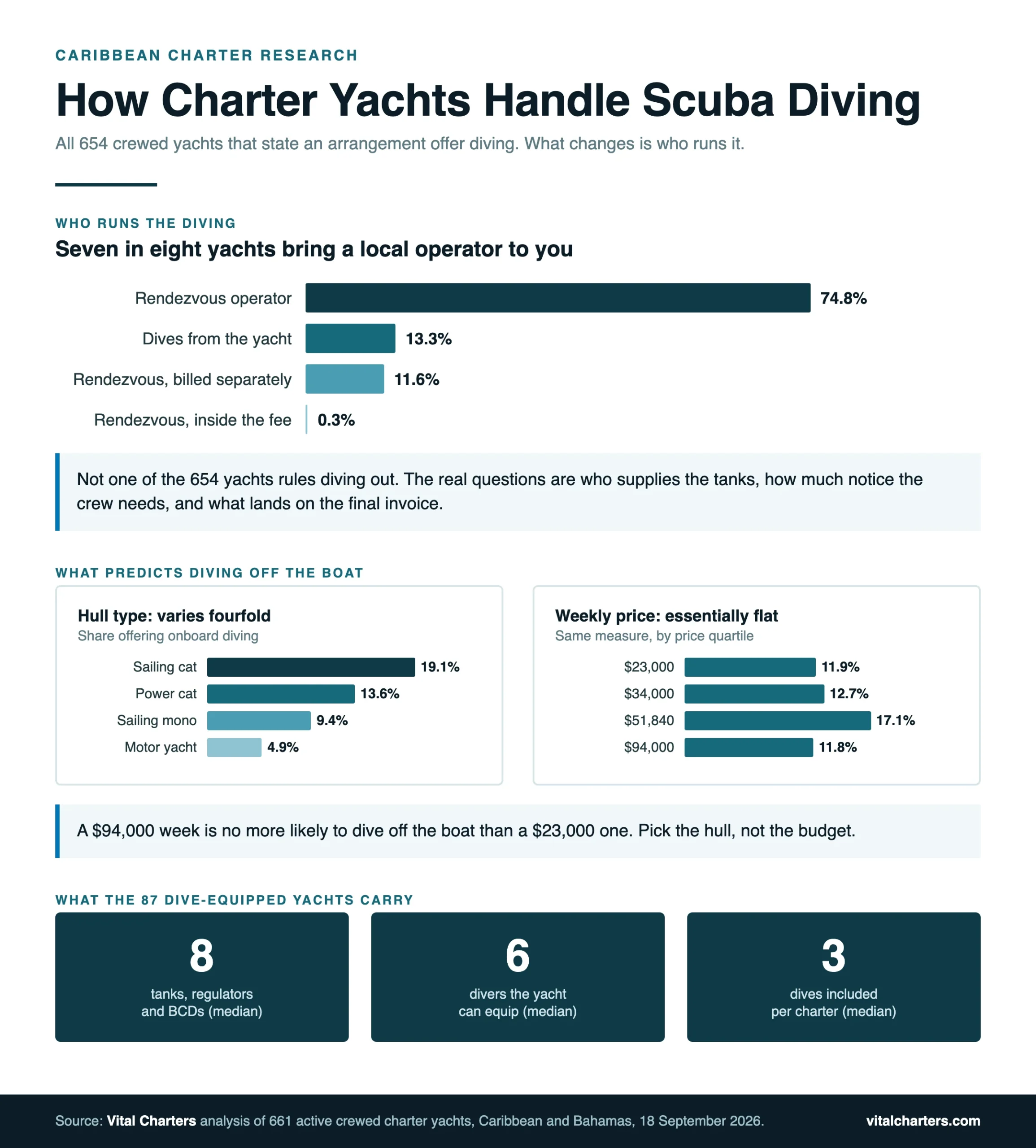
Yes, and the arrangement on a scuba diving charter is the part guests frequently get wrong. Of the 654 crewed yachts in the Caribbean and Bahamas that state how they handle diving, every one has a route to get you underwater. Only 13.3% run it from the boat itself. The other seven in eight bring a local dive operator out to meet you, and that model is the one the region is built around.
Most articles on this subject answer a different question than the one guests ask. They describe what diving is like in the Caribbean, which is well covered. They skip the logistics of doing it from a private yacht you’ve booked for a week. So we counted, using the dive fields and dive notes that yachts publish about themselves, the same way we counted what is in the toy locker.
How do charter yachts arrange scuba diving?
There are four arrangements in use across the fleet, not two, and 654 of 661 yachts state which one applies to them. The split below is the single most useful thing to know before you ask a broker about diving.
View data table
| Arrangement | Share | Yachts | What it means for you |
|---|---|---|---|
| Rendezvous diving offered | 74.8% | 489 | A local dive boat meets the yacht at the site with tanks, guides and rental kit |
| Diving from the yacht | 13.3% | 87 | Tanks and gear live aboard; the crew run the dive |
| Rendezvous, billed separately | 11.6% | 76 | Same model, with the operator’s cost quoted outside the charter fee |
| Rendezvous, inside the fee | 0.3% | 2 | Rare; the operator’s cost is already covered |
| Total stating an arrangement | 100% | 654 | 7 of the 661 active yachts leave the field blank |
As of 18 September 2026.
The practical read is that “does this yacht do diving” is almost never the right question, because the answer is yes. The useful questions are who supplies the tanks, how much notice the crew needs and what lands on the final invoice.
What is rendezvous diving, and is it any good?
Rendezvous diving is how roughly three quarters of the fleet handles it. A local dive operator brings their boat, their tanks and their guides to wherever the yacht is anchored. They take your group out for the dive and hand you back to the crew afterwards. You never lift a tank, and nobody on the yacht has to be a dive professional.
It has a reputation problem it doesn’t deserve. The guides dive the same sites every week and know which end of a wreck to spend your air on in a given tide. In several island groups the guest diving is run by local operators as a matter of course. Booking a yacht with an empty dive locker doesn’t cost you the diving. It costs you the ability to decide at breakfast.
Rendezvous diving is the standard arrangement on Caribbean crewed yacht charters, used by 74.8% of the 654 yachts that state how diving is handled. A local dive operator meets the yacht at anchor with tanks, guides and rental equipment. It typically needs a day’s notice, where onboard diving can be arranged the same morning.
That notice period is the real trade. A rendezvous is a booking, so it gets made the day before and it anchors your itinerary to a place and a time. If your group is keen enough that you want to dive most days, say so at the inquiry stage and the shortlist will look different.
What does it mean when a yacht dives off the boat?
Eighty-seven yachts run diving themselves, and that group splits again in a way that changes your week. Sixty of them carry a compressor as well as the gear, so they refill tanks on board and the diving is limited by daylight and weather. The other 27 carry tanks but fill them ashore. That’s why they tend to carry more of them, a median of 10 tanks against 8 for the yachts that can refill at will.
Where a yacht carries dive kit at all, the quantities are strikingly consistent. The median is 8 tanks, 8 regulators and 8 buoyancy compensators, and the median yacht equips 6 divers. Set that against a median of 8 guests aboard and the shape becomes obvious. This is kit sized for a family or a group of friends where most but not all of them dive, not for a dedicated dive operation.
Eighty-seven Caribbean crewed yachts, 13.3% of those stating an arrangement, run scuba diving from the boat itself. Sixty carry a compressor and refill on board, while 27 carry tanks and fill them ashore. Where dive kit is aboard, the median yacht carries 8 tanks and equips 6 divers.
Which yachts are most likely to have diving onboard?
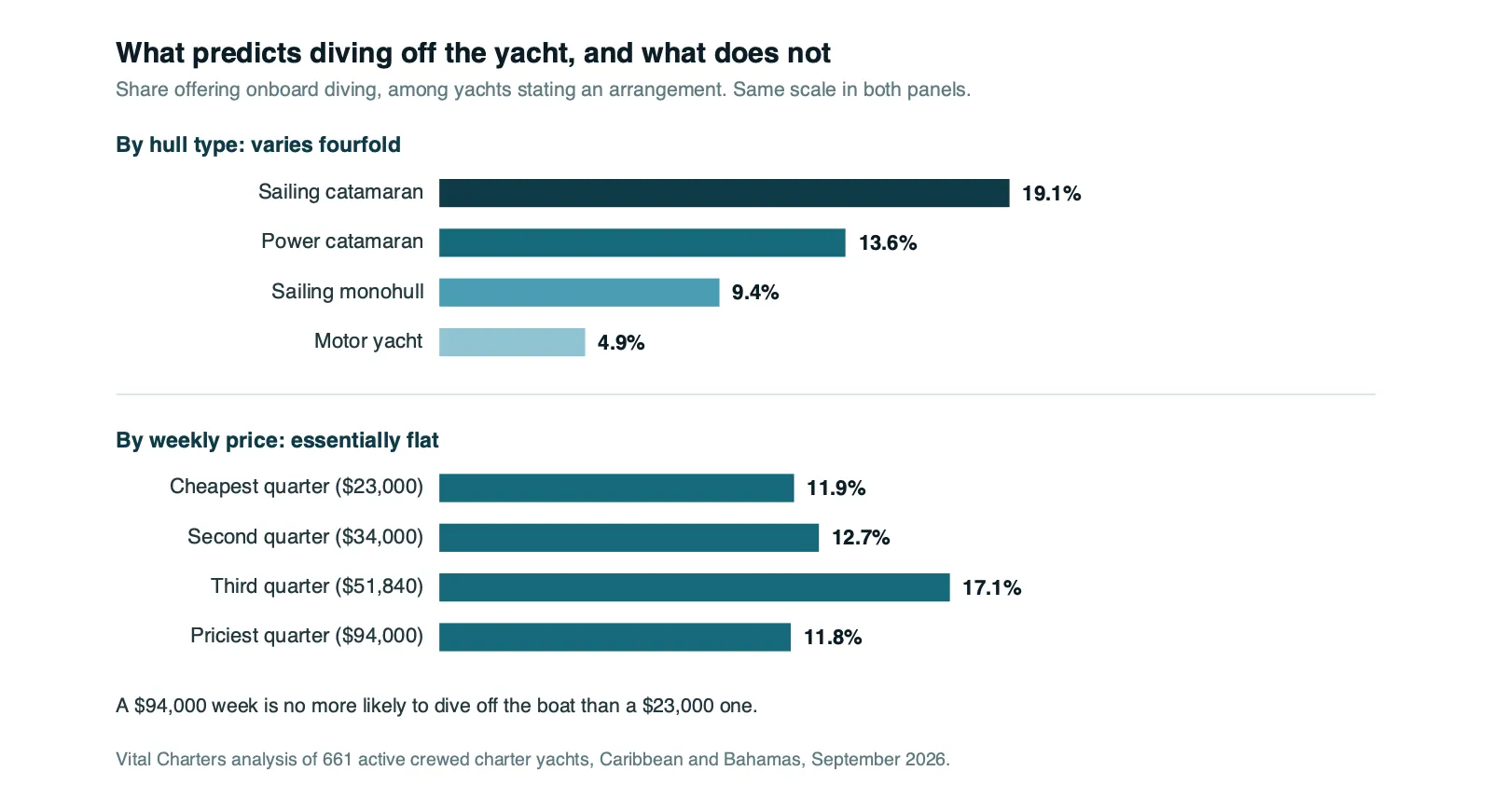
Hull type predicts onboard diving. Price doesn’t. Sailing catamarans offer it at 19.1%, nearly four times the 4.9% rate on motor yachts, while the cheapest and most expensive quarters of the fleet are separated by a single percentage point.
View data table
By hull type
| Hull | Share offering onboard diving | Yachts | Reporting |
|---|---|---|---|
| Sailing catamaran | 19.1% | 67 | 351 |
| Power catamaran | 13.6% | 6 | 44 |
| Sailing monohull | 9.4% | 3 | 32 |
| Motor yacht | 4.9% | 11 | 225 |
By price quartile, measured on the median base week
| Quartile | Median base week | Share | Yachts | Reporting |
|---|---|---|---|---|
| Q1 (cheapest) | $23,000 | 11.9% | 19 | 159 |
| Q2 | $34,000 | 12.7% | 20 | 157 |
| Q3 | $51,840 | 17.1% | 27 | 158 |
| Q4 (priciest) | $94,000 | 11.8% | 19 | 161 |
By length
| Length | Share | Yachts | Reporting |
|---|---|---|---|
| Under 50 ft | 9.0% | 6 | 67 |
| 50 to 59 ft | 13.3% | 28 | 210 |
| 60 to 74 ft | 22.0% | 28 | 127 |
| 75 to 99 ft | 11.9% | 15 | 126 |
| 100 ft and over | 8.1% | 10 | 124 |
Length tells the same story with a twist. The peak isn’t at the top of the fleet: 22.0% of yachts between 60 and 74 feet run onboard diving, against 8.1% of those over 100 feet. Large motor yachts carry serious toy inventories, as the toy-locker numbers show. They lean toward the powered kit that launches off a transom. A compressor, a rack of tanks and a crew member qualified to run a dive is a different sort of commitment, and it’s most common on mid-size sailing catamarans.
Onboard scuba diving on Caribbean charter yachts tracks hull type rather than budget. Sailing catamarans offer it at 19.1% against 4.9% of motor yachts, and the rate peaks at 22.0% for yachts between 60 and 74 feet. The cheapest and priciest quarters of the fleet sit at 11.9% and 11.8%.
What is included on a scuba diving charter, and what does a dive cost?
Three dives per charter is the usual package. Among the 60 yachts that state a number of included dives, the median is 3, and 31 of them state exactly 3. Nearly all of the rest state more rather than fewer, with a cluster at 6.
Extra dives are charged, and the published figure is consistent: 27 of the 38 yachts printing a price list $50 per person, with the remainder mostly at $75. Read that as indicative rather than as a market rate. Several of the yachts quoting it share a single published price list, and a rendezvous operator sets its own prices independently of the yacht.
| What the yachts publish | Figure | Measured on |
|---|---|---|
| Included dives per charter (median) | 3 | 60 stating a number |
| Most commonly published extra-dive price | $50 per person | 27 of 38 publishing one |
| Naming a first-time or try-dive option | 41 | dive-note writers* |
| Naming a dive professional in the crew | 33 | dive-note writers* |
| Stating a certification requirement | 77 | dive-note writers* |
*The 140 yachts that write dive notes of their own. Read the last three as floors: a yacht can do all three and never write it down.
The pattern to take from that table is that the inclusive part is real but modest. A week with three dives in the fee and a couple of extras on top is a normal, well-priced dive week. A week of two dives a day for seven days is a different product and needs to be specified up front.
Among the 60 Caribbean charter yachts that publish a number of included dives, the median is three per charter, and 31 of them state exactly three. Additional dives are charged separately, and rendezvous operators set their own rates independently of the yacht.
Do you need to be certified to dive on a charter?
No, not for a first taste. Forty-one of the 140 yachts that write about their diving name a supervised introductory option for guests who have never dived. It’s usually a short theory session, a shallow skills practice and one guided dive to around 40 feet. Where a price appears alongside it, most fall between $150 and $200 per person.
Full certification is a different commitment. Several yachts will run the practical portion during the week if the theory is completed online beforehand, and referral arrangements appear in the notes of a smaller group of boats. Doing the classroom part at home is the single biggest favour you can do yourself, because the alternative spends two mornings of a seven-day charter on coursework.
If nobody in the group is certified and nobody wants to be, the snorkelling is the reason most people come anyway. Snorkel gear sits aboard 72.5% of the yachts that report it. The shallow reefs at The Baths, Buck Island Reef and the Tobago Cays turtle sanctuary deliver most of what a first dive would. Families in particular tend to find that the mix of ages on board is easier to serve from the surface.
What will the crew ask you for?
Your certification card, first. Of the 140 yachts writing dive notes, 77 state a certification requirement explicitly, and the card is the document that gets checked. Bring the physical card or have the digital version on your phone before you fly.
Expect two more things. If you haven’t been in the water for a year or more, plan on a refresher dive early in the week rather than arguing about it on the day. And you won’t be diving on the last day. Flying after a dive needs a gap, so a week ending with a morning flight effectively ends its diving the day before. Build your best dive into the middle of the trip.
Thirty-three of those yachts name a dive professional among the crew, which is the detail to chase if you want diving without the logistics. A captain or chef who is also an instructor turns a supervised first dive into something that can happen on an afternoon nobody planned. It’s the single feature most correlated with a relaxed dive week.
How to book a scuba diving charter that actually dives
Say the word “diving” in your first message, not your fifth. The shortlist a broker builds for a scuba diving charter looks nothing like the default. Boats combining a compressor with a qualified crew member are a small enough population that they book early for the winter season.
Then pick the region for the diving rather than the other way around. The Virgin Islands put wrecks and shallow reef within a short tender ride of the main anchorages, which is why BVI crewed yacht charter itineraries absorb diving so easily. The Bahamas trade that convenience for walls, blue holes and sharks. Our guide to the best dive sites in the Caribbean sets out eleven of them and which island group each belongs to. If the underwater part of the trip is the point, night diving and bioluminescence are the other half of the same day.
Plan a week around the water, not around the boat
A scuba diving charter is available everywhere and organised differently almost everywhere. Three quarters of the fleet will have a local operator meet you at the site. A smaller and largely catamaran-shaped group runs it themselves, and the difference costs you spontaneity rather than access. Decide which of those you want before you fall for a particular boat, because retro-fitting a dive programme onto the wrong yacht can’t be done at short notice.
If you already know that the underwater half is the point of the trip, tell us at the inquiry stage. You can start a yacht search at Vital Charters and we’ll build the shortlist around the diving. If the surface is more your thing, read how the eFoil became standard kit instead. First-timers will find the wider guide for new charterers covers the parts of the week that happen above the waterline.
Frequently Asked Questions
Can you scuba dive from a charter yacht without being certified?
Yes. Forty-one of the 140 Caribbean charter yachts that publish dive notes describe a supervised introductory dive for uncertified guests, typically a short theory briefing, a shallow skills session and one guided dive to about 40 feet under direct supervision. Published prices mostly fall between $150 and $200 per person. On yachts using a rendezvous operator, the operator runs the same programme.
Do charter yachts provide scuba gear?
The 87 Caribbean crewed yachts that run diving from the boat carry a median of 8 tanks, 8 regulators and 8 buoyancy compensators, and equip a median of 6 divers. Rendezvous operators supply full rental kit as part of the dive. Most guests bring only a mask and a dive computer if they own one, plus the certification card, which is checked.
How many dives are included in a charter week?
Three is the median. Among the 60 Caribbean charter yachts that publish a number of included dives, 31 state exactly three per charter and nearly all of the remainder state more. Additional dives are usually charged, most commonly at $50 per person among the 38 yachts that publish a price. Expect a cap of one or two dives per day.
Is rendezvous diving as good as diving from the yacht?
For the quality of the diving itself, yes. Rendezvous operators dive the same sites weekly and supply guides, tanks and rental gear. The difference is scheduling rather than standard. A rendezvous is a booking that needs roughly a day’s notice and fixes where the yacht will be, where onboard diving can be decided the same morning. It’s used by 74.8% of the fleet.
Which charter yachts are most likely to have diving onboard?
Mid-size sailing catamarans. They offer onboard diving at 19.1%, against 4.9% of motor yachts, and the rate peaks at 22.0% for yachts between 60 and 74 feet. Price is close to irrelevant: the cheapest and most expensive quarters of the fleet sit at 11.9% and 11.8%. The 87 yachts running their own diving have a median base week of $44,000.
Find the yacht that gets you underwater
Tell us your group size, your dates and whether anyone needs a first dive, and we will build the shortlist around the diving rather than bolting it on afterwards.