
Corporate Yacht Charter: Plan a Team Retreat at Sea
Plan a corporate yacht charter team retreat: budgets, the 12-passenger rule, tax-deductibility, and a working week-long agenda from a Caribbean broker.
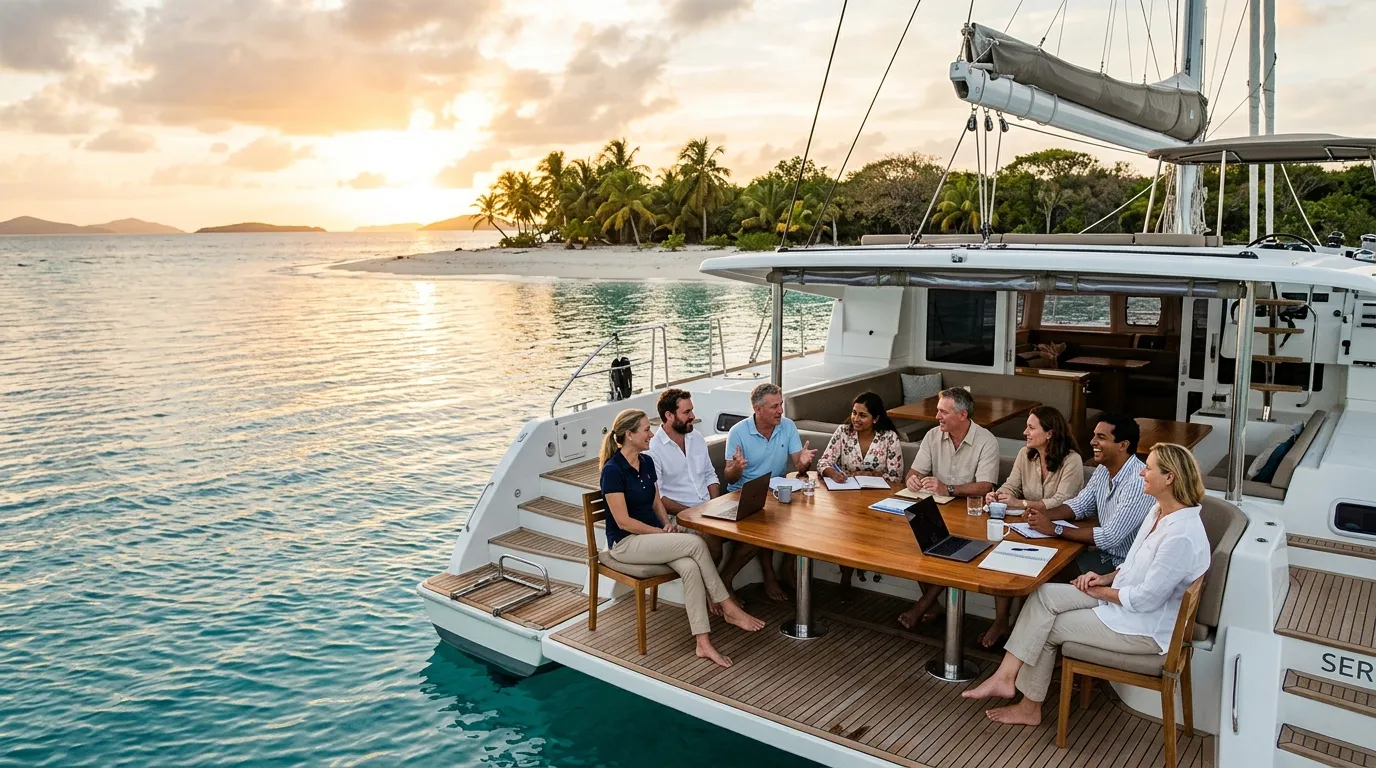
A corporate yacht charter is a private, crewed yacht booked by a company for a team retreat, board meeting, executive offsite, or client incentive trip, typically for 6–12 people on one vessel, or 13–24 across a tandem (two-yacht) charter. As a brokerage that books these every season, we’ve watched companies trade hotel ballrooms for sundecks because the math actually works: a private yacht delivers an enclosed, distraction-free environment where strategy sessions, team building, and downtime happen on the same hull. This is the spoke piece for our complete group and event yacht charter planning guide, focused specifically on the corporate retreat use case.
The global corporate retreats market hit $31.8 billion in 2024 and is projected to reach $73.7 billion by 2034 at a 9.1% CAGR (Allied Market Research, 2025). At the same time, only 21% of employees are engaged at work, costing the world economy roughly US$438 billion in lost productivity in 2024 (Gallup State of the Global Workplace, 2025). The retreat ROI argument writes itself: but the yacht-as-venue question hinges on three things competitors rarely cover: the 12-passenger rule, the §274 tax framework, and the all-in budget. We’ll work through each.
Why companies pick a yacht over a hotel ballroom
Average per-employee corporate retreat spend runs $3,692 for companies of 21–50 employees (RetreatsAndVenues 2025 survey of 210 companies). For a 10-person executive team that’s a $36,920 budget, inside the range of a Caribbean crewed catamaran at $25,000–$45,000 per week base, with venue, lodging, meals, and activities bundled into one contract (Vital Charters rate analysis, 2026).
The pitch isn’t “luxury for luxury’s sake.” A crewed yacht collapses six retreat line items (venue rental, group lodging, ground transportation, all meals, evening entertainment, and team-building activities) into a single contract. There’s no Uber from the hotel to the dinner restaurant, no AV vendor for the breakout room, no hunting for an excursion that fits everyone’s calendar. The boat moves while you sleep; the next morning you wake up at the next strategy block.
The constraint is people. A private crewed charter runs best for 8–12: that’s where the dinner conversation still includes everyone, the salon fits the team for a working session, and the cabins assign one-per-executive without doubling up. See our answer to: Where is the best deep-sea fishing in the Caribbean? Above 12, you’re either in tandem charter territory or looking at a different vessel class (Subchapter K passenger yacht), which we’ll get to.
What a corporate yacht charter actually costs
A 50–60 ft Caribbean crewed catamaran sleeping 8–10 guests runs $25,000–$55,000 per week base fee, and 70-ft motor yachts start at $50,000+ per week (Vital Charters rate analysis, 2026). For a 50-ft cat in the BVI, that translates to roughly $3,600–$5,000 per day all-inclusive. But the headline rate is only the start of the budget. Three add-ons turn a $30,000 quote into a $49,000+ wire transfer if the yacht is not all inclusive.
The all-in number, not the headline rate (if not All-Inclusive)
The base charter fee covers the yacht, the captain and crew salaries, and basic amenities. It does not cover fuel, food, dockage, alcohol, or gratuity. Those flow through two separate line items:
- APA (Advance Provisioning Allowance): paid upfront, typically 25–30% of base on sailing yachts and 30–45% on motor yachts, covering fuel, food, drinks, dockage, and incidentals. Anything not spent gets refunded at the end of the charter. See our APA explainer for the math.
- Crew gratuity: paid at the end of the charter, 15–20% of base fee is the Caribbean standard (20% is the norm in BVI/Bahamas); MYBA’s 2026 guidelines set no percentage. Our crew tipping guide walks through the etiquette.

View data table
| Cost Component | Amount | Percentage of Total |
|---|---|---|
| Base Charter Fee | $30,000 | 61% |
| APA (30%) | $9,000 | 18% |
| Crew Gratuity (18%) | $5,400 | 11% |
| Travel & Transfers | $4,800 | 10% |
| Total All-In | $49,200 | 100% |
| Per executive (10 guests) | $4,920 | , |
That $4,920 per-executive number is in the same neighborhood as the $3,692 industry average, except this version includes the venue, every meal, every excursion, and ground-zero distraction. The full cost picture is in our yacht charter costs guide.
The 12-passenger rule (and the tandem-charter workaround)
A vessel chartered with crew provided by the owner and carrying not more than 12 passengers is classified as an Uninspected Passenger Vessel; carrying more than 12 requires Subchapter T or K inspection (46 U.S.C. §2101). Vessels of 100 gross registered tons or more carrying more than 12 passengers must be inspected under 46 CFR Subchapter H (USCG Small Passenger Vessel Guide, 2024). Our 12-passenger rule explainer goes deeper.
Practically: almost every crewed yacht in the Caribbean charter fleet (the catamarans, the sailing yachts, the motor yachts under 24 meters) is uninspected, and that means 12 paying guests, hard cap, no exceptions. We get asked weekly if a 13th person can sneak on. The answer is no. The fines are real, the insurance voids, and reputable captains will refuse to leave the dock.
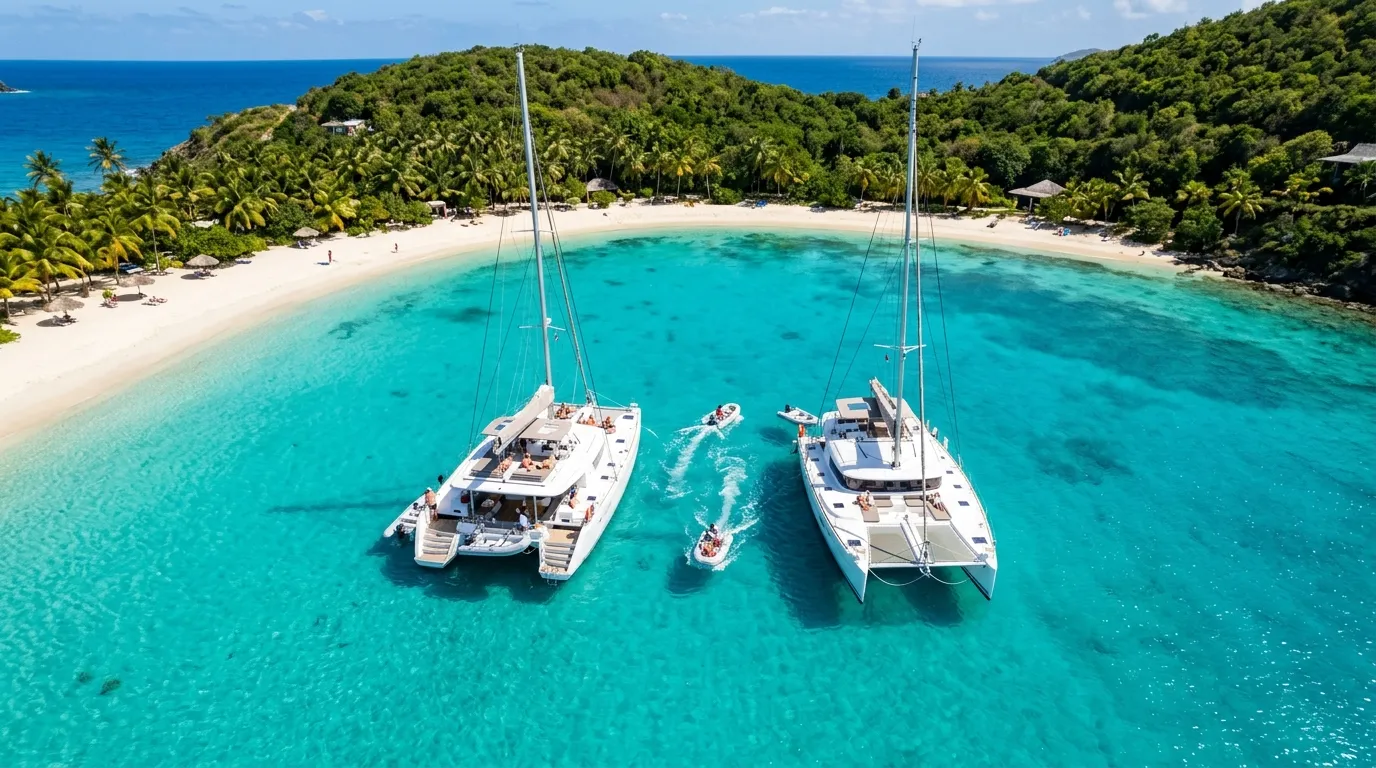
For 13–24 person corporate groups, the workaround is tandem charter: two yachts traveling the same itinerary, anchoring in the same bays, sharing meals and excursions. The teams split sleeping arrangements across boats but converge during the day. Our BVI tandem charter playbook walks through the logistics: anchoring strategy, dinghy management, evening rendezvous, and the cohesion question.
Corporate yacht charter tax treatment: read this before you book
Under §274(a)(1)(B), deductions are disallowed for any expense related to a facility used in connection with entertainment, amusement, or recreation, and yachts are explicitly listed as entertainment facilities (26 U.S.C. §274). The Tax Cuts and Jobs Act of 2017 made entertainment expenses non-deductible starting in 2018, so a “client appreciation cruise” with prospects is generally not deductible. Business meals served during the charter remain 50% deductible under §274(n) (IRS Publication 463, 2025).
The opening to know is §274(e)(5), which preserves deductibility for expenses “directly related to business meetings of employees, stockholders, agents, or directors.” A documented corporate board meeting, executive strategy offsite, or shareholder meeting held on a chartered yacht can qualify, but the substantiation bar is real:
- Written agenda with business topics, time blocks, and required attendance
- Minutes or memos documenting decisions made
- Attendee list with titles and roles (the rule applies to employees, stockholders, agents, or directors, not vendors or prospects)
- Business-purpose memo signed before the trip explaining why the offsite location was chosen
- Allocation between business hours and personal/recreational hours, since only the business portion qualifies
The §274(e)(5) exception preserves deductions for yacht-charter expenses “directly related to business meetings of employees, stockholders, agents, or directors”, but the IRS expects substantiation: a written agenda, attendance memo, and business-purpose documentation completed before the charter, not reconstructed at audit (26 U.S.C. §274(e)(5); IRS Pub. 463, 2025).
This is not legal or tax advice. Run the structure past your CPA and tax counsel before you sign the charter contract, not after the trip. The good news: when corporate retreats are documented properly, the math gets better. The bad news: charters booked as “team-building cruises” without paperwork tend to lose at audit.
When to go: the November opening
The Caribbean high season runs Dec 15-Apr 15, with peak rates from late December through New Year and again over Presidents’ Week. The Atlantic hurricane season is June 1-Nov 30 by NOAA definition. Most corporate planners default to January–March because that’s when their fiscal calendar opens up. They miss November.
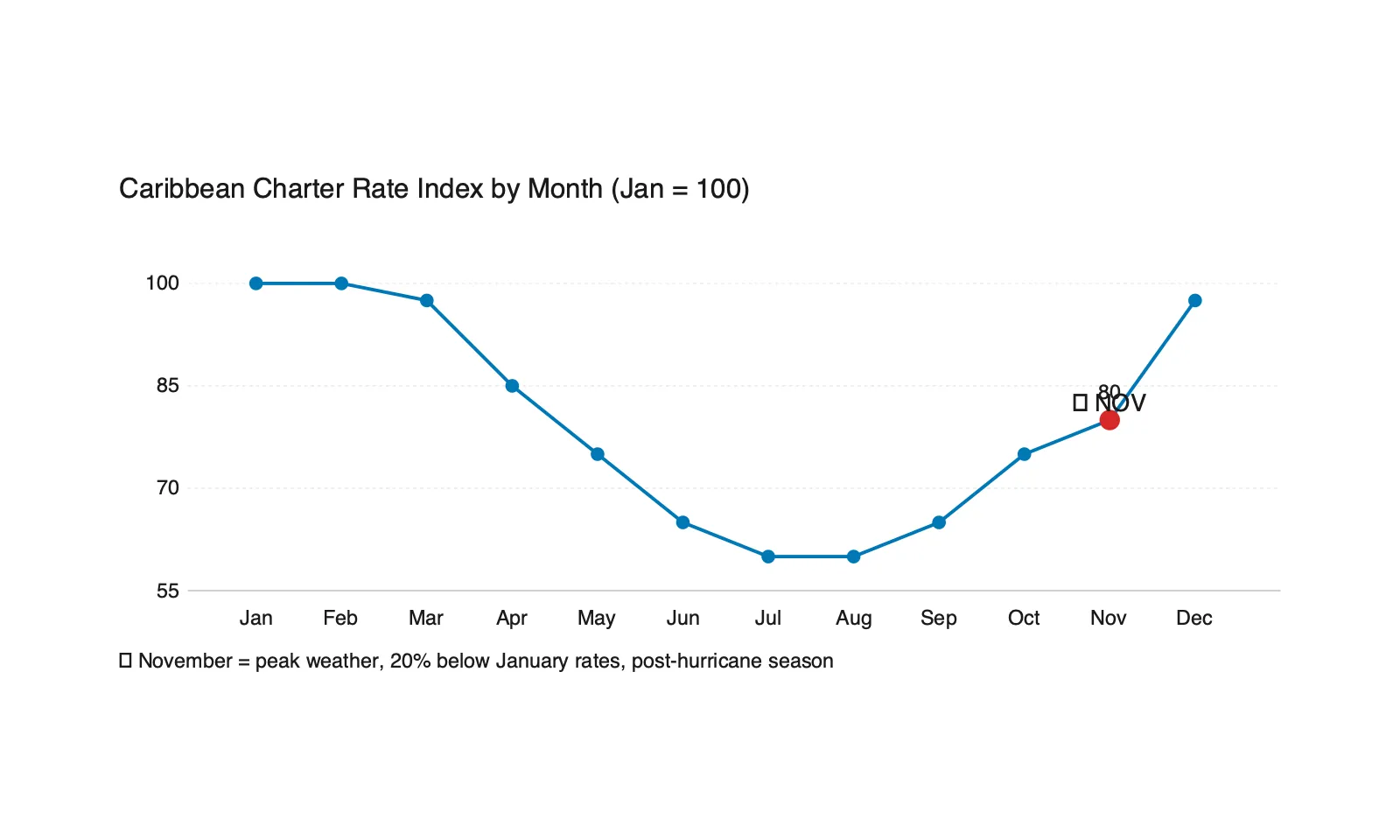
The week after Thanksgiving, once Atlantic hurricane season closes Nov 30, sits at the front edge of peak Caribbean weather: 15–20 knot trades, high 70s air, generally flat sea state. Rates run roughly 20% below January peaks, saving $5,000–$9,000 on a $30,000 base corporate yacht charter with no weather penalty (NOAA hurricane season).
Our best time to charter guide breaks down the month-by-month rate index.
View data table
| Month | Rate Index (Jan=100) | Status |
|---|---|---|
| January | 100 | Peak season |
| February | 100 | Peak season (Presidents Week premium) |
| March | 95 | Peak season (spring break premium) |
| April | 85 | Shoulder begins after Easter |
| May | 70 | Shoulder season |
| June | 65 | Hurricane season opens; many fleets reposition |
| July | 60 | Low season; hurricane risk |
| August | 60 | Low season; hurricane peak |
| September | 65 | Hurricane peak; many fleets closed |
| October | 75 | Hurricane season tail; fleets returning |
| November | 80 | Optimal: post-hurricane, peak weather, ~20% below Jan |
| December | 95 | Peak season ramps Dec 15 |
A working week-long agenda
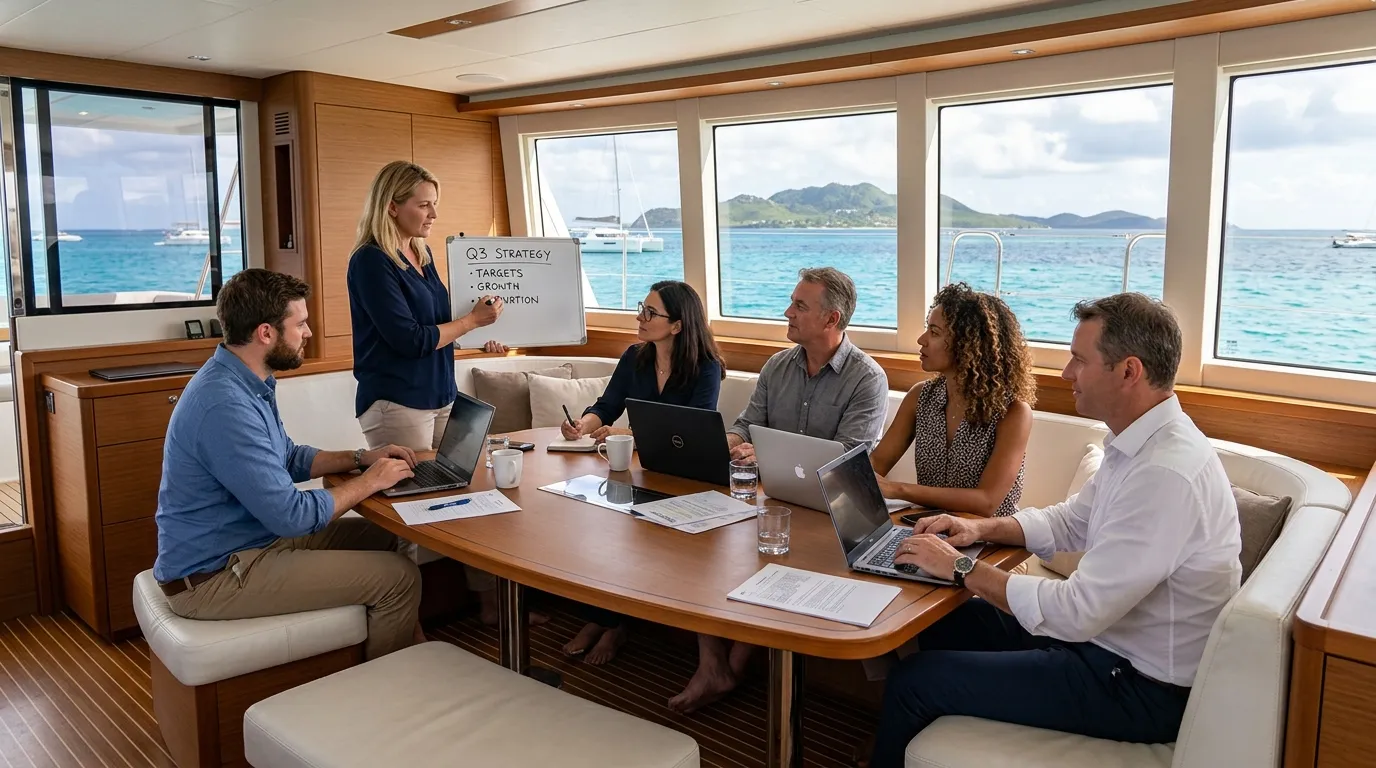
A documented five-night corporate yacht charter agenda typically includes three morning working sessions in the salon, one full off-day mid-week, and structured evening executive dinners, the pattern that satisfies both §274(e)(5) substantiation and team cohesion. Here’s the agenda we hand to corporate clients booking a Caribbean retreat for 8–10 executives. It’s structured so the substantiation paperwork practically writes itself, and so the team comes home having actually decided things.
Sunday: Travel & boarding
Guests arrive at the embarkation port (Tortola, Nassau, or St. Thomas typically) and board between 4–6 pm. Welcome dinner aboard at anchor; no agenda content: let the team decompress. Captain reviews safety briefing.
Monday: Strategy block + cohesion activity
- 8:00–11:30 am: Working session in the salon (financials, quarterly review, or strategic planning). Crew serves coffee and breakfast. Document attendance, agenda, and decisions.
- 12:00–1:30 pm: Lunch under sail to the next anchorage.
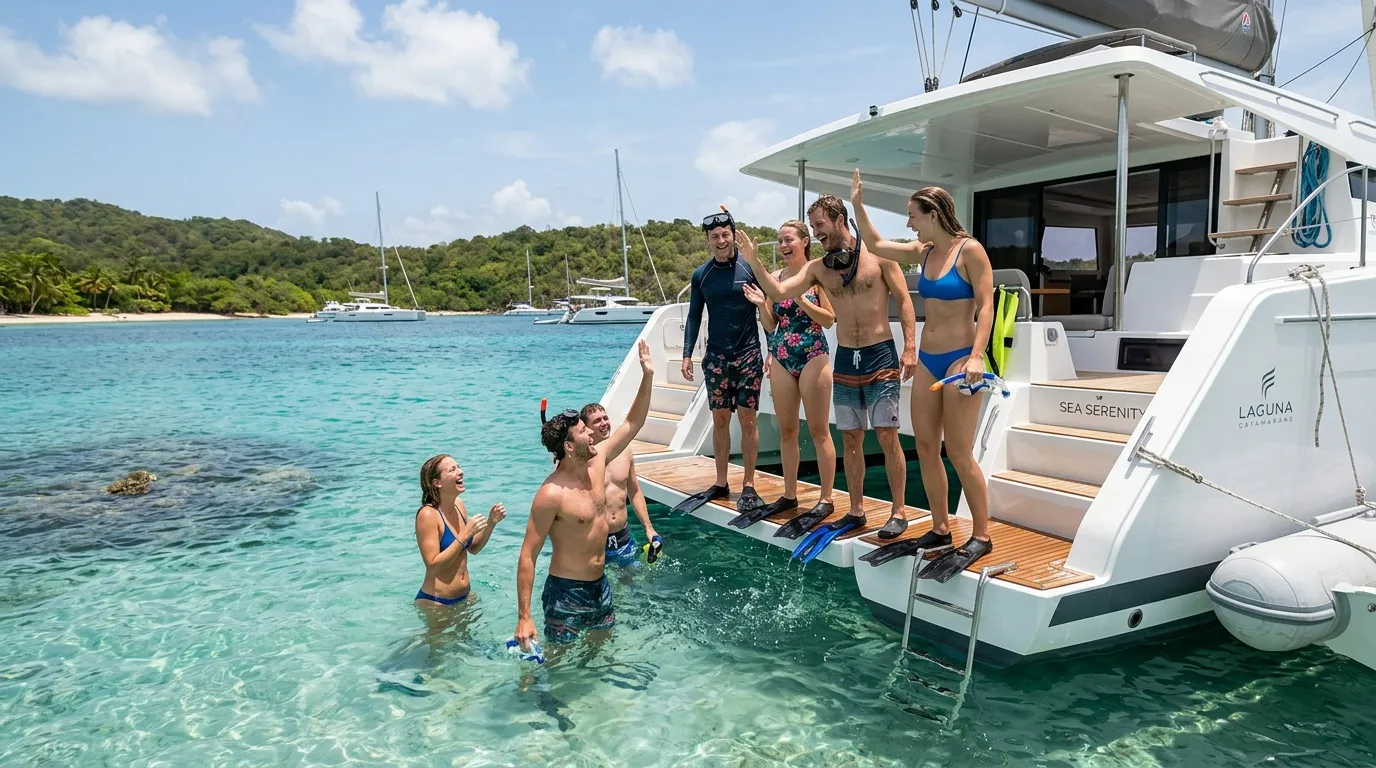
- 2:00–5:00 pm: Group snorkel or guided beach activity. This is where bonds form: the experience that makes the retreat memorable.
- 6:30–9:00 pm: Executive dinner aboard. Set the second-day agenda.
Tuesday: Deep-work day
- 9:00 am–12:00 pm: Focused breakouts (product roadmap, sales planning, OKRs). The crew handles all logistics so leaders focus on the work.
- 1:00–4:00 pm: Optional water activity (paddleboarding, fishing, snorkel); or “free think” time. Some teams do their best thinking on the trampoline.
- 6:00–7:00 pm: Sunset cocktails on the foredeck.
- 7:30 pm: Themed dinner (chef-prepared local cuisine).
Wednesday: The off day
No agenda. Beach day, water sports, or a private excursion (a private island, a customs-cleared lunch ashore). The off-day is the point: cohesion isn’t manufactured in conference rooms.
Thursday: Decision day
- 9:00 am–12:00 pm: Final working session. Lock in the decisions from earlier blocks.
- 1:00–3:00 pm: Underway to final anchorage; light lunch.
- 3:00–6:00 pm: Free time to pack and decompress.
- 7:00 pm: Farewell dinner. CEO closing remarks; team retrospectives.
Friday: Disembarkation
Breakfast aboard; depart yacht by 9 am. Ground transfer to airport.
The pattern: morning work blocks (when minds are sharpest), afternoon water-based cohesion activities (where teams actually bond), structured evening dinners (where decisions get socialized). Three working days inside a five-night retreat, with one designed off-day in the middle. Our broader Caribbean charter planning guide covers itinerary mechanics in more depth.
One yacht or two? The cohesion question
For groups under 12, the answer is one yacht. Above 12, the question is real. Two crewed yachts traveling tandem can host 18–24 guests; three yachts handle 30+. But the experience changes:
- One yacht (8–12): Full cohesion. The team eats every meal together, sleeps in the same hull, and goes through every activity as a unit. This is the executive-team retreat sweet spot.
- Tandem (13–24): Daytime cohesion (shared excursions, joint anchorages, fleet dinners ashore), nighttime split (each yacht has its own crew, dinner, and morning routine). The boats become “team huddle” units. This works for sales kickoffs, regional leadership meetings, and post-merger integration retreats, anywhere natural sub-teams already exist.
- Three or more yachts: Effectively a small conference at sea. Excellent for company-wide quarterly summits, less good for tight executive cohesion.
Most of our corporate clients land at 8–12 on a single yacht, or 18–24 on a two-yacht tandem. The threshold question to ask: do you want this team to merge or to maintain its existing sub-team structure? If the answer is merge, find a way to fit on one boat, even if that means trimming the invite list.
Insurance, liability, and the quiet logistics
A few items most planners forget until the contract is in front of them:
- Charter contract: Reputable Caribbean charters use the CYBA Charter Agreement. Read it before signing: particularly the cancellation, weather diversion, and force-majeure clauses.
- Yacht insurance: The yacht’s hull and liability coverage is the owner’s responsibility. Verify the certificate of insurance lists the charter window and includes passenger liability. Your company’s general liability policy may not cover employees on a chartered vessel internationally. Check with your broker and consider a short-term rider for the trip.
- Travel medical: Caribbean medical care is good but uneven. We recommend a medical evacuation policy ($300–$1,000 per person) for any corporate group offshore. DAN Boater membership is one common option.
- Passports & customs: All Caribbean charters require passports (BVI is a separate jurisdiction from USVI; both check). Build one full work day of buffer between travel and the first scheduled session, flight delays from US East Coast hubs are frequent.
- Connectivity: Most modern charter yachts carry Starlink in 2026, delivering Zoom-quality bandwidth at anchor. Confirm before you commit to a Tuesday morning client call from the salon.
How a broker accelerates the process
Three things a broker handles that compress your planning timeline:
- Vessel matching: We’ve walked through hundreds of charter yachts and know which sleep 12 in genuine cabins (not converted bunks), which have the salon space for a working session, which carry Starlink, and which captains are good with corporate groups. Email us your headcount, dates, and rough budget, and we send you a curated short list, typically within 48 hours.
- Contract negotiation: CYBA contracts are standard, but corporate clients often negotiate NDAs, travel insurance addenda, and custom provisioning lists. We handle this on your behalf.
- No fee to you: Charter brokerage commissions are paid by the yacht owner out of the base fee. You don’t pay us: you save the time of evaluating 80 yachts to find the right 1.
If you’re planning a Q4 retreat, start the conversation in spring. If you’re planning January–March peak season, the best yachts book 6–9 months out. Start a yacht search or reach out and we’ll send a no-obligation curated short list for your dates.
Frequently Asked Questions
How much does a corporate yacht charter cost in the Caribbean?
A 50–60 ft crewed catamaran sleeping 8–10 executives runs $25,000–$55,000 per week base fee, plus 25–30% APA and 15–20% gratuity (if not all-inclusive), for an all-in total of roughly $45,000–$75,000 per week before flights. Per-executive costs typically land at $4,500–$7,500 for a five-night charter.
How many people can a corporate yacht charter hold?
A standard crewed charter yacht is capped at 12 paying passengers under U.S. Coast Guard rules (46 U.S.C. §2101). For groups of 13–24, companies use a tandem charter: two yachts traveling the same itinerary. Larger groups (30+) require multi-yacht arrangements or a Subchapter K commercial passenger vessel.
Is a corporate yacht charter tax-deductible?
Yacht charters are listed as entertainment facilities under IRC §274, which generally disallows deductions. However, §274(e)(5) preserves deductibility for expenses “directly related to business meetings of employees, stockholders, agents, or directors”, meaning a documented board meeting, executive offsite, or shareholder meeting on a chartered yacht can qualify if you maintain a written agenda, attendance memo, business-purpose documentation, and allocation between business and personal time. Business meals remain 50% deductible under §274(n). Confirm with your CPA before booking.
When is the best time for a corporate retreat in the Caribbean?
November is the optimal window: hurricane season closes Nov 30, peak weather arrives, and rates run roughly 20% below January. December 15 through April 15 is peak season at peak rates. May–June is shoulder season. July–October includes the heart of hurricane season; most fleets reposition or close.
Can we hold a real board meeting on a chartered yacht?
Yes, and §274(e)(5) specifically preserves the deduction for it: as long as you treat it like a real meeting. That means a written agenda issued in advance, mandatory attendance for directors, formal minutes capturing decisions, and a clear business-purpose memo. The yacht is the venue, not the vacation. Allocate clearly between meeting hours and personal time, and only deduct the business portion.
What if a hurricane disrupts the charter?
The CYBA Charter Agreement includes weather-diversion provisions. The captain has authority to alter the itinerary for safety, and most contracts include force-majeure language for named-storm events. For peace of mind, schedule corporate retreats outside hurricane season (November 30-June 1), or negotiate trip cancellation insurance if booking June–October.
Your team deserves a meeting room with a view.
Tell us your headcount, dates, and whether you need one yacht or two and we’ll put together crewed options with full-week agendas and all-in cost estimates.