

What to Expect on a Yacht Charter: Day-by-Day Breakdown
First-time charterers make up 40% of guests. Here’s exactly what happens each day on a Caribbean yacht charter, from embarkation to disembarkation.
Last Updated: September 7, 2026
Private and leisure bookings make up 77.88% of global charter revenue (Mordor Intelligence, 2025). That’s nearly half the guests stepping aboard without knowing what a typical day actually looks like. And here’s the thing: no two days on a charter are the same. Day 1 feels completely different from Day 5.
Most guides describe a generic “typical day on a yacht charter” and leave it at that. This one won’t. If you’re planning a Caribbean yacht charter for the first time, you deserve a real breakdown: what happens hour by hour, how the crew operates behind the scenes, and how you’ll feel as the week unfolds.
Below is the day-by-day guide we wish someone had handed us before our first charter in the BVI.
What Happens Before You Board a Yacht Charter?
Your charter starts about six weeks before you board, with a document called the preference sheet. It asks what you eat, what you drink, what you are allergic to, whether anyone is celebrating something, and whether you want to be woken at seven or left alone until ten. Most first-timers treat it as a form. The crew treat it as the brief for the entire week, and the gap between those two readings is the single biggest predictor of how the charter goes.
The market it sits in is growing quickly, from $8.98 billion in 2025 toward a projected $18.2 billion by 2034 (Fortune Business Insights, 2025), which means most people aboard a charter this winter will be doing it for the first time.
Your charter broker sends the preference sheet 4-6 weeks before embarkation. It covers dietary restrictions, drink preferences, activity interests, and special occasions. Don’t rush through it. The chef builds an entire week of menus around your answers.
Our observation: After brokering dozens of Caribbean charters, I’ve noticed that guests who write “I’ll eat anything” on their preference sheet end up the least satisfied with meals. The chef wants specifics. Tell them you love seared tuna but hate cilantro. Mention your kid’s birthday on Day 3. That level of detail is what transforms a good charter into an unforgettable one.
You’ll also confirm your advance provisioning allowance (APA): typically 25-35% of the base charter fee for sailing yachts. The APA covers food, fuel, marina fees, and any extras. Your captain tracks every dollar, and you’ll get an itemized accounting at the end. Any unused APA comes back to you.
What Does Day 1 on a Yacht Charter Look Like?
Weekly charters account for 54.63% of all yacht charter bookings (Mordor Intelligence, 2025), and nearly every one of them starts the same way: controlled chaos. Day 1 is the only day that doesn’t feel like a vacation yet, and that’s completely normal.
Morning: Arrival and Boarding (10:00 AM-12:00 PM)
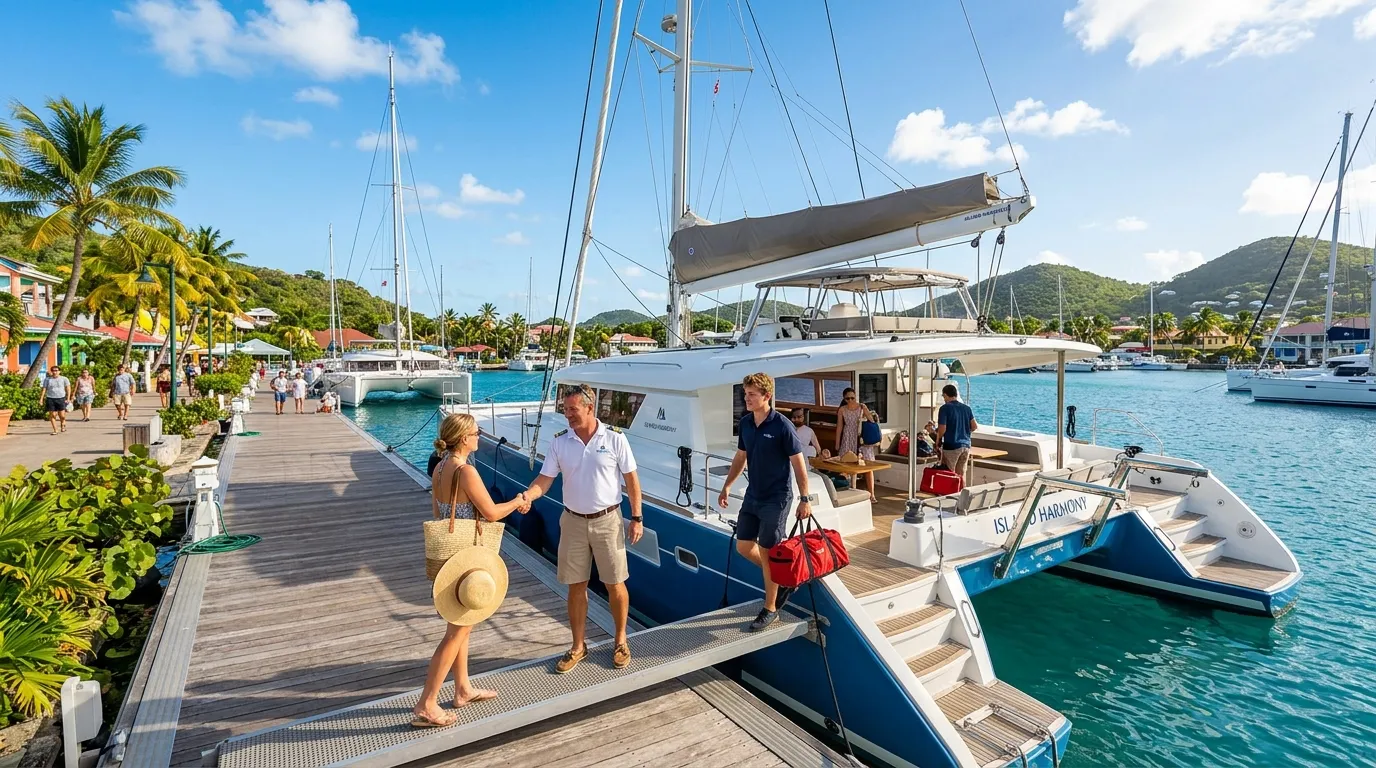
In the BVI, most charters start at Tortola’s Road Town Marina or Nanny Cay. In the Bahamas, it’s usually Nassau or Marsh Harbour. You’ll arrive mid-morning and meet your captain at the dock.
Here’s what actually happens in the first two hours:
- Captain gives a safety briefing (life jackets, fire extinguishers, emergency procedures, VHF radio basics)
- You get a boat tour: cabins, heads (bathrooms), galley, salon, flybridge
- The chef confirms your preference sheet in person (“You mentioned your daughter is vegetarian, does she eat fish?”)
- You stow your bags. Soft bags only: hard suitcases don’t fit in cabin storage
Afternoon: First Sail and Anchoring (12:00 PM-5:00 PM)
After lunch aboard, the captain raises anchor for a short first sail, usually 30-60 minutes to a nearby anchorage. This isn’t a marathon sailing day. The crew wants you settled, not seasick.
First-timer surprises that catch everyone off guard:
- The boat tilts when sailing (heeling). It feels noticeable at first but you’ll stop noticing by Day 2
- Shower water is unlimited. Modern catamarans carry 100-150 gallons of fresh water and have water makers onboard.
- Your phone signal will disappear rarely at some anchorages. Embrace it
- You’ll eat better aboard than at most restaurants. The chef’s first dinner is usually their showstopper
Evening: First Night at Anchor (5:00 PM-9:00 PM)
Sundowners on the flybridge. Dinner under the stars. And then the quiet hits. No traffic, no TV, just water lapping the hull. Most first-timers are asleep by 9 PM: the combination of sun, salt air, and travel exhaustion knocks you out.
Yes, the boat rocks at night. It’s gentle: more of a cradle than a rollercoaster. By Night 2, you won’t notice it at all. Some guests say it becomes the best sleep of their lives.
What Happens on Days 2-3 of a Yacht Charter?

Crewed charters account for 60-82% of global charter revenue (Fortune Business Insights, 2025). That dominance exists because the crew handles everything, and by Day 2, you’ll understand why people choose crewed over bareboat. You wake up to coffee already brewed and breakfast being plated.
A Realistic Daily Schedule
Here’s what a typical Day 2 or Day 3 looks like on a crewed catamaran charter in the BVI:
- 7:00 AM: Crew is already up. Captain checks weather and plans the day’s route. Chef starts breakfast prep.
- 8:00 AM: Breakfast served. Fresh fruit, eggs to order, coffee. Eat on the aft deck watching the sunrise.
- 9:30 AM: Anchor up. Sail to the next stop: maybe Norman Island’s caves for snorkeling, or the Baths at Virgin Gorda.
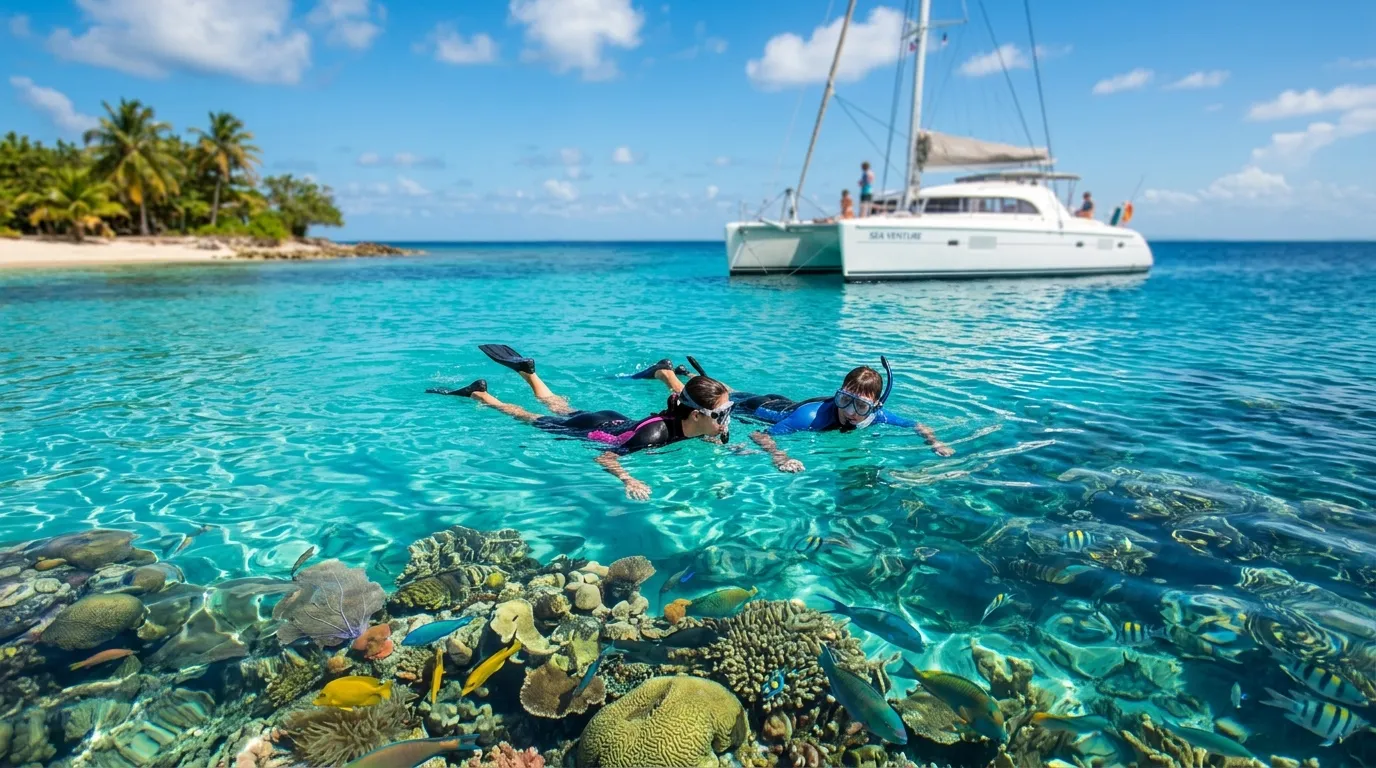
- 10:30 AM-1:00 PM: Water activities. Snorkeling, paddleboarding, kayaking, swimming. The crew sets up the water toys while you eat breakfast.
- 1:00 PM: Lunch at anchor. Fresh grilled mahi-mahi, salads, cold drinks. Nobody’s going anywhere.
- 2:00-4:00 PM: Beach time, more water activities, or just read on the trampoline nets.
- 4:30 PM: Short sail to the evening anchorage.
- 5:30 PM: Sundowners. This becomes the ritual you’ll miss most.
- 7:00 PM: Dinner. Multi-course, chef-prepared, paired with wines from the APA provisions.
- 9:00 PM: Stargazing from the flybridge. Or early to bed. Zero judgment either way.
Our observation: By Day 2, most guests stop asking “what’s the plan?” and start saying “whatever the captain suggests.” That shift is the moment the charter really begins. The crew knows these waters: they’ll take you to snorkeling spots the guidebooks don’t mention and anchorages where you won’t see another boat.
If you’re wondering what’s included in your charter fee, it’s this entire experience: the yacht, the crew, the water toys, the fuel for sailing. Meals and drinks come from your APA if not all inclusive terms.
How Do Charter Guests Actually Spend Their Time?
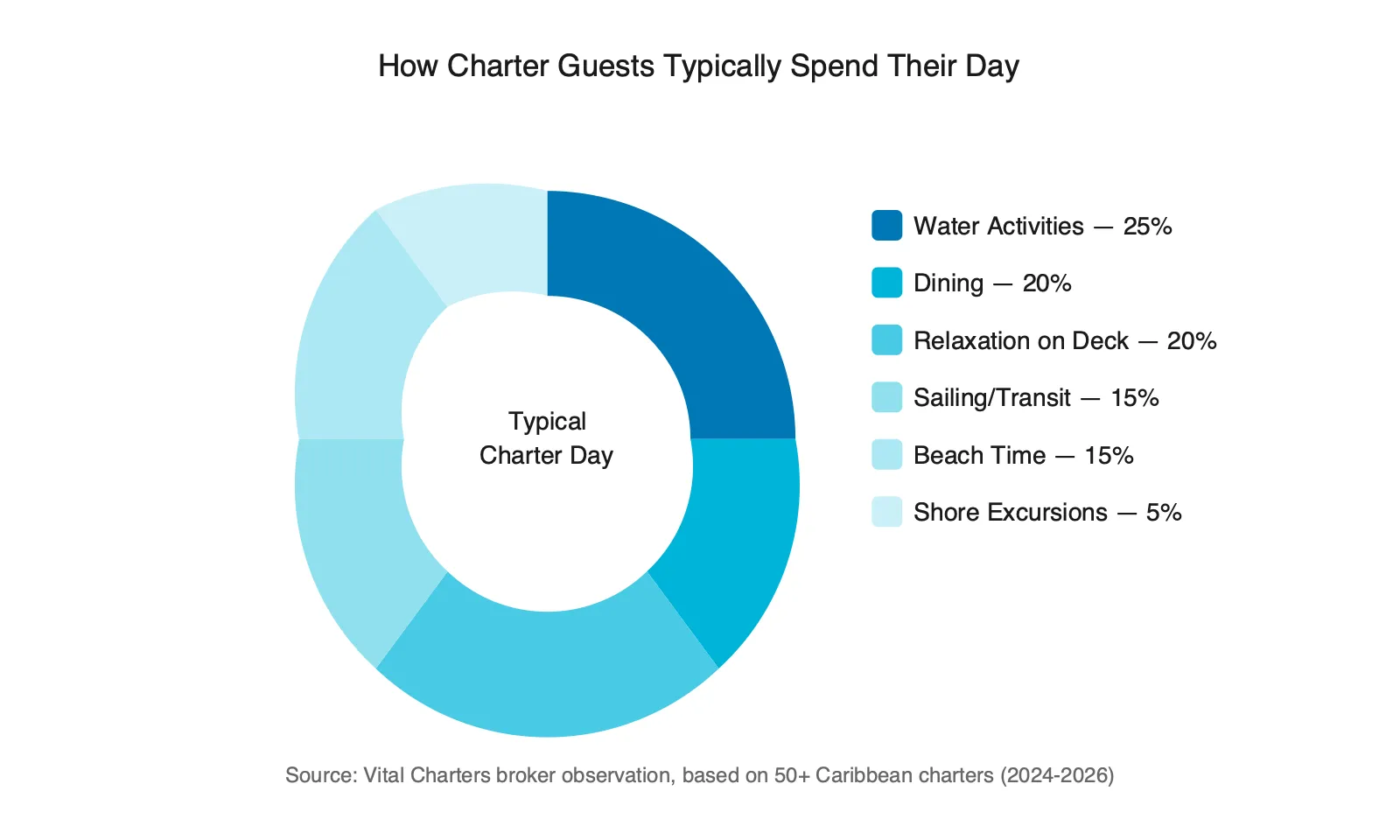
About 70% of charter bookings still run through a broker rather than an online marketplace (Mordor Intelligence, 2025), which means most guests research obsessively before they book, but few understand how relaxed the actual daily rhythm is. Here’s the breakdown based on a typical charter day:
View data table
| Activity | % of Day | Approx. Hours |
|---|---|---|
| Water Activities (snorkeling, paddleboarding, swimming) | 25% | 3-4 hrs |
| Dining (breakfast, lunch, dinner, snacks) | 20% | 2.5-3 hrs |
| Relaxation on Deck (reading, sunbathing, napping) | 20% | 2.5-3 hrs |
| Sailing/Transit | 15% | 2 hrs |
| Beach Time | 15% | 2 hrs |
| Shore Excursions | 5% | 0.5-1 hr |
Notice what’s missing from this chart? Stress. Agenda management. Rushing between activities. That’s the whole point. A yacht charter strips away the logistics that ruin most vacations.
Why Are Days 4-5 the Best Part of a Yacht Charter?
The average charter guest age has dropped roughly 10 years over the past two decades, with the core demographic now sitting at 40-50 years old (SuperYacht Times, 2025). These aren’t retirees with nothing but time: they’re busy professionals who need the first few days just to decompress. Days 4 and 5 are when it finally clicks.
By now, you know the crew by name. The captain knows you like your coffee black. The chef noticed you went back for seconds on the coconut shrimp and has already planned a variation for tomorrow. You’ve stopped checking your phone: partly because you’ve genuinely forgotten to care.
This is where the itinerary gets interesting. The captain has been reading your group’s energy. If you’re adventurous, he’ll suggest a longer sail to a remote snorkeling reef. If you’re in full relaxation mode, he’ll anchor in a protected bay where you won’t see another boat all afternoon.
What the Crew Does Behind the Scenes
You see breakfast appear. You don’t see the captain checking NOAA weather forecasts at 5 AM, the chef hitting a local fish market at the marina before you wake up, or the first mate running engine and watermaker checks below deck. A typical crewed charter has 2-4 crew members, and their day starts hours before yours.
Here’s what’s happening while you sip coffee:
- Captain plots the day’s route based on wind, current, and your group’s interests
- Chef adjusts menus based on what was fresh at the morning market
- First mate inspects water toys, checks fuel, runs the watermaker
- Steward(ess) tidies cabins, sets up breakfast service, preps the aft deck
Understanding how yacht charter costs break down helps you appreciate what you’re paying for. A significant portion of the charter fee goes directly to this crew, professionals who’ve spent years working these waters.
How Do Days 6-7 and Disembarkation Work?
Daily charters are the fastest-growing duration segment in the industry, expanding at a 10.82% CAGR (Mordor Intelligence, 2025). But guests who book full-week charters consistently report that Days 6 and 7 are the most emotionally impactful, and the hardest to leave.
Day 6: The Last Full Day
The captain typically plans a special final anchorage, somewhere photogenic, protected, and memorable. In the BVI, that might be Cooper Island or Deadman’s Bay on Peter Island. In the Bahamas, it could be a private sandbar in the Exumas where you’re the only boat for miles.
If your charter includes an APA allowance, you’ll get a full accounting: fuel costs, marina fees, provisioning receipts, park permits. If there’s money left over, it’s refunded. No surprises: everything is transparent. For more detail on what goes into the APA, check out our all-inclusive charter guide.
Our observation: Day 6 is when guests start asking about rebooking. I’ve had families e-mail me at sundowners to lock in dates for the following year, before they’ve even stepped off the yacht. The crew they bonded with, the anchorages they discovered, the routine they built. That’s what brings people back. About half our clients are repeat charterers.
Day 7: Disembarkation Day
Disembarkation morning is bittersweet. The crew serves a final breakfast, you pack your soft bags, and you’re typically off the yacht by 9-10 AM. Some logistics to know:
- Crew gratuity is customary: typically 15-20% of the base charter fee, given directly to the captain who distributes it. Our crew tipping guide breaks down the math.
- Transfers to the airport or hotel are usually arranged in advance by your broker
- Lost items happen. Do a thorough cabin check before leaving: sunglasses, chargers, and snorkel gear are the usual suspects
Many guests book a hotel night near the marina to decompress before flying home. If you’re chartering in the BVI, our BVI first-timer’s guide has recommendations.
What Should First-Time Charterers Know Before Booking?
The charter fleet of yachts 24 meters and above reached approximately 3,830 vessels in early 2025, a 7.4% year-over-year increase (SuperYacht Times, 2025). More yachts means more options for first-timers: but it also means the booking window for peak Caribbean season (December through April) fills up fast. Plan 6-9 months ahead, or 9-12 months for Christmas and New Year weeks.
A few things nobody tells you before your first charter:
- You don’t need sailing experience. On a crewed charter, the crew handles everything. You’re a guest, not a deckhand. Sit back.
- Pack light and soft. Hard suitcases are a problem on boats. Duffels and soft bags only. Check our yacht charter packing list for specifics.
- The itinerary is flexible. Unlike a cruise ship locked into port schedules, your captain adjusts daily based on weather, your mood, and local conditions. Want to skip that island and snorkel all morning instead? Done.
- You’ll eat extraordinarily well. Charter chefs are trained professionals cooking three meals a day plus snacks and cocktails. Most guests say the food is the biggest surprise of the trip.
- Seasickness is manageable. Catamarans are far more stable than monohulls. If you’re prone to motion sickness, take medication the night before embarkation, not the morning of.
Ready to Experience It Yourself?
Now you know what to expect on a yacht charter: day by day, hour by hour. The first day is logistics. Days 2-3 are adjustment. Days 4-5 are magic. And Days 6-7 are when you start planning next year’s trip.
Whether you’re considering the BVI, the Bahamas, or the Grenadines, a crewed charter takes the planning off your plate. The crew, the food, the anchorages: it all comes together into a week you’ll talk about for years.
Have questions or ready to start planning? Reach out to our team and we’ll match you with the right yacht and crew for your group.
When you’re ready to see real boats and real dates, start a yacht search.
Jason Acosta is the co-founder and principal broker of Vital Charters. He is an avid sailor and yacht charterer. Jason is also a Master Diver and certified ASA 104 sailor.
Frequently Asked Questions
Do you need sailing experience for a yacht charter?
No. On a crewed charter (which accounts for 60-82% of charter revenue globally (Fortune Business Insights, 2025)) the captain and crew handle all sailing, navigation, and boat operations. You’re a guest. Zero experience required. Bareboat charters do require certification, but that’s a completely different product.
Can you customize the itinerary on a yacht charter?
Absolutely. Unlike cruise ships with fixed ports, your captain adjusts the route daily based on weather, wind, and your preferences. Want to stay longer at a snorkeling spot? Skip an island to find a quiet anchorage? Just say the word. The flexibility is the single biggest advantage over any other type of vacation.
What should you pack for a yacht charter?
Soft bags (no hard suitcases), reef-safe sunscreen, swimwear, lightweight layers for evening, a waterproof phone case, and motion sickness medication if you’re prone. Most guests overpack: you’ll live in swimsuits and cover-ups. See our full packing list for a complete checklist.
How much do you tip the crew on a yacht charter?
Industry standard is 15-20% of the base charter fee, given to the captain at the end of the trip. The captain distributes it among the crew. For a $30,000/week charter, that’s $4,500-$6,000 in gratuity. It’s customary, not mandatory: but crews depend on it. Our tipping guide covers the details.
What happens if the weather is bad during your charter?
Caribbean weather is generally reliable from December through April, the region averages only 5-7 rainy days per month during peak season (NOAA, 2025), and most showers pass within 30 minutes. If a storm rolls in, your captain reroutes to protected anchorages, one of many advantages of chartering with an experienced crew. Charters rarely lose a full day to weather. The captain monitors forecasts constantly and adjusts plans before conditions deteriorate.
See every day before you commit.
Tell us your group size and dates and we’ll walk you through what a crewed charter week looks like with real yacht options at your budget.