
All-Inclusive Yacht Charter Explained: What’s In, What’s Not (2026 Rates)
A median $32,000 a week, about $4,000 per person, and almost never an APA. What the all-inclusive rate covers and what it never does.
Last Updated: October 6, 2026 | Originally Published: March 5, 2026
An all-inclusive yacht charter bundles the crew, every meal, the bar, fuel for normal cruising and the watersports equipment into one weekly number, so that the only money you hand over afterwards is the crew gratuity. That is the short version, and for most Caribbean catamarans it is accurate. The longer version is below. “All-inclusive” is a term of art with a specific contract behind it, and the handful of costs it leaves out are the ones that surprise people.
This guide states what the rate covers and what it never covers. It gives the real numbers from 786 current Caribbean and Bahamas rates, then sets the model against the plus-expenses charters you’ll see quoted alongside it.
What’s Included on an All-Inclusive Crewed Charter
An all-inclusive crewed charter fee covers the crew’s wages, three chef-prepared meals a day, a standard open bar, fuel for a normal week’s cruising, and the yacht’s watersports equipment, all inside the single figure you’re quoted. The governing document in the Caribbean is the CYBA Inclusive Charter Agreement, published free as a PDF by the Charter Yacht Brokers Association International. Its Clause 2 is where the word “inclusive” gets its meaning.
What lands on a Caribbean charter invoice in 2026
The island sets the amounts: 14 percent in Bahamas taxes, up to $16 per guest per day in BVI cruising fees, nothing per guest in the USVI. The contract sets who pays: all-inclusive rates cover permits, park fees and levies in the vast majority of cases; charter taxes and the 15 to 20 percent gratuity are always yours.
| Line item | Typical amount | Who sets it | Source |
|---|---|---|---|
| APA (Advance Provisioning Allowance) | None mandatory on all-inclusive catamarans, except a small allowance, usually 5 percent, on about 1 rate in 50. Plus-expenses charters add an APA, typically 30 to 35 percent of the base rate, intended to cover every running fee except government taxes, refunded where unspent | Each yacht’s own charter terms; MYBA publishes the mechanics, not a percentage | Vital Charters APA listings analysis |
| Government charter taxes | 0 to 14 percent of the charter fee by destination; the Bahamas is highest at 10 percent VAT plus a 4 percent charter tax (per-destination figures in the destination blocks) | Each territory’s government | S.I. No. 57 of 2025 (Bahamas example) |
| Marine park fees | Where you cruise them: EC$15 per guest per day at the Tobago Cays, $12.73 per extra guest per day in the Exuma park, $3 at the BVI’s Baths | TCMP; Bahamas National Trust; BVI National Parks Trust | TCMP fee schedule, effective January 1, 2023 |
| Crew gratuity | Customarily 15 to 20 percent of the charter fee in the Caribbean crewed fleet, the band CYBA’s Inclusive Agreement (Clause 2.B) calls the customary rate; MYBA’s 2026 guidelines publish no percentage, and both leave it at your discretion | Custom, written into the CYBA form | CYBA Inclusive Agreement, Clause 2.B (2020) |
Fees verified September 2026.
The practical test of an inclusive rate is simple: nobody aboard is keeping a tab. The chef provisions to your preference sheet before you arrive, the bar is stocked to it, and the captain burns whatever fuel a normal week of island hopping takes. Nothing on that list produces a receipt you settle later.
Here is what the inclusive fee typically carries, and what sits outside it on the same yacht:
| Inside the all-inclusive rate | Outside it |
|---|---|
| Professional crew, normally a captain and chef at minimum | Crew gratuity, customarily 15 to 20 percent |
| Three meals a day, provisioned to your preference sheet | Government charter taxes and VAT |
| Standard bar: beer, wine, spirits, mixers | Excursions and activities ashore |
| Fuel for a normal week of cruising | Premium or vintage wines requested by name |
| Snorkel gear, kayaks, paddleboards, floating mats | Scuba diving with an outside operator |
| Linens, towels, toiletries, ice, water | Flights, transfers and pre-charter hotels |
What’s Never Included
Two costs sit outside an all-inclusive rate every single time: a crew gratuity of 15 to 20 percent and a charter tax between 0 and 14 percent depending on the island. Everything else on the exclusions list is negotiable or avoidable, but those two are structural.
The gratuity is the largest of them and the one people underestimate. CYBA’s Inclusive Agreement calls 15 to 20 percent of the charter fee the customary band in the Caribbean, handed to the captain at the end of the week and shared out among the crew. On a median $32,000 week that is $4,800 to $6,400. Our guide to tipping yacht crew covers how and when to hand it over, and who to hand it to.
Charter taxes are set by the government of wherever you cruise, not by the yacht, which is why they can’t be folded into a rate quoted a year ahead. The Bahamas is the highest in the region at 14 percent, and it’s two separate charges rather than one: 10 percent VAT plus a 4 percent charter tax. The US Virgin Islands sit at the other end with no per-guest cruising permit for charter guests at all. Our breakdown of Caribbean and Bahamas charter taxes and fees has the per-destination figures with the official sources beside each one.
Park fees only apply if you go. The Tobago Cays Marine Park charges per guest per day, the Exuma park charges per extra guest per day, and the Baths in the BVI charge a few dollars a head. Your crew handles the paperwork, and the all-inclusive rate covers these fees in the vast majority of cases.
All-Inclusive Rates in 2026
The median all-inclusive crewed catamaran in the Caribbean and Bahamas is priced at $32,000 for the week, with the middle half of the market between $25,000 and $43,500. That comes from 786 current seasonal rates across 331 catamarans. The set is filtered to active yachts with a season that hasn’t expired (Vital Charters analysis of current Caribbean and Bahamas all-inclusive catamaran rates, October 2026). The Virgin Islands, where 275 of 280 all-inclusive yachts are catamarans, sit on that same median: see the Virgin Islands rate breakdown for the size bands behind it.
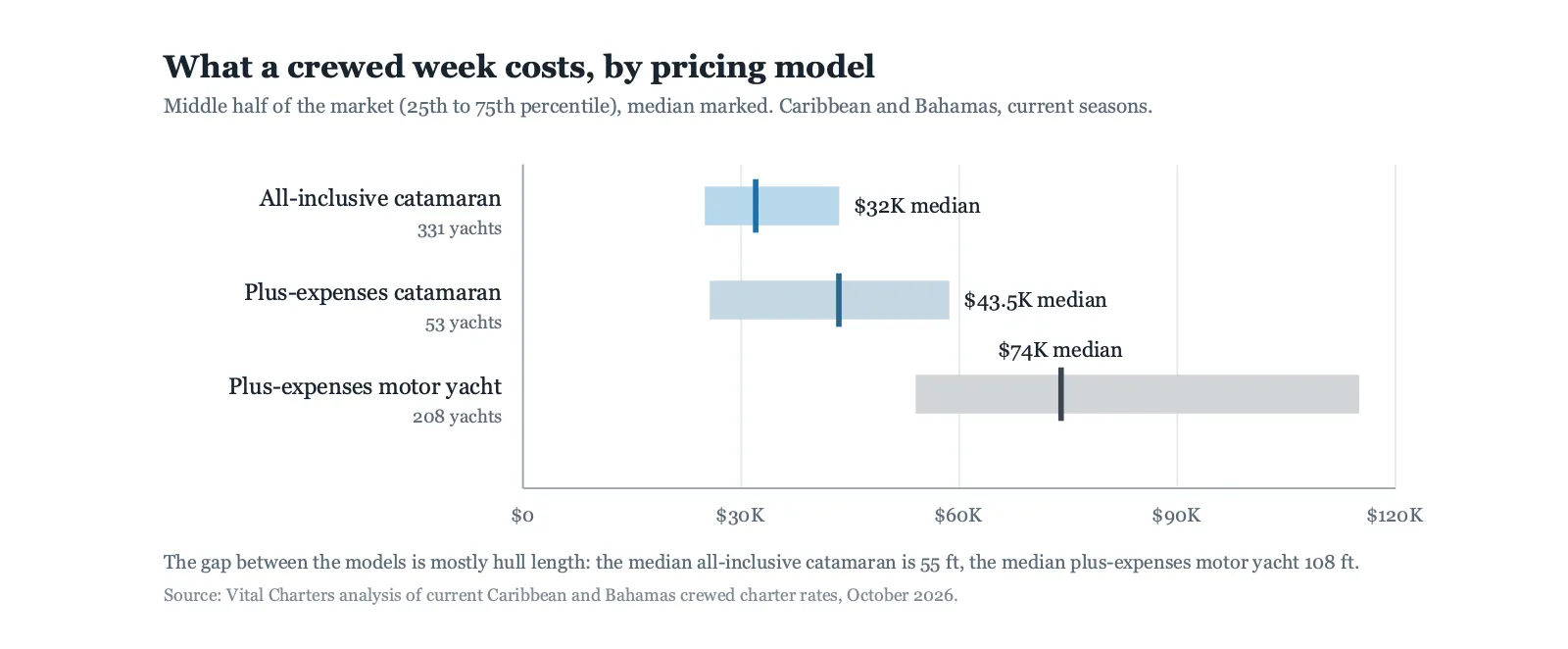
View data table
| Pricing model and vessel | Yachts | 25th percentile | Median week | 75th percentile | Median length |
|---|---|---|---|---|---|
| All-inclusive catamaran | 331 | $25,000 | $32,000 | $43,500 | 55 ft |
| Plus-expenses catamaran | 53 | $25,688 | $43,450 | $58,625 | 62 ft |
| Plus-expenses motor yacht | 208 | $54,000 | $74,000 | $115,000 | 108 ft |
Source: Vital Charters analysis of current Caribbean and Bahamas crewed charter rates, October 2026. Filtered to active yachts with an unexpired season.
Per person, the same set works out at a median of $4,000 for seven nights, with the middle half between $3,200 and $5,375. That figure is calculated from each yacht’s own cabin count rather than a flat assumption: the median all-inclusive catamaran has four guest cabins, so it sleeps eight. Here’s plainly what that $4,000 buys, because the per-night comparison to a resort isn’t like for like. It covers the accommodation, 21 meals, the bar, the fuel, the watersports gear and the crew who run all of it.

All-Inclusive vs Plus-Expenses (APA) Charters
The difference isn’t the total, it’s who holds the money and who does the arithmetic. On an all-inclusive charter you pay one figure and the operator absorbs the running costs. On a plus-expenses charter you pay a lower base rate plus an advance provisioning allowance, the APA. That account funds food, drink, fuel and dockage as they’re spent, and it’s reconciled against receipts at the end of the week.
Where a Caribbean or Bahamas plus-expenses rate states an APA at all, the median is 35 percent of the base rate, with the middle half between 30 and 35 percent. Only 43 percent of those rates state a figure in the first place; the rest leave it to the contract. Our explainer on what APA is and how much to budget goes through the reconciliation mechanics, and all-inclusive against bareboat pricing covers the third model you will see quoted.
On the all-inclusive side the equivalent number is close to zero. Of 786 current all-inclusive catamaran rates, 19 state an APA of any size, which is 2.4 percent, and 18 of those 19 set it at 5 percent. If you book an inclusive catamaran in the Caribbean, the overwhelming likelihood is that there is no provisioning account at all.
The comparison people reach for is which model costs less, and the honest answer is that the question is usually malformed. The two families don’t describe the same yacht. The median all-inclusive catamaran is 55 feet. The median plus-expenses motor yacht is 108 feet, and its median week is $74,000. You aren’t choosing between two ways to price the same holiday, you’re mostly choosing between two different sizes of boat, and the pricing model follows from that.
| All-inclusive | Plus-expenses | |
|---|---|---|
| Median week | $32,000 | $65,000 |
| Typical vessel | 55 ft catamaran | 62 ft catamaran or 108 ft motor yacht |
| APA | None in 97.6% of rates | Median 35% where stated |
| What you settle at the end | Gratuity only | Gratuity plus APA reconciliation |
| Suits | Groups who want one number | Groups who want a larger yacht |
Source: Vital Charters analysis of current Caribbean and Bahamas rates, October 2026.
Who an All-Inclusive Yacht Charter Suits
All-inclusive terms suit groups of six to eight who want the week’s cost fixed before they leave home, which at a median $4,000 per person is the configuration the Caribbean market is built around. That’s the clearest case, and it’s most of the Caribbean crewed catamaran market for a reason: the per-person number lands in the same territory as a good resort while the yacht moves every day.
It suits first-time charterers particularly well. The failure mode of a plus-expenses charter isn’t overspending, it’s anxiety. Guests who have never chartered before have no intuition for what an APA should be running at on day three, and some of them spend the week quietly worrying about it.
It suits families and multi-generational groups, where the alternative is coordinating restaurant bookings for nine people across seven nights in a place none of you know.
It suits you less well if you’re two people. You’re chartering an entire yacht and its crew either way, and a couple splitting a $25,000 week is paying resort-suite money for a boat built for eight. It also suits you less well if you want a yacht much above 60 feet, because above that size the market is mostly priced plus-expenses and the inclusive option thins out fast.
Where Can You Book an All-Inclusive Catamaran Charter in the Caribbean?
Everywhere the crewed fleet sails, at almost the same price. An all-inclusive catamaran charter has a median of $32,000 a week in the BVI, the USVI, the Leewards and the Grenadines, and $31,000 in the Bahamas (Vital Charters rate analysis, October 2026). The destination decides the sailing, not the contract or the rate.
| Where it sails | All-inclusive catamarans | Median week, high season |
|---|---|---|
| British Virgin Islands | 274 | $32,000 |
| US Virgin Islands | 173 | $32,000 |
| Leewards: St Martin, St Barts, Antigua | 105 | $32,000 |
| Grenadines and the Windwards | 90 | $32,000 |
| Bahamas | 37 | $31,000 |
Source: Vital Charters rate analysis, October 2026. Many yachts list more than one cruising area, so the counts overlap.
One search trap is the word itself. An “all-inclusive catamaran” on a tour site is usually a shared day sail: a few hours on a boat with other passengers. A charter is the whole yacht and its crew for the week. And if you’re after the cheapest all-inclusive catamaran charter, the floor is a three-cabin boat, where a quarter of them list at about $20,900 a week or less (Vital Charters rate analysis, October 2026).
The British Virgin Islands carry the deepest inventory and the shortest hops between anchorages, which is why first-time groups are usually pointed there. The Bahamas trade those short hops for clearer water and longer passages, and carry the region’s highest charter tax at 14 percent. They’re also the thinnest all-inclusive market of the five, with 37 catamarans against 274 in the BVI. The Grenadines sit furthest from a major airport and reward groups who have chartered before. Our guide to Caribbean crewed charter destinations compares them properly.
The Bottom Line
An all-inclusive charter is the simplest way to buy a crewed week in the Caribbean. The numbers say it’s also the normal way, with 331 catamarans across the region priced on inclusive terms. You pay one figure, you tip the crew at the end, and the only other money that moves is whatever the local government charges in tax.
The decision to think about isn’t the pricing model. It’s the size of the yacht and how many of its cabins you fill, because that’s what actually moves the per-person number. Eight people on a four-cabin catamaran is the configuration the whole Caribbean market is built around, and it is priced accordingly.
When you’re ready to see real yachts and real dates, start a yacht search at Vital Charters or tell us what your group is looking for and we’ll come back with matched options.
Frequently Asked Questions
What does all-inclusive mean on a yacht charter?
It means the quoted weekly rate covers the crew, all meals, a standard bar, fuel for normal cruising and the yacht’s watersports equipment, with no separate provisioning account to fund. In the Caribbean the term is defined by the CYBA Inclusive Charter Agreement rather than by the operator, so it carries the same meaning from yacht to yacht. The crew gratuity and government charter taxes remain outside it.
How much does an all-inclusive yacht charter cost per person?
The median works out at about $4,000 per person for a seven-night week, based on 786 current Caribbean and Bahamas all-inclusive catamaran rates and each yacht’s own cabin count. The middle half of the market runs $3,200 to $5,375 per person. The median yacht itself is $32,000 for the week and sleeps eight in four cabins.
Do all-inclusive charters have an APA?
Almost never. Of 786 current all-inclusive catamaran rates in the Caribbean and Bahamas, 19 state an advance provisioning allowance of any size, which is 2.4 percent (the 2026 fleet rate report has the wider cuts). Eighteen of those 19 set it at 5 percent, which is the roughly 2 percent figure the invoice table above quotes. On a plus-expenses charter the APA is standard, and the median is 35 percent of the base rate where a figure is stated.
What taxes and fees are added to a Caribbean yacht charter?
It varies by destination: 14 percent in the Bahamas (10 percent VAT plus a 4 percent charter tax), $4 to $16 per guest per day in BVI cruising fees plus a $10 arrival levy, marine park fees in the Grenadines and Exumas, nothing per guest in the USVI, and in the French islands only a 1 euro per person per day waste tax in Gustavia. On all-inclusive terms the permits, levies and park fees are covered by the rate in the vast majority of cases; the percentage taxes and the crew gratuity are the lines you pay directly.
Is there an all-inclusive catamaran charter in the Bahamas?
Yes. 37 all-inclusive crewed catamarans list the Bahamas with a current high-season rate, at a $31,000 median week (Vital Charters rate analysis, October 2026). It’s a thinner market than the BVI’s 274, and the Bahamas adds 14 percent in VAT and charter tax on top of the rate, which an all-inclusive price never includes. Our Bahamas yacht charter prices break the market down by size.
Is an all-inclusive charter cheaper than plus-expenses?
Usually, but not for the reason people assume. The median all-inclusive week is $32,000 against $65,000 plus-expenses. Almost all of that gap is vessel size, not pricing model. The typical inclusive yacht is a 55 foot catamaran; the typical plus-expenses yacht is a 108 foot motor yacht. Compared like for like on a catamaran, the gap narrows, though the APA still sits on top of the plus-expenses rate.
What is the best time to book an all-inclusive charter?
High season runs December to April and the best yachts for Christmas and New Year weeks are taken 12 to 18 months ahead. Booking six to nine months out is comfortable for the rest of high season. Summer and autumn rates mostly don’t fall: of 156 four-cabin all-inclusive catamarans quoting both seasons, 122 charge the same all year (Vital Charters rate analysis, October 2026). What the quieter months change is availability and weather, covered in our guide to the best time to charter in the Caribbean.
See what $32,000 a week actually buys.
Tell us your dates and group size and we’ll come back with matched all-inclusive catamarans, the rate, and the two costs that sit outside it.