
Swimming Pigs of the Bahamas: How to Visit Pig Beach by Yacht
The swimming pigs of the Bahamas live on Big Major Cay in the Exumas. How to visit Pig Beach by crewed yacht, when to go, and how to do it right.
Last Updated: September 6, 2026
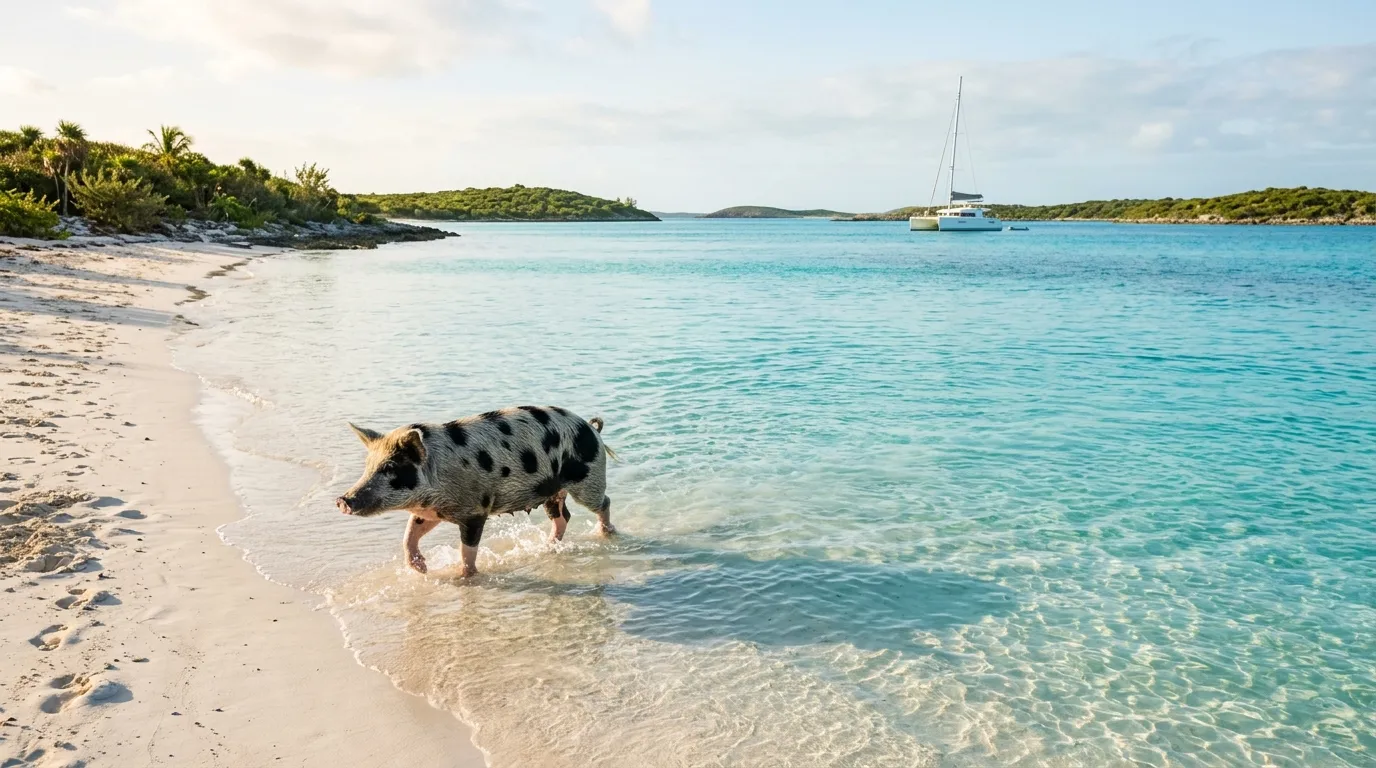
The swimming pigs of the Bahamas live on Big Major Cay, a tiny uninhabited island in the Exuma Cays, and arriving by private crewed yacht is the calmest, least crowded way to meet them. Most visitors see Pig Beach the hard way: a two-hour speedboat pounding from Nassau, fifteen rushed minutes on the sand, then the long ride home. A crewed Bahamas charter flips that script entirely: you anchor in the lee overnight and step onto the beach at sunrise, before the first day boat is even loading.
Where Are the Swimming Pigs in the Bahamas?
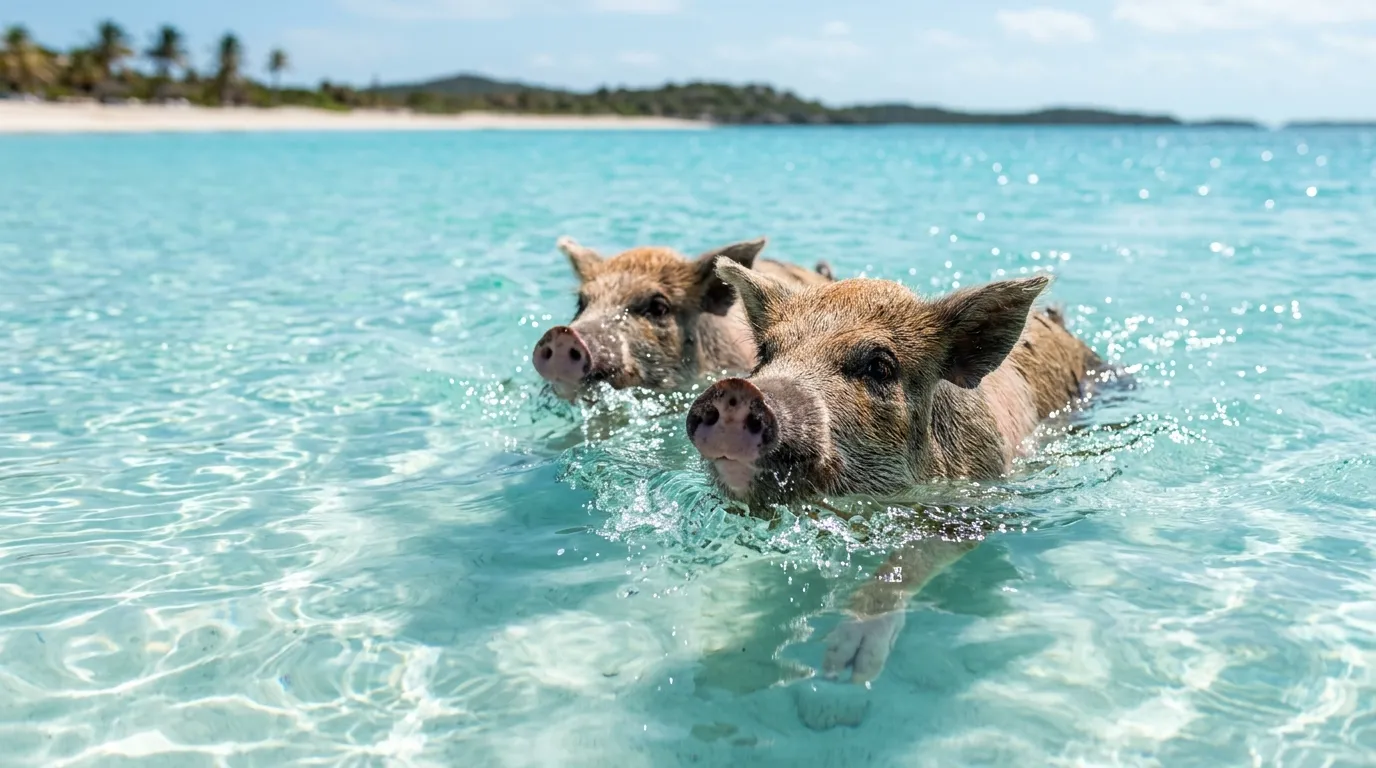
The swimming pigs of the Bahamas live on Big Major Cay, an uninhabited island in the Exuma Cays roughly 89 miles southeast of Nassau (Bahamas Ministry of Tourism, 2025). The beach where they gather is known the world over as “Pig Beach,” and it sits a short boat ride from settled Staniel Cay, the hub for the central Exumas.
Big Major Cay, home to the swimming pigs of the Bahamas, is an uninhabited island in the Exuma Cays about 89 miles (143 km) southeast of Nassau, roughly two hours by speedboat. It has no road, no airport, and no resort, so the only way to reach Pig Beach is by boat (Bahamas Ministry of Tourism, 2025).
There’s no road to the pigs and no airstrip on Big Major Cay itself. That single fact shapes the entire trip: every visitor arrives by water, whether on a packed day-tour boat from Nassau or aboard their own yacht. Staniel Cay, next door, has a small airstrip and a marina, which is why it works as the gateway to the whole pig-and-grotto cluster. For the full lay of the land (the 365 cays, the marine park, the other anchorages) see our Bahamas charter destinations.
The colony itself is small. Around 20 pigs and piglets currently live on Big Major Cay, a number that has risen and fallen sharply over the years (Bahamas Ministry of Tourism, 2025).
The swimming pigs of the Bahamas number around 20 today, including piglets, though estimates have ranged as high as 50–60 in past years. The free-roaming colony is fed by visitors and neighboring-island residents and has lived on uninhabited Big Major Cay for decades (Bahamas Ministry of Tourism, 2025).
How the Pigs Got to Big Major Cay
The origin of the swimming pigs is undocumented folklore, not history, the official Bahamas tourism site says so outright (Bahamas Ministry of Tourism, 2025). You’ll hear three or four versions told as fact, but every one of them is a story rather than a record.
One legend says sailors dropped the pigs off planning to come back and cook them, but never returned. Another claims the pigs swam ashore from a shipwreck. A local account holds that a Staniel Cay resident kept pigs at home until neighbors complained about the smell, so the animals were relocated to the empty cay next door. All of them are charming. None of them is documented. What’s certain is that the colony has been there for decades and is now the most photographed group of animals in the Bahamas.
Day-Tour vs. Private Crewed Yacht: Two Ways to See the Pigs
There are two realistic ways to see the swimming pigs, and they produce very different days. A shared day-tour gives you as little as 10–15 minutes on the sand (Nassau speedboats) up to about an hour (closer Staniel Cay boats); a private crewed yacht gives you the beach on your own schedule, with no clock running. The gap is bigger than most first-timers expect.
A day-tour from Nassau is a long out-and-back: about two hours by speedboat each way, shared with a full boat of strangers, and a brief, busy window at Pig Beach when several tour boats often arrive at once. It’s the cheapest way to tick the box. A yacht does the opposite: you’re already there. The boat is your hotel, the dinghy is your shuttle, and you decide when to go ashore.
| Nassau day-tour | Shared Staniel Cay boat | Private crewed yacht | |
|---|---|---|---|
| Time at Pig Beach | ~10–15 min | ~30–60 min | As long as you like |
| Travel each way | ~2 hrs by speedboat | ~10 min by boat | You’re anchored right there |
| Crowds | High: multiple boats at once | Moderate | You pick the quiet windows |
| Schedule | Fixed | Fixed | Yours |
| Also see | Usually one or two stops | A few nearby cays | The whole chain over days |
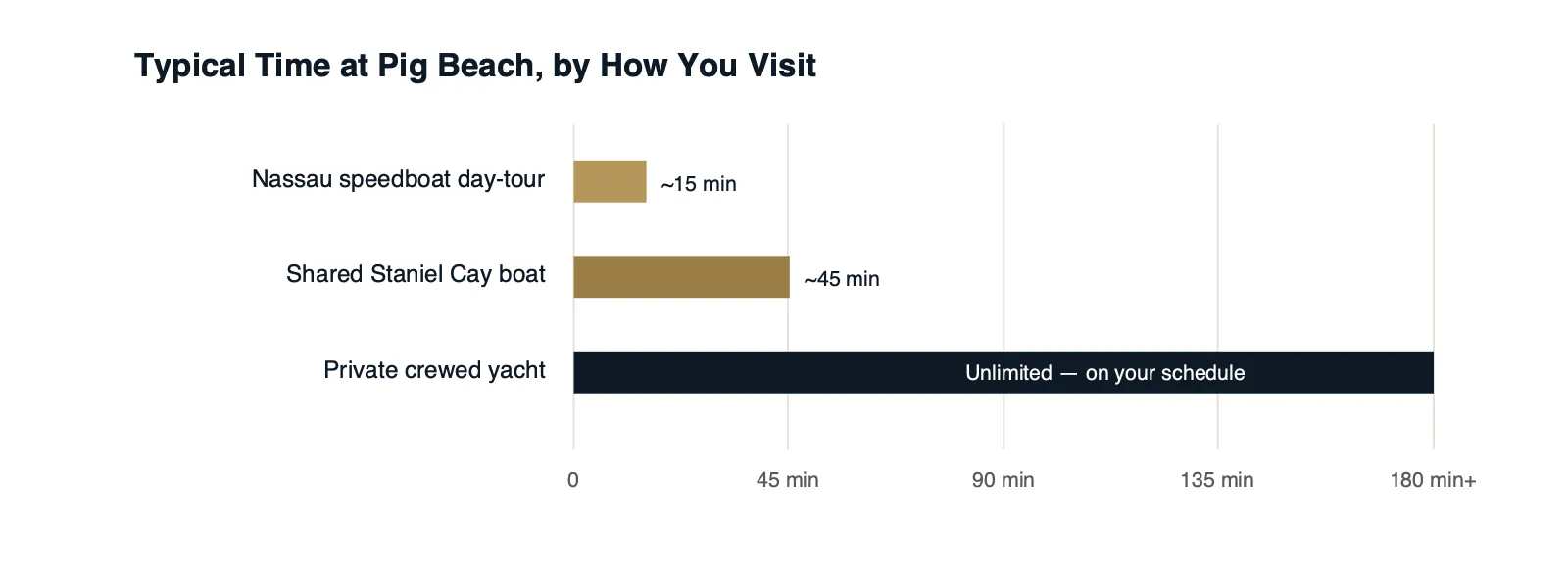
View data table
| How you visit | Typical time at Pig Beach |
|---|---|
| Nassau speedboat day-tour | ~10–15 minutes |
| Shared Staniel Cay boat tour | ~30–60 minutes |
| Private crewed yacht | Unlimited: on your own schedule |
Source: typical durations reported by Exuma boat-tour operators, 2025; private-yacht time reflects Vital Charters charter experience.
Anchoring and Approaching Big Major Cay
The water around Big Major Cay is shallow and shifting, which is exactly why shallow-draft catamarans rule this corner of the Bahamas (Vital Charters charter experience, 2026). Boats typically anchor in the sandy lee on the protected side of the cay, then run guests to the beach by dinghy, a short, calm hop rather than a beach landing through surf. The holding is good in sand, but the banks are thin, so a captain who knows where the deeper water sits earns their keep.
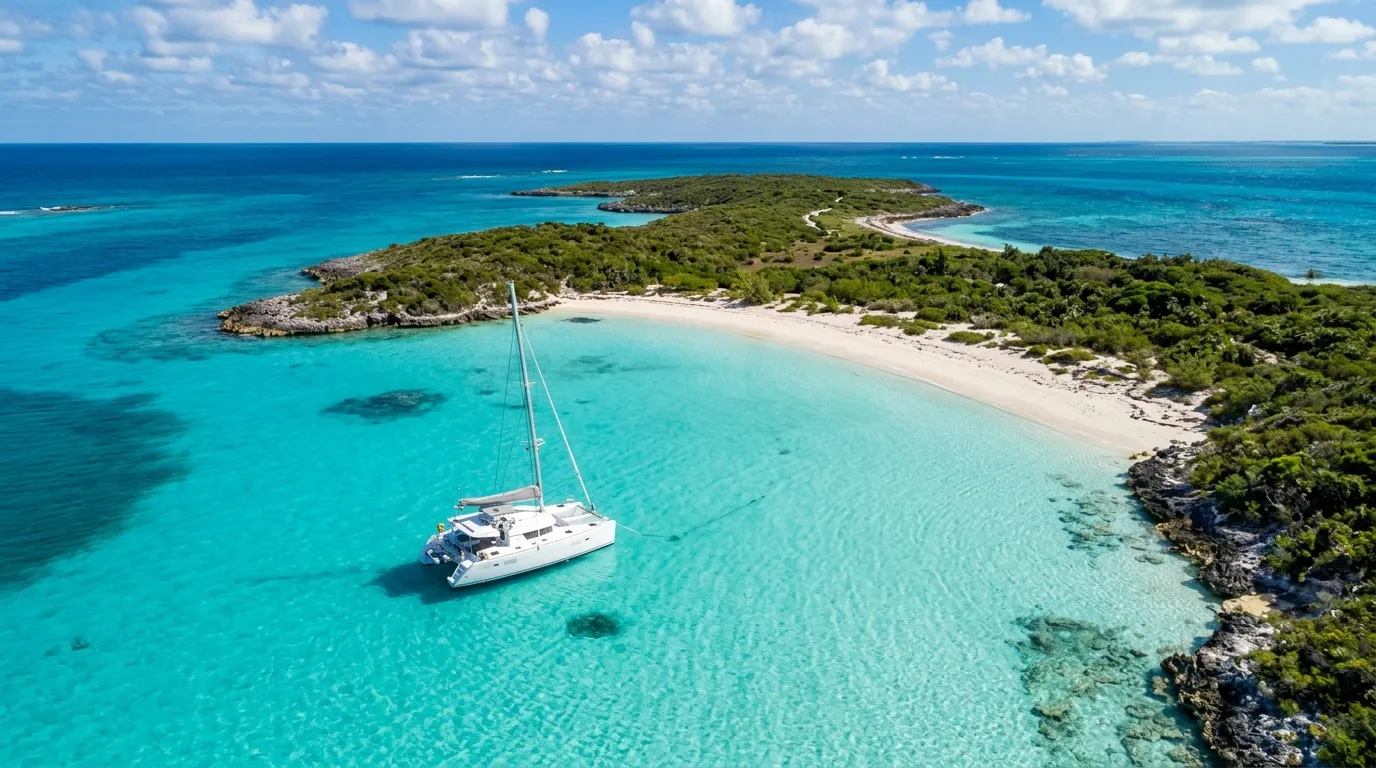
A boat that fits this water well is a good example of the type. Zuri 3, a 55-foot Bali 5.4 sailing catamaran we represent, sleeps six guests in three cabins with a crew of two, runs all-inclusive at roughly $26,000–$28,500 a week, and is based in Nassau with Exumas itineraries that name Staniel Cay directly (Zuri 3 listing). A cat like that draws little enough to tuck into the thin water around the pigs and still cross the open banks at a sensible pace.
Best Time to Visit Pig Beach: and How to Beat the Tour Boats
The best weather window for visiting the swimming pigs is mid-December through April, when the Bahamas is driest and seas are calmest, with air temperatures in the mid-70s to low-80s °F (Bahamas Ministry of Tourism, 2025). That’s also peak season for crowds, which is why the time of day matters as much as the time of year.
Atlantic hurricane season runs June 1 to November 30, with the highest storm risk concentrated August through October (NOAA National Hurricane Center, 2025). Late April–May and November are strong shoulder windows, warm water, thinner crowds, softer pricing. For a month-by-month read across the wider region, see our guide to the best time to charter in the Caribbean.
The crowd-beating trick is simple but only a yacht can pull it off: be anchored at Big Major overnight and go ashore at dawn. The Nassau day-tour boats are a two-hour run away and rarely arrive before mid-morning, so the first hour of daylight at Pig Beach often belongs to whoever slept there.
Swimming With the Pigs as a Family
A private boat is the calmest, most relaxed way for families with young kids to meet the pigs, because you set the size, timing, and pace of the encounter (Vital Charters charter experience, 2026). Instead of sharing a busy tour beach, your group has room to take it slowly, the crew scouts the beach, brings the right food, and helps one or two children wade out to a friendly pig in the shallows.
It’s one reason the Exumas land so well with multi-generational groups, grandparents watch from the dinghy, parents wade with the kids, and nobody is rushed. We dig into why private charters suit multi-generational families in a dedicated guide, but Pig Beach is the picture-perfect example: a once-in-a-lifetime animal encounter you can dial up or down to match a four-year-old’s attention span.
Beyond Pig Beach: Thunderball Grotto, Nurse Sharks & Iguanas
Pig Beach is the headliner, but the best stops in the Bahamas cluster within a few miles of it, which is what makes the area such a rewarding charter base (Bahamas Ministry of Tourism, 2025). From the same anchorage you can reach a James Bond grotto, a marina full of friendly sharks, and a cay of endangered iguanas in a single relaxed day.
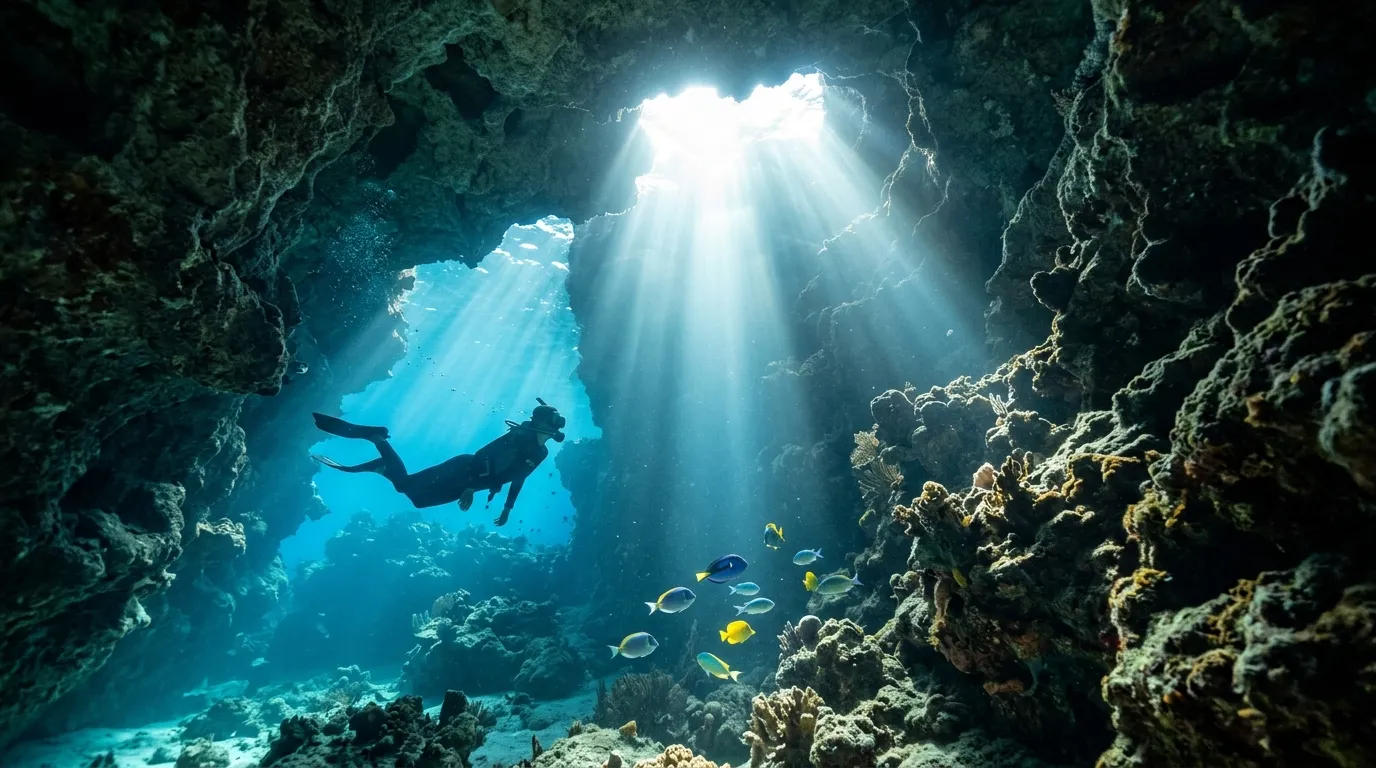
Within a short boat ride of Big Major Cay, swimmers can snorkel Thunderball Grotto, a sunlit underwater cave off Staniel Cay named after the 1965 James Bond film, wade with nurse sharks at Compass Cay Marina, and see endangered Bahamian rock iguanas, all within a day’s cruise of the swimming pigs (Bahamas Ministry of Tourism, 2025).
Thunderball Grotto is best snorkeled at slack or low tide, when the currents ease and the cave entrances are easy to reach, a timing window a crewed captain plans around. The nurse sharks at Compass Cay are harmless bottom-dwellers and a favorite with kids, and the iguanas on cays like Allen’s and Bitter Guana are protected, so you look but don’t feed. To string all of it into a full week, our Exuma Cays itinerary lays out a day-by-day route.
What It Costs to See the Swimming Pigs
Seeing the swimming pigs ranges from under $150 on a shared day-tour to several thousand dollars for a private boat day, while a full crewed charter week that includes Pig Beach starts around $20,000 (Vital Charters rate analysis, 2026). What you pay buys very different experiences, not just different price tags.
A shared speedboat day-tour from Nassau or Staniel Cay is the budget route, typically a few hundred dollars per person, with the pigs as one stop on a fixed circuit. A private day-charter boat for your group runs higher but gives you the schedule. A multi-day crewed yacht is a different category: an all-inclusive catamaran in the Exumas runs roughly $20,000–$70,000 per week, with the pigs as just one morning of a week that also covers the grotto, the sharks, the sandbars, and the marine park (Vital Charters rate analysis, 2026). For how the Bahamas compares to other regions on price, see our Caribbean charter cost breakdown by destination.
If you’re flying in the night before to catch an early boat, our guide to the best Nassau hotels before a charter covers where to stay by airport and marina.
Plan Your Visit to the Swimming Pigs
The swimming pigs are a 15-minute photo stop for most visitors and a relaxed sunrise morning for the few who arrive by yacht, and the difference comes down entirely to the boat under your feet. Tell us your dates and group size and we’ll match you to a shallow-draft catamaran that can tuck into the Exumas, then handle the Nassau logistics from arrival to anchor. Start a yacht search at Vital Charters, or read our complete guide to planning a Caribbean charter first.
Pig Beach sits mid-way down the Exumas, and what a week around it costs is set out band by band in our Bahamas yacht charter prices guide. For a completely different Bahamas week, the sheltered Abacos itinerary runs north of Nassau instead.
Frequently Asked Questions
Which island in the Bahamas has the swimming pigs?
The swimming pigs live on Big Major Cay, often called Pig Beach, an uninhabited island in the Exuma Cays next to Staniel Cay (Bahamas Ministry of Tourism, 2025). It’s reachable only by boat: there’s no road or airport on the cay itself.
How do you get to the swimming pigs from Nassau?
From Nassau, you can take a roughly two-hour speedboat day-tour (about 89 miles each way), fly about 40 minutes to Staniel Cay and take a short boat from there, or board a crewed yacht and cruise down (Bahamas Ministry of Tourism, 2025). A yacht lets you anchor overnight and reach Pig Beach at sunrise.
How many swimming pigs are there?
The official Bahamas tourism site puts the current colony at around 20 pigs and piglets (Bahamas Ministry of Tourism, 2025). The number has fluctuated over the years, estimates ran as high as 50–60 in 2019, and counts vary by source and season.
How much does it cost to swim with the pigs?
A shared day-tour typically runs a few hundred dollars per person, while a private day-charter boat costs more and a full week aboard a crewed yacht starts around $20,000 all-inclusive (Vital Charters rate analysis, 2026). The pigs themselves are free to visit; you’re paying for the boat that gets you there.
Are the swimming pigs dangerous: do they bite?
The pigs are generally docile, but they’re large, semi-wild animals that can nip or knock over a person while lunging for food. Keep portions small, feed at the water’s edge, supervise children closely, and don’t chase or crowd them.
Can you feed the pigs, and what can you feed them?
Yes, but only fresh fruit, vegetables, or locally bought pig feed, never processed junk food or alcohol, and never on dry sand (Bahamas Ministry of Tourism, 2025). Feeding on sand caused several pig deaths in 2017, so hand or float food in the shallow water instead.
What is the best time of day and year to visit Pig Beach?
Visit between mid-December and April for the driest weather and calmest seas, and go early in the morning to beat the Nassau day-tour boats (DiscoverBahamas, 2025). A yacht anchored overnight can be on the beach at first light, well before the tour fleet arrives.
Can you visit the swimming pigs on your own private boat?
Yes: and a private crewed yacht is widely considered the best way to see them, since Big Major Cay is reachable only by boat (Bahamas Ministry of Tourism, 2025). You anchor in the lee of the cay, run ashore by dinghy on your own schedule, and avoid the time limits and crowds of a shared tour.
How long do you get at Pig Beach?
On a Nassau speedboat day-tour, often just 10–15 minutes; on a shared Staniel Cay boat, roughly 30–60 minutes. On a private crewed yacht there’s no time limit: you go ashore when you like and stay as long as the pigs (and your group) are happy.
Can kids swim with the pigs safely?
Yes, with supervision. A small private group on a crewed yacht is the calmest setting for children, because the crew can manage the food, the timing, and the number of pigs around your kids, far easier than on a crowded day-tour boat.
Meet the pigs the unhurried way.
Tell us your group size and travel dates and we’ll match you to a shallow-draft catamaran that puts Pig Beach, the grotto, and the sandbars on your own schedule.