
Scuba Diving BVI: The RMS Rhone and the Best Dive Sites by Yacht
Scuba diving in the BVI by crewed yacht: see the 1867 RMS Rhone at 20-80 ft, Painted Walls and the Indians, how dives run aboard, and when to fly home.
Scuba diving in the BVI centers on the wreck of the RMS Rhone, which has lain off Salt Island since a hurricane in October 1867 and now sits inside a protected marine park (BVI National Parks Trust, 2026). Around it, pinnacles, canyons and purpose-sunk wrecks lie within a short run of the next anchorage.
Most of those sites line the Sir Francis Drake Channel. That’s the sheltered water a crewed BVI charter spends most of its week in. The Rhone also heads the BVI entry in our ranking of the best scuba diving in the Caribbean, which sets the territory beside the Bahamas and Cozumel.
Where is the best scuba diving in the BVI?
The best scuba diving in the BVI is off Salt Island and Dead Chest, where the RMS Rhone, the canyons of Painted Walls and the pinnacles of Blonde Rock share the Rhone Marine Park (BVI National Parks Trust, 2026). The Indians at Norman Island, Carrot Shoal off Peter Island and Cooper Island’s Wreck Alley are within a few miles of it.
Cruising World counted more than 65 moored dive sites in the territory in 2017. They fall in two clusters: along the south side of the channel from Norman Island east to Ginger Island, and in the north around the Dogs and off Virgin Gorda. Joe’s Cave, off West Dog Island, is one of the northern sites (Cruising World, 2017). The Chikuzen wreck lies on its own in open water.
| Site | Where | What it is | Depth | Who it suits |
|---|---|---|---|---|
| RMS Rhone | Lee Bay, Salt Island | 1867 steamship wreck in two parts | 20 to 80 ft | Divers, plus snorkelers at the propeller |
| Painted Walls | Dead Chest | Canyons | Not published | Not published |
| Blonde Rock | 0.6 mile east-northeast of Dead Chest | Pinnacles and ledges | Top at about 9 ft | Not published |
| The Indians | West of Pelican Island, Norman Island | Four pinnacle rocks, 50 ft high | Not published | Divers and snorkelers |
| Carrot Shoal | Southwest tip of Peter Island | Platform cut by channels | 40 ft on top, 60 to 70 ft at the base | Not published |
| Ginger Steps | Ginger Island | Wall in three steps | 40, 65 and 95 ft | All levels |
| Wreck Alley | Beside Cooper Island | Purpose-sunk vessels | Not published | Not published |
| Kodiak Queen | Off Virgin Gorda | 1940 Navy fuel barge, sunk 2017 | To 65 ft, top about 10 ft | Divers and snorkelers |
| Chikuzen | Open water off Tortola | 246-ft refrigerated ship | To 75 ft | Intermediate to advanced |
Sources: BVI National Parks Trust, 2026; NOAA Coast Pilot 5, 2026; Cruising World, 2017; PADI, 2026; Wikipedia, 2026; DIVE Magazine, 2025.
What happened to the RMS Rhone, and how do you dive it?
The RMS Rhone was a 310-foot Royal Mail steamship, powered by both sail and steam, that broke in two on Black Rock Point at Salt Island in the hurricane of 29 October 1867 (Cruising World, 2017; OECS, 2026). Only 23 of the 146 crew and passengers survived (Virgin Islands News Online, 2024). Most dive operators run the wreck as a two-tank dive, starting on the deeper bow section (Cruising World, 2017).
The Rhone was the flagship of the Royal Mail Steam Packet Company (Cruising World, 2017), and the Parks Trust gives her beam as 40 feet and her weight as 2,738 gross tons. She’d been at anchor off Peter Island, and the anchor she left behind still lies at Great Harbour in 55 feet of water (BVI National Parks Trust, 2026). As she tried to get past Salt Island, the waves drove her onto the rocks. Some of the bodies drifted ashore on Salt Island, where its residents buried them in a mass grave. The wreck featured in the 1977 film The Deep (Virgin Islands News Online, 2024).
What you see on the Rhone dive
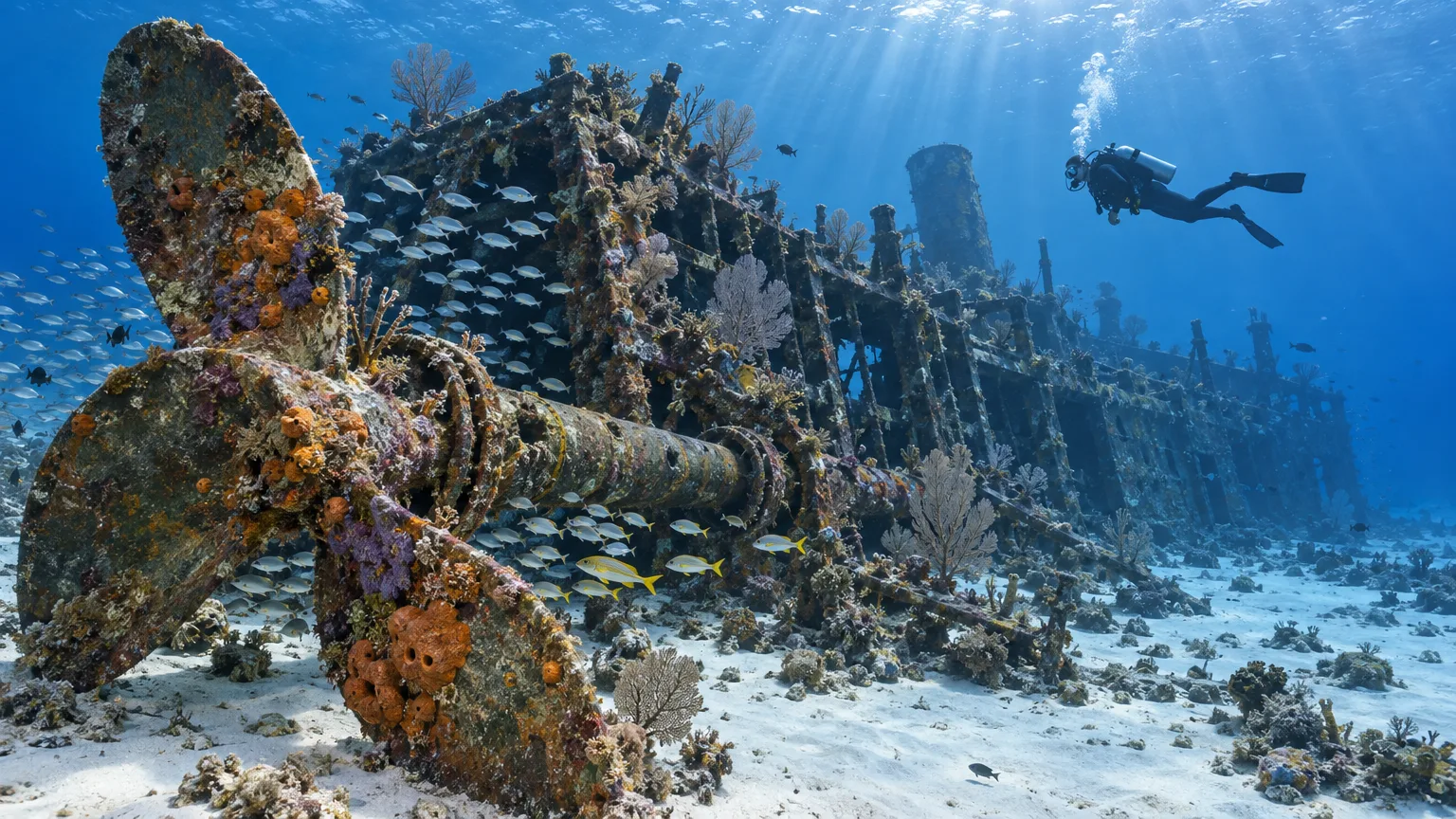
The Rhone “lies in two main parts at depths between 20 and 80 feet,” and divers see “the bow section, boilers, condenser, engines and prop shaft,” plus parts of the rigging and the propeller (BVI National Parks Trust, 2026). The bow rests on its side in 80 feet of water, crusted with coral and sponges (Cruising World, 2017).
The propeller lies in the shallows, close enough to the surface that the wreck is easy to snorkel from there (SAIL, 2017).
The Rhone Marine Park
The park was established in 1980 and covers 800 acres, including Dead Chest Island, and “anchoring and fishing are strictly prohibited” inside it (BVI National Parks Trust, 2026). So the yacht picks up one of the park’s moorings. Nothing comes up from the wreck: the law treats any wreck in BVI waters for 50 years or more as historic, and historic wreck relics are “strictly protected” (National Parks Act 2006, s.35 and s.52).
See which crewed yachts cruise the BVI for a group your size.
What are the best BVI dive sites after the RMS Rhone?
The best BVI dive sites after the Rhone start with Painted Walls and Blonde Rock, which share its park (BVI National Parks Trust, 2026), and the Indians off Norman Island. The purpose-sunk wrecks lie farther east, at Cooper Island and Virgin Gorda. West Dog Island, near Joe’s Cave, is a national park of its own.
Painted Walls and Blonde Rock
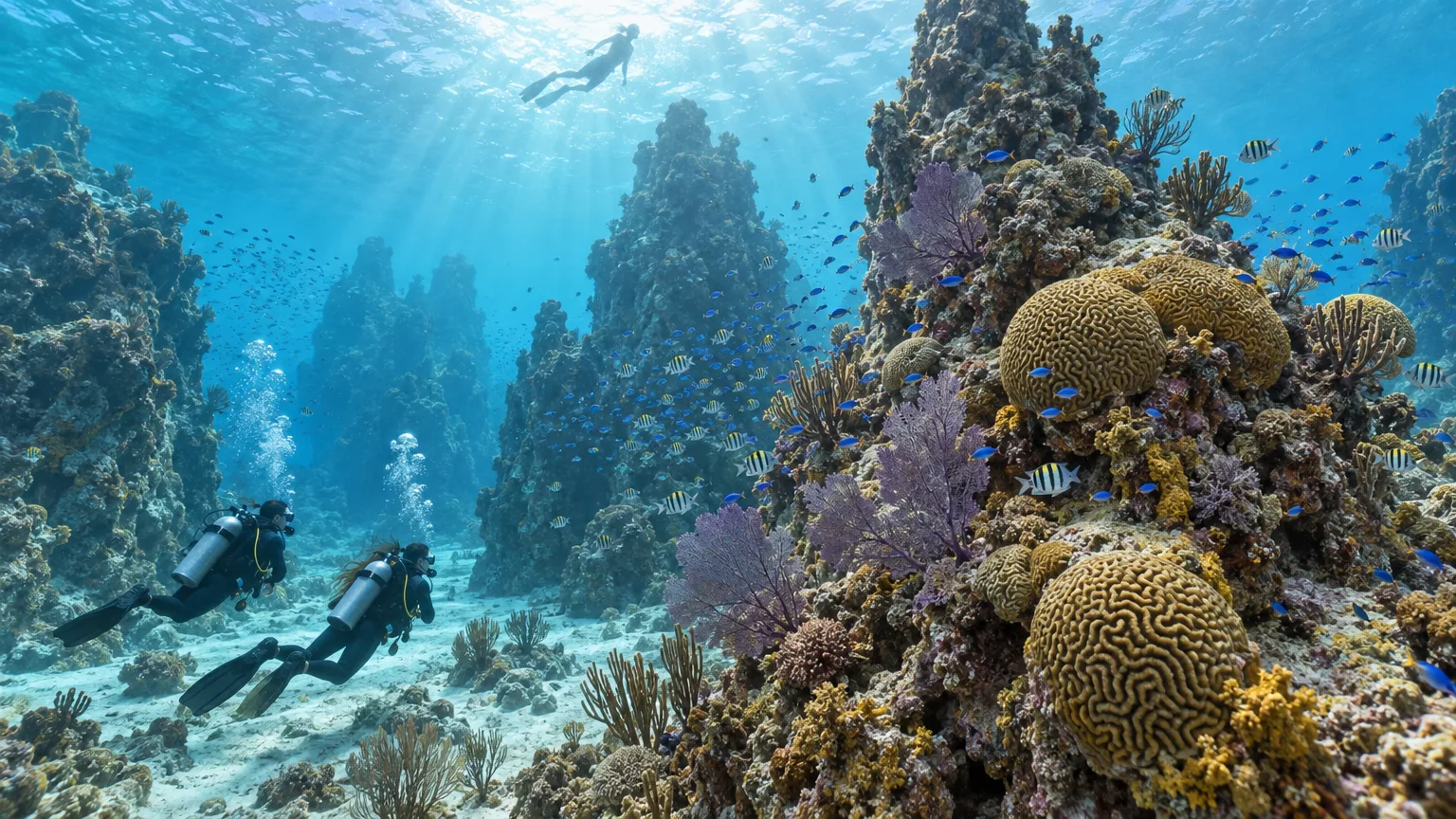
The Parks Trust describes “the colourful canyons of Painted Walls” and the “underwater pinnacles and ledges at Blonde Rock,” both inside the Rhone’s park (BVI National Parks Trust, 2026). Painted Walls is at Dead Chest, a 200-foot-high islet nearly half a mile off the northeast end of Peter Island. Blonde Rock is about 0.6 mile east-northeast of Dead Chest, and its top is charted at 1½ fathoms, about 9 feet below the surface (NOAA Coast Pilot 5, 2026).
The Indians, off Norman Island
The Indians are “four remarkable small pinnacle rocks, 50 feet high,” about 200 yards west of Pelican Island (NOAA Coast Pilot 5, 2026). They’re the second most popular dive site in the BVI after the Rhone, their shallower areas draw snorkelers too, and the site has several mooring balls for day use (Wikipedia, 2026).
Pelican Island, 180 feet high, sits off Norman Island (NOAA Coast Pilot 5, 2026). SAIL puts the Indians six miles southwest of the Rhone, and warns that “yellow fire coral abounds, so no touching” (SAIL, 2017).
Carrot Shoal, off Peter Island
Carrot Shoal, off the southwest tip of Peter Island, is “a large underwater platform that rises from a 60- to 70-foot bottom and levels off at 40 feet,” and channels cut through it in several places (Cruising World, 2017). Divers swim in and out of those cuts. The shoal lies about 0.4 mile southwest of Carrot Rock, an 82-foot islet off the south end of Peter Island (NOAA Coast Pilot 5, 2026).
Ginger Island: Alice in Wonderland and Ginger Steps
Ginger Island, about a mile east of Cooper Island, holds “two of the better dive sites in the British Virgin Islands,” Alice in Wonderland and Ginger Steps (Wikipedia, 2026). It’s privately owned and has no dock, so both are boat dives. Ginger Steps is a wall with three levels: a shallow step at 40 feet, a second at 65 feet and a third that drops to 95 feet (PADI, 2026).
Wreck Alley, Cooper Island
Cooper Island lies beside “wreck alley,” a popular BVI wreck dive where “a number of vessels have been deliberately sunk as dive sites” (Wikipedia, 2026).
The Kodiak Queen, off Virgin Gorda
The Kodiak Queen was commissioned as the US Navy fuel barge YO-44 in September 1940, and she was at Pearl Harbor during the 1941 attack and survived it (DIVE Magazine, 2025). In April 2017 she was sunk off Virgin Gorda as an artificial reef, with a huge sculpture of a kraken built around her. Her deepest point is 20 meters (65 feet), and her superstructure rises to within 3 meters (10 feet) of the surface, so snorkelers can see her too.
The Chikuzen, in open water
The Chikuzen was a 75-meter (246-foot) refrigerated ship built in Japan in 1960, and she lies in a maximum of 23 meters (75 feet) of open water off Tortola (DIVE Magazine, 2025). The site is exposed, so it isn’t always possible to dive it. When it’s calm, divers have “a good chance of sharks, turtles and larger stingrays,” and the magazine rates the dive intermediate to advanced.
How does scuba diving work on a crewed yacht charter in the BVI?
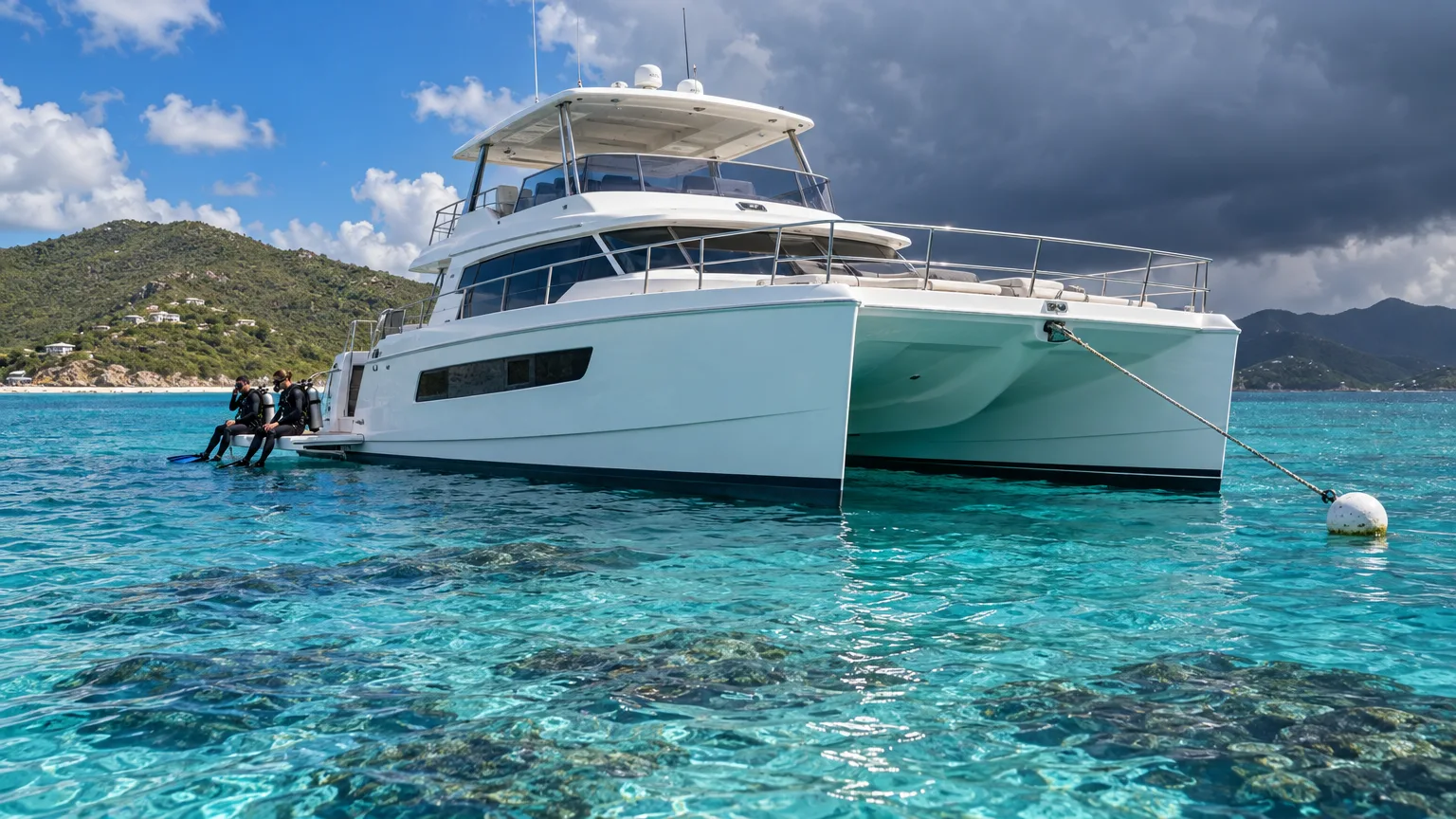
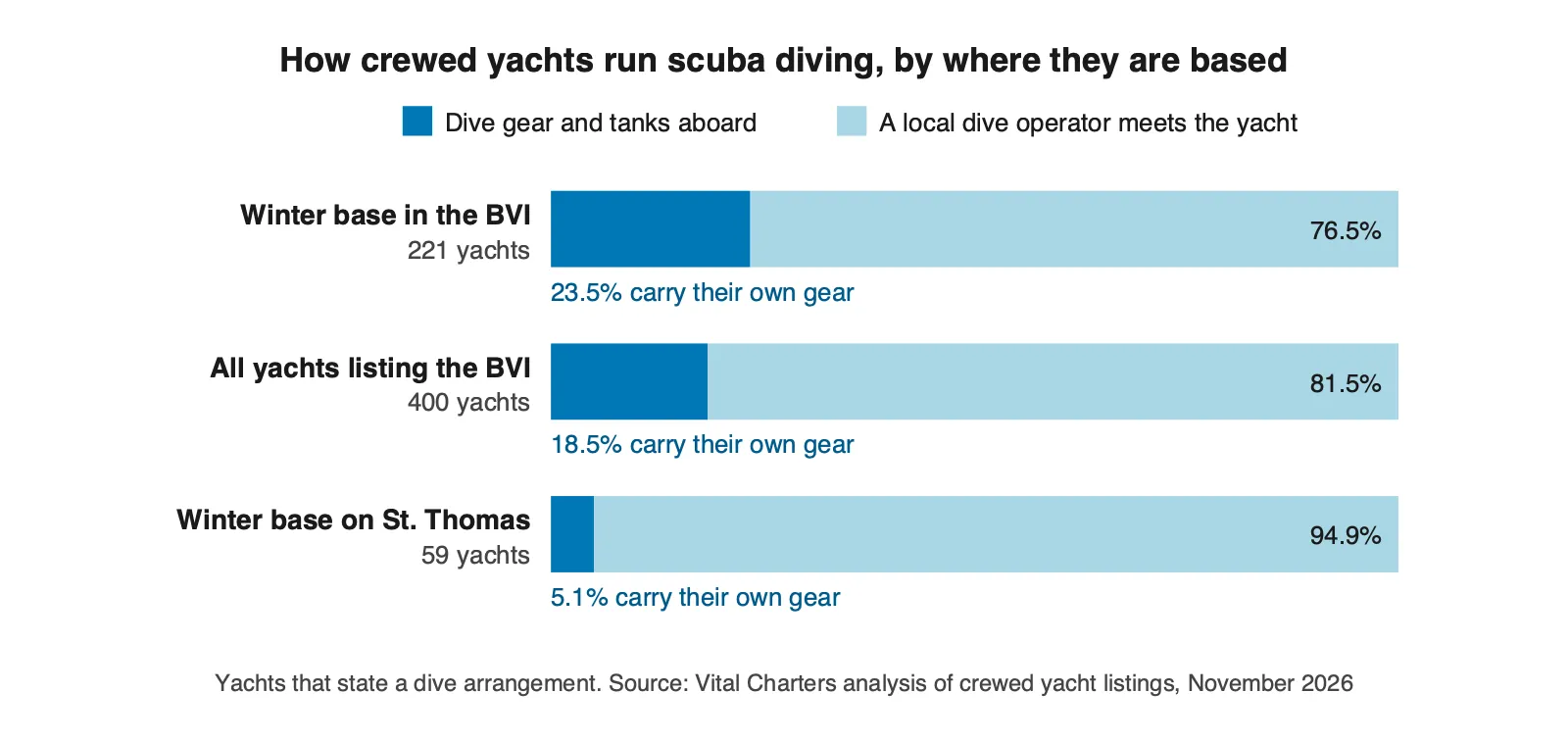
BVI scuba diving on a crewed charter runs one of two ways: a local dive operator’s boat meets the yacht, or the yacht carries its own tanks and a crew member runs the dive. Of the 400 crewed yachts listing the BVI that state an arrangement, 326 use a local operator and 74 dive from the boat (Vital Charters analysis of crewed yacht listings, November 2026).
The BVI pioneered rendezvous scuba diving, and “dive operators will pull up to your yacht so you can hop aboard the dive boat and join other guests for a two-tank trip” (Cruising World, 2017). The two arrangements differ in who brings the gear and who runs the dive:
- Rendezvous diving. The dive operator’s boat brings the tanks, the rental gear and a local guide, and takes you to the site. You may share the boat with other divers.
- Diving from the yacht. A scuba-ready charter yacht carries its own tanks and gear, and a crew member runs the dive. Of the 409 yachts listing the BVI, 56 have a dive compressor aboard to refill tanks.
Among the same 409 yachts, 52 name a crew member as a dive instructor. That’s a floor, since a listing doesn’t have to say so. Of those 52, 24 still list rendezvous diving only.
View data table
| Yachts | Stating an arrangement | Dive gear aboard | Local operator meets the yacht |
|---|---|---|---|
| Winter base in the BVI | 221 | 52 (23.5%) | 169 (76.5%) |
| All yachts listing the BVI | 400 | 74 (18.5%) | 326 (81.5%) |
| Winter base on St. Thomas | 59 | 3 (5.1%) | 56 (94.9%) |
Source: Vital Charters analysis of crewed yacht listings, November 2026. “Winter base” is the base port a yacht lists for the winter season.
Do you need to be certified to scuba dive in the BVI?
No, you don’t need to be certified to scuba dive in the BVI. PADI’s Discover Scuba Diving lets guests aged 10 and over who’ve never dived go down with an instructor to a maximum of 40 feet. It doesn’t qualify them to dive on their own afterward (PADI, 2024). Junior Open Water certification starts at 10, and the adult Open Water card at 15, which allows dives to 60 feet. The same PADI limits apply across the water to scuba diving off St. Thomas and the rest of the USVI.
On the Rhone, the shallow parts sit inside the 40-foot try-dive limit, while the bow, at 80 feet, is deeper than an Open Water diver’s 60. The dive operator decides which part of the wreck each diver sees.
Before the first dive, every guest fills out a medical questionnaire, and a yes to certain questions on it means a doctor has to sign off before you go in (Diver Medical Participant Questionnaire, 2026). If that’s you, get the doctor’s signature at home before the trip.
Certifications don’t expire, but PADI suggests a refresher if it’s been six to twelve months since your last dive (PADI, 2024). Its ReActivate course is an online review plus an optional session in the water with a professional.
How long should you wait to fly after diving in the BVI?
Wait at least 12 hours before flying after a single no-decompression dive, and at least 18 hours after multiple dives or multiple days of diving (CDC Yellow Book, 2025). After a dive that needed decompression stops, the CDC says 24 to 48 hours. The intervals reduce the risk of decompression sickness, but they don’t eliminate it.
PADI’s general advice is a 24-hour surface interval before flying, and longer if your dive computer shows a longer no-fly time (PADI, 2024). On a week of daily diving, that means the last dive ends at least 24 hours before your flight. The crew plans the route so the final day goes to snorkeling, a beach and the run back to the marina.
There’s no recompression chamber in the BVI, as Divers Alert Network noted in a case it published in March 2026: a diver hurt after a dive in the territory was treated at the chamber in Antigua (DAN, 2026). For a dive emergency, DAN runs a 24-hour line at +1-919-684-9111 for medical advice and evacuation help (CDC Yellow Book, 2025).
What do BVI park rules mean on a dive day?
BVI park rules make a park dive a short daytime stop on a mooring, with nothing touched or taken (BVI National Parks Trust, 2026).
- A park dive is a daytime stop. Park moorings are for day use only (BVI National Parks Trust, 2026), so the yacht doesn’t stay the night there.
- A bigger yacht may mean a tender ride. The park’s regular moorings are for smaller boats, so on a larger yacht the dive can start from the tender or the dive operator’s boat.
- Hands off. Spearguns and fishing are banned in parks, feeding fish is banned in marine parks, and you can’t take anything from a historic wreck (National Parks Regulations 2008, reg. 47; National Parks Act 2006, s.49 and s.52).
When is the best time to dive the BVI?
April and May are the steadiest months for scuba diving in the BVI, because they fall outside both the November-to-March swell season and the hurricane season. The National Weather Service in San Juan says “northerly long period swells” bring high surf from November through March (NWS San Juan, 2015). The Atlantic hurricane season runs from June 1 to November 30 and peaks on September 10 (NOAA National Hurricane Center, 2026).
The rest of the year is diveable too. Most of the territory’s best-known dives, and the anchorages near them, sit on the south side of the Sir Francis Drake Channel, with Tortola between them and a north swell. At the Bight on Norman Island, St. John “prevents any sea from setting in,” and Virgin Gorda’s North Sound, Gorda Sound on the chart, is “sheltered from all winds and protected from rollers” (NOAA Coast Pilot 5, 2026). The Chikuzen, out in open water, doesn’t have that shelter.
Planning a dive week in the BVI
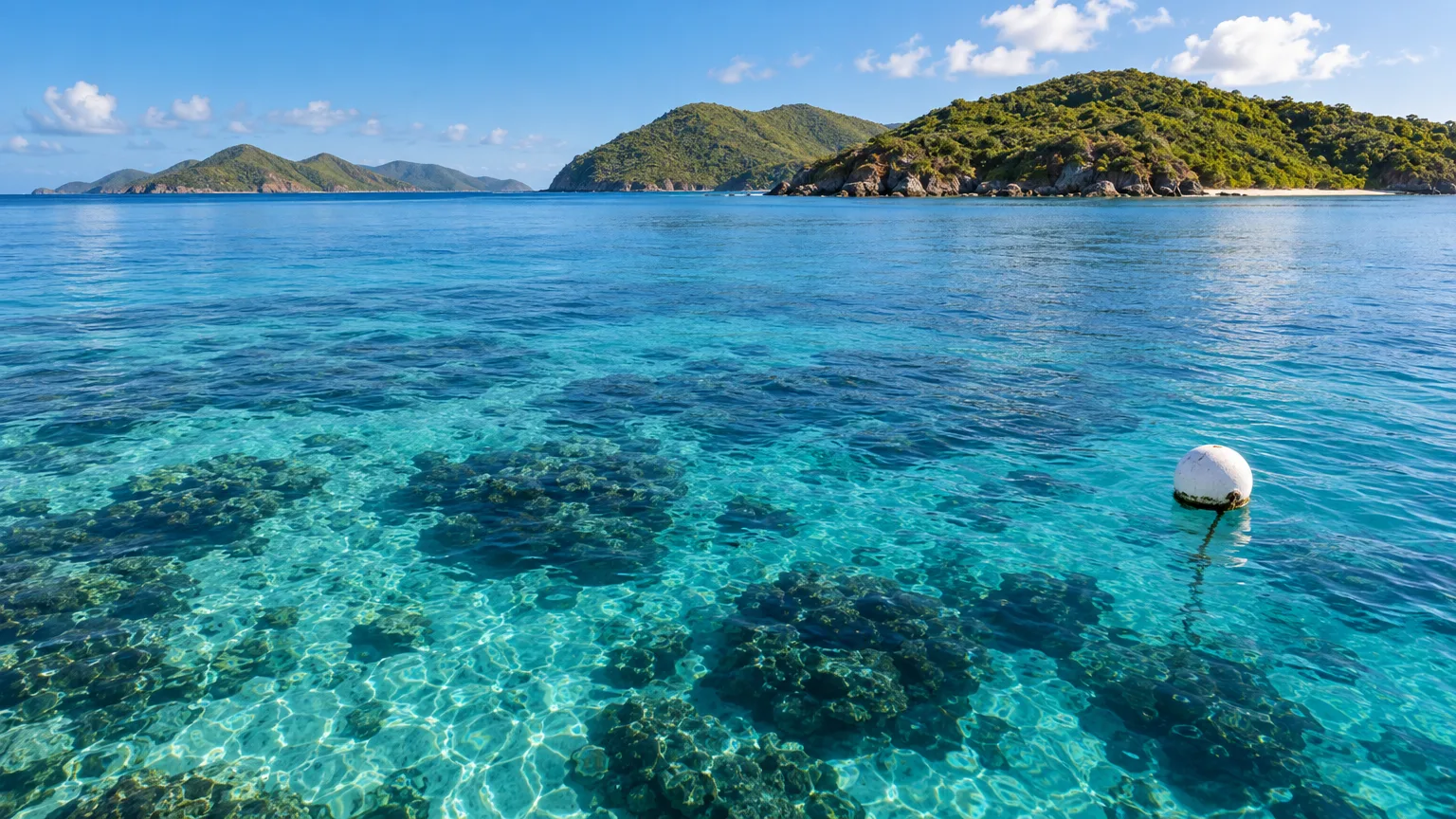
“You can’t come here and not dive the Rhone,” Cruising World’s staff wrote of the BVI in 2017. A dive week on a crewed yacht in the British Virgin Islands can start with the Rhone off Salt Island and Painted Walls at Dead Chest. The Indians and Carrot Shoal are near Norman and Peter Islands, Ginger Steps and Wreck Alley are near Cooper Island, and the Kodiak Queen lies off Virgin Gorda. Days off the tanks go to snorkeling in the BVI or to the water toys a charter yacht carries.
Start a yacht search at Vital Charters with your dates and how many divers are in the group.
Frequently Asked Questions
How deep is the RMS Rhone wreck?
The RMS Rhone lies in two main parts at depths between 20 and 80 feet, according to the BVI National Parks Trust. The bow is the deep end, on its side in about 80 feet of water, and the propeller is in the shallows near the stern.
Can beginners dive the RMS Rhone?
Partly. The shallow end of the wreck sits inside the 40-foot limit for a PADI try-dive and the 60-foot limit for Open Water divers. The bow, at about 80 feet, is deeper than both, and the dive operator decides which part each diver visits.
Can you snorkel the RMS Rhone?
Yes. The propeller lies in the shallows, and SAIL magazine found the wreck easy to snorkel from there. Most of the ship is much deeper, so snorkelers see only part of what’s down there.
How many people died when the RMS Rhone sank?
About 123 people died when the Rhone sank off Salt Island on 29 October 1867. Virgin Islands News Online reports that only 23 of the 146 crew and passengers survived, and some of the dead were buried in a mass grave on Salt Island.
Is there a recompression chamber in the BVI?
No. Divers Alert Network notes there is no hyperbaric chamber in the BVI, and in a 2026 case report it describes a diver injured there who was treated at the chamber in Antigua. DAN’s 24-hour emergency line is +1-919-684-9111.
Do you need a permit to scuba dive in the BVI?
Not as a guest. The yacht or the dive operator arranges the park permits. Under the National Parks Act 2006, snorkeling is exempt from the permission needed to dive in a park.
The Rhone, Painted Walls and the Indians, from your own yacht.
Tell us your group size, dates and how many of you dive, and we’ll match you with crewed yachts that suit your diving in the British Virgin Islands.