
Caribbean Crewed Charter Rates: The 2026 Fleet Report
Every current rate on every crewed yacht in the Caribbean and Bahamas, added up: 1,441 rate rows across 637 yachts, with the medians, the spread and the arithmetic behind them.
Caribbean crewed charter rates are published one yacht at a time and almost never added up. This report adds them up. It reads every current rate on every crewed yacht working the Caribbean and Bahamas, applies one consistent definition of what a week costs, and publishes the medians, the spread and the sample size for each cut, along with the arithmetic that produced them.
It isn’t a price list. Individual yachts vary enormously and the only number you will pay is the one on your contract. What a fleet-wide cut gives you is the thing no single listing can: whether the quote in front of you is normal.
What this report measures
The report covers 1,441 rate rows across 637 yachts, pulled on 7 September 2026. A rate qualifies if the yacht is active in the fleet, the season has not expired, the week falls in the 2026-27 booking window, the rate is a real published number, and the season prices Caribbean or Bahamas cruising rather than a Mediterranean or US one.
The exclusions are the part worth publishing. A denominator nobody states is where fleet statistics go wrong, and an unqualified one collapses the moment somebody asks “of what?”. Starting from every rate row on every active yacht:
| Step | Rows removed | Why |
|---|---|---|
| All rate rows on active yachts | 2,081 to start | The raw population |
| Notes rows | 71 | “Additional Rates & Notes” entries are prose, not prices |
| Expired seasons | 253 | The week has already passed |
| Outside the booking window | 226 | Ends before September 2026 or starts after August 2027 |
| No usable rate | 11 | Blank, or a placeholder under $1,000 |
| Not a Caribbean season | 76 | The rate prices a Mediterranean or US week. That yacht cannot be booked here for it |
| Qualifying rows | 1,441 | across 637 yachts |
| Vital Charters rate analysis, pulled 7 September 2026. | ||
What a week costs, defined once
Every figure below is the total: the published weekly rate plus the advance provisioning allowance where the yacht charges one. Quoting a plus-expenses base rate next to an all-inclusive one compares two different products and makes the plus-expenses yacht look cheaper than it is.
- APA. 243 rates state their percentage outright. 357 charge one without naming it and are imputed from the regional median for the cruising ground on that rate. 808 charge none at all.
- Gratuity is excluded. 40 rates mention a customary figure, median 20%. It’s a discretionary payment to the crew, not a charge from the yacht, so it is reported here and never added to a total.
- Taxes, VAT and port fees are excluded. They follow your itinerary rather than your yacht, so folding them in would make two identical boats look differently priced.
- Seasons are classed by their published label, never inferred from the month. 170 rows labelled “Winter” begin in September; guessing from dates corrupts every seasonal cut.
Totals include the advance provisioning allowance where a yacht charges one. Unspent APA is returned to you at the end of the charter, so a total is a ceiling rather than a receipt.
What does a crewed yacht charter cost, by yacht type?
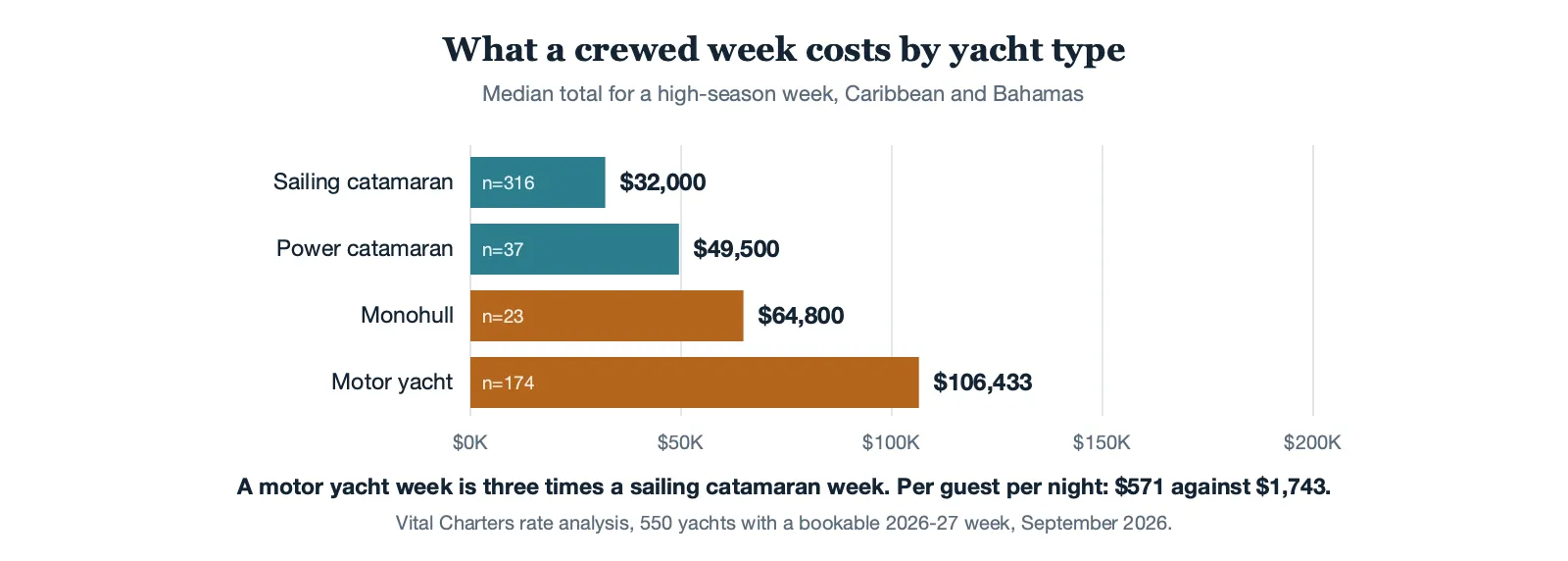
A sailing catamaran is the median Caribbean charter and it costs $32,000 a week all in (316 yachts). A motor yacht costs $106,433 (174 yachts), which is 3.3 times as much (Vital Charters rate analysis, September 2026).
View data table
| Yacht type | Yachts | 25th percentile | Median | 75th percentile | Per guest, per night |
|---|---|---|---|---|---|
| Sailing catamaran | 316 | $25,000 | $32,000 | $44,125 | $571 |
| Power catamaran | 37 | $40,000 | $49,500 | $79,200 | $1,000 |
| Monohull | 23 | $33,021 | $64,800 | $92,104 | $1,203 |
| Motor yacht | 174 | $74,250 | $106,433 | $164,317 | $1,743 |
| Per-guest figures divide the total by the yacht’s guest capacity and seven nights. | |||||
Per guest per night is the fairer comparison and it tells the same story: $571 on a sailing catamaran against $1,743 on a motor yacht. Motor yachts aren’t overpriced; they are bigger, carry three to five times the crew, and burn fuel a sailing boat does not. They are a different product at a different price, and most cost comparisons published about the Caribbean quietly mix the two. We break the two hulls apart in sailing versus power catamaran.
How much do Caribbean crewed charter rates rise with length?
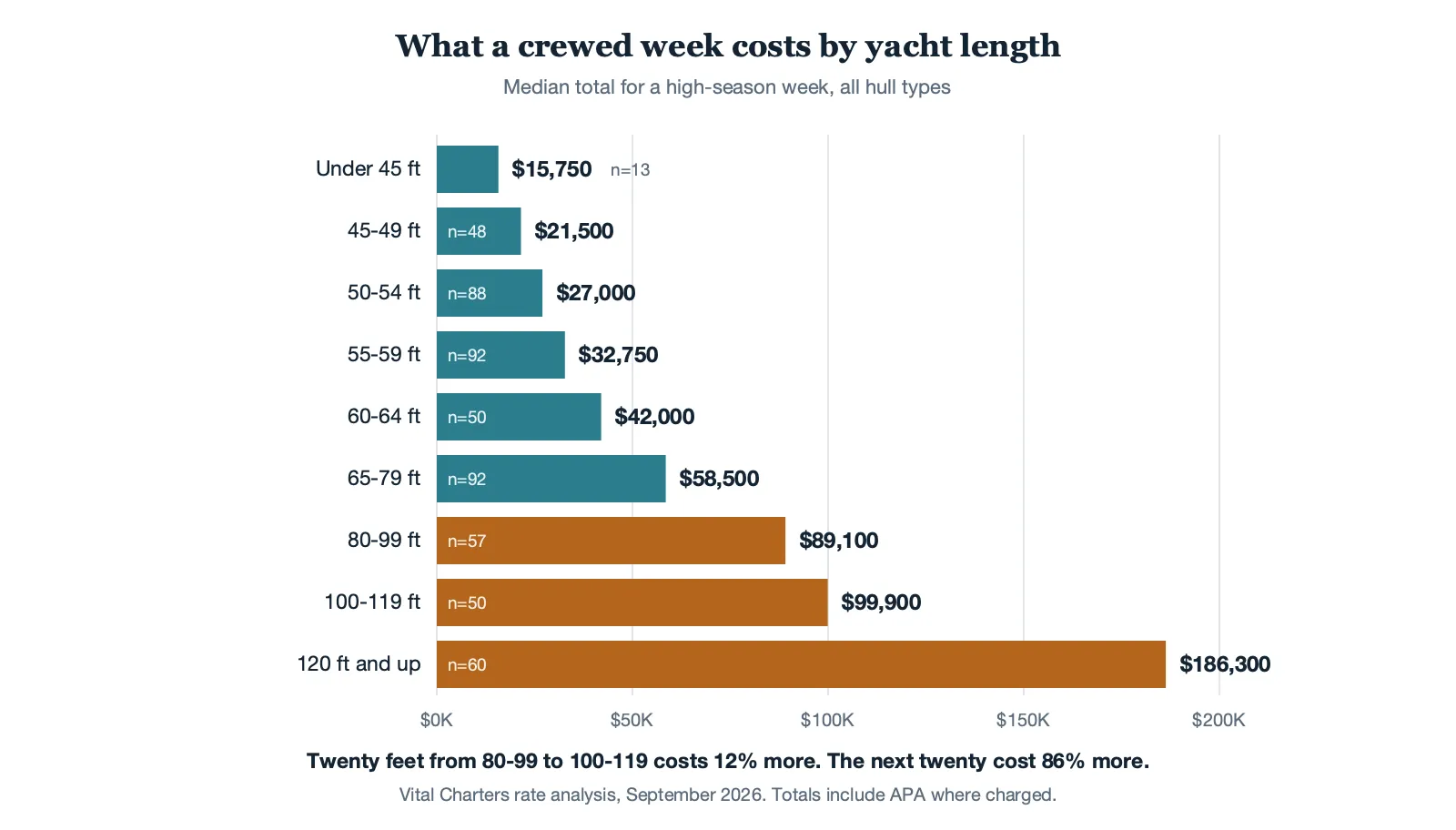
The ladder runs from $15,750 under 45 feet to $186,300 above 120 feet, and it climbs in uneven steps. The rate roughly doubles between 45 and 60 feet, doubles again between 60 and 100, then pauses: an 80-99 ft yacht is $89,100 and a 100-119 ft yacht is only $99,900, twenty more feet for 12% more money. Above 120 feet it nearly doubles once more (Vital Charters rate analysis, September 2026).
View data table
| Length | Yachts | Median total week |
|---|---|---|
| Under 45 ft | 13 | $15,750 |
| 45-49 ft | 48 | $21,500 |
| 50-54 ft | 88 | $27,000 |
| 55-59 ft | 92 | $32,750 |
| 60-64 ft | 50 | $42,000 |
| 65-79 ft | 92 | $58,500 |
| 80-99 ft | 57 | $89,100 |
| 100-119 ft | 50 | $99,900 |
| 120 ft and up | 60 | $186,300 |
That pause between 80 and 119 feet is the useful part. Across those two bands you are choosing between visibly different boats for money that barely moves, which is where asking about crew, layout and cabin count pays far better than asking about length. The band-by-band version of this is in yacht charter cost by size.
Is the Bahamas more expensive than the BVI?
This is the table everyone wants and the one most likely to mislead you, so it comes with its correction attached. On the face of it a Bahamas week runs $89,100 against $39,000 in the British Virgin Islands, which reads as the Bahamas costing 2.3 times as much (Vital Charters rate analysis, September 2026).
| Destination | Yachts offering it | 25th percentile | Median total week | 75th percentile | Per guest, per night |
|---|---|---|---|---|---|
| British Virgin Islands | 353 | $27,000 | $39,000 | $58,000 | $679 |
| US Virgin Islands | 229 | $27,000 | $39,000 | $58,590 | $629 |
| Bahamas | 205 | $56,700 | $89,100 | $148,500 | $1,567 |
| Leeward Islands | 199 | $32,000 | $51,194 | $104,825 | $898 |
| Windward Islands and Grenadines | 166 | $29,000 | $48,675 | $99,819 | $848 |
| A yacht cruising several regions appears in each. High season, totals include APA. | |||||
It does not. The two destinations have different fleets, and the table is measuring the boats rather than the place.
| Fleet mix, high season | British Virgin Islands | Bahamas |
|---|---|---|
| Sailing catamarans | 264 | 34 |
| Motor yachts | 51 | 155 |
| Power catamarans | 29 | 11 |
| Monohulls | 9 | 5 |
Three quarters of the yachts offering the BVI are sailing catamarans. Three quarters of the yachts offering the Bahamas are motor yachts. Hold the boat constant and the destination premium nearly disappears: a sailing catamaran is $32,000 in the BVI (264 yachts) and $31,000 in the Bahamas (29 yachts). A difference of about 3%.
Our observation: Clients arrive convinced the Bahamas is the expensive option and the BVI is the affordable one. It is the same money for the same boat. What changes is what is parked there: the Bahamas draws the motor-yacht fleet because the runs between islands are longer and the water is shallower, and the BVI draws catamarans because the anchorages sit an hour apart. Choose the hull that suits your week, and the destination stops being a budget decision.
All-inclusive or plus expenses: the contract decides the price
321 of the 550 yachts (58.4%) are all-inclusive and 229 (41.6%) are plus expenses (Vital Charters rate analysis, September 2026). The two forms come from the trade associations that publish them: the all-inclusive contract from the Charter Yacht Brokers Association International, the plus-expenses form from MYBA. On an all-inclusive yacht the quoted number is the number. On a plus-expenses yacht an advance provisioning allowance is added on top, and where yachts state it the median is 35%, with almost no variation across the 81 that name a figure.
| Contract | Yachts | Median quoted rate | Median total commitment |
|---|---|---|---|
| All-inclusive | 321 (58.4%) | $32,000 | $32,000 |
| Plus expenses | 229 (41.6%) | $70,000 | $94,500 |
| The two rows are different boats, not the same boat priced two ways: all-inclusive dominates the catamaran fleet, plus expenses the motor-yacht fleet. | |||
The gap between $70,000 and $94,500 is the single most common surprise in charter budgeting, and it is not a hidden fee: it is printed in the rate text. It is simply not in the number most people write down, which is why we wrote a whole explainer on the APA and another on what all-inclusive actually includes. Totals include the advance provisioning allowance where a yacht charges one. Unspent APA is returned to you at the end of the charter, so a total is a ceiling rather than a receipt.
All-inclusive does not always mean no allowance at all. 9 all-inclusive yachts still state a small one, median 5%, usually covering premium spirits and shore excursions. That is 9 of 321 yachts, so it’s the exception, but it is worth one question before you sign.
Does the price fall out of season?
Mostly no. Of 524 yachts publishing both a high and a low season rate, 266 (51%) quote the identical number in both, and the median difference across all of them is zero (Vital Charters rate analysis, September 2026).
| Seasonal rate movement | Yachts |
|---|---|
| Publish both a high and a low season rate | 524 |
| Quote the same number in both | 266 (51%) |
| Cut the rate by 15% or more out of season | 50 |
| Cut the rate by 30% or more | 7 |
| Publish a separate festive rate | 27 |
| Of those, price festive above high season | 27 of 27 |
Two practical conclusions. First, “book out of season and save 30%” describes 7 yachts out of 524, so it isn’t a plan. Second, the festive premium is real but small: every one of the 27 yachts that publishes a Christmas and New Year rate prices it above their own high season, at a median of +12.0% and a maximum of +28.6%. The commonly quoted 25% festive surcharge overstates it by roughly double.
Where are the discounts, actually?
The discount does not live on the rate card. It lives in promotional offers, and 66 of 668 active yachts carry one at any moment, with 71 of the 91 that state a figure set at exactly ten percent (Vital Charters listings analysis, September 2026).
| Discount advertised | Live offers | Yachts |
|---|---|---|
| 5% | 15 | 10 |
| 10% | 71 | 48 |
| 15% | 3 | 3 |
| 30% | 2 | 2 |
| No percentage stated | 5 | 4 |
| All live offers | 96 | 66 |
| Offers turn over weekly; this is a snapshot, not a trend. | ||
Two yachts in the whole region advertise more than fifteen percent off, and both call it a last-minute rate. And the offer is overwhelmingly a catamaran phenomenon: 17.2% of sailing catamarans carry one against 0.8% of motor yachts. The two hulls discount in opposite ways. Motor yachts move their published rate between seasons; catamarans hold the card and post an offer against it. Note also that 69 of the 96 offers carry a restriction, and 46 of those black out Christmas and New Year. The full shape of the offer market is in yacht charter deals.
How to use these numbers, and what they cannot tell you
A median is a place to stand, not a quote. Here is what this report does and does not support.
- It answers “is this normal?” If a broker quotes you $58,000 for a 55-foot catamaran, the 75th percentile for that band says the number is high and worth a question.
- It does not price a specific yacht. Age, refit history, crew reputation and the exact week move a real quote far more than any band here.
- It excludes what depends on your itinerary. Cruising taxes, park fees, VAT and port charges vary by where you go, not by which yacht you take.
- Small cells are counts, not rates. Where a cut has fewer than about 30 yachts it is reported as a count so nobody reads a percentage into a handful of boats.
- It is a snapshot. Rates are what yachts publish today for the 2026-27 season. We re-cut this report quarterly and date every figure in it.
Totals include the advance provisioning allowance where a yacht charges one. Unspent APA is returned to you at the end of the charter, so a total is a ceiling rather than a receipt.
If you want the same numbers applied to a specific decision rather than a fleet, that’s what a broker is for. Start a yacht search at Vital Charters, or tell us your dates and group and we will tell you where your quote sits against the fleet.
Frequently Asked Questions
What is the average cost of a Caribbean crewed yacht charter in 2026?
The median sailing catamaran, which is the boat most charter parties book, is $32,000 a week all in across 316 yachts. Half of them fall between $25,000 and $44,125. A motor yacht week is $106,433 (Vital Charters rate analysis, September 2026). Totals include the advance provisioning allowance where one is charged and exclude crew gratuity and itinerary-based taxes.
Is the Bahamas more expensive to charter than the British Virgin Islands?
Not for the same kind of boat. The headline medians say $89,100 against $39,000, but three quarters of the Bahamas fleet is motor yachts and three quarters of the BVI fleet is sailing catamarans. Compare catamaran to catamaran and it is $31,000 against $32,000, a difference of about 3%.
How much does the APA add to a charter?
On a plus-expenses yacht, a median of 35% on top of the base rate, which takes the median plus-expenses week from $70,000 to $94,500. On an all-inclusive yacht it is usually nothing. Unspent APA is returned at the end of the charter.
Do Caribbean charter rates drop in the low season?
For about half the fleet, no. 266 of 524 yachts quote the identical rate in high and low season and the median difference is zero. Only 50 cut by 15% or more. The real off-season saving is usually a promotional offer rather than a lower rate card, and those run at about ten percent.
How much is the Christmas and New Year surcharge?
A median of +12.0% over the same yacht’s own high-season rate, with a maximum of +28.6%. All 27 yachts publishing a festive rate price it above high season, so the premium is real, but the 25% figure often quoted is roughly double what the fleet charges.
How many crewed yachts are there in the Caribbean and Bahamas?
637 yachts carry a qualifying published rate for the 2026-27 season, out of an active regional fleet of about 668. They are managed by 110 different companies, the largest of which holds 71 boats.
Find out where your quote sits against the fleet.
Tell us your dates, group size and the number you have been given, and we will tell you whether it is normal for that boat in that week.