
Pet-Friendly Caribbean Yacht Charters: A 2026 Dog Guide
A pet friendly yacht charter in the Caribbean is possible on roughly 5–10% of the crewed fleet, but […]
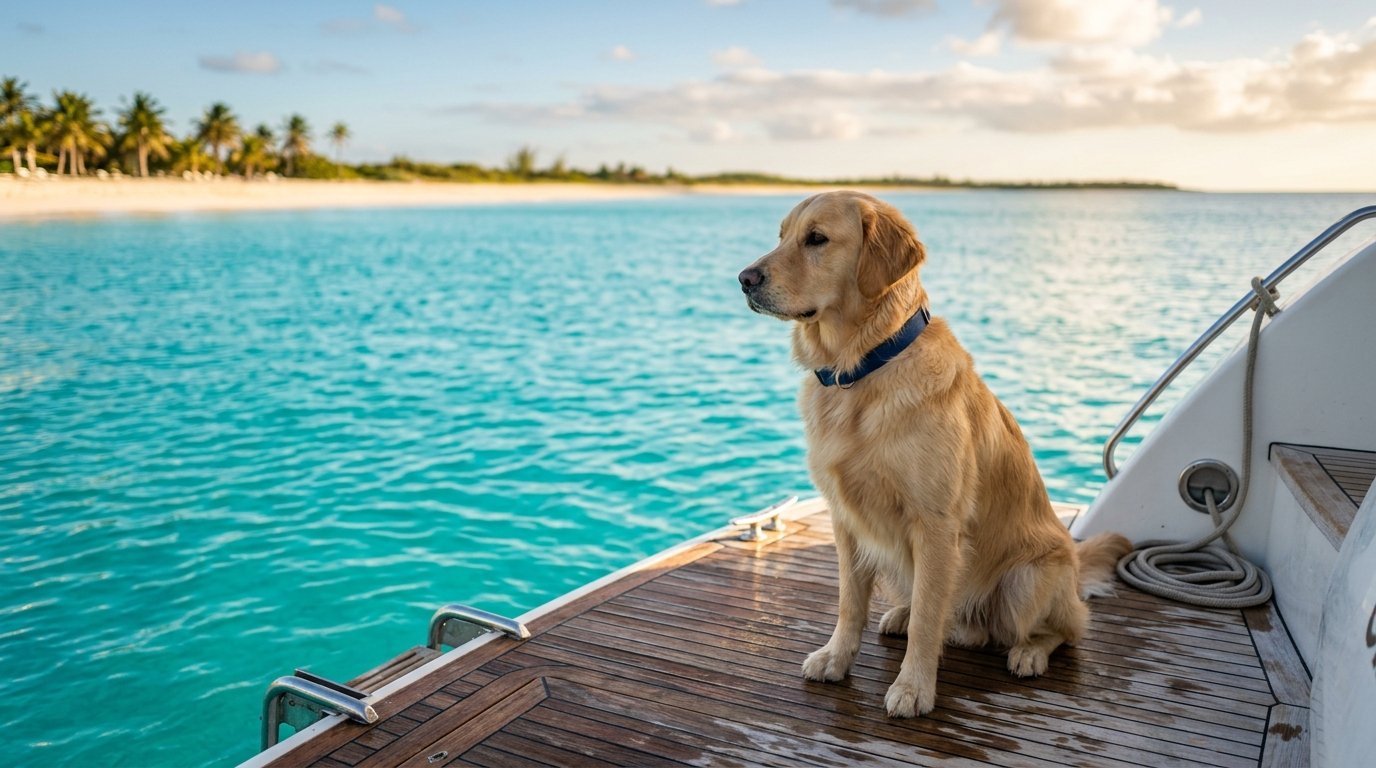
A pet friendly yacht charter in the Caribbean is one of the most undersold formats in the 2026 pet-travel boom, because nearly every published trend report names hotels, not yachts, as the pet-friendly winner. Yet a private crewed yacht is the only travel product where your dog never enters a kennel, a cargo hold, or a stranger’s lobby. This guide answers the questions most brokers gloss over: which Caribbean countries are realistic, what the customs paperwork looks like, what pet-friendly yachts charge, and how to brief a captain before you board.
Can you bring pets on a crewed yacht charter?
Yes, but the pet-friendly fleet is small, rules change by country, and paperwork starts at least four months out. Amadeus’ Travel Trends 2026 report names “The Pawprint Economy” its #1 trend, citing that 27% of US and UK pet owners traveled with their pets for the first time in 2025. Pew Research finds 97% of US pet owners consider pets family. Hilton’s 2026 Trends Report ranks “pet-friendly” the fifth most popular search filter on Hilton.com, used by 64% of travelers.
The yacht charter market is the last format to react. There is no published yacht-industry pet-travel survey, and most broker websites default to a “no pets” answer. The reality on the water: roughly 5–10% of the crewed Caribbean fleet will accept a well-trained dog on a case-by-case basis. The fit usually requires a motor yacht with a swim platform, a captain who has done it before, and a charter agreement that spells out surcharges and damage deposits.
Caribbean countries with the easiest pet entry (and the hardest)
The US Virgin Islands is the easiest pet entry in the Caribbean because it is US territory: a USDA-accredited veterinarian issues an APHIS 7001 health certificate within 10 days of arrival, the USVI Department of Agriculture issues a $25 import permit, and no foreign customs touch your dog. The Bahamas comes second: a BAHFSA import permit costs roughly $11.20 with no rabies titer requirement for US-origin dogs.
The hardest are St. Vincent and the Grenadines and Jamaica. Both require six-month residency in an approved country or face a six-month quarantine on arrival. Cuba is impractical: the CDC lists it as high-risk for dog rabies, and US embargo rules make charter logistics untenable.
The middle tier (the BVI, the Cayman Islands, and St. Lucia) accepts US dogs but requires a rabies neutralizing antibody titer test (FAVN or RNATT) drawn 30 days to 3 months before arrival, plus an ISO microchip on every document. St. Lucia’s three-month wait between titer blood draw and entry date is what catches most charter guests off-guard. For a winter charter in St. Lucia, the bloodwork has to happen in October. The best time to charter in the Caribbean coincides with peak titer-paperwork timing for these three jurisdictions.
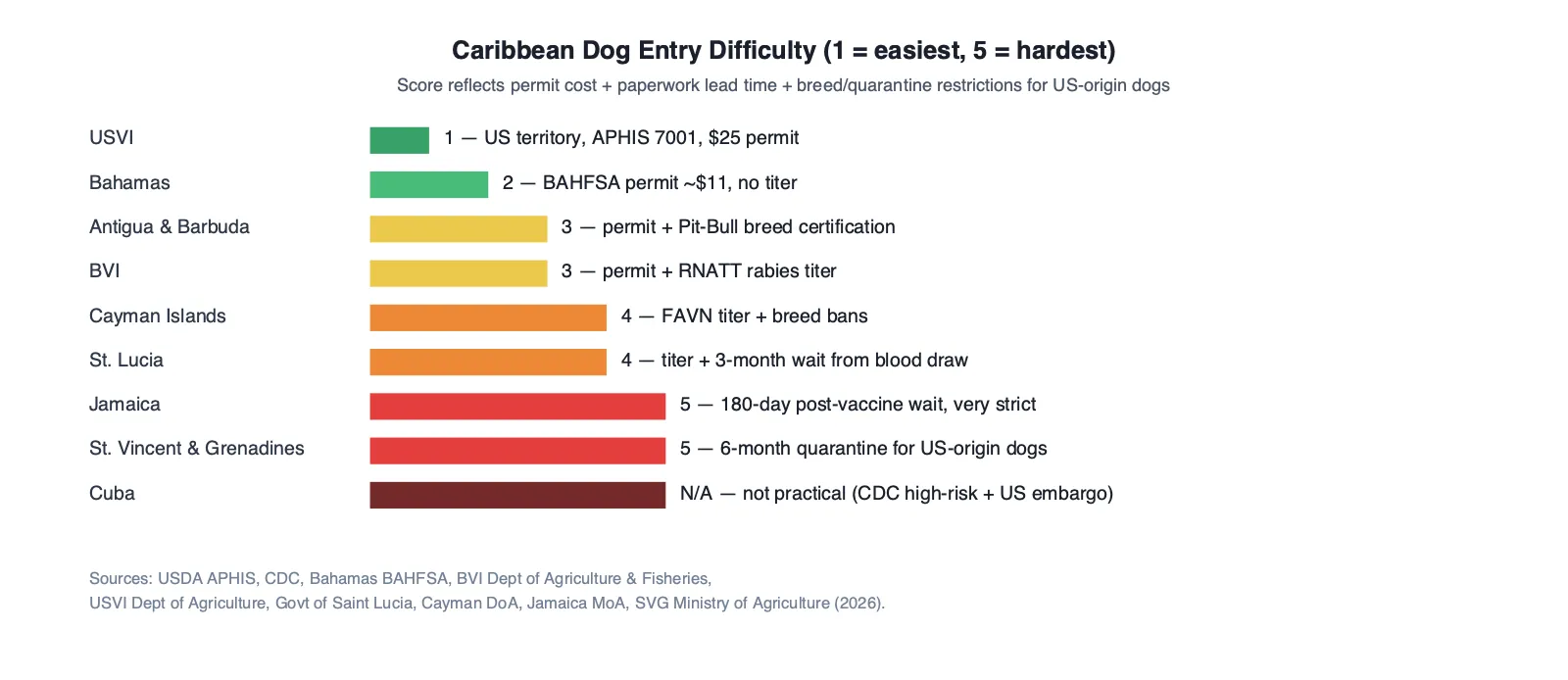
View data table
| Territory | Difficulty (1–5) | Key requirement |
|---|---|---|
| USVI | 1 | APHIS 7001 within 10 days, $25 import permit |
| Bahamas | 2 | BAHFSA permit ~$11.20, no titer for US dogs |
| Antigua & Barbuda | 3 | Import license, Pit-Bull breed certification |
| BVI | 3 | Import permit + rabies titer (RNATT), ISO microchip |
| Cayman Islands | 4 | FAVN titer ≥0.5 IU/ml, ISO microchip, breed bans |
| St. Lucia | 4 | Rabies titer + 3-month wait from blood draw |
| Jamaica | 5 | 180 days from rabies vaccine before entry |
| St. Vincent & the Grenadines | 5 | 6-month quarantine for US dogs |
| Cuba | N/A | CDC high-risk + US embargo logistics |
Bahamas pet entry requirements for chartering
Bahamas pet entry is governed by BAHFSA, the Bahamas Agricultural Health and Food Safety Authority. You apply for the Permit to Import Domestic Animals through bahamas.gov.bs or BAHFSA’s Click2Clear customs system, pay $10 plus 12% VAT, and receive the permit by email within five to ten business days. Apply at least four weeks before your charter.
A USDA-accredited veterinarian must issue an international health certificate within 48 hours of departure. The certificate confirms a current rabies vaccine (not older than one year, not within 30 days of departure), recent tick and tapeworm treatment, and an exam clearing the dog of communicable disease. A USDA APHIS-endorsed copy must travel with the dog; accredited vets handle the APHIS endorsement digitally via VEHCS in 24–72 hours.
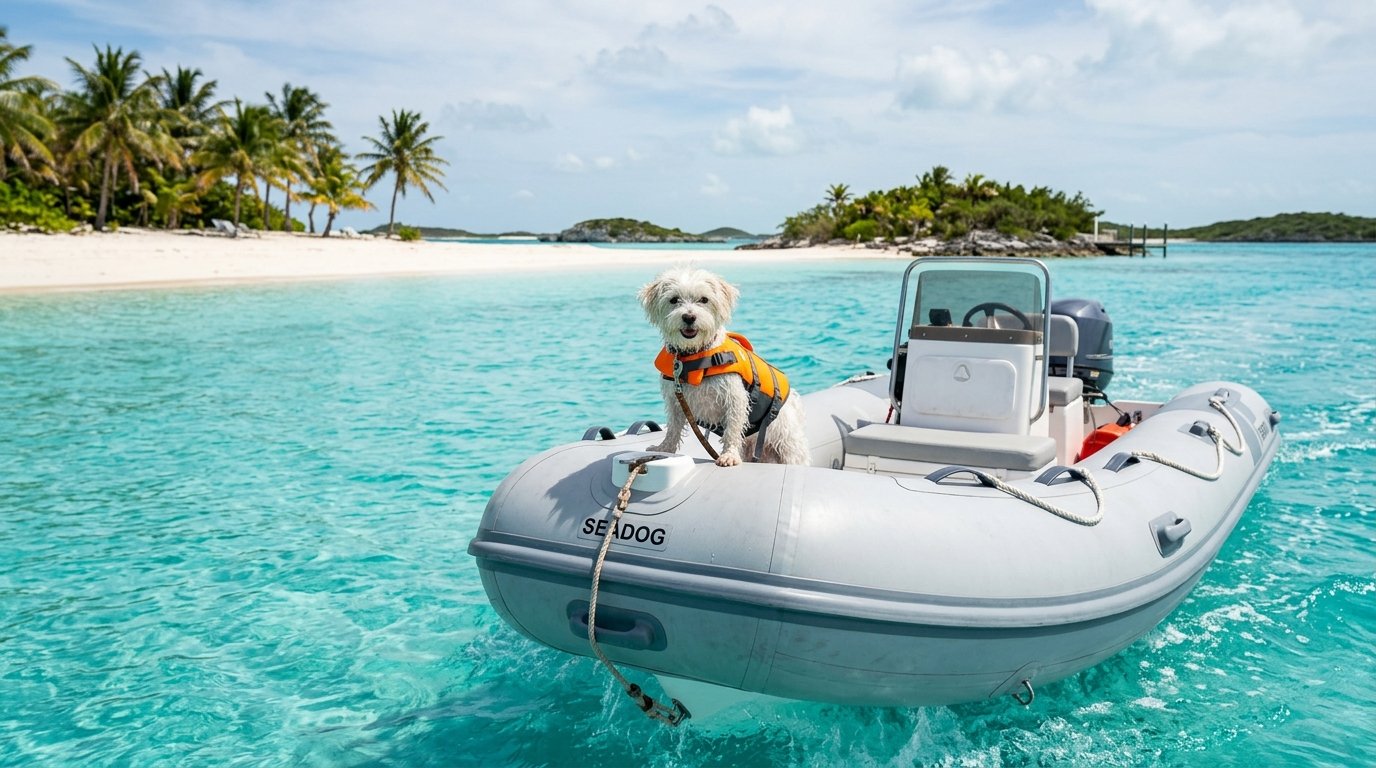
No titer, no quarantine, no breed ban applies in the Bahamas as of 2026. That makes it the most realistic first-charter destination for US dog owners. Practical Exuma anchorages such as Highbourne Cay, Compass Cay, and Big Major Cay all allow dogs ashore on private cays where the operator permits. A captain who has done this before will know which beach landings welcome dogs and which post no-pet ordinances.
BVI, USVI, and the Eastern Caribbean pet rules
The USVI accepts US-origin dogs with an APHIS 7001 (or your state’s Interstate Certificate of Veterinary Inspection) issued within 10 days of arrival and a $25 import permit from the USVI Department of Agriculture. No titer, no quarantine, no microchip mandate, though a microchip is required if the dog later re-enters the mainland US.
The BVI is a separate jurisdiction with stricter rules. The BVI Department of Agriculture and Fisheries requires an import permit, an ISO 11784/11785 microchip, a current rabies vaccine, and a rabies neutralizing antibody titer (RNATT) test drawn at least 30 days after the most recent rabies vaccine and within 12 months of arrival. Fees are set by the receiving Veterinary Officer at port of entry.
Antigua and Barbuda accepts US dogs with an import license from the Veterinary and Livestock Division, a current rabies vaccine, a DHLPP combination vaccine, and a written kennel-club certification that the dog is not a Pit Bull or look-alike. The breed certification catches charter guests by surprise: a $50 letter from a local kennel club covers it, but you cannot get one at the airport. The same Eastern Caribbean rules apply if you anchor in the hidden Caribbean anchorages of Antigua’s south coast or Barbuda’s Codrington Lagoon.
How to brief your broker for a pet-friendly charter
Brief a broker by leading with three details: the dog’s weight and breed, the territory you want to enter, and your earliest possible departure date. Most pet-friendly yachts have a 50-pound weight cap; some accept up to 80 pounds. Owners with light-upholstery interiors often restrict shedding breeds.
Then ask your broker to confirm five specifics in writing before you sign:
- The owner’s written pet-acceptance clause: confirming this dog, by name and microchip, has been approved for the dated charter.
- The pet damage deposit: typically $1,500–$5,000, refundable on departure inspection.
- The post-charter deep-cleaning fee: usually $300–$800, non-refundable.
- The captain’s pet experience: how many prior pet charters and familiarity with the country’s customs process.
- The pet liability gap: most yacht insurance excludes pet-caused damage to third parties; confirm your homeowner’s or renter’s umbrella policy covers off-vessel incidents.
A broker who can answer these in 48 hours is doing the work. The same questions across multiple brokers will surface the 5–10% of yachts that genuinely welcome dogs versus the ones that say “maybe” to get the deposit. The same diligence applies to any quiet luxury vacation booking; privacy yachts deliver only works when the contract handles the awkward details upfront.
What pet-friendly yachts charge (deposits, surcharges, cleaning)
Pet-friendly yachts charge three layers on top of the base charter: a refundable pet damage deposit of $1,500–$5,000, a non-refundable post-charter deep-cleaning fee of $300–$800, and either a flat per-charter pet surcharge ($500–$1,500) or a per-night surcharge ($75–$200). Some owners waive the surcharge and only charge the deposit and cleaning fee.
The total premium for bringing a dog on a seven-night charter typically runs $1,000 to $2,500 on top of the base rate (excluding the refundable deposit). The global pet travel services market reached $2.4 billion in 2024 and is projected to hit $3.9 billion by 2030 at an 8.9% CAGR (Grand View Research). Yachts are still pricing pet acceptance like a favor; the hotel sector monetized it as a category years ago. See our answer to: Which Caribbean islands are dog-friendly? As the wellness yacht charter segment did between 2023 and 2026, pet-friendly chartering is on a similar pricing-formalization curve.
The yachts most likely to say yes are larger motor yachts (60+ feet) with hard floors, dedicated heads for crew, and an owner who is themselves a pet owner. Smaller sailing catamarans and traditional sailing yachts almost universally decline. Why some yachts say no at any price: gel coat, teak decks, and rope rigging are vulnerable to dog claws and chewing; head plumbing on most yachts cannot handle dog hair; and customs paperwork is a real cost in captain hours. A “no pets” answer in 10 seconds isn’t lazy; it’s protective.
Returning to the US: the CDC’s 2024–2025 rules
The CDC tightened US dog re-entry rules in two stages: a final rule effective August 1, 2024, and a follow-up amendment effective August 1, 2025. All dogs returning to the US must now present a free CDC Dog Import Form (filed online before arrival, valid for six months and multiple entries from low-risk countries), an ISO microchip, and a minimum age of six months.
The August 2025 amendment replaced the prior USDA-endorsed export health certificate with a new “Certification of U.S.-issued Rabies Vaccination” form that must be completed by a USDA-accredited veterinarian before the dog leaves the US. This is the only document the CDC accepts for re-entry of US-vaccinated dogs. Get it before you fly to the charter, not after.
The Caribbean territories above (except Cuba) are all classified by the CDC as low-risk or rabies-free, meaning your dog comes back without a quarantine or a second titer.
Start a yacht search at Vital Charters if you want a broker who will tell you upfront whether a specific yacht accepts dogs. Contact us with your dog’s weight, target territory, and dates, and we’ll come back with a vetted short-list, not a “maybe.”
Frequently Asked Questions
Can dogs go on yacht charters in the Caribbean?
Yes, on roughly 5–10% of the crewed Caribbean fleet. The yacht owner and captain decide on a case-by-case basis. The Bahamas and the US Virgin Islands have the most pet-friendly options because their customs rules are the simplest for US-origin dogs.
What does a pet friendly yacht charter cost extra?
Expect $1,000–$2,500 in non-refundable fees on top of the base charter (pet surcharge plus deep cleaning), plus a refundable damage deposit of $1,500–$5,000. Per-night pet surcharges of $75–$200 are common.
Which Caribbean countries are the hardest for dogs?
St. Vincent and the Grenadines and Jamaica are effectively closed to US-origin dogs because both require six-month residency in an approved country or a six-month quarantine. Cuba is not practical due to CDC high-risk classification and US embargo logistics.
Do I need a rabies titer test for a Caribbean charter?
For the BVI, Cayman Islands, and St. Lucia: yes. The blood draw must happen 30 days to 3 months before arrival (St. Lucia requires the longest wait). For the Bahamas, USVI, and Antigua, a current rabies vaccine alone is sufficient.
How early should I start the paperwork for a pet friendly yacht charter?
Start four months out for any Caribbean destination requiring a titer (BVI, Cayman, St. Lucia). Start six to eight weeks out for the Bahamas and USVI. Start six to eight months out for any country requiring a quarantine waiver.
Are there breed restrictions on Caribbean yacht charters?
Yes. The Cayman Islands bans Pit Bulls, Dogo Argentinos, Fila Brazileiros, and Japanese Tosas at the country level. Antigua and Barbuda bans Pit Bull and look-alike breeds and requires kennel-club certification. Individual yachts may also restrict shedding breeds or dogs over 50–80 pounds.
About the author: Jason Acosta is co-founder and principal broker at Vital Charters, a Caribbean and Bahamas crewed yacht charter brokerage. He has placed clients on motor yachts and catamarans across the BVI, USVI, Bahamas, and Leeward and Windward chains since 2019 and personally handles every pet-friendly inquiry.
Sources: USDA APHIS, CDC, Bahamas BAHFSA, BVI Department of Agriculture and Fisheries, USVI Department of Agriculture, Government of Saint Lucia, Cayman Islands Department of Agriculture, Jamaica Ministry of Agriculture, SVG Ministry of Agriculture, Pew Research Center, Hilton 2026 Trends Report, Amadeus Travel Trends 2026, APPA 2025 Dog & Cat Report, Grand View Research, Skift.
A crewed charter that welcomes your whole crew.
Tell us your dog breed, group size, and preferred islands and we’ll find a pet-friendly crewed yacht with a captain who’s done this before.