
Yacht Charter Seasickness: A Broker’s Honest Guide
Up to 25% of charter guests get seasick, but it’s preventable. A broker covers Bonine, scopolamine patches, natural remedies, and why prevention beats treatment.
Up to 25% of passengers on large vessels develop seasickness within the first two to three days at sea (Golding, Autonomic Neuroscience, 2020). Yacht charter seasickness — also called motion sickness at sea — is the number one concern I hear from first-time charter guests. But here’s what the number doesn’t tell you: the vast majority of those cases are preventable.
After many yacht charters as a passenger with different mixes of friends and family, and I can count on one hand the trips where seasickness became a real problem. The difference isn’t luck. It’s preparation. People who take precautions before they step aboard almost never get sick. People who wait until they feel queasy are already behind.
This guide covers what actually works — medications, natural remedies, boat selection, and behavioral strategies — all backed by medical research, not sailor folklore. Whether you’re prone to motion sickness or just want peace of mind for your upcoming charter vacation, you’ll find straightforward answers here.
Why Does Yacht Charter Seasickness Happen?
Your inner ear detects motion that your eyes don’t confirm — a sensory mismatch your brain interprets as a toxin warning (CDC Yellow Book, 2026). On a yacht, this conflict intensifies below deck where you can’t see the horizon, or when you’re reading, staring at a phone, or focused on a fixed object inside the cabin.
Genetics play a bigger role than most people realize. The heritability of motion sickness susceptibility ranges from 55% to 70%, meaning more than half of your vulnerability is hardwired (CDC Yellow Book, 2026). If your parents got seasick easily, you’re more likely to as well. Women are also more susceptible than men, particularly during menstruation or pregnancy.
Children between ages 6 and 12 hit peak susceptibility — something no other charter guide mentions, but it matters enormously for family yacht vacations. Susceptibility drops through puberty and rarely causes problems after age 50.
Our observation: In my experience brokering Caribbean charters, guests who spend their first afternoon on deck — swimming, snorkeling, or just watching the islands — almost never report nausea. It’s the ones who head straight to their cabin to unpack and settle in who struggle. Your brain needs to see the motion to process it.
Seasickness on a yacht charter results from sensory mismatch between the inner ear and eyes, with 55–70% of susceptibility determined by genetics (CDC Yellow Book, 2026). Children aged 6–12 face peak vulnerability, while susceptibility generally declines after age 50. The condition intensifies below deck where visual horizon cues are absent.
Why Should You Take Seasickness Medication Before Boarding?
Motion sickness triggers gastric stasis (slowed stomach emptying) — a 47% reduction in stomach processing measured by nuclear medicine imaging (NIH StatPearls, 2024). Once nausea starts, your stomach essentially stops absorbing oral medication. That’s why swallowing pills after symptoms begin rarely helps.
This is the single most important thing I tell every charter guest: prevention is your only reliable strategy. Once you’re already nauseous, your body can’t absorb the very medication that would help. It isn’t that the drugs don’t work — they can’t reach your bloodstream fast enough.
The CDC puts it bluntly: “Medications are far more effective when taken before the onset of symptoms” (CDC Yellow Book, 2026). Every physician who specializes in travel medicine will tell you the same thing. Start your medication the night before embarkation, not the morning of.
Even people who’ve never had motion sickness should consider preventive medication for their first charter. About 60% of passengers can develop symptoms in rough conditions, including experienced crew members (Golding, Autonomic Neuroscience, 2020). The Caribbean is typically calm, but a weather system or an open-water crossing between islands can produce swells that catch anyone off guard.
What Medications Prevent Yacht Charter Seasickness?
A Cochrane systematic review of 14 clinical trials (1,025 subjects) found that scopolamine patches reduce motion sickness symptoms by approximately 52% compared to placebo (Spinks et al., Cochrane Database of Systematic Reviews). That makes it the gold standard — but it’s not the only option. Here’s how the main medications compare:
| Medication | Type | Effectiveness | Duration | Key Side Effect | Best For |
|---|---|---|---|---|---|
| Scopolamine patch | Prescription | 89% symptom reduction | 72 hours | Dry mouth | Moderate–high susceptibility |
| Bonine (meclizine) | OTC | 59% symptom reduction | 8 hours | Mild drowsiness | Mild susceptibility, first-timers |
| Dramamine (dimenhydrinate) | OTC | Comparable to placebo in some trials | 4–6 hours | Strong sedation | Short crossings only |
| Ginger (940mg) | Supplement | Matched dimenhydrinate | ~4 hours | None significant | Supplement to medication |
Scopolamine Patch (Transderm Scōp) — Prescription Required
The scopolamine transdermal patch is the most effective single medication for preventing seasickness on a yacht. In head-to-head studies, scopolamine reduced symptoms by 89% compared to 59% for meclizine (Cochrane Review, Spinks et al.). You apply it behind your ear 4 to 8 hours before departure, and each patch lasts up to 72 hours — perfect for a week-long charter where you just swap patches.
Side effects include dry mouth (common), occasional drowsiness, and blurred vision at close range. You’ll need a prescription from your doctor, so don’t wait until the week before your trip. Ask at least a month ahead. Some physicians recommend trying the patch on a weekend at home first to check for side effects before you’re out at sea.
Bonine (Meclizine) — Over the Counter
Bonine is the most popular over-the-counter option for charter guests. Its active ingredient, meclizine, takes about one to two hours to kick in and lasts roughly eight hours (Wibble et al., British Journal of Clinical Pharmacology, 2020). It causes less drowsiness than Dramamine, which is why experienced sailors prefer it.
The catch: meclizine scored a 59% symptom reduction in clinical studies versus scopolamine’s 89%. For calm Caribbean anchorages and short crossings, Bonine is often enough. For open-water passages or rough weather, you may want the patch instead. Many experienced charterers use both — Bonine for mild days, a scopolamine patch when the forecast calls for swells.
Bonine (meclizine) reduces yacht charter seasickness symptoms by 59% and is available over the counter, while scopolamine patches achieve 89% reduction but require a prescription. Both work best when taken before symptoms begin (Cochrane Database of Systematic Reviews).
Dramamine (Dimenhydrinate)
Dramamine works, but it’ll likely knock you out. It’s an older antihistamine with strong sedative effects — fine for a short ferry crossing, less ideal when you’ve paid thousands for a Caribbean charter and want to enjoy the experience. The non-drowsy version (Dramamine II) is actually just meclizine, the same ingredient in Bonine.
Which Medication Should You Choose?
For a week-long Caribbean yacht charter, here’s my practical recommendation based on what works for my clients:
- Mild susceptibility or first-timers wanting insurance: Bonine (meclizine), one tablet the night before and one each morning
- Moderate susceptibility or known motion sickness history: Scopolamine patch applied the evening before embarkation
- High susceptibility or anxious about it: Scopolamine patch plus Bonine for the first two days, then taper to patch only once acclimated
- Children under 12: Consult your pediatrician — dosing is weight-based and different from adults
Do Natural Remedies for Seasickness Actually Work?
Ginger (940mg powdered root) outperformed dimenhydrinate in a placebo-controlled study of 36 subjects, and a separate naval cadet trial of 80 participants confirmed significant reductions in vomiting and cold sweating (Golding, Autonomic Neuroscience, 2020, citing Mowrey & Clayson 1982; Grøntved et al. 1988). Ginger isn’t just folk wisdom — it has genuine clinical backing.
Ginger
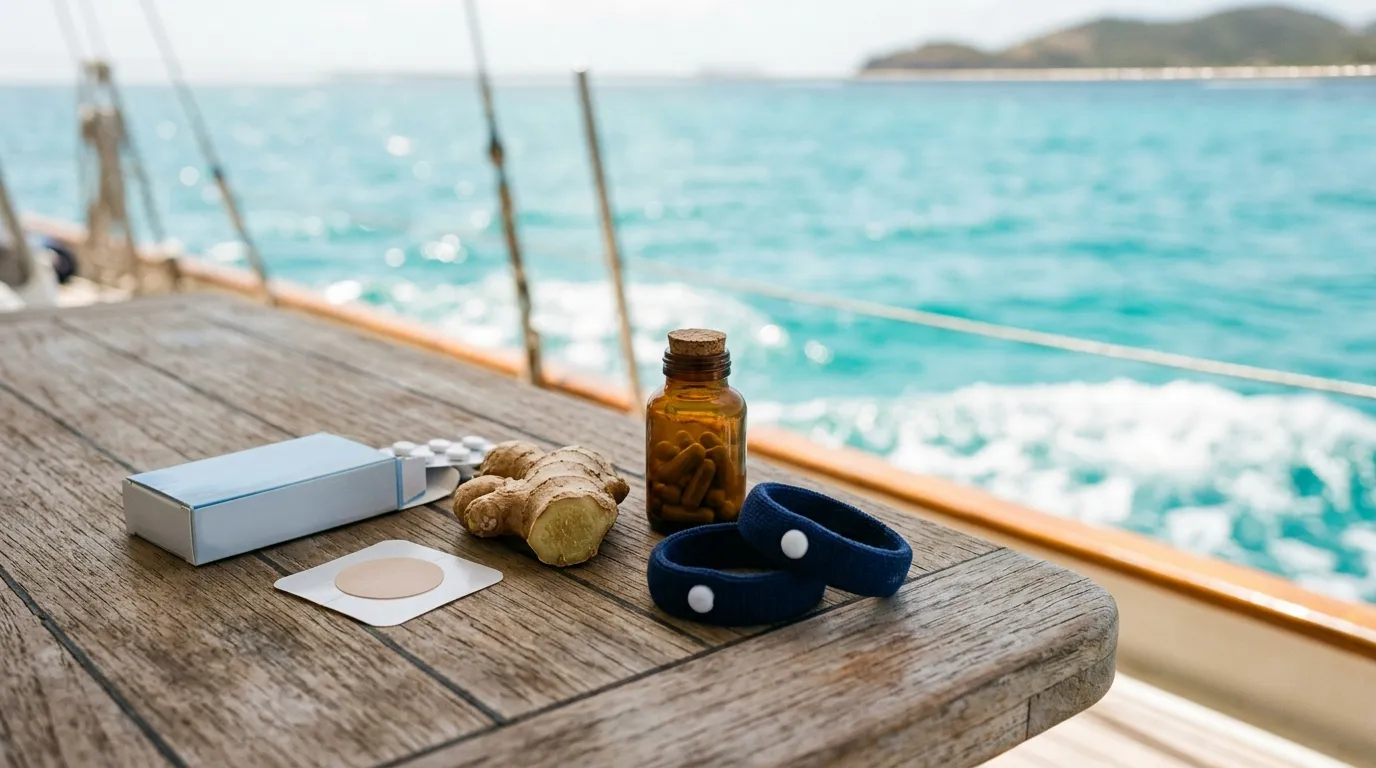
The key is dosage. Candied ginger from the grocery store won’t cut it. You need 940mg to 1,000mg of powdered ginger root, taken as capsules 30 minutes before boarding. A more recent clinical evaluation of ginger extract (160mg standardized to 8mg gingerols) showed statistically significant symptom reductions across all motion sickness domains (Alcoforado et al., PMC, 2020). Pack ginger capsules on your charter packing list even if you’re taking medication — they make a solid backup.
Acupressure Wristbands (Sea-Bands)
These elastic wristbands press a plastic stud against the P6 (Nei Guan) acupressure point on your inner wrist. The evidence is mixed — approximately 25% of patients show benefit, but systematic reviews call the data “still controversial” (PMC systematic review, 2011). They’re inexpensive, have zero side effects, and won’t interact with medications. Worth wearing as a supplement, but don’t rely on them as your only prevention.
Behavioral Strategies That Cost Nothing
- Watch the horizon. This is the single best free remedy. It gives your eyes motion data that matches what your inner ear senses, resolving the mismatch that causes nausea.
- Stay on deck. Fresh air and visual access to the horizon work together. Even in rain, being on deck usually beats being below (NOAA Ocean Service).
- Avoid reading or screens below deck. Fixed visual focus while your body moves is the fastest trigger for queasiness.
- Stay hydrated. Drink water, apple juice, or clear broth. Avoid coffee and milk, which can worsen nausea (NOAA Ocean Service).
- Eat light, bland food. Crackers, bread, and bananas are your friends. An empty stomach is actually worse than a settled one.
- Sleep well the night before. Fatigue significantly amplifies motion sickness symptoms.
- Position yourself midship. The center of the boat has the least motion. On a catamaran, the salon between the two hulls is the most stable spot aboard.
- Stay active. Helping with lines, swimming, or snorkeling keeps your mind and body engaged. Sitting still and focusing inward makes symptoms worse.
What most reviews miss: The order matters. Start medication the night before. Add ginger the morning of. Wear Sea-Bands as a bonus. Stay on deck when underway. This layered approach is how our charter guests — even the ones who get carsick on mountain roads — sail through a week without trouble.
Ginger (940mg powdered root) matched dimenhydrinate effectiveness in placebo-controlled trials, while acupressure wristbands show approximately 25% benefit (Golding, Autonomic Neuroscience, 2020; PMC systematic review, 2011). Behavioral strategies — horizon watching, staying on deck, and midship positioning — are free, have no side effects, and are consistently recommended by the CDC and NOAA.
How Long Does It Take to Get Your Sea Legs?
Roughly 50% of the population can fully habituate to sea motion, and the CDC calls habituation “the most effective countermeasure — even more than any medication” (CDC Yellow Book, 2026). Symptoms typically peak within the first 24 to 72 hours, then fade substantially. Most people feel completely normal by day three.
Here’s the typical acclimation pattern on a Caribbean charter:
- Day 1: Highest risk. Take your medication, stay on deck, and ease into it. Most charters start with a short sail to a nearby anchorage — your crew knows this drill.
- Day 2: Noticeable improvement for most guests. Your brain is learning to interpret the motion signals.
- Day 3+: The majority of guests feel no symptoms at all. Many stop taking medication entirely by mid-week.
About 5% of people show no habituation regardless of exposure time (Golding, Autonomic Neuroscience, 2020). If you’re in this group, maintaining medication throughout your charter is the right call. It doesn’t mean you can’t enjoy the trip — it just means you keep the patch on.
Are Catamarans Better Than Monohulls for Seasickness?
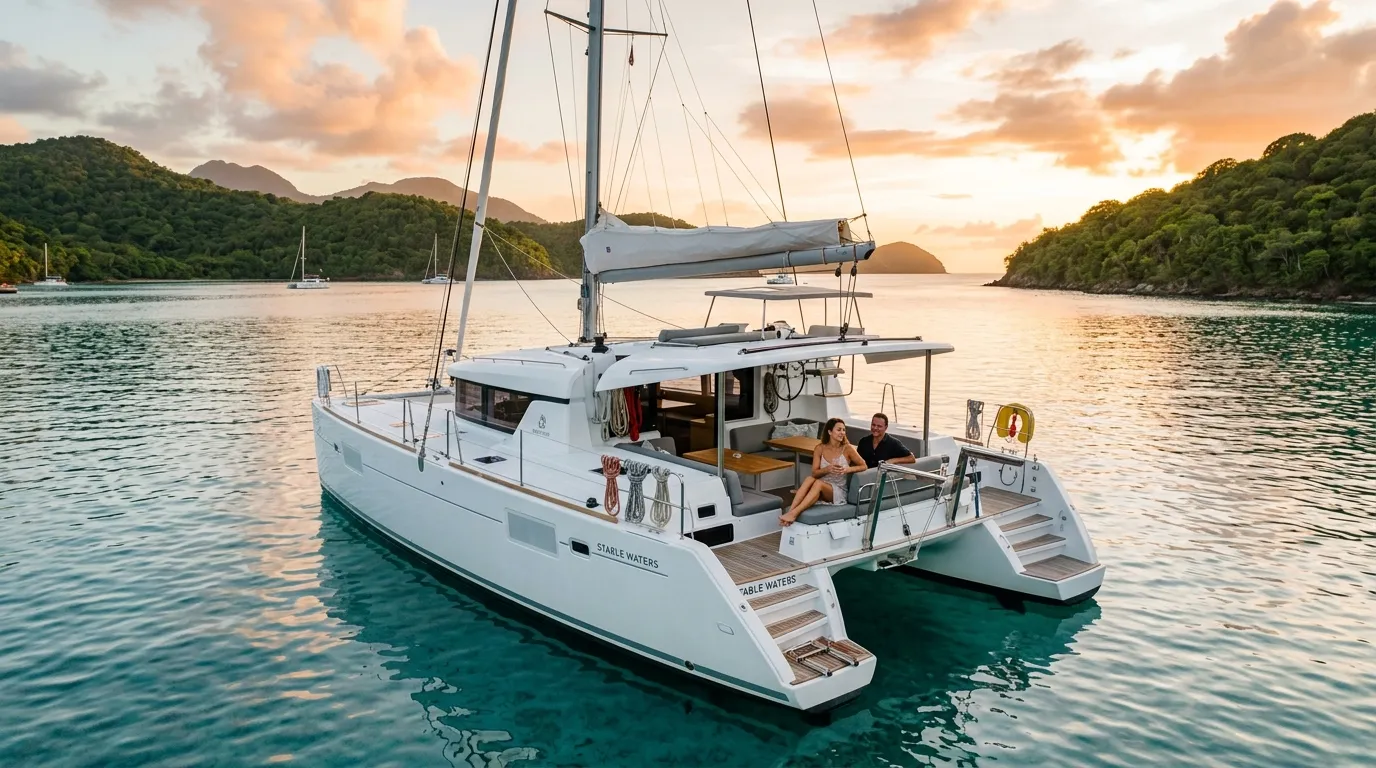
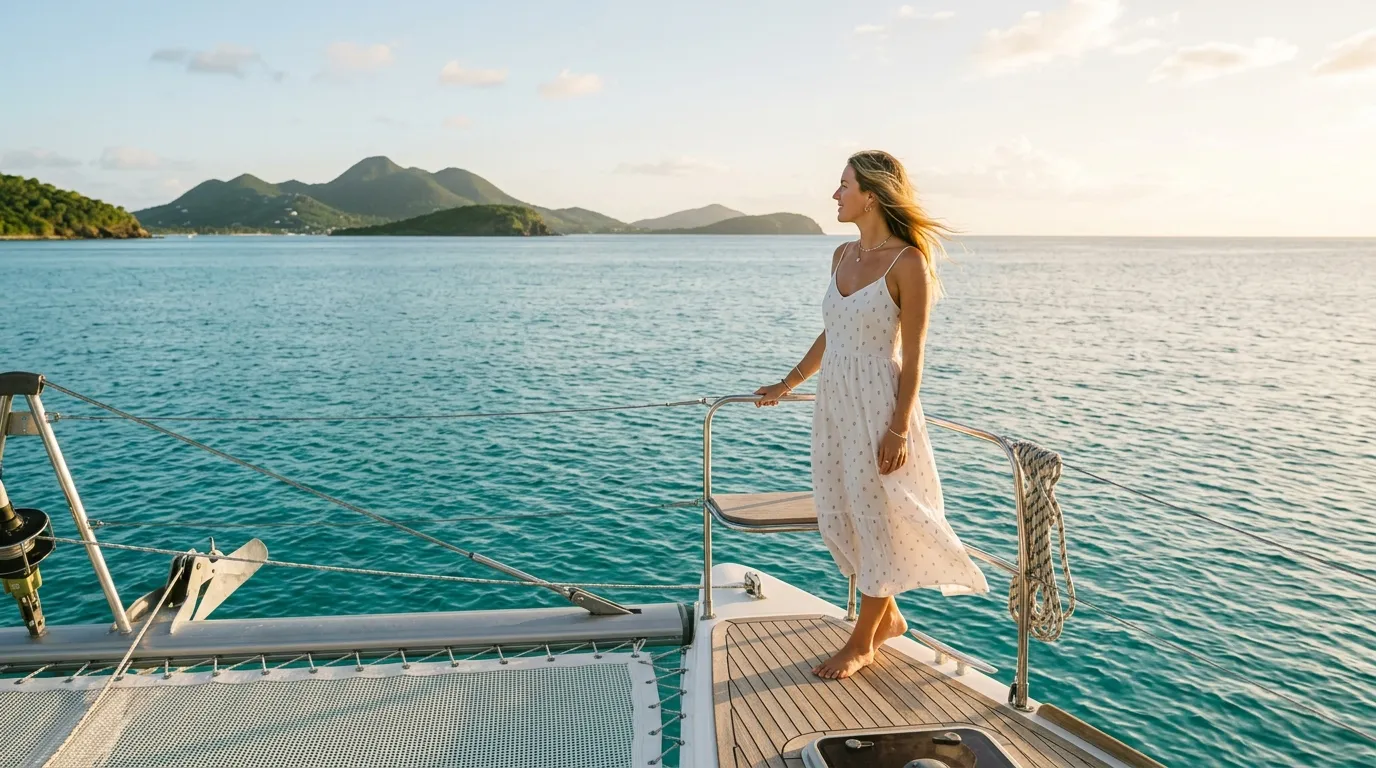
Catamarans heel at just 5 to 10 degrees under sail, compared to 30 degrees or more on a monohull (Sunreef Yachts, 2024). That’s not a subtle difference — it’s the gap between a stable platform and a tilted floor. For anyone concerned about yacht charter seasickness, a catamaran should be your default choice when chartering in the Caribbean.
The wide beam of a catamaran also means far less roll at anchor. You’ll sleep better, move around the deck more easily, and spend less time bracing yourself. Most Caribbean charter fleets are catamaran-heavy for exactly this reason.
Catamarans heel at just 5–10 degrees versus 30+ degrees on monohulls, making them the best yacht type for guests prone to seasickness. Motor yachts with gyroscopic stabilizers reduce roll by up to 95% (Seakeeper, 2025), but cost significantly more per week.
If budget allows, motor yachts equipped with gyroscopic stabilizers (like Seakeeper units) reduce roll by up to 95%. These are typically found on superyachts in the $50,000-plus-per-week range. For most charter guests, a crewed catamaran in the $15,000 to $40,000 range offers the best balance of stability and value. Your charter broker can help you choose the right vessel for your comfort level.
What If Someone Gets Sick Despite Prevention?
Even with careful preparation, it happens on occasion. Here’s the protocol your crew will follow, and what you can handle yourself:
- Get on deck immediately. Fresh air and horizon contact are the fastest non-pharmaceutical intervention.
- Apply a scopolamine patch if available. Transdermal absorption bypasses the stomach entirely — this is why the patch works even after symptoms start, unlike oral medications.
- Lie down in a central, low position. The midship cabin on a catamaran has the least motion. Close your eyes if the visual environment is making things worse.
- Sip cold water or ginger ale. Small, frequent sips — don’t gulp.
- Ask the captain to adjust course. On a crewed charter, the captain can alter the heading or speed to reduce motion. A slight course change can transform a beam sea (waves hitting the side) into a following sea (waves pushing from behind), which is dramatically more comfortable.
- Don’t fight it. If you need to vomit, let it happen. Most people feel substantially better afterward, and it’s nothing your crew hasn’t seen before.
Our observation: I’ve seen guests who were convinced they’d spend the whole trip sick feel completely fine by dinner on day one. The Caribbean’s protected waters — especially the British Virgin Islands and the Bahamas — are some of the calmest sailing grounds on earth. Your charter isn’t a transatlantic crossing. Most passages are 45 minutes to two hours between islands, in waters shielded by land.
When seasickness occurs despite prevention, transdermal scopolamine patches remain effective because they bypass the stomach’s impaired absorption. The Caribbean’s protected island waters — particularly the BVI and Bahamas — limit most passages to 45 minutes to 2 hours in sheltered conditions, and captains on crewed charters can adjust course to reduce beam seas.
Frequently Asked Questions
Will I get seasick on a yacht charter?
Maybe, but probably not if you prepare. Up to 25% of passengers experience symptoms in the first few days, but preventive medication reduces that risk by 52–89% depending on the drug (Cochrane Review). Most guests who take Bonine or wear a scopolamine patch before boarding never feel symptoms at all.
Is Bonine or scopolamine better for yacht charter seasickness?
Scopolamine patches are more effective (89% symptom reduction vs. 59% for Bonine) and last 72 hours. But they require a prescription and can cause dry mouth. Bonine is available at any pharmacy, works well in calm to moderate conditions, and causes less drowsiness than Dramamine. For a Caribbean charter, either is a solid choice — scopolamine just has a higher ceiling.
Can I take Bonine and wear a scopolamine patch at the same time?
Some physicians approve this combination for the first 24–48 hours of a voyage when seas may be roughest. Both are anticholinergic medications, so side effects (dry mouth, drowsiness) can compound. Ask your doctor before combining them.
Do natural remedies for seasickness actually work?
Ginger has legitimate clinical backing — 940mg of powdered ginger root performed as well as dimenhydrinate in a controlled study (Golding, 2020). Acupressure wristbands show modest benefit (~25%) but aren’t reliable as standalone prevention. Behavioral strategies (horizon watching, fresh air, staying on deck) are consistently effective and free.
How long does seasickness last on a charter?
Symptoms typically peak within 24–72 hours and then fade as your body habituates. About 50% of people fully acclimate within this window (Golding, 2020). By day three of a charter, the overwhelming majority of guests feel normal — many forget they were ever worried about it.
Are catamarans better than monohulls for seasickness?
Yes, significantly. Catamarans heel at 5–10 degrees versus 30+ degrees on monohulls (Sunreef Yachts, 2024). The wider platform also means less roll at anchor. If seasickness is a concern, a catamaran is the right vessel for your Caribbean charter.
Should I take seasickness medication even if I’ve never been seasick?
For your first charter, yes — at least for the first day or two. Conditions at sea are different from anything on land, and 55–70% of susceptibility is genetic (CDC Yellow Book, 2026). You may not know you’re susceptible until you’re on open water. Bonine is inexpensive and low-risk.
What about children and seasickness on a yacht?
Children ages 6 to 12 are at peak susceptibility for motion sickness (CDC Yellow Book, 2026). Consult your pediatrician before the trip for age-appropriate medication. Behavioral strategies — staying on deck, watching the horizon, staying active — are especially effective with kids because they’re naturally inclined to be outside and moving around.
Have more questions about preparing for your first charter? Reach out to our team — we’ve helped hundreds of first-time guests plan worry-free vacations in the Caribbean and Bahamas.
The right yacht makes all the difference.
Tell us who in your group is prone to seasickness and we’ll steer you toward crewed catamarans and sheltered Caribbean routes that keep everyone comfortable.