
Multigenerational Family Yacht Charter: A Broker’s Guide (2026)
All-inclusive Caribbean catamarans for 8-10 guests run $28,800 to $48,000 a week, median $34,000. What a multigenerational family yacht charter really costs.
Last Updated: September 7, 2026
Planning a multigenerational family yacht charter starts with one uncomfortable question: whose vacation are you actually building? A record 71% of grandparents have now taken a multigenerational trip, and 57% are already planning the next one (NYU SPS / Family Travel Association, 2025). That’s not a blip. It’s a change in how families spend time together.
Here’s the problem every one of those families hits. Gathering three generations under one roof sounds wonderful right up until the toddler’s nap collides with grandma’s mobility needs and the teenager’s boredom threshold. A resort can’t solve that. Neither can a cruise ship. A crewed charter can, and this guide covers what it costs, which boat to ask for, and how to plan one that works for everybody aboard.
What Is a Multigenerational Family Yacht Charter?
Private and leisure travel drives 77.88% of global charter revenue (Mordor Intelligence, 2025), and family groups spanning three generations are a meaningful slice of it. The format is simple: one yacht, one crew, one family, typically 8 to 12 guests across grandparents, parents and children, chartered by the week.
The distinction to get right is crewed, not bareboat. A crewed charter comes with a captain, chef and stew who run the boat, cook every meal and manage the itinerary. Your family are guests aboard, not operators. For a group with an 8-year-old and an 80-year-old in it, that difference is the entire proposition.
Whole-boat privacy is the second half. You’re not sharing a pool deck, a dining room or a beach with anyone. The only people aboard are the ones you invited and the crew looking after them.
What Does a Multigenerational Yacht Charter Cost?
Across current listings, all-inclusive catamarans sleeping 8 to 10 guests run $28,800 to $48,000 per week, with a median of $34,000 (Vital Charters rate analysis, September 2026, n=216). For a group of ten, that median works out to about $3,400 per person for seven nights, and it’s genuinely all-in.
That last point trips up almost everyone, so it’s worth being precise. All-inclusive means there’s no Advance Provisioning Allowance. Food, drink, fuel and dockage are already inside the rate. The only thing left is a crew gratuity, customarily 15% to 20% of the charter fee (CYBA). Plus-expenses charters work differently and add an APA of 25% to 35% on a catamaran, which is why comparing two quotes without checking which structure you’re looking at will mislead you by a third or more.
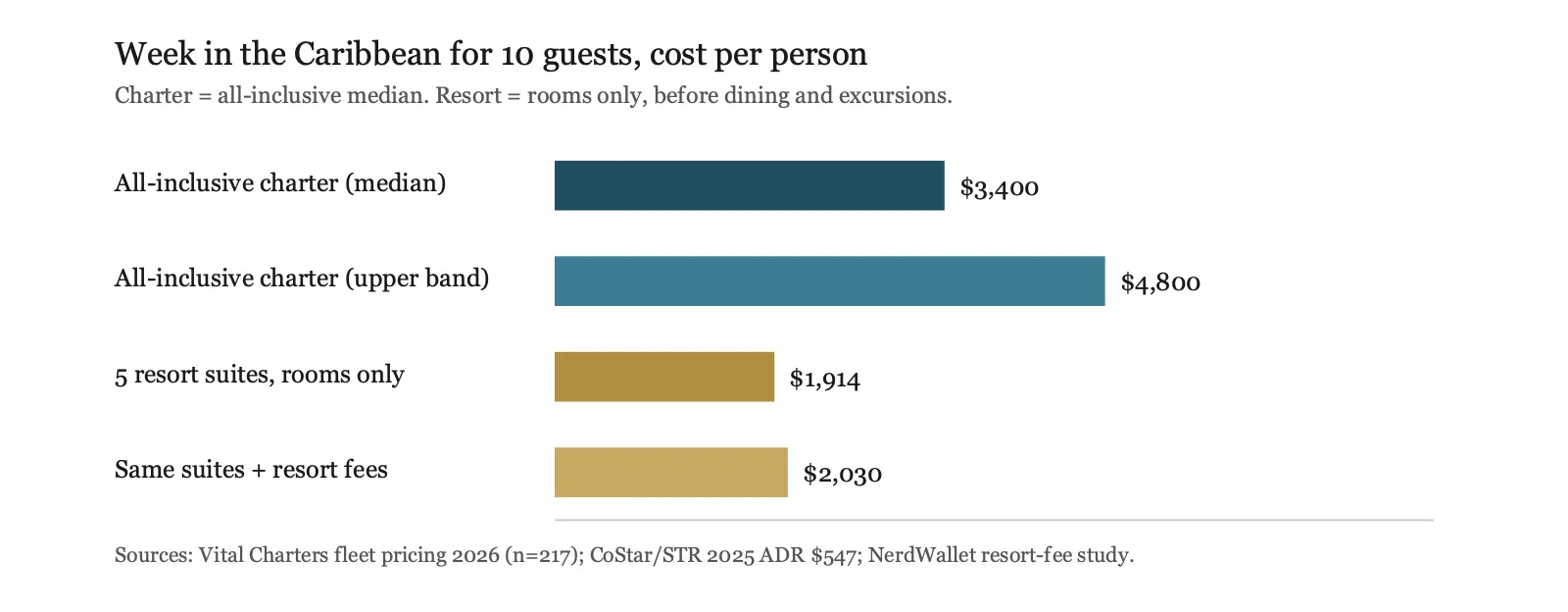
Compare that with the alternative for the same ten people. Caribbean luxury hotel rooms averaged $547 per night in 2025 (CoStar/STR), so five suites for seven nights comes to $19,145. That’s before anyone eats a meal or books an excursion. Resort fees land on top, averaging about $33 per night and reaching $50 at the major chains (NerdWallet). Add dining and activities for ten and the gap closes fast.
View data table
| Option | Basis | Week total (10 guests) | Per person |
|---|---|---|---|
| All-inclusive charter, median | $34,000/wk, no APA | $34,000 | $3,400 |
| All-inclusive charter, upper band | $48,000/wk, no APA | $48,000 | $4,800 |
| 5 resort suites, rooms only | $547/night ADR x 5 x 7 | $19,145 | $1,914 |
| Same suites + resort fees | plus $33/night/suite | $20,300 | $2,030 |
Charter figures include food, drink, fuel and dockage; a crew gratuity of 15% to 20% is additional. Resort figures are rooms and fees only, before any dining, drinks or excursions for ten people.
Read that chart honestly and the resort starts ahead. Rooms and fees for ten people come to about $2,030 each, against $3,400 for the charter median. The charter is roughly $1,370 per person more expensive at the point of booking.
What that $1,370 covers is the whole argument. Across seven days it works out near $196 per person per day, and it has to absorb three meals, all drinks, the crew who cook and serve them, the water toys, and the boat that carries you between islands. Price a week of resort restaurant dining, drinks and a couple of boat excursions for ten people against roughly $196 each per day. The two columns converge quickly. Except that only one of them has paid for a boat.
So the correct claim isn’t that a charter is cheaper. It’s that a charter is priced completely, while a resort quote is a deposit on a week that keeps billing you.
Why Don’t Resorts and Cruises Work for Three Generations?
Customized and private travel now holds a 32% share of the U.S. luxury travel market (IMARC Group, 2025), and multigenerational groups are a big reason why. Both mainstream alternatives fail these families in predictable ways.
A resort runs a one-to-many service model. You share pools, restaurants and beach with hundreds of guests, dinner reservations force everyone onto a single schedule, and the kids’ club solves the childcare problem by separating the grandchildren from the grandparents who came to see them. We’ve covered the full financial side in our yacht charter versus resort cost comparison.
A large cruise ship fixes mobility, since everything sits under one roof, then introduces new constraints. You’re on the ship’s schedule, port calls are short, and the dining and entertainment are designed for several thousand passengers rather than your eleven. Our catamaran versus small-ship cruise breakdown goes deeper on that trade.
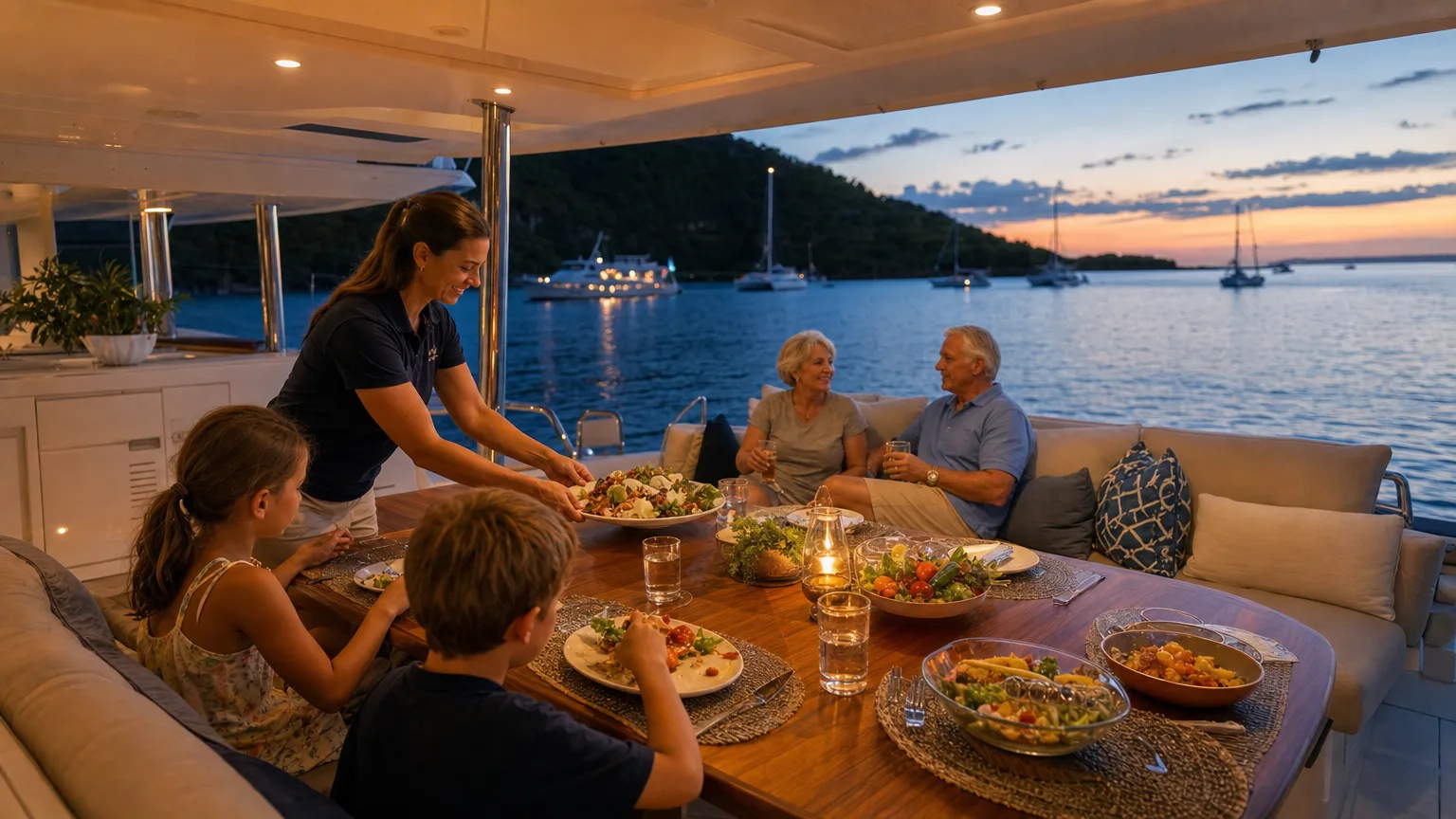
A crewed yacht inverts the model. Rather than fitting your family to the venue, the venue reshapes around your family every morning. That’s the whole argument, and it’s why we built Vital Charters around crewed boats rather than bareboats.
What Makes a Yacht Work for Every Age Group?
Fifty-seven percent of parents now plan trips that include both grandparents and children, up from 55% in 2023 (NYU SPS / Family Travel Association, 2025). Making that work aboard comes down to three specifications, and the one that decides the week is rarely the one families ask about first. Here’s what to prioritize by generation.
For Grandparents
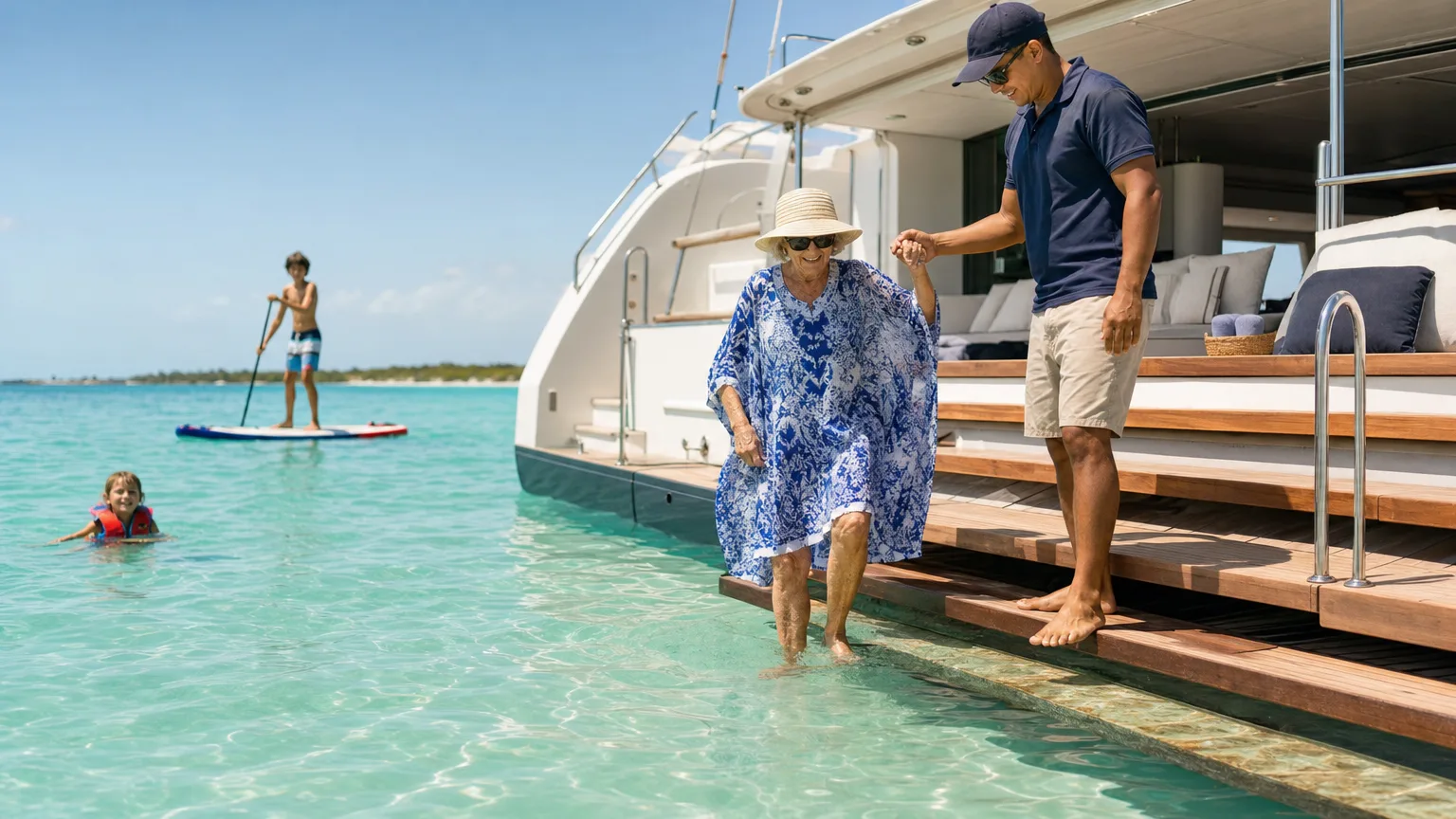
Physical access is the barrier, not comfort. Ask for a main-deck master suite, which removes stair climbing entirely, and zero-speed stabilizers, which hold the boat steady at anchor and matter enormously to anyone prone to motion sickness. A swim platform with steps means water access without a ladder. The crew handles every transfer and every boarding.
For Parents
On most family trips the parents are the logistics department. A crewed charter deletes that job. The captain plans the route, the chef handles every meal including separate seatings if you want them, and the stew keeps the boat running. Parents get to be on the holiday rather than administering it.
For Kids and Teenagers
Bored teenagers sink family trips faster than bad weather. A well-equipped yacht carries paddleboards, kayaks, snorkel gear, wakeboards and fishing tackle, and the crew usually doubles as activity coordinators. The advantage over a kids’ club is that nothing separates anyone: the whole family snorkels the same reef, with grandpa floating in a vest while the 15-year-old dives down to look at a turtle.
Where Should a Multigenerational Family Charter in the Caribbean?
Beach vacations are the single most popular family trip type, planned by 62% of families (NYU SPS / Family Travel Association, 2025). Within the Caribbean, three cruising grounds suit three generations better than the rest.
The British Virgin Islands are the default for a reason. Island hops run 30 to 60 minutes in protected water, which keeps seasickness off the table, and the anchorages are dense enough to move daily without long passages. Our BVI crewed charter guide has itinerary detail.
The Bahamas, specifically the Exumas, offer shallow, calm, startlingly clear water. That suits both ends of the age range: toddlers wading on a sandbar and grandparents who want to swim without surf.
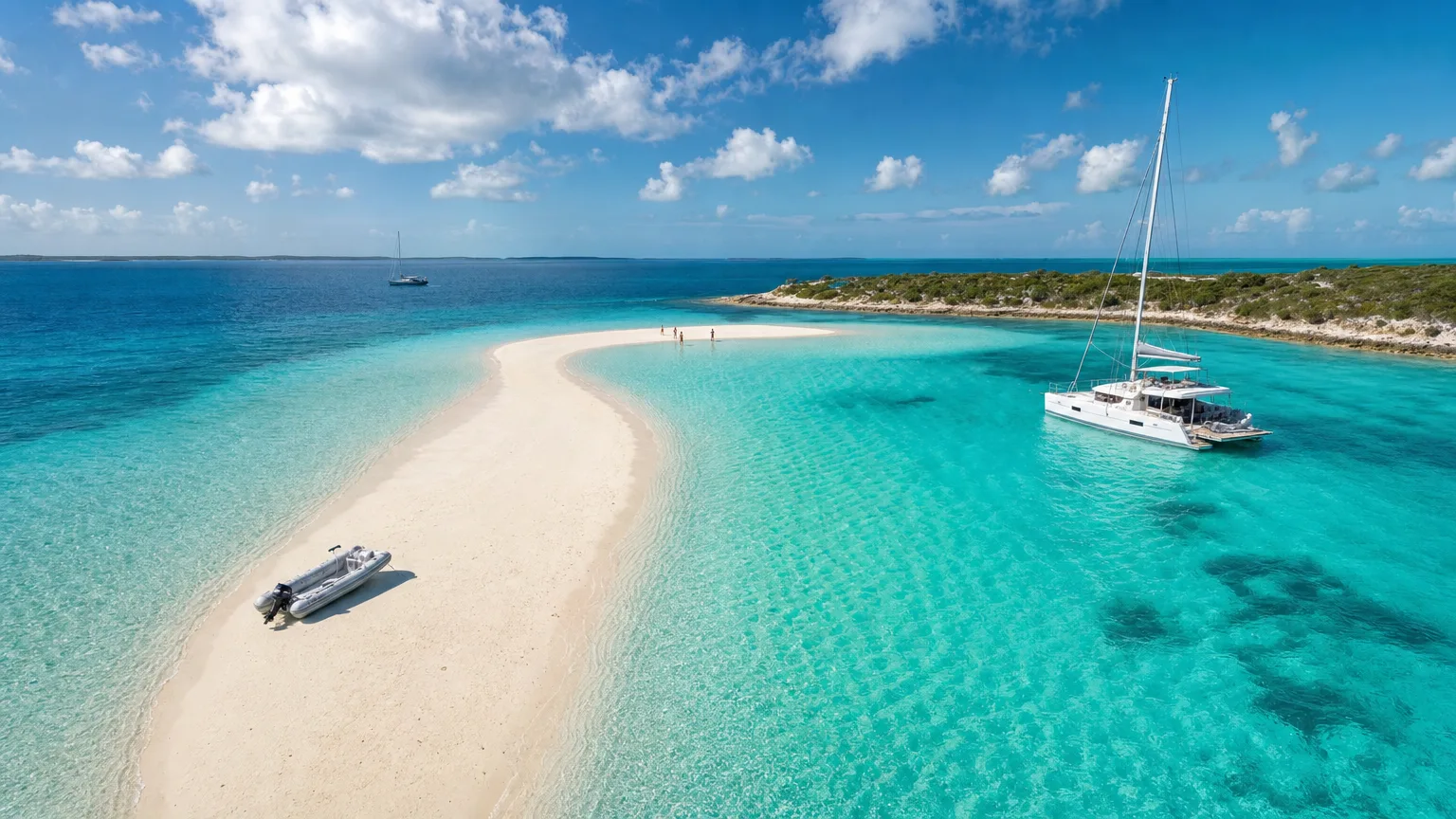
The US Virgin Islands work best for families who want shore time alongside water time, and they pair naturally with the BVI. See our BVI and USVI comparison if you’re choosing between them.
How Do You Plan a Multigenerational Charter?
Ninety-two percent of parents say they’re likely to travel with children in the next 12 months (NYU SPS, 2025). If you’re one of them, the process runs in three steps.
Step 1: Choose the Right Vessel
For 8 to 10 guests, a crewed catamaran in the 50 to 65 foot range is the sweet spot: stable, wide, and carrying the water toys. Groups of 10 to 12 usually need a motor yacht in the 70 to 100 foot range. Note that 12 guests is a hard ceiling, not a preference, because vessels carrying more than 12 passengers fall under a different regulatory class entirely (IMO SOLAS). Prioritize cabin count with en-suites, a main-deck master, stabilizers, and multiple separate deck areas so people can spread out.
Step 2: Fill Out the Preference Sheet Properly
This is the most important document in chartering and most families under-use it. Be specific and be blunt. Note that the grandchildren eat at 6:00 and the adults at 8:30, and list every allergy so the chef can build parallel menus. Flag mobility limits too, so the crew can prepare boarding assistance in advance. If the teenagers need working Wi-Fi to stay civil, say so, since Starlink-equipped boats are now common.
Step 3: Book Early
Peak Caribbean season runs December through April, and multigenerational groups should be booking 8 to 12 months out. School holiday weeks go first. Shoulder season in November or May trades a little weather certainty for meaningfully lower rates.
Start Planning
A multigenerational charter works because it removes the compromise that defines most family trips. Three generations want genuinely different days, and a crewed yacht is one of the few formats that can deliver all three at once without anybody negotiating for it.
If you’re weighing one for your family, talk to our charter specialists and we’ll match the group to a boat, a crew and an itinerary that fits everyone aboard.
Frequently Asked Questions
How much does a multigenerational family yacht charter cost?
All-inclusive Caribbean catamarans for 8 to 10 guests run $28,800 to $48,000 per week, median $34,000 (Vital Charters rate analysis, September 2026, n=216). For ten guests that’s roughly $3,400 each for the week, covering the boat, crew, food, drink and fuel. The only additional cost is the crew gratuity, customarily 15% to 20% (CYBA).
Does an all-inclusive charter still charge APA?
No. All-inclusive rates already contain provisioning, fuel and dockage, so there’s no Advance Provisioning Allowance on top. Plus-expenses charters are the ones that add an APA, typically 25% to 35% on a catamaran and 35% to 40% on a motor yacht (MYBA). Always confirm which structure a quote uses before comparing two boats.
What size yacht do we need for three generations?
For 8 to 10 guests, a 50 to 65 foot crewed catamaran with 4 to 5 en-suite cabins. For 10 to 12, look at a 70 to 100 foot motor yacht with 5 to 6 cabins. Twelve guests is the maximum on a standard charter yacht under SOLAS rules, so a larger family needs a second boat.
Are yacht charters workable for elderly family members?
Yes, with the right boat. Ask for a main-deck master suite so there are no stairs to the cabin, zero-speed stabilizers to hold the boat steady at anchor, and a swim platform with steps rather than a ladder. The crew manages all boarding and tender transfers. Flag any mobility concerns on the preference sheet, because crews handle this routinely.
Can one chef handle different diets across three generations?
Yes, and it’s standard. Charter chefs routinely run parallel menus across a single week: gluten-free, nut-free, toddler food and an adult tasting menu on the same evening. Many crews also split dinner into an early children’s seating and a later adult one, which is often what makes the week work socially.
When should we book a Caribbean family charter?
Book 8 to 12 months ahead for peak season, December through April, and earlier still for Christmas and spring break weeks. Shoulder season in November and May carries lower rates with generally good conditions.
Three generations, one boat
Peak Caribbean weeks book eight to twelve months out. Tell us your dates and how many are coming, and we’ll match the group to a yacht and a crew that suits every age aboard.