
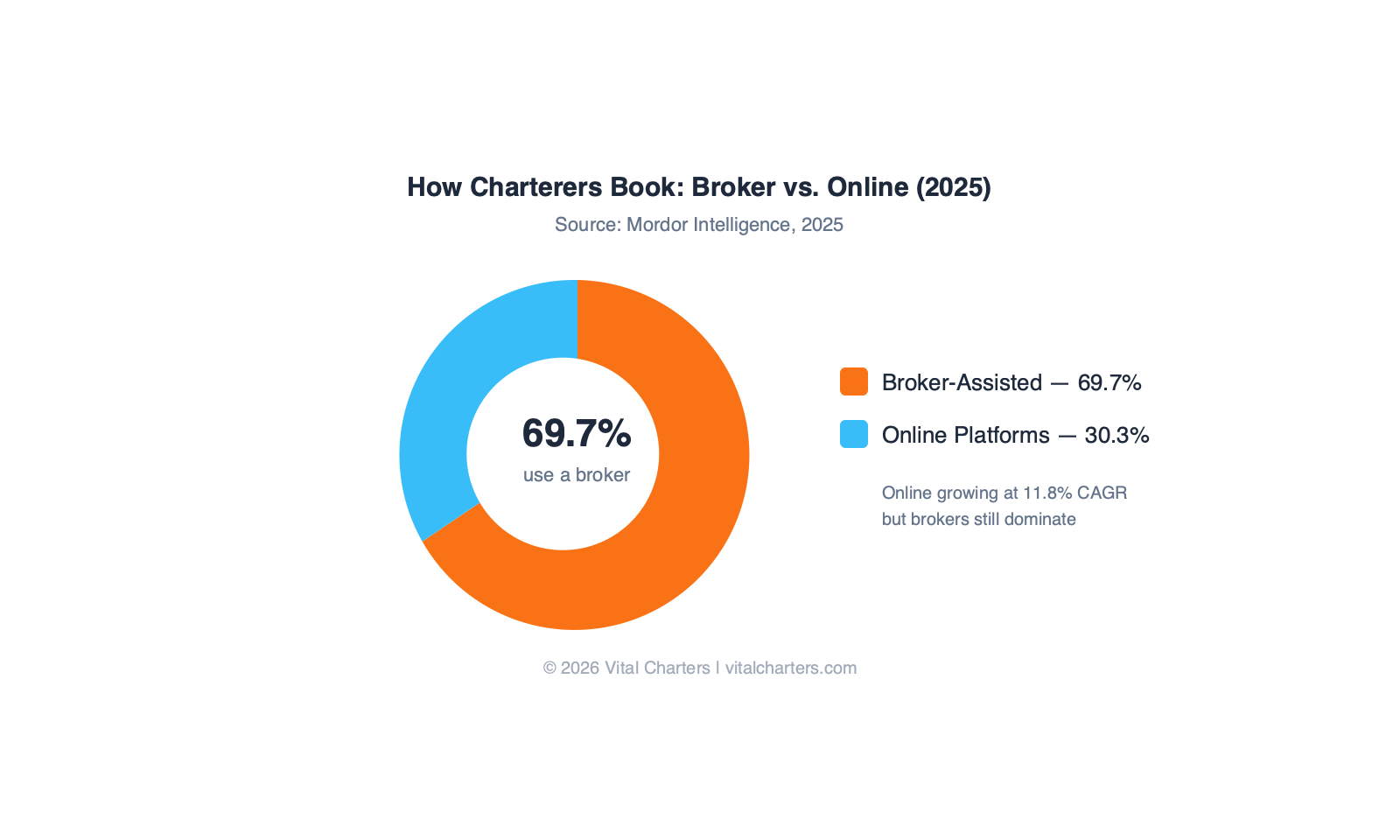
Broker-assisted bookings still account for 69.74% of all yacht charters worldwide, even as online platforms grow at 11.8% annually (Mordor Intelligence, 2025). In a $9.3 billion global market projected to reach $12.7 billion by 2031, that dominance tells you something: most charterers — including roughly 40% who are booking for the first time — still want a person, not a platform. But not all brokers are the same. Some are exceptional. Some are order-takers. And a few have financial incentives that don’t align with yours.
If you’re planning a Caribbean yacht charter for the first time — or even the fifth — the broker you work with shapes every aspect of the experience. The right broker doesn’t just find a yacht. They match you with the right crew, the right itinerary, and the right contract terms. The wrong one costs you money, time, and potentially a week you won’t get back.
TL;DR: The best charter brokers know the yachts personally, represent the client (not a fleet), stay involved from first inquiry through post-charter follow-up, and hold professional credentials. Always ask whether a brokerage is affiliated with a yacht management company — independent brokers give unbiased guidance (MYBA, broker standards).
What Does a Charter Broker Actually Do?
Crewed charters generate over 61% of global charter revenue (Mordor Intelligence, 2025), and a broker manages roughly 90% of the logistics behind each one — from yacht shortlisting through contract execution, preference sheet coordination, crew communication, and post-charter resolution (IYBA, industry standards). Think of the role less like a travel agent and more like a personal advocate with deep industry access.
View data table
| Booking Channel | Market Share (2025) | Growth Rate |
|---|---|---|
| Broker-Assisted | 69.74% | Stable |
| Online Platforms | 30.26% | 11.8% CAGR (2026-2031) |
Source: Mordor Intelligence, Yacht Charter Market Report, 2025
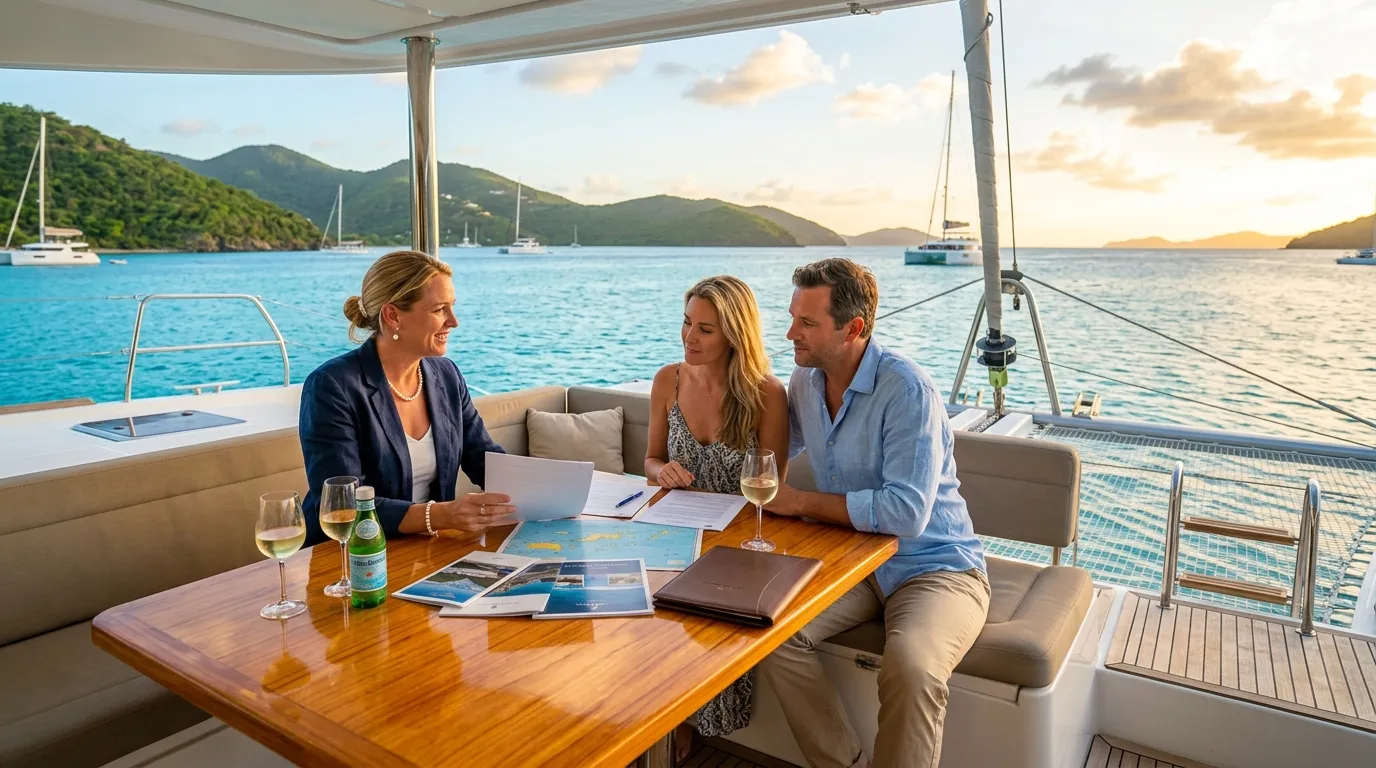
Here’s what that looks like in practice. When you contact a broker, you’re not browsing a website and clicking “book.” You’re having a conversation about what matters to you — how many guests, what age range, whether anyone gets seasick, what kind of food you want, whether you care more about water toys or quiet anchorages. A good broker translates those preferences into a shortlist of yachts that actually fit.
Then the behind-the-scenes work starts. Your broker negotiates the charter agreement, reviews the contract terms, coordinates your preference sheets with the crew, confirms provisioning details, arranges transfers if needed, and stays available throughout the charter week. If something goes sideways — a mechanical issue, a crew conflict, a weather reroute — your broker is the person who advocates for you with the yacht’s management company.
After you disembark, a good broker follows up. Did the crew deliver? Was the yacht as described? Did the itinerary work? This isn’t just customer service — it’s how a broker builds the knowledge base that makes their next recommendation to you even better.
A charter broker serves as the client’s representative throughout the entire process — from initial yacht selection and contract negotiation through preference sheet coordination, crew communication during the charter, and post-trip follow-up to ensure the experience matched expectations (IYBA, broker professional standards).
How Do the Best Brokers Know the Yachts and Crews?
The Caribbean charter fleet includes over 3,000 crewed yachts across destinations from the BVI to the Bahamas to the Grenadines. No charter broker knows every yacht. But the best ones know the ones that matter for their clients — because they’ve been aboard, met the crews, and tracked performance over multiple seasons.
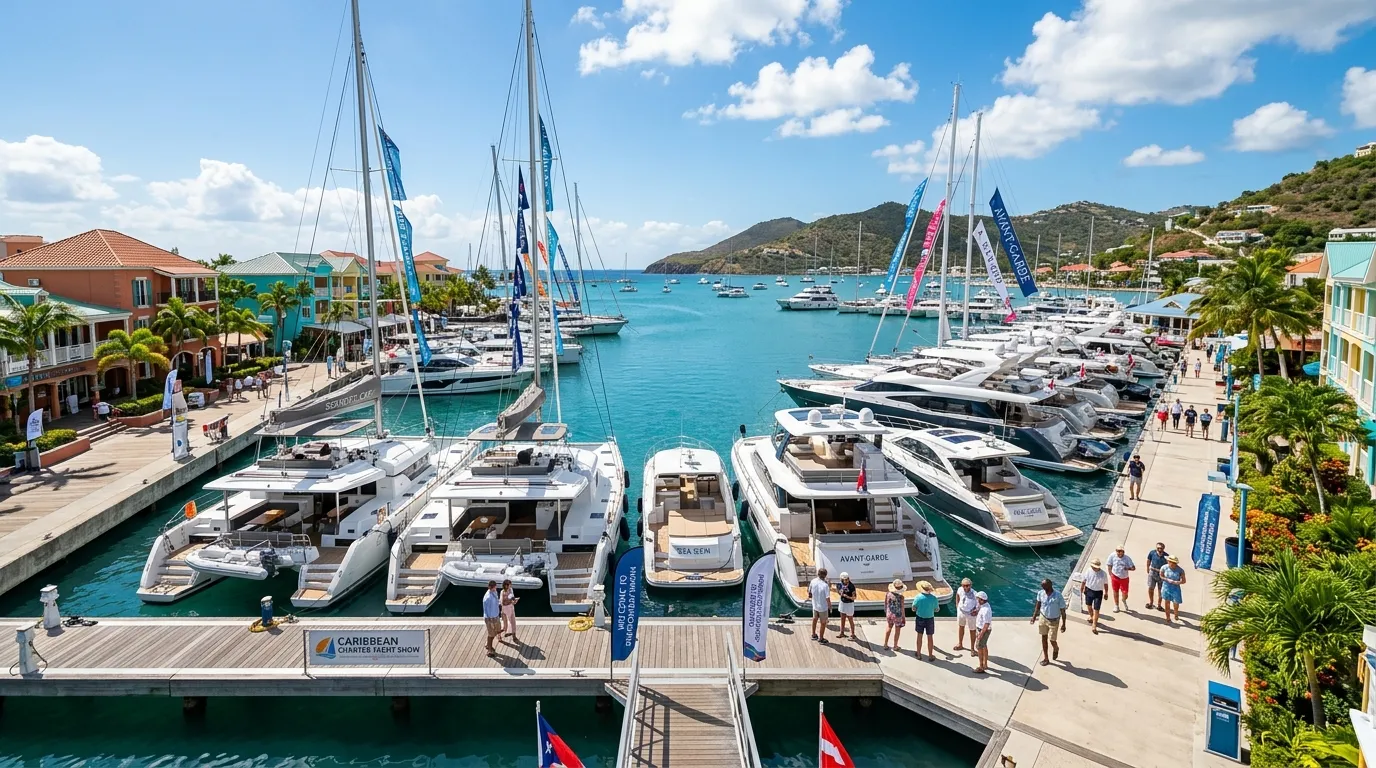
Charter yacht shows are where this happens. Events like the Antigua Charter Yacht Show and the BVI Charter Yacht Show bring together hundreds of yachts and crews every fall. Brokers walk the docks, inspect cabins, test water toys, sit down with captains and chefs, and evaluate which yachts are actually delivering what they promise. There’s no substitute for seeing a galley in person or watching how a captain talks about guest experience.
Our observation: We’ve walked dozens of yachts at Caribbean shows where the online photos looked stunning but the real condition told a different story — worn upholstery, outdated water toys, a chef who’s clearly burned out. The reverse happens too: modest-looking listings that turn out to be immaculate, with crews that radiate genuine hospitality. You can’t know this from a website. Your broker can.
Beyond shows, experienced brokers build relationships with crews over years. They know which captain handles rough weather with calm confidence. They know which chef can accommodate a table of allergies without breaking a sweat. They know which yachts just completed a major refit and which ones are coasting on reputation. This knowledge comes from repeat interactions and client feedback — and it’s the single biggest thing a broker brings to the table that a booking platform can’t replicate.
When you’re evaluating a broker, ask: “How do you vet the yachts you recommend?” If the answer is “we look at the listings,” that’s a red flag. If the answer involves yacht shows, personal inspections, crew relationships, and client feedback loops, you’re talking to someone who does the work.
Why Does Broker Independence Matter?
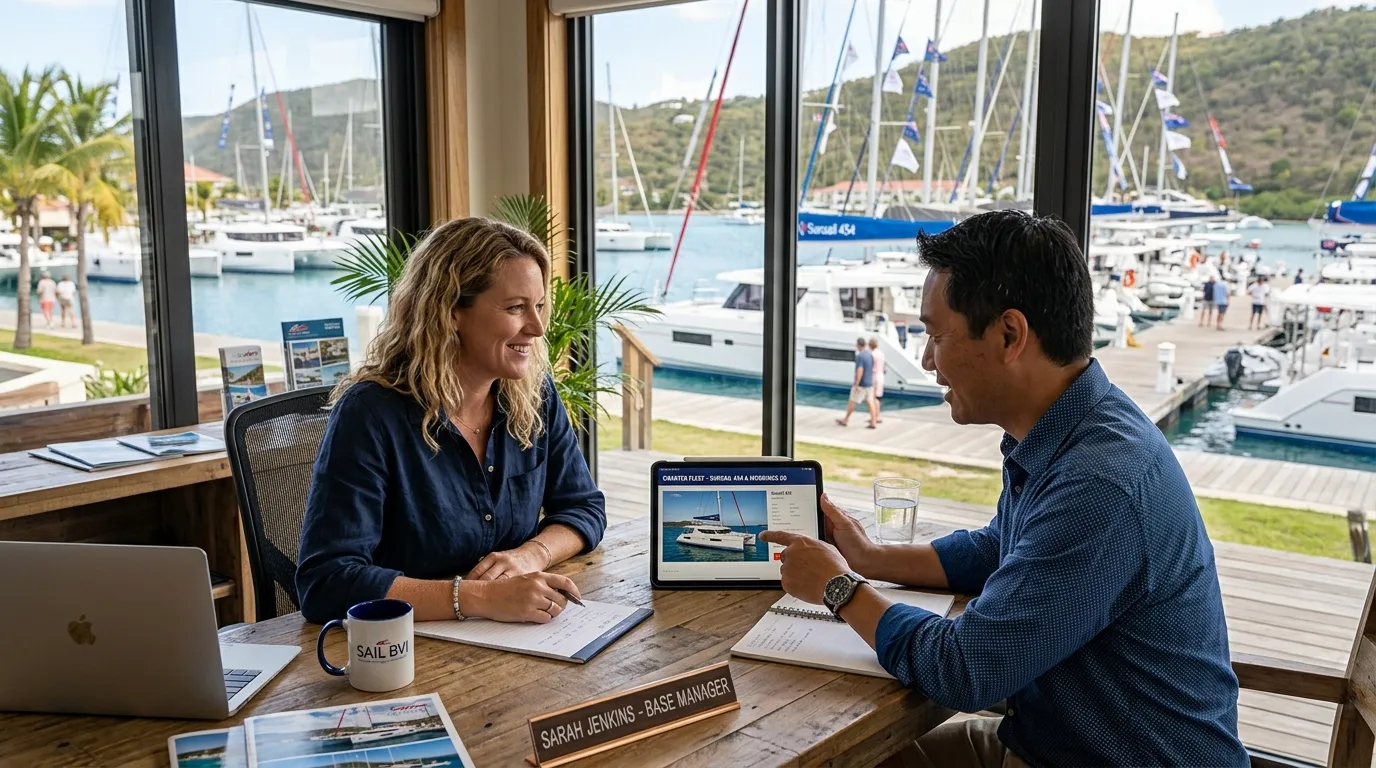
Not every charter brokerage operates the same way. Some are fully independent — they represent the client, not a fleet. Others are affiliated with yacht management companies, meaning the same organization that brokers your charter also manages (and profits from) specific yachts in their fleet. According to MYBA‘s broker code of ethics, brokers must disclose any conflicts of interest and act in the client’s best interest, but enforcement varies across the industry.
Here’s why it matters. A brokerage tied to a managed fleet has a financial incentive to steer you toward their own yachts. They may present those boats first, emphasize their availability, or subtly downplay alternatives from independent owners. It’s not necessarily malicious — it’s structural. The incentive exists whether anyone acts on it or not.
The analogy is a financial advisor. An independent fee-only advisor recommends the investments that serve your goals. An advisor employed by a brokerage firm may have incentives to sell you in-house financial products — funds their employer earns fees on, regardless of whether those funds are the best fit for your portfolio. The advice might still be decent, but the alignment isn’t the same.
The same dynamic plays out in yacht chartering. An independent broker evaluates the entire market — every yacht, every crew, every management company — and recommends the best match for you. A fleet-tied brokerage evaluates their own inventory first.
This doesn’t mean fleet-affiliated brokers are bad. Many are highly professional. But you should know the relationship before you sign. Ask directly: “Does your company own, manage, or have financial relationships with any of the yachts you’re recommending?” A transparent broker will answer without hesitation.
Independent charter brokers who are not affiliated with yacht management companies provide unbiased yacht recommendations drawn from the entire market rather than a proprietary fleet. MYBA’s broker code of ethics requires disclosure of conflicts of interest, but clients should ask directly whether the brokerage manages or has ownership stakes in any recommended yachts (MYBA, code of ethics).
What Questions Should You Ask Before Hiring a Broker?
The right questions separate a capable broker from a polished salesperson. Here are the ones that reveal the most — and what good answers sound like.
“How do you select the yachts you recommend?” A strong answer mentions yacht shows, personal inspections, crew relationships, and client feedback. A weak answer references listing databases or “our network” without specifics. The best brokers can name specific yachts they’ve been aboard recently and explain why they would or wouldn’t recommend them for your trip.
“Is your company affiliated with or does it manage any charter yachts?” You want a direct, clear answer. If yes, ask how they ensure recommendations aren’t biased toward their own fleet. If no, you’re working with an independent broker who represents only you.
“What happens if something goes wrong during the charter?” A good broker has a specific answer — they’ll contact the management company, negotiate solutions, arrange alternatives if needed, and advocate for you. A vague answer (“we’ll handle it”) suggests they haven’t dealt with enough real problems to have a process.
“Can I talk to a recent client?” Any broker confident in their service will connect you with references. Hesitation here is telling.
“What’s your commission structure?” Brokers typically earn 15–20% commission from the yacht’s charter fee — paid by the yacht, not the client. You aren’t paying extra by using a broker. But understanding the structure confirms there are no hidden fees on your side. See our full breakdown of hidden fees in yacht charters.
“Will you be my point of contact through the entire process?” Some brokerages hand you off to a different team after booking. The best brokers stay with you from first call through post-charter follow-up — continuity matters because context gets lost in handoffs.
What Makes Vital Charters Different?
Most charter brokerages are built by people who came up through the yachting industry — crew, captains, or yacht management professionals who transitioned into sales. That background gives them operational knowledge, but it also means they tend to see chartering from the supply side: yachts, crews, logistics.
Vital Charters was built differently. Our brokers came to this industry primarily as charterers. We’ve been the clients sitting in the saloon, wondering if the itinerary was right, asking whether the APA was fair, figuring out how to get eight people from Miami to Tortola on the same day. We understand the industry from all sides now — fleet operations, pricing structures, crew dynamics, contract terms — but we view chartering predominantly through the same lens as the people we serve.
Our observation: When you’ve been the person on the other end of the booking — the one who saved up, coordinated the family schedules, flew everyone to a Caribbean island — you don’t treat a charter as a transaction. You treat it as someone’s week. That perspective shapes everything we do, from how we vet crews to how aggressively we negotiate APA terms on your behalf.
We’re also fully independent. Vital Charters doesn’t own, manage, or have financial relationships with any charter yachts. When we recommend a yacht, it’s because we believe it’s the best match for your group — not because we earn more from one boat than another. Every recommendation starts with your preferences, not our inventory.
And we don’t disappear after booking. From your first inquiry through embarkation day and beyond, you work with the same broker. After you’re back home, we follow up — not with a survey link, but with a real conversation about what worked and what didn’t. That feedback makes us better, and it makes your next charter better too.
Frequently Asked Questions
Do I pay extra to use a charter broker?
No. Brokers earn commission from the yacht’s charter fee — typically 15–20%, paid by the yacht owner or management company. The charter rate is the same whether you book direct or through a broker. You get expert guidance, advocacy, and logistics management at no additional cost.
Can a broker get me a better deal than booking direct?
Often, yes. Brokers know which yachts offer early-booking discounts, repositioning specials, or introductory rates for new-to-charter vessels. They also negotiate all-inclusive terms and APA percentages that you wouldn’t know to ask for. A broker’s market knowledge is the advantage.
How far in advance should I contact a broker?
Six to twelve months is ideal for peak-season Caribbean charters (December through April). For shoulder season (May through July), three to six months is usually sufficient. Last-minute charters are possible but limit your yacht and crew options significantly.
What if I’ve never chartered before?
That’s exactly when a broker adds the most value. First-time charterers have the most questions — about costs, yacht types, destinations, what to pack, what to expect on board. A broker who specializes in first-time charterers will walk you through every step without making you feel like you should already know the answers.
What’s the difference between a charter broker and a charter company?
A charter company typically manages its own fleet of yachts and sells charters on those specific boats. A broker is independent and searches the entire market to find the best yacht for your needs. Think of it as renting a car from Hertz (charter company) vs. working with a travel agent who compares every rental company to find the best car at the best price (broker).
Jason Acosta is the co-founder and principal broker of Vital Charters. He is an avid sailor and yacht charterer. Jason is also a Master Diver and certified ASA 104 sailor.