
Quiet Luxury Vacations: Why Crewed Yacht Charters Fit the Bill
Quiet luxury yacht charter demand surged in Virtuoso’s 2026 Luxe Report. See why crewed Caribbean yachts deliver privacy resorts and villas can’t match.
Last Updated: September 7, 2026
A quiet luxury yacht charter vacation is the cleanest expression of the dominant 2026 travel trend (privacy, silence, no logos) because it’s the only travel product where the entire venue belongs to your party 24 hours a day. The trend now has a formal industry name: hushpitality, Hilton’s 2026 label for the surge in demand for silence and unmarked luxury. Privacy ranks among the top three ultraluxe experiences in Virtuoso’s 2026 Luxe Report, surveying 2,485 luxury advisors across 50+ countries (Virtuoso, October 2025). This post is the deeper dive on one trend from our 2026 travel trends pillar: why hushpitality lives at sea more purely than on land.
Quiet luxury isn’t a feature you can shop for: it’s a posture, the absence of friction, branding, and strangers. The rest of this post covers what the trend means in 2026 data, why crewed yacht charters fit it better than any other premium product, what invisible service looks like at sea, which Caribbean and Bahamas itineraries maximize privacy, and what a fully private yacht week actually costs.
What Is Quiet Luxury in 2026 Travel?
The Virtuoso 2026 Luxe Report frames the mood as “stealth wealth”, understated design, private access, deliberate retreat from visible status (Virtuoso 2026 Luxe Report, October 2025). Skift’s 2026 Megatrends puts it more bluntly: the entire luxury category has reframed itself as “less abundance, more restraint”, fewer logos, less noise, less congestion (Skift Megatrends 2026, January 2026).
The trend has three observable features in 2026 booking data:
- Smaller group sizes and full buyouts. Hilton’s 2026 Travel Trends Report tracks rising demand for full-property buyouts and “no-other-guests” stays (Hilton 2026 Travel Trends, 2026).
- Logo aversion. American Express Travel’s 2026 report shows luxury travelers deprioritizing branded experiences in favor of unmarked, residential-feeling spaces (American Express Travel, 2026).
- Silence as an amenity. Booking.com’s Travel Predictions 2026 lists “quiet escapes” and noise-free zones among the top motivations for premium travelers (Booking.com Travel Predictions 2026, 2026).
This isn’t only an aesthetic preference: it’s a structural response to overtourism. The UN World Tourism Barometer reports international arrivals well above pre-pandemic levels, with the strongest growth concentrated in already-crowded coastal destinations (UN Tourism Barometer, 2026). Crowds got worse. Premium travelers responded by buying their way out.
Why Crewed Yacht Charters Fit Quiet Luxury Better Than Resorts or Villas
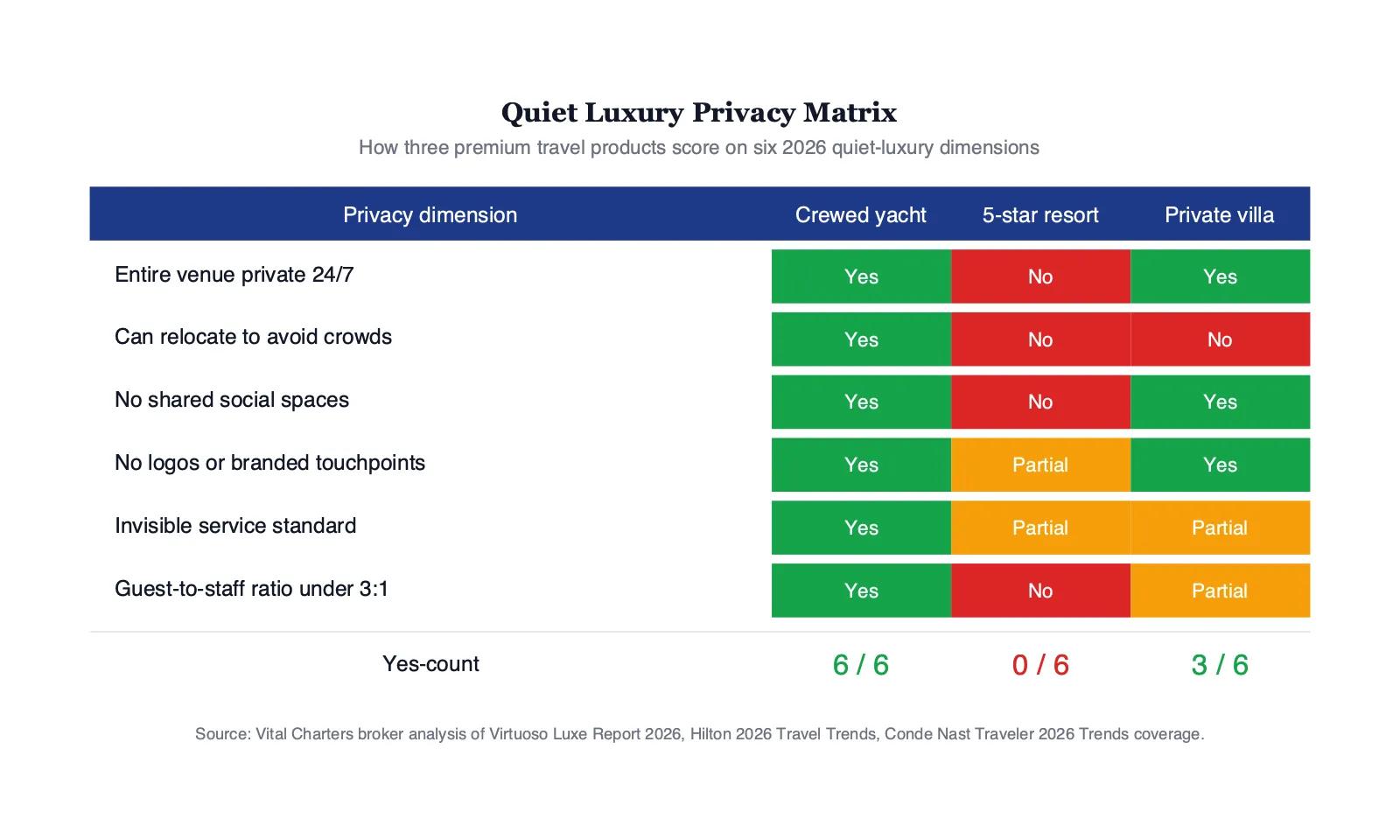
A crewed yacht is the only travel product where the entire venue is private 24/7, every pool, every dining room, every social space belongs to your party alone. That’s not true at any 5-star resort (lobbies, bars, restaurants, beach clubs, and most pools are shared) and it’s only partially true at a private villa, which is private indoors but anchored to one address. On the dimensions that actually define quiet luxury (exclusivity of space, freedom from strangers, control over location, and invisibility to other guests) a yacht wins on every axis. Our crewed yacht charter vs luxury resort price comparison walks through the cost side of the same trade-off.
View data table
| Privacy dimension | Crewed yacht | 5-star resort | Private villa |
|---|---|---|---|
| Entire venue private 24/7 | Yes | No | Yes |
| Can relocate to avoid crowds | Yes | No | No |
| No shared social spaces | Yes | No | Yes |
| No logos or branded touchpoints | Yes | Partial | Yes |
| Invisible service standard | Yes | Partial | Partial |
| Guest-to-staff ratio under 3:1 | Yes | No | Partial |
| Yes-count | 6 / 6 | 0 / 6 | 3 / 6 |
Source: Vital Charters broker analysis of Virtuoso Luxe Report 2026, Hilton 2026 Travel Trends, Conde Nast Traveler 2026 Trends coverage.
The villa-versus-yacht comparison is more nuanced. A villa wins on square footage and indoor privacy, but it drops you into someone else’s neighborhood: beach access is often shared, restaurants are public, and you can’t relocate when crowds build at the nearest beach. A yacht’s mobility means privacy compounds: you aren’t just renting a private venue, you’re renting the ability to leave when anyone else arrives. The same privacy logic is why a honeymoon yacht charter consistently outperforms a resort honeymoon for couples who specifically don’t want to see other guests.
The ‘Invisible Service’ Standard of Professional Yacht Crew
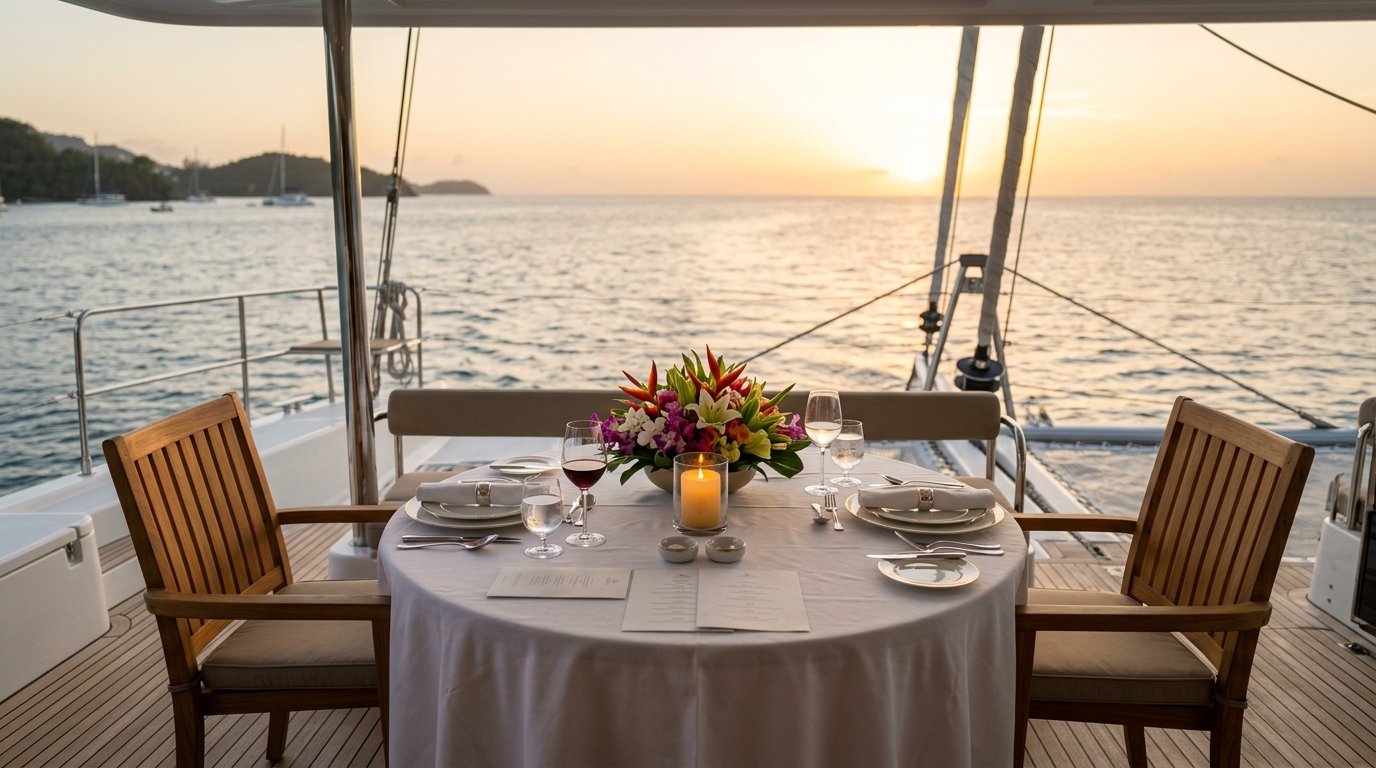
Six-star hospitality in 2026 is no longer about being seen. It’s about not being seen until you’re needed, a service standard Conde Nast Traveler’s 2026 trends coverage flags as “invisible luxury” (Conde Nast Traveler 2026 Trends, 2026). Crewed yacht charters institutionalized this years before it became a wider hospitality trend. A typical 5-cabin yacht carries 4–6 crew (captain, chef, chief stewardess, deck and engineer) trained to anticipate, prepare, and disappear.
What that looks like in practice on a Caribbean charter:
- The chef plans menus from a preference brief filled out before the charter, then adjusts to what guests actually eat. You don’t read a printed menu unless you ask for one.
- The stewardess resets cabins and refills the bar without entering the main saloon while guests are there.
- The captain briefs the day’s options the night before, then executes silently in the morning while guests sleep.
- Crew quarters sit on a separate deck, so crew exist only when summoned.
The guest-to-crew ratio is what you feel here. A 10-guest yacht with 5 crew runs at 2:1. A 5-star resort runs roughly 1.5 guests per staff member counting back-of-house, but those staff serve hundreds of guests across shared spaces. On a yacht, that 5-person team serves your party exclusively for the entire week.
Itineraries That Maximize Privacy in the Caribbean and Bahamas
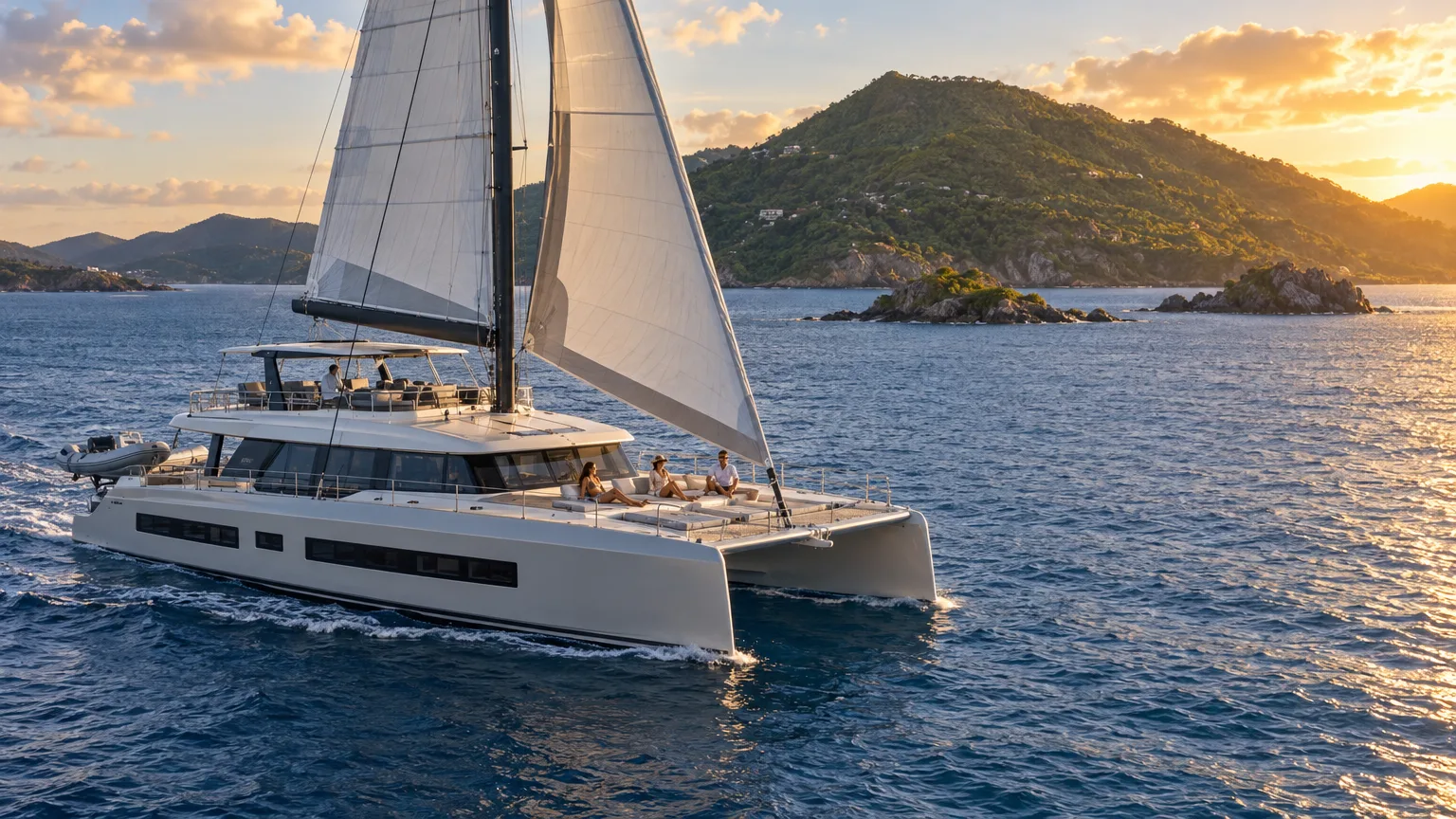
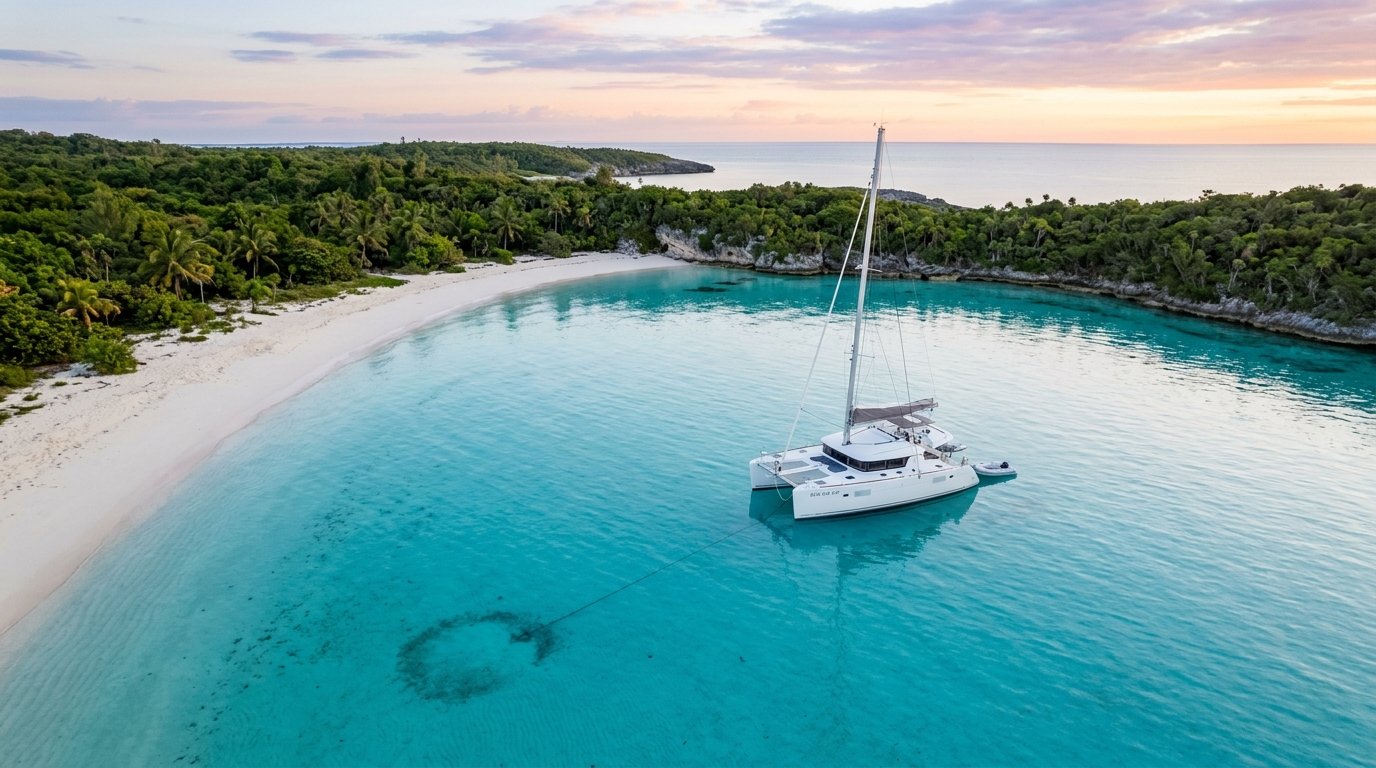
The Caribbean and Bahamas have cruising regions where commercial cruise ships physically can’t operate (shallow drafts, no cruise infrastructure, no commercial development) and those are where quiet luxury actually lives (Hilton 2026 Travel Trends, 2026). The Exumas, the Grenadines from Bequia south to Union Island, and the BVI’s lesser-known anchorages all qualify.
Anchorages to brief a broker on for a quiet-luxury charter:
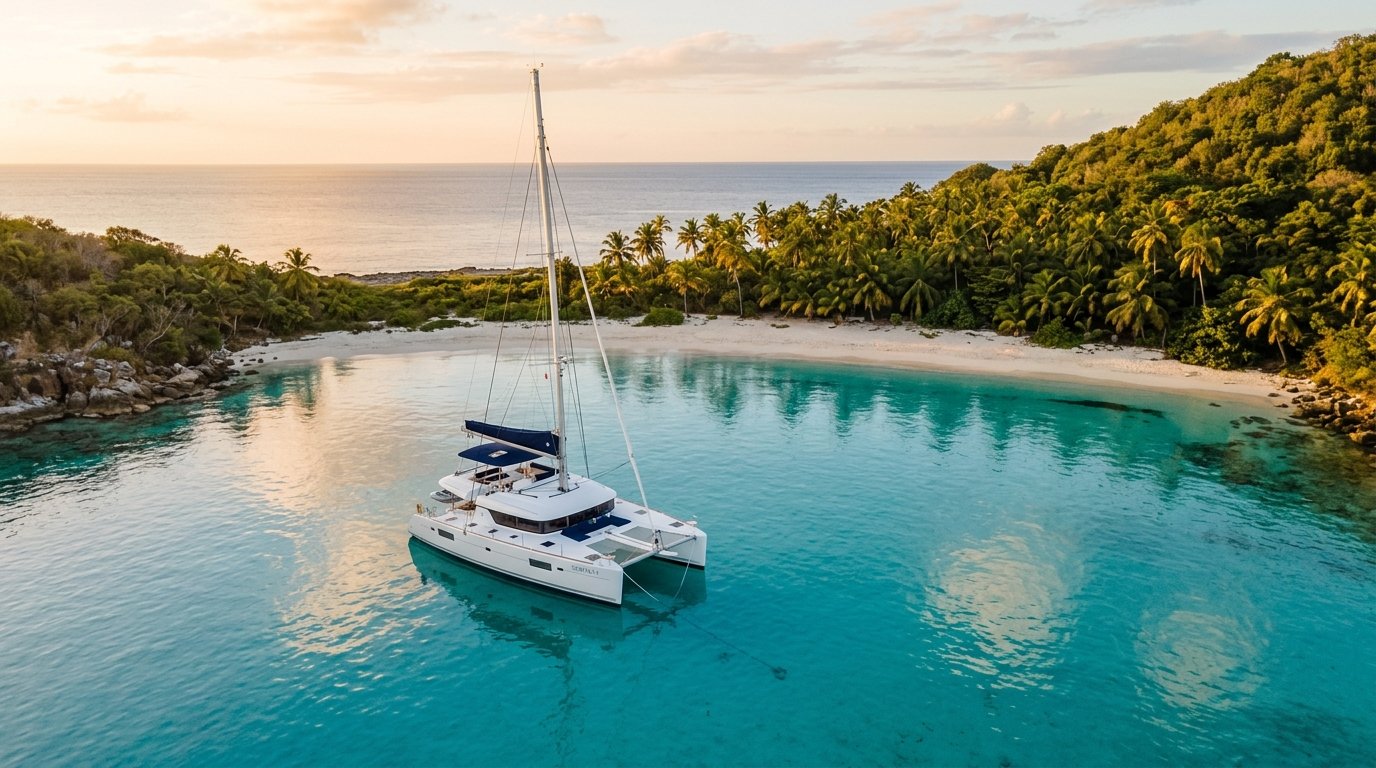
- Compass Cay and Shroud Cay (Exumas, Bahamas). Tender-access only. No resort infrastructure. The anchorage typically holds 2–4 other yachts at most.
- Tobago Cays (Grenadines). Marine park with anchoring caps. A crowded day is 8 boats; cruise ships can’t enter at all.
- Anegada North Shore (BVI). Reef-protected, shallow approach that excludes most large vessels and day-charter traffic.
- Mayreau (Grenadines). A 0.46-square-mile island with one road, one village, and beaches accessible primarily from the water, including Salt Whistle Bay.
A worked example of how these anchorages string together: our 7-day Grenadines yacht charter itinerary walks through Bequia, Mustique, Tobago Cays, and Union Island as a single privacy-maximized loop.
A well-designed quiet-luxury itinerary alternates anchored days (zero motion, full privacy) with short cruising legs under three hours, timed for sunset arrivals. Briefing your broker with “we want the fewest other boats per anchorage” produces a meaningfully different proposal than “we want the most amenities”, and it’s the brief that actually delivers the trend.
What a Quiet Luxury Yacht Week Actually Costs
A fully private quiet-luxury yacht week for 8–10 guests in the Caribbean runs roughly $20,000–$180,000 base fee, with all-in cost (CYBA all-inclusive contract plus crew gratuity plus park and cruising permits) landing in the $30,000–$230,000 range for the week (Virtuoso 2026 Luxe Report, 2026). That band covers crewed sailing catamarans and motor yachts in the 50–80 foot range, which captures most of the quiet-luxury inventory across the Caribbean and Bahamas.
Per person, that’s roughly $6,000–$23,000 for the week, the same price band as buyout suites at top-end Caribbean resorts (American Express Travel, 2026): but with the entire venue, not just your room, included. Our luxury catamaran charter price tiers guide breaks the band down by yacht size. Step up into 100+ foot motor yachts and the math moves substantially: $250,000–$500,000+ all-in for the week.
The Bottom Line: Quiet Luxury Lives at Sea
The 2026 trend reports describe what premium travelers want. A crewed Caribbean yacht charter is one of the few products that delivers it without compromise, private venue 24/7, invisible service, mobility, and zero logos. Resorts can do parts of it. Villas can do parts of it. A yacht is the rare product that does the full set. Hushpitality is one of nine 2026 travel trends our pillar piece maps against crewed charter: and it’s the trend yachts deliver most purely.
When you’re ready to think through dates, group size, and the specific anchorages that match your privacy threshold, start a yacht search at Vital Charters and we’ll match the brief to inventory. If you’d rather talk it through first, our contact form routes directly to me.
Frequently Asked Questions
What does quiet luxury mean for a yacht charter?
In 2026 travel reports from Virtuoso, Skift, and Hilton, quiet luxury means three things: privacy (small group, no shared spaces), invisibility (no logos, no branded experiences, residential aesthetics), and silence (no crowds, no piped music, no scheduled activities). On a crewed yacht, all three are structural: you’ve rented the entire venue, the crew is trained to be invisible until needed, and the cruising area excludes commercial traffic.
How is a quiet luxury yacht charter different from a 5-star resort?
The biggest difference is venue exclusivity. A 5-star resort’s pools, restaurants, lobbies, and beach clubs are shared among hundreds of guests. A crewed yacht’s spaces are yours exclusively for the week, plus you can relocate when wind, crowds, or weather shift. Resorts replicate room-level privacy. Yachts replicate venue-level privacy: which is what 2026 luxury travelers are buying.
Is a private villa equivalent to a yacht for quiet luxury?
Partially. A villa wins on square footage and indoor privacy, but it’s tied to one neighborhood, shared beaches, public roads, external restaurants. A yacht is private and mobile. If a beach gets crowded, you move. The mobility is the part most first-time clients underestimate.
How many guests can a quiet luxury yacht hold without losing the feel?
Industry inventory caps most crewed Caribbean charters at 12 guests because of the U.S. Coast Guard’s 12-passenger rule for commercial vessels. For quiet luxury specifically, 6–10 guests on a 5-cabin yacht is the sweet spot, enough to share the experience without the noise and logistics overhead that creep in past 10 guests.
What’s included in a quiet luxury yacht charter price?
Caribbean charters typically use the CYBA All-Inclusive E-Contract, which bundles the yacht, the crew, three meals per day, the standard ship’s bar, four hours of daily cruising fuel, water toys, and ship’s laundry (CYBA E-Contract, 2026). Not included: crew gratuity (15–20% of base), cruising permits and park fees, premium liquor, scuba certification dives, off-yacht excursions, and travel insurance.
When is the best time to book a quiet luxury Caribbean yacht charter?
The premium quiet-luxury yachts book six to twelve months ahead for high season (mid-December through April). For the quietest experience specifically, early December and late April through May deliver the best yacht-to-crowd ratio in the same anchorages while keeping water temperatures and weather firmly in the swim window.
Understated, private, yours alone at anchor.
Share your group size and preferred islands and we’ll find a crewed yacht that delivers the privacy and service quiet luxury demands, no crowds, no show.