
Sailing Catamaran vs Power Catamaran: Which to Charter
Sailing vs power catamaran: 17 knots against 7, and a 56% price gap at the length most charters book. Measured 2026 fleet rates and the BVI-vs-Bahamas rule a broker uses to decide.
Last Updated: September 7, 2026
Choosing between a sailing vs power catamaran for your Caribbean charter is really a choice between range and rhythm versus speed and space. Both share the wide-beam stability that makes catamarans feel less like a boat and more like a floating villa, and both outperform monohulls on stability and group space for the kind of vacation most charterers actually want. The split comes down to how fast you want to move, how much fuel you want to burn, and which islands you want to link together.
I’m a Caribbean and Bahamas broker, so this comparison is written for guests stepping onto a crewed charter: captain and chef on board, no helm time required. Most boat-format comparisons elsewhere are written for owners; this one is for charterers, especially first-time charterers trying to pick a boat. The crewed catamaran fleet we represent covers both sail and power options across the five charter yacht brands that dominate Caribbean fleets: the right answer changes depending on where you’re headed and how long you have.
The short version sits below. The long version is where the trade-offs get specific.
The short answer: which catamaran should you charter?
A sailing catamaran costs far less than a power catamaran of the same length. At 50 to 54 feet, the one band where both are common, the sailing median is $27,000 a week against $42,210 for a power cat, a 56% difference (Vital Charters rate analysis, September 2026). Power cats cruise at 17+ knots, roughly double a sail cat’s pace, and reclaim the interior volume normally given to mast and rigging (Power & Motoryacht, 2022). The choice is destination-driven: sail for the BVI trades, power for shallow-water Bahamas and tight schedules.
Pick a sailing catamaran if you want a quieter boat, lower weekly rate, the sound of wind in the rig, and an itinerary where most hops are 10-25 nautical miles. The British Virgin Islands were built for this. Pick a power catamaran if you want to cover ground without waiting on weather, you have kids or guests who get antsy on a slow passage, or you’re chartering in the Bahamas where the legs are longer and the wind is fluky.
One thing to settle before the trade-offs: below 50 feet the choice does not exist. Of the 353 charter catamarans working the Caribbean and Bahamas, 37 are power cats, and exactly one of those is under 45 feet while none at all sit in the 45-49 ft band (Vital Charters listings analysis, September 2026). The rest of this guide breaks down what changes once you make the call, speed, fuel, range, price, draft, and the workload your crew actually takes on.
Speed and itinerary: how much further does a power cat actually go?
A 45-foot sailing catamaran averages 7-8 knots on a tradewinds passage; a comparable Leopard 53 power catamaran cruises at 17.2 knots and tops out near 25 knots (Sail Magazine, 2017; Power & Motoryacht, 2022). That’s roughly double the pace: and on a one-week charter, doubling your transit speed can stretch the itinerary by one or two extra anchorages.
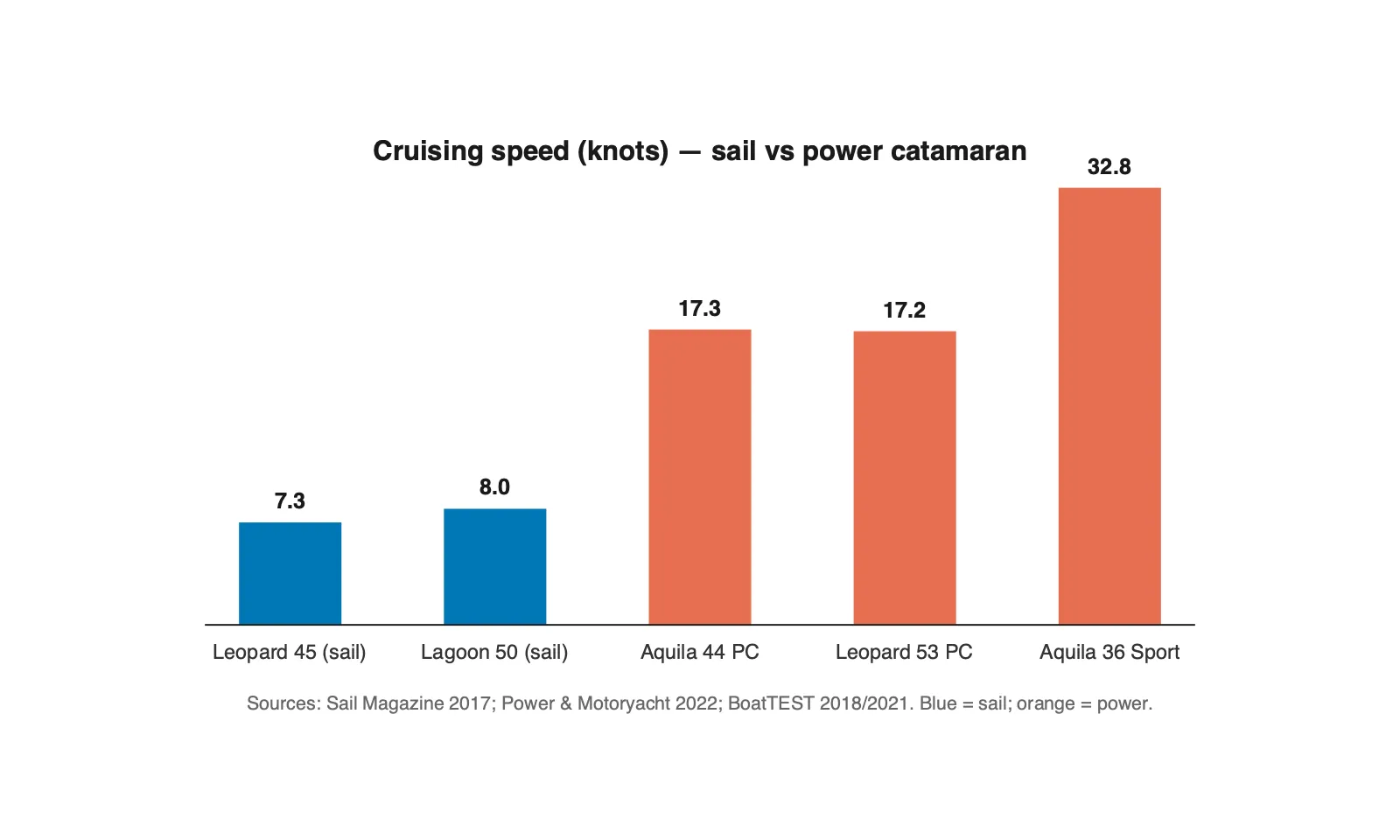
View data table
| Boat | Type | Cruise speed (knots) | Source |
|---|---|---|---|
| Leopard 45 | Sailing cat | 7.3 | Sail Magazine, 2017 |
| Lagoon 50 (typical) | Sailing cat | ~8.0 | Manufacturer / trades |
| Aquila 44 | Power cat | 17.3 | BoatTEST, 2018 |
| Leopard 53 PC | Power cat | 17.2 | Power & Motoryacht, 2022 |
| Aquila 36 Sport | Sport power cat | 32.8 | BoatTEST, 2021 |
What does that look like in practice? On a BVI loop, the islands sit close together: Tortola to Norman Island is six miles, Norman to The Baths on Virgin Gorda is about eleven. Sail or power, you’re at the next mooring before lunch. See our answer to: Which is better, Virgin Gorda or Tortola? The itinerary advantage of a power cat almost disappears.
The Bahamas tell a different story. Nassau to Highbourne Cay in the Exumas is roughly 35 nautical miles. A sailing cat at 7 knots eats five hours of that day; a power cat at 17 knots wraps it in two. Over a seven-day Exumas itinerary, that difference compounds into one or two extra anchorages a power cat can comfortably visit.
Fuel burn and real charter fuel costs
A Leopard 53 power catamaran burns 9.4 gallons per hour at its 17.2-knot cruise; an Aquila 44 burns about 20 gph; an Aquila 54 burns roughly 33.5 gph at 17 knots (Power & Motoryacht, 2022; BoatTEST, 2018; Yachting Magazine). A sailing catamaran of similar size, motoring at 7 knots when the wind dies, sips closer to 1-2 gph total across both auxiliaries.
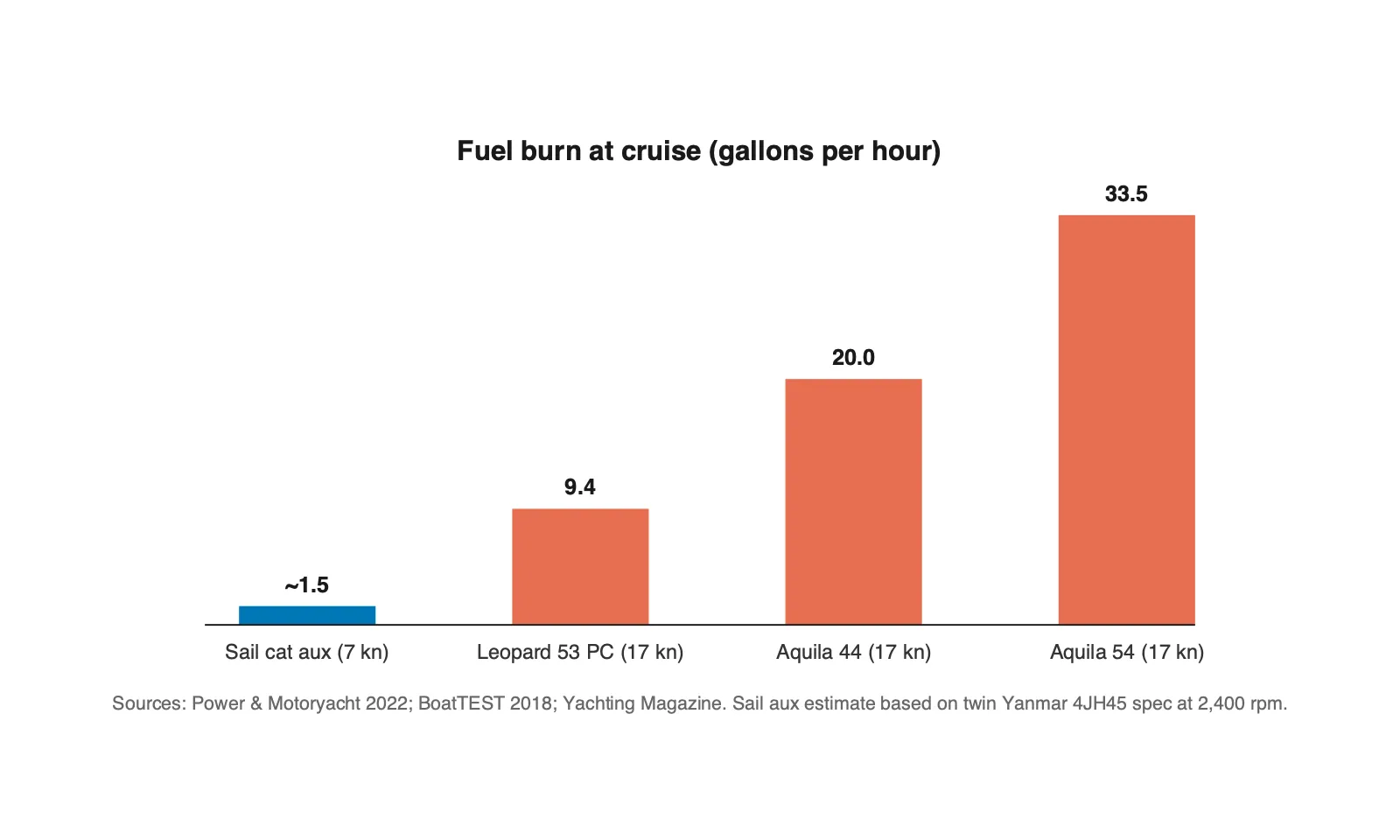
View data table
| Boat | Cruise speed | Fuel burn (gph) | Source |
|---|---|---|---|
| Sailing cat auxiliary engines (twin 45 hp diesels) | 7 knots | ~1.5 | Yanmar 4JH45 spec sheet at 2,400 rpm |
| Leopard 53 PC | 17.2 knots | 9.4 | Power & Motoryacht, 2022 |
| Aquila 44 | 17.3 knots | 20.0 | BoatTEST, 2018 |
| Aquila 54 | 17 knots | 33.5 | Yachting Magazine |
What does that mean for your APA? Assume four hours of cruising a day across a seven-day BVI charter and Caribbean diesel at roughly $7 per gallon. A Leopard 53 PC burns about 263 gallons in transit ($1,840). A sailing cat using auxiliaries on a calm day burns maybe 30-40 gallons all week ($210-$280). Even after adding generator runtime on the power cat for AC, you’re looking at a fuel bill that’s $1,500-$2,500 higher per week on power.
A Leopard 53 power catamaran burns 9.4 gallons per hour at its 17.2-knot cruise (Power & Motoryacht, 2022). A comparable sailing catamaran motors at 7 knots burning roughly 1-2 gph total when the wind dies. On a 100-nautical-mile charter day, that’s the difference between roughly 55 gallons and under 15, a fuel-bill gap most guests don’t see coming.
This is the line item that flips most guests’ assumption that “a few hundred more per night” is the only cost difference. Yacht charter costs (and the APA that funds them) move noticeably on power.
Range: when fuel capacity decides the itinerary
A Leopard 53 PC carries 581 gallons of diesel for a maximum range of roughly 2,000 nautical miles at single-engine trawler pace; an Aquila 54 covers about 957 nm at 7.8 knots or roughly 1,300 nm at 6 knots (Power & Motoryacht, 2022; Yachting Magazine). A sailing cat’s range is effectively unlimited as long as the wind blows. Fuel is for getting in and out of the harbor.
For a seven-day BVI loop, range never enters the conversation. You’ll cover maybe 80-120 nautical miles all week, and any of these boats handle that. Range becomes a real planning input on three trips:
- Bahamas long legs. Exumas to Eleuthera, or Nassau to the Abacos, are 40-60 nm hops that force fuel planning on a power cat.
- Multi-region charters. A 10-14 day trip combining BVI and St. Martin, or Bahamas and Turks & Caicos, includes ocean passages where a sailing cat’s range becomes a real advantage.
- Crossings or repositions. If you’re flying the boat from Florida to the Bahamas at the start of your charter, a sail cat does it on wind; a power cat needs a fuel stop at full cruise speed.
For one-week Caribbean trips, range is a non-issue on either format. Don’t let a salesperson convince you it should drive the decision.
Sailing vs power catamaran price: how much more per week?
At 50 to 54 feet a crewed sailing catamaran carries a median listed week of $27,000 and a power catamaran $42,210, a difference of 56% (Vital Charters rate analysis, 353 charter catamarans, September 2026). The often-quoted 10 to 20 percent gap does not survive contact with the fleet, and neither does a single percentage of any kind: the premium runs from 56% in the mid-size band to roughly nothing at 60 to 64 feet, then widens again above 65 feet.
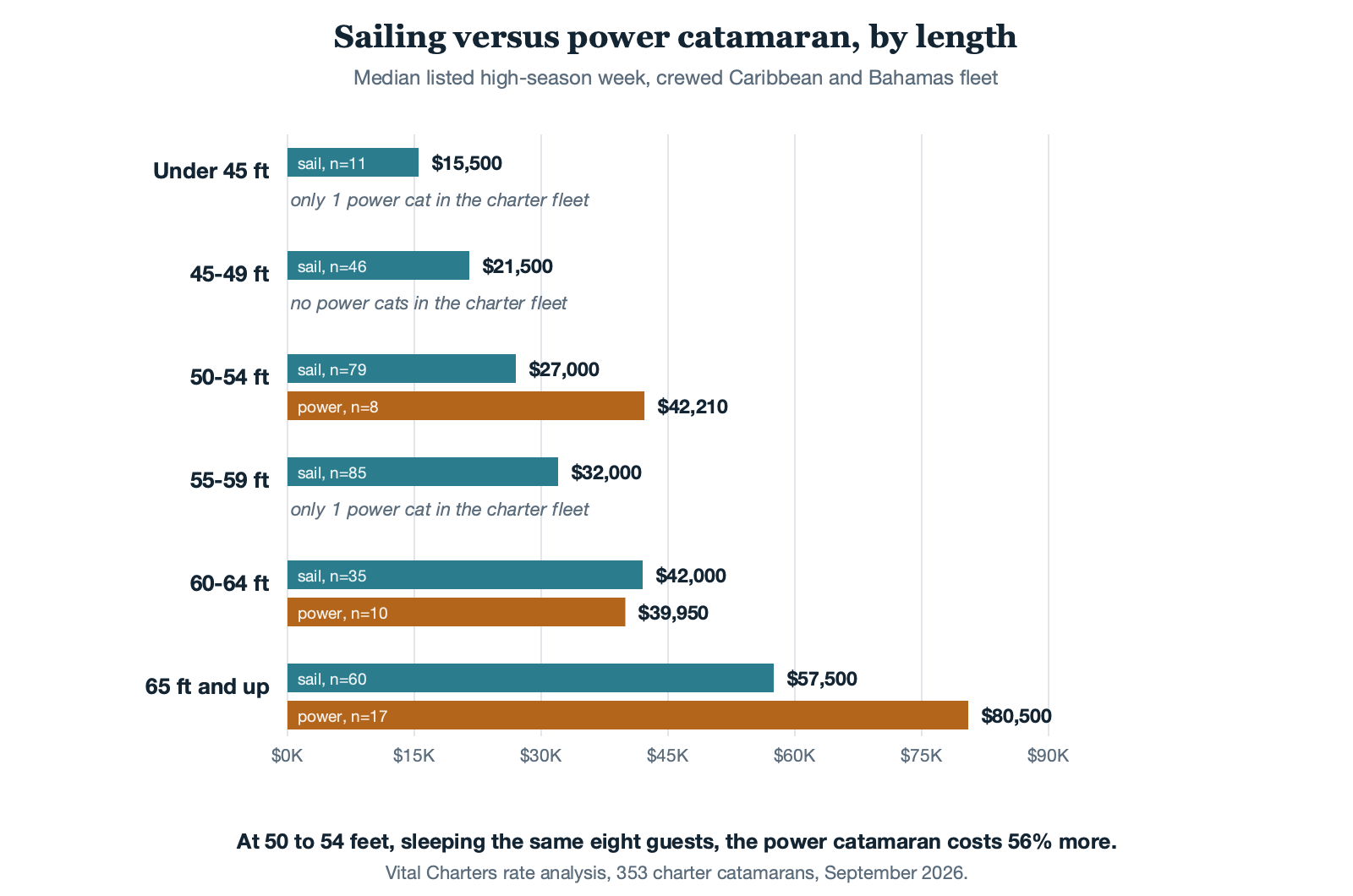
View data table
| Length band | Sailing catamaran | Power catamaran | Difference |
|---|---|---|---|
| Under 45 ft | $15,500 (n=11) | 1 yacht in the fleet | Not comparable |
| 45-49 ft | $21,500 (n=46) | None in the fleet | No choice to make |
| 50-54 ft | $27,000 (n=79) | $42,210 (n=8) | +56% |
| 55-59 ft | $32,000 (n=85) | 1 yacht in the fleet | Not comparable |
| 60-64 ft | $42,000 (n=35) | $39,950 (n=10) | -5% |
| 65 ft and up | $57,500 (n=60) | $80,500 (n=17) | +40% |
Per person the gap is similar and easier to picture. In that 50-54 ft band the sailing catamaran sleeps 8 across 4 cabins and the power catamaran sleeps 7 or 8 across 3 or 4, so the power cat is buying you speed rather than beds. Landed cost, meaning the listed rate plus any APA plus a 15% gratuity divided by guests and seven nights, is a median of $575 per guest per night on the sailing cats and $867 on the power cats.
Two cautions on those numbers. Eight power catamarans is a small sample and one new build entering charter would move that median, so treat the 56% as the size of the gap rather than a precise figure. And it is base rate: the fuel math from the previous section sits on top of it, which widens the real difference rather than narrowing it.
Our observation: The question we get is almost never “how much more is a power cat”, it is “can I have a power cat for my budget”. Below 50 feet the answer is no, because the boats do not exist in charter. That is a more useful fact than any percentage, and it settles the conversation in about a minute.
For a head-to-head look at how catamaran rates compare to other formats, see our breakdown of luxury catamaran charter price tiers and the full ladder in yacht charter cost by size.
Interior space, draft, and the flybridge factor
Catamarans of either type deliver roughly double the interior volume of a comparable-length monohull, and power versions reclaim still more space because there’s no mast step or rigging compression post. That footprint typically becomes a full flybridge. The flybridge is the second helm and a second outdoor lounge area, usually with an upper bar and sun pads.
For groups of 8-10, the volume difference is genuinely noticeable. A 50-foot power cat often feels like a 55-foot sailing cat because the rig’s footprint is gone. If your charter is built around extended-family meals on board or a chef who needs a real outdoor entertaining deck, power scores higher.
Catamarans of either format carry roughly double the interior volume of a comparable monohull, and power versions reclaim more space by deleting the mast step and rigging, typically adding a flybridge where the sail version carries its rig. Shallow ~3-foot draft on most power cats also opens Bahamas anchorages that 5-7 foot sailing cat keels can’t reach.
Draft is the other dimension the Bahamas will test. Most charter power cats draw about three feet of water; sailing cats with daggerboards or keels draw five to seven. In the Exumas and Abacos, that difference unlocks anchorages a sailing cat genuinely cannot enter. Bahamas yacht charter itineraries skew toward power for exactly this reason.
Stability and seasickness: both win, but differently
Catamarans heel under 5-10 degrees underway versus 30°+ on a comparable monohull, and sit nearly motionless at anchor thanks to the wide beam (Sunreef Yachts). At anchor, sail and power cats feel essentially the same, flat, quiet, no slow roll that wears guests out by day three.
Underway, the experiences diverge. A sailing cat heels slightly to leeward and bounces a touch when crossing wakes; a power cat stays flatter but vibrates at cruise from the engines. For seasickness-prone guests, both are dramatically better than a monohull, and the differences between them come down to personal preference.
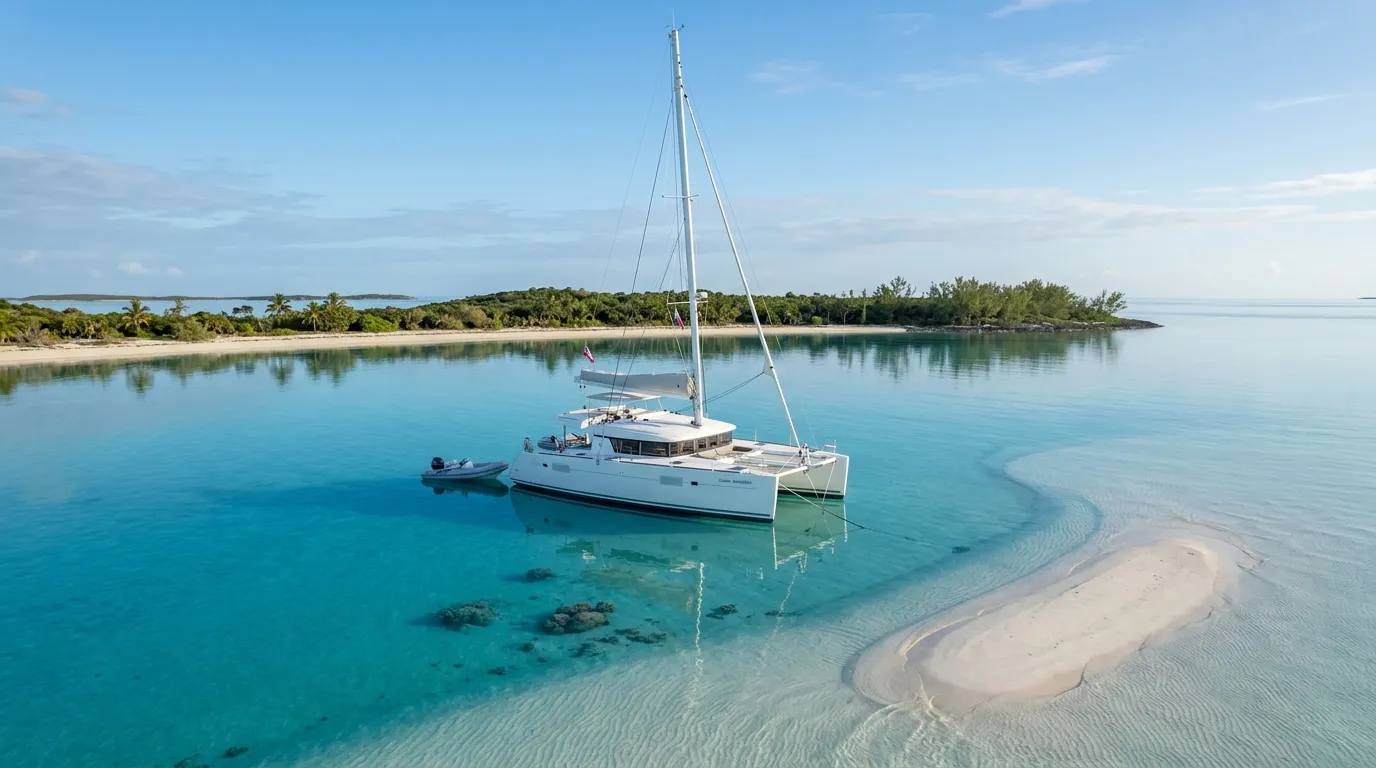
If anyone in your group is genuinely worried about motion, see our guide to yacht charter seasickness. Both formats are excellent choices, but pre-trip prep still helps.
Destination decision tree: BVI vs Bahamas
The clearest single rule in this comparison is destination-driven: pick sail in the BVI and power in the Bahamas, unless something specific about your group pushes the other way.
The BVI is built for sail. Steady 15-25 knot trade winds blow most of the season, the island chain runs roughly 30 miles bow-to-stern, and every anchorage sits within an easy daysail of the next. The wind is your free engine. You’ll spend most of the week with the sails up and the motors quiet, which is what makes the BVI charter experience feel different from anywhere else.
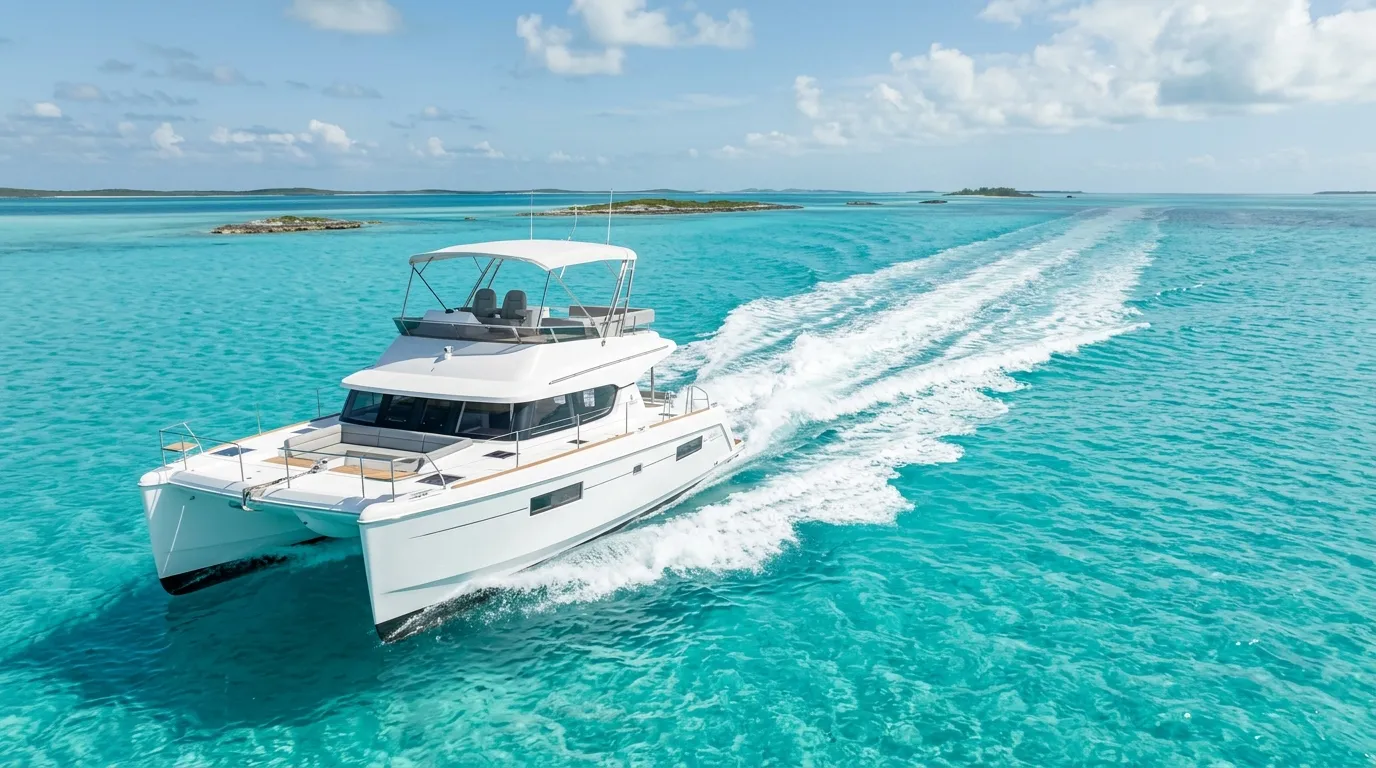
The Bahamas (particularly the Exumas, Abacos, and Berry Islands) favor power. Inter-island hops are longer (sometimes 40+ nm), the wind is lighter and less reliable, and shallow water rules out the deeper sailing-cat drafts. A sailing cat in the Exumas spends a lot of time motoring, which is the worst of both worlds: you’re paying sailing-cat range advantages for power-cat fuel costs.
Edge cases:
- St. Vincent & the Grenadines: strong trades, scattered island hops. Either works; sail still has the edge for the experience.
- USVI: short hops between St. Thomas, St. John, and St. Croix. Sail wins on price and experience; power is fine for tight schedules.
- Leewards (St. Barts, St. Martin, Antigua): open-water passages with reliable trades. Sail’s natural turf.
Crewed-charter workload: how the captain spends their day
On a crewed sailing catamaran, the captain spends meaningful time managing the rig, raising and trimming sails, reefing when squalls come through, watching wind angles for the day’s destination. None of that becomes the guests’ responsibility, but it does mean the captain is up on deck working while you’re at the helm cushion with a drink.
On a crewed power catamaran, the captain mostly drives. The cruise speed work is straightforward (set the autopilot, monitor traffic, eyeball the fuel) and the captain often has more bandwidth for guest interaction during transit. Some guests prefer this. Others enjoy watching a skilled sailor work the rig and feel the wind do its job.
This is a small thing on most charters, but it’s a real preference signal. Guests who want a quieter, more contemplative passage day tend to gravitate to sail. Guests who want the captain to point out the next anchorage and pour another mimosa tend to prefer power.
Quick comparison: sailing vs power catamaran
| Factor | Sailing Catamaran | Power Catamaran |
|---|---|---|
| Cruise speed | 7-8 knots | 17-25 knots |
| Fuel burn at cruise | ~1-2 gph (aux only) | 9-35 gph |
| Range | Effectively unlimited under sail | 600-2,000 nm |
| Draft (typical 45-50ft) | 5-7 feet | ~3 feet |
| Interior space | Wide beam, mast/rigging footprint | Wider effective use; flybridge added |
| Stability underway | Slight heel, more motion | Flat, steady |
| Stability at anchor | Excellent | Excellent (slightly slower roll) |
| BVI charter rate (45-50ft) | $20K-$35K/wk | $25K-$40K/wk |
| Best for | BVI, USVI, Grenadines, Leewards | Bahamas, tight schedules, light wind |
| Vibe | Quieter, classic yachting | Faster, condo-on-water feel |
Which should you charter?
Use this decision rule, in order:
- Where are you going? BVI / USVI / Grenadines → start with sail. Bahamas / Abacos / Exumas → start with power.
- How long is the charter? 5 days or fewer with multiple destinations → lean power for the speed margin. 7+ days in one cruising ground → either works; sail saves money.
- What’s the group like? Kids who get restless, anyone with a tight schedule, or guests who don’t care about sailing → power. Guests who’ll appreciate the rig and the quiet → sail.
- What’s your fuel tolerance? If a $1,500-$2,500 fuel bill makes your stomach hurt, sail.
- Anchorage shopping list? Bahamas itinerary heavy on shallow cays → power for the draft advantage.
For most BVI charterers, that decision tree ends on a sailing catamaran from one of the Lagoon, Bali, Fountaine Pajot, Leopard, or Sunreef fleets. For most Bahamas charterers, it ends on an Aquila or Leopard power cat. Within each lane, the boat-specific differences come down to which model, which year, and what the crew is like. That’s the part a broker should walk you through.
Choose by destination, then by boat
The sailing vs power catamaran question isn’t really about which format is “better”. Both are excellent, and both vastly outperform monohulls for the kind of group charter most guests want. The decision is destination-first, schedule-second. Pick the right cruising ground, then pick the right format for that water, then pick the right boat and crew for your group.
If you’re not sure which side of the line you fall on, that’s exactly what a broker is for. Start a yacht search at Vital Charters or send us your group size, dates, and destination: we’ll line up sailing and power options side by side so you can compare on price, layout, and crew before you commit.
Frequently Asked Questions
Is a sailing catamaran or power catamaran better for a first-time charter?
Sailing catamaran for first-time charters in the BVI, USVI, or Grenadines. The destination does the heavy lifting and you get a more classic charter experience. Power catamaran for first-time charters in the Bahamas, where shallow draft and longer inter-island hops actually matter. Both formats are dramatically more stable than a monohull, so motion sickness isn’t a deciding factor.
How much more does a power catamaran charter cost than a sailing catamaran?
Far more than the usual 10 to 20 percent estimate. At 50 to 54 feet, the one length where both are common in the Caribbean fleet, the sailing catamaran median is $27,000 a week and the power catamaran median is $42,210, a gap of 56% before fuel (Vital Charters rate analysis, September 2026). Above 65 feet the gap is about 40%; at 60 to 64 feet the two are level. Below 50 feet there are no power catamarans in charter, so the comparison has no answer.
Are power catamarans faster than sailing catamarans?
Yes: substantially. Typical sailing catamarans cruise at 7-8 knots; power catamarans cruise at 17-25 knots, roughly double the pace. A Leopard 53 PC cruises at 17.2 knots and tops out near 25; an Aquila 36 Sport reaches 32+ knots. For one-week BVI charters the speed advantage rarely shows up; for Bahamas itineraries with longer hops it can add an extra anchorage or two.
Can a power catamaran cross from Florida to the Bahamas?
Yes, with planning. Most charter-sized power cats (44-54 feet) have enough range at trawler speed to make the Gulf Stream crossing comfortably. At full cruise speed, fuel range drops and a stop at Bimini becomes part of the plan. Sailing catamarans cover the same crossing on wind and reserve fuel for harbor maneuvering.
Why does a power catamaran have shallower draft than a sailing catamaran?
Sailing catamarans need a keel or daggerboards to resist leeway under sail; those structures add three to four feet of draft. Power cats don’t sail, so they don’t need keels: just clean, shallow hulls. Most charter power cats draw about three feet of water, opening anchorages in the Exumas, Abacos, and Berry Islands that sailing cats can’t reach.
Do power catamarans handle Caribbean weather as well as sailing catamarans?
Both formats are stable in normal Caribbean conditions, including 25-30 knot trade winds and the typical 4-6 foot ocean swell. In heavier weather, sailing catamarans have the option to reef sails and slow down; power cats rely on speed and routing decisions to manage conditions. For named-storm-season planning, sailing cats handle bigger seas a bit more forgivingly, but neither format should be sailing into a storm.
Are power catamarans louder than sailing catamarans?
Underway, yes: engines run continuously at cruise speed on a power cat, while sailing cats run quietly under sail. At anchor, the difference depends on generator use: power cats often need more generator runtime to support AC and amenities, while sailing cats sometimes have larger battery banks and less reliance. Some sailing cats run silent for hours overnight on batteries.
Speed or sail: we’ll match you to the right cat.
Tell us your destination, group size, and dates and we’ll recommend the right catamaran type with real crewed options and current availability.